THE BUSINESS OF BEING CHEROKEE: AN EXAMINATION OF THE TRANSFORMATIVE POWER AND VISION OF SMALL BUSINESSES ON THE
QUALLA BOUNDARY OF THE EASTERN BAND OF CHEROKEE INDIANS
Courtney Lewis
A dissertation submitted to the faculty of the University of North Carolina at Chapel Hill in partial fulfillment of the requirements for the degree of Doctor of Philosophy in the
Department of Anthropology
Chapel Hill 2012
ABSTRACT
COURTNEY LEWIS: The Business of Being Cherokee: An Examination of the Transformative Power and Vision of Small Businesses on the Qualla Boundary of the
Eastern Band of Cherokee Indians (Under the direction of Valerie Lambert)
This dissertation examines the crucial socio-economic impact of small businesses and small business owners on the Qualla Boundary of the Eastern Band of Cherokee Indians. It addresses the questions of how boundaries that Native Nations must work within—land, legal, and representational—impact these small business owners, how these boundaries are transformed, and how these transformations can literally and figuratively alter the landscape of a Native Nation. Within these boundaries, I discuss the EBCI governmental programs initiated specifically to encourage and aid small business owners. I then critically explore the characteristics of these businesses and business owners (products/services offered, education provided through employee training and public information, previous business experience, etc.), as well as how issues of representation and the EBCI’s casino bear upon business ownership. This work furthermore chronicles these businesses’ challenges during the Great Recession, thereby documenting the means by which these critical components of our worldwide economy buttress themselves against economic shocks.
people as entrepreneurs and small business owners, but also our overall understandings of reservation economies.
PREFACE
That night was so cold and blustery that every breath cut into your lungs. I hustled
across the parking lot and the snow that signaled that a power outage was a real possibility
for the weekend. It was a Friday evening. I entered the crowded coffeehouse called Tribal
Grounds, shook off the snow, and was immediately enveloped by the warm aroma of coffee
and pastries. I had braved the weather to attend a Cherokee language class led by a local
high school student who worked at the new children’s Kituwah Immersion Language
Academy. He had his sights set on teaching college someday. This was his first foray into
formally teaching adults—though he had coached beginners, including me, for years.
I skimmed the menu, written in both English and Cherokee syllabary, and ordered an
indigenously grown coffee. The beans were hand-roasted by the owner, Natalie, an Eastern
Band of Cherokee Indians (EBCI) citizen. While I waited for my order, I chatted with her
about an open-mic night for locals that was planned for tomorrow night. I picked up my
coffee and clung to it until my fingers regained warmth, then I went into the room for
community events and meetings. The walls were covered with bright oil paintings created by
a young contemporary Cherokee artist, Joshua L. Adams1(See figure P.1).
Figure P.1: “Conscious Effort” by Adams.
A diverse groupof students were already waiting for class to begin: one was a
neighboring high school teacher who wanted to make the Cherokee language available to
her students; another was a coffee house employee and EBCI citizen who was given the night
off to attend the class; and a third was a retired woman, also EBCI, who wanted to become
conversational in Cherokee so she could speak with her grandchild in the new EBCI
immersion program. As I sat down with them to practice (“Osiyo! Osigwotsu? Osda—
nihina?” is heard in a repetitive chorus since we had only covered the basics of
conversation), I considered how small businesses like this one—so vital for the economy and
the exchange of language, art, and food— had been neglected by academic research (See
Figure P.2: Tribal Grounds coffee house.
Figure P.3. A drink at Tribal Grounds coffee house.
The problem with the topic of business, like software programming or car
large-world, you never truly buy a product from someone—only from something, i.e., the corporate
entity. And when you call this entity with a concern or compliment, you are often met with an automated system instead of a person. Small businesses are different and this difference makes them exciting. In a real sense, small businesses are their owners: they are also your neighbors, family, and friends. They sell products you want because you asked for them, not just the same products that get shipped worldwide. They offer the services that are needed in their community because the owners live there and see the specific needs. And small
businesses are the force that, by multitudes, drives the economy of every country.
The most difficult issue when discussing businesses on reservations with American Indian business owners, in particular, is the nearly inconceivable amount of variation across those reservations and business owners. I could claim that the stereotype so often portrayed in movies and in literature of the reservation’s desolate and barren landscape, dotted by corrugated tin roofed shacks, rusted and dead cars, and the occasional tumbleweed does not exist. But it does—albeit in differing forms—as any report on poverty in the United States will attest to. Alternatively, I could claim that Native Nations2 are struggling every minute of the day to provide for people who live hand-to-mouth. But that also would also not be true because there are Native Nations who are, beyond a doubt, succeeding and continuing to create vital and sustainable economies for their communities. But to focus on either one of these scenarios, or even juggle them together like delicately labeled glass balls (“Poor Reservation,” “Rich Reservation”), would be problematic at best, and would miss the entire point of this research.
2 I choose to use the term “Native Nations” in reference to the federally recognized tribal entities in the United
The fact is that small businesses, and the people who own them, exist at every class and wealth level. Of course they appear in different guises—here a business consulting firm, there a one-pump gas station with an attached one room grocery store—but that is the beauty and advantage of small business. By nature, it can be more dexterous and, theoretically, be what you need it to be, at the place you need it to be. The reality, however, is that many small businesses are not allowed to be what they need to be. They are constrained by location, education, discrimination, and plain old issues of capital. These issues are compounded if you are an American Indian business owner and located on a reservation. For most business owners in the United States, if your business faces one of these issues, you have the ability to relocate. There are 3.5 million square miles of land available to find the best place to realize your dream. However, for a citizen of a Native Nation, such as the EBCI3, your choice is limited to the approximately 56,000 acres (Eastern Band of Cherokee Indians 2010) of your reservation in order to sustain the business privileges of citizenship in that nation.
This dissertation addresses these and other Native Nation-specific perspectives and answers the questions regarding the small businesses impacts for American Indian peoples by unfolding a rich ethnographic study of small business owners and entrepreneurs on the
homeland of the Eastern Band of Cherokee Indians in western North Carolina. My research is based on over fourteen months of participant observation field research working with the EBCI and my own experiences as a Cherokee citizen and small business owner. It utilizes both my graduate training in economics and doctoral training in anthropology. Since the
3 I use “EBCI” in this dissertation to refer to the EBCI government or collective actions (such as the results of
founding of the Harvard Project on American Indian Economic Development in 1987, scholars from diverse disciplines have conducted large-scale investigations into reservation economies. However, nearly all of this work has focused exclusively on large tribally-owned and -operated businesses such as factories and casinos. My research goes beyond this focus to reveal that small businesses also have a crucial impact on reservation economies. This impact is due to the independence and choice provided by small businesses that diversifies, stimulates, and helps sustain the robustness of a Native Nation’s economy. This suggests that our lack of information about small businesses has hindered our understandings of not only American Indian people as entrepreneurs and small business owners, but also our overall understandings of reservation economies. Having established and thoroughly documented this economic point of departure, my dissertation progresses to describing and analyzing the myriad sociocultural ramifications of these small businesses on the Qualla Boundary (the EBCI’s reservation4
). I critically explore, amongst other concepts, the physical spaces of these small businesses, the products and services they sell, and the education (in the form of both training and information) that these businesses provide to their employees and the public. Additionally, my work chronicles the shifting challenges of these small businesses during the time of the Great Recession, thereby documenting the means by which these critical components of our worldwide economy buttress themselves against economic shocks and survive. Most importantly, I answer the questions of how the boundaries that Native Nations have to work within—land, legal, and representational—impact these small
4
businesses, how these boundaries are transformed, and how these transformations can truly alter the landscape of a Native Nation in both figurative and literal forms.
Why Am I Doing This Research? The Situating of Self
Academic Experience
Anthropologists would like to take credit for their relatively recent discovery of reflexivity, but the call for change was not strictly internal. In reality, it was many of the peoples who were the subjects of study who began to demand, “Anthropologist, study thyself!5” This would eventually be followed by a cohort of indigenous people who thought that if they were going to be studied and published about, then they should be involved in this process and, thus, joined the ranks of academia. These are some of the powerful scholars that I descend from academically. The academic path that brought me to stand on the shoulders of these giants also colored my choice of this project, my methodology, and my perspectives on this project.
My path began as an undergraduate at the University of Michigan, where I studied economics as a major and anthropology as a minor. My experience in advanced research began in my master’s program where I was a research assistant for a labor economics professor; this work furnished me with the initial tools to conduct my doctoral research on American Indian tribal economic development and businesses. This training in economics gave me a solid base for statistical analysis as well as an ample understanding of the principles at work in American Indian economies. After receiving my master’s degree, I
5
applied this knowledge while working at a Fortune 100 Top Ten finance firm where I researched and produced reports that forecasted the economic climate.
My current studies in economic anthropology at the University of North Carolina— Chapel Hill complemented these experiences by adding anthropological theory, practice, and PhD level academic knowledge of indigenous peoples to my mathematic and statistical skills. In my ethnography coursework I spent a semester working with a local knitting group
researching the emerging knitting trend amongst college students and its place in the larger “subversive” DIY (do-it-yourself) movement. This course focused heavily on collaborative work and had an immense impact on my methods for ethnographic work.
The papers I developed during this time in the PhD program mark the beginning of my working relationship with the EBCI and gave me valuable experience working with Native Nations and academics in a collaborative environment. During my first semester at UNC, I produced a research paper on economic development. For this paper, I spoke in person with Chief Hicks and other EBCI members about the new economic and “cultural revitalization” programs they are currently implementing. Not only did this paper bolster my background knowledge on EBCI history, but I was also able to develop a strong
community including small business owners, the EBCI Economic Development Office, and Chief Hicks.
Personal Experience
My academic experiences shaped how I developed my research, but it is my personal background that addresses the “why?” To begin, I am an enrolled citizen of the Cherokee Nation. This citizenship comes from my dad, whose experiences had a profound effect on my choice of research focus. Although Protests, death threats, and machine guns may not be the typical components of an academic career—but events like these punctuated my father’s life. He was the first person in his family to go to college and progressed to become the first American Indian to receive a Ph.D. in Social Work. As one of the few American Indian professors during the late 1960’s, he was involved with many cutting edge and controversial policies. These included helping to pass the Indian Child Welfare Act (a controversial act aimed to limit adoptions of American Indian children by non-Natives, resulting in the death threats) and being called on to participate in events like the occupation of Wounded Knee in 1973. From his experiences, I gradually came to understand the influence—and considerable responsibility—that being a professor means for your communities. Consequently, it has been my career and life goal to follow in his footsteps by bringing my diverse knowledge and experience to academia, as a researcher contributing to my Cherokee Nation and as a
Small business ownership came into my consciousness when my grandfather, also a Cherokee Nation citizen, opened his own diner in Muskogee called “Paul’s Top Dog” (See figure P.4). To this day, his hot dogs are still the gold standard for our family. It was not until I left the finance firm decades later that I became personally entrenched in small business ownership. It was at this time that my husband and I co-founded a small online business from the ground up. Programming knowledge and online marketing strategies change at a
breakneck pace, which means that it takes constant vigilance to keep ahead of the
competition. I found, however, that although an online business is different in many ways from a physical location, most of the fundamental challenges remain the same: finance
management, personal connections to every aspect of the business, and the ability to live with perpetual uncertainty (financial, time management, etc.). Small businesses, then, are not just a mere curiosity for me, but a topic that I am intimately familiar with.
TABLE OF CONTENTS
LIST OF FIGURES ... xxi
Chapter 1. INTRODUCTION ... 1
Focus Statement ... 5
Why This Research Needs to be Done ... 6
For Native Nations ... 6
For Anthropology... 12
For Timing: The Great Recession and the Importance of Small Businesses .. 17
For Global Economic Implications ... 20
Why This Has Not Yet Been Done ... 21
Stereotypes and Assumptions ... 21
File Drawer Effect... 23
2. THE HOW: METHODOLOGY AND TERMINOLOGY ... 24
Terminology ... 24
Cultural Revitalization and Cultural Representation ... 26
Identity ... 31
What is an Entrepreneur... 31
Identity Construction ... 40
Governmental Activities ... 42
3. BACKGROUND ... 45
Introduction ... 45
EBCI History ... 46
EBCI Government’s Current Legal Standing and What They Can Provide to Businesses ... 52
Tax Laws ... 54
Financial and Structural Help ... 56
Investment and Collateral ... 56
TERO ... 58
Buildings ... 61
The Per Cap... 62
Training ... 63
The Indianpreneurship Program ... 66
Other Sequoyah Fund and Cherokee Business Training ... 72
Beyond Sequoyah Fund Training ... 73
The Complications of Buying Local ... 75
When “Buy Local” Fails ... 75
4. AMERICAN INDIAN BUSINESSES AND PRACTICES ... 79
The Landscape of Businesses Varieties on the Qualla Boundary ... 79
Capitalism ... 89
Capitalism Discussion ... 90
Socialism Discussion ... 92
Entrepreneurial History: U.S. American Indians and EBCI ... 95
History and Business Sustainability ... 102
Particularities of Rural Business and Reservation Business ... 103
Employees ... 103
TERO and Employees... 105
Inventory and Rural Living ... 108
5. BOUNDING AMERICAN INDIAN BUSINESSES ... 110
Introduction ... 110
Legal ... 113
Land ... 114
Leasing ... 117
Citizenship ... 120
Citizenship Reformulations ... 122
Brain Drain... 124
Economic Drain ... 125
Scarcity ... 126
Culture Legalities: The Indian Arts and Crafts Act ... 129
Problems of Tradition ... 137
Economic ... 139
Introduction to Current Economic Standing of the EBCI ... 139
The Casino: Introduction ... 140
The Casino: Benefits and Hindrances ... 147
The Impact of Per Cap ... 152
Opting-Out ... 154
Summary ... 155
6. IMPACTS AND INFLUENCE: SOVEREIGNTY AND ECONOMIC DEVELOPMENT ... 157
Sovereignty ... 161
Economic Development ... 168
Conflicts ... 168
Recent Literature ... 172
How Does Entrepreneurship Positively Affect Economic Development ... 181
Measurable Impacts ... 182
Psychological Impacts ... 185
Impacts on Sovereignty... 187
Negative Impacts ... 189
Sovereignty: Relinquishing Native Nation Rights in Order to do Business with Outside Corporations ... 189
7. TOURISM: WHERE ARE THE INDIANS? ... 191
Focus Statement ... 191
Early Tourism ... 195
Early Tourism History ... 196
The Red Power Movement ... 198
Modern Tourism Development ... 201
Representation, Authenticity, and the Market ... 202
The Search for Authenticity ... 203
Small Businesses and Representation ... 214
Inventory Changes ... 216
Pricing ... 222
Seeing the Authentic ... 227
The Market in Tourism Studies ... 228
How Cherokee Differs from Other Tourist Markets ... 228
Public vs. Private ... 232
Buffering as a Concept... 233
Who is Local? ... 235
The Sellers’ Views ... 235
The Customers’ Views ... 237
8. CONCLUSION ... 239
Looking Forward: Current, and as of Yet, Unresolved Issues on the Qualla Boundary ... 239
Sustainability of the Market ... 242
Larger Scope ... 243
Wal-Mart ... 243
Summary ... 245
Appendices A. EBCI SMALL BUSINESS ASSISTANCE OFFICES ... 248
B. SEQUOYAH FUND LOAN EXAMPLES ... 251
C. HICKS CAMPAIGN AD 2011 ... 254
D. “ENROLLMENT FACTS” ... 256
LIST OF FIGURES
Figure
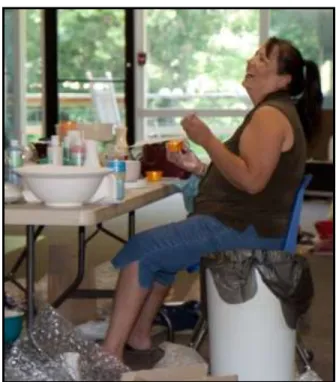
1.1 Charla Crowe ... 2
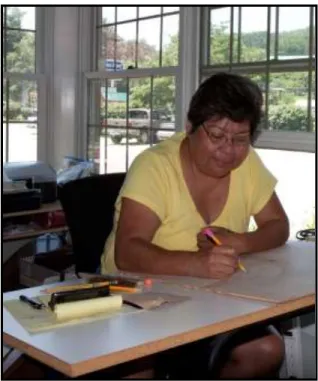
1.2 Zena Wolfe... 3
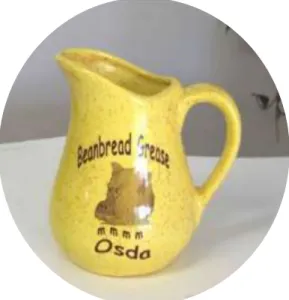
1.3 Cherokee By Design Products—Beanbread grease pitcher. ... 4
1.4 Cookie jar. ... 4
1.5 Federal health care spending. ... 9
1.6 World gross domestic product percentage change by year.. ... 17
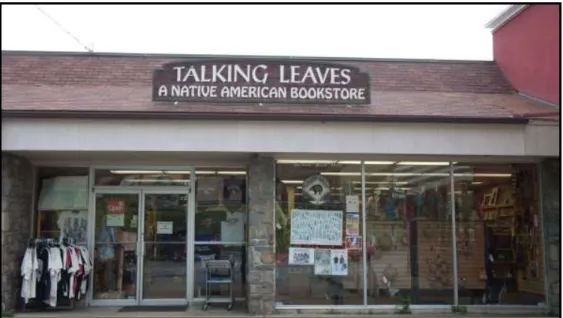
2.1 Talking Leaves. ... 26
2.2 Street sign... 29
2.3 New Kituwah school sign. ... 29
2.4 Qualla Boundary entrance welcome sign. ... 29
2.5 Yellowhill Community welcome sign and visitor welcome billboard. ... 30
3.1 Joel Queen Gallery. ... 46
5.1 Cherokee Chamber of Commerce. ... 111
5.2 One of the dangers of building in the mountains—ice. ... 117
5.3 Sign on a Qualla Boundary storefront. ... 130
6.1 Longhouse funeral home... 157
6.2 Longhouse funeral home... 158
6.3 Nancy and Bruce Martin. ... 161
6.4 Billboard found on and off of the Qualla Boundary. ... 163
CHAPTER 1:
INTRODUCTION
After having picked up my usual post-lunch “soy-capp” at Tribal Grounds, I hit the road
to go visit Charla and Zena (both EBCI citizens) at their store Cherokee By Design. Cherokee By
Design originally began in 2007 as a small section in Charla’s dad’s store across the street and
walking distance from the casino. Later, she and Zena were able to move into a vacant store
space, also owned by her dad, and also across from the casino, but further away and off of the
main road. Normally, this would have been a prime location because tourists drove by in order
to go to the casino or to take a drive through the mountains to Maggie Valley, but that was
before the new casino construction. Driving down Highway 19 towards the shop that day began
with the traffic—cars piled up waiting to turn left with no light into the casino from the one-lane
road. After passing the casino entrance, there was noise and dust from jackhammers and heavy
earth-moving machinery. On my left was a massive skeletal structure of a parking deck and a
giant hole; on my right was the temporary parking area for the construction workers. It was here
that you could, if you looked hard enough, see a small sign with an arrow that read: Cherokee
By Design. Turning right down the dirt-covered road, I found that tucked back off of the road
(and, luckily, away from the rolling dust clouds) was a small building, no bigger than 16 feet
across, with a tidy lawn and garden. This was the then home of Cherokee By Design.
The store inside was no bigger than 10 feet across and Zena sat at a table carefully
short, black nearly buzz-cut hair and Charla with a ponytail so she wouldn’t get her hair
covered in paint while doing ceramic work. They also had similar backgrounds in business
before this. Zena had a landscape design company; Charla’s family was famous for their
Bigmeet pottery, Both had laid-back personalities, laughing at themselves (and occasionally
others) as they worked all day preparing their items, researching new designs, and taking orders
from locals for the upcoming holidays(See figures 1.1 and 1.2).
Figure 1.2: Zena Wolfe
The store was lined with shelves and packed with one of the most impressive arrays of
unique and contemporary items found on the Qualla Boundary: including handmade and
hand-painted ceramics covered in EBCI- and Cherokee-specific designs, such as the Road to Soco
basket-weave pattern and both phonetic and syllabary Cherokee language. Other non-ceramic
items (clocks, jewelry, curtains, etc.) were covered with these patterns. The unique aspect of
Cherokee By Design products is that all their crafts are designed with daily use in mind, as
opposed to most Native-made and EBCI-made “pottery as strictly art” items found in the
upscale galleries around Cherokee. These items did not relegate Native-made products to the
realm of only high art, but proved that they could, and should, be contemporary items that
anyone, especially Cherokee citizens, could own and use every day. As Zena told me about their
people like our native culture but at the same time, I’m more proud that . . . Charlie came up
with this idea. Man she’s preserving. She’s preserving our language, our heritage” (See figures 1.3 and 1.4).
Figure 1.3: Cherokee By Design Products—Beanbread grease pitcher.
Focus Statement
The theoretical tools I have chosen to employ in my studies of small business on reservations are those of borders and boundaries, specifically those of land, citizenry, and
representation, which I will discuss in detail in Chapter Five. Individually, these topics have been the subject of intense study since they form the basis of discourses on sovereignty, land rights (mineral, water, etc.), intellectual property, and many more topics vital to the practice of contemporary nation-building. As I sat down to gather my thoughts on the years of study and fieldwork that went into this research, I prepared myself to tackle this subject of boundaries being the embodiment of many contradictions: they are both intangible and physical, both
ephemeral and timeless. The contradictions involved in discussing borders come into sharp focus when we look at how borders are used against Native Nations and used by Native Nations. They embody the power of the United States government to both dismantle and protect Native
issues into one pot labeled “the problem of the (rural) small business owner,” but it would also be an egregious error that overlooks (1) how deeply these issues are embedded for Native Nations and (2) how, in order to address them, they must be dealt with as the distinct/unique problems that they are.
Why This Research Needs to be Done
For Native Nations
There are three concepts that are of primary importance to Native Nations when addressing the diverse economic topics. The first is economic identity. I use my own term of “economic identity” as a way to construct the perceptions (and/or stereotypes), both internal and external, that shape the economic choices made by either individuals or nations6. The Great Recession of 2008 brought into sharp focus, and public interest, issues of plutonomy (and plutocracy), globalization, and the need for solutions that provide for sustainable economic bases. Although Native Nations here in the United States have been actively engaged in these debates for nearly 500 years, they have been markedly excluded from these global dialogues. This is especially notable since their experiences and activities have achieved many successes despite legal, economic, and cultural violence and in defiance of baseless stereotypes. As I will discuss in detail in later, these stereotypes are the basis for Native Nations’ and their citizens’ economic identity as perceived by the larger American society. This economic identity
characterizes American Indians as economically “pure” entities (i.e., free of capitalistic behavior) that have not, or should not, understand concepts of land ownership, profit, etc. and whose work
6 Using the United States as an example: since WWII, its identity as an economic world power has shaped both
efficacy, especially when residing on reservations, is highly underdeveloped. In short, these ideas claim that American Indians are incapable of shaping the economic world around them.
When Native Nations then challenge these notions by, for example, managing a successful casino, a backlash occurs. They can be accused of being not American Indian anymore (Cattelino 2010) and/or a new stereotype will emerge in its place, such as the wealthy casino-owning American Indian. As Lisa Neuman relates with the Wabanaki efforts in both casino ownership and basket making, the non-Natives of Maine accepted Wabanaki basket-making enterprises, “because they may romanticize Indian artisans, fitting basketmakers into the expected stereotypical roles of indigenous “craftspeople” and were seen as, “non-threatening.” When the Wabanaki attempted to open a casino, however, the non-Native residents of Maine voted down their proposal, while simultaneously approving an out-of-state racino. As Neuman states, “Wabanaki people are sometimes viewed by non-Natives as being incapable of mustering the kind of modern, businesslike efficiency required to manage a high-stakes casino” (Neuman 2009).
As succinctly put by William Ledford in the Cherokee One Feather newspaper7 (speaking about the Cobell litigation, which was tied up by the Senate), “One attitude from some
Democrats and a LOT of Republicans is that they still maintain the view that we can’t handle our affairs and we don’t need this money. They’re worried about us spending OUR money?
the ability to achieve this success in the context of one’s own unique and transformative culture and on one’s own terms. Tribally-run enterprises have been major actors in this process and they have garnered the expected backlash, both politically (Lambert 2007:211) and socially, from the larger non-Native society in the U.S. The idea of American Indians as competent and successful small business owners still has to make headway.
The second concept that Native Nations know well through experience is economic hegemony. I use this term to describe the actions and manipulations of a larger country, or body of countries, that use economic means (accumulation of debt, manipulation of resources, etc.) to subjugate a country or people8. This, historically and presently, is one of the single most
effective ways to control and dominate another country because it renders that country unable to resist on nearly every level. It is also not usually thought of as an act of violence, per se, by other international countries and is therefore not condemned or resisted on a larger scale. But this economic subjugation that Native Nations have experienced has profound impacts on issues of sovereignty. By keeping a population in poverty and economically weak you ensure that issues such as crime and health care will be constant battles for them (See figure 1.5).
Figure 1.5: Federal health care spending.
In this graph, put together by the United States Commission on Civil Rights, we see that Indian Health Services is the least federally-funded health care (even ranking below federal prisoners). The results of this, also as published in this study, are statistics such as these: Tuberculosis (500-650% higher than the average non-Native in the U.S.)
Alcoholism (550-770% higher) Diabetes (200-420% higher)
Unintentional injuries (150-280% higher) Homicide (100% higher)
Heart disease (100%+ higher) Infant mortality (150% higher) SIDS (400% higher)
These internal struggles then become a drain on Native Nations’ resources of both time and money thereby reducing the ability of Native Nations to fight effectively to protect their
sovereign status. I will demonstrate in the sections on EBCI and Native Nations history how this tactic has been used on Native Nations in the past as well as how it continues to be used.
The concept of economic violence, on the other hand, often accompanies physical violence, although the primary objective is not bodily violence, but, instead, focuses on the destruction of a primary economic element (generally to the benefit of those enacting the violence), such as agricultural fields or water supplies or factories. One of the most well-known historical cases of this in American culture in the U.S. is the Trail of Tears in which Cherokees, in this particular removal, were forced from their land—i.e., being disposed from their economic base. In this case, there was the horrifying physical violence of the removal and the
accompanying concentration camps, but there was also the breaking of the economic base which is done purposefully to cripple another nation by separating its people from a means in which to support themselves (food, schools, medicine, etc.). This is also a case in which the use of
removals can be seen as attempting (if the U.S. had accomplished the removal of all Native Nations) to break all American Indian claims to being from here, the U.S., at all.
One reason that economic hegemony is so effective is that it can tear down the ability of a nation to form an effective government and, therefore, a stable nation (this is especially salient to discussions of the practice of sovereignty, which I will discuss in Chapter Six). This is where my last concept for Native Nations enters: that of economy-building. I define this as the act of developing an economy with the result being the ability to support the pursuit of nation-building. When discussing economy-building, it is important to understand that it is indeed possible to construct a solid, effective governing body under the thumb of economic hegemony (and, therefore, without a strong economic base) but it is exponentially more difficult to achieve. It is also important to notice that you do not need a wealthy economy; you only need a stable
economy. The effects of economy-building can be seen on many levels from better health care (a healthy citizenship is an active citizenship) to political campaign contributions—an example I will illustrate more fully in my section on sovereignty.
More pragmatically for Native Nations, I hope that this research can add to the discourse and practices of building stable economies. In the past few years, the rarely-highlighted benefits of small, private businesses have begun to be discussed in the tribal economic development literature. These include discussions of the multiplier effect9, talent retention, diversification, and psychological impact with accompanying examples of success stories also being highlighted (Jorgensen 2007; Pickering 2004; i.e., they are tackling the problems of brain drain, economic
9 The multiplier effect refers to the result of local investment which translates to an even greater increase in a
drain, psychological inertia, and problems that will be discussed in Chapter Five). These theorists also argue that large tribally-owned enterprises alone cannot meet the challenges of economic development; therefore I claim in this research that it will be the diversity of small, private businesses that will sustain a Native Nation’s long-term economy.
For Anthropology
The question of the “Indian problem” (Meriam 1928) has plagued the United States since Europeans first stepped on American Indian land—and the question (as well as the answers) has taken many forms. First, the question was how to “get rid” of the problem (i.e., genocide), then it was how to mask the problem (through assimilation), then how to ignore the problem (by
removal), and finally, how to solve the problem (via economic analysis). Of course, these questions are simplified here and were both asked and answered by many different people throughout time, as I will parse out in Chapter Six. American anthropologists have been deeply involved with these questions throughout their time as a discipline and even had their beginnings in the early 1900’s practicing salvage anthropology on Native Nations. Today, as applied
anthropology and developmental anthropology have become increasingly popular, the “Indian problem” (currently classified as economic under-development) is being directly addressed more frequently. Because of this, it is becoming more important for anthropologists to be able to work in interdisciplinary environments alongside other fields such as sociology, linguistics, political science, and economics.
can there be a “post-“ when we live within, and as products of, these systems?—but the issues are real. In other words, the anthropologist's quandary is that if, as in post-colonial discourse, writing is part of a system of intellectual and political oppression of The Other (Smith 1999), how can you avoid contributing to and perpetuating that oppression if you continue to write about The Other? This quandary is made even more complex if you, as an anthropologist, are
“The Other” you are working with. This particular aspect points out the flaws still inherent to the discipline of anthropology, which assumes that some sort of Otherness is what we as
anthropologists are, and/or should be, studying. When an indigenous anthropologist dares to undertake study as an insider, the exclusionary devices Linda Tuhiwai Smith describes in order to “dismiss the challenges made from outside the fold” are called up. The most common of these is the accusation that the insider does not have the ability to be “objective”—said as if this was the highest standard (or even the most useful) of ethnographic goals. The newer works on Indigenous Anthropologies by indigenous anthropologists (Valerie Lambert, Jean Dennison, Audra Simpson, Renya Ramirez, Kimberly Tallbear, to name a few) are begin to break down some of these constructs.
systems like education, semiotic representation issues, and the creation of consent10) and which does not claim totality and authenticity.
Theories of development anthropology are also strongly woven into this dissertation. And as we conduct research into the issues of development in anthropology it is also imperative that we integrate into these discussions issues of agency. My dissertation advances our social science theoretical understandings in this way with at least two approaches: (1) by examining the
significance of small businesses in transforming contemporary debates about our understandings of development and how this relates to issues of economic identity construction, and (2) by demonstrating the relevance of including in ethnographic examinations of contemporary anthropological development projects, which currently focus primarily on tribally–owned businesses, the complex effects of small businesses on reservations. Consequently, the results of this study will contribute to better understandings of not only the role that small businesses play in these economic and cultural representational efforts on reservations, but more broadly it will add to our understandings of how small businesses reflect and contribute to communities within a society.
Furthermore, I also explore broader anthropological concerns regarding questions of identity (e.g., is there an internal construct of “native entrepreneurship”; how are entrepreneurs and small business owners recursively shaped in regards to community identity construction?) and small businesses as the forces of economic and social change. For example, what type of economic impact do small businesses have on reservations? Do these small businesses and
10 In addition to the creation of consent is the twist of how “consent” is used as a form of resistance. This can be
entrepreneurs act as agents of change? If so, in what ways does this manifest in their business practices and community involvement? Does citizen-driven economic development differ from tribally-driven economic development? If so, what are the effects on tribal cultural revitalization efforts which are linked with economic development projects, such as those developed by the EBCI government?
Research on American Indian citizen entrepreneurship and small, private11 businesses, specifically, is critical for anthropology not only because we know so little about it, but also because their collective actions help to solve many pressing economic and related social issues. This is achieved through benefits which include: economic impacts such as (1) the multiplier effect which keeps money within the community, (2) increases in the tax base for the tribe, (3) job creation/talent retention, and (4) diversification which provides economic stability, especially for tribes with a single source income, and sociocultural effects such as (5) community
inspiration from seeing successful tribal members (e.g., because they can see their fellow community members succeeding, the false notion that one’s “Indian-ness” is inherently associated positively with poverty and negatively with success in business begins to disintegrate), (6) quality of life increase (e.g., reduction of long distance travel to buy
necessities), and (7) strengthened tribal sovereignty through an increased role of “self-advocacy” (Widenhouse 2010) and reduced dependence on outside funding and policy makers. Specifically for the EBCI, who also own a successful casino, another overarching question became: what (if anything) do these small business owners and their businesses contribute to both the
11 When studying small businesses, it is often assumed that they are privately owned, therefore it would not need to
representation of the EBCI community and economically that their large tribally-owned enterprise alone does not, or is unable to do?
When discussing the casino, however, we must acknowledge that large tribally-owned enterprises not only pose an economic risk due to their lack of financial diversity (specifically when a Native Nation relies on only one or two primary enterprises for their income), but that some are also meant to minister nearly exclusively to those from outside the community (i.e., they are for tourists). This creates the common situation in tourism of having to deliberately decide, as a community via governmental regulations, how to represent yourself as a Native Nation to the non-Native world. In doing so, cultural centers (such as museums) are formed that are not intended for Native citizens as primary users. This begs the question of where/how/what do citizens consider as their place for community centers. In Cherokee, we see that the casino has to be designed as a monolithic cultural representation of the EBCI; small businesses, however, have the freedom to represent individual families, communities, or individuals12.
My dissertation, therefore, puts forward that collectively as well as independently, individuals who own small businesses13 on the EBCI’s reservation, the Qualla Boundary: (1) contribute in distinct ways to the overall tribal economy that differ from the casino and (2) impact the constructs of identity and cultural representation both as an American Indian and as an Eastern Cherokee Indian. Investigating the economic impact of small businesses on
12
This is not to imply that individual small business do not portray the EBCI as unidimensional or even Pan-Indian—they most definitely do—but this is rather is an illustration, again, of the diversity that small businesses can provide that one, large institution cannot.
13 For the purposes of this study, I will be following the EBCI’s own protocol for determining, legally, what a
reservation economies is crucial due to the diversity they provide, which helps sustain the robustness of that economy. Furthermore, the question of economic impact must be addressed in order to investigate the consequences for cultural representation. Specifically, small businesses have to not only be present on said reservation, but also be economically viable—a subject matter that has previously not been researched adequately. Therefore, a viable small business allows an impact not only on issues of cultural reproduction, such as language, but also identity construction, through, for example, impacting perceptions of American Indians as capable business owners. The timing of this project is especially salient as the current economic
recession may take its toll on larger tribally-owned, tourist-based, enterprises such as the EBCI’s casino.
For Timing: The Great Recession and the Importance of Small Businesses
Although unconventional, I wanted this graph (Figure 1.6) to lead this section of my dissertation. It makes clear and in no uncertain terms the timing, scope, and impact of the Great Recession that hit the world in 2008 in a way that words cannot convey. What it cannot do, however, is truly capture the ramp up period to the recession—a period that was denied by many with larger incomes, but keenly felt by the lower classes; the damage to people’s lives during the recession; and the aftermath as people tried to pull together the pieces of their lives.
I have lived in North Carolina since 2005, but before that my home was just outside of Detroit, Michigan. We were the lucky ones. We finally sold our house after a year of renovation, price dropping, and just plain good luck just as the market began its frightening spiral downward in 2005. Six years later in Michigan there are entire neighborhoods that are now foreclosed on and abandoned. In North Carolina, the picture was a bit rosier—as was anywhere other than Michigan it seemed—but the Great Recession eventually found its way, even to this state consistently voted a top state to live in (for example, Durham, NC ranks number one in CNN Money’s 2010 “25 Best Places to Retire” (Max and Gengler 2010).
The Great Recession had been in full swing for about a year by the time I moved to the mountains of Western North Carolina. I had been commuting to the Qualla Boundary
intermittently for the years preceding that, so I was able to see the changes that were taking place there and in the broader area of the Appalachian Mountains. Gas prices soared to well over four dollars a gallon and unemployment grew to its largest since the Great Depression14, causing the visitors to the mountains to slow to a trickle. The freeways became nearly empty even on major travel holidays like Memorial Day and Fourth of July. But poverty has never been a stranger to those living in the Southern Appalachians (Tickamyer and Duncan 1990) and business owners
had faced times like this before, either personally or through older family members who had carried their businesses through periods like the 1973 OPEC oil crisis. Then, in 2008, the Lehman Brother’s corporation crashed and companies across the country began laying off up to three-quarters of their employees.
But in Cherokee, one small business owner chose to go without a salary herself and is thousands of dollars in debt in order to keep her staff employed (Abe 2010). She continued to buy artists’ work, albeit in lesser quantities, so their families could eat. And she kept her stores open. This was no easy feat and was not done without anguish or anger as she relayed her story to me. To add salt to the wounds of an already difficult time, that year, 2009, there were two landslides that blocked both major freeway accesses to North Carolina from the west, and a series of snowstorms that blocked the section of the 441 Highway that traverses the park into Tennessee15. Even if travelers could reach Cherokee by bypassing the landslides, there was no guarantee that they could get home that weekend if an ice storm hit. And in the midst of all of this, banks began refusing to loan money to small businesses. Bank of America was the one of the worst offenders, having taken relief money from the government but then refusing to make loans for under $50,000 to small businesses (Arriola 2009). Their behavior may have earned them class action lawsuits, but that did nothing to help the businesses struggling to come out on the other side of a dismal year (Service Employees International Union 2012). Again and again, I heard stories from small business owners trying to stay afloat through these years:
15 According to the Cherokee One Feather, outlying Park entrances were up by 155% the year after my fieldwork,
The problem with the economic stimulus package and everything is that none of that filtered down to us, not a dime. [Nancy Martin, Long House Funeral Home]
It is a tougher year because people aren’t spending as much money as they have been. . . . Our customer loyalty you might say, they’re still here. It’s just people are not spending as much money. . . . They’re not buying the higher ticket items. They’re splitting plates. [Carl16, Restaurant manager on Qualla Boundary]
Everybody’s doing good this month, but the hotels have been down about 10%. . That, and the shopping. The shops, they're down. . . . And the restaurants are down. And that’s the reason the cabins and the campgrounds are up, because you can cook out, or cook your meals in your cabin. [Darlene Waycaster, Cherokee Chamber of Commerce] [People think that we’re becoming millionaires out here. We’re not becoming
millionaires. We struggle just like everybody else. Artwork is a very volatile market to be in because if the economy goes down, people don’t have the money to invest much. If the economy’s up, people will buy. It hit us last October, a year ago in October. [But] we made it a year in this economy. [Joel Queen, artist]
This research is about these small businesses that, for the most part, continued to survive during this time providing employment, training, services, and goods to the people in their communities. Their collective actions provided a stable base in a shaky economic world.
For Global Economic Implications
The Great Recession was not confined to the United States, however. Internationally, the timing of this project is especially relevant as the current recession takes its toll on the stability of economic systems worldwide. Consequently, the issues of economic development and economic growth are clearly pressing global issues. And, more broadly in academia, as the role of the individual in economic development begins to be addressed, the role of the private business in community development is also starting to be explored internationally (Gudeman 2001; Williamson, Imbroscio, and Alperovitz 2002). The larger impact of this work will potentially bring into this global dialogue, which seeks a means of stabilization with a focus on
locally-based solutions17, the experience and actions of Native Nations who have engaged these very issues—i.e., rampant unemployment, poverty, instability, etc.—throughout their histories on reservations. As stated above, then, this research demonstrates the stability that these businesses provide to economies during times of shock. Additionally, though, the results of this work (which indicate that small businesses do indeed have sustained, positive impacts) can be applied directly to communities in which one industry dominates the economic base, thus leaving that community vulnerable and potentially powerless if that industry fails. These results can also be applied even more broadly, as they have extensive implications for small communities globally, by providing these communities with another tool to use when planning the best means to support their citizens in creating a vibrant economy that can also sustain their community’s goals.
Why This Has Not Yet Been Done
Stereotypes and Assumptions
In recent years there has been an increasing amount of intellectual and monetary resources dedicated to large tribal enterprises such as casinos or factories. However, many reservations also have thriving private businesses, yet nearly no scholarly attention has been given to this type of American Indian enterprise. This inattention appears to stem from an
assumption that there is a lack of private businesses on reservations and a perception of potential problems (ranging from poor location and lack of capital to a cultural “scorn” of
entrepreneurship (Smith 2000) that are difficult to overcome.
17
I believe these stereotypes have their roots in the economic violence and continued hegemony that Native Nations have confronted. It is clear from the historical records that American Indians have succeeded on every level of economic strata from extensive prehistoric trade routes, to agriculture, and to business ownership and yet this specter of the financially-incapable American Indian still casts a shadow over Native Nations. The root of this comes from a victim-blaming initiative. The United States has undertaken massive acts of economic violence and economic hegemony (in the forms of removal and the creation of enormous debt for Native Nations and individual American Indians, for example). When the disastrous effects of these efforts were realized, the U.S. then blamed the American Indians for being financially
incompetent (e.g., they do not know how to farm or cannot manage their finances) and continue to do so today, all while continuing to severely underfund programs that are owed, dictated by treaty, to Native Nations.
Topics concerning small businesses on reservations have additionally been eschewed by researchers as having little to no aggregate impact on reservation economies. Contradicting this assumption, my research indicates that small businesses can thrive on reservations. Particularly for Native Nations, there is little to no anthropological literature on the actual impacts of small businesses on these issues even though the broader social science literature, including economic, emphasizes the importance of entrepreneurial activities to both of these endeavors. This
demonstrates that our lack of information about small businesses has hindered our understandings of not only American Indian people as entrepreneurs, but also our overall
File Drawer Effect
Due to the dearth of literature available regarding private businesses on reservations, there is a perception in academia that Native American entrepreneurship is a new phenomenon. However, state-licensed American Indian businesses in North Carolina have been quietly operating for almost a century with little notice given to their work.
This leads me to suspect, although by definition it can only be a suspicion, that the File Drawer Effect is also applicable here (Rosenthal 1979). The File Drawer Effect addresses how, in the world of publishing, a “difference” gets noticed and reported. When a topic is being studied and does not find a “difference”—here that would be that American Indians, like other Americans, do own successful small businesses—these findings of uniformity do not get reported because they do not provide exciting and unusual results. Publishing favors these unusual results, so we would expect to hear about the situations with the least or the most small businesses. Locations with a stable number of small businesses are overlooked. These results are then filed away, never to be reported publically. Consequently, the only reports that do get published are those that purport the “difference,” even if it may be the exception: that American Indian businesses, unlike other American businesses, do not exist and/or do not succeed.
Unfortunately, this leads to an issue in which these poorly supported ideas about what is happening do not coincide with reality, but are then allowed to flourish because no other
CHAPTER 2
THE HOW: METHODOLOGY AND TERMINOLOGY
Terminology
One time this guy came in my store, “Which one is your most accurate book?” and I said – I guess he thought I was going to go sell him a book, “Oh, you need this.” I said, “Sir, I don’t know. These are from different people’s perspectives. I don’t know what’s true or not.” Even if I’ve read it, I can disagree with it. I said, “You got to decide on your own.” I don’t know which one might [be accurate] – none of them may be accurate. We can [sell ten people one book], ten people’s going to have a different story. That’s all I’m saying. [Ron Blankenship, Talking Leaves Bookstore, EBCI citizen]
Ron Blankenship’s store Talking Leaves is the only store dedicated bookstore in
Cherokee. What makes the store remarkable is that it is solely dedicated to American Indian
topics and authors. Each wall and shelf is well-stocked and immaculately organized with the
latest books, movies, and CDs spanning topics from children’s books written in Cherokee
syllabary (such as the newest children’s book A Very ‘Wendy’ Day) to the latest academic
offerings on topics such as NAGPRA (the Native American Graves and Repatriation Act).
These are interspersed with other items such as clothing (like Cherokee High School
t-shirts), Pendleton steering wheel covers, locally-made EBCI pottery, American Indian–
centric stickers (e.g., “rez diva”), and American Indian-made jewelry—nearly all supplied
from American Indian-owned businesses. As you wander through the shelves, music is
always playing, ranging from live pow wow CDs to contemporary artists, and they will play
any CD so you can decide if you would like to buy it. The store itself is located at the
Oconaluftee Island (home of the enormously popular Children’s Trout Derby) on the other,
so most tourists and locals drive past at some point on their travels through the town of
Cherokee. Like many physical buildings in the mountains, the location is a bit awkward,
sitting below the level of the road, overshadowed by a Kentucky Fried Chicken, with one
entrance of the plaza at a far end that feels like a 45 angle drop and the other entrance
plagued by the constant traffic going past the Island.
I found that I always had to leave significantly more time for Talking Leaves than
other stores that I was browsing through. Not only was there always someone to talk to, but I
also spent quite a bit of time just making sure that I was abreast of the newest tomes(often, I
would find ones I did not realize had been released). Many of these items were not available
to Ron at wholesale prices. As he says, “Sometimes, my problem is [that] I’m not getting a
discount on some booksbut I carry them anyway. Sometimes I don’t make a dime, but I just
call it customer service. Now, I can’t afford to sell 1,000 copies of it, but one or two ain’t
going to kill me, it’s just customer service.” You might imagine that this kind of dedication
would come from someone who has a deep and abiding interest in books, but in this case it
was Ron’s mother who pestered him year after year (specifically 1992, ’93, and ’94) to start
the bookstore. He claims not be a “reader” although his extensive traveling (200+ nights per
year to sell and research new products) compliments his significant appetite for educational
magazines., which travel lightly. This, combined with the information he receives from his
customers about the books he sells, keeps him far more informed than most about the latest
Figure 2.1: Talking Leaves.
Cultural Revitalization and Cultural Representation
Although I have tried to weave explanations of terminology throughout this
dissertation, there are phrases that need more clarification as to why I did—or did not—use them. The first word that I use only sparingly is culture. First, culture tends to be an etic category as used by anthropologists, thus the anthropologist is, as an outsider, labeling a society. Second, culture is used as a singular, static term, i.e., “the culture of . . . ” When, in reality, culture truly contains multitudes. Ask any two people to define their collective culture and you will get two divergent answers. This is especially problematic with Native Nations since, in the past, they have been described as “caught between worlds,”
with that of the entire national U.S. culture, yet it is never claimed that those states’
inhabitants are “schizophrenic” for trying to balance two identities. The fact is that both of these identity markers are aspects of what they consider, from their point of view, their own singular perception of their culture.
When I use the term culture in this research, I take its context from the community, government, and individual dialogues (e.g., newspapers, interviews, etc.). Naturally, this means that it is not a static term. Each person has their view on what constitutes a part of their culture and this view is constantly in flux, as is the culture itself (Peacock 2001); even something as culturally-specific to Cherokees as language is not always agreed upon as a cultural component18. This perception on culture was illustrated in Mark Junaluska’s paid political ad in which he states that, “I believe that Tradition and Progress are key factors for the continued success of our Tribe” (Junaluska 2009). As I read this statement it called to mind another phrase that I had read regarding the current cultural revitalization plans that specified a request for, “culturally themed streetlights featuring LED technology.” This balance of Progress and Tradition encapsulates the complexities of “culture” as a concept and it is in this spirit that I use it.
Similarly to “culture”, when terms such as “cultural revitalization” are used in this research, they are used in the context of the EBCI’s own circulated publications (Eastern Band of Cherokee Indians 2005), rather than as my own pedagogically informative phrases. Consequently, I use the term “cultural revitalization” in the way the nation itself promotes it via these publicized documents (alternatively, when individuals express their opinions on
18
what constitutes “cultural revitalizations” and similar notions, I specify that). This concept is circulated through tribal documents such as their newspaper, the Cherokee One Feather, and is supported monetarily by the Cherokee Preservation Foundation through programs like the Revitalization of Traditional Cherokee Artisan Resources (RTCAR) and language
revitalization programs (for example, the Kituwah Immersion Language Academy). Publicized EBCI dialogues regarding the concept of cultural revitalization are primarily constructed around specific programs that will perpetuate and preserve EBCI history, culture, and natural resources including those which bolster EBCI-specific practices that are waning (e.g., language) or those that are being actively recovered (e.g., working with archaeologists to recover lost pottery techniques for EBCI artists to employ).
This concept is strongly connected to their practice of heritage tourism. “Heritage tourism,” as defined by the tribe, is “a concerted community-wide effort to attract more visitors interested in a cultural experience to the Qualla Boundary” (Eastern Band of Cherokee Indians 2008b). This “cultural experience” includes their three principal cultural attractions: the Museum of the Cherokee Indian, Qualla Arts and Crafts, and the Cherokee Historical Association which presents the Unto These Hills outdoor drama and the
Figure 2.2: Street sign.
Figure 2.3: New Kituwah school sign.
Figure 2.5: Yellowhill Community welcome sign and visitor welcome billboard.
Like the term “culture,” however, the term “cultural revitalization” has semantic issues that prevent me from fully embracing it outside of these publicized works. First, it seems to imply that the current culture (i.e., the culture that is in need of the revitalization efforts) is not the valid, authentic culture at all or that it is somehow less valuable, relevant, or “real.” Second, this term implies that somehow a culture was lost and now needs to be recovered or that it was languishing like an unwatered plant. In reality, many of these “lost” cultural elements, such as language use, were forbidden, both legally and through violence. In these cases, the term “reclaiming” would be a more accurate description of the processes involved. Cultural revitalization also seems to imply that forgone elements of a culture
should be revitalized, i.e brought into current practice, which is not always the case. Some cultural ideological notions (and objects) can, and should, be left in the past. I find that a more useful and informative phrase, especially for this research, is “cultural representation.” This phrase conveys the idea both on an individual (e.g., small business owner) and
portrayal and thus can be used to analyze how the EBCI projects these representations about themselves and how non-Natives create representations of American Indians (in movies, television, etc.).
Identity
Following my line of reasoning for the previous terms, my conception of identity construction (economic, representational, etc.) mainly draws from the ideas of Stuart Hall and others who emphasizes the “constant transformations” that cultural identities undergo as, “they are subject to the continuous 'play' of history, culture and power” (Rutherford 1990; Holland et al. 1998) and in which, “actual identities are about questions of using the
resources of history, language, and culture in the process of becoming rather than being: not ‘who we are’ or ‘where we came from’, so much as what we might become, how we have been represented, and how that bears on how we might represent ourselves” (Hall and Du Gay 1996:4). This conception is also informed by the ideas of community from theorists such as Benedict Anderson who puts forth that, “Communities are to be distinguished, not by their falsity/genuineness, but by the style in which they are imagined” (Anderson 2007:6). The concept of identity, like culture, is individualistic, so in the body of this work I will specify who is using this term and in what context (an individual’s identity, the EBCI’s identity construction, etc.).
What is an Entrepreneur
You might say it was more or less my aspiration to hopefully one day be an entrepreneur. [Carl, Restaurant manager on Qualla Boundary, Non-EBCI citizen]
I think we’ve maybe done thirty dollars [today] and people want to think that we’re rolling in it. They have no fucking clue. [Abe19, local business owner]
As Abe so succinctly tells us here, the perception of the entrepreneur does not always match with the harsh realities. “Entrepreneurship” is the new hot topic of this decade and, as such, it is critical to understanding my work. Outside of my research, I am barraged by the concept multiple times each day. In the morning, my email inbox has a message about the new UNC Entrepreneurial Public Service (EPS) Fellowship. Later, on campus our
Chancellor gives a talk on “Innovation and the Entrepreneurial University” based on his book “The Engines of Innovation: The Entrepreneurial University in the Twentieth Century.” In the accompanying brochure, it is stated that, “The entrepreneurial emphasis on ‘knowledge that contributes to a better world’ suggests the need for more interdisciplinary work, more collaborative projects among faculty and with partners outside the University, more ‘problem-based’ research, and more engagement with public policies”20
. When I check my physical mailbox, the standard “sponsor a child” requests for contributions has now been revamped into “Your gift of $25 or more will help provide a first loan to a deserving
entrepreneur” (The Coca-Cola Company 2010). Later on television there is an advertisement for the new Coca-Cola “5 by 20” campaign. As the web address states, Coke has pledged to empower five million women entrepreneurs by 202021.
19 Asked to remain anonymous
20 This comes at an interesting time when books like “University, Inc.” are red flagging the issues that come
with linking universities to corporations and the “capitalist” mindset that competes with the stated purposes of universities.
21 This can be viewed here:
What is interesting about these cases, and many others, is that the concepts they are espousing are not new by any standards, but were never linked to the term
“entrepreneur(ial)” before. College students (especially since the founding of the Peace Corps at the University of Michigan after a speech given there by John F. Kennedy) are regularly called on to contribute to “public service projects;” interdisciplinary and problem-relevant work have been some of the most long-running discussions in academia; and hiring laborers for the distribution of products is as old as the first trade networks in history. The word “entrepreneur” in these examples is being used in a specific way and is meant to evoke a specific ideology. The question is, of course, what is it? What does the word entrepreneur do for agendas that are being promoted today? What does this mean for our understanding of entrepreneurship and entrepreneurs? What is the lure of the term “entrepreneurialism” or the “entrepreneurial ethic” (Colloredo-Mansfeld 1999)? What does it add to our current
discourses on responsibility and individualism in business (as emphasized in these
The academic studies on defining the entrepreneur as a central figure of study began in earnest with Schumpter in 1934 whose definition was focused on innovation. Others followed over the years adding to this description facets such as: takes initiative, desire for responsibility, an authority, ambitious, independent, self-confident, need for achievement, drive, autonomy, need for power, energetic, goal-oriented, and growth-oriented (Carland, Boulton, and Carland 1984). Carland takes these various characteristics and folds them into several labels:
Small business venture: A small business venture is any business that is independently owned and operated, not dominant in its field, and does not engage in any new marketing or innovative practices.
Entrepreneurial venture: An entrepreneurial venture is one that engages in at least one of Schumpeter's four categories of behavior: that is, the principal goals of an entrepreneurial venture are profitability and growth and the business is characterized by innovative strategic practices.
Small business owner: A small business owner is an individual who establishes and manages a business for the principal purpose of furthering personal goals. The business must be the primary source of income and will consume the majority of one's time and resources. The owner perceives the business as an extension of his or her personality, intricately bound with family needs and desires.
Entrepreneur: An entrepreneur is an individual who establishes and manages a business for the principal purposes of profit and growth. The entrepreneur is characterized principally by innovative behavior and will employ strategic management practices in the business.