Yuwei Qian. How do freshmen find information orienting themselves in their first year of college? An investigation of the information seeking behaviors of first-year
undergraduate students. A Master’s Paper for the M.S. in I.S degree. April, 2019. 57 pages. Advisor: Ronald Bergquist
Information seeking behavior (ISB) has been a popular topic to study for researchers in the information field over the years. College students, who are often referred to as millennials, are one of the most studied information user groups. Their academic needs, social life and knowledge of technology have granted them different worldviews and information seeking habits. This study investigates the information seeking behaviors of first-year undergraduate students at UNC in terms of finding orienting information to better adjust to college life.
13 undergraduate students currently enrolled at UNC were interviewed in the study. The participants were asked a series of questions about their first-year experiences at UNC. Results indicate some common patterns among freshmen information seeking behaviors, which may then inform the university to provide better information access for future students.
Headings:
Information-seeking behavior
Information resources
Information needs
HOW DO FRESHMEN FIND INFORMATION ORIENTING THEMSELVES IN THEIR FIRST YEAR OF COLLEGE? AN INVESTIGATION OF THE INFORMATION SEEKING BEHAVIORS OF FIRST-YEAR UNDERGRADUATE
STUDENTS
by Yuwei Qian
A Master’s paper submitted to the faculty of the School of Information and Library Science of the University of North Carolina at Chapel Hill
in partial fulfillment of the requirements for the degree of Master of Science in
Information Science.
Chapel Hill, North Carolina April 2019
Approved by
Table of Contents
1 Introduction ... 2
2 Literature Review ... 4
2.1 Introduction ... 4
2.2 Academic Information Seeking Behaviors ... 4
2.3 Non-Academic Information Seeking Behaviors ... 6
2.4 Information Seeking Behaviors of College Students ... 8
2.5 Role of Technology in Students’ Information Seeking Behaviors ... 10
2.6 Student Adaptation to College ... 12
3 Methodology ... 14
3.1 Introduction ... 14
3.2 Subjects ... 14
3.3 Interviews ... 16
3.4 Recruitment ... 17
3.5 Data Analysis ... 19
4 Results and Discussion ... 20
4.1 Backgrounds ... 20
4.2 Information Needs ... 21
4.3 Difficulty Adjusting to College... 24
4.4 Information Seeking Experiences ... 28
4.5 Use of Technology ... 30
4.6 Source Selection... 32
4.7 Improvement ... 33
4.7.1 Things that are hardest to access ... 33
4.7.2 Suggestions ... 36
5 Conclusion ... 39
References ... 41
Appendices ... 48
Appendix A: Consent Form ... 48
Appendix B: Interview Guide ... 52
Appendix C: Recruitment Email ... 54
1
Introduction
Information seeking behavior is an essential topic in the field of information and
library science. People’s information seeking behaviors differ in different contexts,
settings, situations and from individual to individual. Researchers study people from
different ages, backgrounds, occupations, social classes, fields of study, etc. and
investigate their information behaviors. Many conceptual models have been developed.
While professionals’ information seeking behaviors on academic topics show certain
similar trends, concepts like “information grounds” and “the third place” also indicate
how everyday life information is commonly sought in a social setting.
Among all the information users, college students are getting more and more
attention from scholars conducting researches on information seeking behaviors, due to
their unique standing in life. College students are generally young and constantly
exploring new information to improve themselves both socially and academically. Over
the years, researchers have been studying college students’ information behaviors, in both
academic and non-academic settings. However, few or none have focused on the
information that helps students navigate and set up their new life in college. For first-year
college students, starting a new life in college could be difficult, as it’s a completely
different experience from their high school life. Are they able to locate resources to help
them find the information they want, as new students? Where do they look when they
effectiveness of these resources? Our study intends to answer these questions by
interviewing current freshmen at UNC and analyzing results collected from the
interviews. This will potentially aid the university’s attempt to better identify the ways to
help freshmen adjust to college and provide them with information that matches their
2
Literature Review
2.1
Introduction
The literature related to Information Seeking Behaviors covers a huge number of
articles and various aspects of the field. This literature review section divides the
literature into five thematic areas including general information seeking behaviors that
are focused on either academic or non-academic information, college students’
information behaviors, how technology plays a role in people’s information seeking
process and lastly students’ adjustment to college. Among these related topics, more
focus will be put on college students’ information seeking behaviors, for they belong to
the subject group that is studied in this study, as well as with the literature discussing how
students adjust to college in their first year. Given that being new to college differentiates
freshmen from students of other school years, stressing the first-year setting is important
in this study.
2.2
Academic Information Seeking Behaviors
Information seeking behavior (ISB) has been a popular topic among information
science studies in recent years. Among the literature discussing this topic, various ideas
understand ISB in a better way. The literature in this section covers a broad scope of
information seeking behaviors in an academic setting, whatever the target group is. It
concludes a general idea of the existing literature and theories about ISB, and explains
the way that this topic has been studied and developed over the years, different results
generated from the studies of various focuses.
Jia Tina Du and Nina Evans (2011) identify the task characteristics of academic
information search, which are explorative (Gary Marchionini, 2006), uncertain,
multifaceted, logical, variable and success. They also examine the search techniques
academic users tend to adopt. For example, interaction with multiple search systems and
exploration using popular search engines (e.g. Google).
Among the literature focused on academic settings, one of the studies conducted
by Cheryl Dee and Ellen E. Stanley (2005) investigates nursing professionals’
information source selection. They point out the results differ from study to study, which
then implies the development of information technology may have been changing
professionals’ preference and selection toward information sources, for example, print
sources versus electronic sources. The trend that many researchers choose nurses, doctors
or medical students as their subject group also indicates that health professionals have
been a very popular user group to be studied.
Xi Niu. et al. (2010) conduct a web-based survey designed to study the
information behaviors of the academic researchers in natural science, engineering, and
medical science from five research universities in the United States. One significant
finding shows that university researchers, mostly graduate students, largely rely on and
and systems have been heavily adopted by graduate students for scholarly
communication.
Today’s university undergraduate students are getting more and more involved in
their academic fields and researches, which thus makes them an ideal subject group for
academic information behaviors studies. Lillian Rozaklis (2012) uses surveys and focus
group interviews to understand undergraduate students’ information behaviors. Similar to
the results from previously-mentioned researches, the utilization of online information
resources is significant among undergraduate students in their academic information
searching. However, the study also shows that most of the subjects still seek to use print
books in their academic information seeking process.
2.3
Non-Academic Information Seeking Behaviors
Apart from academic information seeking, many studies are focused on
non-academic information behaviors. Denise E. Agosto and Sandra Hughes-Hassell (2005)
choose to study urban youth aging 14 through 17 and their results show that human
sources are the preferred everyday life information source of urban youth, and social life
is one of the most important parts of their Everyday life Information Seeking (ELIS).
Although this age range is a little younger than the target group of this study - freshmen
who usually age 18 to 20, the social life part should be in accordance between these two
groups, which is a useful reference for this study.
Another very interesting study is conducted by Elfreda A. Chatman (1991).
unique perspective, despite the possibility pointed out by many critics that some part of
the study makes some of the ideas less compelling.
Karen E. Fisher, Carol F. Landry and Charles Naumer (2007) decide to take a
deep look at college students’ information behaviors. Understanding social spaces, casual
interactions and how meaningful exchanges happen around campus is helpful as college
is one of the places where social interactions take place very often and naturally. For
college students, a lot of information exchange happens in the school on campus as
students interact with each other. The concept of “information ground” is worth thinking,
and it indicates people’s everyday life information behaviors mainly rely on social spaces
and personal interactions with other people.
Source selection is one of the moist common and most important topics discussed
among studies on Information Seeking Behaviors. The study initiated by Heidi Julien and
David Michels (2000) proves that most people seek personal sources such as friends or
relatives when there is a problem in their life not related to school, whereas for school
related problems, they tend to rely on print sources, followed by electronic sources. It is
also worth noting that for personal information seeking, people chose human interaction
as their sources partly because it is motived by social goals.
Pamela J. McKenzie (2003) traces back in the history of ISB research and points
out the models constructed by researchers in different stages of the study of this field,
especially the difference between active information seeking and non-direct monitoring
or interaction by proxy. One of the most significant research frameworks reviewed is the
one proposed by Reijo Savolainen (1995). Way of Life and Master of Life are introduced
One important part of everyday life information is health information. Sally
Wyatt, Flis Henwood, Angie Hart and Julie Smith (2005) examine the health information
seeking behaviors of an under-studied group of mid-aged internet users. Although the
study results are not significant, the choice of health information as the focus of the study
marks an era where people of different ages have increasing needs and improving access
to health information on the Internet.
2.4
Information Seeking Behaviors of College Students
This section is one of the main themes in the literature review as it puts college
students, who, over the years, have become a popular experiment subject group in
information behavior study, under the spotlight. College students, though varying in
majors, school years, academic specialties and country of origins makes it hard to study
them in the best comprehensive way as a whole, share some common characteristics and
preferences when it comes to information seeking. It is helpful to understand how
researches in the past have studied college students’ ISB and compare some of the
impactful results of the observation and experiments and use them as a reference in this
study.
Stacy Brinkman, Katie Gibson, and Jenny Presnell (2013, April) introduce some
of the common problems college students are facing, such as financial issues,
relationships with their family and support from their universities. While facing these
challenges, their study skills and information seeking skills may not necessarily lead to
Elizabeth Hartmann (2001) stresses the college students’ literacy skills in
information seeking in college. While college students possess a certain level of literacy
skills that help with their study and information seeking, it is made obvious that
universities should still put efforts into assisting students in establishing research
processes and strategies.
Tracy Gabridge, Millicent Gaskell and Amy Stout (2008) compare information
tasks, goals, methods and efficiency in college students’ information seeking process. A
lot of the results indicate that graduate students tend to focus more on their research and
the depth of a topic. Moreover, they tend to be more detail-oriented, more persistent to
long-term information seeking than their undergraduate counterpart.
To conclude different aspects of students’ information seeking behaviors studied
by researchers, in the previous section of the literature review, the information sources
have been discussed in a few of the studies. Following that, Soo Young Rieh. (2007)
reports a rather different result on students’ selection of sources and media during
information seeking. A large percent of online resources is used for personal information
needs, academic as well as entertainment information. One interesting finding is that
search engines are only used more than general websites in academic information seeking
for college students.
Having adopted a different approach at information sources. Diane H.
Sonnenwald, Barbara M. Wildemuth and Gary L. Harmon (2001) propose the concept of
Information Horizon, which represents a person’s information seeking map and source
choosing process in a certain context or situation. The technique is considered in this
Another important aspect to be discussed is credibility judgements of the
information, which is crucial in determining specific information sources. Soo Young
Rieh and Brian Hilligoss (2008) examine young people’s especially college students’
credibility judgements in their information seeking strategies. Their study also leans
towards the evaluation of the information in the process of ELIS.
Although many researches separately look at academic and non-academic
information seeking, including this study, a certain level of overlaps is also worth
mentioning. Lisa M. Given (2002) investigates the overlap in mature undergraduates'
academic and everyday information seeking behaviors. The study points out there is an
overlap between academic and everyday life information seeking. This is due to the
special character of college students, for many parts of their life are closely connected to
the school and coursework. It may be reasonable to always look at both aspects in this
study as well.
2.5
Role of Technology in Students’ Information Seeking Behaviors
It is noticeable that while reviewing the related literature, there have been certain
numbers of articles specifically looking at how technology plays an important role in
people’s information seeking behaviors, whether it’s for academic or non-academic
information seeking. It is specially so for college students as they are proven to be heavy
users of the Internet and today’s information technologies. Some articles label college
students with different names to represent their familiarity with technology, such as
Digital Natives, which makes the impact of the technology even more of an interesting
Steve Jones (2002)’s book reflects on college students’ adoption of the Internet
based on the findings of the study, compared with the general population. Growing up
with computers and other technologies, use of the Internet is integrated into their daily
communication habits. The Internet has also changed their education and social life,
according to the students.
The use of the Internet primarily in non-work contexts is discussed by Reijo
Savolainen (2000, June). Requirements of work or study, easiness to navigate everyday
life, and social connections are recognized as important motivations for people to use the
Internet.
The nature of the online information raises doubts about its credibility. Thus, it is
important to understand how web users verify the credibility of the information provided
online. Miriam J. Metzger, Andrew J. Flanagin and Lara Zwarun (2003)’s study shows
that students only verify online information rarely or occasionally. However, students
show willingness to expend their effort to verify Web-based information.
The health information seeking has been discussed previously in the literature
review. With the development of the technology, using the Internet to retrieve health
information is getting more and more common nowadays. Cam Escoffery et al. (2005)
discover that most of the college students prefer to get health related information online.
One of the concerns raised by students is the credibility. Different from the general
information in the study of Miriam J. Metzger, et al. (2003), students do consider about
the credibility of health information.
News media is also one significant product of today’s technology and network
use of online and print news media. The findings indicate that students’ purposeful
information seeking is more likely to occur online, but both print and digital news media
still play an incidental role in providing information to students in their everyday lives.
2.6
Student Adaptation to College
How college students adapt themselves to college is an important theme for this
study because the primary population of this study is university freshmen, who are
assumed to be undergoing a process of adjustment in their first year of college. Though
most of the articles under this theme are heavily focused on the psychological side of the
adjustment and are mainly looking into their mental wellbeing, the literature could still be
worth reading as to some extent their mental health can be something that affects their
information needs.
One of the articles mentioned in a previous section, written by Brinkman, S.,
Gibson, K., & Presnell, J. (2013, April), reveals that most of the college students are
struggling with adjusting to college, depending on their backgrounds and study skills.
This points out the need to review some literature focused on students’ adaption to
college, which does not necessarily have to be connected to their information seeking
behaviors.
Shelley Blundell and Frank Lambert (2014) measure how the anxiety elements of
second-semester freshmen impact students’ information literacy skills and research
abilities and compares the differences among different genders, races and whether or not
Rafael García-Ros et al. (2018) study first-year engineering students at a public
school in Spain and the result shows that motivation and social interaction learning
strategies both have direct effects on first-year university experiences.
Enes Rahat and Tahsin İlhan (2016) investigate how well coping styles, social
support, relational self-construal, and resilience characteristics predict first year
university students' ability to adjust to university life. The findings indicate that resilience
characteristics have the greatest contribution to predicting at-risk students' overall
adjustment in university.
Mücahıt Dılekmen (2007) designed a 3-week orientation program for first-year
students that exposes students to the academic, social and cultural environment at the
university. Although the results are not significant, it is suggested that the application of a
3
Methodology
3.1
Introduction
This research aims to study first-year college students’ behaviors in seeking
orienting information in a new college environment which they are assumed to be not
familiar with in the beginning of the first few semesters. Students’ experiences and
opinions are of great essence for the study and a comprehensive understanding of their
information seeking behaviors and their feedback is to be constructed. Thus, a qualitative
as opposed to quantitative research method is used in this study. This is appropriate as it
helps the investigator understand better the personal experiences and behaviors of
students, which is helpful in terms of getting more in-depth and more accurate results for
the study. Semi-structured interviews are conducted to gather the above stated data
needed in the study.
3.2
Subjects
First-year undergraduate students at UNC who are not familiar with the university
and Chapel Hill area were identified as target subjects for this research, though some
second-year and third-year students were also chosen later in the study. The decision to
interaction with the subjects mostly happened on campus. It reduced the cost and the
need for travelling and choosing an ideal location for each of the subject, which also
saved time. Knowing that the interview can be done on campus during the day between
their classes might have made it easier for students to agree to participate in the study.
There are possibilities in the future for researchers to generalize it to students in other
universities around U.S.
The study targets freshmen, as very few of them have experienced a university
environment, except for those who have already earned an associate degree, which leads
to difficulties for their information seeking. First-year graduate students were excluded as
they are believed to either have experienced such a transition process to a university
setting or be able to quickly adapt themselves to this environment with similar previous
experiences. For example, some graduate students may have also had their freshman year
in a place that was far from home and was very different from their high school
environment. Such experiences make them unqualified for this study, as the study seeks
to understand what students think and act in an absolutely unfamiliar university setting.
The unfamiliarity with Chapel Hill and surrounding area was also included as part
of the requirement of their experience in their first year at UNC. The reason is that
students growing up or having lived here in Chapel Hill are familiar with the life here to
some extent, which makes their need for looking for navigating information at UNC
different and not as significant as those who are new to both the university and the city,
even though they are also starting their very first year here. Although some local students
thought that it might help mitigate the bias brought by previous living experience that this
group of students might have had.
3.3
Interviews
Semi-structured one-on-one in-person interviews were conducted with freshman
students for this research. One-on-on in-person interviews proved to improve the
communication with participants. It was also made easy to observe their feelings while
talking, confirm and better understand what they try to express, and in the meantime,
reduce the level of distraction, which could be caused by other participants if it was in a
focus group, to the lowest level. All 14 interviews were conducted in a closed study room
in the library on campus. The study room setting helped minimize the distraction by
providing a closed and private environment for students to feel comfortable sharing about
their personal experiences.
An interview guide was developed based on several themes identified throughout
the literature review. The interview guide was intended to guide the investigator through
the interview process with all topics being covered, while potentially leading to follow-up
interview questions in the actual interaction with the participants. The pre-written
questions provide the interviewer and participants with a certain format and help direct
their responses. It also allows room for more detailed explanation behind their answers.
The interviewer has the option to go above the script based on different situations they
participants are saying. Participants were given enough time and space to elaborate as
well.
The interview guide was pre-tested with one faculty member at School of
Information and Library Science (SILS) at UNC, who specializes in the information
seeking behaviors study. During the pre-testing, some problems arose. Some questions
were not helpful in getting meaningful or interpretable responses. It is also obvious that
in an actual interview, it is difficult for a participant to recall many of their experiences,
even if they are recent experiences. It was suggested that the interviewer provide more
guidance in helping the participants recall the events in their first year. The authority and
the professional perspective of the testing subject provided the investigator a better
insight to improve the interview questions, structure and style. They helped add to the
script important elements neglected in the research design.
3.4
Recruitment
In order to reach out to participants, the primary approach was to get in touch with
undergraduate admissions and student organizations on campus. A detailed list of the
organizations contacted includes Academic Advising Office, Undergraduate Admissions,
Carolina Union, Campus Y and Office of Fraternity & Sorority Life. The communication
was mainly through email, where the goals of the study were explained in detail.
However, this method turned out to be unsuccessful, as most of the organizations did not
reply or replied late. Some expressed unwillingness to support individual studies as an
The second approach to recruit students was then adopted. The investigator
designed a flyer for the study and physically posted the copies on the information display
boards in the libraries and department buildings on campus. The print products like this
have more visual impact and may produce higher probability for students to notice on the
hallway of a building. A paragraph describing the study, the confidentiality, the
incentives provided and how to participate were all included in the flyer. Students
interested participate were encouraged to contact the investigator through email which
was also provided.
After a student reached out to the investigator expressing their interest in being a
participant, an email or a text message was sent to them to explain more details about the
study. They were also offered the options to decide not to participate at any time before
or during the interview. Interview times were arranged with each of the students who
agreed to become participants through either email or text messages. The interviews were
conducted in a rather closed space on campus such as a study room, in order to protect
privacy and to make the students feel less nervous. Audio recording was applied with
participants’ consents. They were asked to read and sign a form of consent before the
interviews. Questions were asked according to but not limited to the ones on the
interview guide. Notes were taken when perceived as necessary.
During the recruitment process, a few other recruiting methods were also used
under various circumstances, including in-person interaction and snowballing. Among all
the 13 participants, 3 were asked in person, 5 were recruited through snowballing and the
study, but the snowball approach turned out to be very helpful especially approaching the
end of the recruitment.
3.5
Data Analysis
The original plan for data analysis was to make full interview transcriptions for all
the valid interviews. However, due to the limited time given to this part, the strategy for
data analysis changed accordingly. Based on the notes taken during the interviews, key
responses were gathered and common experiences of the students were analyzed. When
needed, keywords and original sentences were taken out from the recordings for analysis.
Certain transcription software and tools were considered to either help manipulate data or
to visualize the results. Thematic analysis was conducted with the interviews, which
enabled the investigator to examine the meanings behind students’ responses, understand
and identify their significance by looking for important themes. Thematic analysis is all
about identifying similar patterns and themes within the collected data. This process
continues as part of the sense making of the data. If one topic gets mentioned a few times
by participants in the interviews, it should be identified as a theme. This is a reasonable
approach to understand the data for this study especially because in qualitative analysis
the significance is not as easy to identify as in quantitative study, and it oftentimes
4
Results and Discussion
4.1
Backgrounds
The population of the students that participated in this study consists of 8 freshmen,
2 sophomores and 3 juniors. All of the 13 participants are female. In terms of the the
locations from which they came to Chapel Hill, 10 students are from North Carolina, 4 of
whom are from Raleigh/Durham/Chapel Hill/Cary areas that are within one hour of
driving distance. The other 3 participants are out-of-state students, including one
international student. Only 1 participant described herself as very familiar with the
Chapel Hill area before coming to the university, whereas most participants had never
come to the area other than for the purpose of campus tours.
Two of the participants have an associate degree at a different university, so they
are rather familiar with a university setting than the other participants. However, as they
stated, the years they spent at the previous places were nowhere close to what UNC has.
The classes here at UNC are harder and the campus is a lot larger. For this reason, their
responses have still been accepted for this study.
Transportation while studying at UNC was asked as a background question to
better understand students’ experiences in the personal experiences section. All of the
participants reported that they did not have a car in their first year. One said “Freshmen
Many also walked to school or to the places nearby. Some said they would take a ride
with friends or upper-class students to go to somewhere further, like Durham.
The majors of the participants vary. They range from Psychology, Chemistry,
Creative Writing to Nursing, Pre-Med, etc. However, some of the participants explained
that they had to switch major multiple times due to certain reasons. It will be discussed in
a later part of the discussions section.
12 out of 13 participants think they are active or fairly active on campus and in
student organizations. Many listed the organizations and clubs they are in, most of which
are closely related to their majors, interests or backgrounds. For example, participant #5
said that she joined many clubs and volunteer groups to help people in need. Participant
#4 and #8 are both in Christian Organizations, while #11 and #13 belong to the
psychology club and the consulting club respectively, which are directly related to what
they are studying.
4.2
Information Needs
The participants were asked a series of questions about their personal experiences
during their first year, following the background questions. For the very first question,
they were asked what they had researched about college life before their arrival at UNC,
and the second question was about their information needs and how they went about
finding what they need immediately after the arrival. This was designed to understand
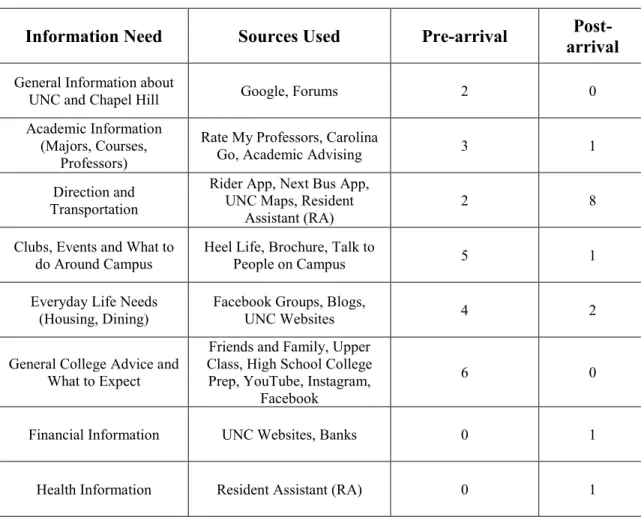
Table 1: Freshmen’s pre and post arrival information needs and sources used
Information Need Sources Used Pre-arrival arrival
Post-General Information about
UNC and Chapel Hill Google, Forums 2 0
Academic Information (Majors, Courses,
Professors)
Rate My Professors, Carolina
Go, Academic Advising 3 1
Direction and Transportation
Rider App, Next Bus App, UNC Maps, Resident
Assistant (RA) 2 8
Clubs, Events and What to
do Around Campus Heel Life, Brochure, Talk to People on Campus 5 1
Everyday Life Needs
(Housing, Dining) Facebook Groups, Blogs, UNC Websites 4 2
General College Advice and What to Expect
Friends and Family, Upper Class, High School College Prep, YouTube, Instagram,
6 0
Financial Information UNC Websites, Banks 0 1
Health Information Resident Assistant (RA) 0 1
According to Table 1, there are some significant differences between students’
pre-arrival and post-arrival information needs. At least 6 participants sought for
information about what to expect in college and general advice from people who have
experienced it. Since this is something that need to be experienced, their primary sources
are mostly social media or people they know, like friends and family. Many participants
also mentioned they looked for what to do around campus and things like housing and
dining. An interesting finding here is that Facebook Groups appeared multiple times in
different interviews. They turn out to be a common place for college students especially
freshmen to find housing information and even roommates. Many find Facebook Groups
It is worth noting that the needs for many types of the information tend to decline
after students have arrived at the university. However, the need for direction and
transportation increases greatly. At least 8 participants expressed their need to find where
classes were when they first arrived at UNC, but found it confusing to navigate on
campus. In terms of the information sources participants used, Resident Assistant was
mentioned a few times, who would take freshmen’s printed class schedules and show
them around different buildings where the classes would take place. Some participants
found this very useful but not all the participants had the knowledge of that, and thus,
most of them used maps for navigation and familiarized themselves by simply walking
around campus.
Although only by a small amount, the needs for health information and financial
information also seem to increase after freshmen’s arrival at UNC. Participant #1 said she
“didn’t care” before coming to UNC but realized the need to apply for funding once
settled down. Participant #7 experienced stress when she first started her first year and
was in need of helpful information on mental health. Information like this is not generally
needed by everyone but can be useful for all the university students. Our findings prove
that students will start to realize their information needs when they experience specific
situations on campus. It is important for the university to make such information always
4.3
Difficulty Adjusting to College
As discussed in the literature review, due to the change of the environment,
freshmen who come to study in the university right after high school, will most likely
experience some level of difficulty to adjust. In this study, participants were asked to
recall some of the difficulty they had trying to adapt themselves to college life. Various
answers were provided.
•
Academic Problems
Academic problems are proven to be the most common obstacle in freshmen’s
adjustment to college. Four of the participants (#4, #6, #7, #13) expressed their
frustration related to their academic development during their first year.
Participant #4, #6 and #7 were all frustrated as the university level classes were
harder than they anticipated. They either stressed over the first exam in college (#4),
enjoyed the in-depth classes but struggled at the same time (#7), or “did poorly” in the
first semester and had to “change major four times” (#6).
Participant #13 had a different problem, where only after going to the class, she
found out that the class she signed up for was not at all the same as described in the
course description.
In order to improve their academic performance, participant #6 and #7 both
turned to online resources for help. They utilized Google and blogs to read about how to
people. They turned to Teaching Assistants (TA), peer, Academic Advising Office, etc.
to make sure they were on a right path to succeed in what they studied.
•
Health Problems and Sickness
One of the significant findings here is that three of the participants (#3, #11,
#12) reported to have experienced major health problems in their first year.
Participant #3 experienced chronic health issues to the point that they affected
her class attendance, whereas participant #11 had mental health issues which lead to
depression. They both referred CAPS (Counseling and Psychological Services) as the
primary health information source they turned to for help, but neither of them was
satisfied with the help they received. People at the CAPS “provide same treatment for
everyone”, repeat what the patient has already told them, and only “read to you stuff off
the book”, according to Participant #11. She ended up seeking diagnosis from her
therapist off campus, which was way more effective.
•
General Lifestyle
Two participants (#2 and #10) elaborated their difficulty in adjusting to a
different lifestyle where they could not come home to parents anymore and they had to
deal with everything on their own. This is one of the problems commonly anticipated
for freshmen. In high school, students have teachers to instruct them at school, the same
group of classmates to discuss homework, and parents to help with anything at home.
They do not have to do everything by themselves and always have people to talk to.
may not know at all. Professors in college are not available all the time and most of the
time, students are expected to find ways to solve problems by themselves. Such changes
in lifestyle certainly cause trouble for some freshmen.
Participant #2 described herself as a very homey person and participant #3
explained how she was raised as an only child back home. Both of them showed
tendency to depend heavily on their parents. Despite the fact that they liked their
roommates, they did not feel comfortable living with strangers in the beginning, and it
took some effort for them to resolve the difference between them and their roommates.
When asked what methods were taken to improve their situations, both of the
participants mentioned the effort they put in to getting used to their new life. Participant
#2 took initiatives to talk to other people about her problems and tried hard to feel
comfortable around people. She ended up befriending all her roommates. Participant
#10 used Facebook Group, as mentioned before, to find roommates with traits that align
with her expectation. Her approach turned out to be effective and she felt more
comfortable after getting an ideal roommate.
•
Time Management
Time management issue is mentioned by two participants (#5 and #8).
According to the previous background section, both participants are in multiple student
organizations and clubs, which could be partially the reason that they had trouble
balancing their time. It is understandable that many undergraduate students, especially
when they first come to the university, are interested in a lot of things, hoping to
skills to help them better balance their life. Participant #5 said it was hard for her to
balance among “classes, clubs and friends”, and sometimes it cost her the opportunities
to “hang out with friends”. Participant #8 decided that she ought to learn how to use her
time, as she “overcommitted to a lot of student organizations”.
The two participants took very different approaches in fixing their problems.
Participant #5 fully utilized the access to professional help at UNC. She consulted with
her Resident Assistant (RA) and her RA worked closely with her to make a schedule
that worked better. She also learned about Academic Advising through her RA and used
drop-in hours to get more help. Participant #8, however, adopted some technology and
online tools, such as Google Calendar to help herself plan time while cutting things out.
Both professional help and technology were helpful in helping them improved the
situations.
•
Other: Trouble Getting Around / Political Issues
Although only one participant (#9) reflected on the difficulty in getting around
without a car and a parking spot during her first year, it is possible that many other
freshmen would agree to it. Participant #9 took some effective information seeking
approaches, for example, through Facebook Groups and friends, to successfully find a
parking spot.
Another problem reported by participant #1 is the fact that the political incidents
that happened over the course of last year, made her feel unsafe about her campus life.
She also expressed concerns about being involved in uncomfortable conversations about
4.4
Information Seeking Experiences
During the interviews, participants were asked to recall some examples of their
information seeking experiences in their first year. They were encouraged to list any
successful or unsuccessful experiences as they saw necessary. Most participants were
able to provide the investigator with at least one example from their first year, although
some juniors did have trouble remembering their detailed behaviors while looking for
relevant information.
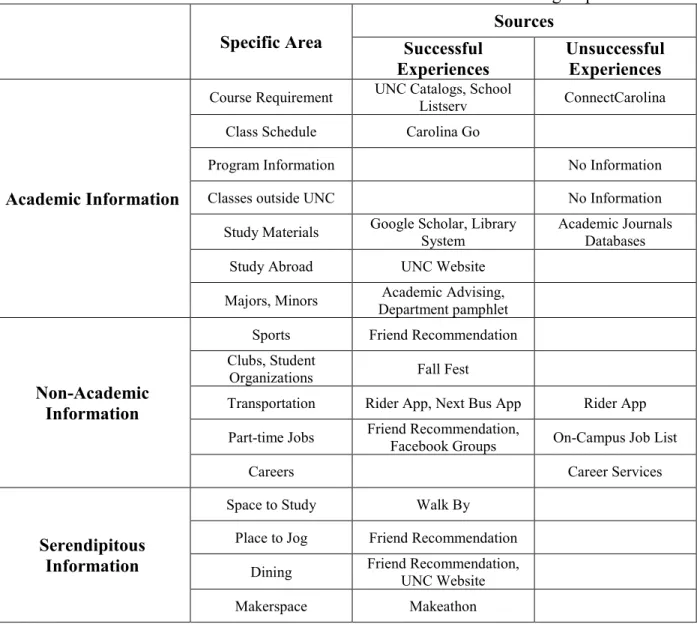
Table 2: Freshmen’s Successful VS Unsuccessful Information Seeking Experiences
Specific Area Successful Sources
Experiences Unsuccessful Experiences
Academic Information
Course Requirement UNC Catalogs, School Listserv ConnectCarolina
Class Schedule Carolina Go
Program Information No Information
Classes outside UNC No Information
Study Materials Google Scholar, Library System Academic Journals Databases
Study Abroad UNC Website
Majors, Minors Department pamphlet Academic Advising,
Non-Academic Information
Sports Friend Recommendation
Clubs, Student
Organizations Fall Fest
Transportation Rider App, Next Bus App Rider App
Part-time Jobs Friend Recommendation, Facebook Groups On-Campus Job List
Careers Career Services
Serendipitous Information
Space to Study Walk By
Place to Jog Friend Recommendation
Dining Friend Recommendation, UNC Website
Table 2 concludes the examples supplied by the participants, along with the
sources they used seeking the information they needed. Most of the feedback is focused
in academic information, which is crucial and most relevant to students’ goals in their
college life, although not all the feedback is positive. At least 2-3 participants have
trouble navigating ConnectCaroline, which is the main course registration system at
UNC. Due to that, many students seemed to seek course related information on other
platforms, such as Carolina Go app and UNC Catalogs, which were more helpful.
Participants were able to find many different types of academic information rather easily,
for example, research materials through UNC Libraries, and information about Study
Abroad or taking a minor. There are also certain kinds of information that students
couldn’t find any relevant information. One participant has been taking summer classes
outside UNC, but she failed to find any information provided by UNC.
Participants have shown to have both negative and positive experiences seeking
non-academic information. More than three participants told the investigator that they
found Fall Fest extremely helpful in presenting students with all the information about
the student organizations and clubs that they could join. According to the students, Fall
Fest is hosted by UNC at the beginning of the Fall semesters and all freshmen are
required to attend. Hosting campus wide events like this proves to be a good way to
provide new students with information access that they might not have thought about
looking for.
Information about transportation and direction is discussed in previous findings
and it is quite necessary for freshmen to find information to help them get around without
common apps to check bus schedules. A phone app is considered convenient but the
accuracy of the bus schedules is the primary factor that determines whether students like
it or not.
Serendipitous Information also appeared in some of the interviews. While
students do not tend to actively seek such information, recommendations from friends
contribute quite a lot to the finding of such information. That makes it a great source for
useful information as well.
4.5
Use of Technology
Participants answered a few questions about their use of technology. First, they
were asked whether they used their laptop more often than their cell phone when looking
for information online, or the other way around. Results show that laptops were
mentioned 10 times and cell phones were mentioned 7 times. This is not a very
significant difference, but if the participants who has no preferences were eliminated
from consideration, the results became 6 versus 3, where participants who prefer laptops
are two times as many as ones that prefer using cell phones for information seeking.
According to the participants, the reasons they use laptops more often are mainly
because “it’s easy to read” and “it’s easier to do research on my laptop”, whereas others
choose to use their phones because “it’s good for quick information”, “phone’s easier on
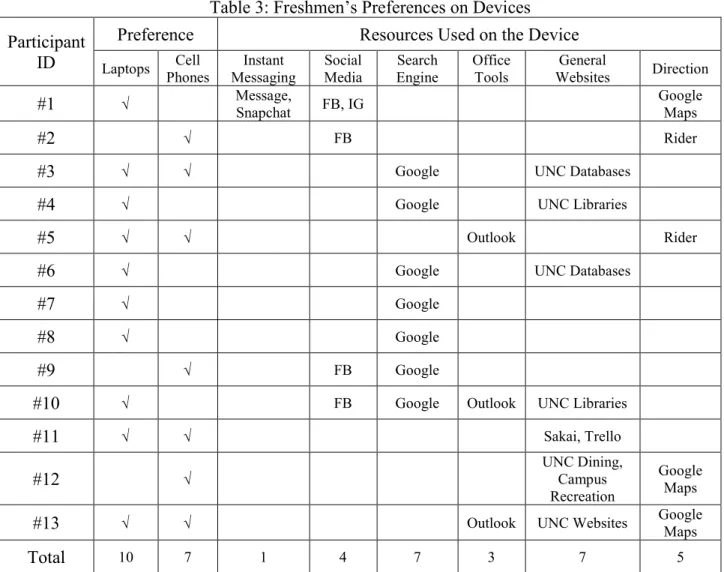
Table 3: Freshmen’s Preferences on Devices Participant
ID
Preference Resources Used on the Device
Laptops Phones Cell Messaging Instant Social Media Engine Search Office Tools Websites General Direction
#1 √ Message, Snapchat FB, IG Google Maps
#2 √ FB Rider
#3 √ √ Google UNC Databases
#4 √ Google UNC Libraries
#5 √ √ Outlook Rider
#6 √ Google UNC Databases
#7 √ Google
#8 √ Google
#9 √ FB Google
#10 √ FB Google Outlook UNC Libraries
#11 √ √ Sakai, Trello
#12 √ UNC Dining, Campus
Recreation
Google Maps
#13 √ √ Outlook UNC Websites Google Maps
Total 10 7 1 4 7 3 7 5
Table 3 lists participants’ preference of devices and what sources they utilize the
most through technology. The uses of Google and UNC websites or resources are rather
dominant. And Social Media like Facebook, as well as direction apps are used quite often
too. Students’ preference to use Google for general information is in accordance with
many previous studies. The good news for the university is that according to the results,
students are using and are willing to use UNC provided resources, such as the library
website, UNC Dining and Campus Recreation. However, feedback is received that not all
the school websites are providing the information needed by the students, and it
ConnectCarolina are two of the sources that received negative feedback from
participants.
4.6
Source Selection
General source selection for orienting information on campus has been studied here.
Participants were given the opportunity to choose one primary information source that
they would turn to first most of the time, and to illustrate the reasons behind their choices.
Table 4: Freshmen’s Source Selection for Orienting Information
Information Sources Number of times chosen Percentage
Technology 8 61.5%
Friends or other Students 4 30.8%
Professionals or
Organizations 1 7.7%
It is not surprising that 61.5% of the participants would turn to technology first for
information related to their college life. As is discussed in the literature review section,
today’s college students possess the ability to adopt new technology quickly and are used
to interacting with screens all the time. When asked why they chose technology over
human sources, participant #3 expressed that she preferred correct information posted in
writing than people’s personal opinions. Participant #11 also said that she simply just did
not trust people. Participant #5 has the concern that all her friends are also freshmen, so
she doubts that they have the information she needs, whereas she can look up anything
online. Most of the other participants think that it’s just easy and quick to access
30.8% of the participants would still like to ask friends first if they needed
information. Participant #2 thinks it’s easier to talk with people face to face. Participant
#10 said she had trustworthy and diverse group of friends, so she had a basic idea of who
might know what. Participant #7 had a rather unique perspective. She thinks asking
friends for information is part of the social life in college.
Although only one participant expressed the preference to consult professionals first,
during the follow-up questions, many participants told the investigator that they would
seek help from professors or organizations in specific situations.
4.7
Improvement
4.7.1 Things that are hardest to access
Almost all the participants said yes to the question of whether or not the university
needs to improve students’ access to more orienting information. They were then asked
what information in general did they find the hardest to access in their first year. Their
responses are as follow.
Academic Information:
Participant #1 – It’s hard for freshmen to find research opportunities.
Participant #2 – The hardest thing for me was how to make class schedule. They
teach us step by step in high school. ConneceCarolina is just not user-friendly.
Participant #11 – No sample syllabus. No way to know if classes or professors are
any good.
Participant #13 – Course descriptions are only a few lines of words. Not enough.
Clubs & Student Organizations:
Participant #3 – Navigating Heel Life website. I lost the chance to join clubs.
Participant #7 – Heel Life has no information for clubs to join. Registration process
is too hard.
Directions & Events:
Participant #4 – What kind of transportation? What bus do I take? What’s out there
fun but free? Best places to eat for broke college students?
Participant #6 – What actually goes on at school? Cannot find course syllabus.
Participant #10 – Events are not promoted by UNC. Did not know when the blood
drives are.
Everyday Life Needs:
Participant #5 – Housing. Applied to stay together with my old roommate for the
next year but got split up.
Participant #8 – Student loan. Had to go to a UNC website and then got directed to a
federal website.
The responses from the participants show that many of the problems of students’
information access occur in their academia. One thing worth noting is that one of the
common complaints falls onto the course registration system. There is not enough
information or instruction on registering classes, understanding what each class is about
or simply what are some classes for freshmen to take, whether they have a major or not.
One response also points out the lack of information about researching provided for
freshmen.
Two of the participants reflected on the student life website Heel Life, which did not
do a good job in providing students with potential club information for them to view and
join, especially for students that missed Fall Fest. Future changes could be made to the
website to better serve the freshmen and students of all years.
Directions and events information is proved to be needed by many students when
they first come to UNC. However, even with all the maps, posters, brochures, apps
available, many participants in this study still find it the hardest to access. There are two
reasons that might cause this problem. First, the accuracy of the bus apps is not
satisfactory at all time, which is the main reason why students have different opinions
about same apps. Secondly, campus events are being promoted at different time of the
semester, which could potentially lead to information overload. The result of that is
students not getting the information they need the most.
For everyday life needs, one thing that gets talked about the most is housing.
Participants are unsatisfied with UNC Housing portal and almost 100% of them turn to
Facebook Groups for more useful housing information. The university should think of a
4.7.2 Suggestions
Blogs
One suggestion that would gain support from majority of the freshmen has come up
during the interviews. Instead of having to join a Facebook group for each class, the
university should consider developing a blog of some sort, where upper-class students
can share their experiences and comments about the classes they have taken. Many
participants complained about the lack of information on course content and sample
syllabus. A blog or a website like this will provide students with syllabus from previous
classes shared by past students. This would be designed more toward UNC students,
compared to the generalized information on other common websites students would go
to.
One-on-one Orientation Sessions
Since almost all the participants had problem with registration when they first started
here, and they did not find school orientation helpful at all, there could be another way to
improve freshmen’s experiences and their information access to registration information.
Many participants reflected that too much information was thrown at them over the days
of orientation, even if some of the information wasn’t of their immediate need at the
beginning of the semester. It is suggested that the university consider hosting shorter but
one-on-one orientation sessions, where incoming freshmen can sit down with an advisor,
RA or simply someone who can explain how to register classes on ConnectCarolina. It
into UNC every year. Methods like recruiting volunteers from junior or senior students
would be a reasonable option.
Easier access to counseling services
Mental health information and the lack of access to such information has appeared in
many parts of this study, and thus it should be seen as another category that is in urgent
need of improving. As reported, the majority of the freshmen have not heard of CAPS,
the counseling services provided by the campus health center at UNC. Even if some of
the sophomore and junior participants acknowledge their knowledge of its existence, they
have mostly heard about it from a friend who has also suffered mental health issues.
Moreover, the services provided by CAPS are not at all satisfactory. Some students had
to travel off campus to see a therapist instead. It is advised that counseling services at
UNC be made more customized toward each student’s situation. Information like this
should also be made available to freshmen over the course of their first semester here.
Academic Advising More Available
It is learned from the interviews with the participants that the Academic Advising
services provided on campus has been helpful in providing academic information,
especially for questions like course requirements, major and minor questions, etc.
However, students seem to experience difficulty in actually getting the chance to sit with
an advisor, as they are usually fully booked. If more appointments could be made
available on campus would be filled quickly, so that they wouldn’t be struggling as much
5
Conclusion
College students’ information seeking behaviors have been studied in various
research institutions and universities. Nevertheless, few of them are entirely focused on
freshmen orienting information needs while taking into consideration their difficulties in
adjusting to college life. In this study, 13 undergraduate students currently enrolled at
UNC were recruited for one-on-one interviews. Whether a freshman or not, their
experiences and comments about their first-year information seeking process and
information availability they perceived were documented.
Results show that direction and transportation information is needed the most when
non-local students first arrive at the area. Most of the participants reported confusion
about direction and where classes are the first few weeks of their first semester.
Suggestions are made that directory on campus and signs of the buildings be made more
visible.
During the time the participants were enrolled as freshmen, academic information
and health information seemed to be the two most lacking types of information. Some
students struggle to register for courses that are suitable for them, while some experience
health issues with nowhere to find helpful information. These are two major areas the
university should consider reflecting and improving on.
Despite the negative results, many of the university websites and resources are
it is noticeable that Google, UNC websites (especially library website, dining and
recreation sites), and social media are all popular sources. More than half of the
participants prefer using technology for information searching over human sources.
However, human interactions that provide useful information are preferred by students
who value personal experience and social value in their information seeking process.
At the last part of the results and discussion, a few reasonable suggestions are made,
after analyzing the results from the study. A blog or a website that contains all detailed
course information provided by upper-class students who have taken the courses, is
strongly recommended. Providing each freshman with a one-on-one orientation session
that is entirely focused on course selection, registration and degree requirements could be
more helpful to freshmen than a 3-day long orientation with overwhelming information
that tends to be forgotten right after. Academic Advising has been told to be extremely
useful for students, and thus should be more available to freshmen. Last but not least,
students’ mental health is just as important as their academic performance. Something
should be done to improve the counseling services on campus that’s available to students
especially freshmen who experience stress trying to adjusting to college.
The suggestions made in this study will hopefully be of reference for the university
to improve its information access and to assist freshmen better adjust to their new life
here. To quote one of the participants from this study, “we are still kids and we need
more attention”. One thing a university can always do, is to be more supportive, and let
References
Agosto, D. E., & Hughes-Hassell, S. (2005). People, places, and questions: An
investigation of the everyday life information-seeking behaviors of urban young
adults. Library & information science research, 27(2), 141-163.
Blundell, S., & Lambert, F. (2014). Information anxiety from the undergraduate student
perspective: a pilot study of second-semester freshmen. Journal of Education for
Library and Information Science, 261-273.
Brinkmann S. (2014). Unstructured and Semi-Structured Interviewing. In The Oxford
Handbook of Qualitative Research. Retrieved from:
http://www.oxfordhandbooks.com.libproxy.lib.unc.edu/view/10.1093/oxfordhb/9
780199811755.001.0001/oxfordhb-9780199811755-e-030
Brinkman, S., Gibson, K., & Presnell, J. (2013, April). When the helicopters are silent:
The information seeking strategies of first-generation college students. In
presentation at the ACRL Conference, Indianapolis, IN, April (pp. 10-13).
Chatman, E. A. (1991). Life in a small world: Applicability of gratification theory to
information‐seeking behavior. Journal of the American Society for information
Cho, I. Y. (2014). The relationship of career identity, major satisfaction and college
adaptation of nursing freshmen. Journal of the Korea Academia-Industrial
cooperation Society, 15(5), 2937-2945.
Cooper‐Thomas, H., & Anderson, N. (2002). Newcomer adjustment: The relationship
between organizational socialization tactics, information acquisition and attitudes.
Journal of occupational and organizational psychology, 75(4), 423-437.
Dee, C., & Stanley, E. E. (2005). Information-seeking behavior of nursing students and
clinical nurses: implications for health sciences librarians. Journal of the Medical
Library Association, 93(2), 213.
Dılekmen, M. (2007). Orientation program and adaptation of university students.
Psychological reports, 101(3_suppl), 1141-1144.
Du, J. T., & Evans, N. (2011). Academic users' information searching on research topics:
Characteristics of research tasks and search strategies. The Journal of Academic
Librarianship, 37(4), 299-306.
Escoffery, C., Miner, K. R., Adame, D. D., Butler, S., McCormick, L., & Mendell, E.
(2005). Internet use for health information among college students. Journal of
American College Health, 53(4), 183-188.
Evans, C. (2018). In Lewis, J. (Ed.) (Ed.), Analysing semi-structured interviews using
thematic analysis: Exploring voluntary civic participation among adults. 55 City
Road, United Kingdom: SAGE Publications, Ltd. Retrieved from:
Fisher, K. E., Durrance, J. C., & Hinton, M. B. (2004). Information grounds and the use
of need‐based services by immigrants in Queens, New York: A context‐based,
outcome evaluation approach. Journal of the American Society for Information
Science and Technology, 55(8), 754-766.
Fisher, K. E., Landry, C. F., & Naumer, C. (2007). Social spaces, casual interactions,
meaningful exchanges: 'information ground' characteristics based on the college
student experience. Information Research, 12(2), 12-2.
Gabridge, T., Gaskell, M., & Stout, A. (2008). Information seeking through students’
eyes: The MIT photo diary study. College & Research Libraries, 69(6), 510-523.
García-Ros, R., Pérez-González, F., Cavas-Martínez, F., & Tomás, J. M. (2018). Social
interaction learning strategies, motivation, first-year students’ experiences and
permanence in university studies. Educational Psychology, 38(4), 451-469.
Given, L. M. (2002). The academic and the everyday: Investigating the overlap in mature
undergraduates' information–seeking behaviors. Library & information science
research, 24(1), 17-29.
Gross, M., & Latham, D. (2011). Experiences with and perceptions of information: A
phenomenographic study of first-year college students. The Library Quarterly,
81(2), 161-186.
Hamburg, D. A., & Adams, J. E. (1967). A perspective on coping behavior: Seeking and
utilizing information in major transitions. Archives of general psychiatry, 17(3),
Hartmann, E. (2001). Understandings of information literacy: The perceptions of first
year undergraduate students at the University of Ballarat. Australian Academic &
Research Libraries, 32(2), 110-122.
Julien, H., & Michels, D. (2000). Source Selection among Information Seekers: Ideals
and Realities. Canadian Journal of Information and Library Science, 25(1), 1-18.
Jones, S. (2008). Internet goes to college: How students are living in the future with
today's technology. Diane Publishing.
Koo, J. H., & Gross, M. (2009). Adolescents' information behavior when isolated from
peer groups: Lessons from new immigrant adolescents' everyday life information
seeking. Proceedings of the American Society for Information Science and
Technology, 46(1), 1-3.
McKenzie, P. J. (2003). A model of information practices in accounts of everyday-life
information seeking. Journal of documentation, 59(1), 19-40.
Metzger, M. J., Flanagin, A. J., & Zwarun, L. (2003). College student Web use,
perceptions of information credibility, and verification behavior. Computers &
Education, 41(3), 271-290.
Miller, V. D., & Jablin, F. M. (1991). Information seeking during organizational entry:
Influences, tactics, and a model of the process. Academy of Management Review,
Moring, C. (2012). Newcomer information practice: negotiations on information seeking
in and across communities of practice. Human IT: Journal for Information
Technology Studies as a Human Science, 11(2).
Moring, C. (2017). Newcomer information seeking: the role of information seeking in
newcomer socialization and learning in the workplace. Information Research,
22(1).
Morrison, E. W. (1993). Longitudinal study of the effects of information seeking on
newcomer socialization. Journal of applied psychology, 78(2), 173.
Niu, X., Hemminger, B. M., Lown, C., Adams, S., Brown, C., Level, A., ... & Cataldo, T.
(2010). National study of information seeking behavior of academic researchers
in the United States. Journal of the American Society for Information Science and
Technology, 61(5), 869-890.
Peterson, K., Hahn, H., Lee, A. J., Madison, C. A., & Atri, A. (2016). In the Information
Age, do dementia caregivers get the information they need? Semi-structured
interviews to determine informal caregivers’ education needs, barriers, and
preferences. BMC geriatrics, 16(1), 164. Retrieved from:
https://search-proquest-com.libproxy.lib.unc.edu/docview/1824997395?pq-origsite=summon
Rahat, E., & İlhan, T. (2016). Coping Styles, Social Support, Relational Self-Construal,
and Resilience in Predicting Students' Adjustment to University Life. Educational