THE ROLE OF OPTIMISM AND RELIGIOUS INVOLVEMENT IN THE RELATIONSHIP BETWEEN RACE-RELATED STRESS AND WELL-BEING
Daniel B Lee
A thesis submitted to the faculty of the University of North Carolina at Chapel Hill in partial fulfillment of the requirements for the degree of Masters of Art in the Department of Psychology (Clinical).
Chapel Hill 2012
Approved by:
ii Abstract
DANIEL B LEE: The Role of Optimism and Religious Involvement in the Relationship Between Race-Related Stress and Well-Being.
(Under the direction of Enrique W. Neblett, Jr)
iii
ACKNOWLEDGMENTS
To complete a research project of this magnitude requires a network of support, and I am indebted to many people. I wish to express sincere appreciation to the
iv
TABLE OF CONTENTS
List of Figures……….vi
Introduction……….………...1
Method………...19
Results………27
Discussion………..33
Figures………42
v
LIST OF FIGURES Figure
1. The relationship between individual race-related stress and anxiety
symptomatology at low, moderate, and high levels of optimism………..39 2. The relationship between cultural race-related stress and self-esteem
at low, moderate, and high levels of optimism...40 3. The relationship between individual race-related stress and anxiety
symptomatology at low and high levels of religious involvement and
optimism………....41 4. The relationship between institutional race-related stress and personal
Introduction
Much of the research focusing on African American emerging adults’ racial discrimination experiences delineates the damaging effect racial discrimination can have on psychological well-being (Bynum, Burton, & Best, 2007; Castle, Conner, Kaukeinen, & Tu, 2011; Cooper, McLoyd, & Wood, 2007; Harrell, 2000; Simons et al., 2002; Stock, Gibbons, & Walsh, 2011). These studies encompass a wide range of psychological well-being indices such as mental health (Cooper, McLoyd, & Wood, 2007; Harrell, 2000), self-esteem (Seaton, 2009; Seaton, Caldwell, Sellers, & Jackson, 2010), and general life satisfaction (Utsey, Ponterotto, Reynolds, & Cancelli, 2000), with the general finding that racial discrimination is inversely related to favorable psychological well-being outcomes.
Although racial discrimination experiences are negatively associated with psychological well-being outcomes, studies have also reported considerable
heterogeneity in well-being outcomes (Miller & MacIntosh, 1999; Neblett, White, Ford, Philip, Nguyên, & Sellers, 2008). To explain this variation, researchers have examined the role of “protective factors,” or variables that mitigate the harmful effect of exposure to stress and adversity (Luthar & Zelazo, 2003). One such factor is optimism. Several studies suggest that optimism may modulate the negative relationship between stress and well-being outcomes (Peterson, 2000; Taylor, Larsen-Rife, Conger, Widaman, &
2
well-being of African Americans from race-related stress (Utsey, Giesbrecht, Hook, & Stanard, 2008).
In addition to optimism, another important factor to consider may be religious involvement. For African Americans, religion plays an important role in coping by evoking optimism and a sense of hope in adversity (Bruce & Jones, 1978; Hopkins, 1999). African American theology posits that God will eventually deliver African
Americans from the burden of White oppression (Cone, 1990; Hopkins, 1999). In several studies, African Americans who reported higher levels of religious involvement endorsed more optimism than individuals who were less religiously involved (Mattis, Fontenot, Hatcher-Kay, Grayman, & Beale, 2004; Seligman, 1996). Thus, theoretical and empirical work suggests that religious involvement and optimism may operate together to influence psychological well-being.
3
psychological well-being; (2) to investigate whether optimism protects African
Americans from the deleterious association between race-related stress and psychological well-being; and (3) to evaluate whether religious involvement amplifies the protective effect of optimism within the context of race-related stress for African American emerging adults.
Racial Discrimination
Research on race-related stress characterizes racial discrimination in a variety of ways. The broadest definitions encompass all acts of inequality toward racial groups, stemming from current and past discriminatory practices. The narrowest definitions restrict discrimination to acts of inequality that harm a target minority racial group (Quillian, 2006). Bobo (2001) posits an intermediate definition, defining racial discrimination as systematic disadvantages [e.g., unequal housing and employment opportunities] imposed on certain minority racial groups. In addition to the
aforementioned definitions of racial discrimination, a report by the National Research Council defines racial discrimination in two ways. First, racial discrimination is defined as disadvantaging a racial group by providing disparate treatment based on racial affiliation (Feagin & Eckberg, 1980; Blank, Dabady, & Citro). Second, racial
discrimination is defined as disadvantaging a racial group by providing treatment based on inadequately justifiable factors (Blank, Dabady, & Citro, 2004). Together, the body of research conceptualizing racial discrimination broadly defines the social phenomenon as “…beliefs, attitudes, institutional arrangements, and acts that tend to denigrate
4
Williams, 1999, p.805). Examples for this conceptualization of racial discrimination may entail unequal housing opportunities, hiring practices, levels of educational attainment, and access to health care services due to one’s racial and/or ethnic affiliation. Researchers have also conceptualized racial discrimination as a multidimensional social phenomenon. Jones’ (1997) seminal conceptualization of racial discrimination posits a tripartite
typology of racial discrimination. The tripartite model unpacks and delineates the complexity of racial discrimination into three domains – individual, institutional, and cultural. At the individual level, racial discrimination is characterized by personal and degrading actions experienced by minorities. An example of individual racism may entail being called a racially derogatory name. At the institutional level, racial discrimination is characterized by differential access to societal resources and services based on one’s race. An example of institutional racism may entail unequal employment opportunities due to one’s racial group affiliation. At the cultural level, racial discrimination is characterized as cultural practices that laud one culture as superior to another. An example of cultural racism may entail hearing or reading negative remarks about one’s ethnic group by a member of another ethnic group (Jones, 1997).
Other scholars have also examined various dimensions of racial discrimination. For example, Essed (1991) discussed micro and macro dimensions of racial
5
forms of discrimination may involve perceptions of prejudiced attitudes through overt expressions of behavior [e.g., being called a racial slur]. Covert forms of discrimination may involve perceptions of prejudiced attitudes through subtler forms of discriminatory behavior [e.g., symbolic beliefs and behaviors] (McConahay & Hough, 1976; Sears, 1988; Yetman, 1991). Furthermore, to account for the total experience of racial discrimination, Harrell (2000) indicated that discriminatory experiences consisted of simultaneous exposure to racial discrimination in interpersonal, collective, cultural-symbolic, and sociopolitical contexts. In measuring the different dimensions of racial discrimination, Utsey and Ponterotto (1996) established a multi-dimensional measure, which assesses individual, institution, cultural, and collective discriminatory experiences. Taken together, the aforementioned conceptualizations of racial discrimination suggest that there are many different ways to think about racially discriminatory experiences.
Irrespective of how racial discrimination is conceptualized, prior research indicates that racial discrimination is a normative experience for African American emerging adults (Banks, 2010; Bank & Kohn-Wood, 2007; Sellers, Caldwell, Schmeelk-Cone, & Zimmerman, 2003; Thompson, 2002). In a study by Biasco, Goodwin, and Vitale (2001), 66% of African American emerging adults reported perceiving racial hostility (i.e., overt discrimination experiences). Furthermore, using a daily diary technique, Swim, Hyers, Cohen, Fitzgerald, and Bylsma (2003) found that African American emerging adults reported experiencing at least one instance of racial
6
more racial discrimination experiences than African American college students in historically Black colleges and universities (Greer & Chwalisz, 2007). Together, these studies indicate that African American emerging adults are no strangers to racial discrimination.
Although many African Americans experience racial discrimination during childhood and adolescence (Brody et al., 2006), emerging adulthood is a pivotal developmental period for examining racial discrimination experiences. Emerging adulthood has been characterized as a period of traversing beyond the familial context into environments that are more ethnically diverse and, often times, predominantly white (Phinney, 2006). Studies propose that African Americans in emerging adulthood are more likely to encounter racial discrimination in ethnically diverse and non-Black environments (Arnett & Brody, 2006; Ethier & Deaux, 1994; Scottham, Sellers, & Nguyên, 2008). Thus, as African Americans transition from their immediate social world of family, friends, and neighborhood to a predominantly non-Black environment such as a predominantly white university, the likelihood of perceiving and experiencing racial discrimination may increase (Blank, Dabady, & Citro, 2004; C.E. Thompson & Neville, 1999; Krieger, 2001). Given the unique challenges of this transition, examining this particular developmental period may enhance our understanding of normative and non-normative development for African American emerging adults.
Racial Discrimination and Well-Being
The body of research on racial discrimination experiences suggests that
7
2010; Seaton, Caldwell, Sellers, & Jackson, 2010; Sellers, Copeland-Linder, Martin, & Lewis, 2006). Various theoretical frameworks provide a rationale for the linkage between racial discrimination and poorer psychological well-being outcomes. Lazarus and
Folkman’s theoretical work on stress, appraisal, and coping, posits that if the relationship between the individual and the environment is appraised by the person as taxing, it could endanger his or her well-being” (Lazarus & Folkman, 1984). Thus, ongoing exposure to race-related stress can exhaust the individual’s coping resources. As coping resources diminish, Clark, Anderson, Clark, and Williams (1999) suggest that individuals respond to stress psychologically [e.g., anger, paranoia, helplessness, and hopelessness] and physiologically [e.g., depressed immune system functioning]. Ultimately, individuals’ psychological and physiological responses to stress may influence the genesis of psychopathology [e.g., depression] (Clark et al., 1999).
Another prominent theoretical model pertaining to discrimination and well-being is Garcia Coll and colleagues’ (1996) proposed integrative model, which posits
theoretically derived pathways that link racial discrimination to developmental competencies. The pathways included in the model are social position variables [e.g., race], racial discrimination, segregation, promoting/inhibiting environment [e.g., neighborhoods and schools], adaptive cultures [e.g., traditions and cultural legacies], child characteristics [e.g., age and temperament], family [e.g., racial socialization], and developmental competencies [e.g., emotion, cognitive, and coping with racism]. The proposed model delineates the role of environmental/social factors and individual
8
for the maintenance of psychological well-being (Garcia Coll et al., 1996).
Supporting the aforementioned theoretical frameworks, empirical work suggests a negative association between racial discrimination experiences and psychological well-being for African American adolescents and emerging adults. These studies are
characterized by two general approaches. First, psychological well-being is treated as a unique theoretical construct that often serves as a key variable or outcome (Neblett, White, Ford, Philip, Nguyen, & Sellers, 2008; Seaton, Scottham, & Sellers, 2006; Sellers, Copeland-Linder, Martin, & Lewis, 2006). Second, psychological well-being is assessed by examining correlates of well-being such as psychiatric symptoms, self-esteem, and life satisfaction (Pieterse, Todd, Neville, & Carter, 2012). Research from both approaches can be useful in understanding the harmful effects of racial discrimination experiences on psychological well-being for African American adolescents and emerging adults.
With regard to the theory-guided approach to well-being, Ryff (1989) described six theoretically and empirically driven domains of well-being: self-acceptance, positive relations with others, autonomy, environmental mastery, purpose in life, and personal growth. Sellers, Copeland-Linder, Martin, and Lewis (2006), employed Ryff’s theory-based measure of psychological well-being and found that increased levels of perceived racial discrimination experiences were negatively associated with well-being. In another study of African American adolescents, Neblett et al. (2008) indicated that racial
9 by Ryff.
Studies have also assessed psychological well-being by examining particular correlates of psychological well-being, rather than the construct of well-being itself. In the racial discrimination related literature, the correlates of psychological well-being most often examined include psychiatric symptoms (Brody et al., 2006; Cooper, McLoyd, & Wood, 2007; Greene et al., 2006; Landrine & Klonoff, 1996), self-esteem (Sellers et al., 2006), and general life satisfaction (Utsey, Ponterotto, Reynolds, & Cancelli, 2000).
Symptoms of psychopathology serve as a prominent correlate of psychological well-being in the racial discrimination literature. For example, various cross-sectional studies report a positive association between racial discrimination experiences and depressive symptomatology (Harell, 2000; Cooper, McLoyd, & Wood, 2007; Neblett et al., 2008; Seaton, 2009). A study by Seaton, Caldwell, Sellers, and Jackson (2010) indicated a positive link between racial discrimination and depressive symptomatology and several longitudinal studies also report a positive linkage between racial
discrimination and depressive symptomatology across developmental periods. (Brody et al., 2006; Sellers & Shelton, 2003; Sellers et al., 2006). In addition to depressive
10 comorbid (Angold, Costello, & Erkanli, 1999).
Research has also demonstrated the adverse effects of racial discrimination experiences on self-esteem for African American adolescents. One of the earlier
longitudinal studies examining racial discrimination experiences and self-esteem suggests a prospective link between racial discrimination experiences and lowered self-esteem in African American adolescents (Wong, Eccles, & Sameroff, 2003). Furthermore, in a three-year longitudinal study by Greene, Way, and Pahl (2006), racial discriminatory acts by peers and adults lowered self-esteem across developmental trajectories for African American adolescents. Together, these findings provide strong evidence of a causal link between racial discrimination and self-esteem.
General life satisfaction is another index of well-being that has been examined in African American adolescent samples. Cross sectional work by Seaton, Caldwell, Sellers, and Jackson (2008) posits that African American adolescents’ perceived racial
discrimination experiences lower life satisfaction. Hierarchical regression analysis in the study suggested that perceived racial discrimination was a risk factor for lower life satisfaction for black adolescents. More specifically, males or individuals in late
adolescence reported the lowest life satisfaction in the face of race-related stress (Seaton et al., 2008).
11
functioning such as positive relationships with others and mental health conditions reflected by the endorsement of psychiatric symptoms is needed. Ultimately, taking into account positive psychological functioning and other determinants that facilitate
psychological well-being will yield a more holistic understanding of psychological wellness.
Optimism as a Protective Factor
Despite the general negative relationship between racial discrimination experiences and psychological well-being, a considerable proportion of African American adolescents still report high levels of psychological well-being (Miller & MacIntosh, 1999; Neblett, White, Ford, Philip, Nguyên, & Sellers, 2008). The heterogeneity in psychological well-being outcomes, within the context of race-related stress, can be explained by the interplay between risk factors and protective factors (Masten, Cutuli, Herbers, & Reeds, 2009). A risk factor is defined as a factor that in ordinary circumstances predicts a maladaptive outcome (Rutter, 1987). In the present study, the risk factor being examined is racial discrimination, as such experiences are predicted to harm psychological well-being. In contrast to risk factors, protective factors predict positive outcomes in the context of risk factors. To date, research on racial discrimination has identified various individual factors [e.g., gender] and social factors [e.g., racial socialization] that modulate the deleterious influence of racial discrimination experiences on psychological well-being (Stevenson, 1995; Miller, 1999; Miller & MacIntosh, 1999; Neblett et al., 2008; Sellers, Copeland-Linder, Martin, & Lewis, 2006; Brown, 2008).
12
motivation to conceptualize the mechanics that underlie the influence of optimism on stressful experiences (Carver & Scheier, 1998). The expectancy-based theory posits that an individual’s belief in positive future outcomes will motivate the individual to
adaptively cope and improve well-being in the face of stress and adversity. Researchers also examined variations in coping style between optimists and pessimists (Carver, Scheier, & Weintraub, 1989; Fontaine, Manstead, & Wagner, 1993). In a recent meta-analysis conducted by Nes and Segerstrom (2006), greater levels of optimism were associated with adaptive coping strategies which help individuals reduce, manage, or eliminate stress. In addition to coping style, the distress-deterring model of coping (Ensel & Lin, 1991) posits that the presence of certain psychosocial resources (e.g., optimism) inhibits stress, independent of the stressful conditions. Optimism would serve as a safeguard against psychological distress amidst stressful life events (e.g., race-related stress). Finally, according to Lazarus and Folkman’s (1984) conceptualization of stress and appraisal, an individual’s personal appraisal of a stressful situation serves as a proximate indicator of adaptive coping behavior. Following this line of thought,
optimism would facilitate positive appraisals by providing a sense of hope in the course of an ongoing stressor (Utsey et al., 2008). In sum, theoretical work suggests that optimism is a psychological resource utilized to appraise and cope with stressful situations.
13
well-being in the context of ongoing stress (Carver & Gaines, 1987; Carver et al., 1993; Farber et al., 2010; Carver, Sheier, & Segerstrom, 2010). For example, a longitudinal investigation of individual differences and college adjustment outcomes reported optimism as a viable factor for the maintenance of positive psychological well-being (Aspinwall & Taylor, 1996). In addition, several health psychology studies have reported that optimism modulates the harmful effect of health-related stress (i.e., cancer) on various psychological well-being indicators (i.e., depression, psychological distress) (Carver et al., 1993; Given et al., 1993).
Optimism has also shown salubrious effects on psychological well-being outcomes for African Americans facing general life stress (i.e., not specific to race-related stress; Aspin & Taylor, 1992; Baldwin, Chambliss, & Towler, 2003; Shelby et al., 2008; Taylor, Conger, Widaman, Larsen-Rife, & Cutrona, 2010). In a recent study examining single-parent African American mothers, optimism moderated the impact of economic stress on maternal internalizing problems (Taylor, Larsen-Rife, Conger, Widaman, Cutrona, 2010). In another relevant study by Baldwin, Chambliss, and Towler (2003), optimism
modulated the harmful effects of academic stress on psychological well-being for African American college students. Although it appears that optimism serves a protective
14
study, Danoff-Burg, Prelow, and Swenson (2004) suggested that the harmful effects of perceived racial discrimination experiences on psychological well-being were moderated by hope and optimism in late adolescent African Americans. Together, these studies suggest that optimism protects African American youth from the deleterious effect of racial discrimination on psychological well-being outcomes. The present study seeks to contribute to the scant body of research examining whether optimism protects African American youth against the deleterious effects of racial discrimination.
Religious Involvement and Optimism
In addition to examining the protective nature of optimism, it is reasonable to conceptually link optimism and religious involvement. Previous theoretical work on religion and optimism suggests a positive association between the two constructs. As scholars of religion and psychology interpret human responses to religion, optimism is a crucial element to their analytic framework (Hick, 2004). Dating back to Freud, the functionality of religion served to reprieve people of the burdens and difficulties from the realities of life (Freud, 1928). Tiger (1979) similarly argued that religion tapped into the biologically given trait of optimism. Furthermore, the image of an all-loving, forgiving, and merciful God was apt in providing “cosmic optimism” for believers (Beck, 1971). Religious texts, such as the Bible, reinforce the notion that God heals in times of sickness, comforts in times of despair, and protects in times of harm (Nelson, 1997).
For African Americans, religion helps African Americans interpret and appraise race-related stress and adversity (Cone, 1990). African American theology
metaphorically links Black oppression to the oppression experienced by the Old
15
doctrinal modification established an affinity between African Americans and
Christianity, as the new theology addressed race-related adversity and discrimination (Bruce & Jones, 1978, Hopkins, 1999). The doctrine of liberation theology, on the whole, asserts that God will one day vindicate the oppressed. As God delivered biblical Israel from their oppressors, liberation theology ensures believers that God will liberate African Americans from racist oppression. As a result, liberation theology cultivates optimism and hope within the context of race-related stress. As religious scholars explore thematic elements represented in African American theology, optimism is a vital component integrated into the theology (Cone, 1990). Scriptural messages portraying God’s
unconditional love and just character would elicit a profound sense of optimism and hope among African Americans undergoing race-related stress.
Empirical work suggests a promising link between optimism and religious
16
reported that individuals who report higher levels of religiosity also reported higher levels of optimism. Furthermore, the study indicated that people who reported that higher levels of religious commitment also reported lower levels of pessimism (Mattis et al., 2004). Hence, empirical studies suggest that a promising linkage between optimism and religious involvement may exist in face of ongoing race-related stress for African American adults.
To date, no study has examined how religious involvement and optimism operate within the context of race-related stress for African American emerging adults. Emerging adulthood is a pivotal period to examine religious involvement as individuals in this developmental stage embark on developing a complex understanding of how religion operates in their lives (Barry, Nelson, Davarya, & Urry, 2010; Braskamp, 2008). More specifically, studies suggest that emerging adults utilize religion to make meaning of stressful events by attempting to see stressful events in a more optimistic light (Park, 2005; Pearlin, 1991). Collectively, these studies suggest that African American emerging adults may utilize religious involvement and optimism to cope with race-related stress. The Present Study
Several limitations must be addressed in increasing our understanding of the links among race-related stress, optimism, and religious involvement in African American emerging adults. First, only a few studies have examined the unique effects of different types of discrimination experience on psychological well-being. Second, only a few studies have examined the role of optimism within the context of race-related stress for African Americans emerging adults. Finally, the current body of research on
17
operate together within the context of race-related stress for African American emerging adults. Thus, the present study seeks to address these shortcomings in the current body of research on racial discrimination and well-being.
The first aim of the study is to examine if specific types of racial discrimination stress affect psychological well-being and correlates of psychological well-being. The second aim of the study is to examine if optimism buffers the deleterious impact of specific types of racial discrimination stress on psychological well-being and its related correlates. The third aim of the study is to examine if religious involvement enhances the protective role of optimism within the context of different types of race-related stressors for African American emerging adults.
With regard to the relationship between specific types of racial discrimination stress and psychological well-being, higher levels of all types of discrimination stress will be linked with lower psychological well-being. To date, no study has aimed to understand the negative association between a particular dimension of race-related stress and
18
Method Participants
Participants were 171 self-identified Black/African American students enrolled at a mid-sized southeastern university. The age of the participants ranged from 18 to 24 years old (M = 19.78, SD = 1.29). One hundred thirty (76%) of the participants were females. Participants described their family’s socio-economic status as either poor (5.3%), working class (24%), middle class (52%), upper middle class (18.1%), and wealthy (0.6%).
Procedures
To recruit participants, contact information of self-identified African American undergraduate students was obtained from the university registrar’s office. Students on this list received information briefly describing the study and contact information for scheduling an appointment. Lastly, the research team posted fliers in campus buildings and local venues [e.g., cafes and book stores].
At the onset of the study, each participant was greeted by a trained research assistant and told that the study examined individual reactions to challenging situations. The participant was then asked to read and sign a consent form. After obtaining informed consent, the participant completed surveys consisting of measures of racial
20
approximately 45-60 minutes to complete. At the completion of the study, participants received 10 dollars for compensation.
Measures
Demographic Information. Participants completed a demographic questionnaire
assessing their gender, race/ethnicity, age, socio-economic status, parents’ educational attainment, and religious affiliation.
Multidimensional measure of racial discrimination. The Index of Race Related
Stress (IRRS; Utsey & Ponterotto, 1996) is a 46-item multidimensional measure of stress experienced by African Americans as a result of chronic exposure to racial
discrimination. The measure consists of four subscales: individual, institutional, cultural, and collective race-related stress. The scale assesses lifetime prevalence with responses ranging from 0 (this has never happened to me) to 4 (event happened and I was extremely upset). The individual race-related stress subscale (α = 0.82) contains 11 items that
assess the level of stress evoked by perceiving racism at a personal level. Sample items include, “Security people have followed you while shopping in some stores” and “While shopping at a store, the salesperson thought that you couldn’t afford certain items.” The institutional race-related stress subscale (α = 0.69) contains 11-items that assess the level
21
include, “You have heard bad remarks or comments about Black people spoken with little guilt by important white people” and “You have observed the police treat Whites/non-Blacks with more respect than they do Whites/non-Blacks.” The collective race-related stress subscale (α = 0.58) contains 8-items assessing the level of stress evoked by perceiving a collective organization of dominant group members (e.g., white supremacy groups) restricting the rights of blacks. Sample items include, “You were physically attacked by a group of White/Non-Blacks.” Unfortunately, the collective racism subscale demonstrated low reliability in the study sample, and therefore was not further examined in the present study.
Measure of Religious Involvement. The Multidimensional Measure of Religious
22
Measure of Depressive Symptoms. The Beck Depression Inventory (BDI-II; Beck,
Steer, & Brown, 1996) is a 21-item self-report inventory that assesses the intensity of depression in mood, pessimism, guilt, sense of failure, suicidal thoughts, fatigue, and weight loss. Using a 4-point Likert-type scale, the total score ranges from 0 to 63, with higher scores reflecting more severe depressive symptoms. Sample items include rating particular symptoms related to depression, such as sadness (e.g., “I do not feel sad,” “I feel sad much of the time,” “I am sad all the time,” or “I am so sad or unhappy that I can’t stand it”). The BDI-II is a widely used measure of depression symptomatology and prior research has found the instrument to be a reliable and valid measure of depressive symptomatology (Dozois, Dobson, & Ahnberg, 1998). In the present sample, the BDI-II was a reliable measure of depressive symptomatology (α = 0.87).
Measure of Anxiety. The Beck Anxiety Inventory (BAI; Beck & Steer, 1990) is a
21-item self report inventory measuring the degree of anxiety in the respondent. Using a 4-point Likert-type scale of 1 (not at all) to 4 (severely – it bothered me a lot), the BAI measures the severity of anxiety symptoms (total score range: 0 to 63), with higher scores reflecting more severe anxiety symptoms. Sample items include rating the degree of experiences with symptoms pertaining to anxiety, such as “Numbness,” “Unable to relax,” and “Fear of losing control.” Prior research examining the reliability of the BAI reported a Cronbach’s alpha of 0.87 for clinical subsamples and 0.83 for “normal” subsamples (Beck & Steer, 1990). In the present sample, the BAI is a reliable measure of anxiety symptomatology (α = 0.85).
Measure of Optimism. The Revised Life Orientation Test (LOT-R; Scheier, Carver,
23
optimism. The items making up the optimism index are scored on a 5-point Likert-type scale of 1 (strongly disagree) to 5 (strongly agree). Sample items include, “In uncertain times, I usually expect the best” and “I am always optimistic about my future.” The LOT-R is a reliable measure of optimism (α = 0.82).
Measure of Self Esteem. The Rosenberg Self-Esteem Inventory (RSE; Rosenberg,
1965) is a 10-item measure that examines positive and negative orientations towards one’s self; an overall value of one’s worth or value. The RSE consists of positive and negative statements rated on a 4-point scale ranging from 0 (strongly disagree) to 3 (strongly agree). Scores range from 0-30, with higher scores corresponding to higher levels of self-esteem. Sample items include, “On a whole, I am satisfied with myself” and “I feel that I am a person of worth.” In the present sample, the RSE was a reliable
measure of self-esteem (α = 0.87).
Measure of Life satisfaction. The Satisfaction with Life Scale (SWLS; Diener,
Emmons, Larsen & Griffin, 1985) is a 5-item questionnaire measuring the participants’ global life satisfaction. Life satisfaction is one factor in the more general construct of subjective well-being. Sample items include, “I am satisfied with my life” and “In most ways my life is close to my ideals.” In the present sample, SWLS was a reliable measure of life satisfaction (α = 0.80).
Measure of Psychological being. The Ryff Scales of Psychological
24
25
include, “I like most aspects of my personality” and “When I look at the story of my life, I am pleased with how things have turned out.”
Analytic Procedure
Ordinary least square (OLS) linear regressions were conducted for the three types of race-related stress experiences (e.g., individual racism, collective/institutional racism, and cultural racism). Within each dimension of race-related stress, nine OLS regression models predicted a psychological well-being outcome variable. The multivariate analyses regressed an indicator of psychological well-being on the following predictors: socio-demographic control variables, a type of race-related stress, optimism, religious
involvement, a two-way interaction between race-related stress and optimism, a two-way interaction between race-related stress, a two-way interaction between optimism and religious involvement, and a three-way interaction between race-related stress, optimism, and religious involvement. All predictors were mean-centered and the interactions were cross-products of the mean-centered predictors. In interpreting significant interactions, simple intercepts and simple slopes were obtained by using the interaction utility described by Preacher, Curran, and Bauer (2006). Furthermore, follow-up analyses also involved plotting regression lines 1 standard deviation below and above the mean for race-related stress and the two moderating variables (i.e., optimism, religious
involvement).
26
were examined. A significant two-way interaction would indicate that optimism
moderates the relationship between race-related stress and psychological well-being. To address the third aim of our study, significant three-way interactions between race-related stress, optimism, and religious involvement were examined. A significant three-way interaction would indicate that religious involvement amplifies the moderating effect of optimism in the association between race-related stress and psychological well-being.
Results Preliminary Analyses
Preliminary analyses were conducted prior to the inferential multivariate
regression analyses. Data were initially evaluated for the presence of outliers, skewness, and normality. Four outlier cases were removed due to extreme values in various
psychological well-being outcome variables. The skewness value and kurtosis of each variable were in acceptable limits to proceed with the planned analyses.
Our preliminary analyses focused on descriptive statistics among the different forms of race-related stress, optimism, religious involvement, mental health outcomes, and indices of psychological well-being. On average, participants endorsed feeling slightly upset by racial discrimination experiences as a whole (M = 1.43, SD = 0.54). With regard to specific dimensions of race-related stress, participants, on average, reported feeling not upset to slightly upset by individual racial discrimination (M = 1.51, SD = 0.82), not upset by institutional race-related stress (0.74, SD = 0.56), and slightly
upset to moderately upset by cultural racial discrimination (M = 2.39, SD = 0.78). Participants also reported, on average, moderate levels of dispositional optimism (M = 2.73, SD = .72) and religious involvement (M = 19.81, SD = 7.54).
28
moderate levels of self-esteem (M = 2.29, SD = 0.49) and life satisfaction (M = 4.69, SD = 1.20). Within the theory driven measure of psychological well-being, participants, on average, moderately endorsed having purpose in life (M = 4.89, SD = 0.75), self-acceptance (M = 4.61, SD = 0.86), positive relationship with others (M = 4.61, SD = 0.80), autonomy (M = 4.33, SD = 0.79), and environmental mastery (M = 4.20, SD = 0.74). Participants, on average, strongly endorsed pursuing personal growth (M = 5.10, SD = 0.59).
The associations among socio-demographic variables, race-related stress,
29
associated with positive relationship with others (r = .30; p < .001), self-acceptance (r = .71; p < .001), and purpose in life (r = .65; p < .001).
Racial Discrimination as a Risk Factor for Psychological Well-Being
The first aim of the study was to investigate the association between different domains of race-related stress (i.e., individual, institutional, and cultural) and
psychological well-being outcomes. After controlling for covariates, significant main effects of race-related stress were found in a number of regression models. Individual race-related stress predicted more anxiety symptomatology (b = 0.07, p = .04) and higher self-esteem (b = 0.09, p = .04). Institutional race-related stress predicted more anxiety symptomatology (b = 0.14, p < .001) and less positive relationships with others (b = -0.30, p < .001). Interestingly, cultural race-related stress significantly predicted more personal growth (b = 0.15, p = .01). Individual, institutional, and cultural race-related stress were unrelated to depressive symptomatology, self-esteem, life satisfaction, autonomy, environmental mastery, purpose in life, and self-acceptance.
Optimism as a Protective Factor
30
not significantly different from zero when participants endorsed high levels of optimism (b = 0.00, p = .93). Figure 1 plots the relationship between individual race-related stress and anxiety by the level of optimism. Increases in individual race-related stress were linked with greater anxiety symptomatology for participants endorsing low and moderate levels of optimism. However, there was no relationship between individual race-related stress and anxiety symptomatology for individuals endorsing high optimism.
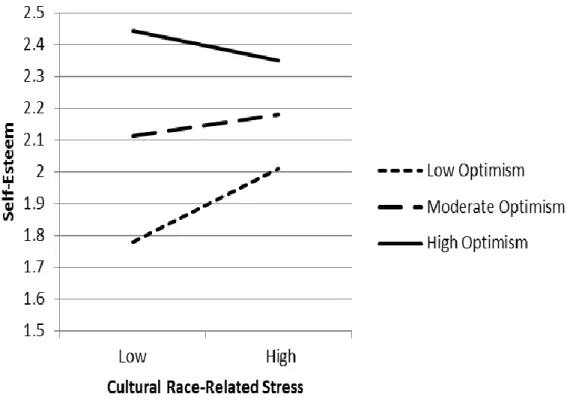
A significant interaction between cultural race-related stress and optimism was found for self-esteem (b = -0.15, p = .03). Simple slope analyses revealed that the slope representing the association between cultural race-related related stress and self-esteem to be positive and significantly different from zero when participants endorsed low
optimism (b = 0.16, p = .02). In contrast, the slope representing the association between cultural race-related stress and self-esteem was not significant for participants who endorsed high (b = -0.06, p = .32) and moderate levels (b = 0.05, p = .30) of optimism. Figure 2 plots the relationship between cultural race-related stress and self-esteem by the level of optimism. Increased cultural race-related stress was linked with increased self-esteem for participants who endorse low levels of optimism though these individuals still had the lowest level of self-esteem at high levels of cultural race-related stress. There was no relationship, however, between cultural race-related stress and self-esteem for
individuals who endorsed moderate and high levels of optimism. Religious Involvement and Optimism as Protective Factors
31
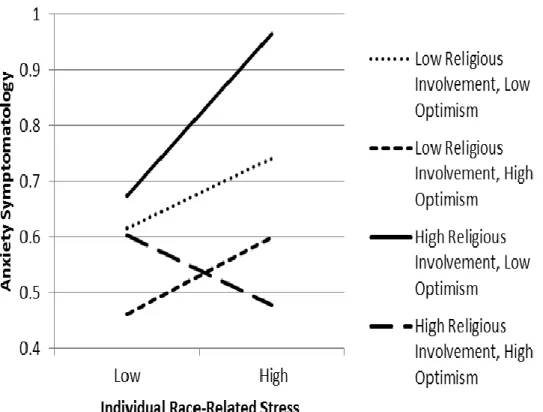
Involvement interaction term, significantly predicted anxiety symptomatology (b = -0.01, p = .02). Simple slope analyses found the slope representing the association between
individual race-related stress and anxiety to be positive and significantly different from zero when participants reported high religious involvement and low optimism (b =0.17, p = .01). Individuals with high religious involvement and low optimism also had the
highest levels of anxiety at high levels of individual race-related stress. The slope representing the association between individual race-related stress and anxiety was not significantly different from zero when participants reported low religious involvement and low optimism (b = 0.08, p = .15), low religious involvement and high optimism (b = 0.08, p = .16), and high religious involvement and high optimism (b = -0.08, p = .23). Individuals with high religious involvement and high optimism also had the lowest level of anxiety at high levels of individual race-related stress. These findings are illustrated in Figure 3.
32
Discussion
The first aim of the study was to examine the associations between race-related stress and psychological well-being outcomes. In particular, the study explored the relationships between different types of race-related stress (i.e., individual, institutional, and cultural) and theory-driven constructs of psychological well-being (e.g.,
environmental mastery, personal growth) and correlates of well being (e.g., psychiatric symptoms, life satisfaction, self-esteem). The results indicate that the association between race-related stress and well-being depends on the type of race-related stress and the particular measure of well-being in question. Individual race-related stress was positively linked with anxiety symptomatology and self-esteem. Institutional race-related stress was positively linked with anxiety symptomatology and negatively linked with positive relationship with others. Contrary to expectations, cultural race-related stress was positively linked with personal growth.
34
Strauman, & Higgins, 2010). Contrary to previous studies suggesting an inverse
relationship between race-related stress and self-esteem (Greene et al., 2006; Romero & Roberts, 2003), our findings suggest a positive relationship between individual race-related stress and self-esteem. One way of understanding this finding may be that African American emerging adults use self-esteem to cope with individual race-related stress. For example, Chapman and Mullis (2000) posit that a positive appraisal of self-identity may help one cope when hearing derogatory remarks about one’s racial identity.
In understanding the pattern of findings for institutional race-related stress, Feagin (2006) argued that poorer well-being outcomes develop due to the lack of agency one has over managing stressors at an institutional level. Lacking agency over stress is linked with increased anxiety as one is unable to control the outcome of a situation (Rucker, West, & Roemer, 2010). Additionally, a lack of agency over managing a stressor has been linked to utilization of passive coping methods (Lazarus & Folkman, 1984). Passive coping would have negative implications on having positive relationship with others since passive coping entails social withdrawal (Bianchi, Zea, Poppen, Reisen, & Echeverry, 2004).
35
Alternatively, it may be that reading or overhearing negative remarks about one’s group motivates the pursuit of self-development and personal growth.
The second aim of this study was to examine whether dispositional optimism moderated the association between different types of race-related stress and
psychological well-being outcomes. Optimism served as a moderator in two instances. First, optimism moderated the association between individual race-related stress and anxiety symptomatology. Consistent with the idea of optimism serving as a protective factor (Carver, Scheier, & Segerstrom, 2010; Peterson, 2000; Taylor, Conger, Widaman, Larsen-Rife, & Cutrona, 2010), the findings indicate that high levels of optimism nullify the negative association between individual race-related stress and anxiety
symptomatology. Carver, Scheier, and Segerstrom’s (2010) conceptualization of
optimism posits that optimists expect positive outcomes in stressful situations, which in turn, evokes less negative emotions, like anxiety. Second, optimism also moderated the association between cultural race-related stress and self-esteem. In contrast to my hypothesis and previous empirical work, cultural race-related stress was positively associated with self-esteem at low levels of optimism while cultural race-related stress was unrelated to self-esteem at moderate and high levels of optimism. In making
conceptual sense of this unexpected finding, research has conceptualized self-esteem not only as an index of well-being (Romero & Roberts, 2003; Seaton, 2009; Seaton,
Caldwell, Sellers, & Jackson, 2010), but also as a method of coping (Clark, Anderson, Clark, & Williams, 1999; Harrell, 2000). Thus, it is conceptually plausible that
36
Although optimism moderated two relationships between race-related stress and being, most of the associations between race-related stress and psychological well-being were not moderated by optimism. A number of explanations may inform this pattern of findings. First, the present study examined an individual’s disposition towards optimism. However, Peterson (2000) noted that even dispositional optimists are
pessimistic about certain situations. Thus, generally optimistic participants may still possess pessimistic beliefs about race-related stress. Second, there is a lack of research on optimism within the context of race-related stress. As racism has been alive and well in our society for hundreds of years, it may be especially difficult for victims of
discrimination to cultivate optimism towards racism. Despite the majority of null findings, it is noteworthy to mention that optimism still functioned as a compensatory factor for many indices of psychological well-being. This suggests that optimism still plays some role in the psychological well-being of African American emerging adults across all levels of race-related stress.
37
individual race-related stress. Although previous studies suggest the protective role of religious involvement in the context of race-related stress, the present finding suggests that religious involvement, coupled with low optimism, is not protective. African American theology and religious involvement is shaped by racial oppression and offers an important avenue to promote optimism in the context of race-related stress (Ward, 1995). In turn, the optimism cultivated from, and combined with religious involvement may be what makes religious involvement protective in the context of race-related stress (Mattis et al., 2003). Individuals who are religiously involved and optimistic may believe that external factors (e.g., God’s grace) will open up opportunities for positive outcomes in the face of race-related stress (Cone, 1990; Lupfer, Tolliver, & Jackson, 1996). Reframing race-related stressors in this way could ameliorate symptoms of anxiety elicited by race-related stress.
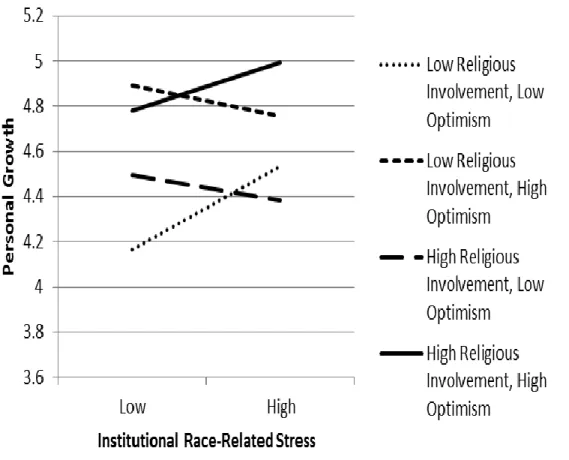
In the second instance, participants endorsing low religious involvement and low optimism and high religious involvement and high optimism reported more personal growth as a function of institutional race-related stress. Personal growth did not change as a function of institutional race-related stress for all other participants. This finding can be explained in two ways. Consistent with the theory of growth through adversity,
38
Nelson (1997), religious involvement instilled the idea in African American believers that God would prepare and use believers as his instrument in their lives. In the context of race-related stress, the notion that God prepares believers to do his will, would cultivate optimism and hope, but more importantly, foster a sense of self-development and personal growth. Thus, our findings suggest that religious involvement and optimism, coupled together, fosters positive orientations, which in turn, reframes the stressful experience to cultivate personal growth or decrease anxiety symptomatology. Study Limitations and Future Directions
The present study contributes to the growing body of research on race-related stress and psychological well-being in a number of ways. However, several limitations will need to be addressed in future research. First, the study examined 36 multivariate regression models, which would inflate the likelihood of a type I error. Second, this study may not generalize to other samples of African American emerging adults. The
participants in our current sample were undergraduate and graduate students from a prestigious academic institution in the southeastern region of the United States. Different socio-demographic contexts (e.g., age, socio-economic status) have been shown to influence religious involvement (Taylor, Chatters, & Levin, 2004), optimism (Peterson, 2000), and perceived race-related stress experiences (Prelow et al., 2004). Our sample was also predominantly female which may further threaten the external validity of the study. Third, the directionality of the observed findings remains unclear due to the cross-sectional data. For example, we are unable to determine if institutional race-related stress increased anxiety symptomatology, or if high anxiety symptomatology increased
39
over time to develop a temporal understanding of the role of optimism and religious involvement in the context of race-related stress.
In addition to addressing the methodological limitations of the present study, I propose that future research examines specific domains of religious involvement (e.g., prayer, church attendance) that are salutary for African American emerging adults in the context of race-related stress. Despite the plethora of research on religious coping for African Americans (Boyd-Franklin, 2010; Brown, Ndubuisi, & Gary, 1990; Levin & Taylor, 1998; Nooney & Woodrum, 2002), no such study has examined specific religious expressions that buffer the deleterious impact of race-related stress for African American emerging adults. Second, as alluded to previously, the present study focused exclusively on dispositional optimism. However, research suggests that optimism may change based on situational and contextual factors (Luthans, 2002; Luthans & Youssef, 2007). Thus, it is conceptually plausible for optimism to operate dissimilarly in the context of
race-related than other stressors (e.g., academic stress) for African American emerging adults.
It would be wise for future studies to examine the role of state optimism in the context of
race-related stress. Third, future research should develop a more theoretically-driven
conceptualization of psychological well-being for African American emerging adults.
Much of the research examining psychological well-being for African Americans
employs indicators of well-being (e.g., depressive symptomatology, self-esteem, life
satisfaction) that may not adequately reflect the psychological wellness for this
population. A large body of research exists that examines cross-cultural differences in
subjective well-being (Hughes & Thomas, 1998; Keyes, 2007; Lopez et al., 2005). For
40
of life satisfaction than Whites, Keyes (2007) reported that Blacks endorsed higher levels
of positive relations with others, purpose in life, and self-acceptance than Whites. In line
with the ideas of Ryff and Singer (1998), it is important to look at African American
history and traditions in conceptualizing well-being for African Americans.
Conclusion
Individual, institutional, and cultural race-related stress emerged as correlates of several indices of African American adults’ psychological well-being, with the general finding that race-related stress was negatively associated with well-being. Findings indicated that optimism may provide protection to African American emerging adults, particularly in the context of race-related stress and anxiety symptomatology. Optimism and religious involvement, in combination, may also provide protection to African
American emerging adults in the context of race-related stress. The results underscore the need for future research to examine underlying mechanisms that account for the salutary properties of optimism and religious involvement for African American emerging adults in the context of race-related stress. While the study findings highlight the negative implications of race-related stress for the well-being of African American emerging adults, study findings also suggest the potential benefits of cultivating optimism and incorporating or invoking religious involvement in mental health service delivery.
Scholars have posited the notion that religious involvement and spirituality is an effective
intervention tool in the mental health setting for African Americans (Boyd-Franklin,
2010; Hill & Pargament, 2008; Walsh, 2009) and the inclusion of race-related stress,
41
42 Figures
43
44
45
46 References
Angold, A. E., Costello, J., & Erkanli, A. (1999). Comorbidity. Journal of Child Psychology and Psychiatry, 40(1), 57-87. doi:10.1111/1469-7610.00424
Arnett, J. J., & Brody, G. H. (2008). A fraught passage: The identity challenges of African American emerging adults. Human Development, 51, 291-293. doi:10.1159/000170891
Aspinwall, L. G., & Taylor, S. E. (1992). Modeling cognitive adaptation: A longitudinal investigation of the impact of individual differences and coping on college adjustment and performance. Journal of Personality and Social Psychology, 61, 755-765. doi:10.1037/0022-3514.63.6.989
Baldwin, D. R., Chambliss, L. N., & Towler, K. (2003). Optimism and Stress: An African-American College Student Perspective. College Student Journal, 37(2), 276. Retrieved from http://www.projectinnovation.biz/csj_2006.html
Banks, K. H. (2010). African American college students’ experience of racial discrimination and the role of college hassles. Journal of College Students Development, 51(1), 23-34. Retrieved from
http://works.bepress.com/kira_banks/18/
Banks, K. H., & Kohn-Wood, L. P. (2007). The influence of racial identity profiles on the relationship between racial discrimination and depressive symptoms. Journal of Black Psychology, 33, 331-354. doi:10.1177/0095798407302540
Barry, C. M., Nelson, L., Davarya, S., & Urry, S. (2010). Religiosity and spirituality during the transition to adulthood. International Journal of Behavior
Development, 34(4), 311-324. doi:10.1177/0165025409350964
Beck, S. (1971). Cosmic optimism in some Genesis myths. American Journal of Orthopsychiatry, 41(3), 380–389. doi:10.1111/j.1939-0025.1971.tb01125.x
Beck, A. T., & Steer, R. A. (1990). Beck Anxiety Inventory manual. San Antonio, TX: Psychological Corporation.
Beck, A. T., Steer, R. A., & Brown, G. K. (1996). Manual for Beck Depression Inventory–II. San Antonio, TX: Psychological Corporation.
Biasco, E, Goodwin, E. A, & Vitale, K. L. (2001). College students' attitudes towards racial discrimination. College Student Journal, 35, 523-528. Retrieved from http://www.projectinnovation.biz/csj_2006.html
47
Bobo, L. (2001). Racial attitudes and relations at the close of the 20th Century. In N. Smelser, W. J. Wilson, & F. Mitchell (Eds.), America becoming: Racial trends and their consequences (Vol. 1, pp. 264-301). Washington, DC: National Academy Press.
Boyd-Franklin, N. (2010). Incorporating spirituality and religion into the treatment of African American clients. The Counseling Psychologist, 38(7), 976-1000. doi:10.1177/0011000010374881
Braskamp, L. A. (2008). The religious and spiritual journeys of college students. In D. Jacobsen & R.H. Jacobsen (Eds.), The American university in a postsecular age (pp. 117–134). New York: Oxford University Press.
Brody, G. H., Chen, Y., Murry, V. M., Simons, R. L., Xiaojia, G., Gibbons, F. X., Gerrard, M., & Cutrona, C. E. (2006). Perceived discrimination and the adjustment of African American youth: A five-year longitudinal analysis with contextual moderation effects. Child Development, 77(5), 1170–1189.
doi:10.1111/j.1467-8624.2006.00927.x
Brown, D. R., Ndubuisi, S. C., & Gary, L. E. (1990). Religiosity and psychological distress among Blacks. Journal of Religion and Health, 29(1), 55-68. doi:10.2307/27506047
Bruce, C. E., Jones, W. R. (1978). Black Theology. Lewisburg, PA: Bucknell University Press.
Caldwell, C. H., Zimmerman, M. A., Bernat, D. H., Sellers, R. M., & Notaro, P. C. (2002). Racial identity, maternal support, and psychological distress among African American adolescents. Child Development, 73(4), 1322-1336. doi:10.1111/1467-8624.00474
Carver, C.S., & Gaines, J. G. (1987). Optimism, pessimism, and postpartum depression. Cognitive Therapy and Research, 11(4), 449-462. doi:10.1007/BF01175355
Carver C. S., Pozo C, Harris S. D., Noriega V., Scheier M. F., et al. (1993). How coping mediates the effect of optimism on distress: a study of women with early stage breast cancer. Journal of Personality and Social Psychology, 65, 375–90. doi:10.1037/0022-3514.65.2.375
Carver, C. S., & Scheier, M. F. (1998). On the self-regulation of behavior. Cambridge, NY: Cambridge University Press.
48
Carver, C. S. Scheier, M. F., & Weintraub, J. K. (1989). Assessing coping strategies: A theoretically based approach. Journal of Personality and Social Psychology, 56(2), 267-283. doi:10.1037/0022-3514.56.2.267
Chapman, P. L, & Mullis, R. L. (2000). Racial differences in adolescent coping and self-esteem. Journal of Genetic Psychology, 161(2), 152-160. Retrieved from
http://www.tandfonline.com.libproxy.lib.unc.edu/loi/vgnt20
Chatters, L. M., Levin, J. S., & Taylor, R. J. (1992). Antecedents and dimensions of religious involvement among older black adults. Journal of Gerontology, 47(6), 5269-5278. doi:10.1093/geronj/47.6.S269
Clark, R., Anderson, N. B., Clark, V. R., & Williams, D. R. (1999). Racism as a stressor for African Americans. A biopsychosocial model. American Psychologist, 54(10), 805-816. doi:10.1037/0003-066X.54.10.805
Clark, R. (2004). Interethnic Group and Intraethnic Group Racism: Perceptions and Coping in Black University Students. Journal of Black Psychology, 30(4), 506-526. doi:10.1177/0095798404268286
Cone, J. H. (1990). A Black Theology of Liberation. Maryknoll, NY: Orbis Books Constantine, M. G., & Sue, D. W. (2006). Factors contributing to optimal human
functioning in people of color in the United States. The Counseling Psychologist, 34(2), 228-244. doi:10.1177/0011000005281318
Cooper, S., McLoyd, V. C., Wood, D., & Hardaway, C. (2008). Racial discrimination and the mental health of African American adolescents. In C. McKown & S. Quintana (Eds.), The handbook of race, racism, and the developing child. New York: Wiley.
Diener, E., Emmons, R. A., Larsen, R. J., & Griffin, S. (1985). The satisfaction with life scale. Journal of Personality Assessment, 41(1), 71-75. Retrieved from
http://www.unt.edu/rss/SWLS.pdf
Danoff-Burg, S., Prelow, S. M., & Swenson, R. R. (2004). Hope and life satisfaction in black college students coping with race-related stress. Journal of Black
Psychology, 30(2), 208-228. doi:10.1177/0095798403260725
Ellison, C. G., Musick, M. A., & Henderson, A. K. (2008). Balm in gilead: Racism, religious involvement, and psychological distress among African-American adults. Journal for the Scientific Study for Religion, 47(2), 291-301.
doi:10.1111/j.1468-5906.2008.00408.x
49
Essed, P. (1991). Understanding everyday racism: an interdisciplinary theory. California, Newbury Park: SAGE Publications, Inc.
Ethier, K. A., & Deaux, K. (1994). Negotiating social identity when contexts change: Maintaining identification and responding to threat. Journal of Personality and Social Psychology, 67(2), 243-251. doi:10.1037/0022-3514.67.2.243
Farber, E. W., Bhaju, J., Campos, P. E., Hodari, K. E., Motley, V. J., Dennany, B. E., Yonker, M. E., & Sharma S. M. (2010). Psychological well-being in persons receiving HIV-related mental health services: the role of personal meaning in a stress and coping model. General Hospital Psychiatry, 32(1), 73-79.
doi:10.1016/j.genhosppsych.2009.09.011
Feagin, J. R. (2006). Systemic Racism. London, England: Taylor & Francis.
Feagin, J. R., & Eckberg, D. L. (1980). Discrimination: Motivation, Actions, Effects, and Contexts. Annual Review of Sociology, 6, 1-20.
doi:10.1146/annurev.so.06.080180.000245
Fisher, C. B., Wallace, S. A., & Fenton, R. E. (2000). Discrimination Distress During Adolescence. Journal of Youth and Adolescence, 29(6), 679-695.
doi:10.1023/A:1026455906512
Fontaine, K. R., Manstead, A. R., & Wagner H. (1993). Optimism, perceived control over stress and coping. European Journal of Personality, 7(4), 267-281.
doi:10.1002/per.2410070407
Freud, S. (1928). The future of an illusion. London: Hogarth Press.
García Coll, C., Crnic, K., Lamberty, G., Wasik, B. H., Jenkins, R., García, H. V., McAdoo, H. P. (1996). An Integrative Model for the Study of Developmental Competencies in Minority Children. Child Development, 67(5), 1891-1914. doi:10.1111/j.1467-8624.1996.tb01834.x
Given, C. W., Stommel, M., Given, B., Osuch, J., Kurtz, M. E., & Kurtz, J. C. (1993). The influence of cancer patients' symptoms and functional states on patients' depression and family caregivers' reaction and depression. Health Psychology, 12(4), 277−285. doi:10.1037/0278-6133.12.4.277
50
Greer, T. M., & Chwalisz, K. (2007). Minority-related stressors and coping processes among African American college students. Journal of College Student
Development, 48(4), 388-404. doi:10.1353/csd.2007.0037
Harrell, S. P. (2000). A Multidimensional Conceptualization of Racism-Related Stress: Implications for the Well-Being of People of Color. American Journal of Orthopsychiatry, 70(1), 42-57. doi:10.1037/h0087722
Hicks, D. (2004). Teaching for tomorrow: how can futures studies contribute to peace education? Journal of Peace Education, 1(2), 165-177.
doi:10.1080/1740020042000253721
Hill, P. C., & Pargament, K. I. (2008). Advances in the conceptualization and
measurement of religion and spirituality: Implications for physical and mental health research. American Psychologist, 58(1), 64-74. doi:10.1037/0003-066X.58.1.64
Hopkins, D. N. (1999). Black Theology of Liberation. In D. Ford & R. Muers (Eds.), The modern theologians: an introduction to Christian theology since 1918. Malden, MA: Blackwell Publishing Ltd.
Hughes, M., & Thomas, M. (1998). The continuing significance of race revisited: A study of race, class, and quality of life in America, 1972 to 1996. American Sociological Review, 63(6), 785-795. Retrieved from
http://www.jstor.org/stable/265750
Jackson, A. P., & Sears, S. J. (1992). Implications of an africentric worldview in reducing stress for African American women. Journal of Counseling & Development, 71(2), 184-190. doi:10.1002/j.1556-6676.1992.tb02196.x
Jones, J. M. (1997). Prejudice and Racism (2nd ed.). Reading, MA: Addison-Wesley Publication Company.
Kessler, R. C., Mickelson, K. D., & Williams, D. R. (1999). The Prevalence,
Distribution, and Mental Health Correlates of Perceived Discrimination in the United States. Journal of Health and Social Behavior, 40(3), 208-230. Retrieved from http://www.jstor.org/stable/2676349
Keyes, C. (2007). Promoting and protecting mental health and flourishing: A complementary strategy for improving national mental health. American Psychologist, 62(2), 95-108. doi:10.1037/0003-066X.62.2.95
51
Krieger, N. (2001). Theories for social epidemiology in the 21st century: an erosocial perspective. International Journal of Epidemiology, 30, 668-677.
doi:10.1093/ije/30.4.668
Landrine, H. & Klonoff, E. A. (1996). The Schedule of Racist Events: A Measure of Racial Discrimination and a Study of Its Negative Physical and Mental Health Consequences. Journal of Black Psychology, 22(2), 144-168.
doi:10.1177/00957984960222002
Levin, J., & Taylor R. (1998). The religion-health connection: Evidence, theory, and future directions. Health Education, & Behavior, 25(6), 700-720.
doi:10.1177/109019819802500603
Levin, J., Taylor, R., & Chatters, L. (1995). A multidimensional measure of religious involvement for African Americans. The Sociological Quarterly, 36(1), 157–173. Retrieved from http://www.jstor.org/stable/4121282
Lopez, S. J., Prosser, E. C., Edwards, L. M., Magyar-Moe, J. L., Neufeld, J. E., & Rasmussen, H. N. (2005). Putting positive psychology in a multicultural context. In C. R. Synder & S. J. Lopez (Eds.), Handbook of positive psychology (pp.700-714). New York: Oxford University Press.
Lupfer, M. B., Tolliver, D., & Jackson, M. (1996). Explaining life-altering occurrences: A test of the ‘God-of-the-gaps’ hypothesis. Journal of the Scientific Study of Religion, 35(4), 379-391. Retrieved from http://www.jstor.org/stable/1386413
Luthans, F. (2002). The need and meaning of positive organizational behavior. Journal of Organizational Behavior, 23(6), 695-706. doi:10.1002/job.165
Luthans, F., & Youssef, C. M. (2007). Emerging positive organization behavior. Journal of Management, 33(3), 321-349. doi:0.1177/0149206307300814
Luthar, S. S., & Zelazo, L. B. (2003). Research on resilience: An integrative review. In S. S. Luthar (Ed.), Resilience and vulnerability: Adaptation in the context of
childhood adversities. New York: Cambridge University Press.
Maslow, A. H. (1968). Toward a psychology of being (2nd ed.). New York: Van Nostrand.
Masten, A. S., Cutuli, J. J., Herbers, J. E., & Reed, M. J. (2009). Resilience in
Development. In C. R. Synder & S. J. Lopez (Eds.), Oxford Handbook of Positive Psychology. New York, NY: Oxford University Press, Inc.
52
Mattis, J. S., Fontenot, D. L., Hatcher-Kay, C. A., Grayman, N. A., & Beale, R. L. (2004). Religiosity, Optimism, and Pessimism Among African Americans. Journal of Black Psychology, 30(2), 187-207. doi:10.1177/0095798403260730
McConahay, J. B. and Hough, J. C. (1976), Symbolic Racism. Journal of Social Issues, 32: 23–45. doi:10.1111/j.1540-4560.1976.tb02493.x
Miller, D. B., MacIntosh, R. (1999). Promoting resilience in urban African American adolescents: Racial socialization and identity as protective factors. Social Work Research, 23(3), 159-169. doi:10.1093/swr/23.3.159
Miller, D. B. (1999). Racial socialization and racial identity: Can they promote resiliency for African American adolescents? Adolescence, 34, 493-502. Retrieved from http://www.questia.com/googleScholar.qst?docId=5001885897
Myers, L. J., Montgomery, D., Fine, M., & Reese, R. (1996). Belief System Analysis Scale and Belief and Behavior Awareness Scale Development: Measuring an optimal, Afrocentric world- view. In R. L. Jones (Ed.), Handbook of tests and measurements for Black populations (Vol. 2, pp.19–35). Hampton, VA: Cobb & Henry.
Neblett, E. W., Hammond, W., Seaton, E. K., & Townsend, T. G. (2010). Underlying mechanisms in the relationship between Africentric worldview and depressive symptoms. Journal Of Counseling Psychology, 57(1), 105-113.
doi:10.1037/a0017710
Neblett, E. W., White, R. L., Ford, K. R., Philip, C. L., Nguyên, H. X., & Sellers, R. M. (2008). Patterns of Racial Socialization and Psychological Adjustment: Can Parental Communications About Race Reduce the Impact of Racial
Discrimination? Journal of Research on Adolescence, 18(3), 477-515. doi:10.1111/j.1532-7795.2008.00568.x
Nelson, T. (1997). He made a way out of no way: Religious experience in an African American congregation. Review of Religious Research, 39(1), 5-24. Retrieved from http://www.jstor.org/stable/3512476
Nes, L. S., & Segerstrom, S. C. (2006). Dispositional optimism and coping: A meta-analytic review. Personality and Social Psychology Review, 10(3), 235-251. doi:10.1207/s15327957pspr1003_3