One session yoga for short-term anxiety relief
By A. Claire Stark
Senior Honors Thesis
Department of Psychology and Neuroscience The University of North Carolina at Chapel Hill
Abstract
Both yoga and mindfulness have been studied as treatments for anxiety. However, few studies have explored the effects of one session of yoga on short-term anxiety relief. In the current study, it was hypothesized that one session of yoga would lead to a decrease in state anxiety and that yoga taught with an emphasis on mindfulness would yield significantly larger decreases in state anxiety compared to yoga taught without a mindfulness component. Furthermore, it was
hypothesized that high levels of anxiety sensitivity and experiential avoidance would result in smaller decreases in state anxiety, while high levels of distress tolerance would result in larger decreases in state anxiety. In a sample of 79 participants, results from a two-way ANOVA demonstrated a significant main effect of time on anxiety, F (1, 79) = 200.36, p < .001). There was no significant interaction between time and condition, F (1, 79) = .19, p = .665).
One session yoga for short-term anxiety relief Mindfulness in Theory and Practice
Mindfulness is an essential component of Acceptance and Commitment Therapy (ACT)—a type of therapeutic intervention that focuses on promoting psychological flexibility through acceptance of the present moment when reality is unable to be changed. Instead of fighting against unpleasant or unwanted stimuli, ACT offers several strategies for learning to cope with these unpleasant or unwanted stimuli—one of which is contact with the present
moment (Hayes et al., 2011), which is also referred to as mindfulness (Fletcher & Hayes, 2005). Mindfulness has taken many forms, one of which is mindfulness-based stress reduction (MBSR). Evidence has supported the effectiveness of MBSR in a variety of populations, including those working in healthcare. A recent literature review demonstrated that MBSR not only improved the stress and anxiety levels of nurse practitioners, but also improved the quality of their interactions with patients. Furthermore, there were no harmful effects of MBSR, making it a good option for those looking to improve their stress and anxiety levels (Praissman, 2008).
Yoga and the Role of Mindfulness
Yoga has been shown to increase a person’s ability to practice mindfulness. In a 2009 study, 46 individuals underwent an 8-week yoga program. Their levels of mindfulness were assessed pre-yoga and post-yoga using the Freiburg Mindfulness Scale (FMS). After 8 weeks of yoga, results demonstrated that participants’ post-treatment mindfulness levels were significantly higher than their pre-treatment levels (Shevlov & Suchday, 2009).
Yoga and Anxiety Reduction
Yoga has also received recent publicity for being beneficial for mental health disorders, such as anxiety. In a study conducted in South Australia, 131 participants with mild to moderate stress levels practiced either weekly hatha yoga or weekly relaxation for 10 weeks. After the 10-week intervention, yoga appeared to be more beneficial than relaxation at improving mental health based on responses on the SF-36. At a 6-week follow up, there were no group differences found in anxiety and stress levels reported, indicating that yoga was as beneficial as relaxation for reducing anxiety and stress (Smith et al., 2007).
Furthermore, Telles et al. 2009 conducted a study in northern India with 300 participants who were inexperienced with yoga. These participants were assigned to either a 2-hour yoga practice condition or a 2-hour yoga theory condition and their state anxiety levels were measured before and after treatment. Though a significant decrease in state anxiety was found in both conditions, the yoga practice condition appeared to be more beneficial for anxiety reduction compared to yoga theory.
studies, 19 demonstrated a significant reduction in state and/or trait anxiety when yoga was part of the intervention (Sharma & Haider, 2013). These findings are supported by another systematic review conducted by Li & Goldsmith in 2012. In this review, 25 out of 35 studies also showed significant decreases in anxiety and/or stress when yoga was part of the treatment. However, many of these studies were limited due to lack of a control group, lack of randomization, and small sample sizes.
Current Study
In summary, previous literature has demonstrated the benefits of mindfulness for anxiety, the benefits of yoga for anxiety, as well as yoga’s ability to increase mindfulness. However, many of these studies have similar limitations, including lack of randomization, lack of a control group, and small sample sizes. The current study aims to incorporate quasi-randomization, a control group, and a larger sample size to further understand the impact of yoga and mindfulness on state anxiety. Furthermore, the current study aims to explore yoga and mindfulness
synergistically rather than as separate constructs.
Lastly, while one session of yoga has been shown to support reduction in state anxiety among individuals with schizophrenia (Vancampfort et al., 2011), few studies have documented the effects of one session of yoga on state anxiety in the general population.
Hypotheses
This study aims to examine the impact of one session of yoga on state anxiety levels. First, it is hypothesized that one session of yoga will result in a decrease in state anxiety levels among participants in both conditions. Second, it is hypothesized that yoga taught with a
Additionally, pre-intervention measures of anxiety sensitivity (AS), distress tolerance (DT) and experiential avoidance (EA) will be obtained to assess potential impacts these may have on the change in state anxiety from pre-yoga to post-yoga. It is predicted that both higher anxiety sensitivity and higher experiential avoidance will result in a smaller change in state anxiety levels from pre to post. It is also predicted that higher distress tolerance will result in a greater change in state anxiety levels from pre to post.
Methods Participants
This study was conducted at the University of North Carolina at Chapel Hill in the Rams Head Recreation Center facility. A total of 84 participants enrolled in the study. 40 were
assigned to the experimental condition and 44 were assigned to the control condition, though 5 were excluded due to incomplete data responses. Participants were asked to report their gender and age on the STAI questionnaire, however demographic data was only collected for 55 participants. 51 individuals identified as female, 3 identified as male, and 1 identified as other (age M = 22.02, SD = 6.74). The class was titled “Yoga for Anxiety” and was listed on UNC Campus Recreation’s website. Participants who chose to attend the class had the option to enroll in this study. All individuals gave consent prior to beginning the study, and participants did not receive compensation in any form.
Design
A between-subjects design was used for this research. Each week, the type of class being taught was either experimental (yoga with mindfulness) or control (yoga without
Mindfulness was used as the manipulation in this study and was operationalized in the
experimental group in three ways: a 5-minute mindfulness meditation at the beginning of class, breathing cues and reminders to stay in the present moment throughout class, and a 5-minute guided relaxation at the end of the class. The control group did not receive any manipulation and were instead taught a yoga class with simple instruction through the poses (no breathing cues or reminders to stay present). After the consent process and before the yoga portion began, all participants in both conditions were given four paper and pencil pre-questionnaires: the State-Trait Anxiety Inventory (STAI) (Spielberg et al., 1970), the Anxiety Sensitivity Index (ASI-III) (Taylor et al., 2007), the Distress Tolerance Scale (DTS) (Simons & Gaher, 2005), and the Acceptance and Action Questionnaire (AAQ-II) (Bond et al., 2011). After these
pre-questionnaires, participants engaged in a 30-minute yoga session, and were asked to complete the STAI once more immediately after the yoga session. Though participants filled out all parts of the STAI (state and trait), only state anxiety responses were relevant to the hypotheses and thus the only ones included in analyses.
Materials and Procedure
Manipulation. After completing the pre-questionnaires (STAI, ASI-III, DTS, and AAQ-II), participants completed a 30-minute yoga class, targeted towards beginners. This meant that both the intensity and types of yoga poses included in the class were accessible for all levels. The yoga poses taught in each class were kept consistent throughout the study to avoid
confounding.
comfortable as well as any areas of tension or tightness. Participants were encouraged to try to release any areas of tension or tightness prior to beginning class. Lastly, participants were instructed to continually return their focus back to their breath throughout class if they noticed themselves becoming distracted by other stimuli (thoughts, noises in the environment, physical sensations, etc.). This concluded the beginning meditation. Throughout class, the instructor asked participants several times to check back in with their breath, and to breathe into any areas of tightness. For example, in a deep hip stretch referred to as pigeon pose, participants were instructed to send breath into the hip while inhaling and release any tension in the hip while exhaling. Other breathing cues such as “with your next inhale, lift the left leg,” were also given to encourage participants to breathe during the poses. Class concluded with a 5-minute guided relaxation. This involved asking participants to scan their bodies for any remaining places of tension and intentionally relax each part of the body, starting at the feet and ending with the head.
In the control condition, participants were not given a mindfulness meditation, breathing cues, or reminders to stay present. Instead of a guided relaxation at the end of class, participants were told to lie on their mats and rest for a few minutes before concluding the session. These several minutes of rest at the end of yoga (referred to as savasana) is common practice and thus was included in the study control. Poses were taught one after the other without any breathing cues. For example, participants were simply told “lift your left leg and place it between your hands” instead of “with your next inhale, lift the left leg and place it between your hands.”
The purpose behind choosing this manipulation was to test whether an explicit
has recently gained publicity for being an effective remedy for anxiety reduction, but studies have yet to examine whether this reduction in anxiety is due to the yoga poses alone or to the addition of mindfulness, which is often included in many yoga classes. Furthermore, most evidence for mindfulness has been gathered through studies spanning the course of several weeks; few studies have examined whether one-session interventions can be effective for relieving anxiety. If evidence were to be found that supports the effectiveness for one-session interventions, this would provide another beneficial treatment option for those dealing with anxiety.
Results
Results from a two-way analysis of variance (ANOVA) demonstrated a significant main effect of time on anxiety, suggesting that anxiety significantly decreased from pre-yoga to post-yoga in both conditions, F(1, 79) = 200.36, p < .001). There was no significant interaction between time and condition F(1, 79) = .19, p = .665), suggesting that there was no outcome difference between yoga taught with a mindfulness component and yoga taught without a mindfulness component (see Figure 1).
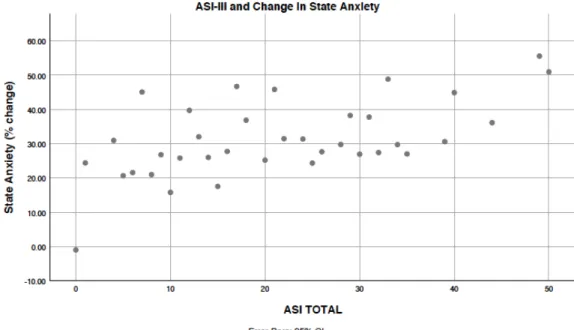
Next, to determine whether anxiety sensitivity predicted level of change in state anxiety from pre-yoga to post-yoga, we conducted a regression analysis. Results demonstrated a
significant positive relationship between anxiety sensitivity and post-STAI scores (β = .31, p < .01), showing that as anxiety sensitivity increased, the change in anxiety from pre-yoga to post-yoga also increased (R2=.10, F(1,79)=8.32, p<.01) (see Figure 2).
F(1,79)=.45, p=.505). Similarly, no significant relationship was found (β = .20, p=.080) between experiential avoidance and change in state anxiety, R2=.04, F(1,79)=3.15, p=.080).
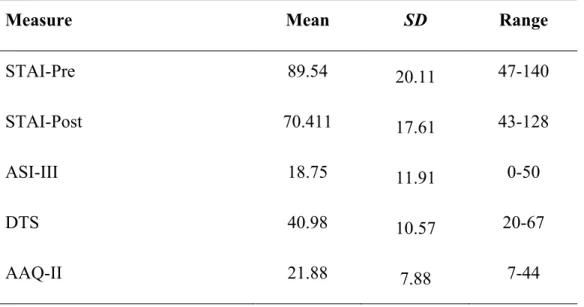
Descriptive statistics for anxiety sensitivity, distress tolerance, and experiential avoidance were comparable to other non-clinical populations in published studies (Blakey et al., 2016; Wheaton et al., 2012) (see Table 1).
Discussion
It was first hypothesized that one session of yoga would decrease state anxiety among participants in both conditions. Results supported this and showed a decrease in state anxiety from pre-yoga to post-yoga for both mindfulness and non-mindfulness groups. However, it was also hypothesized that yoga taught with a mindfulness component would result in greater decreases in state anxiety from pre to post than yoga taught without a mindfulness component. Results did not support this and demonstrated no significant interaction between time and condition. There was no significant difference in change in state anxiety between the mindfulness and non-mindfulness groups.
These results suggest that yoga might be an effective intervention for short-term anxiety. The lack of interaction between time and condition could potentially be attributed to mindfulness being experienced in a variety of ways. Mindfulness may not be limited to verbal cues or
the present moment without being explicitly told to stay present. Though verbal cues and reminders to stay focused on the breath are often regarded as the hallmarks of mindfulness, results suggest that they may not be necessary to reap the benefits of yoga and experience short-term anxiety relief. However, it is also possible that mindfulness was not the mechanism through which state anxiety was reduced in the current study. Rather, reduction in state anxiety could have been due to other factors, which will be discussed.
Anxiety sensitivity, experiential avoidance, and distress tolerance were also measured as possible predictors of change in state anxiety from pre-yoga to post-yoga. To begin with, it was hypothesized that participants with higher levels of anxiety sensitivity would experience a smaller decrease in state anxiety. Results did not support this hypothesis and demonstrated the opposite effect. Individuals who scored higher on the ASI-III pre-intervention experienced a greater decrease in state anxiety from pre to post. This could be attributed to yoga being a mind-body practice, and thus able to reduce physiological symptoms of anxiety that are often present in anxiety sensitivity (i.e. rapid heartbeat, racing thoughts, sweating, etc.). Furthermore, those with higher levels of anxiety sensitivity could potentially have more to gain from a mind-body practice such as yoga and therefore experience more impactful results.
tolerance would experience a greater change in state anxiety. Results did not support this
hypothesis and showed no significant relationship between distress tolerance and change in state anxiety. This is also an optimistic finding. Individuals can have highly developed distress
tolerance skills or a low capacity for tolerating distress and still experience short-term anxiety relief through one session of yoga.
There were many limitations present in the study, which should be considered in the interpretation of results. To begin with, participants were chosen from a sample of convenience and most were college-aged and female. Since participants were not randomly selected from the population, the majority of class attendees were females in a University environment. Though racial/ethnic information was not officially recorded from participants, based on anecdotal observation, racial diversity was low and the majority of participants were Caucasian.
Demand characteristics were another limitation present in this study. Part of the decrease in anxiety could be contributed to a placebo effect; the class was listed as “Yoga for Anxiety” and it can be inferred from the title that participants are not engaging in yoga to increase their anxiety. Therefore, perhaps the implicit suggestion of anxiety relief was enough to yield a decrease in state anxiety levels. Social desirability could have also confounded results.
Participants were made aware during the consent process that this research was being conducted as part of a Senior Honors Thesis, thus it is possible that participants wanted to give favorable responses (particularly on the STAI) in order to help a fellow student.
participants were new to yoga or mindfulness, this could also account for significant decreases in state anxiety as they are experiencing the effects of both for the first time.
In the future, studies should use stronger control groups. A yoga with mindfulness condition, a yoga without mindfulness condition, an exercise control and a waiting control should be compared to determine whether yoga and mindfulness are actually responsible for reducing anxiety. Additionally, future studies should directly measure mindfulness in participants to isolate whether mindfulness is actually the mechanism through which state
anxiety is decreasing via yoga. Since this information was not measured in participants, it cannot be definitively concluded whether state anxiety levels were decreasing due to mindfulness.
Future studies should also examine the relationship between yoga and state anxiety in a clinical population, and target a more diverse population to see how these effects vary based on race, sex, gender, and age. It would also be beneficial to record participants’ level of experience with yoga before the intervention and control for any potential impacts this may have on the change in state anxiety. Lastly, it would be advantageous to expand data analysis to include the trait items on the STAI and measure whether this decrease in anxiety is maintained after a few hours, days, etc.
References
Baer, R. A. (Ed.). (2015). Mindfulness-based treatment approaches: Clinician's guide to evidence base and applications. Elsevier.
Bond, F.W., Hayes, S.C., Baer, R.A., Carpenter, K.M., Guenole, N., Orcutt, . . .T., Zettle, R.D. (2011). Preliminary Psychometric Properties of the Acceptance and Action Questionnaire–II: A Revised Measure of Psychological Inflexibility and Experiential Avoidance. Behavior Therapy, 42(4), 676-688.
Blakey, S. M., Jacoby, R.J., Reuman, L., & Abramowitz, J. S. (2016). The Relative
Contributions of Experiential Avoidance and Distress Tolerance to OC Symptoms. Behavioural and Cognitive Psychotherapy, 44(4), 460-471.
Brisbon, N. M., & Lowery, G. A. (2011). Mindfulness and levels of stress: a comparison of beginner and advanced hatha yoga practitioners. Journal of Religion and Health, 50(4), 931-941.
Fletcher, L., & Hayes, S. C. (2005). Relational frame theory, acceptance and commitment therapy, and a functional analytic definition of mindfulness. Journal of
rational-emotive and cognitive-behavior therapy, 23(4), 315-336.
Gard, T., Brach, N., Hölzel, B. K., Noggle, J. J., Conboy, L. A., & Lazar, S. W. (2012). Effects of a yoga-based intervention for young adults on quality of life and perceived stress: the
potential mediating roles of mindfulness and self-compassion. The Journal of Positive Psychology, 7(3), 165-175.
Hayes, S. C., Levin, M. E., Plumb-Vilardaga, J., Villatte, J. L., & Pistorello, J. (2011).
Acceptance and commitment therapy and contextual behavioral science: examining the progress of a distinctive model of behavioral and cognitive therapy. Behavior
therapy, 44(2), 180-98.
Hofmann, S. G., Sawyer, A. T., Witt, A. A., & Oh, D. (2010). The effect of mindfulness- based
therapy on anxiety and depression: A meta-analytic review. Journal of Consulting
and Clinical Psychology, 78(2), 169-183.
Javnbakht, M., Kenari, R. H., & Ghasemi, M. (2009). Effects of yoga on depression and anxiety
of women. Complementary therapies in clinical practice, 15(2), 102-104.
Kang, C., & Whittingham, K. (2010). Minfulness: A dialogue between Buddhism and clinical psychology. Mindfulness, 1(3), 161-173.
Li, A. W., & Goldsmith, C. A. (2012). The effects of yoga on anxiety and stress. Altern Med Rev, 17(1), 21-35.
Miller, J. J., Fletcher, K., & Kabat-Zinn, J. (1995). Three-year follow-up and clinical
implications of a mindfulness meditation-based stress reduction intervention in the
treatment of anxiety disorders. General hospital psychiatry, 17(3), 192-200.
Praissman, S. (2008). Mindfulness‐based stress reduction: A literature review and clinician’s
guide. Journal of the American Academy of Nurse Practitioners, 20(4), 212-216. Sharma, M., & Haider, T. (2013). Yoga as an alternative and complementary therapy for
Shelov, D. V., Suchday, S., & Friedberg, J. P. (2009). A pilot study measuring the impact of yoga on the trait of mindfulness. Behavioural and cognitive psychotherapy, 37(5), 595-598.
Simons, J. S., & Gaher, R. M. (2005). The Distress Tolerance Scale: Development and validation of a self-report measure. Motivation and Emotion, 29, 83-102.
Smith, C., Hancock, H., Blake-Mortimer, J., & Eckert, K. (2007). A randomised comparative trial of yoga and relaxation to reduce stress and anxiety. Complementary therapies in medicine, 15(2), 77-83.
Spielberg, C., Gorsuch, R. L., Lushene, R. E., Vagg, P. R., & Jacobs, G. A. (1970). The state– trait anxiety inventory. Palo Alto.
Taylor, S., Zvolensky, M. J., Cox, B. J., Deacon, B., Heimberg, R. G., Ledley, D. R., . . . Cardenas, S. J. (2007). Robust dimensions of anxiety sensitivity: Development and initial validation of the Anxiety Sensitivity Index-3. Psychological Assessment, 19(2), 176-188.
Telles, S., Gaur, V., & Balkrishna, A. (2009). Effect of a Yoga Practice Session and a Yoga
Theory Session on State Anxiety. Perceptual and Motor Skills, 109(3), 924–930.
Vancampfort, D., De Hert, M., Knapen, J., Wampers, M., Demunter, H., Deckx, S.,
Maurissen, K. & Probst, M. (2011). State anxiety, psychological stress and
positive well-being responses to yoga and aerobic exercise in people with schizophrenia:
a pilot study, Disability and Rehabilitation, 33(8), 684-689.
dimensions. Journal of Behavior Therapy and Experimental Psychiatry, 43(3), 891-896.
Table 1: Descriptive Statistics.
Measure Mean SD Range
STAI-Pre 89.54 20.11 47-140
STAI-Post 70.411 17.61 43-128
ASI-III 18.75 11.91 0-50
DTS 40.98 10.57 20-67
AAQ-II 21.88 7.88 7-44