©2016 JGC All rights reserved; www.jgc301.com
http://www.jgc301.com; [email protected] | Journal of Geriatric Cardiology
Cardiovascular Care for Older Adults
Open Access
Acute coronary syndrome in the older adults
Xuming DAI
1, Jan Busby-Whitehead
2, Karen P Alexander
31Division of Cardiology, University of North Carolina at Chapel Hill Chapel Hill, North Carolina, USA
2Division of Geriatric Medicine, Center for Aging and Health, University of North Carolina at Chapel Hill, North Carolina, USA 3Division of Cardiology, Duke University Medical Center, Durham, North Carolina, USA
J Geriatr Cardiol 2016; 13: 101108. doi:10.11909/j.issn.1671-5411.2016.02.012
Keywords: Acute coronary syndrome; Aging; Coronary artery disease; Older adults; Risk assessment
1 Introduction
Coronary heart disease remains the leading cause of death in the developed world. Advanced age is the single strongest risk factor for coronary artery disease (CAD) and independent predictor for poor outcomes following an acute coronary syndrome (ACS). ACS refers to a spectrum of conditions compatible with acute myocardial ischemia and/or infarction due to various degrees of reduction in co-ronary blood flow as a result of plaque rupture/erosion and thrombosis formation or supply and demand mismatch. Unstable angina and non-ST segment elevation myocardial infarction are often continuous and clinically indistinguish-able, collectively referred as non-ST elevation ACS (NSTE-ACS). An abrupt total occlusion of a coronary artery causing transmural myocardial ischemia/necrosis and dis-playing ST segment elevation or new left bundle branch block on a12-lead ECG leads to the diagnosis of ST seg-ment elevation myocardial infarction (STEMI). NSTE-ACS and STEMI require acute cardiac care. Professional socie-ties have established guidelines for high quality contempo-rary care for ACS patients, i.e., American Heart Associa-tion/American College of Cardiology guidelines for STEMI and NSTE-ACS, European Society of Cardiology guide-lines for STEMI and NSTE-ACS, and the United Kingdom National Institute for Health and Care Excellence guidelines for STEMI and NSTE-ACS.[16] Implementation of evi-dence-based therapies has significantly decreased mortality and morbidities of ACS.[3,7,8] However, these advancements
in ACS management have not equally improved outcomes for older adults. Vulnerable older patients continue to be at
Correspondence to: Karen P. Alexander, MD, Division of Cardiology, Duke University Medical Center, Durham, North Carolina, U.S.A. Email: [email protected]
Received: January 19, 2016 Revised: February 7, 2016 Accepted: February 9, 2016 Published online: February 16, 2016
high risk of poor outcomes, are less likely to receive evi-dence based care, and have high mortality rates regardless of treatments given.[9,10] These disparities and challenges in
caring for ACS in older adults are well recognized.[1113] This review summarizes the increasing burden and persis-tent unfavorable outcome of ACS in older adults, and dis-cusses the clinical presentation, diagnosis and strategies for medical and invasive therapy.
2 ACS in older adults
2.1 Epidemiology
The exact prevalence and incidence rate of ACS among older adults ( 75 years of age) is not known. About 60% of hospital admissions for ACS are for patients older than 65 years of age, and approximately 85% of ACS related deaths occur in this age group. Large registries show 32% to 43% of NSTE-ACS,[11,14] and about 24%28% of STEMI
admis-sions were for patients aged 75 years.[12] Elderly ACS
patients were under-represented in clinical trials in which subjects older than 75 years of age account for less than 10%, and older than 85 years account for less than 2% of all NSTE-ACS subjects.[15] In both STEMI and NSTE-ACS,
advanced age independently associates with increased mor-tality. Mortality is at least three fold higher in patients older than 85 years compared with the younger than 65 years of age group. The median survival time after a first myocardial infarction (MI) is 3.2 years for men and women age 75 while it is 9.3 years for men and 8.8 years for women aged between 65 and 74 years; 17.0 for men and 13.3 for women at age 55 to 64 years, respectively.[8] Each 10-year increase
are more likely to be women, white, and have lower body mass indices, higher prevalence of such comorbidities as hypertension, heart failure (HF), atrial fibrillation, transient Ischemic attack/stroke, anemia and renal deficiency.[16,17]
As a result of improved prevention and treatment, there is a constant trend of steady decline of death rate due to car-diovascular disease in the USA and other countries. Para-doxically, the burden of ACS in older adults is expected to rise due to (1) expansion of the population age 65 as soci-ety ages; (2) increased life expectancy; and (3) increased population of older adults with history of CAD due to im-proved therapies. This also means that ACS is an increas-ingly common presentation in the last stages of life.
2.2 Pathophysiology
Atherosclerotic CAD is a result of multi-decade proc-esses that intertwine with general aging mechanisms.[18] The
process of atherogenesis includes endothelial injury; lipid particle deposition (fatty streak formation); and local cellu-lar and inflammatory response (early atheroma formation) further followed by progression of atheroma with the for-mation and expansion of necrotic core, fibrous cap, matrix accumulation and various degree of plaque instability, in-tertwined with various degrees of thrombosis formation. The “open-artery theory” suggests thrombosis at the site of rupture, erosion or fissuring of the atherosclerotic plaque leading to STEMI or NSTE-ACS, depending on the degree and duration of obstruction.[19] The hallmark of ACS is the
sudden imbalance between myocardial oxygen consumption and demand. This can be due to acute thrombosis and pla-que rupture, or to increased supply and demand from co-morbid disease presentations (e.g., tachycardia, hypotension or anemia). In older adults, there are more extensive calcifi-cations of coronary atherosclerosis with more multi-vessel and left main disease.[20] These adverse changes increase the
risk for myocardial injury without new thrombosis.
3 Clinical presentation and diagnosis
3.1 Symptoms
Elderly ACS patients are less likely to present with typi-cal ischemic chest pain (pressure-like quality, substernal location, radiating to jaw, neck, left arm/shoulder and exer-tional component) compared with younger counterparts. Typical angina symptoms predictive of AMI in younger patients were less helpful in predicting AMI in the elderly population.[21] Autonomic symptoms such as dyspnea,
dia-phoresis, nausea and vomiting, pre-syncope or syncope are more common accompaniments to chest discomfort in eld-erly ACS patients. Symptoms may also be less likely to be
induced by physical exertion; instead, they are often pre-cipitated by hemodynamic stressors such as infection or dehydration. These may either be type 1 myocardial infarc-tion if chest symptoms are present, or may also be consid-ered type 2 MI, if the presentation is more consistent with another comorbid condition (e.g., tachycardia, hypoxia from pneumonia, chronic lung disease).[22] Other comorbid
con-ditions, such as altered mental status, bleeding episodes, falls history, impaired activities of daily living, impaired communication skills are also important presenting features in guiding ACS care.[23,24] High index of suspicion for ACS,
along with an appreciation of its context, must be main-tained in assessing elderly patients to achieve timely diag-nosis and appropriate treatment.
3.2 Physical examination
A careful physical examination focused on mental status, vital signs, cardiac murmurs, signs of decomposition of heart failure and peripheral artery disease is critical for ac-curate diagnosis. The elderly patient’s general appearance also may provide information about nutritional status and frailty. An increased number of comorbid conditions may render the older ACS patient less cooperative, and more susceptible for hemodynamic instability.
3.3 Diagnostic testing and differential diagnosis
3.3.1 Early and serial ECG
With a high index of suspicion, early acquisition and in-terpretation of a12-lead ECG, with subsequent serial trac-ings (e.g., at 15- to 30-min intervals during the initial hour of evaluation or recurrence of symptoms) are critical for early diagnosis of ACS in the elderly person. Dynamic ST segment and T wave changes provide high sensitivity for detecting ischemia. ECG interpretation may be challenged by pre-existing alterations, pacing rhythm and conduction delays. The results of an ECG are less likely to demonstrate marked ST-segment deviation. Elderly patients present more frequently with NSTE-ACS than STEMI. Due to the increased prevalence of left bundle branch block (LBBB) with age, older adults with LBBB pose unique challenges, as many of these may be previously documented.[11]
3.3.2 Serial cardiac biomarkers
http://www.jgc301.com; [email protected] | Journal of Geriatric Cardiology
to low-level myocardial necrosis (type 2 MI).[25] A bigger
proportion of the elderly population with ACS has high lev-els of B-type natriuretic peptide (BNP). Elevated BNP in ACS predicts worse outcome.[26,27] Therefore, measurement
of BNP may provide prognostic information about HF with ACS in elders and their risk of mortality.
3.3.3 Differential diagnosis and diagnostic testing
Early assessment of cardiac structure and function by echocardiography adds diagnostic and prognostic value, and guides therapy. A non-ischemic cardiovascular cause of chest pain (e.g., aortic dissection, expanding aortic aneurysm, pericarditis, pulmonary embolism, severe valvular disease, acute decompensation of HF) requires an appropriate im-aging study to thoroughly evaluate as a possible differential
Table 1. Clinical information critical to diagnosis and man-agement of ACS in the older adults.
Clinical symptoms for ACS diagnosis
Typical symptoms (less predictive for ACS in elderly) Atypical symptoms (more common in elderly)
Non-CV acute disease presentation (tachycardia, hypoxia, anemia, hy-potension)
Autonomic symptoms (more common in elderly) Altered mental status (more common in elderly) Exertion-induced symptoms (less common in elderly)
Hemodynamic stressor-induced symptoms (more common in elderly) History relevant to ACS management
Prior MI and intervention history Baseline functional and mental status Baseline quality of life/preferences Expected life expectancy/advanced directive
Comorbid conditions (indication for multiple anticoagulants) Frailty/fall risk
Bleeding risk Nutritional status
Medical compliance/financial concerns Social/family support
Physical signs relevant to ACS management Mental status
Hemodynamic stability Murmurs
Signs of decompensated heart failure Peripheral vascular conditions
Significant degenerative conditions (scoliosis suggestive for aortic tortu-osity, etc)
Laboratory tests
Renal function (creatinine clearance calculation) Baseline hemoglobin
Cardiac biomarkers
Baseline endocrine insufficiency Electrolytes derangement ACS: acute coronary syndrome. MI:
diagnosis. Tachy-arrythmias such as atrial fibrillation are common in the older adults who present with ACS symp-toms requiring ECGs and telemetry. Non-cardiac causes of chest pain and abnormal cardiac biomarkers also include anemia, renal insufficiency, dehydration, metabolic and electrolytes derangements, and infections. To achieve an accurate and timely diagnosis requires a focused history and physical examination, laboratory tests, and the appropriate imaging studies.
4 Risk stratification
In general, the greater ischemic risk patients with ACS warrant more aggressive strategies, in particular, antithrom-botic, anticoagulation and revascularization strategies, to reduce the risk of major negative clinical outcome (death, recurrent ischemia/MI) and often gain the greater benefit from these treatments. Prognostic factors predicting higher ischemic risk in ACS validated score systems, such as TIMI risk score, GRACE score, and TIMI risk index also predict higher bleeding risk when receiving aggressive therapies (Table 2). Age is one of the most important predictors of risk in NSTE-ACS. Patients aged 75 years have at least double the mortality rate of those 75 years. As predicted, all older adults experiencing ACS (NSTE-ACS and STEMI) with elevated cTn with or without ECG changes are high risk and who could potentially benefit from aggressive ther-apy, also have an increased risk of bleeding.[28,29] Frailty
denoting increased vulnerability and decreased physiologi-cal reserve in the elderly population, is a strong and inde-pendent predictor of increased mortality, longer hospital stay, and increased risk of bleeding and morbidity in elderly
Table 2. Risk factors included in major risk scoring systems to predict ischemic and bleeding outcomes in ACS.
Clinical factors
Predict-ing CV risk
Predicting bleeding risk
Predicting long- term survival
Advanced age
Diabetes mellitus ?
Male gender ?
Renal insufficiency
Anemia ?
Prior CAD, PAD, CVA
Killip class (HF symptoms)/
Hemodynamics ?
ST deviation ? ?
Elevated cardiac biomarkers ?
Frailty/Functional decline ?
ACS patients.[30,31] Baseline functional decline in elders is
also predictive of poor outcome for these patients.[32] Recent
study found that a positive status suggested by Gold Stan-dards Framework (GSF) score which incorporated end-stage illness criteria and GRACE score cardiovascular criteria, independently predicts non-cardiovascular events in ACS patients, while GRACE score predicts cardiovascular events in this population.[33]
5 Treatment
The approach to management of elderly patients with ACS should be individualized and balanced based on is-chemic risks, complication risks, estimated life expectancy, co-morbidities, quality of life, patient wishes, and the esti-mated risks and benefits of revascularization.[11,12]
5.1 Pharmacotherapy
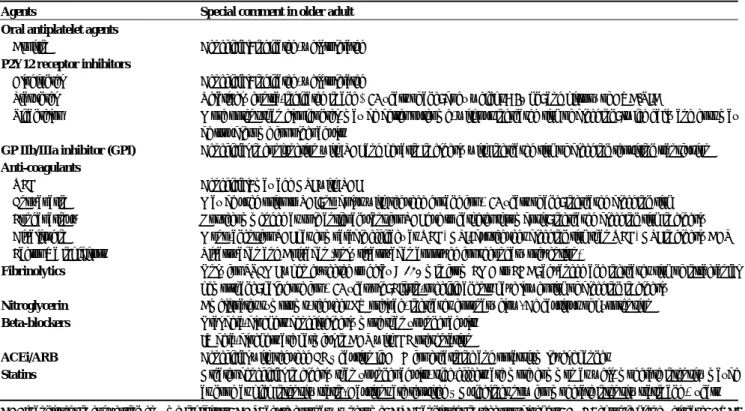
The standard of care for patients with ACS in general applies to older adults, with the common goals to achieve immediate relief of ischemia, prevent further myocardial damage, and avoid complications and death. However, medication side effects are generally more common in eld-erly ACS patients; therefore, special attention is required to monitor and reduce side effects, particularly in the setting of
polypharmacy. Adjunctive antiplatelet and/or anticoagulant therapies are indicated (Table 3). Bivalirudin may provide benefit in reducing bleeding in comparing to unfractionated heparin (UFH) plus glycoprotein (GP) IIb/IIIa inhibitor to support revascularization. The combination of GP IIb/IIIa inhibitors and full dose fibrinolytic medications is associ-ated with high rates of bleeding and intracranial hemorrhage (ICH) in older people. Oxygen support for hypoxemic pa-tients, anti-angina, antiplatelet, and anticoagulant therapies are also generally indicated with special caution for elderly patients with ACS (Table 3).
5.2 Revascularization therapy
In general, high risk elderly ACS patients benefit from invasive revascularization therapy, not only in terms of sur-vival but also improving quality of life and functional ca-pacity. Practice guidelines in revascularization therapy for STEMI and NSTE-ACS are generally applicable to older adults (Table 4). Angiography and percutaneous coronary intervention (PCI) are generally safe with high successful rates. However, increased risks of stroke and bleeding asso-ciated with revascularization require careful consideration and balance of benefits and risks.[3436] In addition, older patients with thrombosis and plaque rupture in coronary arteries are more likely to benefit from initial invasive care.
Table 3. Pharmacotherapy for ACS in older adults.
Agents Special comment in older adult
Oral antiplatelet agents Aspirin
P2Y12 receptor inhibitors Clodiogrel
Prasugrel Ticagrelor
Beneficial: indicated, well tolerated
Beneficial: indicated, well tolerated
Relatively contra-indicated in age ≥ 75 years of age; body weight < 60 kg; and history of CVA/TIA
More potent than clopidogrel, may be better outcome, without increased risk of bleeding; twice daily and cost may be troublesome for older adults
GP IIb/IIIa inhibitor (GPI) Beneficial in conjunction with PCI and heparin in elderly with increased risk of bleeding requiring transfusion Anti-coagulants
UFH Enoxaparin Fondaparinux Bivalirudin Factor Xa inhibitors
Beneficial: may add GPI with PCI
May be used prior to PCI; no bolus with reduced dosage for 75 years of age; increased bleeding risk Not recommended as sole anticoagulant for PCI due to catheter thrombosis; increased bleeding risk in elderly Mono-agent for PCI has comparable efficacy as UFH+GPI, but reduces bleeding risk than UFH+GPI in elderly ACS Rivaroxaban and Apixaban (only rivaroxaban approved for secondary prevention)
Fibrinolytics Only for STEMI when expected to delay > 120 min from FMC to FDA; advanced age increases risk of intracranial hemorrhage; half-dose for 75 year-old; Fibrin-specific agents have lower risk of bleeding in elderly
Nitroglycerin Ameliorates symptoms, reduces LV preload, increases coronary flow. Be cautious of hypotension Beta-blockers Oral beta-blockers benefit elderly more than younger adults
IV beta-blockers are harmful in ACS with HF presentation
ACEi/ARB Beneficial with reduced EF – caution if CKD for creatinine and potassium level changes
http://www.jgc301.com; [email protected] | Journal of Geriatric Cardiology Table 4. Statements in major guidelines relevant to management of ACS in the older adults.
ACS Guideline statements Class, level
of evidence Guidelines A high index of suspicion for MI must be maintained in women, diabetics, and elderly patients with atypical
symp-toms I, B
STEMI
Special attention must be given to proper dosing of antithrombotics in elderly and renal failure patients I, B
2011 ESC Guidelines for
STEMI Because of the frequent atypical presentation, elderly patients (> 75 years) should be investigated for NSTE-ACS at
low level of suspicion I, C
Treatment decisions in the elderly (> 75 years) should be made in the context of estimated life expectancy,
co-morbidities, quality of life, and patient wishes and preferences I, C
Choice and dosage of antithrombotic drugs should be tailored in elderly patients to prevent the occurrence of
ad-verse effects I, C
Elderly patients should be considered for an early invasive strategy with the option of possible revascularization,
after careful weighing up of the risks and benefits IIa, B
2011 ESC Guidelines for
NSTE-ACS
Older patients with NSTE-ACS should be treated with GDMT, an early invasive strategy, and revascularization as
appropriate I, A
Pharmacotherapy in older patients with NSTE-ACS should be individualized and dose adjusted by weight and/or CrCl to reduce adverse events caused by age-related changes in pharmacokinetics/dynamics, volume of distribu-tion, comorbidities, drug interactions, and increased drug sensitivity
I, A
Management decisions for older patients with NSTE-ACS should be patient centered, and consider patient prefer-ences/goals, comorbidities, functional and cognitive status, and life expectancy I, B Bivalirudin, rather than a GPIIb/IIIa inhibitor plus UFH, is reasonable in older patients with NSTE-ACS, both
initially and at PCI, given similar efficacy but less bleeding risk IIa, B
NSTE-ACS
It is reasonable to choose CABG over PCI in older patients with NSTE-ACS who are appropriate candidates, par-ticularly those with diabetes mellitus or complex 3-vessel CAD (e.g., SYNTAX score > 22), with or without in-volvement of the proximal LAD artery, to reduce CVD events and readmission and to improve survival
IIa, B
2014 AHA/ACC guideline for NSTE-ACS
ACS: acute coronary syndrome; CABG: coronary artery bypass grafting; CrCl: creatinine clearance; CVD: cardiovascular disease; GDMT: guideline-directed medical therapy; GP: glycoprotein; LAD: left anterior descending; NSTE: non-ST elevation; PCI: percutaneous coronary intervention; STEMI: ST elevation myocardial infarction; UFH: unfractionated heparin.
However, data to guide this invasive risk stratification in older adults is limited, so the treatment decision remains in the realm of clinical judgment.
5.2.1 STEMI
Timely reperfusion is the cornerstone in caring patients with STEMI and is applicable to elderly patient population. Even the very elderly STEMI patients have reasonable post-MI outcomes when treated aggressively with reperfu-sion therapy. In all age groups, primary PCI with stent placement is the preferred strategy over thrombolysis, when primary PCI is feasible and timely. In high risk elderly STEMI patients, primary PCI is generally safe as well. It results in even greater survival benefit for older compared with younger counterparts, reduces re-infarction and tar-get-vessel revascularization, and is associated with less ICH. Emergent primary PCI may also provide survival benefit in elderly STEMI with cardiogenic shock.[37] An integrated
regional STEMI transfer program is applicable to elderly patients, and proven to lessen age-related treatment dispari-ties and to improve outcome.[38] In comparison with
pla-cebo, fibrinolytic therapy reduces STEMI mortality in elders
up to the age of 85 years.[39] Today, in elderly STEMI
pa-tients, fibrinolytic therapy should be only used in confirmed STEMI, presenting ≤ 12 h after symptom onset and ex-pected to have system delay ≥ 120 min before first-device activation (FDA) and without contraindications.[34,35,40,41]
Elderly STEMI patients receiving fibrinolytic therapy should be immediately transferred to a PCI center with con-tinued assessment of reperfusion, and early angiography and revascularization.[42,43] In older adults, coronary artery
by-pass grafting (CABG) has a limited role in the acute phase of STEMI with excess mortality risk, unless in the settings of failed PCI, coronary anatomy not amenable to PCI, or requiring surgical repair of mechanic complications [ven-tricular septal defect (VSD), papillary muscle rupture, free-wall rupture].
5.2.2 NSTE-ACS
(e.g. hepatic, renal, pulmonary failure, cancer etc.).[34,44,45]
The advancement of equipment and technique has made PCI safer for even very elderly patients (≥ 90 years of age) with high success rates and declining major bleeding risk. Although the highest risk reduction in death/MI with an early invasive strategy occurred in those ≥ 75 years of age, this strategy was associated significantly increased bleeding risk. Older patients with NSTE-ACS, and diabetes mellitus have a greater survival advantage with CABG as revascu-larization modalities. However, operative mortality rates and risk of complications (i.e., stroke) for CAGB in elderly patients were substantial (up to 8% at ≥ 80 years of age). Prolonged hospitalization and post-surgery recovery in older persons were also significant.
5.3 On-going care
The elderly ACS patients require close inpatient moni-toring for potential complications from ischemic events, invasive procedures and side effects from medical treatment, in particular for the risk of bleeding with antiplatelet agents and anticoagulants, and also for hypotension, bradycardia, and renal failure. Acute ACS hospitalization of older adults often provides the healthcare system an opportunity to re-assess the patients’ social status and supportive networks, re-establish aggressive risk modification strategies (smoking cessation, treating hypertension, hyperlipidemia, diabetes mellitus, and physical inactivity, etc), secondary prevention and provide guideline directed medical therapy.
6 Post-ACS care for the older adults
Older adults are susceptible to experience complications from ACS. In the acute phase, these complications include but are not limited to (1) ischemia related complications (HF due to pump failure; post-MI pericarditis; arrhythmia (both ventricular and atrial arrhythmia, conduction system malfunctions); mechanical complications from ischemia, i.e., papillary muscle rupture, VSD, free wall rupture ); (2) pro-cedural complications (access site bleeding/hematoma, re-troperitoneal bleeding, stroke, pericardial effusion); (3) bleeding due to anti-platelet therapy and anemia; (4) renal insufficiency; (5) hypotension due to excessive medications; and (6) adverse effects from new medications. Post ACS, elderly patients have a high risk of re-hospitalization and death both from cardiovascular and non-cardiovascular eti-ologies. There is a 50% increased mortality risk per 10-year increase in age starting from 65 years of age.[46]
6.1 Patient education and social support
Elderly patients suffering from ACS are particularly
vul-nerable. Due to comorbid conditions, polypharmacy, frailty and often impaired communication skills and cognitive func-tion, a comprehensive discharge planning process involving patient, family and advocates is essential and often challeng-ing. Failure to understand and comply with a plan of care contributes to high rate of ACS re-admission rates and poor outcomes. The post-hospitalization care plan should include (1) detailed medication lists and instructions; (2) clear follow- up arrangement; (3) dietary instructions; (4) physical activ-ity instructions; (5) reaction plan for adverse effects from medications and interventions; and (6) cardiac rehabilitation.
6.2 Secondary prevention and lifestyle modification
Aggressive lifestyle modification (smoking cessation, weight control, dietary intervention, etc) and pharmacologi-cal secondary prevention (tighter blood pressure and serum glucose control, statin therapy, etc) are indicated for older adults treated for ACS. Close collaboration among cardi-ologists, general practitioner, patient's rehabilitation special-ists, pharmacspecial-ists, dieticians, and patients and caregivers are crucial for the ongoing care.
6.3 Cardiac rehabilitation and exercise
Comprehensive cardiac rehabilitation programs provide patient education, identify and monitor risk factors, address lifestyle modification; provide psychosocial support and enhance exercise training for patients with ACS.[47] These
programs were robustly tested and proven to be beneficial to all spectrums of age group ACS patients and endorsed by societal guidelines and healthcare administration. Exercise therapy improves functional capacity, cardiorespiratory fit-ness, and perception of well-being, as well as reduces car-diac event rate. Each step of increase in peak exercise ca-pacity is associated with a reduction in all-cause mortality risk in all age groups, including elderly patients. Elderly ACS patients should be encouraged to participate in cardiac rehabilitation. However, low rate of referral and particition in cardiac rehabilitaparticition by eligible elderly ACS pa-tients were repeatedly reported. Healthcare providers must eliminate barriers to referrals and enrollment, and facilitate participation and monitor progress.
7 Opportunities for future research and
clini-cal pearls
http://www.jgc301.com; [email protected] | Journal of Geriatric Cardiology
stratification algorithm incorporating frailty and functional data for ischemia outcomes and complication risks and their efficacy in guiding clinical decision making; (3) Study indi-vidualized, targeted strategies for coronary revascularization that achieve optimized goal of care for elderly ACS patients; (4) Study new safety, efficacy and optimal duration of novel P2Y12 antagonists in older adults; (5) Optimize cardiac rehabilitation programs for elderly ACS patients.
The clinical pearls are: (1) Older adults make up an in-creasingly large proportion of ACS patients. However, there are significant disparities in collecting clinical evidence and delivery of evidence-based effective therapy to these pa-tients compared with their younger counterparts. (2) Type 2 MI is increasingly common with highly sensitive troponin assays. Judgment regarding coronary risk and revasculariza-tion is warranted, and initial strategy should focus on treat-ment of presenting non-cardiac conditions with monitoring for CAD complications. (3) High risk elderly ACS patients may derive more benefit from aggressive antithrombotic therapy and invasive revascularization, but also carry higher risks of complications, such as bleeding and stroke. (4) Op-timized approach requires careful considerations of the in-dividual patient’s ischemic risk, comorbidities, risk of com-plications, frailty, cognitive function, life expectancy and advanced directive (patient’s wish). (5) All older adults who survived from ACS should be encouraged and referred for cardiac rehabilitation. Exercise training improves long term survival and well-being of ACS patients.
References
1 O’Gara PT, Kushner FG, Ascheim DD, et al. 2013 ACCF/ AHA guideline for the management of ST-elevation myocar-dial infarction: executive summary: a report of the American College of Cardiology Foundation/American Heart Associa-tion Task Force on Practice Guidelines. J Am Coll Cardiol 2013; 61: 485–510.
2 Amsterdam EA, Wenger NK, Brindis RG, et al. 2014 AHA/ ACC Guideline for the management of patients with non-ST- elevation acute coronary syndromes: a report of the American College of Cardiology/American Heart Association Task Force on Practice Guidelines. J Am Coll Cardiol 64: e139–e228. 3 Steg PG, James SK, Atar D, et al. ESC Guidelines for the
management of acute myocardial infarction in patients pre-senting with ST-segment elevation. Eur Heart J 2012; 33: 2569–2619.
4 Hamm CW, Bassand JP, Agewall S, et al. ESC Guidelines for the management of acute coronary syndromes in patients pre-senting without persistent ST-segment elevation: The Task Force for the management of acute coronary syndromes (ACS) in patients presenting without persistent ST-segment elevation of the European Society of Cardiology (ESC). Eur Heart J 2011; 32: 2999–3054.
5 The National Institute for Health and Care Excellence. Myo-cardial infarction with ST-segment elevation: acute manage-ment, 2013. The National Institute for Health and Care Excel-lence website. https://www.nice.org.uk/guidance/cg167/re-sources/myocardial-infarction-with-stsegment-elevation-acu te-management-35109696806341. (accessed March 5, 2016). 6 The National Institute for Health and Care Excellence. Unsta-ble angina and NSTEMI: early management, 2010. The Na-tional Institute for Health and Care Excellence website. https:// www.nice.org.uk/guidance/cg94/resources/unstable-angina-and- nstemi-early-management-975749355205. (accessed March 5, 2016).
7 Fox KA, Steg PG, Eagle KA, et al. Decline in rates of death and heart failure in acute coronary syndromes, 1999-2006. JAMA 2007; 297: 1892–1900.
8 Mozaffarian D, Benjamin EJ, Go AS, et al. Heart disease and stroke statistics-2015 update: a report from the American Heart Association. Circulation 2015; 131: e29–e322.
9 Alexander KP, Roe MT, Chen AY, et al. Evolution in cardio-vascular care for elderly patients with non-ST-segment eleva-tion acute coronary syndromes: results from the CRUSADE National Quality Improvement Initiative. J Am Coll Cardiol 2005; 46: 1479–1487.
10 Zaman MJ, Stirling S, Shepstone L, et al. The association between older age and receipt of care and outcomes in patients with acute coronary syndromes: a cohort study of the Myo-cardial Ischaemia National Audit Project (MINAP). Eur Heart J 2014; 35: 1551–1558.
11 Alexander KP, Newby LK, Cannon CP, et al. Acute coronary care in the elderly, part I: Non-ST-segment-elevation acute coronary syndromes: a scientific statement for healthcare pro-fessionals from the American Heart Association Council on Clinical Cardiology: in collaboration with the Society of Geri-atric Cardiology. Circulation 2007; 115: 2549–2569.
12 Alexander KP, Newby LK, Armstrong PW, et al. Acute coronary care in the elderly, part II: ST-segment-elevation myocardial infarction: a scientific statement for healthcare professionals from the American Heart Association Council on Clinical Cardiology: in collaboration with the Society of Geriatric Cardiology. Circulation 2007; 115: 2570–2589. 13 Saunderson CE, Brogan RA, Simms AD, et al. Acute
coro-nary syndrome management in older adults: guidelines, tem-poral changes and challenges. Age Ageing 2014; 43: 450–455. 14 De Luca L, Olivari Z, Bolognese L, et al. A decade of changes in clinical characteristics and management of elderly patients with non-ST elevation myocardial infarction admitted in Ital-ian cardiac care units. Open Heart 2014; 1: e000148. 15 Lee PY, Alexander KP, Hammill BG, et al. Representation of
elderly persons and women in published randomized trials of acute coronary syndromes. JAMA 2001; 286: 708–713. 16 Avezum A, Makdisse M, Spencer F, et al. Impact of age on
management and outcome of acute coronary syndrome: ob-servations from the Global Registry of Acute Coronary Events (GRACE). Am Heart J 2005; 149: 67–73.
syndrome among older patients: a review. Cardiol Rev 2015; 23: 26–32.
18 Hazzard WR. Atherosclerosis and aging: a scenario in flux. Am J Cardiol 1989; 63: 20H–24H.
19 DeWood MA, Spores J, Notske R, et al. Prevalence of total coronary occlusion during the early hours of transmural myo-cardial infarction. N Engl J Med 1980; 303: 897–902. 20 Wang TY, Gutierrez A, Peterson ED. Percutaneous coronary
intervention in the elderly. Nat Rev Cardiol 2011; 8: 79–90. 21 Solomon CG, Lee TH, Cook EF, et al. Comparison of clinical
presentation of acute myocardial infarction in patients older than 65 years of age to younger patients: the Multicenter Chest Pain Study experience. Am J Cardiol 1989; 63: 772–776.
22 Thygesen K, Alpert JS, Jaffe AS, et al. Third universal defini-tion of myocardial infarcdefini-tion. J Am Coll Cardiol 2012; 60: 1581–1598.
23 Brieger D, Eagle KA, Goodman SG, et al. Acute coronary syndromes without chest pain, an underdiagnosed and under-treated high-risk group: insights from the Global Registry of Acute Coronary Events. Chest 2004; 126: 461–469.
24 Grosmaitre P, Le Vavasseur O, Yachouh E, et al. Significance of atypical symptoms for the diagnosis and management of myocardial infarction in elderly patients admitted to emer-gency departments. Arch Cardiovasc Dis 2013; 106: 586–592. 25 Alpert JS, Thygesen KA, White HD, et al. Diagnostic and
therapeutic implications of type 2 myocardial infarction: re-view and commentary. Am J Med 2014; 127: 105–108. 26 Morrow DA, de Lemos JA, Sabatine MS, et al. Evaluation of
B-type natriuretic peptide for risk assessment in unstable an-gina/non-ST-elevation myocardial infarction: B-type natri-uretic peptide and prognosis in TACTICS-TIMI 18. J Am Coll Cardiol 2003; 41: 1264–1272.
27 Scirica BM, Kadakia MB, de Lemos JA, et al. Association between natriuretic peptides and mortality among patients admitted with myocardial infarction: a report from the AC-TION Registry(R)-GWTG. Clin Chem 2013; 59: 1205–1214. 28 Angeli F, Cavallini C, Verdecchia P, et al. A risk score for
predicting 1-year mortality in patients >/=75 years of age pre-senting with non-ST-elevation acute coronary syndrome. Am J Cardiol 2015; 116: 208–213.
29 Roe MT, Chen AY, Thomas L, et al. Predicting long-term mortality in older patients after non-ST-segment elevation myocardial infarction: the CRUSADE long-term mortality model and risk score. Am Heart J 2011; 162: 875–883. 30 Ekerstad N, Swahn E, Janzon M, et al. Frailty is
independ-ently associated with short-term outcomes for elderly patients with non-ST-segment elevation myocardial infarction. Circu-lation 2011; 124: 2397–2404.
31 Ariza-Sole A, Formiga F, Lorente V, et al. Efficacy of bleed-ing risk scores in elderly patients with acute coronary syn-dromes. Rev Esp Cardiol (Engl Ed) 2014; 67: 463–470. 32 Decourcelle V, Marechaux S, Pincon C, et al. Impact of
func-tional decline on outcome in elderly patients with acute
coro-nary syndromes. Am J Crit Care 2013; 22: e1–e11.
33 Moretti C, Quadri G, D’Ascenzo F, et al. THE STORM (acute coronary Syndrome in paTients end Of life and Risk asses-Ment) study. Emerg Med J 2016; 33:10–16.
34 Bach RG, Cannon CP, Weintraub WS, et al. The effect of routine, early invasive management on outcome for elderly patients with non-ST-segment elevation acute coronary syn-dromes. Ann Intern Med 2004; 141: 186–195.
35 Rosengren A, Wallentin L, A KG, et al. Sex, age, and clinical presentation of acute coronary syndromes. Eur Heart J 2004; 25: 663–670.
36 Rosengren A, Wallentin L, Simoons M, et al. Age, clinical presentation, and outcome of acute coronary syndromes in the Euroheart acute coronary syndrome survey. Eur Heart J 2006; 27: 789–795.
37 Dzavik V, Sleeper LA, Cocke TP, et al. Early revasculariza-tion is associated with improved survival in elderly patients with acute myocardial infarction complicated by cardiogenic shock: a report from the SHOCK Trial Registry. Eur Heart J 2003; 24: 828–837.
38 Newell MC, Henry JT, Henry TD, et al. Impact of age on treatment and outcomes in ST-elevation myocardial infarction. Am Heart J 2011; 161: 664–672.
39 White HD, Barbash GI, Califf RM, et al. Age and outcome with contemporary thrombolytic therapy. Results from the GUSTO-I trial. Global Utilization of Streptokinase and TPA for Occluded coronary arteries trial. Circulation 1996; 94: 1826–1833.
40 White HD. Debate: Should the elderly receive thrombolytic therapy or primary angioplasty? Curr Control Trials Cardio-vasc Med 2000; 1: 150–154.
41 White HD. Thrombolytic therapy in the elderly. Lancet 2000; 356: 2028–2030.
42 Cantor WJ, Fitchett D, Borgundvaag B, et al. Routine early angioplasty after fibrinolysis for acute myocardial infarction. N Engl J Med 2009; 360: 2705–2718.
43 Borgia F, Goodman SG, Halvorsen S, et al. Early routine percutaneous coronary intervention after fibrinolysis vs. stan-dard therapy in ST-segment elevation myocardial infarction: a meta-analysis. Eur Heart J 2010; 31: 2156–2169.
44 Damman P, Clayton T, Wallentin L, et al. Effects of age on long-term outcomes after a routine invasive or selective inva-sive strategy in patients presenting with non-ST segment ele-vation acute coronary syndromes: a collaborative analysis of individual data from the FRISC II - ICTUS - RITA-3 (FIR) trials. Heart 2012; 98: 207–213.
45 Bauer T, Koeth O, Junger C, et al. Effect of an invasive strategy on in-hospital outcome in elderly patients with non-ST- eleva-tion myocardial infarceleva-tion. Eur Heart J 2007; 28: 2873–2878. 46 Lopes RD, Gharacholou SM, Holmes DN, et al. Cumulative
incidence of death and rehospitalization among the elderly in the first year after NSTEMI. Am J Med 2015; 128: 582–590. 47 Pasquali SK, Alexander KP, Peterson ED. Cardiac