S T U D Y P R O T O C O L
Open Access
Tranexamic Acid in Chronic Subdural
Hematomas (TRACS): study protocol for a
randomized controlled trial
Christian Iorio-Morin
1*, Jocelyn Blanchard
1, Maxime Richer
2and David Mathieu
1,3Abstract
Background:Chronic subdural hematoma (CSDH) is one of the most frequent reason for cranial neurosurgical consultation. There is no widely accepted medical treatment for this condition. Herein, we present the protocol for the Tranexamic Acid (TXA) in Chronic Subdural Hematomas (TRACS) trial aiming at determining whether TXA can increase the rate of CSDH resolution following conservative management, lower the number of required surgical procedures and decrease the rate of CSDH recurrence following surgical evacuation.
Methods:TRACS is a multicenter, double-blind, randomized, parallel-design, placebo-controlled, phase IIB study designed to provide preliminary efficacy data as well as feasibility, safety and incidence data required to plan a larger definitive phase III trial.
Consecutive patients presenting with a diagnosis of chronic subdural hematoma will be screened for eligibility. Exclusion criteria include: specific risk factors for thromboembolic disease, anticoagulant use or contraindication to TXA. A total of 130 patients will be randomized to receive either 750 mg of TXA daily or placebo until complete radiological resolution of the CSDH or for a maximum of 20 weeks. CSDH volume will be measured on serial computed tomography (CT) scanning. Cognitive function tests, quality of life questionnaires as well as functional autonomy assessments will be performed at enrollment, at 10 weeks following randomization and at 3 months following treatment cessation. During the treatment period, patients will undergo standard CSDH management with surgery being performed at the discretion of the treating physician. If surgery is performed, the CSDH and its outer membrane will be sampled for in vitro analysis.
The primary outcome is the rate of CSDH resolution by 20 weeks without intervening unplanned surgical procedure. Secondary outcomes include: CSDH volume, incidence of surgical evacuation procedures, CSDH recurrence, cognitive functions, functional autonomy, quality of life, incidence of complications and length of hospital stay. Planned subgroup analyses will be performed for conservatively versus surgically managed subjects and highly versus poorly vascularized CSDH.
Discussion:CSDH is a frequent morbidity for which an effective medical treatment has yet to be discovered. The TRACS trial will be the first prospective study of TXA for CSDH.
Trial registration:NCT ID: NCT02568124.
Keywords:Tranexamic acid, Cyklokapron, Conservative management, Medical management, Traumatic, Non-traumatic, Chronic subdural hematoma
* Correspondence:[email protected]
1Division of Neurosurgery, Department of Surgery, Centre Hospitalier
Universitaire de Sherbrooke, 3001, 12e avenue Nord, Sherbrooke, QC J1H 5N4, Canada
Full list of author information is available at the end of the article
Background
Chronic subdural hematoma (CSDH) is one of the most frequent reasons for cranial neurosurgical consultation and a significant public health problem. The incidence in modern series ranges from 13.5 to 58.1 per 100,000 persons, depending on the studied population [1], and it peaks in the eighth decade.
As the name implies, CSDH results from venous bleeding in the space between the brain and the dura mater. While a major trauma is usually required to produce a subdural bleeding in young adults, a simple fall can be sufficient in the elderly, because brain atrophy results in stretching of bridging veins, rendering them susceptible to bleeding from minor trauma. In the acute stage, hemostasis is achieved through activation of coagulation cascades and formation of a blood clot. It is subsequently reorganized and reab-sorbed following activation of the fibrinolytic cascade. For unknown reasons, however, this process often fails in the elderly, where an inflammatory reaction triggers the forma-tion of a neovascularized membrane surrounding the clot [2]. It is postulated that activation of fibrinolysis within the hematoma might sustain a local coagulopathy which would promote low-volume bleeding from the outer membrane of the clot [3, 4]. This prevents resolution of the subdural col-lection, which then becomes “chronic”. Depending on its size, the hematoma can produce a variety of symptoms ran-ging from headaches and cognitive dysfunction to seizures, hemiplegia and coma. In most cases, motor symptoms and gait disruption will result in subsequent falls, which might lead to rebleeding [5]. Only 2.4 to 18 % of CSDH will re-solve spontaneously [6] and most patients will require sur-gical drainage. In frail, elderly patients, this can be non-trivial.
There is no widely accepted medical treatment for CSDH. Evidence is currently available for four classes of drugs: corticosteroids, angiotensin-converting enzyme (ACE) inhibitors, platelet-activating factor (PAF) recep-tor antagonists and antifibrinolytics.
Corticosteroids
Corticosteroids have been proposed as a way to reduce inflammation and angiogenesis in mild CSDH cases [2]. A recent meta-analysis of CSDHs found 5 studies inves-tigating corticosteroids as the primary management strategy and 17 studies assessing its impact as an adju-vant to surgery [7]. Pooled analysis found no benefit and an increased morbidity when corticosteroids are used. Multiple prospective randomized controlled trials are currently ongoing to clarify the issue (NCT02111785, NCT02192320, NCT01380028).
ACE inhibitors
In 2007, a retrospective analysis of 438 patients who underwent surgery for CSDH suggested that concomitant
use of an ACE inhibitor for the management of hyperten-sion lowered the risk of CSDH recurrence following
sur-gery [8]. Indeed, ACE inhibitors have known
antiangiogenic properties and might inhibit neovasculari-zation in the CSDH outer membrane. A prospective
ran-domized controlled trial comparing the effect of
perindopril on postoperative recurrence has just been completed and is pending publication (NCT00915928).
Platelet-activating factor receptor antagonist
Platelet-activating factor has been shown to be a po-tent lipid mediator of the inflammation involved in the formation and growth of the CSDH membrane [9]. Two small prospective studies from a single group demonstrated that treatment with the PAF re-ceptor antagonist etizolam decreases the need for sur-gery [10] and decreases CSDH recurrence after surgery [11]. No further study is currently announced despite these interesting results.
Antifibrinolytics
Tranexamic acid (TXA) is an antifibrinolytic agent used to minimize bleeding in trauma patients [12], high-risk surgical procedures [13] and refractory menorrhagia [14]. Its use in the treatment of CSDH was reported in two papers. The first is a case report of a hemodialyzed patient with CSDH refractory to three surgical evacua-tions [15]. The patient was given TXA (20 mg/kg/48 h intravenously (IV) for 4 weeks, followed by 10 mg/kg/ 48 h per os (PO) for 4 weeks) which led to complete radiological resolution of the CSDH. The patient remained recurrence-free at the 1-year follow-up. The second paper is a Japanese case series of 21 consecutive patients treated with TXA (750 mg PO daily) until radio-logical CSDH resolution on follow-up computed tomog-raphy (CT) scans performed every 3 weeks [16]. The authors report a 100 % success rate with a median treat-ment duration of 58 days (range 28–137 days).
Objective
We will be conducting a phase IIB trial, called “Tranex-amic Acid in Chronic Subdural Hematomas” (TRACS), to investigate whether TXA can increase the rate of CSDH resolution following conservative management, lower the number of required surgical procedures and decrease the rate of CSDH recurrence following surgical evacuation. The TRACS trial will provide preliminary ef-ficacy data as well as the safety and incidence data re-quired to plan a larger definitive phase III trial. The trial registration ID is NCT02568124. This paper is a sum-mary of the study protocol adhering to the Standard Protocol Items: Recommendations for Interventional Trials (SPIRIT) Statement [17] (Additional file 1). The full, original protocol is available as Additional file 2 (French version only).
Methods
Overview
TRACS is a double-blinded, randomized, parallel-design, placebo-controlled trial investigating the effect of long-term (up to 20 weeks) TXA administration on CSDH resolution when used as an adjunct to standard manage-ment. A total of 130 adult CSDH patients will be ran-domized to receive either TXA or placebo. Hematoma resolution will be assessed by serial CT scanning.
Inclusion criteria
TRACS will be open to adult patients (18 years of age or older) for whom a recent (up to 14 days) CT scan dem-onstrates the existence of a subdural hematoma contain-ing a chronic component.
A subdural hematoma is defined as a measurable liquid and hemorrhagic collection within the subdural space as assessed by CT scanning A chronic component is defined as a hypodense
(<25 Hounsfield units (HU)) or isodense (25–35 HU) region within the subdural collection in the absence of anemia or coagulopathy
In the presence of anemia or coagulopathy, at least one additional sign suggestive of a chronic process must be seen. Acceptable signs include:
○Bilateral hematomas
○Loculation within the hematoma
○Visible membrane surrounding the hematoma
Subjects presenting with an acute rebleeding within a CSDH are eligible.
Exclusion criteria
Patients will be excluded from the study in the fol-lowing cases:
Acute subdural hematoma with no chronic component
Active thrombotic, thromboembolic or atheroembolic disease, including:
○Deep venous thrombosis within the last 6 months
○Cerebral thrombosis within the last 6 months ○Symptomatic carotid stenosis that did not undergo surgery
○Stroke (ischemic or hemorrhagic) within the last year
○Acute coronary syndrome within the last year; Past history of unprovoked deep venous thrombosis
or idiopathic pulmonary embolism
Known hereditary thrombophilia including: ○Factor V Leiden
○Antithrombin III mutation ○Protein C deficiency ○Protein S deficiency
Atrial fibrillation (unless under successful rhythm control therapy)
Metallic heart valve
Vascular stenting procedure within the last year Cardiac or vascular surgical procedure within the
last 6 months, including: ○Endarterectomy ○Bypass
○Angioplasty
Ongoing investigation for suspected malignancy Confirmed active malignancy
Concomitant hormone therapy for malignancy Concomitant use of a hormone contraceptive pill Macroscopic hematuria
Known or suspected TXA allergy Pregnancy or breastfeeding
Concomitant use of anticoagulant medication Any concern from the attending physician
These extensive exclusion criteria have been selected to provide maximum safety for the study subjects. It is likely that our patient population will be significantly older and at higher risk for thromboembolic complica-tions than in most other studies of TXA, notably the trauma studies [12]. Until the effectiveness of TXA use in CSDH is demonstrated, we believe that any risk factor for thrombotic events should be carefully considered. Should any exclusion criteria be newly diagnosed during the course of the study, treatment will be discontinued, although follow-up will proceed as planned.
Setting and screening
CHUS and at the Centre Hospitalier Affilié Universitaire de Québec. In both centers, all consecutive patients pre-senting to the neurosurgery department with a diagnosis of a subdural hematoma with a chronic component will be screened for eligibility by the treating physicians. It is likely that some eligible patients will be missed because of physician oversight. However, this screening method was deemed more sensitive than a systematic review of the participating centers’daily head CT reports, because a significant proportion of patients are referred for con-sultation based on head CT scans performed in outside community hospitals. A screening log will be kept. Fol-lowing screening, interested and potentially eligible pa-tients will meet a trained research nurse who will consent and enroll the subjects.
Power calculation
The primary goal of TRACS is to generate the feasibility, safety and incidence data required to inform the design of a larger definitive phase III trial. Powering for efficacy is, therefore, not required. However, given the impressive effect size reported in the case series, demonstration of efficacy might be achievable even within this smaller phase II study.
At our institution (CHUS) between 2009 and 2012, ad-ministrative data suggests that about 30 % of CSDH were symptomatic and underwent surgical treatment. This amounted to about 28 surgical procedures per-formed annually when including reoperations (unpub-lished data). In the literature, rates of complete radiological resolution following surgery have been re-ported to be between 70 and 95 % [18] with only 3– 18 % of cases resolving spontaneously if conservative management is undertaken [6]. Using these data, if we postulate that 30 % of patients enrolled in the study will undergo surgical evacuation, the primary outcome in the placebo group should be met in 23–41 %. We believe that the effect of TXA would be clinically significant if it can double the rate of CSDH resolution. Given those pa-rameters, obtaining an 80 % power with a statistical sig-nificance threshold set at p= 0.05 would require each treatment arm to recruit between 21 (if the primary out-come in the placebo group is met in 41 % of subjects) and 65 subjects (if the primary outcome in the placebo group is met in 23 % of subjects). The initial recruitment goal will, therefore, be of 65 subjects per group, for a total of 130 analyzed patients. With two recruiting cen-ters, this goal could be achieved within 2.5 years if more than 40 % of screened patients are eligible and consent to participate.
This power analysis is based on a number of assump-tions, including the incidence of the primary outcome, the size of the treatment effect, the proportion of patients undergoing planned surgical evacuation and the rate of
change from planned conservative to surgical management (which leads to a failure of meeting the primary outcome). This can significantly impact the power of the study. Since 100 % of the 22 cases published achieved complete CSDH resolution [15, 16], powering for an incidence of primary outcome of 46–82 % in the treatment arm (odds ratio of 2) seems reasonable. A lower odds ratio could still be clinically significant given the reported safety of TXA, although de-tecting it would require a substantially larger cohort (225 subjects per group for a 1.5 odds ratio with a 23 % rate of primary outcome in the placebo group). To verify these as-sumptions, an interim power analysis will be performed after follow-up data is available for the 65th subject and using the study’s real primary outcome incidence. Target sample size will be adjusted if this analysis suggests that the power required to assess effectiveness could be reached with available or minimal extension of funding. However, while TRACS is designed to provide preliminary efficacy data, the main objective is to provide the feasibility, safety and incidence data required to plan a larger definitive phase III trial. Therefore, powering for effectiveness is not strictly required.
Ethics, consent and permissions
Study explanation to potential subjects will be performed by research personnel independent from the treating physi-cians. Consent will be obtained from the patient directly whenever possible. However, it is expected that a significant proportion of patients in the target population will be un-able to give informed consent because of confusion or speech impairment caused by their condition. In such cases, consent will be obtained from a legal representative or the patient’s most significant relative. Consent to remain in the study will be obtained from the subject as soon as competency to consent is recovered. This process is in ac-cordance with the World Medical Association’s Declaration of Helsinki [19]. The TRACS trial has received local Institu-tional Review Board (IRB) (Comité d’éthique de la recherche du CR-CHUS) approval as well as approval from Health Canada. The French and English consent forms are available as Additional files 3 and 4.
Stopping guidelines
Randomization, blinding and unblinding
Upon giving informed consent, subjects will be random-ized by the recruiting center’s central pharmacy to one of two groups: a group treated with TXA and a control
group treated with a placebo. Stratified block
randomization will be used with a block size of 4 and the use of antiplatelet drugs within the last month and recruiting center as covariates. The allocation sequence, produced by an independent statistician, will be deter-mined by assigning a random number to each subject within a block (two taking placebo and two taking TXA) and then sorting the subjects by number. Four tables of 128 allocations will be generated with Table A used for patients not previously taking antiplatelet therapy and Table B used for patients previously taking antiplatelet therapy. Tables C and D will be similarly generated and reserved for the second recruiting center. Subjects and care providers will be blinded by the use of a placebo tablet. In order to minimize cost, the placebo tablet will not be perfectly identical to the TXA tablet and the drugs will, therefore, be served in an opaque container to further protect the allocation from the physician. Blinding will be maintained throughout the trial period, including during the interim analysis where patient’s group assignation will be unmasked, but not the group’s assignation to a specific treatment. After database lock following the last follow-up of the last patient, planned
statistical analyses will be performed and conclusions drawn and presented to the trial steering committee prior to unblinding of the groups’allocation.
There should be no need for unblinding during the treatment phase. If, for any patient, an adverse event oc-curs such as a thrombosis, pseudo-nephrolithiasis or suspected allergic reaction, the trial intervention should be stopped for the affected patient and standard sup-portive care given. Should the attending physician re-quire unblinding, the coordination center’s pharmacy can be contacted at any time.
Intervention
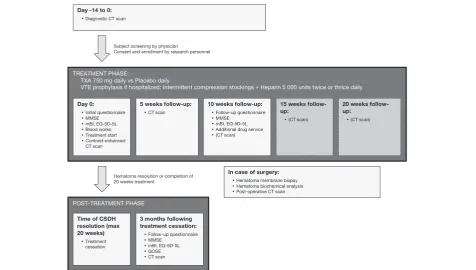
TRACS is divided into three phases: (1) the treatment phase, (2) the post-treatment phase, and (3) the optional surgical phase (see Fig. 1).
The treatment phase begins immediately after
randomization and involves the administration of daily oral TXA or placebo. Planned procedures include blood tests at 0 weeks, a set of questionnaires and cognitive function tests at 0 and 10 weeks and serial CT scans every 5 weeks. The first CT scan will be
contrast-enhanced to assess the degree of membrane
vascularization. Throughout the treatment phase and re-gardless of treatment arm assignation, CSDH manage-ment proceeds at the discretion of the attending physician. This can include a conservative observation
[image:5.595.60.537.422.692.2]period, a surgical evacuation or any procedure deemed appropriate by the medical team. Resumption of prior antiplatelet medications is not standardized but is docu-mented. The treatment phase continues until complete radiological resolution of the CSDH or for a maximum of 20 weeks.
The post-treatment phase begins at the first CT scan demonstrating complete radiological resolution of the CSDH or after 20 weeks of treatment. It involves the cessation of trial drug administration and a set of ques-tionnaires, cognitive function tests and a CT scan to be performed after 3 months following treatment cessation.
If a surgical evacuation is performed, the optional sur-gical phase is entered and mandates sampling and ana-lysis of the hematoma and its outer membrane, as detailed in the Outcomes section. Surgical technique is left to the discretion of the treating team. Timing of sur-gery, use of drains and use of burr holes versus craniot-omy will be recorded, but are not pre-specified.
Treatment adherence will be monitored by asking pa-tients to return any remaining drug tablets at each clin-ical visit and at the end of the study. The schedule of enrollment, interventions, and assessments is summa-rized in Fig. 1.
Dose selection
TXA has been used for many applications and the doses studied vary widely. Loading doses of 2.5–100 mg/kg and maintenance doses of 0.25–4 mg/kg/h have been re-ported as safe and effective in surgical patients, although total treatment duration in these studies was less than 12 h [20]. Approved dosing for menorrhagia is 1300 mg three times daily for up to 5 days. Off-label, long-term use of 500 mg/dose PO once or twice daily has been re-ported for hereditary angioedema prophylaxis with some patients treated safely for years [21].
CSDH is believed to result from a slow, occult bleed-ing from the subdural hematoma membrane. The goal of an antifibrinolytic therapy in this context is to correct the coagulopathy within the hematoma so that throm-bosis of the surrounding membrane can occur and be followed by CSDH reabsorption. Because this process is unlikely to take place within 12 h, the use of a long-term, low-dose regimen might be favored. In the first case report of TXA use for CSDH, a dose of 20 mg/kg/ 48 h IV for 4 weeks, followed by 10 mg/kg/48 h PO for 4 weeks was administered [15]. For a 70-kg subject, this would yield 700 mg IV daily for 4 weeks, followed by 350 mg PO daily for 4 weeks. For all the other reported patients, a dose of 750 mg PO daily was used [16]. Be-cause of the high effectiveness and absence of adverse event in this series, the latter dose was chosen for the TRACS trial.
TXA and placebo will be provided as tablets to be taken orally. The drug can be administered through a nasogastric tube if the patient is dysphagic.
Drug manufacture and supply of trial treatment
TXA and placebo drugs will be purchased on the open market by the trial coordinating center pharmacy (Centre de recherche du CHUS). The pharmacy will also manage the blinding process and drug packaging. As long as subjects are hospitalized, the drugs will be ad-ministered by the ward nurses along with the patient’s other medication. Upon discharge, remaining doses will be packaged and given to the patient with detailed writ-ten administration instructions. The initial trial drug ser-vice will cover the first 10 weeks of treatment. If, at the 10-week follow-up, the control CT scan demonstrates persistence of the CSDH, a second service of trial drugs will be performed and the treatment will be continued for a total of 20 weeks. Complete radiological resolution of the CSDH on any CT scan, at any time during the treatment phase, will end the trial intervention and trig-ger the post-treatment phase. At treatment cessation, remaining drug tablets will be collected be the trial phar-macy and counted to monitor compliance.
Venous thrombosis prophylaxis
All hospitalized patients will undergo mandatory stand-ard neurosurgical venous thrombosis prophylaxis con-sisting of intermittent compression stockings plus 5,000 units of unfractionated heparin given subcutaneously twice daily (or thrice if the patient weighs over 100 kg), to be discontinued 12 h preoperatively and resumed 12 h after removal of all postoperative subdural drains. Prophylaxis will be discontinued at hospital discharge.
Other treatments
TXA or placebo administered as part of the TRACS trial is provided as an adjunct to the usual management of CSDH. There is no need to modify or withhold any clin-ically indicated treatment, including surgery, antiplatelet therapy or prophylactic heparin administration.
Adverse events
Event Report Form. Adverse events to be specifically assessed at each follow-up include the incidence of deep venous thrombosis, pulmonary embolism, transient ische-mic attacks, stroke, pseudo-nephrolithiasis and subjective changes in vision. Any other side effects reported by pa-tients will also be documented. Adverse Event Reports will be screened by each site’s principal investigator as soon as they are produced. An independent safety monitoring com-mittee will review all Adverse Event Reports, and analyze the rates of TXA adverse events after follow-up data is available for the 65th subject. As part of the interim ana-lysis, the safety monitoring committee will produce a report to be reviewed by the trial steering committee and might request a trial review by the IRB should any concern arise. Group allocation unblinding will be performed if a highly statistically significant (p<0.001) difference in the rate of adverse events is identified.
Adverse events will be reported using the classification of the Medical Dictionary for Regulatory Activities, ver-sion 19.0.
Measures of outcome
The primary outcome is the rate of complete CSDH radiological resolution (see definition in CSDH radio-logical assessment section below) by 20 weeks without intervening unplanned surgical procedure. The manage-ment strategy chosen is documanage-mented at the time of randomization as a categorical variable (no surgery planned versus elective evacuation planned versus emer-gent (cannot wait 24 h) evacuation planned). An un-planned surgical procedure is any surgery performed in addition to the management strategy documented at randomization. Specifically:
If the management strategy chosen by the attending physician within the first 24 hours of presentation included a surgical evacuation of the CSDH, the primary outcome is met if a control CT scan by 20 weeks demonstrates complete radiological resolution of the CSDH.
○If a second surgical procedure is required, the subject is considered to have failed CSDH treatment and the primary outcome is not met, even if the CSDH has completely resolved by 20 weeks ○If a surgical procedure is never performed, the primary outcome is met if a control CT scan by 20 weeks demonstrates complete radiological resolution of the CSDH
If the management strategy chosen by the attending physician within the first 24 hours of presentation consisted of expectant management, the primary outcome is met if a control CT scan by 20 weeks demonstrates complete radiological resolution of the CSDH.
○If a surgical procedure is performed, the subject is considered to have failed CSDH treatment and the primary outcome is not met, even if the CSDH has completely resolved by 20 weeks
For patients presenting with bilateral hematomas, only the largest hematoma at presentation will be considered for the primary outcome analysis.
The secondary outcomes are:
CSDH volume at 20 weeks
Incidence of surgical evacuation procedures Incidence of symptomatic and asymptomatic CSDH
recurrence at 3 months following complete radiological resolution
Cognitive functions at 10 weeks following
randomization and at 3 months following the end of treatment as assessed by the Mini-Mental State Examination (MMSE)
Functional autonomy at 10 weeks following
randomization and at 3 months following the end of treatment as assessed by the modified Barthel Index (mBI) and Glasgow Outcome Scale Extended (GOSE)
Quality of life at 10 weeks following randomization and at 3 months following the end of treatment as assessed by the EuroQol five dimensions, five levels health survey (EQ-5D-5L) questionnaire
Length of initial hospital stay Number of rehospitalization Incidence of complications
Additional variables will be collected to allow planned subgroup analyses of the primary outcome, secondary outcomes and response to TXA when stratifying patients by:
Conservatively versus surgically managed patients Level of CSDH membrane contrast-enhancement on
the initial CT scan
Level of CSDH membrane vascularization on histopathological analysis
Evidence of coagulopathy in the CSDH
The primary analysis will be performed and reported on an intention-to-treat basis. As-treated analyses and hematoma-level analyses (for patients with bilateral CSDH) will also be performed and compared to the intention-to-treat results.
CSDH radiological assessment
of the membrane will be assessed on injected sequences by volume measurement and reported as the volume/vol-ume percentage of contrast enhancement relative to the total CSDH volume. Radiological resolution of the CSDH is defined as the absence of a measurable subdural collec-tion discernable from cerebrospinal fluid (CSF) on the 3-mm sliced axial reconstructions of a non-enhanced iso-tropic CT scan. Recurrence is defined as the apparition of a new CSDH after radiological resolution of a prior known CSDH in the same location. Progression is defined as a more than 10 % increase in CSDH volume.
Radiological resolution during the treatment phase will be assessed by local investigators who will review the CT scans as they are performed and trigger the post-treatment phase upon resolution or at 20 weeks. All local investigators will undergo a standardized training in CSDH radiological resolution assessment by the study radiologist prior to subject enrollment at their center. After study completion, all CT scans will be centrally reviewed by an independent, blinded radiologist who will perform the volumetric ana-lyses and determine the official CSDH resolution and recur-rence status for outcome analyses.
Cognitive functions assessment
Cognitive functions will be assessed using the Mini-Mental State Examination (MMSE), a validated and widely used test [24].
Functional autonomy assessment
Functional autonomy will be assessed using a 10-item questionnaire: the Modified Barthel Index of Activities of Daily Living (mBI) [25]. This tool has been used in more than 2500 studies and is the most commonly used functional autonomy scale in the elderly [26]. The Glas-gow Outcome Scale Extended (GOSE) will also be used at the last follow-up to measure gross functional auton-omy. It is the most frequent outcome measure in neuro-surgical trials, although less sensitive than the mBI for highly functional individuals.
Quality of life assessment
Quality of life (QOL) will be assessed using the EQ-5D-5L questionnaire, a validated QOL tool and standard test for cost-effectiveness and health utility analyses [27].
Hematoma analysis
Patients enrolled in the trial and undergoing surgical evacuation of their CSDH provide an opportunity for further analysis of CSDH pathophysiology. Immediately after trepanation, the CSDH and its outer membrane will be sampled. Levels of glucose, proteins, osmolarity, prothrombin time (PT), activated partial thromboplastin time (aPTT), fibrinogen, D-dimers and the platelet count will be measured in the hematoma liquid. A measure of
membrane vascularization will be reported as assessed by standard hematoxylin and eosin staining and immu-nohistochemical labeling. Membrane analysis will be performed by a single, blinded pathologist at the coord-inating center. For better reproducibility, all membranes will be analyzed simultaneously once patient recruitment has stopped and the last follow-up is completed. Sam-pling of the CSDH will not affect the surgical procedure itself and no tissue will be banked for future use once the trial analyses have been performed.
Data collection and management
All data will be collected by the recruiting center’s re-search personnel. Paper data collection forms will be used (see Additional file 5) when questioning patients and then transcribed in a secure online database with range checks for data values. At the time of analysis, all outliers in the electronic data will be double-checked on the paper questionnaires to rule out errors in data entry. All data will be conserved for 25 years after the end of the study. Data will be collected for all enrolled patients even if the intervention is discontinued. Investigators, the trial steering committee and the safety monitoring committee will have access to the final dataset. Participant-level data and statistical code will be made available upon request for external review, substudies or meta-analysis purposes.
Analysis
models will be used to test the impact of treatment arm on CSDH volume and the various questionnaire scores. GOSE score, hospitalization length and number of readmissions will be tested using Student’sttest or the Mann-WhitneyU
test. Other secondary outcomes will be tested using Fisher’s exact test. Statistical significance will be defined asp<0.05. Risk factors for primary outcome failure will be ex-plored using logistic regression analyses. Potential risk factors to be tested include age, alcohol consumption, smoking, previous history of CSDH, use of antiplatelet medication, ACE inhibitors or glucocorticoids, previous neurosurgical procedure, chronic renal failure, brain atrophy, convexity CSDH, loculated CSDH, enhancing CSDH membranes, high membrane vascularization and low fibrinogen level in the CSDH fluid. Subgroup ana-lyses of the primary outcome will also be performed for conservatively managed patients and surgically managed patients.
Results will be published in peer-reviewed journals and reported in the ClinicalTrial.gov result database.
Administrative data
Protocol development
The protocol was developed by and following the in-put of:
Dr David Mathieu MD, Department of Surgery (Neurosurgery), principal investigator
Dr Christian Iorio-Morin MD PhD, Department of Surgery (Neurosurgery)
Dr Jocelyn Blanchard MD, Department of Surgery (Neurosurgery)
Dr Jean-François Castilloux MD, Department of Medicine (Hematology)
Dr Jean Chénard MD, Department of Diagnostic Radiology
Dr Ana-Maria Crous Tsanaclis MD, Department of Pathology
Dr Maxime Richer MD PhD, Department of Pathology
Dr Marie-Pierre Garant PhD, statistician
No patient was involved in the development of the study protocol.
Trial steering committee
The trial steering committee will oversee the progress of the trial, review the safety data, review the Adverse Events Reports as they become available and provide ad-vice regarding trial extension and funding after the power calculations are performed using the interim ana-lysis data. The trial steering committee will consist of:
Dr David Mathieu MD, Department of Surgery (Neurosurgery), principal investigator
Dr Christian Iorio-Morin MD PhD, Department of Surgery (Neurosurgery)
Dr Jocelyn Blanchard MD, Department of Surgery (Neurosurgery)
Safety monitoring committee
The safety monitoring committee will analyze the safety data and all Adverse Events Reports available at the in-terim analysis. They will provide advice to the trial steer-ing committee for protocol improvement and might request IRB reevaluation should significant safety con-cerns arise from the interim analysis report. The safety monitoring committee will consist of:
Dr François Lamontagne MD MSc, Department of Medicine (Critical Care)
Dr Jean-François Castilloux MD, Department of Medicine (Hematology)
Dr Nicolas Dea MD MSc, Department of Surgery (Neurosurgery)
Dr David Fortin MD MSc, Department of Surgery (Neurosurgery)
Financial support
Funding for the TRACS trial has been provided by:
Fond de recherche du Québec–Santé Centre de recherche du CHUS
Department of Surgery, University of Sherbrooke Fondation Neuro-Trauma Marie-Robert
Additional funding sources are being solicited. There is neither funding nor support provided by the pharma-ceutical industry.
This trial will not generate any intellectual property for the sponsor or any participating party. The funders did not participate at any point in the design of the study and will have no role in data collection, manage-ment, analysis, interpretation and reporting.
Discussion
CSDH is a frequent and morbid condition. A better un-derstanding of the underlying pathophysiological pro-cesses will support direct targeting of dysregulated elements of coagulation cascades that are thought to be responsible for CSDH growth. TXA is a safe and widely used inhibitor of fibrinolysis. Its effective use as a med-ical treatment for CSDH has been reported for 22
pa-tients. While these results are promising, their
be drawn. TRACS will be the first prospective trial of TXA in CSDH.
Safety
TRACS’ protocol requires discontinuation of TXA ad-ministration at the first CT scan demonstrating complete CSDH radiological resolution rather than at a fixed 20-week time point. This design decision will result in vari-able treatment duration and time of primary outcome assessment within the cohort. We anticipate that our pa-tient population will be significantly older and at higher risk for complications than most other studies of TXA. While the low TXA dose used in TRACS will hopefully increase the safety of the intervention, the risk of thromboembolic events will likely be proportional to treatment duration. Therefore, because the goal of TXA treatment is resolution of the CSDH, we believe this variable treatment duration paradigm will maximize the safety of the intervention by allowing treatment to be discontinued in patients who have responded and for whom no additional benefit is expected, while allowing a longer course of treatment to non-responders.
Consequently, total follow-up will also be variable since the last follow-up, scheduled 3 months following treatment cessation, will depend on the time at which CSDH resolution occurred. Because the goal of this post-treatment assessment is to investigate recurrence relative to the demonstration of complete resolution and treatment cessation (as opposed to initial CSDH diagno-sis and treatment start), we do not believe this design will introduce any significant bias.
Expected impact
The TRACS trial will provide safety and incidence data, as well as effect size estimation to inform the design of a lar-ger, definitive trial. Depending on the resulting power cal-culations, TRACS itself could be sufficiently powered to provide reliable evidence as to whether TXA can increase the rate of CSDH resolution following conservative man-agement, lower the number of required surgical proce-dures and decrease the rate of CSDH recurrence following surgical evacuation. Exploratory analyses will investigate the impact of CSDH presence and resolution on QOL and cognitive function. While patients with no pain, motor deficit or marked cognitive impairment are often consid-ered“asymptomatic,”these analyses might identify subtle yet clinically meaningful deficits that might benefit from a minimally-invasive treatment. Planned subgroup analyses will try to identify risk factors for CSDH recurrence and TXA failure with particular focus on prior use of anti-platelet medication, poorly-vascularized CSDH mem-branes and low fibrinogen levels within the CSDH fluid. CSDH sampling in the surgical patients and subsequent comparison of biochemical and immunohistological data
to clinical outcome will further enhance our understand-ing of the pathophysiology of CSDH with the goal of pre-dicting TXA response in individual patients. If the trial hypothesis is confirmed, it could help position TXA as a new non-invasive treatment modality for CSDH.
Trial status
Patient enrollment began at the coordinating center in late October 2015. At the time of submission (March 2016), nine patients had been enrolled. Enrollment at the second site has not yet begun. Any change to the trial protocol will be communicated to relevant parties by the principal investigator and mentioned in the re-sults manuscript.
Consent to publish
Consent to publish anonymized, individual patient data will be obtained as part of the general consent for study participation.
Additional files
Additional file 1:SPIRIT checklist. (DOC 122 kb)
Additional file 2:Protocol (original French version). (PDF 3571 kb)
Additional file 3:Consent form (original French version). (PDF 253 kb)
Additional file 4:Consent form (English translation). (PDF 324 kb)
Additional file 5:Data collection forms (original French version). (PDF 334 kb)
Abbreviations
ACE:angiotensin-converting enzyme; CSDH: chronic subdural hematoma; CSF: cerebrospinal fluid; GOSE: Glasgow Outcome Scale Extended; HU: Hounsfield unit; ICMJE: International Committee of Medical Journal Editors; IRB: Institutional Review Board; IV: intravenous; mBI: modified Barthel Index of activities of daily living; MMSE: Mini-Mental State Examination; PAF: platelet-activating factor; PO: per os; QOL: quality of life;
TRACS: Tranexamic Acid in Chronic Subdural Hematomas; TXA: tranexamic acid.
Competing interests
The authors declare that they have no competing interests.
Authors’contributions
CI-M proposed the original idea for the TRACS study, drafted the study protocol and documentation and is responsible for the trial implementation. JB contributed to the overall study design and critically reviewed all study documentation, the protocol and this manuscript. MR designed and will implement the protocol for the in vitro CSDH membrane analysis. He critically reviewed the full protocol and this manuscript. DM contributed to the overall study design and critically reviewed all study documentation, the protocol and this manuscript. He supervised the IRB approval process and study implementation at the CHUS. He is the trial’s principal investigator. All authors reviewed and approved the final manuscript.
Acknowledgements
The authors would like to acknowledge Dr Jean-François Castilloux, Dr Jean Chénard, and Dr Ana-Maria Crous Tsanaclis for their contribution and input to the design of this trial.
Author details
1Division of Neurosurgery, Department of Surgery, Centre Hospitalier
Universitaire de Sherbrooke, 3001, 12e avenue Nord, Sherbrooke, QC J1H 5N4, Canada.2Department of Pathology, Centre Hospitalier Universitaire de Sherbrooke, 3001, 12e avenue Nord, Sherbrooke, QC J1H 5N4, Canada.
3Centre de recherche du CHUS, Sherbrooke, QC, Canada.
Received: 11 November 2015 Accepted: 13 April 2016
References
1. Kudo H, Kuwamura K, Izawa I, Sawa H, Tamaki N. Chronic subdural hematoma in elderly people: present status on Awaji Island and epidemiological prospect. Neurol Med Chir (Tokyo). 1992;32:207–9. 2. Stanisic M, Lyngstadaas SP, Pripp AH, Aasen AO, Lindegaard K-F, Ivanovic J,
et al. Chemokines as markers of local inflammation and angiogenesis in patients with chronic subdural hematoma: a prospective study. Acta Neurochir. 2012;154:113–20. discussion 120.
3. Labadie EL, Glover D. Local alterations of hemostatic-fibrinolytic
mechanisms in reforming subdural hematomas. Neurology. 1975;25:669–75. 4. Lim DJ, Chung YG, Park YK, Song JH, Lee HK, Lee KC, et al. Relationship
between tissue plasminogen activator, plasminogen activator inhibitor and CT image in chronic subdural hematoma. J Korean Med Sci. 1995;10:373–8. 5. Sambasivan M. An overview of chronic subdural hematoma: experience
with 2300 cases. Surg Neurol. 1997;47:418–22.
6. Horikoshi T, Naganuma H, Fukasawa I, Uchida M, Nukui H. Computed tomography characteristics suggestive of spontaneous resolution of chronic subdural hematoma. Neurol Med Chir (Tokyo). 1998;38:527–32. discussion 532–3. 7. Almenawer SA, Farrokhyar F, Hong C, Alhazzani W, Manoranjan B,
Yarascavitch B, Arjmand P, Baronia B, Reddy K, Murty N, Singh S. Chronic subdural hematoma management: a systematic review and meta-analysis of 34,829 patients. Ann Surg. 2014;259(3):449–57.
8. Weigel R, Hohenstein A, Schlickum L, Weiss C, Schilling L. Angiotensin converting enzyme inhibition for arterial hypertension reduces the risk of recurrence in patients with chronic subdural hematoma possibly by an antiangiogenic mechanism. Neurosurgery. 2007;61:788–92. discussion 792–3. 9. Hirasima Y, Endo S, Kato R, Ohmori T, Nagahori T, Nishijima M, et al.
Platelet-activating factor (PAF) and the development of chronic subdural haematoma. Acta Neurochir. 1994;129:20–5.
10. Hirashima Y, Kurimoto M, Nagai S, Hori E, Origasa H, Endo S. Effect of platelet-activating factor receptor antagonist, etizolam, on resolution of chronic subdural hematoma–a prospective study to investigate use as conservative therapy. Neurol Med Chir (Tokyo). 2005;45:621–6. discussion 626.
11. Hirashima Y, Kuwayama N, Hamada H, Hayashi N, Endo S. Etizolam, an anti-anxiety agent, attenuates recurrence of chronic subdural hematoma –evaluation by computed tomography. Neurol Med Chir (Tokyo). 2002; 42:53–5. discussion 56.
12. CRASH-2 trial collaborators, Shakur H, Roberts I, Bautista R, Caballero J, Coats T, et al. Effects of tranexamic acid on death, vascular occlusive events, and blood transfusion in trauma patients with significant haemorrhage (CRASH-2): a randomised, placebo-controlled trial. Lancet. 2010;376:23–32. 13. Ker K, Edwards P, Perel P, Shakur H, Roberts I. Effect of tranexamic acid on
surgical bleeding: systematic review and cumulative meta-analysis. BMJ. 2012;344:e3054.
14. Wellington K, Wagstaff AJ. Tranexamic acid: a review of its use in the management of menorrhagia. Drugs. 2003;63:1417–33.
15. Vujkovac B, Sabovic M. Treatment of subdural and intracerebral
haematomas in a haemodialysis patient with tranexamic acid. Nephrol Dial Transplant. 2000;15:107–9.
16. Kageyama H, Toyooka T, Tsuzuki N, Oka K. Nonsurgical treatment of chronic subdural hematoma with tranexamic acid. J Neurosurg. 2013;119:332–7. 17. Chan A-W, Tetzlaff JM, Altman DG, Laupacis A, Gøtzsche PC, Krleza-Jeric K,
et al. SPIRIT 2013 statement: defining standard protocol items for clinical trials. Am Coll Phys. 2013;158:200–7.
18. Oh H-J, Lee K-S, Shim J-J, Yoon S-M, Yun I-G, Bae H-G. Postoperative course and recurrence of chronic subdural hematoma. J Korean Neurosurg Soc. 2010;48:518–23.
19. World Medical Association. World Medical Association Declaration of Helsinki: ethical principles for medical research involving human subjects. JAMA. 2013;310:2191–4.
20. Henry DA, Carless PA, Moxey AJ, O’Connell D, Stokes BJ, Fergusson DA, Ker K. Anti-fibrinolytic use for minimising perioperative allogeneic blood transfusion. Cochrane Database Syst Rev. 2011;(3):CD001886. doi:10.1002/ 14651858.CD001886.pub4.
21. Levy JH, Freiberger DJ, Roback J. Hereditary angioedema: current and emerging treatment options. Anesth Analg. 2010;110:1271–80.
22. Perel P, Al-Shahi Salman R, Kawahara T, Morris Z, Prieto-Merino D, Roberts I, et al. CRASH-2 (Clinical Randomisation of an Antifibrinolytic in Significant Haemorrhage) intracranial bleeding study: the effect of tranexamic acid in traumatic brain injury–a nested randomised, placebo-controlled trial. Health Technol Assess. 2012;16:iii–xii. 1–54.
23. Dewan Y, Komolafe EO, Mejía-Mantilla JH, Perel P, Roberts I, Shakur H, et al. CRASH-3–tranexamic acid for the treatment of significant traumatic brain injury: study protocol for an international randomized, double-blind, placebo-controlled trial. Trials. 2012;13:87.
24. Ismail Z, Mulsant BH, Herrmann N, Rapoport M, Nilsson M, Shulman K. Canadian academy of geriatric psychiatry survey of brief cognitive screening instruments. Can Geriatr J. 2013;16:54–60.
25. Shah S, Vanclay F, Cooper B. Improving the sensitivity of the Barthel Index for stroke rehabilitation. J Clin Epidemiol. 1989;42:703–9.
26. Yang M, Ding X, Dong B. The measurement of disability in the elderly: a systematic review of self-reported questionnaires. J Am Med Dir Assoc. 2014;15:150. e1–9.
27. Devlin NJ, Krabbe PFM. The development of new research methods for the valuation of EQ-5D-5 L. Eur J Health Econ. 2013;14 Suppl 1:S1–3.
• We accept pre-submission inquiries
• Our selector tool helps you to find the most relevant journal
• We provide round the clock customer support
• Convenient online submission
• Thorough peer review
• Inclusion in PubMed and all major indexing services
• Maximum visibility for your research
Submit your manuscript at www.biomedcentral.com/submit