UNDERWATER FISH SHAPE RECOGNITION IN MALAYSIAN
SEAWATER BY USING CHAIN CODE TECHNIQUES
ALGORITHM IN REAL TIME IMAGE PROCESSING
Atzroulnizam Abu, Muhammad Saiful Bin Meh, Ahmad Makarimi Abdullah, Fatimah Abdul Hamid, Shareen Adlina Shamsuddin and Noorazlina Mohamid Salih
Department of Marine Electrical and Electronics Technology, Malaysian Institute Marine Engineering Technology, Universiti Kuala Lumpur, Malaysia
E-Mail: [email protected]
ABSTRACT
A fish recognition system is to recognize the type of fish at sea taken using an underwater video camera. It is a computer vision application for automatically differentiating the species of fish. The system developed is to sort the type of fishes in Malaysian seawater. This paper proposed an algorithm of pattern recognition by using Matlab. The fish image recognition system is designed to differentiate the selected features of fish which are the shapes of the fish species. A Graphical User Interface (GUI) is being to represent the recognized fish species based on specific algorithm. The details of the fish are also stated in the GUI for operator information purpose. There are several process to make sure the final image is cleared and the system able to identify the fished detected. The Minimum Sum of Absolute Difference (SAD) method is used to calculate the difference between the chain code and the input fish image. The experiment results using simple technique show an acceptable results. The efficiency of this system is about 72%.
Keywords:fish recognition, image processing, fish shape and texture, minimum sum of absolute difference.
INTRODUCTION
The paper is a research of underwater pattern recognition. The pattern recognition has been actively developed now days for example fingerprint, barcode and etc. It also has become famous when the technology of computer vision has been developed. The pattern recognition is quite similar but it has different techniques of representation. The goal of pattern recognition is to assign the input image with the classified data. There are many fields that are related to recognition system nowadays such as the face detection system, iris discrimination, optical character recognition, fingerprint verification and so on. Most engineers and researchers has studied various ways to solve the problems in current situation. There are a lot of approach in digital image processing can be improved to make a highly matching performance of pattern recognition. Furthermore, many methods of pattern recognition have also been compared and evaluated, thus the work for future system is achievable and even more convenient for a lot of application.
IMAGEPROCESSING
Technique 1- Chain code generation
Azzam & Rahmeh, (2006) [11] approached Chain code generation to recognize the basic shapes based on the two-dimensional shapes shown in Figure-1. The advantages of this technique are the shape should be in closed. It is because the point should be connected together.
Figure-1. Basic shape using chain code generation.
Figure-2. (a & b) A 4-connected object and its boundary; (c & d) Obtaining the chain code from the object in (a & b) with (c) for 4-connected and (d) for 8-connected [10].
Kho Geok Hong, (2011) [4] a technique to recognize fish species using Freeman Chain Code Generation shown in Figure 3. It extract the features by using the shape of fish. It can be divided into 4 or 8 connectivity of segmentation that represent the boundary of connected sequence of straight line segments at specified length and direction. The Minimum Sum of Absolute Difference (SAD) method is recognized five fish species so far which are Bawal, Cencaru, Merah, Pari dan Kerisi. In this recognition system, 50 input images have been used. The overall performance of this system is about 80%.
Figure-3. Freeman chain code generation [4].
Technique II - Principal component analysis
Matai, Kastner, & Cutter, (2012) [8] has used Principal Component Analysis (PCA) approach to recognize four species of rockfish (genus Sebastes) and one species of butterfly fish. Seven images of each species were used as a training set. The data has been trained in high quality whereby training images were normalized for position and had similar illumination. The result of
applying the PCA resulted is almost 100% successful clustering for every case. Unfortunately, it was limited by the number of high quality training images, and should be further evaluated with larger image sets, and with fish in different positions and varying illumination.
EXPERIMENTAL METHODOLOGY
The data analysis can be comprised into algorithm and chain code techniques which is in the feature extraction process. In this stage, the data collected can be analyzed by using the algorithm and chain code techniques for feature extraction process.
START
INPUT
IMAGE
RECOGNITION ?
IMAGE
ENHANCEMENT
GRAYSCALE
SEGMENTATION
EDGE DETECTION
FEATURE
EXTRACTION NO
YES
RESULT TYPE OF
FISH
END
Figure-4. Recognition system flowchart.
A. Input image
This research project recorded a video of the underwater fishes including the background at a daytime with good weather condition. The video was captured by a digital video camera at Akuarium Tunku Abdul Rahman. The length of the video is between 15-20 seconds.
Method 1 - RGB contrast ranging
[image:3.612.319.541.88.206.2]The program required user to browse any image as input. The input image in JPEG is much preferable to be processed. The original images are load in Matlab file function (.mat) which is consist of several types of fish. In this method, the images are convert in grayscale. Then, the process of filtering unwanted noise and deblurring images is also quite necessary in the enhancement of image. The image RGB contrast is based on the nearest neighboring pixels of RGB.
[image:3.612.74.300.208.443.2]Figure-6. Sharpened image.
Figure 7. Pixel indexed of original image.
Figure-8. Pixel indexed of sharpened image.
Method 2 - Gray-scaling image
[image:3.612.74.299.469.573.2]The element of input image is uint8 or uint16 class and has integer of [0, 255] or [0, 65535] respectively. Input image is convert in grayscale by using function im2gray. Then, the values of gray-scale image in the range of [0, 1]. The image should be less blur and in the form of one layer.
Figure-9. Gray-scaled image.
Method 3 - Image segmentation (Edge detection)
The purpose of edge detection algorithms is to figure out the most relevant edges in the images. These edges should be connected into continuous lines and boundaries, resulting in a segmented image containing two or more regions. After done it, the process proceeds to segmentation. Segmentation is a process to create a partition between the regions of interest from the background of an image. In this project, the region of interest is the fish captured on the image. Segmentation is done on the grayscale image to separate the fish from other regions such as from the background. There are several segmentation techniques which includes point detection, line detection and edge detection techniques. However, edge detection techniques is chosen in this project for segmentation in order to get the shapes/boundaries of the object, since edge detection is a most common approach in detecting meaningful discontinuities in gray levels of an image.
Whenever there is a sharp transition in gray levels, an edge is detected. An edge is a ‘local’ concept whereas boundary is a more global idea. There are several edge detection filters such as Laplacian, Sobel, Roberts, Canny, Prewitt filters and so on. Canny operator is chosen for edge detection in this project as it is an optimal edge detector that has a low error rate. It also reduces missing edges that occurs in images and will have no responses to non-edges and only have one response to a single edge hence possibility of multiple responses to an edge is not likely to occur.
Figure-10. Segmented image.
[image:3.612.317.542.555.659.2]Global thresholding is applied to the whole image since the image is taken under controlled environment (in the laboratory under constant illumination).
Technique 1 - Feature extraction (chain code techniques)
After pre-processing image, feature extraction which is one of the vital process need to take place in order to get desired features which will be used in the classification stage. Finding the efficient features is always the key to solve the problem. In this process, the point extraction is identify based on the different shape of fish species. Basically, the boundary of fish shape is determined by using edge detection and segmentation. The binary image is require which is in black and white color and has the range of [0, 1]. Then, the point is connected by relevant selection of shape.
Figure-11. Exterior shape traced.
Method 2 - Image recognition
Image recognition is generally performed in two steps, which is to extract the image features and to construct an image classifier. After the feature extraction stage, the extracted feature which is the chain code will be fed into the system for comparisons and classification of the species. The classifier will operate based on the features and then classify the objects of interest into a number of categories or types. This is the recognition stage or classification stage of the system.
The classifier used in the project is the Minimum Sum of Absolute Difference (SAD) method. This method will calculate the minimum difference between the chain code of the input fish image with the chain codes of the all the species of fishes stored in the image database. The minimum absolute difference obtained from comparison would means that the result is of minimum absolute error and is the selected as the result of the recognition which is the species classified.
REAL TIME IMAGE PROCESSING
The underwater image has been recorded using digital camera. The video tested are recorded at Akuarium Tunku Abdul Rahman, Penang. The input images of Debam Ekor Kuning fish species has been captured for evaluation of algorithm in terms of image and video processing.
Part 1 - Aligorithm
The algorithm analyze about 100 fish images as positive instances for training database fish species. The cascaded detector used is 4 to 5 and the time taken for every fish species is 1-2 minutes. The underwater image will be fed into the fish recognition system. However, the underwater image should be enhanced and filtered from noise. The features extraction of 1000 points of chain code generation has been plotted in Figure 9 to 15.
Figure-12. Detection and tracking in blob analysis.
Figure-13. Peacock bass.
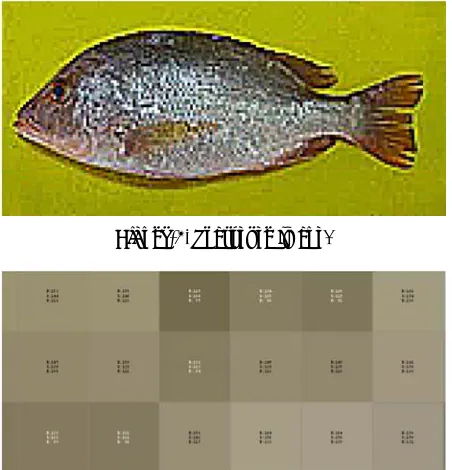
Figure-15. Debam Ekor Kuning.
Figure-16. Debam Kuning.
Figure-17. Debam Ekor Hitam.
Figure-18. Cencaru.
Figure-19. Bawal.
Figure-20. Accuracy performance of every fish.
CONCLUSIONS
In this project, the fish recognition system in video processing has been proposed. Finally, the study and analyze of fish species and population at Kelong Penarak, Langkawi has been successfully achieved. Based on the experimental result on the chain code generation, the following evaluation have been made regarding the background algorithms tested in this paper.
Fish recognition system improves image quality. The algorithm has provided dependent processing steps which respectively filter unwanted noise, enhance contrast and adjust pixel to nearest neighboring RGB values.
Chain code generation has successfully extracted the features of shape and texture. 1000 points has connected around subject in binary images. The discontinuous connection of chain code generation might cause a failure in feature extraction process.
The accuracy of fish recognition system is based on the 70 fish images. Total accuracy of the program is approximately 78%. The detected three different fish species is shown in Figure-21.
0% 20% 40% 60% 80% 100%
Figure-21. Detected fish species in video processing.
For further recommendation is the algorithm of underwater image enhancement should be developed. The underwater scattering should be filtered thoroughly as to make the image clear and sharp. The noise also has to be reduced for higher background ratio. Thus, it is required to make detection and tracking of fish species.
REFERENCES
[1] Ahmad, A., & Lim, K. 2006. Inland Fishes Recorded from the Langkawi Islands, Peninsular Malaysia.
[2] Kho Geok Hong. 2011. Fish Species Recognition System Based on Chain Code. Fish Species Recognition System Based on Chain Code.
[3] Pornpanomchai, C., Lurstwut, B., Leerasakultham, P., & Kitiyanan, W. 2013. Shape- and texture-based fish image recognition system. Kasetsart Journal - Natural Science, 47(4), 624-634.
[4] Singh, P., & Pandey, D. 2014. Shape- Based Fish Recognition Using Neural Network, 9359(5), 121– 126.
[5] Wu, N. 2012. Fish Detection in Underwater Video of Benthic Habitats in Virgin Islands.
[6] Matai, J, Kastner, R & Cutter, G R. 2012. Automated Techniques for Detection and Recognition of Fishes using Computer Vision Algorithms.
[7] Nixon, Mark & Aguado, As. 2008. Feature extraction & image processing.
[8] Jusoh, Nor Amizam & Zain, Jasni Mohamad. 2009. Application of Freeman Chain Codes: An Alternative Recognition Technique for Malaysian Car Plates.
[9] Sleit, Azzam Talal & Jabay, Rahmeh Omar. 2006. A Chain Code Approach for Recognizing Basic Shapes.
[10]Levner, Ilya, 2002. Shape Detection, Analysis and Recognition.
[11]Gonzalez, R., Woods, R., & Eddins, S. 2004. Digital Image processing using MATLAB. Upper Saddle River, N.J.: Pearson Prentice Hall.
[12]Marques, O. 2011. Practical image and video processing using MATLAB. Hoboken, NJ: Wiley-IEEE Press.