Applied Linguistics and English as a Second
Language Dissertations Department of Applied Linguistics and English as a Second Language
7-15-2008
Negotiation of Identities by International Teaching Assistants
Negotiation of Identities by International Teaching Assistants
through the Use of Humor in University Classrooms
through the Use of Humor in University Classrooms
Iryna Kozlova
Follow this and additional works at: https://scholarworks.gsu.edu/alesl_diss
Recommended Citation Recommended Citation
Kozlova, Iryna, "Negotiation of Identities by International Teaching Assistants through the Use of Humor in University Classrooms." Dissertation, Georgia State University, 2008.
https://scholarworks.gsu.edu/alesl_diss/2
NEGOTIATION OF IDENTITIES BY INTERNATIONAL TEACHING ASSISTANTS
THROUGH THE USE OF HUMOR IN UNIVERSITY CLASSROOMS
by
IRYNA KOZLOVA
Under the Direction of Dr. Gayle Nelson and Dr. Stephanie Lindemann
ABSTRACT
Research on international teaching assistants (ITAs) often highlights that ITAs have at
least two identities, an identity of a teacher and a student (e.g., Jenkins, 2000). Since American
classrooms foster a variety of behaviors that are negotiated by instructors and students, ITAs
may identify themselves with students during behavior negotiation when building rapport,
especially by exchanging jokes (Unger-Gallagher, 1991). Making their student identity relevant
may distort the teacher-student relationship, which ITAs might need to renegotiate. Little
research has been done to show whether ITA student identity actually emerges and if does, then
how. This study addresses the questions of what attributes of ITAs’ identities emerge during
humorous exchanges with their students, how these attributes shape the teacher-student
relationship, and what role humor plays in the identity negotiation process between the ITAs and
their students in the university classroom. Four ITAs, all non-native English speakers,
This study informs research on social identity in that, most of the time, participants made
the attributes of their teacher identity relevant, with teacher authority emerging as the most
important attribute. While enacting their teacher identity through humorous exchanges, ITAs
built rapport and created affiliation with their students. Although humor led to establishing good
relationships, it did not lead to the emergence of ITA student identity. This study also contributes
to research on humor in that it makes a distinction between the concepts of the target and the butt
which allows for deeper understanding of how humor is used to negotiate identity. It also
introduces the target switch, or a particular type of counter teasing, in which the initial target
redirects humorous aggression to the teaser, thus making her/him the target and a potential butt
of the tease. An optimistic finding for ITA research and research on the use of humor by
non-native speakers is that even without extensive experience with American culture in general, ITAs
can use humor rooted in the local context to negotiate different classroom behaviors and their
identities with their students.
NEGOTIATION OF IDENTITIES BY INTERNATIONAL TEACHING ASSISTANTS
THROUGH THE USE OF HUMOR IN UNIVERSITY CLASSROOMS
by
IRYNA KOZLOVA
A Dissertation Submitted in Partial Fulfillment of the Requirements for the Degree of
Doctor of Philosophy
in the College of Arts and Sciences
Georgia State University
Copyright by Iryna Kozlova
NEGOTIATION OF IDENTITIES BY INTERNATIONAL TEACHING ASSISTANTS
THROUGH THE USE OF HUMOR IN UNIVERSITY CLASSROOMS
by
IRYNA KOZLOVA
Committee Chairs: Gayle Nelson
Stephanie Lindemann
Committee: Diane Belcher Lucy Pickering Margaret DuFon
Electronic Version Approved
DEDICATION
ACKNOWLEDGEMENTS
Many people guided me through my journey to this stage and to all of them I am deeply
indebted. I would like to express special gratitude to my advisers, Dr. Gayle Nelson and Dr.
Stephanie Lindemann, who led me through my dissertation. For the past two years, these two
women were always with me and for me with their wise advice, immense support, and
encouragement. Without their incredibly helpful feedback on my numerous drafts, this day
would never come. I would also like to thank Dr. Nelson and Dr. Lindemann for their patience
with editing my drafts. I am incredibly thankful to Dr. Lindemann for the
last-minute-before-the-deadline feedback, which took her lots of time and energy.
I also highly appreciate help and advice of my committee members Dr. Diane Belcher,
Dr. Lucy Pickering, and Dr. Margaret DuFon. Dr. Belcher has been working with me through the
years I spent at GSU and has taught me that good writing opens the doors to the community of
practice. Dr. Pickering’s enthusiasm and interest in my project encouraged numerous quick small
talks that supported my spirit. I do not know what magic she puts in her words, but after she
made a joke that my dissertation would be five pages long if the participants do not perform
humorous exchanges, humor in the classrooms mushroomed. Dr. DuFon takes a special place in
my life. She introduced me to research and saw me developing as a researcher while guiding
through my M.A. thesis and dissertation. Her kindness, open heartedness, and wisdom helped me
survive in the most difficult moments of my academic career and her positive attitude to life
always makes me believe that I am able to do anything I want.
My participants Wen, Rana, Ming, and Alexandros deserve special appreciation. These
four men volunteered to participate in this project in spite of the fact that they were tremendously
teaching assistants, the more I admired them as teachers who cared about their students and who
did their best to share their knowledge and expertise with them.
My special thanks are to Sharon Cavusgil, John Stowe, and Guiling Hu who assisted me
in a very important process of searching for participants. I would also like to thank two people,
Tim Merritt and Zena MaNais, who were of tremendous assistance at the busiest time of data
collection. Tim’s enthusiasm, willingness to help and to share all his knowledge about the
videotaping, computers, and video editing, to mention just few things, made my rough days with
technology more tolerable. I am grateful to Zena without whom my stimulated recall sessions
would be practically impossible. Through the four months of data collection she was helping me
with the conference room reservations, which allowed me to conduct stimulated recalls with the
least possible delays.
I would like to thank my friend Julia Turlington with whom I worked during the pilot
study for her emotional support throughout my big project. I am grateful to my colleagues and
friends Lauren Lukkarila, Luciana Diniz, Weimin Zhang, Magdi Kandil, Joseph Lee, Jason
Litzenberg, Guilling Hu, Yanbin Lu, Cheongmin Yook, Kate Moran, Eliana Hirano, Caroline
Payant, Pam Pearson, and Amanda Baker and also all the IEP instructors who always found nice
words at the time I needed encouragement. My friends Elizabeth Kozlovski and Lukas Faber
supported me emotionally by making me have fun. They reminded me that there is life outside
academia and that I deserve to have it. My friends Natasha Anthony and Thora DeLey were
always for me on the phone and supported with their talks. I also would like to thank my children
Masha and Kirill for their kind attitude and pleasant moments that they shared with me during
Finally, I am very thankful to all the faculty members and the staff from the Department
of the Applied Linguistics and ESL who during my five and a half years at this school
co-constructed with me my identity of a teacher, a researcher, and, of course, a student. They also
TABLE OF CONTENTS
DEDICATION………...iv
ACKNOWLEDGEMENTS………...v
LIST OF TABLES………. ...xiv
CHAPTER I INTRODUCTION…...1
International Teaching Assistants: Historical Perspective……...………..…...1
The Role of ITAs in the American Classroom………...…..….…3
Humor in Educational Settings……….………..…7
Motivation for This Research………..………9
The Present Study………...………11
Organization of the Study...12
II LITERATURE REVIEW ...14
Theoretical Background………..………..…….14
Identity Defined……….….………..….14
Identity and Institutional Talk ...16
Identity Through Turn-taking Organization...17
Negotiation of Identities Through the Use of Humor……..………..………20
Conversational Joking Defined…………..……….….20
Identity Negotiation and Display Through Conversational Joking…………...22
Identity Display Through Narrative Jokes...23
Identity Display Through Self-denigrating Humor...25
Identity Negotiation Through Teasing...26
Identity Negotiation Through Laughter ...28
Politeness and Identity……….29
Humor in Institutional Settings……….………31
Affiliation While Exerting Authority ...32
Building Rapport While Maintaining Authority ...33
Affiliation While Recovering Status ...34
Creating a Team While Collaborating...35
Affiliating While Re-asserting Authority...35
Summary………..…..37
III METHOD ...38
Introduction………..………..38
Microethnography………..………39
Reciprocity and Complementarity ...39
Contextualization Cues...40
Study Design………..41
Methodological, Data, and Participant Triangulation...42
Participant Triangulation...42
Methodological Triangulation...43
Data Triangulation...45
Participants and Their Recruitment………...45
Participants ...49
Ming………. ...50
Wen………51
Rana………...52
Alexandros………...53
Data Collection Procedures………54
Video Equipment……….……….54
Videotaping...55
Stimulated Recall Sessions ...56
Questions for the Stimulated Recall...58
Field Notes...60
Data Analysis and Coding……….61
Data Segmenting...61
Laughter and Smiles...62
Markers of Irony...63
Markers of Teases...64
Identifying Boundaries of Humorous Exchanges ...65
Data Transcription...66
Orthography…...67
Laughter……...68
Layout…………...69
IV RESULTS AND DISCUSSION ...73
Introduction ………...73
Social Identity and Humor ...73
General Description of the Data………75
Categorizing Humorous Exchanges………...76
Teacher-initiated Humorous Exchanges………79
Affiliating While Exerting Authority ...79
Affiliating While Exerting Authority as Evaluators of Students...79
Evaluation of students’ responses…………..………...80
Evaluation of students' questions……….………94
Evaluation of students' behavior………101
Affiliating While Exerting Authority to Manage Class Issues………….107
Target switch ……….122
Affiliating While Maintaining Teacher Authority...135
Rapport Building Through Narrative Jokes and Cartoons...136
Creating Affiliation Through Joking About Absent Other and Joking Without Targets...145
Rapport Building Through Humorous Self-repair...151
Affiliating While Recovering Teacher Authority...153
Student-initiated Humorous Exchanges………...159
Affiliating While Having Authority Enhanced...160
Affiliating While Re-asserting Authority...162
Affiliating While Responding to the Students’ Challenging Questions...168
Affiliating While Passing Authority to Students...175
Extended Sequences………...178
Affiliating While Sharing Authority with Students………...178
Sharing Authority During Negotiation of Class Issues...178
Sharing Authority While Constructing Meaning Collaboratively...194
Affiliating While Competing for Authority...199
Non-native Identity: Foreigner and a Non-native Speaker………..212
The Role of Humor in the Classroom: The ITAs' Perspective………215
Ming………...215
Alexandros………...216
Wen………...218
Rana……… ...219
V CONCLUSIONS AND IMPLICATIONS...221
Summary of findings………...…222
Research Question #1: What Attributes of ITAs’ Identities Emerge During Humorous Exchanges With Their Students?...222
Research Question #2. How Do the Attributes of ITAs’ Identity Shape Their Relationships With Their Students?...224
Research Question #3. What is the Role of Humor in the Identity Negotiation Process Between the ITAs and Their Students? ...225
ITA Identity: Teacher or Student? ...228
Contributions and Applications………...234
Contribution to the Study of Identity...234
Contribution to the Research on ITAs...235
Contributions to the Study of Humor ...237
Contribution to the Research on Humor in Educational Settings ...239
Pedagogical Applications of the Study ...240
Limitations………...243
Directions for Further Research………...244
REFERENCES……… ...246
APPENDICES 1 INFORMED CONSENT FOR INTERNATIONAL TEACHING ASSISTANTS..255
2 INFORMED CONSENT FOR VIDEOTAPING STUDENTS SITTING IN THE CLASSES………...258
3 INFORMED CONSENT FOR THE INTERVIEW WITH THE STUDENTS SITTING IN THE CLASSES………261
4 INSTRUMENT FOR THE STIMULATED RECALL PROCEDURE FOR STUDENTS PARTICIPATING IN STIMULATED RECALL………..264
5 INSTRUMENT FOR THE STIMULATED RECALL PROCEDURE FOR INTERNATIONAL TEACHING ASSISTANTS………266
LIST OF TABLES
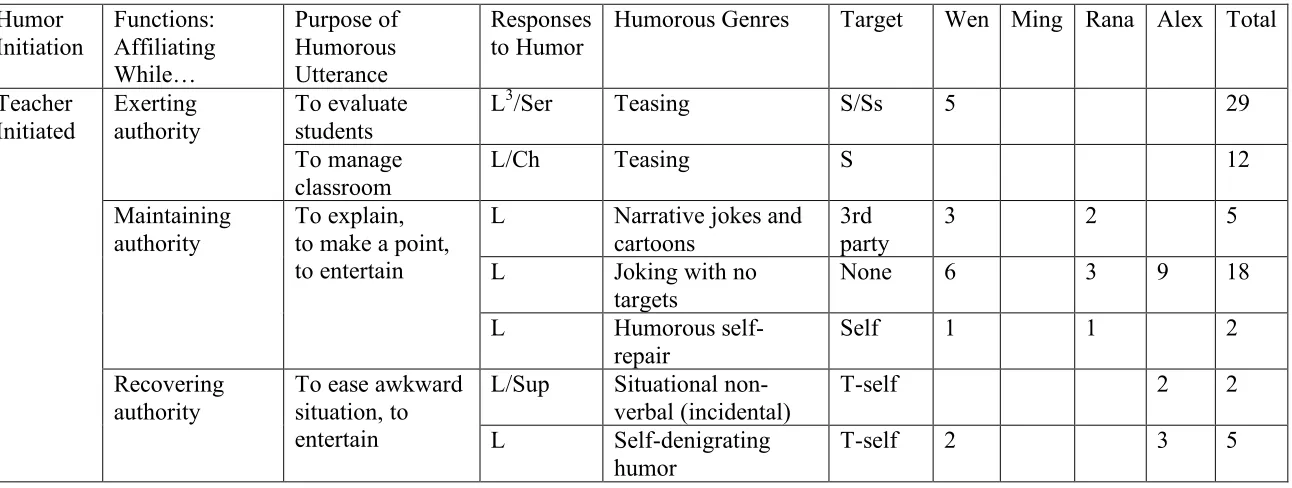
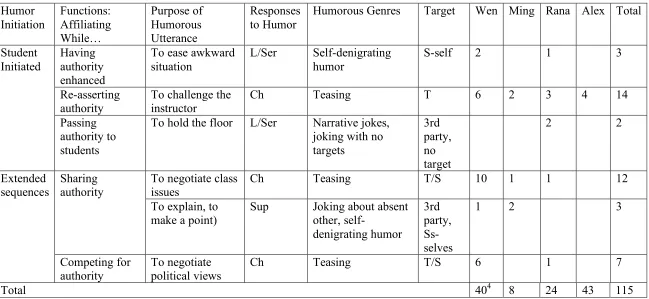
Table 1: Teacher authority and affiliation in relation to the humor initiation, functions of the humorous utterance, responses to humor, humorous genres, and the
CHAPTER I: INTRODUCTION
International Teaching Assistants: Historical Perspective
The end of the 1970s and 1980s witnessed a burst of studies on International Teaching
Assistants (ITAs) (see Bailey, 1984b; Madden & Myers, 1994). ITAs are graduate students,
“non-U.S. citizens or recent U.S. residents” (Smith, Byrd, Nelson, Barret, & Constntinides, 1992,
p. 11), who pursue their doctoral or Master’s degree and are employed as teaching assistants
(TAs) to teach university introductory undergraduate courses or to assist professors in grading
students’ homework, quizzes and tests, leading discussion sessions, supervising laboratory
sessions, and proctoring tests (Plakans, 1997). The main reason for the U.S. universities to
employ international graduate students, whose first language was other than English, was the
shortage of qualified American graduate students who spoke English as their first language,
especially in the disciplines such as business administration, engineering, sciences, and
technological fields (Smith, Byrd, Nelson, Barret, & Constantinides, 1992). While ITAs were
considered to be competent in their disciplines, students and their parents complained to the
university authorities that the ITAs’ imperfect command of English led to the “ITA problem”
that includes problems in communication and in the relationships between the ITAs and their
students (Bailey, 1984b, 1984c).
The existing communication problem between the ITAs and their students was identified
and elucidated differently by the parties involved, specifically, the university professors and
administrators, the students and their parents, and the ITAs themselves (Bailey, 1984c). The
university authorities recognize that both ITAs and the universities benefit from foreign graduate
student employment as TAs (Cole et al., not dated, as cited in Bailey, 1984b). ITAs benefit from
involvement in the educational process. As added by Pialorsi (1984), American students also
benefit from ITAs because they often offer a different perspective on the material taught and
approach teaching the subject in a way “that U.S. academicians may not have considered” (p.
16). At the same time, universities realize that some ITAs have issues with fossilized
pronunciation and may sometimes use teaching methods and classroom practices that American
students are not used to. Finally, university administrations admit that part of the problem is
American students’ assumption that they will have communication problems with a TA because
the TA is of foreign origin.
Many students’ and parents’ perspective on the “ITA problem” is that the English
proficiency of the ITAs is so low that undergraduate students do not understand material
delivered in class (Bailey, 1984b, 1984c). ITAs, on the other hand, may believe that American
students find ITAs’ language proficiency as “an easy excuse” for the students’ laziness, poor
comprehension of the subject matter, and “poor performance in class and on tests” (Bailey,
1984c, p. 7). Although the ITA problem is perceived differently by the students and parents and
ITAs themselves, in reality, the problem is not just in the ITAs’ English proficiency or in their
students’ ethnocentrism, but, according to Bailey (1984c), in reality, the problem “probably lies
in between these two extremes” (p. 7). Although the students’ attitudes towards ITAs also add to
the “ITA problem”, the ITAs still need to clearly understand their roles as teaching assistants and
to have English proficiency that allows them to perform their teaching job successfully (Bailey,
1984c). However, as Bailey emphasizes, English proficiency and teaching success are “debatable
issues” and the roles of ITAs can also vary, so what it means to be a successful ITA is difficult to
describe. At the same time, both understanding their roles in certain situations and using
communication between ITAs and their students. Without knowing the culture of American
classrooms, however, ITAs may not have clear understanding of their roles within the
educational system in the United States (Bailey, 1984c). Therefore, according to Bailey (1984c),
linguistic and cultural differences can make the interaction between the ITAs and their students
“complicated and sometimes problematic” (p. 3).
The Role of ITAs in the American Classroom
The distinguishing features of the American college classroom include an array of
behaviors and “the relative freedom that exists for a professor and students to jointly negotiate
the behavior patterns that will subsequently typify the conduct of the class” (Shaw & Bailey,
1990, p. 318). For example, one of the prominent behaviors that is allowed in American
classrooms, but may not be permitted in other cultures, is that students can ask questions in the
middle of the instructor’s lecture. However, it is up to the instructor and the students to negotiate
whether this kind of behavior is acceptable in this particular classroom and if yes, then when
during the lecture it is allowed. Shaw and Bailey claim that most of the time, the negotiation of
behavior patters occurs covertly, when instructors somehow let students know what is
appropriate. Students, for instance, may ask questions in the middle of the lecture, but the
instructor may just ignore their questions, thus setting a class norm of not allowing for the
interruption of the lecture. As Shaw and Bailey maintain, the patterns of classroom behavior vary
because they are based on what instructors and students negotiate as allowable for this particular
classroom. According to these scholars, while the instructors and students sustain their power
relationship in the classroom in general (e.g., students are not allowed to order pizza when in
class), their power differential is reduced at times when behavior negotiation occurs. Although
negotiation also involves negotiation of the teacher and student identities, or who they are at
certain moments of classroom interaction.
Since negotiation of behaviors involves negotiation of power relationships, Shaw and
Bailey (1990) foresee two challenges for ITAs during the behavior negotiation process. The first
challenge is that the ITAs may lack the experience of behavior negotiation simply because in
their cultures “behavior is much more restricted” (p. 318). The second one is ITAs’ student
identity, which they share with their students. Because of the shared status, the status difference
between the two groups is reduced, which may lead to a greater degree of freedom for
negotiation of the behavior patterns between the ITAs and their students.
While American classrooms foster numerous behavior patterns, e.g., instructor giving a
lecture, instructor evaluating students, another prominent behavior pattern in the American
classroom is its interactivity (Pialorsi, 1984). Students often speak out in class without raising
their hands or being called on by the teacher, which results in “interactive dialogue between
students and professors” (Pialorsi, 1984, p. 19). Giving students more freedom for interaction
may lead to authority problems; therefore, as Pialorsi argues, balancing teacher authority with
permissiveness is one of the skills that teachers, both foreign and American, need to develop.
Unger-Gallagher (1991) is also concerned with the challenge for ITAs to balance authority with
permissiveness and suggests that ITAs may opt for more interactive classroom “without
changing power strategies” (p. 277). In an interactive classroom the role of the instructor is to
orchestrate students’ participation in discussion rather than to be in charge of the discussion.
Thus, students in an interactive classroom obtain more rights to make contributions to the
discussion and to negotiate issues not clear to them. Such participation involves altering the
in the discussion, but if their roles are not negotiated, students’ participation may be constrained.
Thus, if a TA invites students for a class discussion, but remains in charge of it, students may not
participate as much as they would if the TA allowed them more rights for participation and
participated in the discussion on equal footing with the students. However, when offering
students more rights and opportunities to talk, the TAs must negotiate their new roles and
relationships because students may not be accustomed to this type of behavior and may be
confused with the new relationships (Unger-Gallagher, 1991). Unger-Gallagher argues that if a
TA takes on the new role of being a participant in a class discussion in order to encourage mutual
interaction between the TA and the students, the TA may “attempt to identify with students by
exchanging jokes, chatting with students before class and revealing personal aspects of his or her
life” (p. 279). If the TA maintains this type of behavior during class discussions and, in addition,
places students in charge of the discussion, students may test these relationships “to see how far
they can assert their role in the relationship” (p. 279) and may challenge the TA “to determine
the boundaries of what is appropriate” (p. 279) in their relationships.
Although Pialorsi (1984) and Shaw and Bailey (1990) focus on ITAs and
Unger-Gallagher (1991) concentrates on TAs in general, they seem to agree in their proposition that for
(I)TAs, it is important to know how to negotiate different types of behaviors that are appropriate
in their classrooms with their students, and, consequently, how to negotiate instructor-student
roles relevant to different activities in their classrooms. While these researchers agree that the
role negotiation involves altering the teacher-student power relationship, their common concern
is that (I)TAs’ student identity may unfavorably affect the (I)TAs’ authority, especially, as
students, e.g., exchanging jokes, and through these activities may identify themselves with their
students.
An individual’s social identity consists of different attributes which maybe classified into
attributes of universalistic and particularistic character (Erickson & Schultz, 1982). The
universalistic attributes, according to Erickson and Schultz, can be acquired by anyone who has
motivation, talent, opportunities, and insistence and are related to the individual’s institutional
identity such as a teacher or a student. The particularistic attributes cannot be acquired by anyone
because they are determined by birth (e.g., sex, skin color, race) and the individual’s culture
(e.g., accent, dialect, interactional style, religious affiliation). Erickson and Schultz believe that
in institutional talk, an individual’s particularistic attributes of the social identity are not expected
to emerge because they are not relevant to the institutional encounter. For example, if both the
instructor and a student/students support the Braves, the Atlanta baseball team, or know the same
person, these attributes are not relevant to the classroom talk and should not emerge during
classroom interaction. However, Erickson and Schultz demonstrate that particularistic attributes
of one’s social identity emerge as relevant during institutional encounters as well.
As Unger-Gallagher (1991) suggests, when participating in rapport-building activities in
the classroom, an ITA may “identify with students”, for example, through the use of humor,
which could be in conflict with the teacher status. This means that, unlike Erickson and Schultz
(1982) predict, ITAs may share universalistic attributes of their student identity with their
students. If ITAs make their student identities relevant in certain encounters in the classroom, it
might lead to the development of comembership, or sharing social status with their students,
which may distort their power relationships. In this case, TAs might need to restore their teacher
both advanced linguistic and cultural knowledge may be necessary. Even though ITAs are more
likely to have a native-like fluency, they may have difficulty in applying their knowledge of the
social functions of humor in American culture to the local context of a particular classroom
encounter.
Humor in Educational Settings
Research on the use of humor in education shows that humor is an important part of
American college classrooms (Gorham & Christopel, 1990; Nelms, 2001; Neuliep, 1991;
Tapper, 1999; Wanzer & Frymier, 1999; White, 2001). Although the studies on the use of humor
in the classroom show how humor functions in the classroom, they do not seem to differentiate
the purpose of the humorous utterance and the social functions of humor. The purpose of the
humorous utterance may be to assist in the teaching/learning process or classroom management
e.g., to make a point or to reprimand a student for missing a class, whereas the social functions of
humor could be to establish rapport with students while making a point or to minimize the effect
of reprimands.
The studies show that instructors use humorous utterances with multiple purposes: to
stimulate students’ learning (Gorham & Christopel, 1990; Nelms, 2001; Neuliep, 1991; Wanzer
& Frymier, 1999), to make a point (Nelms, 2001; Neuliep, 1991), and to facilitate retention of
the class content (Wanzer & Frymier, 1999). The social functions of humor, on the other hand,
are to reduce tension and to make the classroom atmosphere delightful (Gorham & Christopel,
1990; Nelms, 2001; Neuliep, 1991), to relieve embarrassment (Gorham & Christopel, 1990), to
mitigate professor negative comments (Nelms, 2001), and to decrease social distance between
teacher-student relationship unfavorably when it is used to shame, ridicule, and urge to perform
or behave better (Gorham & Christopel, 1990; Nelms, 2001).
Although numerous studies on the use of humor in the classroom involve university
professors, there is lack of studies on the use of humor by ITAs. While a few studies contribute
to the knowledge base on this topic (Bailey, 1984a; Davies, Tyler, & Koran, 1989), none of them
investigates how through the use of humor ITAs build relationships with their students.
Bailey (1984a) demonstrates that the use of humor is a contributing factor to the ITAs’ teaching
effectiveness when it is used “on-task” in the process of explaining class material. It also seems
to contribute to ITA success because of its social function of creating affiliation. However, as
Bailey further argues, the use of humor does not guarantee teacher success. An ITA from her
study who was evaluated as not successful also used humor, but his humor was rarely on-task
and added little to purposeful teaching. Unlike other TAs who succeeded in the use of humor and
its relationship to their teaching activities, that ITA “had not learned to balance his sense of
humor with his primary responsibility—teaching math—or his unwritten responsibility—
supporting his students” (p. 124).
Since the social functions of humor range from building rapport and solidarity to
expressing insult and aggression (Attardo, 2000; Boxer & Cortés-Conde, 1997; Drew, 1987;
Eisenberg, 1986; Gibbs, 2000; Glenn, 1995; Hay, 2000, 2001; Holmes & Marra, 2002a;
Kotthoff, 1996; Straehle, 1993), the use of humor is rather risky for ITAs. If ITAs use humor to
shame or ridicule their students, it may lead to alienation. Both the development of
Motivation for This Research
I have been an ITA for more than five years, so I approach this research project on ITAs
as an insider of the researched group. Smith (2005) advocates for research conducted by the
insiders of the researched communities because this type of research changes the position of
“seeing ourselves as passive victims of all research to seeing ourselves as activists engaging in a
counterhegemonic struggle over research” (p. 87). With the hope to bring new insights into the
field, I take on this endeavor not only to show the problems that ITAs have or might have, but
also to inspire those who are concerned with these problems to believe that ITAs can cope with
the challenges they face in their classrooms in terms of culture, language, and their authority.
Although both TAs and ITAs are graduate students who also teach or assist in teaching
university courses, the word “international” separates ITAs from other TAs who are native
speakers of American English. “International” suggests the other one, or “the foreign Other”
(Holliday, Hyde, & Kullman, 2004). To be “the foreign Other”, one does not necessarily have to
come from a foreign country, but to belong “to any group of people perceived as different” (p.
23, emphasis in the original). The concept of otherization is based on prejudice, or “judgment
made on the basis of interest rather than emergent evidence” (p. 4, figure 4). According to
Holliday, Hyde, and Kullman, interest could include political, religious, or ethnic, and “would
colour, bias, or infect the way in which the foreign Other is seen” (p. 23). The concept of
otherness is somewhat malicious because it tends “to reduce people to be less than what they
are” (p. 21). In relation to ITAs, the concept of otherization can be malicious in a way that ITAs
may be perceived differently or may be thought of as not capable of dealing with certain issues
because of being foreign while experiencing similar problems as domestic TAs, for example, in
My experience of being an ITA shows that, most of the time, students do not openly
demonstrate their orientation to the teacher being “the foreign Other”; however, “the otherness”
sometimes emerges. I remember when I taught my first undergraduate class, I responded to a
student’s sarcasm with humor. The student turned to his classmate and smiled: “See, she
understands sarcasm”. This comment struck me because the student, for some reason, did not
expect me to understand and to use humor. I was wondering if he thought all instructors or just I
would fail to understand sarcasm.
When I teach and just deliver the material without making any jokes or saying something
funny, I feel like a robot programmed for academic purposes who needs to speak clearly with a
minimum foreign accent and explain the material so that students can understand. For me,
making humorous comments, understanding students’ humor, and being able to respond to their
humor connect me somehow with them and make me feel closer to my students. Humor also
helps me build rapport with the students. While humor can relax students, especially when we
discuss a difficult concept, it may lead to classroom “disorder” when everyone wants to make a
humorous comment and to amuse each other. Although such moments, if they happen, bond the
students and the instructor as a group, these moments are challenging because in order to bring
students back to a working mood, I need to renegotiate with them our roles as instructor and the
students.
I feel that using humor in the classroom is like riding a roller coaster. While taking a ride
is exiting, it is dangerous at the same time. The exciting part of using humor with the students is
bonding and developing a friendly relationship, which helps during teaching. The “dangerous”
side of the humorous classroom roller coaster is that the participants may cross the boundaries of
humor, I try to stay alert to be able to deal with unforeseen outcomes of humorous interaction. I
enter this research project with curiosity about how other ITAs use humor, how they deal with
challenging and “dangerous” situations if they happen, and how they negotiate who they are with
their students during humorous exchanges.
The Present Study
Although literature on (I)TAs often highlights that (I)TAs have at least two identities, an
identity of a teacher and identity of a student (e.g., Jenkins, 2000; Pialorsi, 1984; Shaw & Bailey,
1990) and cautions that the (I)TAs’ student identity may emerge in the classroom, especially
when (I)TAs use humor (Unger-Gallagher, 1991), to the best of my knowledge, no studies so far
show whether it actually happens and if it does, then how. This study seeks answers to the
questions of what ITA identities emerge during humorous exchanges with their students and how
ITAs negotiate their identities in humorous interactions with their students.
In this study I look at humor as a pragmatic act and use it as a tool for studying how
identity is negotiated and displayed. I treat humor as a pragmatic act because like any pragmatic
act, it is used to achieve a certain goal, and because to use it appropriately, one needs to be aware
of sociocultural norms of when and how it can be used. I use humor as a tool to study identity
because humor allows for building social relationships and allows for entering humorous
negotiation of the participants’ roles during interaction.
Four ITAs, all non-native speakers of English, participated in the study. To study how
identity is negotiated and constructed, I conducted a detailed analysis of the ITAs’ humorous
exchanges with their students. While analyzing verbal humor, I took into account how the
ITAs and their students took into account their verbal and non-verbal cues during identity
negotiation. My research is guided by the following research questions:
1. What attributes of ITAs’ identities emerge during humorous exchanges with their
students?
2. How do these attributes shape the teacher-student relationship in the classroom?
3. What is the role of humor in the identity negotiation process between the ITAs
and their students?
Organization of the Study
In chapter two, I provide theoretical background for the study of identity and review
studies on how identity is negotiated and displayed through the use of conversational humor and
how identity is negotiated and displayed through laughter. I also review research on how
politeness theory approaches the study of humor and look at research on the social function of
humor in institutional settings.
I describe my methodology and the reasons for choosing microethnography for the data
collection and analysis in chapter three. In this chapter I also introduce the participants of the
study and how they were recruited. In addition, I describe how data were collected, coded, and
analyzed.
In chapter four I present the results of the study with a detailed discussion. Each category
that emerged during the data analysis will be discussed separately to show how the purposes of
humor and the targets of humor, humor initiation and termination, as well as the participation
In the final chapter, I draw conclusions and discuss the implications of the findings. I also
discuss the relation of the findings to the existing research and suggest directions for future
CHAPTER II: LITERATURE REVIEW
Theoretical Background
For this study of how ITAs’ identity is negotiated in the university classroom, I use a
theoretical framework developed by Erickson and Schultz (1982). In this chapter, first, I describe
the theoretical framework for the study of identity. Then, drawing on the research on humor and
identity, I show how scholars have approached the study of humor and identity by investigating
how identity is constructed through (1) different humorous speech genres, (2) laughter practices,
and (3) application of politeness strategies that involve humor. Finally, I discuss the studies on
how identity is constructed through humorous exchanges in institutional settings.
Identity Defined
Scholars who study identity underscore that our presentation of who we are does not
solely depend on us, but on our interaction with other people in the world, across time and space
(Erickson & Schultz, 1982; Norton, 1997; Norton Peirce, 1995; West, 1992). Norton (1997)
defines identity as “how people understand their relationship to the world, how that relationship
is constructed across time and space, and how people understand their possibilities for the
future” (p.409). West (1992) connects identity with individuals’
desire for recognition; quest for visibility …; the sense of being acknowledged; a deep desire for association… . It’s the longing to belong, a deep, visceral need that most linguistically conscious animals who transact with an environment (that’s us) participate in. And then there is a profound desire for protection, for security, for safety, for surety. (p. 20)
Erickson and Schultz’s (1982) view of identity goes in line with Norton (1997) and West
(1992) in that people perform their identities at different moments of their interaction with others
and through their interaction they show their belonging to certain groups, or their desire to
reinforce intimacy between interlocutors” (Bell, 2002, p. 112), occurs when people share
common background, interests, experiences, knowledge, or components of their identities which
they make visible, or relevant, when talking to others. According to Erickson and Schultz (1992)
the components, or attributes, of one’s identity compose a set in which the attributes are placed
along different dimensions.
One of the dimensions, universalism-particularism (Erickson & Schultz, 1992), includes
universalistic attributes that can be shared by any individual and particularistic attributes that can
be shared by a more limited group of people. Universalistic attributes of an individual’s social
identity are those that can be accomplished by any person, assuming that the person has
inspiration, determination, talent and opportunity for certain achievements. These attributes are
linked to the person’s institutional identity. For example, some of the universalistic attributes of a
teacher’s identity include teacher expertise, knowledge of the subject, and teacher authority to
manage the classroom, to evaluate students’ work and behavior, and to give grades. The
universalistic attributes of a student’s identity are different, incorporating students’ performance
in class, their grades, diligence, discipline, desire to learn, subordination to a teacher, and
demonstration of respect to the teacher. Particularistic attributes, according to Erickson and
Schultz, are those that are determined directly by birth, e.g., ethnicity, skin color, sex, social
class, and those that shape identity indirectly, or cultural attributes, e.g., the ways of speaking,
religious affiliation, and social contacts. While the teacher and students are not expected to share
the same universalistic attributes of their identities in the classroom, they may share some of the
same particularistic attributes of their identities.
However, Erickson and Schultz (1982) claim that particularistic attributes of social
universalistic attributes of social identity should emerge in institutional settings. For example, a
college instructor can be also a native speaker of Russian, a female, and a good friend, but these
attributes are not likely to become relevant in an institutional encounter. In practice, however, as
Erickson and Schultz show, particularistic attributes of social identity tend to transpire within an
encounter and influence the outcome of the interaction. Thus, according to Erickson and Schultz,
the universalistic and particularistic attributes that emerge within an institutional encounter
compose performed social identity, which can change from moment to moment during
interaction.
As Erickson and Schultz (1982) argue, during interaction, people may reveal new
information, which may lead to their identity change. For instance, at some point the participants
may reveal their interests that their conversationalists did not know about, and this new
information may lead to the development of comembership. Comembership is belonging to the
same social group, or social category, based on the particularistic features shared by
conversationalists, such as race, ethnicity, social status, sex, common interests, or friends
(Erickson & Schultz, 1982). In the classroom, for example, comembership may develop when
ITAs reveal their identity of students and it may impact classroom interaction and change the
participation structure of the classroom discourse. Students may challenge ITAs with their
questions and comments and feel more freedom to talk in class without the instructors’
permission, which will change the turn-taking organization of classroom discourse.
Identity and Institutional Talk
Scholars studying institutional talk agree that institutional identities do not dictate rights
and obligations on conversationalists, e.g., the instructor has the right to talk because of her or
conversationalists orient toward their roles within a certain encounter and toward what roles they
play within this encounter at a certain moment of interaction (Bergmann, 1992; Drew, 1992;
Heritage, 2005; Schegloff, 1992; Zimmerman, 1992). Even in an institutional setting,
conversationalists do not perform their professional identities all the time. There are moments
when they are involved in ordinary conversation talking about mundane things like weather (see
Drew & Sorjonen, 1997), thus orienting themselves toward their roles as friends or
acquaintances. Similarly, institutional interaction can occur at home or at any other setting
“insofar as participants’ institutional or professional identities are somehow made relevant to the
work activities in which they are engaged” (Drew & Heritage, 1992, pp. 3-4). In other words,
institutional and ordinary talk are products of conversationalists’ co-construction of reality and
the social order at a certain moment of time. Although both ordinary and institutional talk
integrate the elements of the same turn-taking system, e.g., one person talks at a time and the
next speaker can be assigned by the present speaker or may self-select, they remain distinctive in
terms of how turn taking occurs, overall structural organization, sequence organization, turn
design, and lexical choice (Drew & Heritage, 1992; Heritage, 2005).
Identity Through Turn-taking Organization
Turn-taking organization is critical in the analysis of institutional discourse because
conversationalists manifest who they are by means of turn-taking organization. While in casual
talk conversationalists have equal opportunities to participate in the talk, institutional interaction
can “alter the parties’ opportunities for action” (Heritage, 2004, p. 225) and any deviation from
the institutional norms can be openly restricted. The studies on institutional talk demonstrate that
the main difference between ordinary and institutional talk lies in predictability of the next turn
while in institutional talk, turn-taking practices are systematically different from ordinary
conversations because they represent “groupings of distinctive turn-taking practices, used by
both speakers and hearers, that are organized as a group and are geared to a common outcome”
(Heritage, 2005, p. 115). These turn-taking practices demonstrate how conversationalists orient
to their institutional identities as well as how they orient to their tasks and constraints (Heritage
& Greatbatch, 1991).
The basic set of rules that emerges from ordinary conversations (Sacks, Schegloff, &
Jefferson, 1974) regulates turn construction and allows speakers to take the next turn and to
coordinate the turn assignment in a way that the gap between the current and the next speaker
and turn overlap are minimal. At a possible turn end, the current speaker can select the next
speaker or can continue to talk unless another speaker self-selects. This set of rules can be
applied recursively until turn transfer occurs. The rules of turn-taking organization of ordinary
talk manifest that conversationalists have equal rights to contribute to the talk.
The turn-taking system of classroom discourse, however, restricts the participants’ rights
for self-selection of the next speaker, which does not allow for much permutability, or
open-endedness (McHoul, 1978). Unlike the rules governing the turn-taking organization of casual
conversation, the rules regulating classroom talk coordinate the turn taking in a way that allows a
“greater instance of a gap while maintaining conversation’s minimization of overlap” (p. 187).
The smaller opportunities for permutability of talk and the greater instances of a gap characterize
classroom talk as formal, or “medial between local-allocation (conversation) and pre-allocation”
(p. 187).
McHoul’s (1978) rule-modification of turn-taking organization accounts for turn
the teacher and students are not to self-select at the transition-relevance place. If the teacher does
not select a student to speak next, then the teacher continues to talk. A student’s turn is also
constructed in a way that the next speaker must be the teacher, who is to speak at the
transition-relevance place. If the student does not choose the teacher as the next speaker, either the teacher
self-selects or the student who is the current speaker continues to talk.
McHoul (1978) argues that if teacher-student interaction is governed by these rules, then
formal classroom talk provides “grounds for locating one party to those interactions (the teacher)
as ‘head’ or ‘director’” (p. 188). Consequently, “only teachers can direct speakership in any
creative way” (p. 188, emphasis in the original). The turn-taking organization of classroom
interaction exemplifies this rule in that the teacher is the initiator of a “talk-unit” and “any
deviation from the pattern “‘Teacher-Student-Teacher…’ is seen to be in need of repair; and
even some permutations within this pattern may be repaired if they are not teacher-organized” (p.
210).
While the rules of turn taking organization of casual conversation emphasize
conversationalists’ freedom for participation in conversation, the rules of turn-taking
organization of classroom talk highlight that the teacher and students do not have equal
opportunities to navigate classroom talk. The teacher has authority to steer classroom interaction
and students are obliged to conform to the teacher’s moves. Thus, the allocation of teacher and
student turns in classroom talk exhibits the teacher and student identities and if their roles are
changed (e.g., the instructor as the leader of the discussion vs. the instructor as an equal
participant in class discussion), the participation structure of their talk will show this change
self-select as the next speakers. If the instructor is an equal participant in the discussion, students
are more likely to self-select.
I have described the theoretical background of this study and how the participation
structure and turn-taking organization of talk are indicative to the participants identities in terms
of their rights and obligation for participation in the talk. The rest of the chapter is devoted to the
relationship between humor and identity and why humor is a good tool for researching identity.
Negotiation of Identities Through the Use of Humor
Boxer and Cortés-Conde (1997) argue that humor provides a fertile ground for identity
construction and display. Through the use of humor, especially conversational joking, which is
spontaneous, as opposed to narrative jokes, which are created in advance, conversationalists
develop their relational identities, which leads to “a sense of membership in a group” (p. 276).
Similarly, Norrick (1993) maintains that “joking allows participants to recognize their respective
affiliations and to align themselves in terms of them and in spite of them” (p. 5). Before I focus
on the relationship between humor and identity, I will define conversational joking and other
terms that will be used throughout the study.
Conversational Joking Defined
Boxer and Cortés-Conde (1997) treat conversational joking as an umbrella term for
spontaneous humorous speech genres, which they distinguish according to the targets of humor.
Attardo (2001) defines the target as “groups or individuals with (humorous) stereotypes attached
to each” (p. 23), but this definition of the target is more relevant to narrative, or canned jokes.
Although this definition of the target can be applied to conversational humor, the target may not
conversational joking includes teasing, which requires that someone present is the target; joking
about absent other; and self-denigrating humor.
Boxer and Cortés-Conde (1997) argue that the most important functions of
conversational joking can be relational identity display and development because through this
type of humor participants “not only display identity but create new ones based on their past,
present, and future relationship” (p. 282). According to Boxer and Cortés-Conde, through
conversational joking participants can perform their relational identities as friends,
acquaintances, and group members. While by means of joking people can establish an
in-group relationship, joking with those who we do not know very well is less risky because with
strangers we tend to use joking that does not involve teasing. Teasing is more likely to occur
with intimates rather than with strangers because it involves releasing of aggression, which can
hurt, or bite (Boxer & Cortés-Conde, 1997). Joking with intimates and friends, on the other hand,
is a high-risk activity because the identity display occurs based on our past history of
relationships. We may have past history that seems to allow for more freedom, but during the
present encounter the conversationalists’ relationship may not be reconfirmed and teasing that
bites, according to Boxer and Cortés-Conde, may weaken our relationship.
Although Boxer and Cortés-Conde (1997) distinguish between conversational joking and
narrative jokes, I treat narrative jokes as another genre of conversational joking because in
conversation, narrative jokes are often told in relation to the context of conversation (Zajdman,
1991). What makes narrative jokes different from the other three conversational genres in that
unlike teasing, joking about absent other, and self-denigrating humor, all of which are
spontaneous humorous utterances, narrative jokes are short stories prepared in advance with a
scripts involved in the humorous text (Raskin, 1985). Although narrative jokes represent a
different humorous genre, through narrative jokes participants also display their identities
because they demonstrate their understanding and shared attitude toward the humor, for example,
by laughing together at the joke. In the next section I will focus on how conversationalists
construct their identities through different genres of conversational joking.
Identity Negotiation and Display Through Conversational Joking
Although conversationalists display and negotiate their relationships with each other
through all genres of conversational humor, some genres, e.g., teasing, involve more negotiation
of the conversationalists’ relationships than the other genres (Boxer & Cortés-Conde, 1997).
Thus, while narrative jokes, joking about absent others, and self-denigrating humor allow
conversationalists to display who they are in relation to each other, teasing involves not only
identity display, but also identity negotiation, which may change the conversationalists’
relationships by the end of the exchange (Boxer & Cortés-Conde, 1997). Humorous genres that
are less aggressive toward the participants of conversation involve less identity negotiation,
while joking that is more aggressive toward conversationalists requires more conversational
work to define that relationship.
Norrick (1993) argues that humor is aggressive in three ways: it is aggressive toward the
target, toward the audience because they undergo a test, and toward all the participants. It is
aggressive to the target because humorists make fun of the target. It is aggressive to the audience
because the audience needs to interpret and understand the humor in order to enjoy it and risks
looking foolish if it fails. It is aggressive to all the participants because humorists may hold the
floor for a long time which restricts other conversationalists’ participation. According to Norrick,
telling as less aggressive because it leads to rapport building. It could be added that it is also less
aggressive to the participants in cases where it targets a group or groups of people with whom
they are not personally acquainted.
Joking about absent others, similar to narrative jokes, is also less aggressive because it
targets people who are not part of the group, so the aggression is directed at outsiders. While
self-denigrating humor targets a person who is present, it is less aggressive because it leads to
rapport (Norrick, 1993). Teasing is, probably, the most aggressive humorous genre compared to
the other genres of conversational joking because it targets participant(s) who are present and the
target needs to decide very quickly whether the teaser is serious or not and how to deal with the
tease (Boxer & Cortés-Conde, 1997; Norrick, 2003). I will focus on each of these genres
separately and discuss them in terms of how identity is negotiated and displayed through these
genres.
Identity Display Through Narrative Jokes
Jokes carry a social function of rapport building (Norrick, 1993) and “help us get to know
each other” (p. 106). Although in jokes we often take advantage of a group of people or sensitive
topics such as politics, sex, or ethnic identity, the primary goal of jokes is not to test or intimidate
hearers, “but rather to give them an opportunity to affirm shared knowledge and beliefs” (p.
107). Norrick claims that since jokes are directed at a third party, they allow for creating group
affiliation and solidarity. Despite the fact that Norrick argues that the primary goal of jokes is
creating group affiliation rather than testing hearers’ understanding of the joke, to understand
jokes, hearers need to interpret the text as a joke.
The need “to solve the punch line as fast as possible” (Sacks, 1995, p. 481) appears to
cleverness could be compromised. Therefore, “the social circumstances lead a recipient to
attempt to be finding what the punchline means” (p. 481) and to demonstrate her or his
understanding of the jokes by “laughing, and laughing as soon as possible” (p. 481). Jokes,
however, not only test the hearer’s intelligence, but also the speaker’s ability to entertain the
audience. Thus, by appreciating a joke with laughter, hearers simultaneously demonstrate their
understanding of the joke and appreciate the humorist’s wit.
While jokes test the speaker’s ability to entertain the audience and the hearer’s ability to
interpret the humorous test, it appears to create a laughing with environment (Glenn, 1995)
where participants laughing together exhibit affiliation. The humorists, however, tend not to
laugh first after they deliver a joke (Glenn, 1989) because of the “bias against self-praise” (p.
137). According to Glenn (1989), the first laugh by someone other than the humorist, especially
in multi-party conversations, eliminates the bias. The recipient-initiated first laugh indicates that
the audience gives a humorist credit for entertaining them and acknowledges the humorist’s
success with laughter. By not laughing first, a humorist also claims her or his ownership of the
joke. If original authorship of the joke does not belong to the humorist, then the humorist may
“claim credit for successful delivery of the joke” (p. 137). As Glenn concludes, “the barometer of
a successful joke is its ability to draw laughter” (p. 137).
Identity Display Through Joking About Absent Other
When joking about an absent other, conversationalists build a common bond that unites
them against outsiders and characterizes the absent other as different from the participants
(Boxer & Cortés-Conde, 1997). For example, three women from Boxer and Cortés-Conde’s
construct their identities and create comembership based on their shared knowledge about “how
men think and act” (p. 283).
Boxer and Cortés-Conde (1997) show that the three women construct their identity within
a play frame. The play frame suggests that messages, or signals, communicated within this frame
are not faithful and what these messages mean should not be taken seriously (Bateson, 1972). By
accepting the game and playing it, conversationalists exhibit who they are and negotiate their
attitude toward the humorous messages while playing. To enter the play frame,
conversationalists need to interpret the utterance opening the play frame as not serious. Bell
(2002) summarizes different ways of how humorists cue the opening of the play frame. The
opening of the play frame can be marked with (1) laughter or a smile voice; (2) unusual prosody
such as very loud or very quiet voice, very high or very low pitch, and exaggerated intonation
contours; (3) vocabulary which is associated with another genre; and (4) an interlocutor’s
humorous response or a response in a form of laughter.
Identity Display Through Self-denigrating Humor
denigrating humor may lead to identity display (Boxer & Cortés-Conde, 1997).
Self-denigrating humor enhances the speaker’s positive face and leads to rapport and affiliation.
Norrick (1993) argues that through personal anecdotes, humorists present a positive rather than
negative image of themselves because “they present a self with an ability to laugh at problems
and overcome them” (p. 47), thus creating rapport with the hearers and enhancing the speaker’s
positive face. Glenn (1995), similarly, claims that by targeting humor at themselves, speakers
create a situation in which their listeners’ laughing at them is relevant to promote affiliation and
laughing at self is associated with “playing the fool” in order to get laughed at and offer the
situation in which group affiliation is relevant.
Identity Negotiation Through Teasing
Teasing is defined as humor that targets someone present (Boxer & Cortés-Conde, 1997)
and is associated with such speech forms as criticism, joking, assertion (Eisenberg, 1986),
shaming (Shieffelin, 1986) and mock dispute (Miller, 1986) and serves to achieve several goals.
One goal of teasing is to construct friendship and solidarity (Boxer & Cortés-Conde, 1997; Eder,
1993; Hay, 2000; Kotthoff, 2003; Straehle, 1993); others are to maintain power (Hay, 2000),
exert social control (Eisenberg, 1986; Norrick, 2003; Shieffelin, 1986), and “to clarify and
maintain boundaries” (Hay, 2000, p. 719). Eisenberg (1986) defines teasing
as any conversational sequence that opened with a mock challenge, insult, or threat. A key feature of the teasing sequence was that the teaser did not intend the recipient to continue to believe the utterance was true, although he or she might intend the recipient to believe it initially. This is an important distinction, because teasers do often hope to “trick” their listeners into believing them so as to enjoy the results when the latter realize that they have been duped. (pp. 183-184)
The ambiguity of the teasing utterances affects the outcomes of teasing in that it brings a
hearer at a crossroad to decide whether the speaker is serious or not. If the hearer interprets the
message as humorous, s/he shows it by either responding with a tease on a tease, defending
her/himself (Eisenberg, 1986), by providing a non-serious exaggerated response, e.g.,
exaggerated denial or surprise (Eder, 1993), or even by insulting the playful offender (Straehle,
1993). If a hearer fails to interpret teasing correctly, s/he becomes the “butt” of the tease
(Eisenberg, 1986). According to Eisenberg, both correct interpretation of the tease and initial
failure to do so are successful outcomes of teasing. In the former case, participants enjoy playing
as such, unless the recipient demonstrates the tease was taken seriously (Drew, 1987; Glenn,
1995).
Drew (1987) argues that conversationalists respond seriously to a tease not because they
do not understand the tease, but because the utterance prior to the tease demonstrates that the
teased person “is overdoing something” (p. 242), e.g., complains elaborately, praises somebody
with exaggeration, or tells something unrealistic. The teases, in their turn, “attribute some kind of
DEVIANT activity or category to the person who is teased” (p. 244, emphasis in the original).
Thus, according to Drew, teases transform someone’s identity into a deviant one. In Drew’s data,
for example, teases transformed the identities of women who were talking into women who
gossip and talk endlessly, the identities of men being attentive to women into men who are
sexually manipulative, or the identity of someone who is home on time to a person who skips
work. Since teases are close to reality, they “provide the recipients with the motivation to set the
record straight in their serious, po-faced responses to teases” (p. 247) and transform their
transformed unusual identities into their normal identities.
Although teasing transforms conversational normal identities into unusual identities as
Drew (1987) argues, it leads to bonding and enhancing the rapport of the participants (Norrick,
2003). In spite of the fact that teasing is aggressive because it targets someone present and
involves mock challenge and criticism (Eisenberg, 1986), at the same time it conceals the
aggression and “makes it tolerable” (Boxer & Cortés-Conde, 1997, p. 285). In other words it
combines “friendliness and antagonism” (Randcliffe-Brown, 1952) and may lead “from bonding
to biting” (Boxer & Cortés-Conde, 1997). When teasing bonds, more aggressive forms of joking
emphasize that the relationships between conversationalists “need not stand on formalities”
such an activity, conversationalists know that the bite implies something different from what it
would imply in a serious situation because it is realized within a created play frame.
Similar to conversational humor, which provides the ground for identity negotiation and
display, laughter also plays an important role in identity construction. The studies on laughter
show how by sharing laughter interlocutors avoid alienation and tend to create an environment in
which laughing togetheris relevant.
Identity Negotiation Through Laughter
Studies on laughter show that laughter is one of the ways to display and negotiate
relationships between conversationalists (e.g., Glenn, 1989; Glenn, 1995, 2003; Jefferson, 1979,
1984; Jefferson, Sacks, & Schegloff, 1987). Recipients demonstrate their alignment with a
humorist by providing laughter voluntarily or by invitation (Jefferson, 1979). Voluntary laughter
is located after the humorous utterance. With voluntary laughter the recipients of humor show
their interpretation of the utterance as humorous and appreciation of the humorist who amused
them, thus affiliating with the entertainer.
Sometimes humorists invite affiliation by inviting the recipients’ to laugh with them by
initiating laughter upon the completion of the humorous utterance or by inserting laughter in the
speech (Jefferson, 1979). According to Jefferson, the recipient might wait for a laughter
invitation if the speaker’s utterance is ambiguous and the speaker needs to signal that laughter is
appropriate at the moment. In other words, in ambiguous situations, affiliation should be invited.
While laughter may communicate alignment of the conversationalists with each other, it
also can signal disaffiliation. Disaffiliation occurs when the speaker’s humor, which is often a
tease, is targeted at one of the participants and creates a laughing at situation (Glenn, 1995). The