MODIFICATION OF VANT HOFF PARAMETER FOR CONCENTRATE
SALT SOLUTION
Setiyadi, Antaresti
Department of Chemical engineering, Widya Mandala Catholic University Surabaya, Surabaya, East Java, Indonesia E-Mail: [email protected]
ABSTRACT
Van't Hoff equation parameters for calculating the boiling point rise elevation is limited for dilute solution, the objective of this research therefore was to study the estimation of Van't Hoff parameter for concentrated solution. Experiments were carried out using various salt which has different valence at various molality. The result showed that the parameter values were influenced by strength of acidity or basicity of of the salt formed as well as the solution molality. The salt formed from a strong acid with a strong base affects the P parameter but the salt formed from a weak acid with a weak base does not affect the parameter P. The error level of equation P = a + m / b for all type of salt at different molality were insignificance. The smallest error of salt is FeSO4 5.7% and the biggest of salt error is Al2(SO4)3 13.76%.
Keywords: boiling point rise, dilute solution, Van't Hoff parameter.
INTRODUCTION
Over the past decade has increased the interest of low-salt melting point, including molten salt at room temperature, called initially room temperature of liquid salt or ionic liquid room temperature. This name is gradually replaced by the term ionic liquids or ionic room temperature. There is an increasing number of publications of the synthesis report and the nature of the low melting point salts. Research on the salt is practically important, because it is easy to handle the liquid without providing extra heat, which is necessary in the case of classical high temperature liquid salts. Therefore they can be used as non volatile solvents or electrolytes. (Gallus, 2001). The multicomponent investigation of the liquid-solid equilibrium is quite important in chemistry and in materials science. Binary solid-liquid phase diagrams as the simplest representatives of these equilibria are determined in most physical undergraduate chemistry courses as they provide a wide variety of thermodynamics and information about the system (Nogueira, 2011).
Nonvolatile solute cause a decrease in the vapor pressure of a solution so that the vapor pressure of a solution is always lower than the vapor pressure of pure solvent, as a result, the boiling temperature of the solution becomes higher than the boiling temperature of the solvent. The estimation of boiling point elevation can be calculated using Van’t Hoff equation. This equation was based on the parameters as a function of molality of the solution. But this parameter is not suitable when used to calculate concentrated solution; therefore it is necessary research to produce parameters in concentrated solution.
To study the boiling point elevation of concentrated solution an experiment was conducted using electrolyte solution of various valence of ions salt.
The presence of dissolved substances (solutes) which are difficult to evaporate causing vapor pressure
the solvent from the liquid phase to the gas phase so that evaporation of solvent particles become obstructed (Bialik, 2008).
Colligative properties of the solution do not depend on the interaction between the solvent and solute molecules, but depend on the amount of solute dissolved in aqueous solutions. At the same concentration, the amount of particles in non electrolyte solution is not equal to the amount of particles in the electrolyte salt solution; because electrolyte salt solution can be decomposed into ions but non electrolyte solution cannot be decomposed into ions.
Particles (atoms, ions, molecules) of a substance depend on intermolecular forces caused by attraction or repulsion of electric charge between molecules. Molecules in the liquid form can overcome the force of other molecules. The composition of these molecules determines the physical properties of liquids such as boiling point, freezing point, and the surface tension. This behavior affects the temperature and pressure as well as contact with other substances, so it will also affect the rise in boiling point. (Lewandowski A., 2010).
The value of Van't Hoff factor is the number of particles of ions or molecules of dissolved salt solution. In ionic solution, particles have attraction force so that whenever positive ions and negative ions contacts will tend to stick together and form ion pairs that act as a single particle. Therefore an ionic salt having Van't Hoff factor greater than 1 because the Van't Hoff factor depends on the ion dissociation. The value of Van't Hoff factor is determined by experiment (Maron, 1975).
MATERIAL AND METHOD
Material
Theory
The boiling temperature elevation can be calculated as equation (1)
ΔTb = m. Kb.i (1)
with ΔTb as boiling point temperature elevation, m is
molality solution and Kb is boiling point elevation molality, and i is the ratio of colligative properties of electrolyte against non electrolyte solution. The i value was determined experimentally for each type of electrolyte solution, once i has been set then i also applies to the other colligative properties. For the electrolyte solution the strength of tensile force between the ions is stronger than the partial dissociation, so that there is additional factor g stating on colligative properties equation (2) when there is a perfect ionization.
i = ʋ. g (2)
A quantitative approach of the tensile force between the ions is given by the Debye-Hockel expressed
as ionic strength (μ) and is defined as an equation (3).
𝜇 = 0.5 . 𝑚 . 𝑍+2 + 𝑍_2 (3)
for Z + is positive ions valence and Z- negative ions valence. Ionic strength have a relationship with the osmotic coefficient by the equation (4).
(4)
Then the combined equation (2) and (4), factor i can be expressed by the equation (5).
(5)
υ is the number of moles of a substance that is ionized and μ is the ionic strength, resulting in equation (5) ionization
influence factors are included in the parameter K, the equation (5) can be expressed as equation (6).
(6)
.
)
Z
.
(Z
.
P
1
i
for P is a new parameter that cover the number of ionized substance and ionic strength.
Then the combined equation (2) and (6), factor
∆Tb can be expressed by the equation (7).
(7) ) ) Z . (Z . P 1 ( . b K . m i . b K . m b
T
(Sukardjo, 2004) Value of P parameter is determined from data of experiments in the form of P parameter is needed to solve problems in engineering the equation is intended as concise statement to represent a further implementation of mathematical operations on the data. Therefore empirical equations are attempted in order to represent the data as well as possible but with a simple form. The boiling point elevation of the electrolyte solution therefore can be expressed by the equation (8) - (13) (13) . m. . b a m P (12) m b a P (11) m b . a P (10) b.m a.e P (9) b a.m P (8) b.m a P METHOD
The experiment was conducted by dissolving NaCl in a total of 100 mL of water in a beaker glass. The solution was heated up to boiling point. The same method was also conducted for various type of salt solution that has difference valence which were, CaCl2, AlCl3, Na2CO3,
FeSO4, Al3(SO4)2, Na3PO4, and Ca3(PO4)2 The research
was conducted at various molality, such as 0.25, 0.5, 0.75, 1.0, 1.25, 1.5, 1.75, and 2.0 mol/kg.
RESULTS AND DISCUSSIONS
Result
μ
.
)
Z
.
(Z
.
K
1
g
-)
μ
.
)
Z
.
(Z
.
K
(1
g
.
-Figure 1. The Relationship between Molality with Boiling Point Rise
Molality, m (mol salt/kg water)
0,0 0,5 1,0 1,5 2,0 2,5
B
o
ili
n
g
P
o
in
t
R
is
e
,
Tb
(
o C)
0 1 2 3 4 5 6 7
NaCl CaCl2
AlCl3
Na2CO3
FeSO4
Al2(SO4)3 Na3PO4
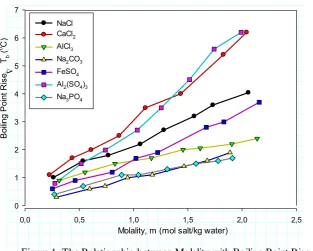
Figure-1 on for various valence of ionic salt solution, the salt used is NaCl, CaCl2, AlCl3, Na2CO3,
FeSO4, Al3(SO4)2, Na3PO4. The results obtained in the
form of the boiling temperature rise of the solution as a function of the type of valence salt and salt molality was showed in Figure-1. Then the boiling temperature difference between the salt solutions with the pure solvent
[image:3.595.142.456.100.351.2] [image:3.595.14.585.479.751.2]boiling temperature, expressed as the boiling point rise is used to calculate the parameter P using equation (7). Furthermore, the value of P parameter was used to calculate a and b in equation (8) to (13). The value of calculation of a and b and corrected results was showed in Table-1.
Table-1. Parameter value of a and b and error.
Salt
Equation of and b parameters and error
Eq (8)c Eq (9)d Eq (10)f Eq (11)g Eq (12)h Eq (13)i
a b Error
(%) a b
Error
(%) a b
Error
(%) a b
Error
(%) a b
Error
(%) a b
Error (%)
NaCL 5.643 -1.7 14.52 3.49 -0.41 6.53 5.676 0.663 68.17 2.222 1.118 4.075 5.707
-0.416 12.65 0.373
-0.062 71.17
CaCl2 1.284 -1.05 19.30 2.57 -0.26 8.13 3.471 0.782 60.40 2.00 0.494 5.12 3.471
-0.246 12.65 0.462
-0.052 68.10
AlCl3 1.63 0.477 - 10.63 1.038 -0.38 4.89 1.671 0.665 8.50 0.70 0.30 4.48 1.671 0.407 - 8.50 1.238 0.202 - 69.73
Na2CO3 2.078
-0.185 15.67 2.286
-0.046 6.58 2.086 1.082 50.37 2.335 0.035 6.23 2.086
-0.035 15.70 0.433
-0.085 43.30
FeSO4 0.242
-0.015 6.98 0.224
-0.068 6.40 0.24 0.938 7.00 0.212 0.015 5.90 0.241
-0.636 5.70 0.473
-0.203 47.09
Al2(SO4)3 0.488 -0.08 13.96 0.386
-0.028 9.66 0.741 0.848 13.76 0.302 0.07 7.61 0.47
-0.164 13.76 3.073
-0.337 59.50
Na3PO4 1.411 -0.55 15.7 0.68
-0.718 3.20 1.22 0.587 12.9 0.134 0.47 5.32 1.605
-0.723 8.1 0.98
-0.065 77.73
Ca3(PO4)2 0.32
-0.115 11.34 0.175
-0.512 9.56 0.353 0.55 13.76 0.111 0.06 9.25 0.353 -0.60 11.45 7.887 -0.15 72
c : P = a + b.m d : P = a.mb f : P = a.eb.m
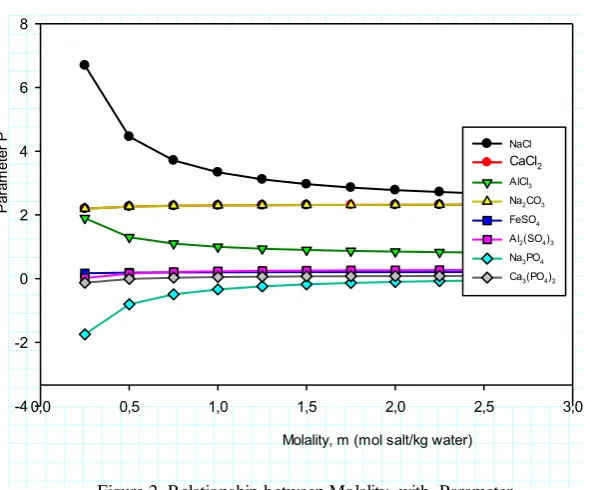
Equations (8) to (13) of Table-1 is a mathematical equations of a parameter P as valence of positive ion and valence of negative ion in salt and molality of salt solutions. All equations of table 1 show that the equations
[image:4.595.150.451.154.399.2]of P = a + b/m having a small error. For all salt when is made the equation of parameter P in the P = a + b/m then created in graphical is given in Figure-2.
Figure 2. Relationship between Molality with Parameter
Molality, m (mol salt/kg water)
0,0 0,5 1,0 1,5 2,0 2,5 3,0
P
a
ra
m
e
te
r
P
-4 -2 0 2 4 6 8
NaCl
CaCl2
AlCl3 Na2CO3 FeSO4 Al2(SO4)3
Na3PO4 Ca3(PO4)2
DISCUSSIONS
The graph on Figure-1 showed that the greater the molality of saline solution, the higher the boiling point elevation of the salt solution. Figure-1 also showed that solutions of NaCl, CaCl2 and Na2CO3 which were salt
formed from a strong acid with a strong base had a boiling point greater than other salt solution, since salt derived from strong acids and bases strong was easier to ionized and may ionized perfectly. Figure-1 showed that a high boiling point was more influenced by the salt formed from a strong acid with a strong base while the valence of ion whether positive or negative salt had less obvious effect, which meant that the stronger the nature of the electrolyte in the salt, the higher the boiling point of the Figure-1 also showed that solutions of NaCl, CaCl2 and Na2CO3 which
were salt formed from a strong acid with a strong base had a boiling point greater than other salt solution, since salt derived from strong acids and bases strong was easier to ionized and may ionized perfectly. lt of these types formed by electrostatic forces and the intermolecular ionic strength which cause the salt to have relatively higher boiling point. Means that perfect ionizing salt have large ionic strength and have a greater boiling point (Wang X.,
2009) .
From Figure-2, parameter P is not linier to the salt molality. Means in the Figure-2 the positive ion valence and negative ion on the salt is not effect on the parameter P. The value of the parameter P more influenced by the type of salt from strong acid or weak acid with strong base or weak base, this is indicated by the value parameter P that is not influenced by the positive
The mathematical equations showed constitute of parameter P as a function of the positive ions and negative ions valence of salt and m, salt solution molality. Of all these equations equation formed from a strong acid or weak acid with a strong base or weak bases, this was showed by the value of P that was not only determined by the valence positive ions and negative ions valence of salt but also the type of salt.
CONCLUSIONS
The increase of the boiling point of the electrolyte salt solution is influenced by strong acid or weak acid and strong base or weak base which form the dissolved salt. The increase of the boiling boint of the electrolyte salt solution is also influenced by the price of the solution molality. The salt prepared from strong acids and strong bases when dissolved into a water solvent of parameter P values varies depending on the molality of the salt solution prepared from the weak acid and the weak base when dissolved into the water solvent the parameter value P is considered. P parameter equation that has the smallest corrected P = a + b / m. The error level of equation P = a + m / b for all type of salt at different molality were insignificance. The smallest error of salt is FeSO4 5.7%
and the biggest of salt error is Al2(SO4)3 13.76%.
REFERENCES
Bialik M., Sedin P. and Theliander H. 2008. Boiling Point Rise Calculations in Sodium Salt Solutions. Industrial and Engineering Chemistry Research. 47(4): 1283-1287
Bird J. 2010. Basic Engineering Mathematics, 5th, p. 87, Royal Naval School of Marine Engineering, Portsmouth.
Gallus J., Lin Q., Zumbuhl A. and Meister E.C. 2001. Binary Solid-Liquid Phase Diagram Organic Compounds. Journal. Chemistry. Education. 78(7): 961.
Ge X. and Wang X. 2009. Estimation of Freezing Point Depression, Boiling Point Elevation, and Vaporization Enthalpies of Electrolyte Solutions. Industrial and Engineering Chemistry Research.48 (4): 2229-2235.
Lewandowski A. 2010. Estimation of Phase Diagram for Room Temperature Ionic Liquids. Journal of Molecular Liquids. 152: 63-65.
Maron S.H. and Lando JK.B. 1974. Fundamentals of Physical Chemistry. p. 102, Macmillan Publishing Co., Ine., New York, U.K.
Nogueira R. and Pires do Rego E.C. 2011. Development Studies of Captopril Certified Reference Material. Brazilian Journal of Pharmaceutical Sciences. 47(2).
Sukardjo. 2004. Chemical Physics. molds to 3, Rineka PT Cipta, Jakarta, Indonesia.
SUPPLEMENTARY DATA
The value of NaCl concentration in the boiling solution is used to calculate the price P using equation (7). The experiment was repeated for various concentrations to determine the various value of P. Hence, different value P used to make empirical equations in equation (8) to (13) using least squred method while m is the molality of salt in solution.
Example the calculation of parameter P, for NaCl solution with molality ± 0.25 mol/kg.
From the experiment the molality of NaCl solution found was 0.2624 mol/kg and value boiling point rise (Δ Tb) by
measuring the boiling temperature of NaCl solution is 1OC NaCl ↔ Na +
+ Cl-
For salt of NaCL value of Valence of Na is Z + = = 1 and valence of Cl is Z_ = 1 For solven is water, value Kb of water = 0.52
Therefore the value of P can be calculated with equation (7) follow: To look for constants a and b in the equation (8):
ΣP = n.a + b. Σm
6.377 P
) 1 . 1 ( P 1 ( . 0.52 . 0.2624 1
) Z . Z ( P 1 ( . K . m
Tb b
-
Σ (m.P) = a. Σm + b. Σ (m2
) This equation can be converted into
Σ P = n.a + b.Σ m 29,427 = 8.a + b. and
Σ m.P = a.Σ m + b.Σ m2
29, 5 = a.9, 25165 + b.13, 3666
By substitution obtaining a = 5,643 and b = -1, 7 So equation (8) becomes
P = 5,643 - 1, 7.m Error obtained 14.52%.
Similar calculation method is also performed for another equation of P which shown from equation (8) to (13). The calculation for other salt and other molality salt solution of CaCl2, AlCl3, Na2CO3, FeSO4, Al3(SO4)2, Na3PO4, and