ISSN 2250-3153
Problems and Factors Affecting Property Developers
Performance in the Dubai Construction Industry
Suhaib Salman Khalid1, Mushtaq Ahmad*2, Layth Salman Khalid3, Temple Chimuanya Odimegwu4
1
School of Engineering Technology, Building and construction Engineering University of Bolton Dubai Campus 2
Department of Civil Engineering, Tenaga Nasional Universiti Malaysia, (Uniten) Kajang Campus 3
Faculty of civil and Environmental Engineering, University tun hussein onn Malaysia (UTHM) 4
Department of Civil Engineering, Infrastructure University Kuala Lumpur, Malaysia
2*
Corresponding author; [email protected]
DOI: 10.29322/IJSRP.8.11.2018.p8312
http://dx.doi.org/10.29322/IJSRP.8.11.2018.p8312 Abstract
The research study aims to identify and evaluate factors that affected the performance of property developers in construction and real estate sector of Dubai, UAE with the intention to identify the root causes faced by property developers while completing construction projects. For this purpose a thorough primary and secondary research was carried out in Dubai. Quantity approached is adopted and survey among developers, consultants and contractors. Total 105 samples of questionnaire were distributed among Design engineers, Project managers, Site engineers, Procurement engineers, Quantity surveyor, General Manager, Sales manager, Finance manager and Health & Safety manager associated with developers, contractors and consultants in Dubai. It was noticed that the property developers faced acute shortage of finance apart from issues related to dropping demand of real estate properties and new strict rules imposed by Dubai government on property developers to protect investors and labours. In addition, factors like man-power, procurement, time, cost, quality, safety and lack of training provided to the employees acts as major constraints influencing the performance of the property developer negatively. The study concluded by identifying and suggesting few approaches that could possibly improve the performance of property developers in Dubai.
Key Words: Real estate, Property development, Construction, Performance, Dubai
1.0 Introduction
Dubai is the second largest city of United Arab Emirates. According to Dubai Statistics Center (2018) an estimated population of
Dubai is 2,976,455 by the end of 2017. According to the statement published by the Dubai Statistics Centre; Dubai’s economy is the
second largest economy after Abu Dhabi with an aggregate growth rate 2.8%. Unlike Abu Dhabi whose economy is based on oil
resources, Dubai’s economy is based on tourism, hospitality, construction, real estate, banking, shipping and logistics. Moreover
Dubai provides both local and international community with sound infrastructure to attract business activities and drive foreign
investments by multinational companies and wealthy individuals (DSC, 2018).
Dubai is known over decades for its state of the art architecture, high rise modern buildings, shopping malls, desert safaris, dhow
cruises and gold souks. Moreover Dubai is also known for its high class business facilities which it offers to global corporate players
in the form of superior and unmatched services. It has one of the best and modern free trade shipping ports and sound economic
infrastructure based on tourism, banking, shipping, re-export and real estate (Kawach, 2011). Dubai has transformed itself to become
first choice business and leisure destination for many high profile multinationals, business executives and individuals. The city has
ISSN 2250-3153
(Kerr, Ryburn, McLaren, & Dentons, 2013) Dubai has initiated a one of a kind concept in infrastructural development in recent past to
complement its fast developing IT, education, media and finance sectors. Clustering knowledge workers as they set up businesses in
industry specific and segmented free zones; including Dubai Media City, Dubai Internet City, Dubai Knowledge Village, Dubai
Academic City, Dubai Technology, Electronic Commerce and Media Free Zone Authority (TECOM) and International Media
Production Zone etc. Early 2002, the Dubai Government took a major initiative by reversing a law whereby emigrants were allowed
to own property in Dubai in especially dedicated areas. Those areas were called freehold areas and properties were sold on the basis of
99 year lease. According to (Al Marashi & Bhinder, 2008; Hennessy, 2005; Kannan, 2012) the decision of opening freehold property
created a construction boom in Dubai from the period of 2002 to 2008 largely driven by mega projects both in inland and offshore
areas.
Palm Islands & The World whereas inland construction comprised of Dubai Marina, Jumeirah Lake Towers & Discovery Garden
were among major off shore construction projects. However, Global financial crisis of 2008 adversely affect the business in Dubai
because it was heavily dependent on foreign direct investment (FDI) to boost its real estate and tourism industry. Many of the
organizations, businesses and individuals lost their savings in the aftermath of the global financial crisis and were therefore unable to
further invest or continue in the high scale projects offered by developers in Dubai (Al Marashi, 2008). Since then it has been an
extremely difficult struggle for the developers to operate in Dubai, as it faces strong challenges from both the customers and Dubai
Government. With the implementation of Escrow account, Real Estate & Regulatory Authority (RERA) laws property, developers
find it extremely difficult to complete undertaken projects.
The most influential factor which tops the list of problems is related to the availability of skilled and semi-skilled labour (Mushtaq et
al., 2017). At present developers in Dubai faces shortage of labour due to the existing political crisis in Middle East specifically in
countries like Egypt, Syria, Yemen, Palestine, Lebanon and Libya. It is becoming seriously difficult for them to complete on-going
projects on time due to the non-availability of labour at construction sites. Some major factors which influence the performance of a
developer are pertaining to contractors, consultants, procurement, quality, time, cost, mobilization, cash flow, competitor, culture,
communication, training and safety (Mushtaq et al., 2018; Akomah, 2016; Lindhard, 2016; Enshassi, 2009). A major problem with
contractors in Dubai is that they undertake construction work beyond their working capacity and then allot part of their construction
tasks to sub-contractors who work on their behalf. The entire process creates communication gaps between developer, contractors and
sub-contractors resulting delays in project with only developer to suffer (Elton, 2016; Purayil, 2015).
Consultants play an important role too in the entire construction process. A consultant is hired develop construction drawings,
designs, layouts and floor plans and any hindrance from the consultant side effects the performance of a developer. A major factor
affecting the performance of a developer is related to quality. Quality constraints causes long term damage to the image of the
developer and requires a lot of financial, human and technical resources to rectify all quality related constraints (Alaloul et al., 2016).
In the present scenario, another factor that affects the performance of a developer the most is related to cost and time schedule. Major
factors responsible for affecting performances of developers are related to the economic environment; closure of many small &
medium sized organizations, reluctance of financial institutions to fund in real estate sector, high job turnover, low savings and
decrease in tourists compared to previous years. These factors have created vacuum in the real estate market whereby developers find
it even harder to sell their residential and commercial properties to domestic and international buyers. The above mentioned are some
of the factors which influence the performance of the property developer in Dubai where more factors with details is elaborated in
ISSN 2250-3153
The aim of the study is to investigate, identify and evaluate factors which affect the performance of property developers in Dubai who
offer and sell residential and free hold properties to their clients. The study on factors affecting the performances of a developer is
extremely important in order to understand construction dynamics and problems faced by them pertaining to the completion of the
project. The findings of this research report will help students, consultants, contractors, developers, economists, researchers and
general readers who are interested in knowing the fundamentals of construction specifically in Dubai.
2.0 Literature Review
Dubai Government took a major initiative in the year 2002 by reversing a law related to Real Estate properties in Dubai. The new law
allowed the Expatriate community to buy and own property in free hold areas on the basis of 99 year lease as indicated by the Dubai
government. According to Abdelgalil, (2007) from the period of new law initiated in the country majority of the real estate and
property developers received over whelming response to the properties they offered on sale. The demand for real estate property was
above expectation due to numerous reasons one being the initiatives taken by the Dubai government in building infrastructure and
providing friendly economic policies. A trend was observed in Dubai whereby local & international buyers came forward and
invested in free hold real estate properties with the utmost intention of making profits for themselves and capitalizes from vibrant
economic environment (Renaud, 2012). As discussed, Dubai was one of the major cities which came into the limelight after economic
recession and it struggled to force itself as a substantial global city when it came to mighty real estate developments. Dubai being
heavily dependent on foreign direct investments (FDI) faltered to mend it ways and continue to construct planned in land and offshore
real estate properties. Back in 2008 before the beginning of the crisis many local and international buyers bought properties from large
and medium size property developers in Dubai seeking to engage in short, and long term investments.
In the aftermath of global financial crisis property developers operating in Dubai have struggled to continue constructing both
commercial and residential developments. Currently they face problems relating to the cash flows as majority of the customers are
unable to pay monthly and quarterly instalments as per the payment plan. Similarly new Real Estate & Regulatory Authority (RERA)
laws imposed by Dubai Government have created immense pressure on developers to safeguard customers’ interest at any cost. In
addition, the implementation of new Escrow account and changes in property laws by Dubai Government to protect customers’ has
made it more difficult and challenging for the property developers to continue constructing the proposed undertaken projects
(Buckley, 2014 #18). The major problems that a property developer in Dubai faces is with the lack of finances to complete the
construction projects, lack of adequate demand of property, excess supply of completed but vacant properties and minimal intent
shown by the buyers to buy the properties (Buckley & Hanieh, 2014; Renaud, 2012).
2.1 Cash Flow
First and foremost the problems which a property developer faces in Dubai are related to cash flows. Property developers are badly hit
due to the non-availability of adequate funds to complete under taken construction project. Due to the recent financial crisis the prices
of property have significantly dipped to a level below the original prices which were offered before the period of financial crisis
(Renaud, 2012; Khamis et al., 2010). Some of the property developers like Deyaar, Emaar & Nakheel have slashed property prices up
to 50% in order to attract buyers. Similarly they have also offered flexible payment plans in order to retain old customers and stop
them from defaulting. Moreover property buyers have even offered customers to swap apartments and exchange larger unit for a
ISSN 2250-3153
2.2 Demand & Supply of Property
In the period of world financial crisis in the last decade, property supply has exceeded significantly than demand in Dubai. The prices
of property and even rental in Dubai have dropped by 20% in 2011(Renaud, 2012). In the recent scenario Dubai has received huge
attention from the world again and attracts huge international investment in the property.
2.3 Escrow Account
The introduction of Escrow account law by the Government of Dubai created even more problems for the property developers after
post-recession period. The new Escrow account law restricted property developers to use funds received from the customers. The new
law ensured that all funds received by the customers would be monitored and administered by Dubai Land Department. Furthermore
the government had more control on regulating the use of funds dispersed by the buyer to the contractor. The new RERA Law No. 8
initiated further problems for the developers as now there was an audit conducted on the financial transaction by the Dubai
Government itself (Naini, 2011; Chiniara et al., 2009).
2.4 Wages Protection System (WPS)
UAE government introduced new Wages Protection System (WPS) which has created fresh problems for the developers in UAE. The
(WPS) is introduced to safeguard the wages of approximately 4 million employees who work in UAE. The step was taken by the
government in a bid to cope with companies defaulting to pay salaries. The initiative was taken in 2009 after economic recession
started. Majority of the companies in Dubai fall under the category of construction industry. Unfortunately after the global financial
crisis majority of the property developers faced cash flow problems and were unable to pay salaries of the their employees for a long
period of time. The (WPS) will now ensure that employees are paid salary on time and disputes between employers and employees
are prevented which means creating further problems for the already hampered property developers in Dubai.
2.5 Visa Law on Freehold Properties
There was lot of speculation in Dubai by the buyers that residential visa will be granted to those individuals who will buy freehold
property in Dubai. Many buyers did purchased property due to the same reason. Back in February 2009, a senior government official
also confirmed that federal law will be introduced within a year whereby visas will be granted to the property owners regardless of
their nationality, size or the value of the property. The news was initially welcomed by property developers however till date no
decision on granting visas to property owners in Dubai is taken which adds further lack of incentive for the investors to buy property
and invest in Dubai. The whole scenario works against the property developers who are keen to sale their properties hence creating
further problems for them.
2.3 Factors affecting performances of Property Developers
In the first part of the research, problems faced by property developers in Dubai were mentioned. Performance affecting property
developers are very less discussed in the literature and especial in the context of Dubai. Important and most affecting factors are
ISSN 2250-3153 2.3.1 Contractors
A contractor serves as a major stakeholder for the developer and plays a major and an important role in the whole development
process (Jin et al., 2017). A property developer obtains permit from Master Developer to initiate a residential or commercial project
after completing all necessary procedures. A developer than selects a contractor who carries out civil, mechanical, electrical,
plumbing, heating, ventilating, air-conditioning, painting and fixing work at a construction site. A contractor is also responsible for
providing material, equipment, man-power, transportation and other necessary services required for the construction of a project.
However a developer’s performance is affected by contractor in many ways if a contractor is not completing project deliverables as
scheduled. Moreover developers’ performances are negatively affected when there are discrepancies related to material, quality, time,
labour, mobilization, permits, and security of the premises, managing of the personnel and disposing construction waste by
contractors at site which is often the case (Doloi, 2012).
2.3.2 Consultants
A consultant is hired by the property developer to overlook and evaluate the performances of contractor. Consultant is also
responsible for designing construction strategies, specifications, plans, estimate variances and do inspections (Nikumbh & Pimplikar
2014). A consultant oversees construction phases, review and monitors progress and assist developer with budget planning and
construction work. A developer’s performance is hampered if a consultant is unable to provide with timely information regarding the
designated construction project. Consultants often avoid field reviews and approve construction materials without proper check-ups.
They often delay the process of inspecting the constructions site and hence delay in giving timely approvals to the contractors to move
on to the next phase. Due to the negligence of consultants construction work at site is delayed halting the progress and affecting
developers’ performances. Poor communisation among major stake holders of the projects leads to affect the performance of the
property developers (Mushtaq et al., 2018).
2.3.3 Labour
A major factor affecting the performance of the property developer in Dubai is with respect to labour shortages due to the political
crisis in countries like Egypt, Syria, Yemen and Palestine making it difficult for the developers to complete under taken projects on
time (Habibi, 2009). Similarly skilled and semi-skilled workers from India, Bangladesh, Pakistan and China prefer to work in their
own countries due to emerging economic trend and tough working conditions in Dubai respectively. This factor further creates
problems for the developer who finds it difficult to arrange appropriate labour to complete the projects. Both factors lead to more
expensive labour at a high wage rate than before which affects the performances of the developer and influence the cash flow
negatively.
2.3.4 Quality Constraints
The performance of the developer is affected due to quality constraints as contractors do not abide by the quality targets setup by the
developer. A quality related constraint damages the image of the developer and requires lot of financial, human and technical
resources to rectify all quality related constraints. Some example of quality constraints are related to the usage of low quality material
in construction. Many a time either developer or the contractor does not have sufficient budget to afford and use high quality material
in project therefore uses low cost alternatives to complete the project. This leads to frequent breakdowns, leakages and faults at
ISSN 2250-3153
affecting performances of a developer. Technical issues are related to engineering problems which occurs at construction site. It can
be issues related to civil, mechanical, and electrical works etc. whereby experienced engineers and project management teams are
required to resolve issues which may occur from time to time.
2.3.5 Time Constraints
Property developer’s performance is also affected by the time constraints. Due to subsequent delays in procuring materials, mobilizing
manpower, arranging equipment, furnishing change order requests and sorting issues related to contractors, sub-contractors,
consultants and within the internal management of property developer’s creates time constraints resulting in delay in the project.
Moreover unavailability of skilled and semi-skilled labour and restriction in working hours particularly in summers and Ramadan
month by Ministry of Labour delays the completion of project on time. Similarly from time to time Dubai Government updates and
changes many labour laws relating to accommodation, food, transportation, wages, working conditions, safety, timings and health
making it stricter for developers and contractors to comply on it.
2.3.6 Budget & Cost Constraints
A developer faces budget and cost constraints apart from quality and time constraints. Non-availability of funds hampers the flow of
work at construction site (Mushtaq et al., 2018; Jin et al., 2017). Most of the times a property developer fails to release funds to the
contractor because clients do not pay their instalments regularly according to the payment plan (Smersh et al., 200). This creates
tremendous amount of pressure on developer to continue constructing proposed residential or commercial tower due to limited
budgets. Therefore cost constraints in current economic environment affect the performance of developer considerably. As discussed
earlier financial institutions have also revised their lending policies pertaining to mortgages making it more tuff and difficult for
individuals to acquire a property loan. Majority of the customers, developers, contractors, sub-contractors, consultants, suppliers and
logistic company issued post-dated cheques to each other of later date. A common problem seen since the financial crisis struck Dubai
was the lack of funds among all of the major stakeholders and hence creating cost constraints for the developers.
2.3.7 Health and Safety
The construction industry is one of the complicated industries where each activity is different than other and most of the activities not
repeat before new activity is happened. Absences of health and safety committees on construction sites and excessive use of heavy
machinery where operators are unskilled are concluded parameter might cause high risk and accidents on construction site (Mushtaq
et al., 2018). Dubai Government and Dubai Municipality ensures that developers and consultants abide by Occupational, Health &
Safety (OH&S) Laws set by them. They ensure that contractors provide working environment that is safe and healthy for all
employees to work within. Dubai Municipality emphasizes on developers and contractors to implement best practices in their
construction approaches to protect environment and eliminate all kind of harmful and poisonous hazards. This is considered to be one
of a very important factor which influences the performance of a developer.
2.3.7 Lack of Training & Communication
Studies conducted by Mushtaq et al., (2017 & 2018) concluded lack of proper training of employees’ leads to numerous problems at
workplaces and negatively affects the performances of employees within an organization. Similar is the case with property developers
who employ workers from various part of the world. These employees’ works in a cross culture environment which often leads to
ISSN 2250-3153
3.0 Data Collection and Analysis
Quantitative research method is used. A sample size of 105 respondents chosen through stratified random sampling technique and
questionnaire was distributed among Design engineers, Project managers, Site engineers, Procurement engineers, Quantity surveyor,
General Manager, Sales manager, Finance manager and Health & Safety manager associated with developers, contractors and
consultants in Dubai. The questionnaire divided into four parts; demographic, current health of global economy, Dubai’s economy
and the performance of real estate industry in Dubai, Problem faced by the real estate developers in Dubai and factors that influenced
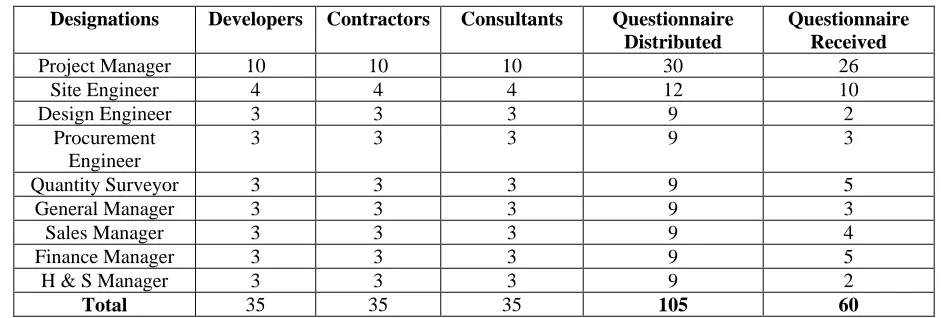
and affected the performances of Property Developer in Dubai.Demographic analysis of the study shows that total 48 males and 12
females participated in the survey. Respondents association with sector shows 15 from contractors, 24 from the developers and 21
[image:7.612.69.541.250.409.2]from the consultant participated in the survey. List of designated respondents participated is shown in the Table 1.
Table 1: Respondents Details
Designations Developers Contractors Consultants Questionnaire Distributed
Questionnaire Received
Project Manager 10 10 10 30 26
Site Engineer 4 4 4 12 10
Design Engineer 3 3 3 9 2
Procurement Engineer
3 3 3 9 3
Quantity Surveyor 3 3 3 9 5
General Manager 3 3 3 9 3
Sales Manager 3 3 3 9 4
Finance Manager 3 3 3 9 5
H & S Manager 3 3 3 9 2
Total 35 35 35 105 60
N=60
Table 2 shows the Dubai real estate market in the current and the global economy. Most of the 29 respondents believe post financial
crisis Dubai economy is poor and about 19 respondents ranked very good so it shows that many experts still believe the economy is
poor after financial crisis. In the next questions respondents rankings for the economic growth of Dubai is good but about 20%
respondents ranked poor. Regarding the recovery of the global financial & stoke markets shows good and 8 respondents ranked very
good meanwhile large ground 22 participants ranked poor but overall shows the recovery and global financial & stock market is much
better post financial crisis. Currently, the middle political crisis has created the vacuum and cause of slow country growth especially
[image:7.612.67.541.579.715.2]the growth of real estate market which is heavily supported by Middle Eastern countries in Dubai
Table 2: Real Estate Market in Dubai & Global Economy
Description Variables Frequency Percentage (%)
Implications on Dubai Economy: Post Financial Crisis Good Very Good Poor Very Poor 5 19 29 7 4.8 18.1 27.6 6.7
Economic Growth in Dubai Good
Very Good Poor Very Poor 27 9 21 3 25.7 8.6 20.0 2.9 Recovery of global Financial & Stock markets Good
Very Good
26 8
ISSN 2250-3153 Poor Very Poor 22 4 21.0 3.8 N=60
4.0 Problems Encountered by Developers
Aforementioned respondents were asked “Is the Property developers in Dubai” faced the problems with closed ended options of “Yes
and “No”. About 48 (80%) respondents said Yes and 12 (20%) said No. Another question was asked about “Influencing of Visa Law
on the buyers resulted problem for the developers most of the respondents (80%) said “yes” and 20% said “No”. Thus it can conclude
that property developers in Dubai are facing problems by implementing the strict visa policy. Table 3 listed the main issues and
problem faced by the developers in the Dubai and among cash flows (27.6) is ranked highest problem followed by demand and supply
of property in Dubai (4.8%), Escrow account (3.8%), Wages protection system (2.9%) and most of the respondent shows listed issue
[image:8.612.72.521.279.394.2]are the problem property developers facing in Dubai.
Table 3: Problems faced by Property developers in Dubai
Frequency Percentage
Valid Cash Flows 29 27.6
Demand & Supply of property in Dubai 5 4.8
Escrow Account 4 3.8
Wage Protection System 3 2.9
All of the above 19 18.1
N=60
5.0 Factors affecting Property Developer Performances
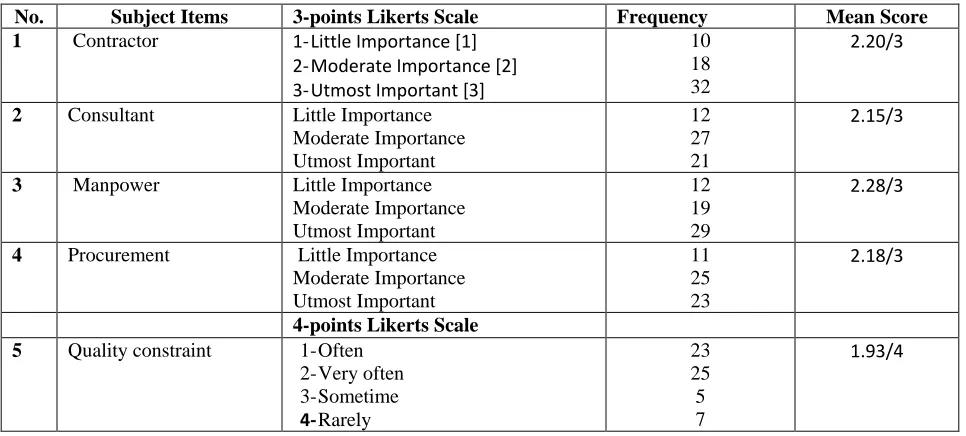
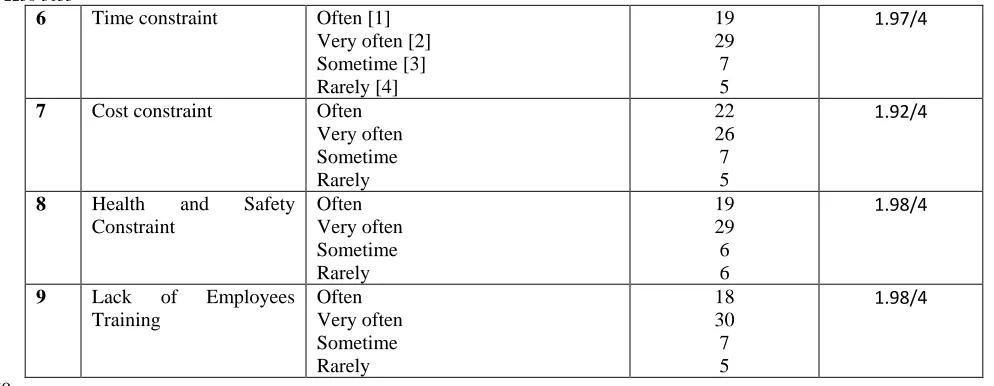
[image:8.612.66.549.493.711.2]There are 9 factors affecting the performance of the property developers of Dubai and the severity of each factors affecting the developers are in table 4
Table 4: Factor affecting the performance of Property Developers in Dubai
No. Subject Items 3-points Likerts Scale Frequency Mean Score 1 Contractor 1-Little Importance [1]
2-Moderate Importance [2] 3-Utmost Important [3]
10 18 32
2.20/3
2 Consultant Little Importance Moderate Importance Utmost Important 12 27 21 2.15/3
3 Manpower Little Importance Moderate Importance Utmost Important 12 19 29 2.28/3
4 Procurement Little Importance Moderate Importance Utmost Important 11 25 23 2.18/3
4-points Likerts Scale 5 Quality constraint 1- Often
ISSN 2250-3153
6 Time constraint Often [1] Very often [2] Sometime [3] Rarely [4] 19 29 7 5 1.97/4
7 Cost constraint Often Very often Sometime Rarely 22 26 7 5 1.92/4
8 Health and Safety
Constraint Often Very often Sometime Rarely 19 29 6 6 1.98/4
9 Lack of Employees
[image:9.612.54.551.52.245.2]Training Often Very often Sometime Rarely 18 30 7 5 1.98/4 N=60
Table 4 shows that manpower mean (2.2833) followed by procurement (2.1833), contractor (2.20) and consultant (2.15) plays big role
and most affecting on the performance of the developer in Dubai. The other affecting factors are quality, cost, time, health and safety
and lack of training mean value slightly lower than the most affecting factor which also cannot deny. [Check the likert scale used].
The most important factors in the questionnaire that affected the performance of the developer are pertaining to the question in the
questionnaire “Problems faced by Property developers in Dubai”. Majority of the respondents believed that this problem alone is
responsible for affecting the performance of the property developers in Dubai as the inadequate supply of cash flows were the major
reason due to which the property developer in Dubai were unable to complete the undertaken property projects.
The other problem was related to the demand and supply of the properties in Dubai. Currently, there are many commercial and
residential buildings that are readily available however they are vacant for a long time even after price reduction indicating that supply
has exceeded the demand significantly. Similarly, the introduction of Escrow Account law and Wage Protection System (WPS) by
Government of Dubai have made it even more challenging for the property developers to function as they are now regularly
monitored by the government and the income they receive through the buyers are first routed to the government of Dubai via Escrow
Account. In addition, the visa law has also influenced the decision making of the buyer in Dubai and negatively influenced the
performance of the property developer. At present, Dubai government is not willing to give visas to those who are buying property in
Dubai. Last but not least, other areas of problem that affected the performance of property developer are the role of stake holders
among manpower, consultant, contractors and procurement are the most affecting factors of the performance. Although, stated factors
are most affecting but time, cost and quality constraints are slightly lower which is also challenging and factor to reduce the
performance of the developers.
6.0 Conclusion and Recommendations
ISSN 2250-3153
for the property developers based in Dubai, UAE in order to positively enhance their performance and enable them to cope with financial, human, technical and legal constraints, challenges and problems. As a part of the recommendation plan, certain strategies are discussed. The property developers in Dubai should look to cut unnecessary costs in order to allow them to reduce their operational expenses. Similarly, they should look into ways by which they can attract real estate buyers. By providing additional incentives and facilities on property offered, property developers in Dubai can certainly attract many buyers. Further research should be conducted on the interest of investors and buyers to buy property on developers. Likewise, research should be conducted on legal issues that property developers face if they are unable to complete the undertaken projects. Similarly, research could be made on the projects that are completely cancelled and ways in which developers are trying to resist pressure and continue to work albeit different problems and challenges faced by them.
Reference
Abdelgalil, E. (2005). Relationship between real estate and financial sectors in Dubai economy. Journal of Property Research, 18, 1-18.
Abdelgalil, E., & Bakheet, B. A. (2007). Dubai Real Estate Sector. Data Management and.
Akomah, B. B., & Jackson, E. N. (2016). Factors Affecting the Performance of Contractors on Building Construction Projects: Central Region, Ghana. International Journal of Innovative Research and Development, 5(10).
Al Marashi, H., & Bhinder, J. (2008). From the tallest to the greenest-paradigm shift in Dubai. Paper presented at the CTBUH 8th World Congress.
Alaloul, W. S., Liew, M. S., & Zawawi, N. A. W. A. (2016). Identification of coordination factors affecting building projects performance. Alexandria Engineering Journal, 55(3), 2689-2698.
Buckley, M., & Hanieh, A. (2014). Diversification by urbanization: Tracing the property‐finance nexus in Dubai and the Gulf. International Journal of Urban and Regional Research, 38(1), 155-175.
Chiniara, W., & De La Rosa, A. (2009). Inheritance laws in the UAE. Trusts & trustees, 15(10), 781-788.
Doloi, H. (2012). Cost overruns and failure in project management: Understanding the roles of key stakeholders in construction projects. Journal of construction engineering and management, 139(3), 267-279.
Dubai Statistic Center (DSC). (2018). Populaiton Bulletin Emirate of Dubai 2016. Dubai Govt of Dubai Retrieved from https://www.dsc.gov.ae/en-us/EServices/Pages/Population-Clock.aspx.
Elton, N. (2016). Provisional Sums and Nominated Subcontracts in Construction Law; A Comparative Analysis of the Rights and Obligations of the Employer Under UAE and Common Laws. The British University in Dubai (BUiD),
Enshassi, A., Mohamed, S., & Abushaban, S. (2009). Factors affecting the performance of construction projects in the Gaza strip. Journal of Civil engineering and Management, 15(3), 269-280.
Habibi, N. (2009). The impact of the global economic crisis on Arab countries: a year-end assessment. Middle East Brief, 40(10). Hennessy, H. (2005). Dubai’s relentless construction boom. BBC News.
Jin, X., Zhang, G., Liu, J., Feng, Y., & Zuo, J. (2017). Major participants in the construction industry and their approaches to risks: a theoretical framework. Procedia Engineering, 182, 314-320. doi:10.1016/j.proeng.2017.03.100
Kannan, R. (2012). The impact of migration on the socio economic status of unskilled keralite labourers in the united Arab Emirates a sociological study.
Kawach, N. (2011, 2011). Dubai economy poised to leap in 2011. Emirates 24/7. Retrieved from http://www.emirates247.com/business/dubai-economy-poised-to-leap-in-2011-2011-05-05-1.389236
Kerr, M., Ryburn, D., McLaren, B., & Dentons, Z. (2013). Construction and projects in United Arab Emirates: overview. MULTI-JURISDICTIONAL GUIDE, 14, 1-12.
Khamis, M. M. Y., Semlali, M. A. S., Sensenbrenner, M. G., Kumah, F. Y., Hasan, M., & Prasad, A. (2010). Impact of the global financial crisis on the Gulf Cooperation Council countries and challenges ahead: International Monetary Fund.
Lindhard, S., & Larsen, J. K. (2016). Identifying the key process factors affecting project performance. Engineering, Construction and Architectural Management, 23(5), 657-673.
Mushtaq Ahmad, A. M., Jamshid Ali Turi. (2018). Safety Management in Construction Projects: Malaysia Context. International Journal of Scientific & Engineering Research (IJSER), 9(2), 1597-1606.
Mushtaq Ahmad, K. N., Osama Omar Haseneshkorfu (2017). Barriers to the implementation of industrialized building system (ibs) in high rise structure in selangor. International journal of advances in mechanical and civil engineering, 4(1).
Mushtaq Ahmad, M. S., A Dash. (2018). Collaboration Impact on The Performance in Construction Projects: Case Study Selangor Malaysia. International Journal for Science and Advance Research in Technology (IJSART), 4(1), 1019-1028.
Naini, A. (2011). Assessment of Dubai Real Estate Trust Accounts Law and Issues of Business: Evidence from Ontario and Utah. Journal of Business Inquiry: Research, Education & Application, 10(1).
ISSN 2250-3153
Purayil, A. P. P. (2015). Dealing with Late Payments-A Challenge for UAE Small Scale Subcontractors?
Renaud, B. (2012). Real estate bubble and financial crisis in Dubai: Dynamics and policy responses. Journal of Real Estate Literature, 20(1), 51-77.