Edge Detection and Object Extraction Using Unbalanced
Weights for Foreground and Background
Bhavya R
1, Vijay V
2*
Asst. Prof., Dept. of Telecommunication, K.S.I.T, Bangalore **
MISTE, Asst. Prof., Dept. of Telecommunication, K.S.I.T, Bangalore
Abstract- Edges define boundaries and are of fundamental importance in image processing. Edge detection is an important feature of image processing which is used for object extraction and finding out minute parts in applications like medical, mining, production etc. Image Edge detection significantly reduces the amount of data and filters out useless information, while preserving the important structural properties in an image. It is therefore important to find even the sensitive edges present in an image. An effort in this regard results a proposal of an edge detection algorithm which not only detects the minute edges present in the image which is very hard to detect from the existing methods, but also proves its efficiency in object extraction. A comparison with a few familiar methods is done in order to prove the efficiency and capability of the proposed method which completely suppresses the background and enhances object extraction.
Index Terms- Edge detection, Noise, Object extraction, Algorithm.
I. INTRODUCTION
dge detection refers to the process of identifying and locating sharp discontinuities in an image. The discontinuities are abrupt changes in pixel intensity which characterize boundaries of objects in a scene. Classical methods of edge detection involve convolving the image with an operator (a 2-D filter), which is constructed to be sensitive to large gradients in the image while returning values of zero in uniform regions [1]. There are an extremely large number of edge detection operators available, each designed to be sensitive to certain types of edges. Variables involved in the selection of an edge detection operator include:
Edge orientation: The geometry of the operator determines a characteristic direction in which it is most sensitive to edges [8]. Operators can be optimized to look for horizontal, vertical, or diagonal edges [1].
Noise environment: Edge detection is difficult in noisy images, since both the noise and the edges contain high-frequency content [8]. Attempts to reduce the noise result in blurred and distorted edges. Operators used on noisy images are typically larger in scope, so they can average enough data to discount localized noisy pixels. This results in less accurate localization of the detected edges [1].
Edge structure: Not all edges involve a step change in intensity. Effects such as refraction or poor focus can result in objects with boundaries defined by a gradual change in intensity
[8]. The operator needs to be chosen to be responsive to such a gradual change in those cases. Newer wavelet-based techniques actually characterize the nature of the transition for each edge in order to distinguish, for example, edges associated with hair from edges associated with a face [1].
Therefore, the objective is to do the comparison of various edge detection techniques and proposing a new method to enhance object extraction.
II. EXISTING METHODS
There are many ways to perform edge detection. The majority of different methods can be grouped into two categories [2]: a).Gradient based edge detection.
b). Laplacian based edge detection.
Only gradient based edge detection is chosen for comparison.
2.1Gradient edge detection:
The gradient method detects the edges by looking for the maximum and minimum in the first derivative of the image.
2.1.1 Robert’s cross operator:
The Roberts Cross operator performs a simple, quick to compute, 2-D spatial gradient measurement on an image [13][11]. Pixel values at each point in the output represent the estimated absolute magnitude of the spatial gradient of the input image at that point [3][7].
The operator consists of a pair of 2×2 convolution kernels as shown in Figure 1[3]. One kernel is simply the other rotated by 90°. This is very similar to the Sobel operator [7].
Figure.1: Masks used for Robert’s operator.
orientation of that gradient [9]. The gradient magnitude is given by:
(1)
Although typically, an approximate magnitude is computed using
. (2)
this is much faster to compute [7]. The angle of orientation of the edge giving rise to the spatial gradient (relative to the pixel grid orientation) is given by:
. (3)
The main reason for using the Roberts Cross operator is that it is very quick to compute [3]. Only four input pixels need to be examined to determine the value of each output pixel, and only subtractions and additions are used in the calculation [3][9]. In addition there are no parameters to set. Its main disadvantages are that since it uses such a small kernel, it is very sensitive to noise. It also produces very weak responses to genuine edges unless they are very sharp [12][10].
2.1.2 Sobel’s operator:
The operator consists of a pair of 3×3 convolution kernels as shown in Figure 2[4]. One kernel is simply the other rotated by 90° [13][11].
-1 0 1 -1 -2 -1
-2 0 2 0 0 0
[image:2.612.89.246.405.446.2]-1 0 1 1 2 1
Figure 2: Masks used by Sobel operator.
These kernels are designed to respond maximally to edges running vertically and horizontally relative to the pixel grid, one kernel for each of the two perpendicular orientations [4].The kernels can be applied separately to the input image, to produce separate measurements of the gradient component in each orientation (call these Gx and Gy) [13]. These can then be combined together to find the absolute magnitude of the gradient at each point and the orientation of that gradient [4][6]. The gradient magnitude is given by:
(4)
Typically, an approximate magnitude is computed using:
(5)
which is much faster to compute. The angle of orientation of the edge (relative to the pixel grid) giving rise to the spatial gradient is given by
(6)
The Sobel operator is slower to compute than the Roberts Cross operator [9], but its larger convolution kernel smooth’s the input image to a greater extent and so makes the operator less sensitive to noise [6]. The operator also generally produces considerably higher output values for similar edges, compared with the Roberts Cross [13][10].
2.1.3 Prewitt’s operator:
Prewitt’s operator also called as Compass Edge Detector is an alternative approach to the differential gradient edge detection [5][11]. The operation usually outputs two images, one estimating the local edge gradient magnitude and one estimating the edge orientation of the input image [13]. When using compass edge detection the image is convolved with a set of (in general 8) convolution kernels, each of which is sensitive to edges in a different orientation [12]. For each pixel the local edge gradient magnitude is estimated with the maximum response of all 8 kernels at this pixel location:
(7)
where
is the response of the kernel i at the particular pixel position and n is the number of convolution kernels [5]. The local edge orientation is estimated with the orientation of the kernel that yields the maximum response.
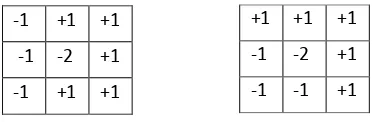
Various kernels can be used for this operation; for the following discussion we will use the Prewitt kernel [12]. Two templates out of the set of 8 are shown in Figure 3 [5].
Figure 3. Prewitt compass edge detecting templates sensitive to edges at 0° and 45°.
The whole set of 8 kernels is produced by taking one of the kernels and rotating its coefficients circularly. Each of the resulting kernels is sensitive to an edge orientation ranging from 0° to 315° in steps of 45°, where 0° corresponds to a vertical edge [9].
The maximum response |G| for each pixel is the value of the corresponding pixel in the output magnitude image. The values for the output orientation image lie between 1 and 8, depending on which of the 8 kernels produced the maximum response [12]. This edge detection method is also called edge template matching, because a set of edge templates is matched to the image, each representing an edge in a certain orientation [12]. The edge magnitude and orientation of a pixel is then determined by the template that matches the local area of the pixel the best [12].
The compass edge detector is an appropriate way to estimate the magnitude and orientation of an edge. Although differential gradient edge detection needs a rather time-consuming calculation to estimate the orientation from the magnitudes in the x- and y-directions, the compass edge
-1 +1 +1
-1 -2 +1
-1 +1 +1
+1 +1 +1
-1 -2 +1
[image:2.612.318.505.406.467.2]detection obtains the orientation directly from the kernel with the maximum response [5]. The compass operator is limited to (here) 8 possible orientations; however experience shows that most direct orientation estimates are not accurate [10]. On the other hand, the compass operator needs (here) 8 convolutions for each pixel, whereas the gradient operator needs only 2, one kernel being sensitive to edges in the vertical direction and one to the horizontal direction [5].
The result for the edge magnitude image is very similar with both methods, provided the same convolving kernel is used [12]. Prewitt operator is similar to the Sobel operator and is used for detecting vertical and horizontal edges in images.
Figure.4: Masks for the Prewitt gradient edge detector.
III. PROPOSED METHOD
This paper concentrates in classifying the dark portion of the image from the light portion and hence can filter undesired portion of the image. This can have immense application in detecting cancer cells and other minute portion of the body during surgery. The difference between the main object and background has to be chosen based on the intensity of the greyscale. If the intensity is high even a minute difference of one point would be enough but if the intensity is less then difference between the object and background has to be more.
Unbalanced weights
Here the greyscale of the pixels of the foreground and background has been given unequal weights in order to have a clear distinguish between them. Even though this type of attempt can be found in Sobel’s edge detector the proposed method proves to be more efficient.
Threshold identification
Threshold identification is required in order to distinguish between the images which have light background with dark foreground and dark background with light foreground.
Reversing the weights for light background
For images having light background with dark foreground the negative weights are decreased to -2 from -1 and the positive weights are increased to 6 from 1. But for images having dark foreground with light background negative weights are decreased to -6 from -1 and positive weights are increased to 2 from 1.
Algorithm for weight distribution
The gray levels g(x,y) of the images are obtained
If g(x, y) >T (Threshold), the magnitude of its weight is increased to 6 with same sign that it originally possessed. If g(x, y) < T, then the magnitude of its weight is decreased to 2 with same sign that it originally possessed.
Gradience of g(x, y) are computed with respect to x and y individually.
Finally both the gradience is added to obtain the final edge detection.
IV. EXPERIMENTAL RESULTS
MATLAB is a high-level language and interactive environment for numerical computation, visualization, and programming. Using MATLAB, you can analyze data, develop algorithms, and create models and applications. The language, tools, and built-in math functions enable you to explore multiple approaches and reach a solution faster than with spreadsheets or traditional programming languages, such as C/C++ or Java [14]. You can use MATLAB for a range of applications, including signal processing and communications, image and video processing, control systems, test and measurement, computational finance, and computational biology. More than a million engineers and scientists in industry and academia use MATLAB, the language of technical computing [14].
Simulation results from MATLAB.
All above said edge detection methods like Robert’s operator, Sobel operator, Prewitt operator and proposed method have been implemented on MATLAB.
The results clearly demonstrate that the proposed method has a better effect than Robert’s, Sobel and Prewitt method also the continuity of the edges are strong. Robert’s, Sobel and Prewitt method give poor and discontinuous results and include false edges.
The proposed method leads to the better performance with good continuity and suppressing the background completely thereby extracting the required object.
Figure.6: Prewitt’s Edge detector
Figure.7: Robert’s Edge detector.
Figure.8: Proposed Edge detector.
V. APPLICATIONS
The purpose of detecting sharp changes in image brightness is to capture important events and changes in properties of the world. It can be shown that under rather general assumptions for an image formation model, discontinuities in image brightness are likely to correspond to:
discontinuities in depth,
discontinuities in surface orientation, changes in material properties and
variations in scene illumination.
It is therefore required sometimes to find the minute edges present in the image rather than identifying only the edges of the main object. It finds its application in medical surgery where even the minute parts are of utmost importance as it is a matter of life.
VI. CONCLUSION
Edge detection is the important step in object extraction. Therefore it becomes important to know about various edge detection techniques. In this paper we studied some edge detection techniques of gradient based. Gradient based edge detection algorithms like Robert’s algorithm: have a major drawback of being very sensitive to noise and produces weak responses for genuine edges [9], Sobel’s algorithm: less sensitive to noise but computationally it is slower, Prewitt’s algorithm: the response of the prewitt kernel is too small and further processing has to be done. Hence different methods are compared with that of the proposed method. As seen from the results, proposed method proves its efficiency in minute edge detection and object extraction by applying unequal weights to the foreground and background and adding the gradient to obtain final edge detection. It is intended to precede this work in order to find some critical images of human body that can be of utmost help to the medical field.
REFERENCES
[1] Raman Maini , Dr.Himanshu Aggarwal,” Study and Comparison of Various Edge Detection Techniques”, International Journal of Image Processing , Vol.3,Issue 1.
[2] Ehsan Nadernejad, Sara Sharifzadeh, Hamid Hassanpour,”Edge Detection techniques: Evaluation and Comparisons”, Applied MathematicalSciences, Vol.no.2, 2008,no.31 ,1507-1520.
[3] homepages.inf.ed.ac.uk/rbf/HIPR2/roberts.htm. [4] homepages.inf.ed.ac.uk/rbf/HIPR2/sobel.htm. [5] homepages.inf.ed.ac.uk/rbf/HIPR2/prewitt.htm.
[6] J. Matthews. “An introduction to edge detection: The sobel edgedetector,”Availableat
http://www.generation5.org/content/2002/im01.asp, 2002.
[7] L. G. Roberts. “Machine perception of 3-D solids” ser. Optical and Electro-Optical Information Processing. MIT Press, 1965 .
[8] R. C. Gonzalez and R. E. Woods. “Digital Image Processing”. 2nd ed. Prentice Hall, 2002
[9] Mamta Juneja , Parvinder Singh Sandhu ,” Performance Evaluation of Edge Detection Techniques for Images in Spatial Domain”, International Journal of Computer Theory and Engineering, Vol.1 No.5 ,December,2009. [10] S.Lakshmi,Dr.V.Sankaranarayanan,” A study of Edge Detection
Techniques for Segmentation Computing Approaches”, IJCA Special Issue on “Computer Aided Soft Computing Techniques for Imaging and Biomedical Applications”CASCT, 2010.
[11] www.robotics.technion.ac.il/courses/advanced.../arl_7
[12] Tapas Kumar,G.Sahoo,” A Novel Method of Edge Detection using Cellular Automata”,International Journal of Computer Applications,(0975-8887)Volume 9,No.4,November,2010.
[13] Y.Ramadevi, T.Sridevi, B.Poornima, B.Kalyani,” SEGMENTATION AND OBJECT RECOGNITION USING EDGE DETECTION TECHNIQUES”, International Journal of Computer Science & Information Technology (IJCSIT), Vol 2, No 6, December 2010.
AUTHORS
First Author –. Vijay V. was born in Bangalore on 25th June 1981. He received Bachelor’s degree in Telecommunication Engg. from VTU in 2003. He served MICROSOFT for two years from 2003 to 2005. Presently serving K.S.I.T as Asst. Prof., in Dept of Telecommunication, Kammavari Sangham , Bangalore, Karnataka, India. . He is a life member of ISTE. He is a certified trainer from MISSION10X, Wipro in 2009. . He is also certified as a System Administrator from Microsoft in 2004