http://dx.doi.org/10.4236/jeas.2015.54015
How to cite this paper: El Ouardi, M., Qourzal, S., Alahiane, S., Assabbane, A. add Douch, J. (2015) Effective Removal of Ni-trates Ions from Aqueous Solution Using New Clay as Potential Low-Cost Adsorbent. Journal of Encapsulation and Adsorp-tion Sciences, 5, 178-190. http://dx.doi.org/10.4236/jeas.2015.54015
Effective Removal of Nitrates Ions from
Aqueous Solution Using New Clay as
Potential Low-Cost Adsorbent
Mahmoud El Ouardi*, Samir Qourzal, Said Alahiane, Ali Assabbane, Jamaa Douch Photocatalysis and Environment Team, Physical Chemistry Laboratory, Department of Chemistry, Faculty of Science, Ibn Zohr University, Agadir, Morocco
Received 19 September 2015; accepted 30 November 2015; published 3 December 2015
Copyright © 2015 by authors and Scientific Research Publishing Inc.
This work is licensed under the Creative Commons Attribution International License (CC BY). http://creativecommons.org/licenses/by/4.0/
Abstract
In the present study, we investigated the performance of clay mineral originated from a dam si-tuated in Morocco (Agadir city), as natural, low-cost, alternative and eco-friendly adsorbent for removal of nitrates ions from aqueous solution within a batch process. The clay was characterized by X-ray diffraction, Scanning Electron Microscopy (SEM), Dispersive Energy of Spectroscopy (EDS), Fourier Transform Infrared (FTIR) and surface area analysis (BET). The effects of various experimental parameters are examined such as contact time, initial concentration of pollutant, adsorbent mass and solution pH. The removal of nitrate was 71.89% at natural pH (pH = 5.1) using 1 g/l of adsorbent in 500 ml of nitrate solution having initial concentration of 300 mg/l (effect of contact time). Adsorption kinetic study revealed that the adsorption process followed first order kinetic. Theoretical correlation of the experimental equilibrium adsorption data for the Nitrate- New Clay system was properly explained by the Langmuir isotherm model. The maximum adsorp-tion capacity was Qm, exp = 244.06 mg/g at 20˚C and at natural pH (with Qm, cal = 250 mg/g). An
in-crease in adsorbent dosage inin-creased the percent removal of nitrate, R = 1 g/l was considered as optimum dose and was used for further study. The pH heavily affected the adsorption capacity, and the percentage removal was found to decrease with increase in pH. The obtained results indi-cated that this New Clay (NC) was very good adsorbent for NO3
−, interesting alternative material
with respect to more costly adsorbent used, and could be used as a highly efficient adsorbent for the separation of nitrate from drinking or waste water.
Keywords
New Clay, Adsorption Capacity, Isotherms, Nitrate Removal, Waste Water
1. Introduction
Nitrate contamination in groundwater has become an ever increasing and serious environmental threat since 1970s [1]. The excessive application of fertilizers in agriculture causes the infiltration of large quantities of this ion into underground and surface water [2]. Nitrate, due to its high water solubility [3], is possibly the most widespread groundwater contaminant in the world, imposing a serious threat to drinking water supplies and promoting eutrophication [4][5]. Elevated levels of nitrate in drinking water can cause many health problems such as gastric cancer, which results from the reduction of nitrate to nitrosamines in the stomach [6]. In addition, methemoglobinemia or blue baby syndrome, a serious health risk, occurs when nitrate is converted to nitrite, which then reacts with the hemoglobin to cause blueness of the skin of newborn infants [7]. After ingestion of plants or water high in NO3
−
, acute poisoning may occur within 30 mins to 4 hrs in cattle. Thus, the problem occurs very quickly and often the cattle are observed to be normal one day and dead the next day [8]. Ward et al. [9] reviewed the epidemiologic evidence for the linkages between drinking water NO3
−
and the risk of specific cancers, adverse reproductive outcomes, and other health outcomes in the context of the current regulatory limit for nitrate in drinking water. Nitrate contaminated water supplies have also been linked to outbreaks of infec-tious diseases in humans [10]. Literature survey reveals that NO3
−
ion also causes diabetes and is a precursor of carcinogen [11][12]. US Environmental Protection Agency (EPA) has set the maximum contamination level as 44 mg/l of NO3
−
[13].
Therefore, numerous techniques for the removal of nitrate from water samples have been reported. These in-clude biological de-nitrification [14], chemical reduction [15], reverse osmosis, electrodialysis [16], and ion ex-change [17], but adsorption has been shown to be an economical and effective alternative for removing ions from water. Adsorption, in general, is the process of collecting soluble substances that are in solution on a suita-ble interface. Clays have been widely used as adsorbents for pollution control due to their high uptake ability, non-toxicity and large potential for ion exchange [18].
The main aim of our study is to determine the adsorption capacity of locally available natural clay materials originated from a dam situated in Morocco (Agadir city) and to remove nitrate from its aqueous solution. Hence, the effect of various parameters on the adsorption process has been investigated: contact time, solution pH, and mass of adsorbent and nitrate concentration. The results are presented and discussed in this study. It is interest-ing to note that the adsorption of cationic and anionic dyes on this support is examined in our laboratory [19].
2. Materials and Methods
2.1. Materials
Potassium nitrate used in the present study was of analytical grade and was obtained from Sigma-Aldrich. 1000 mg/l stock solution of nitrate was prepared. The required concentration of nitrate solution was obtained by serial dilution of the stock nitrate solution.
The untreated clay used in this work is crushed then sifted in order to get fractions <80 μm. Afterwards, the support is rinsed many times with distilled water, of pH = 6.5 and of conductivity = 1.1 μS. After every rinse, the clay is put in a sedimentation test, and during one hour of decantation, we recover the two thirds of superna-tant volume. Finally, it is placed in an oven between 110˚C and 120˚C during 24 hrs, before being subjected to different adsorptions.
2.2. Nitrate Adsorption Studies
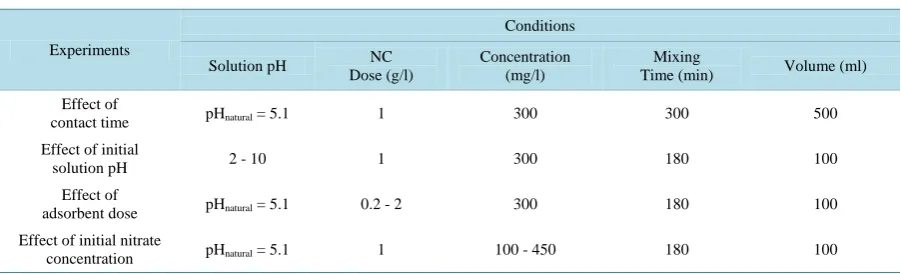
Table 1. Experimental conditions.
Experiments
Conditions
Solution pH Dose (g/l) NC Concentration (mg/l) Time (min) Mixing Volume (ml)
Effect of
contact time pHnatural = 5.1 1 300 300 500
Effect of initial
solution pH 2 - 10 1 300 180 100
Effect of
adsorbent dose pHnatural = 5.1 0.2 - 2 300 180 100
Effect of initial nitrate
concentration pHnatural = 5.1 1 100 - 450 180 100
easily applied [20][21]. On calculating the difference between the initial and final concentrations of nitrate in aqueous phase, the amount of adsorbed nitrate at equilibrium (Qe) was calculated (Equation (1)) and the
percen-tage of nitrate removed was also determined (Equation (2)):
(
0)
e eq
Q = C −C R (1)
( )
(
0)
0
Percentage of nitrate removed % C Ceq 100 C
−
= × (2)
with:
Qe: Quantity of nitrate adsorbed per gram of adsorbent (mg/g);
C0: Initial concentration (mg/1); Ce: Equilibrium concentration (mg/l);
R: Mass of adsorbent per liter of aqueous solution (g/1).
2.3. Characterization of the Adsorbent
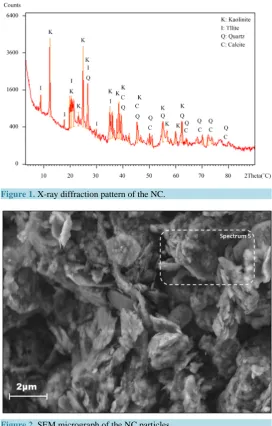
X-ray powder diffraction pattern was obtained using the diffractometer XPERT-PRO type PW3064, with copper anticathode. The spectrum of XRD shows that the untreated clay contains a large amount of the Kaolinite (38%) and Illite (24%) followed by Quartz (20%) and Calcite (18%) (Figure 1), the amounts of the phases were calcu-lated by X’PERT Highscore plus software. The BET (Brunauer-Emmett-Teller) surface area of clay was meas-ured by nitrogen (N2) adsorption-desorption isotherms at (77 K) using an automated gas sorption system (Mi-cromeritics, Quantachrome instrument). The determined surface area is equal to 53.47 m2/g.
The morphology of the clay powder particles was observed by scanning electron microscopy (SEM, using Zeiss Ultra Plus) with a coupled energy dispersive spectroscopy (EDS), at 5 kV, after gold coating. The mor-phological aspects of the clay particles are outlined in Figure 2. The porosity of the surface is clearly visible. The scanning electron micrograph shows the typical regular shapes of the clay particles. The powder is rich in porous and microporous particles that formed noticeable cage-like cavities. These cavities provide suitable binding sites for nitrates ions. On the basis of this fact, it can be concluded that our clay presents an adequate morphology for nitrate adsorption. The chemical compositions (Table 2) have been checked using energy dis-persive spectroscopy (EDS) (Figure 3). The point of zero charge (PZC) of our clay was determined by the solid addition method [22]. The pHPZC of NC was determined to be 5.6.
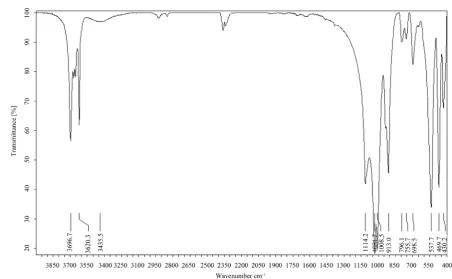
In order to determine the surface functional groups, the Fourier Transform Infrared (FTIR) spectrum of the NC was obtained by using a Bruker Vertex 70 spectrophotometer, at a resolution of 4 cm−1 and averaging over 20 scans, in the range 400 - 4000 cm−1.
Figure 1. X-ray diffraction pattern of the NC.
Figure 2. SEM micrograph of the NC particles.
Figure 4. FTIR spectra of the NC.
Table 2. Atomic and mass percentage of the NC constituents.
Elements O C Na Mg Al Si K Ca Ti Fe
% Atomic 67.71 3.27 0.26 1.03 7.20 14.82 1.36 2.29 0.26 1.79
% Mass 53.58 1.94 0.30 1.24 9.61 20.59 2.63 4.53 0.62 4.94
3. Results and Discussion
3.1. Effect of Contact Time
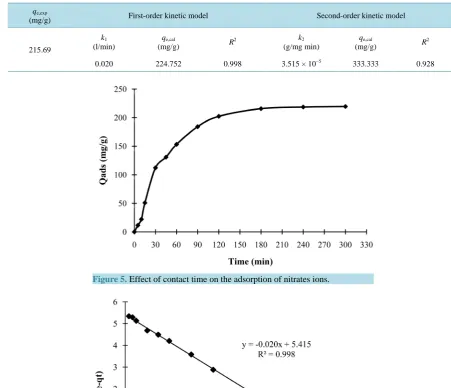
Adsorption kinetic is an important characteristic for evaluating the efficiency of adsorption. The kinetic behavior of this process was studied at natural pH (Table 1). It appears from Figure 5 that the kinetic of nitrate adsorp-tion consists of two phases, an initial rapid phase when the process is very fast and a second slower phase when it reaches equilibrium. The initial high rate of nitrate uptake is probably due to the greater availability of binding sites near the surface of the clay [25]. The kinetic study indicates that the adsorption equilibrium state is reached after a contact time of 180 min with Qe = 215.69 mg/g since no change in the adsorbed amount is detected
af-terward.
3.2. Adsorption Kinetics
The kinetics of adsorption data was processed to understand the dynamics of adsorption process in terms of the order of rate constant. Two kinetic models were applied to the adsorption kinetic data in order to investigate the behavior of adsorption process of nitrates onto our clay. These models are the pseudo-first-order and pseu-do-second-order models.
The pseudo-first-order equation is given by [26]:
(
)
1
dqt dt=K qe−qt (3)
where qe and qt are the amounts of nitrate adsorbed (mg/g) at equilibrium and at time t (min), respectively, and
[image:5.595.86.543.403.452.2]The pseudo-second order process can be written as follows [27]:
(
)
22
dqt dt=K qe−qt (4)
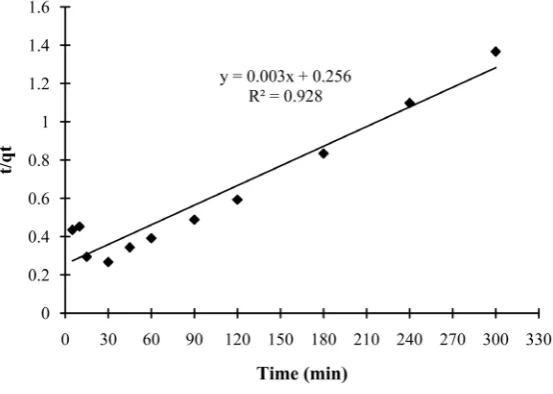
where k2 g/(min.mg) is the rate constant of second-order adsorption. The fit of these models was checked by each linear plot of ln(qe − qt) versus t (Figure 6), (t/qt) versus t (Figure 7). The kinetic constants and correlation
[image:6.595.79.531.220.608.2]coefficients of the pseudo-first-order and the pseudo-second-order models are given in Table 3. The results showed that the adsorption system followed the pseudo-first-order model, with correlation coefficient value of 0.998 which is better than the second-order-model (0.928) and the calculated qe,cal value from the model is also in good agreement with the experimental value qe,exp (Table 3).
Table 3. Kinetic parameters for the adsorption of nitrates ions onto NC.
qe,exp
(mg/g) First-order kinetic model Second-order kinetic model
215.69
k1
(l/min)
qe,cal
(mg/g) R
2 k2
(g/mg min)
qe,cal
(mg/g) R
2
[image:6.595.173.456.514.706.2]0.020 224.752 0.998 3.515 × 10⁻⁵ 333.333 0.928
Figure 5. Effect of contact time on the adsorption of nitrates ions.
Figure 7. Pseudo-second-order kinetic plots.
3.3. Effect of Initial Solution pH
The effect of initial solution pH on nitrate removal is illustrated in Figure 8. The initial pH values were adjusted by adding 0.1 M of HCl or NaOH. It is evident from the figure that the percentage removal of nitrate decreased from 92.72% to 38.96% for increase in pH from 2 to 10. The variation of adsorption with pH can be explained by the electrostatic interaction between the adsorbent and adsorbate. With increase of pH values, the surfaces gradually decrease in the extent of positive charging and become negative at pH of about 6 (the isoelectric points of clay is at pH = 5.6). Thus, the high adsorption capacity at low pH is mainly due to the strong electros-tatic interaction between the positively charged sites of adsorbent (presence of H+) and the anions. However, lower sorption of the nitrates ions at alkaline pH could be attributed to the abundance of OH− ions which will compete with the pollutant for the same sorption sites [28].
3.4. Effect of Adsorbent Dose
For studying the effect of mass of adsorbent on nitrate adsorption onto our clay, experiments were performed with varying amounts of adsorbent, ranging from 0.2 to 2 g/l (Figure 9). It is evident from the figure that the removal of nitrate increased from 9.84% (0.2 g/l) to 72.97% (1 g/l). This study revealed that the adsorption ca-pacity of clay increased with increase in adsorbent dose up to a particular region and then reaches an equilibrium level at higher doses. However it is observed that after dosage of 1 g/l, there was no significant change in per-centage removal of nitrate. This may be due to the overlapping of active sites at higher dosage. So, there was not any appreciable increase in the effective surface area resulting due to the conglomeration of adsorbent particles [29]. Thus, 1 g/l in 100 ml of nitrate solution was considered as an optimum dose and was used for further study.
3.5. Effect of Initial Nitrate Concentration
Figure 8. Influence of pH on the adsorption of nitrates ions.
Figure 9. Effect of adsorbent dose on the adsorption of nitrates ions.
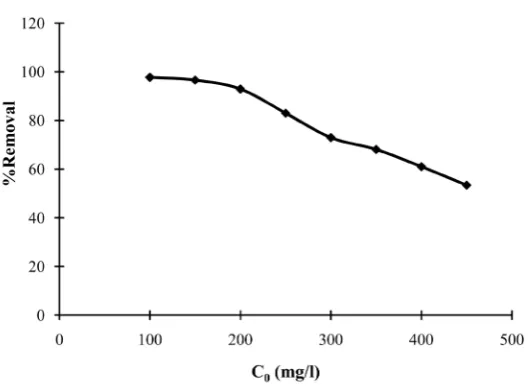
Figure 10. Influence of initial concentration on the adsorption of nitrates
[image:8.595.183.448.500.694.2]3.6. Adsorption Isotherms Studies
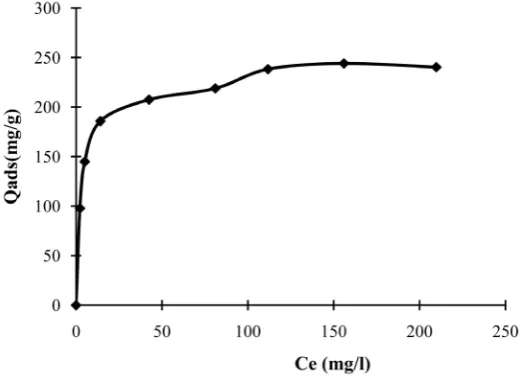
Adsorption isotherms indicate distribution of adsorbate between solution and adsorbent at the equilibrium state of the adsorption process [33]. It is expressed by relating the amount of adsorbate taken up per gram of adsor-bent, Qe (mg/g), to the equilibrium solution concentration, Ce (mg/l), and at different concentrations of nitrates
ions solutions (100, 150, 200, 250, 300, 350, 400 and 450 mg/l), (Figure 11). Monolayer saturation is attained. The type of adsorption isotherm model is very important in order to understand the adsorption behavior for sol-id-liquid adsorption system [34]. In the present study, Langmuir and Freundlich models were tested to study the adsorption behavior of nitrate as these two are the most commonly used.
3.6.1. Langmuir Isotherm
The Langmuir isotherm is based on the assumptions that adsorption takes place at specific homogeneous sites within the adsorbent, there is no significant interaction among adsorbed species, and the adsorbent is saturated after the formation of one layer of adsorbate on the surface of adsorbent [35]. The Langmuir isotherm equation can be written as follows:
(
1)
e m L e L e
Q =Q K C +K C (5)
The linearized form of Equation (5) can be written as Equation (6):
1
e e L m e m
C Q = K ⋅Q +C Q (6)
where Ce is the equilibrium concentration of the remaining solute in the solution (mg/l), Qe is the amount of the
solute adsorbed per mass unit of adsorbent at equilibrium (mg/g), Qm is the amount of adsorbate per mass unit of
adsorbent at complete monolayer coverage (mg/g), and KL (l/mg) is a Langmuir constant. In this work, we used
the linear form of Langmuir isotherm equation and therefore, a plot 1/Qe versus 1/Ce should indicate a straight
line. The Qm and KL values were calculated from the slopes (1/Qm) and intercepts (1/KL∙Qm) of linear plots of
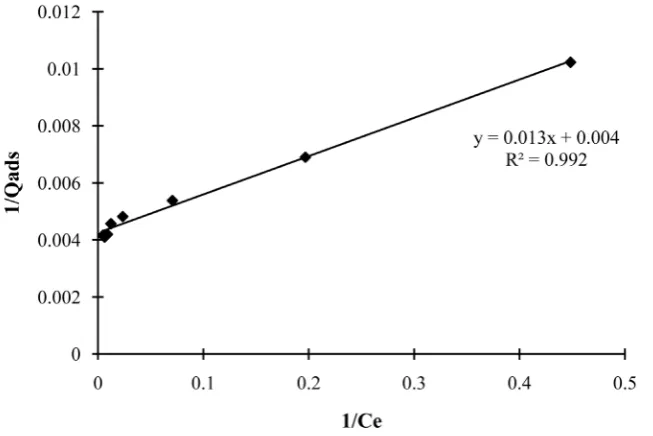
1/Qe versus 1/Ce (Figure 12). The Langmuir isotherms parameters are given in Table 4. The isotherm data of
layered clay fits well the Langmuir equation with a correlation coefficient, R2 = 0.992 and shows excellent li-nearity (Figure 12). The theoretical monolayer saturation capacity Qm,cal is in good agreement with the experi-mental value Qm, exp (Table 4).
One of the essential characteristics of the Langmuir model could be expressed by a dimensionless constant called equilibrium parameter, RL which is determined as follows [36][37]:
0
1 1
L
L
R
K C =
+ (7)
[image:9.595.183.447.514.705.2]where C0 is the initial nitrate concentration (mg/l). The value of RL indicates the type of isotherm to be irreversible
Figure 12. Langmuir isotherm linear plots for the adsorption of nitrates ions.
Table 4. Langmuir and Freundlich isotherm parameters.
Qm, exp
(mg/g)
Langmuir parameters Freundlich parameters
Qm, cal
(mg/g)
KL
(l/mg) R
2 R
L
KF
((mg/g) (1/mg) 1/n) 1/n R
2
244.06 250 0.307 0.992 7.186 × 10⁻³≤ RL≤ 0.031 99.683 0.181 0.908
(RL = 0), favorable (0 < RL < 1), linear (RL = 1), or unfavorable (RL > 1). RL values are well within the defined
range (Table 4) and indicate that the adsorption process is favorable.
3.6.2. Freundlich Isotherm
The Freundlich isotherm was proposed as the earliest empirical equation and was shown to be consistent with exponential distribution of active centers, characteristic of heterogeneous surfaces [38]. This model states that reactions take place in several sorption sites and as the amount of solute adsorbed rises, the binding surface energy decreases exponentially which means multilayer sorption [39]. The isotherm is expressed by the follow-ing equation:
1n
e f e
Q =K ⋅C (8)
Logarithmic form of Equation (8) can be written as Equation (9):
( )
lnQe=lnKf + 1n ⋅lnCe (9)
where Kf ((mg/g) (1/mg) 1/n) and n are Freundlich adsorption isotherm constants, the values of Kf and 1/n are
determined from the intercept and slope of the linear regressions and are presented in Table 4. A plot of ln(Qe)
versus ln(Ce) for the studied samples is shown in Figure 13. The value 1/n gives an indication on the validity of
[image:10.595.91.541.343.409.2]Figure 13. Freundlich isotherm linear plots for the adsorption of nitrates ions.
4. Conclusion
This study investigated the adsorption characteristics and suitability of our new natural clay mineral (NC) as po-tential adsorbent for the removal of nitrate from aqueous solutions using batch technique. The results showed that this clay could be used as potential sorbent and it was highly effective as low-cost adsorbent for the removal of nitrates ions from aqueous solutions. The batch study parameters, pH of solution, mass of adsorbent, initial solution concentration and contact time were found to be effective on the adsorption processes. The adsorption equilibrium was attained within 3 hrs. From the studies conducted, it was established that pseudo-first-order ki-netic model described the kiki-netic rate. The percentage removal was found to decrease with increase in pH. The increase in adsorbent dosage increased the percent removal of nitrate due to the increase in adsorbent surface area in adsorbent dosage. The equilibrium data fitted well the Langmuir isotherm equation and this adsorbent showed large uptake capacity of nitrate (Qm, cal = 250 mg/g, Qm, exp = 244.06 mg/g). Our clay was a potential candidate as a highly efficient adsorbent for remediation of nitrate contaminated water owing to its exceptional uptake capacity as well as high selectivity for this anionic contaminant.
References
[1] Jeong, J.Y., Kim, H.K., Kim, J.H. and Park, J.Y. (2012) Electrochemical Removal of Nitrate Using ZVI Packed Bed Bipolar Electrolytic Cell. Chemosphere, 89, 172-178. http://dx.doi.org/10.1016/j.chemosphere.2012.05.104
[2] Zhou, M., Fu, W., Gu, H. and Lei, L. (2007) Nitrate Removal from Groundwater by a Novel Three-Dimensional Elec-trode Biofilm Reactor. Electrochimica Acta, 52, 6052-6059. http://dx.doi.org/10.1016/j.electacta.2007.03.064
[3] Thomson, T.S. (2001) Nitrate Concentration in Private Rural Drinking Water Supplies in Saskatchewan Canada.
Bulle-tin of Environmental Contamination and Toxicology, 66, 64-70. http://dx.doi.org/10.1007/s001280000206
[4] Majumdar, D. and Gupta, N. (2000) Nitrate Pollution of Groundwater and Associated Human Health Disorders. Indian
Journal of Environmental Health, 42, 28-39.
[5] Tate, C.H. and Arnold, K.F. (1990) Health and Aesthetic Aspects of Water Quality. In: Pontius, F.W., Ed., Water
Quality and Treatment, McGraw-Hill Inc., New York, 63-156.
[6] Zheng, Y. and Wang, A. (2010) Nitrate Adsorption Using Poly(dimethyl diallyl ammonium chloride)/polyacrylamide hydrogel. Journal of Chemical & Engineering Data, 55, 3494-3500. http://dx.doi.org/10.1021/je100169r
[7] Chatterjee, S. and Woo, S.H. (2009) The Removal of Nitrate from Aqueous Solutions by Chitosan Hydrogel Beads.
Journal of Hazardous Materials, 164, 1012-1018. http://dx.doi.org/10.1016/j.jhazmat.2008.09.001
[8] Romano, N. and Zeng, C. (2009) Evaluating the Newly Proposed Protocol of Incorporated Potassium in Nitrate Toxic-ity Experiments at Different Salinities: A Case Study with the Tiger Prawn, Penaeus monodon, Juveniles. Aquaculture, 289, 304-309. http://dx.doi.org/10.1016/j.aquaculture.2009.01.035
Report: Drinking-Water Nitrate and Health Recent Findings and Research Needs. Environmental Health Perspectives, 113, 1607-1614. http://dx.doi.org/10.1289/ehp.8043
[10] Lin, S.H. and Wu, C.L. (1996) Removal of Nitrogenous Compounds from Aqueous Solution by Ozonation and Ion Exchange. Water Research, 30, 1851-1857. http://dx.doi.org/10.1016/0043-1354(95)00329-0
[11] Kostraba, T.N., Gay, E.C., Rewers, M. and Hamman, R.F. (1992) Nitrate Levels in Community Drinking Waters and Risk of IDDM, An Ecological Analysis. Diabetes Care, 15, 1505-1508. http://dx.doi.org/10.2337/diacare.15.11.1505
[12] Wolfe, A.H. and Patz, J.A. (2002) Reactive Nitrogen and Human Health: Acute and Long-Term Implications. AMBIO:
A Journal of the Human Environment, 31, 120-125. http://dx.doi.org/10.1579/0044-7447-31.2.120
[13] US Environmental Protection Agency (2000) Drinking Water Standards and Health 614 Advisories. US Environmental Protection Agency, Office of Water, Washington DC, 822-B-00-001.
[14] Schipper, L.A. and Vukovic, M.V. (2001) Five Years of Nitrate Removal, Denitrification and Carbon Dynamics in a Denitrification Wall. Water Research, 35, 3473-3477. http://dx.doi.org/10.1016/S0043-1354(01)00052-5
[15] Hu, H.Y., Goto, N. and Fujie, K. (2001) Effect of pH on the Reduction of Nitrite in Water by Metallic Iron. Water
Re-search, 35, 2789-2793. http://dx.doi.org/10.1016/S0043-1354(00)00570-4
[16] Pinter, A. and Batista, J. (2006) Improvement of an Integrated Ion-Exchange/Catalytic Process for Nitrate Removal by Introducing a Two-Stage Denitrification Step. Applied Catalysis B: Environmental, 63, 150-159.
http://dx.doi.org/10.1016/j.apcatb.2005.10.006
[17] Baes, B.U., Jung, Y.H., Han, W.W. and Shin, H.S. (2002) Improved Brine Recycling during Nitrate Removal Using Ion Exchange. Water Research, 36, 3330-3340. http://dx.doi.org/10.1016/S0043-1354(02)00012-X
[18] Churchman, G.J., Gates, W.P., Theng, B.K.G. and Yuan, G. (2006) Clays and Clay Minerals for Pollution Control Handbook of Clay Science. Developments in Clay Science, 1, 625-675.
[19] El ouardi, M., Qourzal, S., Alahiane, S., Sakr, F., Assabbane, A. and Douch, J. (2014) Agadir Clay Materials as a New Adsorbent to Remove Cationic and Anionic Dyes from Aqueous Solutions. International Journal of Scientific
Re-search and Thesis, 3, 72-87.
[20] Robinson, J.W. and Hsu, C.J. (1969) Spectroscopic Studies of the Chromotropic Acid-Nitrate Reaction. Analytica
Chimica Acta, 44, 51-58. http://dx.doi.org/10.1016/S0003-2670(01)81736-0
[21] West, P.W. and Lyles, G.L. (1960) A New Method for the Determination of Nitrates. Analytica Chimica Acta, 23, 227- 232. http://dx.doi.org/10.1016/S0003-2670(60)80057-8
[22] Vieira, A.P., Santana, S.A.A., Bezerra, C.W.B., Silva, H.A.S., Chaves, J.A.P., de Melo, J.C.P., da Silva Filho, E.C. and Airoldi, C. (2009) Kinetics and Thermodynamics of Textile Dye Adsorption from Aqueous Solutions Using Babassu Coconut Mesocarp. Journal of Hazardous Materials, 166, 1272-1278. http://dx.doi.org/10.1016/j.jhazmat.2008.12.043
[23] Njoya, A., Nkoumbou, C., Grosbois, C., Njopwouo, D., Njoya, D. and Courtin-Nkoumbou, A. (2006) Genesis of Mayouom Kaolin Deposit (Western Cameroun). Applied Clay Science, 32, 125-140.
http://dx.doi.org/10.1016/j.clay.2005.11.005
[24] Dawodu, F.A. and Akpomie, K.G. (2014) Simultaneous Adsorption of Ni(II) and Mn(II) Ions from Aqueous Solution unto a Nigerian Kaolinite Clay. Journal of Materials Research and Technology, 3, 129-141.
[25] Bhattacharrya, G. and Gupta, S.S. (2006) Pb(II) Uptake by Kaolinite and Montmorillonite in Aqueous Medium: Influ-ence of Acid Activation of the Clays. Colloids and Surfaces A, 277, 191-200.
http://dx.doi.org/10.1016/j.colsurfa.2005.11.060
[26] Guo, X.L., Zengle, L. and Park, X.S. (2008) Ammonium and Potassium Anaerobically Removal for Digested Waste-water Using Natural Clinoptilolite Followed by Membrane Pretreatment. Journal of Hazardous Materials, 151, 125- 133. http://dx.doi.org/10.1016/j.jhazmat.2007.05.066
[27] Bagherifam, S., Lakzian, A., Ahmadi, S., Rahimi, F. and Halajnia, A. (2010) Uranium Removal from Aqueous Solu-tions by Wood Powder and Wheat Straw. Journal of Radioanalytical and Nuclear Chemistry, 283, 289-296.
http://dx.doi.org/10.1007/s10967-009-0348-4
[28] Elmoubarki, R., Mahjoubi, F.Z., Tounsadi, H., Moustadraf, J., Abdennouri, M., Zouhri, A., ElAlbani, A. and Barka, N. (2015) Adsorption of Textile Dyes on Raw and Decanted Moroccan Clays: Kinetics, Equilibrium and Thermodynam-ics. Water Resources and Industry, 9, 16-29. http://dx.doi.org/10.1016/j.wri.2014.11.001
[29] Tahir, H. (2005) Comparative Trace Metal Contents in Sediments and Liquid Waste from Tanneries and Their Remov-al of Chromium Using Zeolite 5A. Electronic Journal of Environmental, Agricultural and Food Chemistry, 4, 23-29. [30] Moussavi, G. and Khosravi, R. (2011) The Removal of Cationic Dyes from Aqueous Solutions by Adsorption onto
Pistachio Hull Waste. Chemical Engineering Research and Design, 89, 2182-2189.
http://dx.doi.org/10.1016/j.cherd.2010.11.024
Kao-lins. Applied Clay Science, 43, 465-472. http://dx.doi.org/10.1016/j.clay.2008.11.008
[32] Islam, M. and Patel, R. (2011) Physicochemical Characterization and Adsorption Behavior of Ca/Al Chloride Hydro-talcite-Like Compound towards Removal of Nitrate. Journal of Hazardous Materials, 190, 659-668.
http://dx.doi.org/10.1016/j.jhazmat.2011.03.094
[33] Wang, Y., Gao, B.Y., Yue, W.W. and Yue, Q.Y. (2007) Adsorption Kinetics of Nitrate from Aqueous Solutions onto Modified Wheat Residue. Colloids and Surfaces A, 308, 1-5. http://dx.doi.org/10.1016/j.colsurfa.2007.05.014
[34] Han, X., Wang, W. and Ma, X. (2011) Adsorption Characteristics of Methylene Blue onto Low Cost Biomass Material Lotus Leaf. Chemical Engineering Journal, 171, 1-8. http://dx.doi.org/10.1016/j.cej.2011.02.067
[35] Hoda, N., Bayram, E. and Ayranci, E. (2006) Kinetic and Equilibrium Studies on the Removal of Acid Dyes from Aqueous Solutions by Adsorption onto Activated Carbon Cloth. Journal of Hazardous Materials, 137, 344-351.
http://dx.doi.org/10.1016/j.jhazmat.2006.02.009
[36] Mohan, D. and Chander, S. (2006) Single, Binary, and Multicomponent Sorption of Iron and Manganese on Lignite.
Journal of Colloid and Interface Science, 299, 76-87. http://dx.doi.org/10.1016/j.jcis.2006.02.010
[37] Seliem, M.K., Komarneni, S., Byrne, T., Cannon, F.S., Shahien, M.G., Khalil, A.A. and Abd El-Gaid, I.M. (2013) Removal of Nitrate by Synthetic Organosilicas and Organoclay: Kinetic and Isotherm Studies. Separation and
Purifi-cation Technology, 110, 181-187. http://dx.doi.org/10.1016/j.seppur.2013.03.023
[38] Gammoudi, S., Srasra, N.F. and Srasra, E. (2012) Nitrate Sorption by Organosmectites. Engineering Geology, 124, 119-129. http://dx.doi.org/10.1016/j.enggeo.2011.10.009
[39] Yusan, S. and Akyil, S. (2008) Sorption of Uranium (VI) from Aqueous Solutions by Akaganeite. Journal of
Hazard-ous Materials, 160, 388-395. http://dx.doi.org/10.1016/j.jhazmat.2008.03.009
[40] Tsai, W.T., Chang, Y.M., Lai, C.W. and Lo, C.C. (2005) Adsorption of Basic Dyes in Aqueous Solution by Clay Ad-sorbent from Regenerated Bleaching Earth. Applied Clay Science, 29, 149-154.