Munich Personal RePEc Archive
Opinion as Incentives
Che, Yeon-Koo and Kartik, Navin
Columbia University, University of California-San Diego
8 August 2006
Opinions as Incentives
∗
Yeon-Koo Che
†Navin Kartik
‡November 26, 2007
Abstract
We study a model where a decision maker (DM) must select an adviser to advise her about an unknown state of the world. There is a pool of available advisers who all have the same underlying preferences as the DM; they differ, however, in their prior beliefs about the state, which we interpret as differences of opinion. We derive a tradeoff faced by the DM: an adviser with a greater difference of opinion has greater incentives to acquire information, but reveals less of any information she acquires, via strategic disclosure. Nevertheless, it is optimal to choose an adviser with at least some difference of opinion. The analysis reveals two novel incentives for an agent to acquire information: a “persuasion” motive and a motive to “avoid prejudice.” Delegation is costly for the DM because it eliminates both of these incentives. We also study the relationship between difference of opinion and difference of preference.
∗We would like to acknowledge the input of Jimmy Chan at early stages of this project. We thank
Nageeb Ali, Oliver Board, Arnaud Costinot, Vince Crawford, Jean Guillaume Forend, Michihiro Kandori, Kohei Kawamura, Li Hao, Bart Lipman, Eric Maskin, Carolyn Pitchik, Jennifer Reinganum, Mike Riordan, Ed Schlee, Joel Sobel, and various seminar audiences for their opinions. David Eil, Chulyoung Kim, and Uliana Loginova provided excellent research assistance. Kartik is grateful to the Institute for Advanced Study at Princeton and the National Science Foundation for funding; he also thanks the Institute for its hospitality.
†Economics Department, Columbia University;[email protected].
“Difference of opinion leads to enquiry.” — Thomas Jefferson
1
Introduction
To an average 17th century (geocentric) person, the emerging idea of the earth moving defied common sense. If the earth revolves, then “why would heavy bodies falling down from on high go by a straight and vertical line to the surface of the earth... [and] not travel, being carried by the whirling earth, many hundreds of yards to the east?” (Galilei, 1953, p. 126) In the face of this seemingly irrefutable argument, Galileo Galilei told a famous story, via his protagonist Salviati in Dialogue Concerning the Two Chief World Systems, about how an observer locked inside a boat, sailing at a constant speed without rocking, cannot tell whether the boat is moving or not. This story, meant to persuade critics of heliocentrism, became a visionary insight now known as theGalilean Principle of Relativity.
The above example dramatically illustrates how a different view of the world (literally) might lead to an extraordinary discovery. But the theme it captures is hardly unique. Indeed, difference of opinion is valued in many organizations and situations. Corporations seek diversity in their workforce allegedly to tap creative ideas. Academic research thrives on the pitting of opposing hypotheses. Government policy failures are sometimes blamed on the lack of a dissenting voice in the cabinet, a phenomenon coined “groupthink” by psychologists (e.g. Janis, 1972). Debates between individuals can be more illuminating when they take different views; in their absence, debaters often create an artificial difference by playing “devil’s advocate.”
Difference of opinion would be obviously valuable if it inherently entails a productive advantage in the sense of bringing new ideas or insights that would otherwise be unavailable. But could it be valuable even when it brings no direct productive advantage? Moreover, are there any costs of people having differing opinions? This paper explores these questions by examining incentive implications of difference of opinion.
the state, which occurs with probability that is increasing in his effort. The signal could take the form of scientific evidence obtainable by conducting an experiment, witnesses or documents locatable by investigation, a mathematical proof, or a convincing insight that can reveal something about the state. Effort is unverifiable, however, and higher effort imposes a greater cost on the adviser. After the adviser privately observes the information, he strategically communicates with the DM. Communication takes the form of verifiable disclosure: sending a message is costless, but the adviser cannot falsify information, or equivalently, the DM can judge objectively what a signal means. The adviser can, nev-ertheless, choose not to disclose the information he acquires. Finally, the DM takes her decision optimally given her updated beliefs after communication with the adviser.
This framework captures common situations encountered by many organizations. For instance, managers solicit information from employees; political leaders seek the opinion of their cabinet members; scientific boards consult experts; and journal editors rely on referees. But the model permits broader interpretations: the DM could be the general public (such as 17th century intelligent laymen), and its decision is simply the posterior belief on some matter. In turn, the adviser could be a scientist (such as Galileo), investigator, special counsel, a lobbying group, or a debater trying to sway that belief.
It is often the case, as in the examples mentioned above, that an adviser is interested in the decision taken by DM. We assume initially that the adviser has the same fundamental preferences as the DM about which decision to take in each state, but that he may have a difference of opinion about what the unknown state is likely to be. More precisely, the adviser may disagree with the DM about the prior probability distribution of the unknown state, and this disagreement is common knowledge.1 Such disagreements abound in many circumstances, as has also been argued by, for example,Banerjee and Somanathan (2001). Consider a firm that must decide which of two technologies to invest in. All employees share the common goal of investing in the better technology, but no one knows which this is. Different employees may hold different beliefs about the viability of each technology, leading to open disagreements about where to invest. As another example, a general and her advisers may agree on the objective of winning a war at minimum cost. They may have
1
different beliefs, however, about the strength of the opposition troops, leading to disagree-ments about how many of their own troops should be sent into combat—disagreedisagree-ments that do not change even when told each other’s views. Many political disagreements also seem best viewed through the lens of different prior beliefs rather than different fundamental preferences (Dixit and Weibull, 2007).2
Specifically, we model the adviser’s opinion as the mean of his (subjective) prior about the state, normalizing the DM’s opinion to mean zero. We suppose that there is a rich pool of possible advisers in terms of their opinion, and advisers are differentiated only by their opinion, meaning that a difference of opinion does not come with better ability or lower cost of acquiring information. This formulation allows us to examine directly whether difference of opinion alone can be valuable to the DM, even without any direct productive benefits.3
Our main results concern a tradeoff associated with difference of opinion. To see this, suppose first that effort is not a choice variable for the adviser. In this case, the DM has no reason to prefer an adviser with a differing opinion. In fact, unless the signal is perfectly informative about the state, the DM will strictly prefer a like-minded adviser— i.e., one with the same opinion as she has. This is because agents with different opinions, despite having the same preference, will generally arrive at different posteriors about what the right decision is given partially-informative signals. Consequently, an adviser with a differing opinion will typically withhold some information from the DM. This strategic withholding of information entails a welfare loss for the DM, whereas no such loss will arise if the adviser is like-minded.
When effort is endogenous, the DM is also concerned with the adviser’s incentive to exert effort; all else equal, she would prefer an adviser who will exert as much effort as possible. We find that differences of opinion provide incentives for information acquisition, for two distinct reasons. First, an adviser with a difference of opinion is motivated to persuade the DM. Such an adviser believes that the DM’s opinion is wrong, and that by acquiring a signal, he is likely to move the DM’s decision towards what he perceives to be the right decision. This motive does not exist for the like-minded adviser. Second, and more subtle,
an adviser with difference of opinion will exert effort to avoid “prejudice.” Intuitively,
2
To mention just two examples, consider disagreements about how serious the global warming problem is (if it exists all, to some) and how to protect a country against terrorism.
3
in equilibrium, an adviser withholds information that is contrary to his opinion, for such information will cause the DM to take an action that the adviser dislikes. Recognizing this, the DM discounts the advice she receives and chooses an action contrary to the adviser’s opinion, unless the advice is corroborated by a hard evidence—this equilibrium feature of strategic interaction is what we call a “prejudicial effect.” Hence, an adviser with difference of opinion has incentives to seek out information in order to avoid prejudice, a motive that does not exist for a like-minded adviser.
In summary, we find that difference of opinion entails a loss of information through strategic communication, but creates incentives for information acquisition. This tradeoff resonates with common notions that, on the one hand, diversity of opinion causes increased conflict because it becomes harder to agree on solutions—this emerges in our analysis as worsened communication; on the other hand (as was recognized by Jefferson, quoted in our epigraph) it also leads to increased efforts to understand and convince other individuals— this emerges here as increased information acquisition.
How should the DM resolve this tradeoff between information acquisition and transmis-sion? We find thatthe DM prefers an adviser with some difference of opinion to a perfectly like-minded one. The reason is that an adviser with sufficiently small difference of opinion engages in only a negligible amount of strategic withholding of information, so the loss associated with such a difference is negligible. By the same token, the prejudicial effect and its beneficial impact on information acquisition is also negligible when the difference of opinion is small. In contrast, the persuasion motive that even a slight difference of opinion generates—and thus the benefit the DM enjoys from its impact on increased effort—is non-negligible by comparison. Therefore, the DM strictly benefits from an adviser with at least a little difference in opinion, and would not optimally choose a like-minded adviser from a rich pool of available individuals. Applied to a broader context, our result implies that new discoveries are more likely to come from those with different views about the world (than would be explainable by their population composition), and the public interest can be served by them even though they will not reveal what they know all the time.
for acquiring a signal—he expects to systematically shift the DM’s decision closer to his preferred decision—an adviser with only a difference of preference has no such expectation, and thus has no persuasion motive. For this reason, having an adviser who differs only in preferences yields no clear benefit for the DM.
Nevertheless, we find the difference of preferences to be valuable in the presence of difference of opinion. In other words, an adviser with a different opinion has more incentive to acquire information if he also has an preference bias in the direction congruent to his opinion. This complementarity between preference and opinion implies that the incentive effect on information acquisition will be larger when the adviser is a zealot—one who believes that evidence is likely to move the DM’s action in the direction of his preference bias—than when he is a skeptic—one who is doubtful that information about the state of the world will support his preference bias.
We explore some other issues in Section 6. Of particular interest, we find that the benefit from difference of opinion is lost when the DM delegates the decision authority to the adviser. This observation sheds new light on the merit of delegation in organizational settings (cf.Aghion and Tirole,1997). We also discuss implications of the adviser’s percep-tion of the precision of his own informapercep-tion, or hisconfidence, finding that more confident advisers exert more effort.
Our paper builds on the literature on strategic communication, combining elements from the structure of conflicts of interest in Crawford and Sobel(1982) with the verifiable disclosure game first introduced by Grossman (1981) and Milgrom (1981). The key inno-vation in this regard is that we endogenize information acquisition and focus on the effects of difference of prior beliefs. It is best to postpone a discussion of the most closely related literature to Section 7, after a full development of our model and analysis. Section 8 then concludes with a discussion of our modeling choices and possible extensions. The Appendix contains omitted proofs.
2
Model
Prior Beliefs. We allow individuals—potential advisers and the DM—to have different prior beliefs about the state. Specifically, while all individuals know the state is distributed according to a Normal distribution with variance σ2
0 > 0, individual i believes the mean of the distribution is µi. The prior beliefs of each person are common knowledge.4 We will refer to an adviser’s prior belief as his opinion or type, even though it is not private information. Two individuals,i and j, have differences of opinion if µi 6=µj. Without loss of generality, we normalize the DM’s prior to µ = 0. An adviser with µ = 0 is said to be
like-minded.
Full-information preferences. All players have the same von Neumann-Morgenstern state-dependent payoff from the DM’s decision:
ui(a, ω) :=−(a−ω)2.
Thus, were the state ω known, players would agree on the optimal decisiona =ω. In this sense, there is no fundamental preference conflict. We allow for such conflicts in Section 5. The quadratic loss function we use is a common specification in the literature: it captures the substantive notion that decisions are progressively worse the further they are from the true state, and technically, makes the analysis tractable.
Information Acquisition. Regardless of the chosen adviser’s type, his investigation technology is the same, described as follows. He chooses the probability that his investi-gation is successful, p ∈ [0,1], at a cost c(p). The function c(·) is smooth, c′′(·) > 0, and
satisfies the Inada conditions c′(0) = 0 and c′(p)→ ∞ as p→1. We will interchangeably
refer topas an effort level or a probability.5 With probabilityp, the adviser obtains a sig-nal about the state,s∼N(ω, σ2
1). That is, the signal is drawn from aNormal distribution with mean equal to the true state and variance σ2
1 >0. With complementary probability 1−p, he receives no signal, denoted by ∅. Thus, effort is success-enhancing in the sense of Green and Stokey (2007) and increases information in the sense of Blackwell (1951).
4
Although game-theoretic models often assume a common prior, referred to as theHarsanyi Doctrine, there is a significant and growing literature that analyzes games with heterogenous priors. Banerjee and Somanathan (2001) and Spector (2000) do so in communication models with exogenous information; in other contexts, examples are Eliaz and Spiegler (2006), Harrington (1993), Van den Steen (2005), and
Yildiz(2003). For a general discussion about non-common priors, seeMorris(1995).
5
Communication. After privately observing the outcome of his investigation, the cho-sen adviser strategically discloses information to the DM. The signal s is “hard” or non-falsifiable. Hence, the adviser can only withhold the signal if he has obtained one; if he did not receive a signal, he has no choice to make. The signal may be non-manipulable because there are large penalties against fraud, information is easily verifiable by the DM once received (even though impossible to acquire herself), or information is technologically hard to manipulate.6
Timing. The sequence of events is as follows. First, the DM selects an adviser from an available set of adviser types, [µ, µ], where µ < 0 < µ. The selected adviser then chooses effort and observes the outcome of his investigation, both unobservable to the DM. In the third stage, the adviser either discloses or withholds any information acquired. Finally, the DM takes a decision.
As this is multi-stage Bayesian game, it is appropriate to solve it using the concept of perfect Bayesian equilibrium (Fudenberg and Tirole, 1991), or for short, equilibrium
hereafter. We restrict attention to pure strategy equilibria.
2.1
Interim Bias
As a prelude to our analysis, it is useful to identify the players’ preferences over decisions when the state is not known. Throughout, we use subscripts DM and A for the decision maker and adviser, respectively. Under the Normality assumptions in our information structure, the signal and state joint distribution can be written, from the perspective of player i=DM, A, as
ω s
!
∼N µi
µi
, σ
2
0 σ02
σ2
0 σ20+σ12 !!
.
Without a signal about the state, the expected utility of playeriis maximized by actionµi. Suppose a signalsis observed. The posterior of playeriis thatω|s∼N(ρs+ (1−ρ)µi,σ˜2),
6
Our formulation follows, for example, Shin (1998). Alternatively, we could assume that the adviser must make an assertion that the signal lies in some compact set, S, or R, with the only constraint that
where ρ := σ20
σ2
0+σ21 and ˜σ
2 := σ20σ21
σ2
0+σ21 (Degroot, 1970).
7 Player i = DM, A therefore has the
following expected utility from action a given s:
E[ui(a, ω)|s, µi] = −E[(a−ω)2|s, µi] =−(a−E[ω|s, µi])2−Var(ω|s)
= −(a− {ρs+ (1−ρ)µi})2−σ˜2. (1)
Clearly, the expected utility is maximized by an action α(s|µi) := ρs+ (1−ρ)µi, where
α(s|µ) is simply the posterior mean for a player with typeµ.
Equation (1) shows that so long as signals are not perfectly informative of the state (ρ < 1), differences of opinion generate conflicts in preferred decisions given any signal, even though fundamental preferences agree. Accordingly, we define the interim bias as
B(µ) := (1−ρ)µ. This completely captures the difference in the two players’ preferences over actions given any signal because α(s|µ) =α(s|0) +B(µ). Observe that for anyµ6= 0,
sign(B(µ)) = sign(µ) but |B(µ)| < |µ|. Hence, while interim bias persists in the same direction as prior bias, it is of strictly smaller magnitude because information about the state mitigates prior disagreement about the optimal decision. This simple observation turns out to have significant consequences. The magnitude of interim bias depends upon how precise the signal is relative to the prior; differences of opinion matter very little once a signal is acquired if the signal is sufficiently precise, i.e. for any µ, B(µ)→ 0 as ρ →1 (equivalently, asσ2
1 →0 or σ02 → ∞).
3
Equilibrium Disclosure Behavior
In this section, we analyze the behavior of adviser and DM in the disclosure sub-game.8 For this purpose, it will be sufficient to focus on the interim bias of the adviser, B(µ), and the DM’s belief about the probability which the adviser observes a signal, p < 1.9 Hence, we take the pair (B, p) with p <1 as a primitive parameter in this section. Our objective
7
Since σ2
0 >0 and σ 2
1 >0,ρ ∈(0,1). However, it will be convenient at points to discuss the case of
ρ= 1; this should be thought of as the limiting case whereσ2
1= 0, so that signals are perfectly informative
about the state. Similarly forρ= 0.
8
Strictly speaking, we are abusing terminology in referring to this as a “sub-game,” because the DM does not observe the adviser’s effort choice,p.
9
is to characterize the set S∈R of signals that the adviser withholds and the action a∅ the
DM chooses when there is no disclosure. Plainly, when s is disclosed, the DM will simply choose her most-preferred action, α(s|0) =ρs.
We start by fixing an arbitrary action a ∈ R the DM may choose in the event of nondisclosure, and ask whether the adviser will disclose his signal if he observes it, assuming that B ≥0 (the logic is symmetric when B <0). The answer can be obtained easily with the aid of Figure 1 below. The figure depicts, as a function of the signal, the action most preferred by the DM (ρs) and the action most preferred by the adviser (ρs+B): each is a straight line, the latter shifted up from the former by the constant B. Since the DM will choose the action ρs whenever s is disclosed, the adviser will withholds whenever the nondisclosure action a is closer to his most-preferred action, ρs+B, than the disclosure action, ρs. This reasoning identifies the nondisclosure interval as the “flat” region of the solid line, which corresponds to the nondisclosure action chosen by the DM.
✻
✲
B
B
Signal Action
ρs+B
a
ρs
a ρ a
ρ − 2B
ρ
✟✟✟✟
✟✟✟✟
✟✟✟✟
✟✟✟✟ ✟✟
[image:11.612.130.524.325.596.2]✟ ✟ ✟ ✟ ✟ ✟ ✟ ✟ ✟
Figure 1: Optimal non-disclosure region
if and only if s∈R(B, a) := [l(B, a), h(a)] defined by
h(a) = a
ρ, (2)
l(B, a) = h(a)− 2B
ρ . (3)
Ats =h(a), the DM will choosea=α(h(a)|0) whethersis disclosed or not, so the adviser is indifferent. Ats =l(B, a), the adviser is again indifferent between disclosure, which leads to α(l(B, a)|0) = a−2B, and nondisclosure, which leads to a, because they are equally distant from his most preferred action, a−B. For any s /∈ [l(B, a), h(a)], disclosure will lead to an action closer to the adviser’s preferred action than would nondisclosure.10
Next, we characterize the DM’s best response in terms of her nondisclosure action, for an arbitrary (measurable) set S ⊂ R of signals that the adviser may withhold. Her best response is to take the action that is equal to her posterior expectation of the state given nondisclosure, which is computed via Bayes rule:
aN(p, S) =
pρRSsγ(s; 0)ds
pRSγ(s; 0)ds+ 1−p, (4)
where γ(s;µ) is a Normal density with mean µ and variance σ2
0 +σ12. Notice that the DM uses her own prior µDM = 0 to update her belief. It is immediate that if S has zero expected value, then aN(p, S) = 0. More importantly, for any p > 0, aN(p, S) increases whenSgets larger in the strong set order.11 Intuitively, the DM rationally raises her action when she suspects the adviser of not disclosing larger values of s.
An equilibrium of the disclosure sub-game requires that both the DM and the adviser must play best responses. This translates into a simple fixed point requirement:
S =R(B, a) and aN(p, S) =a. (5)
Given any (B, p), let (S(B, p), a∅(B, p)) be a pair that satisfies (5), and let s(B, p) and
s(B, p) respectively denote the smallest and the largest elements ofS(B, p). The following result ensures that these objects are uniquely defined; its proof, and all subsequent proofs not in the text, are in the Appendix.
10
We assume nondisclosure when indifferent, but this is immaterial.
11
Proposition1. (Disclosure Equilibrium)For any(B, p)withp <1, there is a unique equilibrium in the disclosure sub-game. In equilibrium, boths(B, p)ands(B, p)are equal to zero if B = 0, are strictly decreasing in B when p > 0, and strictly decreasing (increasing) in p if B >0 (if B < 0). The nondisclosure action a∅(B, p) is zero if B = 0 or p= 0, is
strictly decreasing in B for p >0, and is strictly decreasing (increasing) in p if B >0 (if
B <0).
It is straightforward that the adviser reveals his information fully to the DM if and only if B = 0, i.e. there is no interim bias. To see the effect of an increase in B (when
p > 0), notice from (2) and (3) that if the DM’s nondisclosure action did not change, the upper endpoint of the adviser’s nondisclosure region would not change, but he would withhold more low signals. Consequently, by (4), the DM must adjust his nondisclosure action downward, which has the effect of pushing down both endpoints of the adviser’s nondisclosure region. The new fixed point must therefore feature a smaller nondisclosure set (in the sense of strong set order) and a lower nondisclosure action from the DM. We call this theprejudicial effect, since a more upwardly biased adviser is in essence punished with a lower inference when he claims not to have observed a signal.12 The prejudicial effect implies in particular that for any p > 0 andB 6= 0, a∅(B, p)B <0.
The impact of p can be traced similarly. An increase in p makes it more likely that nondisclosure from the adviser is due to withholding of information rather than a lack of signal. If B > 0 (resp. B < 0), this makes the DM put higher probability on the signal being low (resp. high), leading to a decrease (resp. increase) in the nondisclosure action, which decreases (resp. increases) the nondisclosure set in the strong set order.
Finally, it is worth emphasizing that the adviser’s optimal disclosure behavior depends directly only on his interim bias, B, and the DM’s nondisclosure action, a∅. In particular,
it does not depend directly on the probability of acquiring a signal, although the the DM’s belief about this probability affects the DM’s nondisclosure action, and thereby, indirectly, the adviser’s disclosure choice.
12
4
Opinions as Incentives
This section studies how the adviser’s opinion affects his incentive to acquire information, and the implications this has on the optimal type of adviser for the DM. As a benchmark, the following Proposition establishes the fairly obvious point that, absent information ac-quisition concerns, the optimal adviser is a like-minded one.
Proposition 2. (Exogenous Effort) If the probability of acquiring a signal is held fixed at some p >0, the uniquely optimal type of adviser for the DM is like-minded, i.e. an adviser with µ= 0.
Proof. For any p > 0, S(µ, p) has positive measure when µ >0, whereas S(0, p) has measure zero. Hence, the adviserµ= 0 reveals the signal whenever she obtains one, whereas an adviser with µ 6= 0 withholds the signal with positive probability. The result follows from the fact that DM is strictly better off under full disclosure than partial disclosure.
We now turn to the the case where information acquisition is endogenous. To begin, suppose the DM believes that an adviser with type µ ≥ 0 will choose effort pe. The following Lemma decomposes the payoff for the adviser from choosing effort p, denoted
UA(p;pe, B, µ), in a useful manner.13
Lemma 1. The adviser’s expected utility form choosing effort p can be written as
UA(p;pe, B, µ) =K(B, µ, pe) +p∆(B, µ, pe)−c(p),
where
∆(B, µ, pe) := Z
s /∈S(B,pe)
(a∅(B, pe)−(ρs+B))2−B2
γ(s;µ)ds
(6)
and
K(B, µ, pe) :=−
Z
(a∅(B, pe)−(ρs+B))2γ(s;µ)ds−σ˜2. (7)
The first term in the decomposition, K(·), is the expected utility when a signal is not observed. Equation (7) expresses this utility by iterating expectations over each possible
13
Even though the interim biasBis determined byµ, we write them as separate variables in the funcion
UA(·) to emphasize the two separate effects caused by changes in the difference of opinion: changes in prior
value ofs, reflecting the fact that the DM takes decisiona∅(·) without its disclosure whereas
the adviser’s preferred action if the signal were s is ρs+B, and that ˜σ2 is the residual variance of the state given any signal. The second term in the decomposition,p∆(·), is the probability of a obtaining a signal multiplied by the expected gain from obtaining a signal. Equation (6) expresses the expected gain, ∆(·), via iterated expectations over possible signals. To understand it, note that the adviser’s gain is zero if a signal is not disclosed (whenever s ∈S(B, pe)), whereas when a signal is disclosed, the adviser’s utility (gross of the residual variance) is −B2, because the DM takes decision ρs.
We are now in a position to characterize the adviser’s equilibrium effort level. Given the DM’s belief, pe, the adviser will choose p to maximize UA(p;pe, B, µ). By the Inada conditions on effort costs, this choice is interior and characterized by the first-order condi-tion:
∂UA(p;pe, B, µ)
∂p = ∆(B, µ, p
e)−c′(p) = 0.
Equilibrium requires that the DM’s belief be correct, so we must have pe =p. Therefore, in equilibrium, we must have
∆(B, µ, p) = c′(p). (8)
Lemma 2. For any (B, µ), p is an equilibrium effort choice if and only if p ∈ (0,1) and satisfies (8). For any (B, µ), an equilibrium exists.
We cannot rule out that there may be multiple equilibrium effort levels for a given type of adviser. The reason is that the DM’s action in the event of nondisclosure depends on adviser’s (expected) effort, and the adviser’s equilibrium effort in turn depends on the DM’s action upon nondisclosure.14 For the remainder of the paper, for each (B, µ), we focus on the highest equilibrium effort, denoted ¯p(B, µ). This is somewhat analogous to the standard practice of allowing the DM to select the equilibrium she prefers in principal-agent models. Since the interim bias B is uniquely determined by B(µ) = (1−ρ)µ, we can define the equilibrium probability of information acquisition as a function solely of µ,
p(µ) := ¯p(B(µ), µ). The following is a central result of the paper.
Proposition3. (Incentivizing Effect of Difference of Opinion)An adviser with a greater difference of opinion acquires information with higher probability: p(µ′)> p(µ)if
|µ′|>|µ|.
14
To elucidate the intuition behind the result, first ignore the strategic disclosure of in-formation, assuming instead that the outcome of the adviser’s investigation is publicly observed. In this case, there is no prejudice associated with nondisclosure, so the DM will choose a∅(B, p) = 0 independent of B or p. It follows from a mean-variance
decomposi-tion that −σ2
0 −µ2 is the expected utility for the adviser conditional on no signal, and
−σ˜2−(B(µ))2 is the expected utility conditional on getting a signal. Hence, the adviser’s marginal benefit of acquiring a signal, denotedApub(µ), is given by15
∆pub(µ) = σ02−σ˜2 | {z } uncertainty reduction
+µ2−(B(µ))2
| {z }
persuasion
. (9)
Acquiring information benefits the adviser by reducing uncertainty, as shown by the first term. But moreover, the adviser expects to persuade the DM: without information, the adviser views the DM’s decision as biased by µ, their ex-ante disagreement in beliefs; whereas with information, the disagreement is reduced to the interim bias, B(µ) = (1−
ρ)µ < µ. Sinceµ2−(B(µ))2 is strictly increasing in |µ|, the persuasion incentive is strictly larger for an adviser with a greater difference of opinion. This leads to such an adviser exerting more effort towards information acquisition. A related intuition is that the adviser expects actionρµconditional on acquiring information, whereas he knows that action 0 will be taken without information. Hence, the adviser believes that by acquiring information, he can persuade the DM to take an action that is closer in expectation to his own prior.16 The benefit of such persuasion is more valuable to an adviser with greater difference of opinion.
Now consider the case where information is private, and the adviser strategically com-municates. Suppose the DM expects effort pe from the adviser of type µ. Then he will choosea∅(B(µ), pe) when a signal is not disclosed. Since the adviser always has the option
to disclose all signals, his marginal benefit of acquiring information and then strategi-cally disclosing it, as defined by equation (6), is at least as large as the marginal benefit from (sub-optimally) disclosing all signals, which we shall denote ∆pri(µ, a
∅(B(µ), pe)). By
15
Alternatively, one can also verify that equation (6) simplifies to equation (9) if the nondisclosure region
S(·) =∅anda∅(·) = 0, as is effectively the case under public observation of signal.
16
mean-variance decomposition again, we have
∆(B(µ), µ, pe) ≥ ∆pri(µ, a∅(B(µ), pe))
= σ02−σ˜2 | {z } uncertainty reduction
+µ2−(B(µ))2
| {z }
persuasion
+ (a∅)2−2a∅µ
| {z }
avoiding prejudice
. (10)
Recall from Proposition 1the prejudicial effect: for any pe>0 andµ6= 0, a∅(B(µ), pe)µ <
0. Hence, for any pe > 0 and µ 6= 0, ∆pri(µ, pe) > ∆pub(µ): given that information is private, the DM’s rational response to the adviser claiming a lack of information affects the adviser adversely—this is the prejudicial effect—and to avoid such an adverse inference, the adviser is even more motivated to acquire a signal than when information is public.17
Propositions 1 and 3 identify the tradeoff faced by the DM: an adviser with a greater difference of opinion exerts more effort, but reveals less of any information he may acquire. Does the benefit from improved incentives for information acquisition outweigh the loss from strategic disclosure? We demonstrate below that this is indeed the case for at least some difference in opinion.
Proposition 4. (Optimality of Difference of Opinion) There exists someµA6= 0
such that it is strictly better for the DM to appoint an adviser of type µA over a like-minded
adviser.
The optimality of difference of opinion is largely due to the persuasion effect. As the difference of opinion µis raised slightly, the persuasion motive it generates creates a non-negligible benefit in increased information acquisition, whereas the prejudicial effect (which entails both communication loss and information acquisition gain) is negligible. This can be seen most clearly when the signal is perfectly informative,ρ= 1. In this case,B(µ) = 0, so there is full disclosure in the communication stage, analogous to a situation where information is public; hence, appointing an adviser with difference of opinion is clearly desirable.18 By continuity, there is a set of ρ’s near 1 for which the adviser of type µ is
17
The proof of Proposition3in the Appendix shows that the incentive to avoid prejudice combined with the incentive to persuade leads an adviser with a greater difference of opinion to exert more effort, taking into account the greater strategic suppression of signals by such an adviser.
18
Formally, the DM’s utility from appointing an adviser of typeµwhenρ= 1 is
UDMρ=1(µ) :=−σ20(1−p(µ)),
which is simply the ex-ante variance in the state multiplied by the probability of not acquiring a signal, because when a signal is acquired, there is no residual uncertainty. Proposition 3 implies that for any
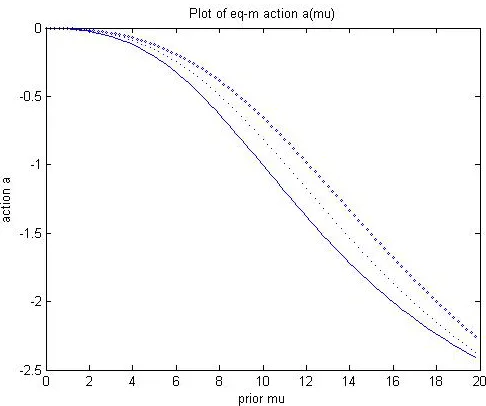
Figure 2: Equilibrium non-disclosure action as a function of adviser’s opinion. Parameters:
c(p) = (1−p4p)2; σ21 = 2; highest curve corresponds to ρ= 109, middle curve to ρ=
8
9, and lowest
curve toρ= 78.
better for the DM than the like-minded adviser. This argument verifies Proposition 4 for all ρ sufficiently close to 1. The proof in the Appendix shows that for any ρ, however far from 1, there is some adviser sufficiently near type 0 who is in fact better for the DM than an adviser of type 0.
Our main results are illustrated in Figures2and3, which show numerical computations with the specified parameter values.19 Figure 2 illustrates that the nondisclosure action is decreasing in µ, which happens for two reasons: directly through the prejudicial effect (holding p fixed, an increase in µ causes a decrease in a∅), and indirectly through the
incentivizing effect, because an adviser with higher µ exerts more effort (when µ > 0), leading to a higher p, which in turn also causes a decrease in a∅ (when µ > 0) as noted
in Proposition 1. Figure 3 illustrates that the DM never finds it optimal to appoint a like-minded expert. It also shows that as signals gets more precise (so that information acquisition is more important to the DM), the DM may prefer to appoint an expert with greater difference of opinion.
19
Figure 3: DM’s utility as a function of adviser’s opinion. Parameters: c(p) = (1−p4p)2; σ12 = 2;
highest curve corresponds to ρ= 7
8, middle curve to ρ=
8
9, and lowest curve to ρ=
9 10.
5
Opinions and Preferences
We have thus far assumed that the DM and the available pool of advisers all have the same fundamental preferences, but differ in opinions. This seems reasonable in some circum-stances, as previously suggested. In this section, we augment the space of types to allow for fundamental preference conflicts. This allows us to explore a number of issues, such as: Will the DM benefit from an adviser with different preferences in the same way she will benefit from one with a different opinion? If an adviser can be chosen from a very rich pool of advisers differing both in opinions and preferences, how will the DM combine the two attributes? For instance, for an adviser with a given preference, will she prefer him to be a
skeptic—one who doubts that discovering the state of the world will shift the DM’s action in the direction of his preferences bias—or a zealot—one who believes that his preference will be also be “vindicated by the evidence.”
To begin, suppose, as is standard in the literature, a player’s preferences are indexed by a single bias parameter b ∈ [b, b], with b < 0 < b, such that his state-dependent von Neumann-Morgenstern utility is
The adviser therefore now has a two-dimensional type (that is common knowledge), (b, µ). The DM’s type is normalized as (0,0).
Interim but not ex-ante equivalence. Similar to earlier analysis, it is straightforward that an adviser of type (b, µ) desires the action α(s|b, µ) :=ρs+ (1−ρ)µ+b when signal
s is observed. Hence, such an adviser has an interim bias of B(b, µ) := (1− ρ)µ+b. This immediately suggests the interchangeability of the two kinds of biases—preferences and opinions—in the disclosure sub-game. For any adviser with opinion bias µ and no preference bias, there exists an adviser with only preference biasb = (1−ρ)µsuch that the latter will have precisely the same incentives to disclose the signal as the former. Formally, given the same effort level, the disclosure sub-game equilibrium played by the DM and either adviser is the same.
This isomorphism does not extend to the information acquisition stage. To see this, start with an adviser of type (0, µ), i.e., with opinion biasµ but no preference bias. When such an adviser does not acquire a signal, he expects the DM to make a decision that is distorted by at leastµfrom what he regards as the right decision.20 Consider now an adviser of type (µ,0), i.e., with preference biasb=µand no opinion bias. This adviser also believes that, absent disclosure of a signal, the DM will choose an action that is at leastµaway from his most preferred decision. Crucially, however, their expected payoffs from disclosing a signal are quite different. The former type (opinion-biased adviser) believes that the signal will vindicate his prior and thus bring the DM closer toward his ex-ante preferred decision; whereas the latter type (preference-biased adviser) has no such expectation. One concludes that the persuasion motive does not exist for an adviser biased in preferences alone.
Publicly observed signal. To see how the two types of biases can interact in affecting the incentive for information acquisition, it is useful to first consider the case where the adviser’s signal (or lack thereof) is publicly observed. This case allows us focus on some of the issues more simply, because there is no strategic withholding of information. Fix any adviser of type (b, µ). If no signal is observed, the DM takes action 0, while the the adviser prefers the actionb+µ. Hence, the adviser has expected utility −σ2
0 −(b+µ)2. If signal s is observed, then the DM takes action ρs, even though the adviser prefer action
ρs+B(b, µ); so the adviser has expected utility −σ˜2−(B(b, µ))2. The adviser’s expected
20
gain from acquiring information is, therefore,
∆pub(b, µ) = σ02−σ˜2 | {z } uncertainty reduction
+ 2ρ−ρ2µ2
| {z }
persuasion
+ (1 +ρ)bµ.
| {z }
reinforcement
(11)
Suppose firstµ= 0, so the adviser is like-minded. In this case, ∆pub(b,0) is independent of
b. That is, the incentive for a like-minded adviser to acquire information does not depend on his preference, and consequently, there is no benefit to appointing an adviser who differs only in preference. This stands in stark contrast to the case of difference of opinion, (0, µ),
µ 6= 0, where equation (9) showed that advisers with greater difference of opinion have bigger marginal benefits of acquiring information, and are therefore strictly better for the DM under public information. This clearly shows the distinction between preferences and opinions.
Now suppose µ6= 0. Then, the persuasion effect appears, as is captured by the second term of (11). More interestingly, the adviser’s preference also matters now, and in fact interacts with the opinion bias. Specifically, a positive opinion bias is reinforced by a positive preference bias, whereas it is counteracted by a negative preference bias; this effect manifests itself as the third term in (11). The intuition turns on the concavity of the adviser’s payoff function, and can be seen as follows. Without a signal, the adviser’s optimal action is away from the DM’s action by |b+µ|. Concavity implies that the bigger is |b +µ|, the greater the utility gain for the adviser when he expects to move the DM’s action in the direction of his ex-ante bias. Therefore, whenµ >0, say, an adviser withb >0 has a greater incentive to acquire information than an adviser with b <0. In fact, ifb were sufficiently negative relative to µ > 0, the adviser may not want to acquire information at all, because he expects it to shift the DM’s decision away from his net bias of b+µ.
Privately observed signal. When the signal is observed privately by the adviser, the prejudicial motive is added to the adviser’s incentive for information acquisition. The next proposition states an incentivizing effect of both preference and opinion biases. Extending our previous notation, we use p(B, µ) to denote the highest equilibrium effort choice of an adviser with interim bias B and prior µ.
Proposition 5. Suppose (|B(b, µ)|,|µ|) < (|B(b′, µ′)|,|µ′|) and B(b′, µ′)µ′ ≥ 0.21 Then, p(B(b′, µ′), µ′)> p(B(b, µ), µ).
21
Figure 4: DM’s utility as a function of adviser’s preference. Parameters: c(p) = 1p−2p, σ2 1 = 1,
σ2
0 = 0.5.
Proposition 5 nests Proposition3 as a special case with b =b′ = 0. Setting µ=µ′ = 0 gives the other special case in which the adviser differs from the DM only in preference. Unlike under public information, a preference bias alone creates incentives for information acquisition when the outcome of the adviser’s experiment is private. The reason is that an adviser exerts additional effort to avoid the prejudicial inference the DM attaches to nondisclosure. Of course, from the DM’s point of view, this incentive benefit is offset by the loss associated with strategic withholding of information. It turns out that these opposing effects are of the same magnitude locally when |b| ≈ 0. Hence, a difference of preference is not unambiguously beneficial to DM in the way that difference of opinion is. Indeed, a numerical example shows that the DM’s utility is decreasing in |b| around b = 0, but interestingly, starts increasing when|b|becomes sufficiently large, to the point where it can rise above the utility associated with type b= 0. This is shown in Figure 4. In such cases, the DM never prefers an adviser with preference bias unless the bias is sufficiently large, contrasting with difference of opinion. This difference may matter if the space of available adviser types is not sufficiently large (such as b <1.4 in the example plotted in Figure4).
More generally, Proposition 5 shows how the two types of biases interact with respect to the incentive for information acquisition. The following corollaries record the nature of the interaction.
0, then an adviser with (b′, µ′) choose a higher effort than one with (b, µ).
Thus, in the domain (b, µ) ∈ R2
+, an increase in either kind of bias—preference or opinion—leads to greater information acquisition.
Corollary 2. (Zealot vs. skeptic) Suppose an adviser has type (b, µ) such that
B(b, µ)≥0but that µ <0. Replacing the adviser with one of type(b,−µ) leads to a higher effort.
An adviser of type (b, µ) with B(b, µ) ≥0 but µ <0 likes actions higher than the DM would like if the state of the world were publicly known, yet he is a priori pessimistic about obtaining a signal that will shift the DM’s action upward. In this sense, he is askeptic, and does not have a strong incentive for information acquisition. Replacing him with a zealot
who believes that information about the state will in fact lead the DM to take a higher action leads to more information acquisition.
The final corollary shows that having access to a rich pool of advisers on both opinion and preference dimensions endows the DM with enough degree of freedom to eliminate disclosure loss altogether, and yet use the adviser’s type as an incentive instrument.
Corollary 3. (Optimal type) If B(b, µ) = B(b′, µ′) ≥ 0 and µ′ > µ ≥ 0, then the
adviser with (b′, µ′) chooses a higher effort than the one with (b, µ). Moreover, the DM
strictly prefers appointing the former. In particular, if one raises µ and lowers b so as to maintain B(b, µ) = 0, then an higher effort is induced while maintaining full disclosure.
Choosing an adviser who has opinion µ >0 but negative preference bias b=−(1−ρ)µ
eliminates interim bias altogether, and thus avoids any strategic withholding of information. If this can be done without any constraints, the DM can raiseµunboundedly and increase his expected utility. However, since the space of types is assumed to be bounded, it may be optimal for the DM to choose an expert with an interim bias B(b, µ) > 0, as was the case when advisers are differentiated by opinions alone.
6
Discussion
6.1
Delegation
An important issue in various organizations is the choice between delegation and commu-nication.22 One prominent view is that delegation of decision-making authority to an agent increases his incentives to become informed about the decision problem if he can extract a greater fraction of the surplus from information gathering, but is costly to the DM insofar as the agent’s actions when given authority do not maximize the DM’s interests. Aghion and Tirole (1997) label this the “initiative” versus “loss of control” tradeoff.
Delegation involves a costly loss of control in our model as well when the adviser has a different opinion. This is because the decision taken by such an adviser will not coincide with the DM’s preferred action, regardless of whether a signal is observed or not. But in addition, delegation also fails to harness the incentive benefits associated with difference of opinion under communication. The reason is that the adviser, in possession of decision-making authority, has no incentive to acquire information to either persuade the DM or to avoid prejudice. Regardless of his opinion, an adviser would acquire information solely to reduce uncertainty about the state. This implies that if the DM must delegate, she would strictly prefer to choose a like-minded adviser, thereby avoiding costly loss of control. Notice, however, that delegation and communication are equivalent when the adviser is like-minded (since there is no ex-ante nor interim bias). Our earlier results shows that the DM would strictly prefer to communicate, instead, with an appropriately chosen adviser. We summarize with the following result:
Proposition 6. Under delegation, it is uniquely optimal for the DM to choose a like-minded adviser. However such an arrangement is strictly worse for the DM than retaining authority and choosing an appropriate adviser with a difference of opinion.
6.2
Heterogeneity in Confidence
Suppose that rather than being differentiated by prior mean, all advisers have the same prior mean as the DM (µ= 0), but they differ in confidence in their ability, represented by beliefs about their signal precision. It is convenient to map signal precision into the weight
22
Our interest here concerns situations where there is an information acquisition problem, butDessein
the posterior mean places on signal versus prior mean, as before. That is, if an adviser believes his signal has variance σ2
1, we represent him via ρ(σ12) := σ2
0
σ2 0+σ21.
23 The DM has
ρDM ∈ (0,1), and she can choose an adviser with any ρA ∈ [0,1]. Interpreting ρDM as a baseline, an adviser with ρA > ρDM is overconfident of his ability and an adviser with
ρA< ρDM is underconfident.24
The preferred action for an adviser of type ρAwho observes signalsisρAs, whereas the DM would take actionρDMsif the signal is disclosed. Hence, any adviser withρA6=ρDM has a conflict of interest in the disclosure sub-game. Surprisingly however, so long asρA≥ρDM, there is an equilibrium in the disclosure sub-game that fully reveals the outcome of the adviser’s investigation, for any effort choice. To see this, notice that if the DM believes the adviser never withholds his signal, he optimally plays a∅ = 0. It is then optimal for
the adviser to disclose any signal he acquires because |ρAs| ≥ |ρDMs| for all s (with strict inequality when s 6= 0 andρA> ρDM).25
We can show that the incentives to acquire information are strictly higher the more overconfident an adviser is. The intuition is that he believes the value of a signal is larger, and hence perceives a larger marginal benefit of effort, even after accounting for the fact that the DM’s decision does not respond to a signal as much as he would like. Therefore, among overconfident advisers, the DM strictly prefers one with ρA= 1. In the proof of the following result, we establish that an underconfident adviser is never optimal either.
Proposition 7. If advisers are distinguished only by confidence, ρA, the DM uniquely
prefers to appoint a maximally overconfident adviser, i.e. one with ρA = 1 who believes
that his signal is perfectly informative.
7
Related Literature
Formally, our model builds upon a Sender-Receiver costless signaling game of verifiable information, first studied byGrossman(1981) and Milgrom(1981). The “unraveling”
phe-23
This makes it clear that the subsequent analysis can also be applied to differences in beliefs about the variance of the prior distribution of state of the world.
24
Admati and Pfleiderer (2004) and Kawamura (2007) analyze cheap talk games with an over/underconfident Sender. Information acquisition is not endogenous in either paper.
25
nomenon noted by these authors does not arise here because the Sender (adviser) may not possess information, as pointed out by Shin (1994, 1998), among others. This literature typically assumes that independent of his information, the Sender’s utility is strictly mono-tone in the Receiver’s decision. In contrast, at the communication stage of our model, the interim preferences—owing to difference of opinion—take the non-monotone form of “finite bias” used in the cheap talk (soft or unverifiable information) literature followingCrawford and Sobel(1982).
The idea that differences of opinion induce interim conflicts, in turn entailing commu-nication loss, is not surprising. In most models of strategic commucommu-nication with exogenous information, if the DM were permitted to choose the type of adviser she communicates with, she would choose an adviser who shares her interim preferences (Suen, 2004, explictly dis-cusses this point).26 Our point of departure is to endogenize the acquisition of information. While previous authors have incorporated this factor (e.g.Matthews and Postlewaite,1985;
Shavell, 1994), there is little work studying the tradeoff between information acquisition and transmission, and how this is affected by the degree of conflict.
A few exceptions are authors who have recently developed similar themes independently.
Dur and Swank (2005) find it optimal for a DM to sometimes choose an adviser of a different preference type from herself, even though communication with such an adviser is less effective than with an adviser of the same type. In a related vein, Gerardi and Yariv
(2007a) show, in a jury model with binary decisions and public information, that appointing a juror with a different preference (in terms of the threshold of reasonable doubt) from the DM can be beneficial. Despite the resemblance of these findings to ours, the underlying rationales are distinct, formally due to the binary decision space in the aforementioned papers. The main idea of Dur and Swank(2005) is the benefit of having an adviser who is more open-minded or less extreme than the DM,rather than one with difference of opinion from DM—the focus of the current work. Indeed, if the DM in their model is ex-ante unbiased between the two available decision alternatives, it is optimal for her to appoint an adviser of the same type; in our continuous model, this is never the case. Likewise, the incentive effect of a preference-biased juror in Gerardi and Yariv (2007a) stems from the binary decision space: facing the unfavorable status quo, a biased adviser can only gain from the new information which will either reinforce the status quo or, with luck,
26
shift the DM’s decision to the favored alternative.27 With non-binary decisions, however, new information can lead to a decision that is less favorable than the status quo. In fact, without a restriction on the decision space, new information does not shift the decision on average when the conflict is one of preferences alone. Consequently, as was shown in Section5, a preference conflict alone with public information cannot motivate information acquisition when the decision is continuous. As such, the persuasion and prejudicial effects we have identified have no counterparts in these papers.
Van den Steen(2004) does find a persuasion incentive stemming from difference of opin-ion.28 His model differs from ours, however, in a number of ways; for example he assumes both binary information and decisions. Substantively, he does not study the prejudicial ef-fect and its implications for information acquisition when information is privately observed by the adviser. There is, therefore, no analog of our finding that some difference of opin-ion is optimal for the DM even accounting for the cost of strategic disclosure. The above papers and ours are best seen complementary, developing related but distinct insights, and focusing on different issues.29
The optimality of having an adviser whose interim preferences are different from the DM’s is also reminiscent ofDewatripont and Tirole (1999), but the frameworks and forces at work are quite different. They study the optimality of giving monetary rewards for “ad-vocacy” from agents when the central problem is that of multitasking between conflicting tasks. In contrast, the effects in our model are derived solely from a single effort choice.
Finally, the current paper is consistent with the emerging theme that ex-post suboptimal mechanisms are sometimes ex-ante optimal because they can provide greater incentives for agents to acquire information. Examples in settings related to ours are Li (2001) and
Szalay(2005).30 Although we are interested in environments where contracting is essentially
27
A related point is made by Hori (2006) who considers an agent hired to advise a principal on the adoption of a new project. The cost of providing incentives for information acquisition may be lower for an agent who is biased toward adoption, if the project is a priori unlikely to be profitable (in which case an unbiased agent may simply recommend non-adoption without learning about the project).
28
This was brought to our attention after the first draft of our paper was complete; we thank Eric Van den Steen.
29
For instance,Van den Steen(2004) also discusses coordination between individual action choices, and
Gerardi and Yariv(2007a) consider multiple jurors and sequential consultation. Meanwhile, we consider private information and the distinction/interaction between opinion and preferences. We should also note the less directly related work ofCai(2004), who develops a model with an endogenously chosen number of advisers who strategically acquire and transmit information. In his environment advisers are assumed to be ex-ante unbiased, instead only discovering their biases if they choose to acquire information about the decision problem.
30
infeasible, our results can be seen in the similar light. It is important to stress, however, that ex post suboptimality is not the only reason that it is ex ante optimal for the DM to appoint an adviser with a difference of opinion: even if signals are public when acquired—in which case the DM always takes an optimal decision given the adviser’s information—an adviser who has a larger difference of opinion with the DM has a greater incentive to acquire information, because of the persuasion motive.
8
Concluding Remarks
This paper has introduced a novel model to study the costs and benefits of difference of opinion from an incentive point of view. Our main findings are threefold. First, because difference of opinion leads to interim conflict of interest even when fundamental preferences agree, it leads to a loss in information transmission via strategic disclosure. This leads to a prejudicial effect against an adviser who has a difference of opinion unless he provides information. Second, difference of opinion increases the incentives for an adviser to exert costly effort towards information acquisition. This is for two reasons: a motive to avoid the prejudicial inference associated with nondisclosure, and a belief that he can systematically shift the decision maker’s action in the direction of his opinion by acquiring information (the persuasion motive). Third, the decision maker optimally resolves the tradeoff by appointing an adviser who has at least some difference of opinion with her.
We have discussed various other issues, including the relationship between opinions and preferences, their interaction, and questions about delegation and confidence. We conclude by discussing some of our modeling assumptions, and some avenues for future research.
Equilibrium and rationality assumptions. Dekel, Fudenberg, and Levine(2004) have pointed out that justifications for equilibrium as a steady state of a learning process are more tenuous than usual under heterogenous priors.31 Although it beyond our scope to consider non-equilibrium (or weaker equilibrium) analysis of our model, we wish to empha-size the following points: first, the prejudicial effect exists whether interim conflicts stem from different priors or preferences; second, the persuasion effect, which is the key novel implication of heterogenous priors, does not depend in any essential way on a sophisticated
andGershkov and Szentes(2004).
31
equilibrium notion. Specifically, as already noted, the persuasion effect exists even if the adviser’s choice of effort and outcome of his experiment were publicly observed. In this case, the game is one of perfect and complete information, so that correct beliefs about the other player’s strategy requires only a few iterations of knowledge of rationality.
The nature of effort. We have assumed that effort is success-enhancing in the sense of increasing the probability of observing an informative signal about the state. Alternatively, one could assume that there is a fixed probability with which the adviser observes a signal, but higher effort increases the precision of the observed signal. We believe our insights would extend to this setting. The incentivizing effect of difference of opinion and non-optimality of a like-minded expert certainly hold when the signal is publicly observed, because in this case there is no disclosure loss, and an adviser with a more extreme opinion has more to gain by producing a more precise signal.
Social Welfare. Our focus has been entirely on the DM’s optimal choice of adviser. One could, instead, discuss the issue of social welfare in our model. It is clear how to evaluate welfare under full information about the state, since all individuals have the same fundamental preferences. More difficult, however, is the question of what the “right” prior is for a social planner (SP), and also how cost of effort from the adviser should be incorporated. Various possibilities can be accommodated by considering a social planner who has his own prior mean, µSP, and the following social welfare function:
uSP(a, ω, e) =−k(a−ω)2 −c(e),
wherek≥1 is the weight placed on correct decision-making relative to effort cost. One can think of k as reflecting the number of people affected by the decision problem at hand. As
k → ∞, the effort cost is essentially ignored by the SP. This may be justified for example if the decision is about a new medicinal drug and the unknown state is the possible side effects the drug may have (cf.Persico,2004). On the other hand, if the decision affects only a small number of people—perhaps just the DM and adviser—then the effort cost plays a significant role in the social calculus.
would apply: in particular, that the SP would not choose a like-minded adviser.32
Monetary payments. We have completely abstracted from monetary transfers alto-gether. In many applications, this seems reasonable, for example if a leader is choosing amongst current members of her organization to investigate some issue, or the wage for an outside adviser is exogenously fixed as far as the DM is concerned, and richer contracts are not feasible. A first step towards relaxing this would be to require the DM to make a fixed payment that will induce the adviser’s ex-ante participation. While the full extension is beyond our current scope, we believe that our main points would carry over to this setting. Intuitively, the DM in this case maximizes some weighted average of her payoff and the adviser’s payoff, with the weight on the adviser’s payoff corresponding to the shadow value on the individual rationality constraint. This is similar to the treatment of “social welfare” above, with a planner who shares the DM’s prior.
Extremism and bounded action space. The set of feasible decisions in our model is
R. If, instead, the decision space were restricted, to, say, a compact interval symmetric around 0, we would have an additional effect: a more extreme adviser (in terms of opinion or preference) would place less direct value on acquiring information than a less extreme adviser (cf. Dur and Swank, 2005). Intuitively, this is because with a restricted decision space, it is unlikely that information will “change the mind” of an extreme adviser. This would introduce another element to the calculus of difference of opinion that may be worthy of further examination. While this would generally make the optimal adviser less extreme than in the current setting, there would still be a gain from appointing an adviser with some of difference of opinion.
The nature of information. We have treated information as hard or verifiable. Aside from the technical tractability this offers, the assumption seems appropriate in various applications. On the other hand, there are some situations where information may be soft or unverifiable. Although a full analysis is left to future research, we can offer some observations. It is important to distinguish between two possibilities here.
32
First, as in Austen-Smith (1994), suppose that the adviser can prove that he has ac-quired a signal, but statements about what the signal is are cheap talk. Our main insights appear to extend to this setting, subject to the caveat of multiple equilibria in the commu-nication stage owing to the usual difficulties with cheap talk. In particular, when signals are perfectly revealing of the state, there is an equilibrium in the communication game where the adviser (regardless of his opinion) reveals whether he is informed or not, and if in-formed, perfectly reveals his signal. Loosely, this is the “most informative” communication equilibrium. Given its selection, a greater difference of opinion leads to greater informa-tion acquisiinforma-tion, because of the persuasion motive, while there is no informainforma-tion loss from communication. By continuity, some difference of opinion will be optimal when signals are close to perfect, even though there is a loss of information from strategic communication in this case.
On the other hand, if the adviser cannot even prove that he has acquired a signal, so that all statements are cheap talk, the incentivizing effects of differences of opinion may be significantly mitigated. Intuitively, the persuasion motive from difference of opinion creates incentives because the adviser believes that by exerting more effort, he creates the ability to systematically shift the DM’s action in his desired direction. Under complete cheap talk, effort does not affect the set of claims the adviser can make, casting doubt on whether the incentivizing effect exists.
A
Appendix: Proofs
Proof of Proposition 1: By assumption, p < 1. Without loss, we assume B ≥ 0. A symmetric argument will establish the result for the opposite case of B < 0. We start by deriving an equation whose solution will constitute the equilibrium condition (5). First, it follows from (5) that
a∅(B, p) =aN(p,[s(B, p), s(B, p)]).
Substituting in from (2), (3), and (4) gives the main equation:
s(B, p) = p
pRs(B,p)s(B,p)−2B ρ
γ(s; 0)ds+ 1−p
Z s(B,p)
s(B,p)−2B ρ
sγ(s; 0)ds. (12)
We will show that there is a unique solution to (12) in two steps below; this implies that is a unique disclosure equilibrium.
Step 1. For any p, s(0, p) =s(0, p) =a∅(0, p) = 0.
Proof: Immediate from the observation that l(0, a) = h(a), and aN(p, S) = 0 if S has measure 0. k
Step 2. For any (B, p), there is a unique equilibrium in the disclosure game.
Proof: Step 1 proves the result for B = 0, so we need only that show that there is a unique solution to (12) when B > 0. This latter is accomplished by showing that there is a unique solution to
Υ (s;B, p) := −p
Z s
s−2B ρ
(s−s)γ(s; 0)ds−s(1−p) = 0. (13)
Without loss of generality, we can restrict attention to s < 0, because there is no solution to (13) with s ≥0 when B >0. To see that there is at least one solution, apply the intermediate value theorem with the following observations: Υ (s;B, p) is continuous ins, and satisfies Υ (0;B, p)<0 and Υ (s;B, p)→ ∞ ass → −∞(because the integral in (13) is positive and bounded above by 4(B
ρ)
To prove uniqueness, observe
∂
∂sΥ (s;B, p) = p
1 + 2(B/ρ)γ(s−2(B/ρ); 0)−
Z s
s−2(B/ρ)
γ(s; 0)ds
−1
< p
1 + 2(B/ρ)γ(s−2(B/ρ); 0)−
Z s
s−2(B/ρ)
γ(s−2(B/ρ); 0)ds
−1
= p−1≤0,
where the inequality uses the fact that γ(·; 0) is strictly increasing on the negative Reals. Consequently, there can only be one solution to (13). k
The comparative statics results are established in several steps again for the caseB ≥0 (with the symmetric argument applicable for the opposite case B <0).
Step 3. For any (B, p)>> (0,0), ∂B∂ s(B, p)<0.
Proof: We showed earlier that ∂s∂Υ (s;B, p)<0. We also have
∂
∂BΥ (s, B, p) = −
4Bp
ρ2 γ(s−2(B/ρ); 0)<0.
By the implicit function theorem,
∂s(B, p)
∂B =−
∂Υ(s(B,p);B,p) ∂B ∂Υ(s(B,p);B,p)
∂s
<(=)0,
(if B = 0). k
Step 4. For any B ≥0, p >0, ∂B∂ s(B, p)<0.
Proof: The result follows from Step 3, upon noting that s(B, p) =s(B, p)− 2Bρ . k
Step5. For anyp >0, ∂p∂s(B, p)<(=) 0ifB >(=) 0; and ∂p∂s(B, p)<(=) 0ifB >(=) 0.
Proof: We showed earlier that ∂s∂Υ (s;B, p)<0. We also have
∂
∂pΥ (s;B, p) = −
Z s
s−2(B/ρ)
(s−s)γ(s; 0)ds+s.
By the implicit function theorem, ∂s(B,p)∂p =−
∂Υ(s(B,p);B,p)
∂p ∂Υ(s(B,p);B,p)
∂s
. The first statement is proven by noting that s(0, p) = 0 and that, for any B > 0, s(B, p) ≤ 0. The second statement follows from the first statement, since s(B, p) =s(B, p)− 2B