A Web Service Selection Model using Cognitive
Parameters
Saurabh Kumar Dixit
Department of Electronics and Computer Engineering,
Indian Institute of Technology Roorkee
Divya Sachan
Department of Electronics andComputer Engineering, Indian Institute of Technology Roorkee
ABSTRACT
Semantic Web Service is considered to be the crux of Dynamic Web Service Selection. It looks forward to automate the different aspects of Service Selection which includes Web Service Discovery, Service Selection, Service Composition and Service Invocation. This paper aims at better understanding the Service Selection aspect of Semantic Web Service giving cognitive parameters the center stage. It looks at the psychological and basic behavioral aspect of consumer behavior. A model for Service Selection is proposed wherein an attempt has been made to measure the consumer behavior using cognitive parameters. A detailed study of these cognitive parameters has been made from both the service provider’s context and the service consumer’s context. These parameters are then used to perform the service selection effectively and efficiently. The cognitive parameters help in efficient modeling of user’s requirements and thus leading to better service selection.
Keywords
Semantic Web, Cognition, Cognitive Ability, Cognitive Parameters.
1 INTRODUCTION
The Service Oriented Architecture [1] proposes two valid points regarding the service providers and the service consumers. First, the service providers will provide a set of services to the consumers and second, the prospective consumer of the services will choose from the given set of services.
The current scenario however has a catch wherein this SOA is partially followed. The services are listed by the service providers however the consumers have to make an ad-hoc decision of choosing a service from the set of listed service. The service selection will thus have to be done not only on how the service has been advertised but also on how the service has behaved in the recent past. This will make the service selection efficient and effective.
Using Cognitive Parameters for service selection will help in better understanding the user’s requirement and thus will help in better service selection.
2 COGNITIVE PARAMETERS
2.1 Cognition and Cognitive Abilities
In science, cognition is an amalgam of mental processes that combines attention, memory, producing and understanding language, solving problems, and making decisions. Several disciplines such as philosophy, linguistics, psychology, science and computer science embarks on the concept of cognition. The use of cognition varies across different disciplines [8]. A branch of social psychology called social cognition uses cognition to explain the concept of attribution, attitudes and group’s
dynamics.
Cognitive Abilities [3] are the brain-based skills required to carry out task varying across different complexities. It deals with the mechanisms of how we remember, learn, problem-solve, and pay attention rather than with the actual detailed knowledge. Almost any task can be divided into different cognitive skills or functions needed to complete that task successfully [9].
2.2 Cognitive Parameters
The cognitive parameters that can be used to model the user behavior in order to get the best service available in the market are as follows: Trust, Reputation, Commitment, Capability, Desire, Intention, Attitude, Credibility, Persuasion, Emotions.
These parameters can provide us with important details about the users which can be used to know the psychology of the user and thus in future, will help the provider agent to provide the best services to the consumer agent depending upon what the user wants.
Trust has not only been described as an “elusive” concept, but the state of trust definition has been called a “conceptual confusion”. Rousseau and her colleagues [5] offer the following definition: “Trust is a psychological state comprising the intention to accept vulnerability based upon positive expectations of the intentions or behavior of another.” Similarly, Lewicki and his colleagues describe trust [6] as “an individual’s belief in, and willingness to act on the basis of, the word, actions, and decisions of another.”
Reputation here is considered in regards to the service provider. It refers to the class of the service provider. Higher the class of the service, higher will be the reputation and thus higher will be the chances of it being selected as the best service [7].
Commitment is a cognitive parameter which further enhances the strength of parameters like trust. It is used in conjunction with trust and thus helps in accurately modeling trust [7].
Capability is a parameter which is again used in context of service provider. It refers to the overall capabilities of the service providers. The kind of technical skills the service provider holds and the kind of service the service provider provides sums up the definition of capability [7].
Desire is a motivational state directed at either a goal or an act and existing in two forms: appetitive (e.g. longing, urge) and volitive (e.g. a wish) [7].
Intention is considered to be a decision to pursue a goal or perform an action. Theories assert that one’s intention to act is an additive function of one’s attitude towards the act and felt normative pressure to act [7].
Attitude refers to evaluatively responding nature towards persons, physical objects, ideas and actions in favorable or unfavorable ways [7]. It is a psychological tendency which has been studied at length by researchers.
Credibility is considered to be a combination of source expertise and the trust worthiness of the source [7].
be changed. It can thus be used in strengthening parameters like attitude which is very helpful to both the consumer and the service provider in knowing each other [7].
Emotion is considered to be a state of mental readiness which arises from cognitive appraisals of thoughts and events [7].
After a detailed analysis of the above parameters several research gaps were found on which research can be carried out in future. The recent work in the field of Semantic Web Service Selection using Cognitive parameters is mostly based on the parameters of Trust, Reputation and Combined Trust and Reputation. Although the work has been successful receiving several accolades, it still demands better research in order to fully capitalize the resources available in the market.
The concept of providing the best services available in the market is still immature and it requires some extraordinarily novel work. It is in this regards to work on novel parameters like Commitment, Trust, Capability, Desire, Intention, Attitude, Credibility, Persuasion, Emotions and Moods.
The Cognitive Parameters used in the proposed model are as follows:
Experience: It refers to the number of times the service has been used by users. So every time a particular service gets selected its experience is incremented. The more experienced a service, better the chances of its selection.
Benevolence: It refers to how much caring the service provider is for the users [3].
Expertness: It is formulated as a function of Reliability, Technical Skills and Experience [2].
Integrity: Using the definition provided in [3] integrity is calculated using the dependability feedback of the all the users which have used this particular service and the experience of the given service provider.
Trust: It is calculated using Integrity, Benevolence, Dependability feedback and Satisfaction level.
Credibility: It is modeled as a function of Trust and Expertness of service [3]
Rank: Rank of a service is dependent on the credibility calculated above and the previous rank that the service holds.
3 PROPOSED MODEL DESIGN:
SERVICE SELECTION APPROACH
Based on the rank value calculated for each service, the service selection procedure gives the user the best service available in the market who has registered themselves in the central registry. The entire model can be divided into these components: Service Arrival, User Arrival, Service Selection Procedure, User Feedback, Calculation of feedback based on these parameters, Updating Registry, Refreshing the Registry.
3.1 Service Arrival
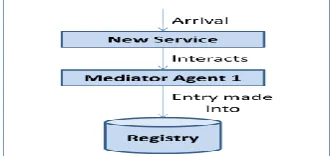
[image:2.595.315.526.225.385.2]When a new service arrives, it interacts with the Mediator agent and an entry is made into the registry corresponding to this new service. The parameters are initialized to the mean value of their range.
Figure 1. Service Arrival Component
The new service provides the specification to the Mediator Agent 1 which in turn makes the entry into the registry as shown in Figure 1. This entry is made in accordance to the values supplied by the service provider. A check is made by the Mediator Agent 1 on the authenticity of the values provided by the service provider in order to prevent any incorrect entry.
3.2 User Arrival
[image:2.595.312.533.539.720.2]When a new user arrives it specifies its requirements to the Mediator Agent 2. The mediator agent thus holds the user’s preferences and requirements. Accordingly it then calls the service selection procedure providing it the user’s preferences. The service selection procedure interacts with the registry and gets the best available service in the market which has an entry in the registry.
Figure 2. User Arrival Component.
The service Selection Procedure returns the best available service to the mediator agent 2 which in turn relays it to the user. The user now has a service which it can use in order to fulfill its requirements. Thus the task of finding the best service has been shifted from the user to the service selection procedure and the mediator agent. The entire flow of this process is shown in figure 2.
3.3 Service Selection Procedure
The Service Selection Procedure is the heart of our Service Selection Model. Depending upon the type of service requested by the mediator agent 2 (which is just relaying the type of service selected by the user) the availability of the requested service is looked for in the registry as shown in Figure 3.
Figure 3. Service Selection Procedure Component
[image:2.595.85.253.678.756.2]registry the service selection procedure either provides the best ranked service available or it gives a message referring to the absence of any such service.
The service selection procedure works on several parameters which are defined in section 2.4. The ranking of the selected service is dependent on these parameters. An intensive use of these parameters is made in order to rank the service. How these parameters are calculated and used to rank the service is defined in section 3.5.
3.4 User feedback Component
After using the service the user provides feedback which comprises of three parameter values which includes: Reliability Feedback, Dependability feedback, Satisfaction level.
It specifies the three feedback provided by the user. These three feedback values is then used ahead in order to calculate other parameters as it will be seen in the next section.
Reliability feedback lies in the range of 0 to 1 referring services varying from not reliable to completely reliable. Similarly dependability feedback lies in the same range of 0 to 1. Satisfaction level is given as percentage. It refers to how much percent the user was satisfied with the service.
3.5 Calculation of Parameters Values
After using the service user provides three feedbacks as seen in section 3.4. These feedbacks are used in this section to calculate the other cognitive parameters.
[image:3.595.318.540.71.245.2]These parameters as described earlier are: Expertness, Experience, Integrity, Benevolence, Technical Skills, Trust, Credibility, and Rank.
Figure 4. Dependence between Parameters.
Figure 4 shows how the parameters are inter-dependent on one another. The entire flow of calculating each parameter can be found using this figure and the definitions provided above. The exact formulation is a part of future work. Referring to the figure 4 the above formulation can be understood efficiently.
3.6 Registry Updating Component
[image:3.595.64.283.389.531.2]This component of the model updates the registry once the user has finished using the service and provided the feedback. Once the above cognitive parameters are calculated, this component updates the registry with the corresponding new values for the selected service.
Figure 5. Registry Updation Component.
Figure 5 diagrammatically explains this component of the model. The entire calculation of the parameters is done in the previous component. This component just updates the registry with the newly calculated values.
3.7 Refreshing the Registry Component
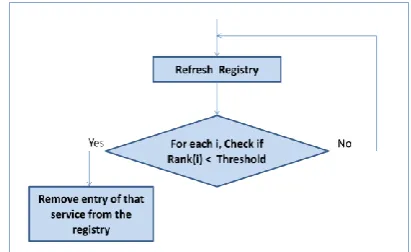
The registry keeps a track of all services which have registered with the mediator agent 1. However there may be services which has become obsolete or whose rank value is below a threshold decided by the mediator agent. These services which have their rank value less than the given threshold has to be removed from the database. Refreshing the registry does exactly the same and helps in maintaining the registry. This component ensures that the registry is not filled with unimportant services. The exact value of the threshold to be used in this component can be updated with time and requirements.
Figure 6. Refreshing the Registry Component of the Model
[image:3.595.318.524.424.550.2]4 SIMULATION RESULTS AND
ANALYSIS
A service selection simulation model was developed using the Net-logo platform [7]. The user interface prepared is shown in figure 7 referring to type of service equal to 1.
Figure 7. Service Selection Simulation Interface in Netlogo
with Selected type of Service = 1.
The above simulation tool was used to analyze and evaluate the validity of our approach. In the following section an outline of the testing environment and associated outcomes is discussed.
4.1 Implementation
The implementation of the model was two-fold: Initial Registry Entry (Using MySql). Simulation in Netlogo.
Initial Registry Entry
[image:4.595.307.539.76.223.2]For the first part of the simulation MySql was used. Since the extension of MySql was used in the Netlogo platform so the registry could be populated with services directly from the simulation tool itself. However the structure of the registry needs to be defined beforehand. The structure of the registry used for this purpose is shown below in Figure 8.
Figure 8. Structure of the Registry. Simulation in Net logo
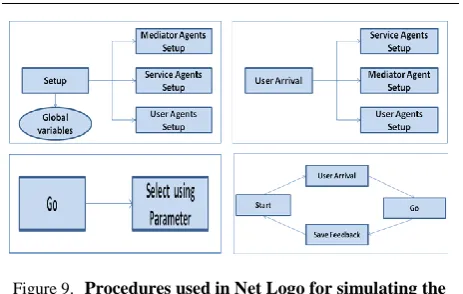
The model design discussed in section 3 was simulated using Net logo. The set up procedure does the initial set -up of mediator agents, user’s agents and service agents. The Go procedure calls the select using parameter procedure which does the service selection. The user arrival procedure again does the initialization setting up the required environment depending upon the type of service selected to use.
Figure 9. Procedures used in Net Logo for simulating the
model.
In Figure 9 the various procedures used in the simulation of the model are described diagrammatically. Note that all the global variables used in this simulation are initialized in the setup procedure.
4.2 Results and Analysis
After the model was simulated, the results were collected and plotted on the Net-logo platform itself.
Figure 10. The plot for Selected Rank and Feedback rank
with the number of times service used for service type = 1.
The above figure (Figure 10) plots the selected rank of the service and the feedback rank of the service with respect to the number of times the service is getting selected. From the above figures we can see that the higher ranked service which is getting selected is getting a better feedback from the user most of the times. This leads us to the point that the selected service returned by the model is turning out to be the best service most of the times. It thus validates the use of the model proposed for best service selection.
From the above plot it is very clear that the feedback rank and the selected rank lies in the same phase. It implies if the selected rank is high it is going to get a better rank as feedback in most of the cases. Similarly if the selected rank is low it will get a lower rank in most of the cases. But it is not only dependent on these. This is because of the fact that the rank is calculated is using several parameters in tandem.
5 CHALLENGES AND FUTURE WORK
[image:4.595.59.279.143.293.2] [image:4.595.317.531.343.403.2] [image:4.595.60.261.464.582.2]In near future, the Semantic Web Service Selection will change the future of Web Services. The Multi-Agent Systems along with the Semantic Web will ease the overall burden of finding the best services for the consumers and it’s not far, using the above cognitive parameters, when the agents will find the best services available in the market making the consumer choose the service on wish.
Several other cognitive parameters like Desire, Intention, Persuasion, Attitudes and many more are still to be modeled. These cognitive parameters can be used in further understanding the behavior of the consumers. This in turn will help the consumer’s agent to find the most appropriate service available in the market. Similarly the provider agents will benefit from these parameters and will thus provide the services accordingly meeting the demands of the consumers.
The formalization and weightings used in formulating the cognitive parameters is an area of research which can be pursued in future. The proposed Agent-based Service Selection model using Cognitive Parameters will be converted into Semantic Web Service Selection model using Cognitive Parameters in future.
6 CONCLUSIONS
It is observed that although there has been an increased interest in Semantic Web Service Selection, there has hardly been any work on modeling consumer’s behavior on the basis of cognitive parameters. Although some models have been prepared based on parameters like Trust and Reputation, however Trust and Reputation seems to be the only two parameters that has been explored in detail. This leads to the novelty of these parameters which could definitely help us to better understand both the consumer and the provider agents.
In this paper, a model for Web Service Selection is proposed based on Multi- Agent Systems. The concept of providing the best services available in the market is still immature and it requires some extraordinarily novel work.
It is in this regards to work on novel parameters like Capability, Credibility, Integrity, Expertness, Dependability, Trust, Reliability, Satisfaction and Experience. After an in-depth analysis of the above parameters, a model is proposed which performs Web Service Selection using Multi-Agent Systems. The model tries to change the overall nature of Web Service Selection.
In nutshell, this paper brings into limelight the role played by Cognitive parameters in context of Web Service Selection using Multi-Agent Systems. It emphasizes the concepts of
Cognitive parameters and the ease which it can bring in issues of interoperability and Automatic Service Discovery and Selection. The proposed service selection model does the job of selecting the best service efficiently.
The proposed model can be used in Automatic Agent based Web Service Selection. Since it tries to model the human behavior it could be of great help for machines which simulates human behavior which is crux of Semantic Web.
7. REFERENCES
[1] E. M. Maximilien and M. P. Singh. “Multi-agent system for Dynamic Web Services Selection”. In: Proc of 1st Workshop on Service-Oriented Computing and Agent-Based Engineering (SOCABE at AAMAS), 2005.
[2] M. D. Lee, M. Steyvers, M. D. Young, B.J. Miller, “A Model Based Approach To Measuring Expertise In Ranking Tasks,” Cognitive Science Society, 2011.
[3] R. P. Bagozzi, Z. G. Canli, And J. R. Preister. The Social Psychology Of Consumer Behavior. Tata Mcgraw-Hill Edition 2010.
[4] Net Logo Home Page. “On Line At: Http://Ccl.Northwestern.Edu/Netlogo/”, 2012.
[5] L. Gasser, Mas Infrastructure: Definitions, Needs And Prospects, In: Infrastructure For Agents, Multi-Agent Systems And Scalable Multi-Agent Systems, Vol. 1887 Of Lecture Notes In Artificial Intelligence, Springer-Verlag, Pp. 1-11, 2001.
[6] K. Decker, K. Sycara, M. Williamson, Matchmaking And Brokering, In: Proc. Of The Second International Conference On Multi-Agent Systems (Icmas-96), Pp.432, 1996.
[7] D. Fensel, F. M. Facca, E. Simperl, I. Toma. “Semantic Web” In Semantic Web Services. Springer-Verlag Berlin Heidelberg, Pp. 87-102, 2011.
[8] Cognition,
“Http://Www.Sciencedirect.Com/Science/Journal/00100277 ”.