Munich Personal RePEc Archive
Procedural Concerns
Sebald, Alexander
ECORE
4 June 2007
2007/54
Procedural Concerns
ECORE DISCUSSION PAPER
Procedural Concerns
∗
Alexander Sebald
†June 4, 2007
Abstract
Different to other scientific disciplines traditional economic theory has remained remarkably silent about procedural aspects of strategic interactions. Much to the con-trast, among psychologists there is by now a broad consensus that not only expected outcomes shape human behavior, but also procedures that are used to take decisions. It is argued that procedural concerns are especially pervasive in the resolution of con-flicts. In our paper we show that procedural concerns are in fact an inherent feature of the interaction of reciprocal agents. More precisely, using Dufwenberg and Kirchsteiger (2004)’s theory of sequential reciprocity we demonstrate that procedural choices deter-mine the responsibility that people have for outcomes. The responsibility for outcomes in turn influences peoples’ evaluations of intentions and, hence, subsequent reactions. Two applications are discussed to highlight the impact and importance of procedural concerns in strategic interactions.
Keywords: Psychological Games, Procedural Concerns, Reciprocity
JEL Classification: D01, C70
Introduction
Imagine a group of three friends. One of them has a free ticket for the local concert of their favorite music band. Unfortunately, however, he cannot go himself, as he has an exam the following day. As his friends love the band as much as he does, he would like to give the ticket to one of them instead. He is indifferent as to whom of the two to give it. He knows,
∗ I am very grateful to Martin Dufwenberg, Georg Kirchsteiger, Pierpaolo Battigalli, Estelle Cantillon,
Paolo Casini and the seminar participants at ECARES/ULB and the University of Maastricht for helpful comments.
† Department of Economics, University of Maastricht, PO Box 616, 6200 MD Maastricht, The
however, that if one of them feels unkindly treated, he will get into a quarrel. It is easy to see that this situation bears much resemblance to the ‘So long, Sucker’ game analyzed e.g. by Nalebuff and Shubik (1988). A player (A), i.e. the ticket holder, is driven to choose an unlucky player, i.e. the friend that does not receive the ticket, out of two players (B) and (C). Subsequently the unlucky player is allowed to choose an action which is either kind, i.e. not quarreling, or unkind, i.e. quarreling, towards player (A). As in the ‘So long, Sucker’ game, it seems also here, at first sight, that theticket holder is trapped: By choosing who gets the ticket he inevitably has to be unkind to one of his friends, creating the risk of trouble. At a second glance, however, when asked how this conflict could be resolved, one is intuitively driven to suggest that he should flip a coin to take the decision as in this way he avoids being unkind to either of them.
This example and our intuition of how to resolve the conflict effectively highlight two essential aspects of any human interaction. First, very often there are numerous ways in which decisions can be taken. On the one hand, the friend holding the ticket could decide to take the decision himself as to whom to give it, but, on the other hand, he could also let
chance decide by flipping a coin. Secondly, one can easily see that decisions are inherently associated with procedures which characterize the way in which they are taken. The ticket holder, in our example, first has to decide how he wants to take the decision before he can effectively take it.
Among psychologists there is by now a broad consensus that not only expected outcomes shape human behavior, but also procedures that are used to take decisions [e.g. Thibaut and Walker (1975), Lind and Tyler (1988), Collie et al (2002), Anderson and Otto (2003) and Blader and Tyler (2003)]. It is argued thatprocedural concerns are especially pervasive in the resolution of conflicts. Prominent examples of conflict resolutions are to be found in the areas of workplace relations and the public acceptability of policies and laws. First, psychologists have found evidence that behavioral reactions to promotion decisions, bonus allocations, dismissals etc. strongly depend on the perceived fairness of selection procedures
[e.g. Lemons and Jones (2001), Konovsky (2000), Bies and Tyler (1993), Lind, Greenberg, Scott and Welchans (2000) and Roberts and Markel (2001)]. Second, it has been shown that public compliance with policies and laws strongly depends on the perceived fairness of their enforcement procedures [e.g. Tyler (1990), Wenzel (2002), Murphy (2004), De Cremer and van Knippenberg (2003) and Tyler (2003)].
out-come to the principal. His choice is interpreted as intentional, which fosters perceptions of favoritism. If, by contrast, the principal uses a transparent procedure which credibly shows that the decision is based on an unbiased criterion, i.e. a criterion which ‘a priori’ ensures that both agents have the same chance to be promoted, the principal is not blamed for the final outcome.
In line with attribution theory Blount (1995) experimentally showed that the responder behavior in ultimatum games is very sensitive to the way, i.e. procedure, in which a proposal is made. In her experiments proposals in the ultimatum game were either made by a proposer actively having a stake in the final outcome of the game, by a neutral third party not having any monetary stake in the final outcome or bychance. She observed that the same proposal triggered significantly lower rejection rates in case a neutral third party orchance had chosen the proposal compared to situations in which the proposal was made by a stakeholder. According to attribution theory lower rejection rates in case of neutrality of the proposer or explicit randomizations hint at the fact that responders attach a lower degree of responsibility and intentionality for outcomes to other stakeholders as they do not have any influence over proposals. In other words, the responders’ willingness to punish other stakeholders seems to decrease the lower the others’ influence over the final division of the pie.
Notwithstanding this experimental evidence and the fact that e.g. workplace relations play an eminent role in the economic literature, economists have remained remarkably silent so far about the impact of procedures on human behavior in strategic interactions. Only three recent economic papers have started to address the issue of procedural choices in strategic interactions [Bolton et al (2005), Trautmann (2006), Krawczyk (2007)]. In contrast to attribution theory, however, they all extend models of distributional concerns to account for the impact ofprocedural choices on strategic behavior. Bolton et al (2005) only present a sketch of a possible model based on the model of inequity aversion by Bolton and Ockenfels (2000). Trautmann, on the other hand, manipulates Fehr and Schmidt (1999)’s model of inequality aversion suggesting that agents’ utilities depend on ‘expected outcome differences’ ‘ex ante’ as well as ‘ex post’ to any outcome realization. In the context of our introductory example this means that even after the flipping of a coin theticket holder’s utility depends on the ‘ex ante’ expected outcome difference. The expected outcome differential for his friends is lowest when flipping a coin. Hence, an inequality aversticket holder would prefer flipping a coin to any otherprocedure because it ensures a zero expected outcome differential. Although Trautmann’s functional form is able to accommodate the experimental finding that rejection rates in random ultimatum games are lower then in the standard ultimatum games, it can only be applied to single decision situations. It cannot be applied to more complicated strategic interactions as the calculation of expected payoffs needs expectations about the other player’s play.
In contrast, our paper follows the psychologists’ view. As a main result, using psycholog-ical game theory we show thatprocedural concerns are an inherent feature of the interaction of reciprocal agents. We first formally define the concepts ofprocedural game and procedure
distributions defined over pure actions. In our concert-ticket example the two pure actions of friend (A) obviously are: i) giving the ticket to friend (B) andii) giving the ticket to friend (C). The flipping of a coin assigns the probability 1
2 to both of them. The more skewed this
probability distribution is towards a certain pure action, the stronger the impression that the decision maker is intentionally aiming at this outcome. At the extreme this means, if friend (A) takes the decision directly, i.e. without explicitly randomizing, to give the ticket to friend (B), the unlucky friend (C) assigns full responsibility and intentionality to the de-cision of friend (A). In this situation player (C)’s kindness perceptions are obviously shaped by the fact that player (A) has directly chosen player (B) without giving him any ‘credible’
chance to also get the ticket.
Dufwenberg and Kirchsteiger (2004)’s class of sequential games does not allow for different
procedural choices. More precisely, it only allows for one type of procedures: procedures
that imply full responsibility and intentionality. To the contrary of this, in our class of
procedural games we allow for different procedural choices which then allows to analyze the impact of procedural choices on strategic interactions. To exemplify, when player (A) in our introductory example decides to take his decision by flipping a coin instead of taking the decision himself both his pure actions, i) and ii), are ‘ex ante’ equally probable. The outcome is pure chance and, hence, no responsibility and intentionality is associated with it. As a consequence, reciprocal agents react differently to the same outcomes, i.e. choice of pure actions, depending on the procedure which has led to them.
To highlight this impact of procedural choices on the strategic interactions of reciprocal agents we analyze two applications in the final section of this paper. More precisely, we allow for differentproceduresin the ‘So long, Sucker’ game analyzed by Nalebuff and Shubik (1988) as well as Dufwenberg and Kirchsteiger (2004) and the Sequential Prisoners Dilemma also analysed by Dufwenberg and Kirchsteiger (2004). Comparing our results to their equilibrium predictions shows that the interaction of reciprocal agents is very sensitive to the availability of different procedures.
Summarizing, the organization of the paper is as follows: In the next section we formally define procedures and characterize a procedural game in which agents choose for procedures
rather than actions and strategies. In the second section we point at the impact ofprocedures
on the behavior of reciprocal agents. More precisely, we formally define reciprocity in the context of our procedural game and in this way explain the impact of procedural choices
on the strategic interaction of reciprocal agents. We furthermore show that the concept of sequential reciprocity equilibria (SRE) defined by Dufwenberg and Kirchsteiger (2004) can also be applied to our class of procedural games in which agents choose for procedural strategies. Finally, as said above, two applications are discussed to highlight the impact and importance of procedural concerns in strategic interactions.
Procedures
In this section we proceed in two steps. First, we intuitively sketch our argument with the help of two examples. In a second step we i) formally define the concept of procedures and
games in which agents choose procedures is thenceforth used in the subsequent sections to analyze the impact of procedural choices on the strategic interaction of reciprocal agents.
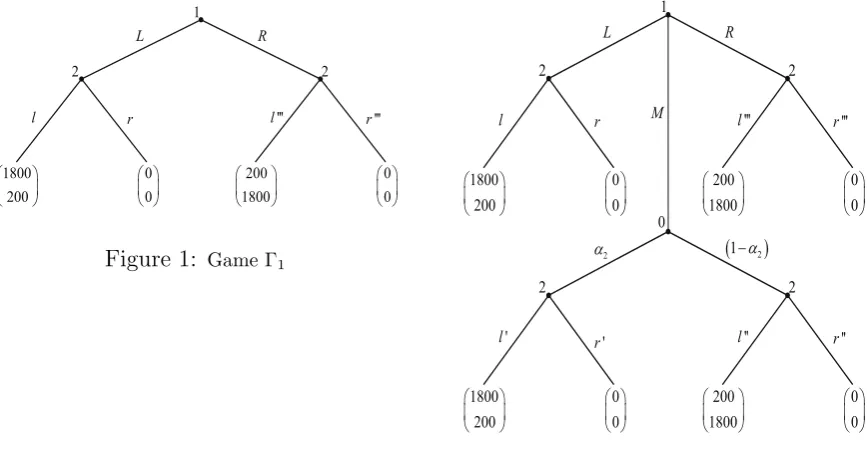
As a starting point consider games Γ1 and Γ2 in Figure 1 and 2:
1800 200
§ · ¨ ¸ © ¹
0 0
§ · ¨ ¸ © ¹
200 1800
§ · ¨ ¸ © ¹
0 0
§ · ¨ ¸ © ¹
l r l''' r'''
2 2
1
[image:7.595.99.533.117.351.2]L R
Figure 1: Game Γ1
1800
200
§ · ¨ ¸ © ¹
0
0
§ · ¨ ¸ © ¹
200
1800
§ · ¨ ¸ © ¹
0
0
§ · ¨ ¸ © ¹
l r l''' r'''
2 2
1
L R
M
1800
200
§ · ¨ ¸ © ¹
0
0
§ · ¨ ¸ © ¹
200
1800
§ · ¨ ¸ © ¹
0
0
§ · ¨ ¸ © ¹
'
l r' l'' r''
2 2
0
2 1D2 D
Figure 2: Game Γ2
The sole difference between games Γ1 and Γ2 is that in Γ2 player 1 can choose (M) on
top of his pure actions (L) and (R). Player 1’s pure action (M), however, is nothing else than choosing an explicit randomization device, (0), assigning probabilities α2 and (1−α2) to his pure actions (L) and (R) respectively. ‘Flipping a coin’ or ‘throwing a dice’ constitute explicit randomization devices, for example. ‘Flipping a coin’ assigns the probability 1
2 to
both pure actions (L) and (R). ‘Throwing a dice’, on the other hand, leads to α2 = 5 6 and
(1−α2) = 1
6, if, for example, (L) is chosen, whenever numbers 1 to 5 come up, and (R) is
chosen, if 6 appears. Obviously, ‘flipping a coin’ and ‘throwing a dice’ are but two credible ways in which a decision can be taken. In reality one usually disposes of many differentways. Nevertheless the two examples suffice to show how different ways, or in our words explicit randomization devices, are associated with differing explicit probability distributions with which an action is indirectly chosen by chance.
But not only choices like (M) can be characterized as choices for explicit randomization devices. Taking the thought about the credible ways and the differing explicit probability distributions to the extreme shows that also pure actions like (L) and (R) can equally be defined as choices for explicit randomization mechanisms. Imagine, for example, that player 1 in Γ1 and Γ2 chooses for his pure actions (L). This is equivalent to saying that player
1 chooses for chance to take the decision between (L) and (R) assigning probability 1 to his pure action (L). Hence, although (L) represents a pure action, it can nevertheless be reinterpreted in a way in which the decision is indirectly taken bychance randomizing with a degenerated probability distribution over the set {(L),(R)}.
This shows that in our two examples, Γ1 and Γ2, any choice for a pure actions, i.e. (L)
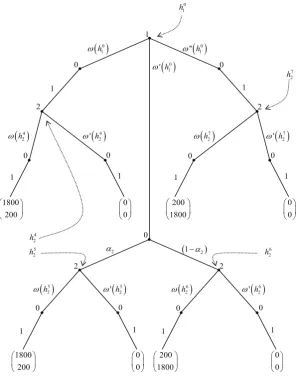
be reinterpreted as a choice for an explicit randomization device through which the actual decision is subsequently taken by chance. Consider, for example, game Γ3 in Figure 3, which
is a restatement of game Γ2 in the spirit of this intuition:
1800 200 § · ¨ ¸ © ¹ 0 0 § · ¨ ¸ © ¹ 200 1800 § · ¨ ¸ © ¹ 0 0 § · ¨ ¸ © ¹ 1 0 0 1 0 1 h Z 0 1 '' h Z 1 0 1 h 7 2 h 2 2 4 2 h Z 4 2 ' h Z 7 2 h Z 7 2 ' h Z 0 1 0 1 0 1 0 1 0 1 ' h Z 0 4 2 h 5 2 h 6 2 h 5 2 h Z 5 2 ' h Z 6 2 h Z 6 2 ' h Z
0 0 0
1 1 1 1
1800 200 § · ¨ ¸ © ¹ 0 0 § · ¨ ¸ © ¹ 200 1800 § · ¨ ¸ © ¹ 0 0 § · ¨ ¸ © ¹ 0 1D2
2
D
[image:8.595.158.457.118.505.2]2 2
Figure 3: Game Γ3
As one can see, in Γ3 we reformulate all strategic choices of game Γ2 into choices for
explicit randomization mechanisms, i.e. chance or player 0, through which decisions are subsequently taken. In game Γ2 player 1 can decide between (L), (M) and (R), and player 2
can decide between (l) and (r), (l′) and (r′), (l′′) and (r′′) or (l′′′) and (r′′′) depending on player 1’s choice. Equivalently, in game Γ3 player 1, for example, has to decide between the explicit
randomization devicesω(h0
1),ω′(h 0
1) andω′′(h 0
1) in the initial history h 0
1. First, by choosing ω(h0
1) he can decide to letchance take the decision between (L) and (R) assigning probability
1 to (L). Second, by choosing ω′(h0
1) he can decide to let chance take the decision between
(L) and (R) assigning probabilityα2 to (L) and (1−α2) to (R). Finally, by choosingω′′(h0 1)
the decision, rather then taking the decision himself. Hence, notwithstanding the formal equivalence between games Γ2 and Γ3, an interpretive difference exists. Choosing for an
explicit randomization mechanism implies that players do not take decisions themselves. They merely determine how decisions are taken by chance. In other words, players decide about the procedures which are used to take decisions. The example in Figure 3, thus, uncovers that strategic decision making is not only about choosing actions but also about
how actions are chosen. For this reason we call game Γ3 aprocedural game.
This brings us to a more formal definition of our class of procedural games. Formally, let the set of players be N = {0,1, ..., N} where 0 denotes the uninterested player chance. Denote asH, with the empty sequence ∅∈ H, the finite set of histories, h, andX the finite
set of decision nodes x, such that hx is the sequence of decisions on the path to the decision
node x. The player function, C, assigns to each nonterminal history hx ∈ H a member
i ∈ N who moves after that history hx. Therefore, let hx
i be the history h on the path to
the decision nodex which is controlled by player i∈ N and Hi the set of all histories after
which player i has to move throughout the game. At each history, hx
i, after which player
i ∈ N \ {0} has to move, he disposes of a nonempty finite set of pure actions A(hx
i) and a
finite set of explicit randomization devices, Ω (hx
i), through which he can choose an action
from A(hx
i). As already suggested in example Γ3 players in our procedural games do not
choose actions a ∈ A(hx
i) directly, but choose explicit randomization mechanisms, denoted
ω(hx
i) ∈ Ω (hxi), through which a decision is indirectly taken by chance. The choice for
a specific explicit randomization device, ω(hx
i), in history hxi by player i ∈ N \ {0} leads
to a specific decision node v ∈ X defined by hv
0 in which chance takes the actual decision
using the explicit probability distributionρ(ω(hx
i)) associated withω(hxi) defined onA(hv0),
with A(hv
0) = A(h
x
i). Hence, the choice for a pure action a (e.g. (L) in Γ2), for example,
translates in our procedural game into a choice for an explicit randomization mechanisms,
ω(hx
i), that is associated with a degenerated probability distributionρ(ω(hxi)) which assigns
probability 1 to the pure action a in the set of possible actions A(hv0) =A(h
x
i). The choice
for an explicit randomization (e.g. (M) in Γ2), on the other hand, is a choice for an explicit
randomization mechanism, ω′(hx
i), that is associated with a non-degenerated probability
distribution ρ(ω′(hx
i)) defined on A(hv0) = A(hxi). As said before, the set of player i’s
degenerated as well as non-degenerated explicit randomization mechanisms in any history
hx
i is Ω (hxi). The associated set of explicit probability distributions is furthermore denoted
as P(hx
i), where P(hxi) = {ρ(ω(hxi))|ω(hxi)∈Ω (hxi)}. It can easily be seen that the
minimum number of explicit randomization mechanisms that a player can decide between in any history hx
i in our procedural game equals the number of pure actions that he has in the
traditional extensive form representation.
As said before, by choosing for randomization devices players do not take decisions di-rectly but only determine how chance subsequently takes them. Intuitively, as players only decide on how the decisions are subsequently taken, they only decide on theprocedure, which is used to take a decision.
This brings us to a formal definition of procedures:
Definition 1 A procedure, ω(hx
i) ∈ Ω (hxi), for player i ∈ N \ {0} in history hxi ∈ Hi is a
tuple:
where:
1. ρ(ω(hx
i))is the explicit probability distribution associated withω(hxi)defined onA(hv0) 2. A(hv
0) =A(hxi), and
3. hv
0 directly succeeds hxi.
In example Γ3proceduresare used to choose for pure actions. We do not exclude, however,
the possibility of procedures that choose between procedures and procedures that choose between procedures that choose between procedures etc. Procedures, ω(hx
i)∈Ω (hxi), rather
have to be understood as reduced procedures. At any history hx
i the explicit probability
distribution associated with a reduced procedure,ρ(ω(hx
i))∈ P(hxi), basically subsumes the
probability distributions of procedures of all levels into one explicit distribution defined on
A(hx
i). It is assumed that all players learn the outcome of a reduced procedure directly after
its realization.
We denote a collection of procedures for any player i∈ N \ {0} that specifies a procedure
for each history after which player i moves a procedural strategy, ωi. Abehavioral procedural
strategy, mi ∈ Mi, of player i, on the other hand, has to be understood as an implicit
randomization at each history hx
i ∈ Hi over the set of possible procedures Ω (hxi). Note,
procedural strategies, ωi ∈Ωi, and behavioral procedural strategies, mi ∈ Mi, in our class of
procedural games are respectively the analogue to pure strategies and mixed strategies in the traditional extensive form representation. We assume throughout that players choose for behavioral procedural strategies.
Given a behavioral procedural strategy, mi, for each player i∈ N \ {0}and the commonly
known system of probability distributions,P =∪i∈N \{0}Pi, wherePi =∪hx
i∈HiP(h
x
i), we can
compute a probability distribution over endnodes, z∈ Z. By assigning payoffs to endnodes, we can derive an expected payoff function, πi : Z × P → ℜ, for every player i ∈ N \ {0}
which depends on what behavioral procedural profile, m in M, where M=×N \{0}Mi, is
played. In what follows we will assume that payoffs are material payoffs like money or any other measurable quantity of some good.
Summarizing, a procedural game is a tuple:
Γ =N,M,P,(πi :Z × P → ℜ)N \{0}
. (1)
This concludes the definition ofprocedures and the characterization of the class of proce-dural gameswhich is the basis of our subsequent analysis. Starting from two simple examples, i.e. Γ1 and Γ2, we have formalized the idea that players choose for procedures rather than
actions. In the remainder of the paper we use this class ofprocedural games in order to isolate the impact of procedures on strategic behavior. More precisely, the following section uses this characterization of procedural games to analyze the impact ofprocedural choices on the interaction of reciprocal agents.
Procedural choices and reciprocity
subgames. Looking again at game Γ3 in Figure 3, for example, this means that players
would react the same in histories h4 2 or h
5
2. However, experimental evidence contradicts
this. For example, in ultimatum games rejection rates for the same proposal significantly decrease if proposals are made by a random draw [Blount (1995) and Bolton et al (2005)]. In other words proposer behaviors in ultimatum games significantly depend on how a certain proposal has come about. Psychologists have termed this dependence procedural fairness or
procedural concerns and explain the observed behavior with the help of attribution theory. According to attribution theory agents behave reciprocally and evaluate the (un)kindness of themselves and others taking into consideration their as well as the others’ possible influence on (expected) outcomes. The less influence people have over outcomes at the time of their decision the less they are held responsible for it. Therefore, in order to demonstrate how
procedural concerns can theoretically be reconciled with economic theory, we broaden the behavioral presumption in this section by assuming that agents are reciprocal. This means we formally define reciprocity in the context of our procedural game and show how it can explain the aforementioned evidence on procedural concerns.
Generally speaking, reciprocity means that agents do not only care about their own material payoff but also about the intentions of others [e.g. Rabin (1993), Dufwenberg and Kirchsteiger (2004) and Falk and Fischbacher (2006)]. They act kindly or unkindly depending on whether others are kind or unkind to them. Before we can more formally characterize the motivation of reciprocal agents and precisely define kindness and perceived kindness, however, it is necessary to highlight four theoretical peculiarities: kindness and perceived kindness of any player towards/from any other player i) cannot be measured directly, ii) might change after different histories of a game, iii) should be unaffected by inefficient
procedural strategies and iv) realizations of the moves of chance.
i) Kindness and perceived kindness cannot be measured directly as they depend on each player’s procedural strategies, beliefs about the others’ procedural strategies and beliefs about the others’ beliefs. Therefore, to model kindness we assume that every player holds a belief over the behavioral procedural strategies as well as a belief over the other players’ beliefs. In the spirit of Dufwenberg and Kirchsteiger (2004) we model beliefs as behavioral procedural strategies, mi ∈ Mi,∀i ∈ N \ {0}. However, in order to avoid confusion we
introduce a separate notation for beliefs. LetBij =Mj,∀i, j ∈ N \ {0}be the set of possible
beliefs of player iabout the behavioral procedural strategy of player j (i.e. first-order belief). Furthermore let Cijq = Bjq = Mq,∀i, j, q ∈ N \ {0} be the set of possible beliefs of player
i about the belief of player j about the behavioral procedural strategy of player q = j (i.e. second-order belief). Obviously, players do not have beliefs about the moves of the player
chance. They do know, however, the explicit probability distributions associated with them. Therefore, let (a)hx denote the collection of all passed realizations of moves ofchance on the path up to history hx.
ii) Players are assumed to have initial first- and second-order beliefs about the other players. As the game unravels these beliefs might change, however. In order to capture this it is important to keep track of how each player’s behavior, beliefs, kindness and kindness perceptions differ across histories. We do this by updating behavioral procedural strategies
Definition 2 Let mi ∈ Mi and hxi ∈ Hi, let mi(hxi) ∈ Mi be the (updated) behavioral
procedural strategy that prescribes the same procedural choices asmi except for the procedural
choices of player i on the path to hx
i which are made with probability 1.
In correspondence with the collection of passed realizations of the moves of chance, (a)hx i, the collection of passed procedural choices of player i on the path to hx
i is denoted (ωi)hx i. Hence, the updated behavioral procedural strategy mi(hxi) is identical to (ωi)hx
i on the path to history hx
i and identical to the initial behavioral procedural strategy, mi, in all other
histories. To exemplify consider again game Γ3 in Figure 3. Let player 2’s initialbehavioral procedural strategy m2 be an implicit randomization over his set of pure procedures at each history that he controls. Player 2 moves after history h5
2, which means that the implicit
randomization prescribed by his initialbehavioral procedural strategy over his pureprocedural choices, ω(h5
2) and ω′(h 5
2), leads to some realization. Following this his updated behavioral procedural strategy becomes such that the implicit randomization at h5
2 is substituted by its
realization, but all other procedural choices at histories not reached remain the same. The updating of beliefs is assumed to work in an analogous fashion. Let, for example, player 2’s initial belief about player 1’s behavioral procedural strategy be b21 = (ω(h0
1)). If later
on he finds himself in history h5
2 in game Γ3, his updated belief about player 1’s behavioral procedural strategy becomes b21(h5
2) = (ω′(h 0
1)), where b21(h 5
2) is player 2’s updated
first-order belief in history h5
2 about player 1’s behavioral procedural strategy. This shows that,
parallel to the definition of mi(hxi), the updated first order belief bij(hxi) is identical to the
passed procedural choices of player j on the path to hx
i, (ωj)hx
i, and identical to the initial belief, bij, in all other histories.
A remark on mixed strategies and procedures. The concept of psychological games was first introduced by Geanakoplos et al.(1989). In their seminal work Geanakoplos et al.(1989) only allow for initial beliefs to enter utility functions. Dufwenberg and Kirchsteiger (2004) and more recently Battigalli and Dufwenberg (2005) have shown, however, that in modeling, for example, reciprocity in a sequential setting unreasonable conclusions might be drawn if utility functions only depend on initial beliefs.1
They show that it is necessary to keep track of how beliefs change as play unravels. Two areas in which the updating of beliefs needs some further explanation are mixed strategies and beliefs in mixed strategies. Dufwenberg and Kirchsteiger (2004) allow for mixed strategies and also allow players to hold beliefs in mixed strategies. Mixed strategies in their setting should be interpreted in terms of frequencies with which pure choices are made in a ‘population’. This interpretation then explains why players that possibly hold mixed beliefs about the action of some other player update their beliefs (as soon as they learn his choice) as if he had chosen his actions with probability 1, i.e intentionally. Procedures, in comparison to that, might assign probabilities to pure actions in equivalence to mixed strategies. As they are observable, however, players do not update their beliefs after learning their outcome. If a player, for example, uses the flip of a coin to take a decision, this is observed by other players. This observability and the fact that probabilities connected toprocedures are common knowledge implies thatprocedural choices
represent perfect signals about intentions. Consequently, player’s beliefs are updated taking
1
into account the degree with which specific outcomes are intentionally aimed at. Therefore, in contrast to Dufwenberg and Kirchsteiger (2004), in our setting players update their beliefs according to the observed procedural choices that players make.
iii) For the same reason as in Dufwenberg and Kirchsteiger (2004) we restrict our atten-tion to the set of efficient procedural strategies, Ei. The set ofefficient procedural strategies,
Ei, is defined as:
Ei =
mi ∈ Mi |there exists no mi′ ∈ Mi such that for all hxi ∈ Hi,(mj)j=i ∈Πj=iMj,
q ∈ N \ {0} it holds that πq
m′i(hxi),(mj(hxi))j=i
≥πq
mi(hxi),(mj(hxi))j=i
with strict inequality for some h,(mj(hxi))j=i, q
.
Strategic choices are inefficient if there exists at least one other choice which conditional on any history of play and subsequent choices by the others provides no lower material payoff for any player, and a higher expected material payoff for some player for some history of play and subsequent choices by the others. In other words any behavioral procedural strategy
is inefficient if it involves ‘wasteful play’ following some history, hx
i ∈ Hi. As also pointed
out by Dufwenberg and Kirchsteiger (2004), it is unreasonable to let kindness and perceived kindness be influenced by strategies or, in our context, procedural strategies that imply ‘wasteful play’. More precisely, the fact that ‘wasteful play’ is possible should be irrelevant for drawing conclusions regarding the kindness of the others’ ‘efficient’ choices.2
iv) As said above, kindness and perceived kindness should also be unaffected by the realizations of the move ofchance. Intuitively this captures the idea that people are not held responsible for situations over which they had no control. Or, to put it positively, people are held responsible for situations in as much as they were/are able to influence them. To give an example, if the ticket holder in our introductory situation chose to flip a coin to allocate the concert ticket to one of his friends, the friends’s kindness perceptions of the ticket holder’s choice would depend on hisprocedural choiceeven after the realization of the move ofchance. He would not be held responsible for the realization itself as he was not able to influence it after he had taken the decision to flip a coin. Similarly, ‘ex ante’ theticket holder’s kindness perception of his own choice is also based only on what he is able to influence, i.e. he does not hold himself responsible for the realization of the flip of the coin but only for his
procedural choice. To capture this idea we define the decision context of a person i in any history hx
i. In every history hxi the decision context comprises, first, all passed procedural
choices on the path to history hx
i, (ω)hx
i, with (ω)hxi =
(ωi)hx
i , ...,(ωN)hxi
. Remember, the knowledge of all passed procedural choices on the path to history hx
i is included in the
updated procedural strategiesmi(hxi) and the updated first order beliefsbij(hxi). Second, the
decision context includes the realizations of the moves of chance on the path up to history
hx i, (a)hx
i, and, third, the remaining explicit probability distributions, (P)¬hxi, where ¬h
x i
indicates all histories beside the histories on the path up tohx
i. Hence, formally speaking:
2
Definition 3 The decision context in any history hx
i is a tuple:
(ω)hx
i ,(a)hxi ,(P)¬hxi
.
This means it is the collection ofi) all passed procedural choices of all players on the path to hx
i, (ω)hx
i, ii) all passed realizations of the moves of chance on the path up to h
x i, (a)hx
i, and
iii) the unreached explicit probability distributions, (P)¬hx i.
Intuitively speaking the decision context can be understood as the ‘informational back-ground’ which players use to evaluate their own kindness towards others and, hence, to take their decisions. It is also the ‘informational background’ which is used by other players in later stages to evaluate the kindness of passed choices by others. More precisely, thedecision context helps to decide in how far others were consciously aiming at a certain decision, i.e. pure action, or whether it was by chance that it was chosen.
We can now capture the idea that players strive to be kind if treated kindly and are unkind if treated unkindly by assuming that every player i ∈ N \ {0} chooses a behavioral procedural strategy, mi, that maximizes his utility defined as:
Ui =πi+
j=i
Yij ·(κij·λiji), (2)
where i, j ∈ N \ {0}, κij is the believed kindness of player i to player j and λiji is player i’s
belief about the kindness of player j towards himself.
More precisely, playeri’s utility is the sum ofN terms. The first termπirepresents player
i’s self interest. It is his expected material payoff in any history hx
i after which he moves.
It obviously depends on his ownbehavioral procedural strategy, mi(hxi), his belief about the
others’ behavioral procedural strategies, bij(hxi),∀j = i, all past outcomes/realizations of
procedures (a)hx
i until history h
x
i, and, finally, on the explicit probability distributions in all
histories that have not been reached yet during the course of the game, (P)¬hx. Hence:
πi =πi
mi(hxi),(bij (hxi))j=i,(a)hx
i ,(P)¬hx
.
It can easily be seen that, as we allow for explicit randomizations in our class of procedural games our definition of expected material payoffs differs from the definition by Dufwenberg and Kirchsteiger (2005). It takes the player i’s decision context in history hx
i into account.
The following N −1 terms, j=iYij ·(κij ·λiji), in equation (2), on the other hand,
represent player i’s reciprocity payoff with respect to each other player j = i. The fac-tor Yij is a non-negative reciprocity parameter which describes player i’s sensitivity to the
(un)kindness of player j. The higherYij the more sensitive to reciprocity player iis. Finally
the factorsκij andλijicapture respectively the kindness of playerito any other playerj and
player i’s perceived kindness of player j towards him. Intuitively, kindness κij is positive
or negative depending on whether i is kind or unkind to j and perceived kindness λiji is
positive (negative) if player ibeliefs player j to be kind (unkind) to him. Notice, reciprocity is captured by the factorial specification of the kindness parameters, κij and λiji. It drives
players to match perceived kindness (positiveλiji) with kindness (positiveκij) and perceived
unkindness (negative λiji) with unkindness (negative κij).
Definition 4 The kindness of player i to another player j = i at any history hx
i ∈ H is
given by the function κij :Mi×Πj=iBij → ℜ defined as:
κij =πj
mi(hxi),(bij(hxi))j=i,(a)hx
i ,(P)¬hx
−πei
j
(bij(hxi))j=i,(a)hx
i ,(P)¬hx
.
The kindness of playeritowards playerj in historyhx
i is defined as the difference between
the expected material payoff of player j , πj, that playeri intends to give j and the average
expected material payoff, πei
j
(bij(hxi))j=i,(a)hx
i ,(P)¬hx
, defined as:
πei
j
(bij(hxi))j=i,(a)hx
i ,(P)¬hx
= 1
2
maxπj
mi(hxi),(bij(hxi))j=i,(a)hx
i ,(P)¬hx
|mi(hxi)∈ Mi
+ minπj
mi(hxi),(bij(hxi))j=i,(a)hx
i ,(P)¬hx
|mi(hxi)∈ Ei
.
Think of πei
j as a norm for i describing the ‘equitable’ payoff for player j when i’s beliefs
about the other players’ behavior are summarized by (bij(hxi))j=i, the passed realization on
the path to hx
i are (a)hx
i and the unreached explicit probability distributions are given by (P)¬hx. Thus, whenπ
ei
j =πj then playeri’s kindness towards playerj is zero. Intuitively the
above definition means that player i is kinder the more he expects to give player j relative to the average that he could give him given his beliefs about the other players play. To exemplify consider, for example, history h5
2 of game Γ3. The behavioral procedural strategy
of player 2, m2(h5
2), as well as his first-order belief over the profile of player 1, b21(h 5 2),
and the passed realized move of nature, (a)h5
2 = {(L)}, define history h 5
2. Furthermore,
player 2’sbehavioral procedural strategy together with his first-order belief and the remaining probability distributions, (P)¬hx, on the other hand, define what player 2 is willing to give to player 1 in expected terms as well as what he could give him. Assume, for example, that player 2’sbehavioral procedural strategy inh5
2 ism2(h 5
2) = (ω(h 4 2), ω(h
5 2), ω(h
6 2), ω(h
7 2)). It
can easily be seen that player 2 intends to give player 1 π1(h5
2) = 1800, i.e. according to m2(h5
2) he will choose ω(h 5
2) after his history h 5
2. On the other hand, the average of the
maximum and minimum which he could give to player 1 isπe2 1 (h
5 2) =
1
2(1800) + 1
2(0) = 900.
Hence, player 2’s kindness towards player 1 inh5 2 is:
κ21h52
= π1h52
−πe2 1
h52
= 1800−900 = 900.
The above definition of kindness is a necessary adaptation from Dufwenberg and Kirch-steiger (2004) in the context of our procedural game. It includes the decision context on which players base their decisions.
The definition of perceived kindness, λiji, also requires a change though. As said above,
in the evaluation of intentions agents take into account in how far others were/are actually responsible for the unraveled play. Hence, it would be unreasonable to assume that player 2 in game Γ3 perceived the kindness of player 1 in histories h52 and h
6
2 differently. It is simply
in which the others have taken their last procedural choice. Remember, a decision context
characterizes the ‘informational base’ on which a decision is taken. As players know all passed procedural choices as well as the realizations of moves of chance along the path up to hx
i, they obviously not only know their own current decision context, but they can also
deduce all passed decision contexts which were the basis of the other players’ last procedural choices. Denote the history in which any player j =i has made his last procedural choice along the path up to hx
i as hxi
hl j
. When player i evaluates the kindness of player j’s
procedural choice in historyhx
i, he, hence, uses player j’sdecision context inhxi
hl j : (ω)hx
i(hlj),(a)hxi(hlj),(P)¬hxi(hlj)
,
where (ω)hx
i(hlj) defines all passed procedural choices on the path to h
x
i up to history hlj,
(a)hx
i(hlj) defines all passed realizations of moves of chance on the path to history h
x i up to
history hl
j and (P)¬hx
i(hlj) indicates all remaining explicit randomizations in h
l
j. Evaluating
player j’s kindness only on the basis of the decision context in which he has made his last
procedural choice on the path up to historyhx
i ensures that playerj is held solely responsible
for the decisions that he has explicitly taken himself. To exemplify, in both histories h5 2 and h6
2 player 2 evaluates player 1’s kindness on the basis of player 1’s decision context at the
history,h0 1:
(ω)h5
2(h 0 1),(a)h
5 2(h
0
1),(P)¬h 5 2(h
0 1)
=(ω)h6 2(h
0 1),(a)h
6 2(h
0
1),(P)¬h 6 2(h
0 1)
,
in which player 1 had to take his last procedural decision, i.e. hl j = h
0
1. In other words, in
histories h5 2 andh
6
2 player 2 does not take the realization of the move ofchance after history h2
0 into account when evaluating the kindness of player 1. The realization of the move of chance after h2
0 is by chance and hence not the responsibility of player 1.
Given this let perceived kindness be defined as:
Definition 5 Player i’s beliefs about how kind playerj =iis to iat historyhx
i ∈ H is given
by the function λiji :Bij ×Πi=jCiji→ ℜ defined as:
λiji = πi
bij(hxi),(cijq(hxi))q=j,(a)hx
i(hlj),(P)¬hxi(hlj)
−πiej(ciji(hxi))i=j,(a)hx
i(hlj),(P)¬hxi(hlj)
,
where hx i
hl j
is the last history after which player j has moved on the path to hx i.
As one can see, similar to the definition of kindness also perceived kindness is defined as the difference between what player i beliefs to receive in expected material payoff relative to the average that he could have gotten. To exemplify, assume now again that players find themselves in history h5
2 of game Γ3. We have seen above that, given player 2’s updated behavioral procedural strategy, his first-order belief and the past realizations of the moves of
chance up to historyh5
2, player 2’s kindness towards player 1 is 900 inh 5
2. In addition to player
2’s updated first-order belief b21(h5
2) = (ω′(h 0
belief be c212(h5
2) = (ω(h 4 2), ω(h
5
2), ω(h 6 2), ω(h
7
2)). The kindness that player 2 perceives
from player 1 is then given by:
λ212
h52
= π2b21
h52
, c212
h52
,(a)h5 2(h
0
1),(P)¬h 5 2(h
0 1)
−πe1 2 c212 h5 2
,(a)h5 2(h
0
1),(P)¬h 5 2(h
0 1) = 1
2(1800) + 1 2(200)
− 1
2((1800) + (200)) = 0.
This means, player 2 has the impression in history h5
2 that player 1 intends to give him π2(h5
2) = 1000. As 1000 is also the ‘equitable’ payoff that player 1 could have given to
him, player 2 judges player 1’s kindness to be 0. Now consider history h4
2, on the other
hand, which is the starting point of an identical subgame. Player 2’s perceived kindness of player 1’s behavioral procedural strategy given his updated beliefs, b21(h4
2) = (ω1(h 0 1)) and c212(h4
2) = (ω(h 4 2), ω(h
5
2), ω(h 6 2), ω(h
7 2)) is:
λ212
h4 2
= π2b21
h4 2 , c212 h4 2
,(a)h4 2(h
0
1),(P)¬h 4 2(h
0 1)
−πe1 2
c212h42
,(a)h4 2(h
0
1),(P)¬h 4 2(h
0 1)
= (200)− 1
2((1800) + (200)) = −800.
Hence, althoughh4 2andh
5
2 are starting points of identical subgames, players perceives the
situations totally different, i.e. perceived kindness of 0 inh5
2 vs. perceived kindness of −800
in h4
2. It follows that as both histories are perceived differently, optimal reactions in one
history might not be optimal in the other even though the subsequent situation seems to be the same. This exemplifies that reciprocal agents do care about the way a certain situation has come about or, in other words, reciprocity inherently leads to procedural concerns.
This completes the description of the reciprocal preferences in the context of our proce-dural game. Putting together the procedural game, Γ, as defined in (1) and the vector of utilities, (Ui)i∈N \{0}, as defined in (2) we get a tuple
Γp =Γ,(U
i)i∈N \{0}
. (3)
We refer to Γp as a procedural game with reciprocity preferences. Note, as the ‘psychological
game with reciprocity preferences’ defined by Dufwenberg and Kirchsteiger (2004) Γp is not
a ‘traditional game’. In line with Dufwenberg and Kirchsteiger (2004), utility functions, Ui,
are defined on richer domains including subjective beliefs. Different to them, however, and also different to ‘traditional games’ agents in our setting choose forprocedures,as defined in Definition (1), rather than actions and strategies.
beliefs. The players’ initial first and second order beliefs are required to be correct, and following each history of play the beliefs are updated as explained above.
LetMi(hxi, m) be the non-empty set ofbehavioral procedural strategies that prescribe, for
each player i∈ N \ {0}, the same choices as the strategymi(hxi) for all histories other than
hx
i. Given this, the sequential reciprocity equilibrium (SRE) in the context of our procedural
game with reciprocity preferences is defined as:
Definition 6 The profile m∗ = (m∗i)i∈N \{0} is a sequential reciprocity equilibrium (SRE) if
for all i∈ N \ {0} and for each history hx
i ∈ H it holds that
1. m∗i (hx i)∈
arg maxm
i∈Mi(hxi,m)Ui
mi(hxi),
bij(hxi),(cijq(hxi))q=j
j=i,(a)h
x
i ,(P)¬h x i
,
2. bij =m∗j for all j =i,
3. cijq =m∗q for all j =i, q=j.
Condition 1 assures that a SRE is a strategy profile such that at historyhxi playerimakes
choices which maximize his utility given his beliefs and given that he follows his equilibrium strategy at other histories. At the initial stage, conditions (2) and (3) guarantee that the initial beliefs are correct. At any subsequent history, condition (1) requires that beliefs assign probability one to the sequence of choices that define that history, but are otherwise as the initial beliefs.
Concluding, in this section we have formally defined the motivation of reciprocal agents in the context of our procedural game and have given a glimpse of the impact of procedural choices on the strategic interaction of reciprocal agents. In the following section we will more fully analyze the impact ofprocedural choices by applying the concept of thesequential reciprocity equilibrium to two examples.
Applications
The first application is the ‘Sequential Prisoners Dilemma’ also analyzed by Dufwenberg and Kirchsteiger (2004). The second is the ‘So Long, Sucker’ game in the spirit of Nalebuff and Shubik (1988) and Dufwenberg and Kirchsteiger (2004). Note, a full description of the strategic interaction and all possible equilibria that might arise in these two situations is beyond the scope of this paper. We, therefore, limit the analysis to the characterization of only one equilibrium to demonstrate the impact and importance of procedural concerns. Results and intuitions are presented in this section, mathematical proofs are relegated to the Appendix.
Example 1:
Sequential Prisoners Dilemma
0 1
h
1
1
§ · ¨ ¸ © ¹
1
2
§ · ¨ ¸ © ¹
2
1
§ · ¨ ¸ © ¹
0
0
§ · ¨ ¸ © ¹
1
0 0
1
0 1
c h 0
1
d h
1
2 2
4 2
c h 4
2
d h 7
2
c h 7
2
d h 0
1
0
1
0
1
0
1
0 1
r h
0
7 2
h
4 2
h
5 2
h 6
2
h
5 2
c h 5
2
d h 6
2
c h 6
2
d h
0 0 0
1 1 1 1
1
1
§ · ¨ ¸ © ¹
1
2
0 1D2
2 D
2 2
§ · ¨ ¸ © ¹
2
1
§ · ¨ ¸ © ¹
0
0
[image:19.595.160.457.62.449.2]§ · ¨ ¸ © ¹
Figure 4: Game Γ4
As can easily be seen, game Γ4 is an adaptation of the sequential prisoners dilemma
analyzed by Dufwenberg and Kirchsteiger (2004). The difference is that in Γ4 player 1
cannot only choose to cooperate (c) and defect (d), but can also explicitly randomize by choosing procedure (r). One sequential reciprocity equilibrium is:
Result 1 If player 1’s and 2’s sensitivity to reciprocity, Y1 and Y2, is such that
0< Y1 < 1
2
and
Y2 > 1
4α2−3
and player 1’s procedurer(h0
1)is associated with an explicit probability distribution such that
1 > α2 > 34, then the SRE is given by player 1 choosing r(h0
1) in history h 0
choosing c(h4 2), c(h
5 2), c(h
6
2) and d(h 7
2) in histories h 4 2, h5
2, h6
2 and h 7
2 respectively. 3
Proof: see Appendix.
The intuition is the following. If α2 is such that 1 > α2 > 3
4, player 2 perceives player
1’sprocedural choice as kind. If, in addition, his sensitivity to reciprocity Y2 is high enough, i.e. Y2 > 1
4α2−3, then he reciprocates player 1’s kindness by choosing (c) in history h 6 2. At
the same time player 2 punishes player 1 in equilibrium at history h7
2 which is the starting
point of a payoff equivalent subgame. The difference between historiesh6
2 and h 7
2 is that the
explicit probability α2 is such that player 2 perceives player 1’s choice of (r) as kind. He does not attribute enough responsibility for the outcome, i.e. historyh6
2, to player 1 to make
it worth while to punish him. Furthermore, since Y1 is relatively small, player 1 is mainly interested by money and his expected monetary payoff is highest by playing (r) given that player 2 does not play (d) following player 1’s choice of (r).
Dufwenberg and Kirchsteiger (2004), on the other hand, showed in the context of their setting that if player 2’s sensitivity to reciprocity is strong enough, he cooperates if player 1 cooperates and defects if player 1 defects. Furthermore, they showed that if player 1’s sensitivity to reciprocity is low and player 2’s sensitivity is high, cooperation is player 1’s equilibrium behavior for both monetary and reciprocity reasons.
Comparing the results shows that their equilibrium predictions are very sensitive to the availability of other procedures to take the same decision. As player 1 can also use procedure (r) to take his decision cooperation is no longer his optimal action given that player 2 is very sensitive to reciprocity. He chooses (r) because this makes player 2 to cooperate even in history h6
2 which is identical to the subgame starting in h 7
2. Hence, procedural choices influence the kindness and perceived kindness of players and therefore influence the interaction of reciprocal agents.
Example 2:
The ‘So Long, Sucker’ Game
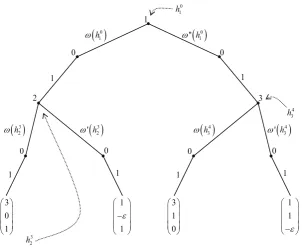
In the following we will apply the concept of the sequential reciprocity equilibrium to the example, Γ5, in Figure 5.1 Example Γ5 is an adaptation of the ‘So Long, Sucker’ game also
analyzed by Nalebuff and Shubik (1988) and Dufwenberg and Kirchsteiger (2004). With
ε = 0, Γ5 is a strategic situation in which player 1 has to decide on whom of two other
players to give a zero payoff. Following his decision, the player who was unfavorably treated is called upon to decide whether player 1 should get 3 or whether both the others should equally get a payoff of 1. Intuitively it looks as if player 1 is ‘a priori’ worst off, as whoever he chooses will feel badly treated, and hence take revenge on player 1 by giving him the lowest possible monetary payoff.
3
For simplicity we denote the sensitivity of reciprocity asYi in example 1. In example 2 we stick to Yij
1
1
H § · ¨ ¸ ¨ ¸ ¨ ¸ © ¹
3
1
0
§ · ¨ ¸ ¨ ¸ ¨ ¸ © ¹
1
1
H § · ¨ ¸ ¨ ¸ ¨ ¸ © ¹
1
0 0
1
0 1
h
Z
0 1
h
0 1
'' h
Z
1
3 2
3 2
h
Z 3
2
' h
Z 4
3
h
Z 4
3
' h
Z
0 0
1
0
1
0
1 1
3 2
h
4 3
h
3
0
1
[image:21.595.156.459.60.311.2]§ · ¨ ¸ ¨ ¸ ¨ ¸ © ¹
Figure 5: Game Γ6
However, if all players are solely motivated by purely selfish monetary concerns, this outcome is not guaranteed, as players 2 and 3 are indifferent between all their choices given thatε= 0. In order to allow for the possibility of revenge, Nalebuff and Shubik (1988) depart from the usual selfishness assumption, and assume that the players have lexicographically ordered objectives. This means that each player primarily maximizes his monetary payoff, but in case some choices yield exactly the same monetary payoff ties are broken so as to allow a player to take revenge. Dufwenberg and Kirchsteiger (2004), on the other hand, show that if agents behave reciprocally this outcome is also guaranteed for ε ≥ 0. More precisely, they show that for any ε ≥ 0 there exist sensitivities to reciprocity Y21 > 0 and
Y31 >0 for which taking revenge on player 1 is the best alternative for player 2 and 3. As said above, if players 2 and 3 are willing to take revenge even if it is costly, it seems that player 1 is trapped, as whatever he does, his action is perceived unkind by the player who has to take the subsequent decision.
1 1 H § · ¨ ¸ ¨ ¸ ¨ ¸ © ¹ 3 1 0 § · ¨ ¸ ¨ ¸ ¨ ¸ © ¹ 1 1 H § · ¨ ¸ ¨ ¸ ¨ ¸ © ¹ 1 0 0 1 0 1 h Z 0 1 h 0 1 '' h Z 1 3 2 4 2 h Z 4 2 ' h Z 7 3 h Z 7 3 ' h Z 0 1 0 1 0 1 0 1 0 1 ' h Z 0 7 3 h 3 0 1 § · ¨ ¸ ¨ ¸ ¨ ¸ © ¹ 4 2 h 5 2 h 1 2 1 2 5 2 h Z 5 2 ' h Z 6 3 h Z 6 3 ' h Z
0 0 0
1 1 1 1
[image:22.595.156.457.61.445.2]3 0 1 § · ¨ ¸ ¨ ¸ ¨ ¸ © ¹ 1 1 0 H § · ¨ ¸ ¨ ¸ ¨ ¸ © ¹ 3 1 0 § · ¨ ¸ ¨ ¸ ¨ ¸ © ¹ 1 1 H § · ¨ ¸ ¨ ¸ ¨ ¸ © ¹ 6 3 h 2 3
Figure 6: Game Γ6
As can easily be seen, the only difference between games Γ5 and Γ6 lies in the fact that
in the latter player 1 cannot only take his decision directly but can also e.g. flip a coin, i.e. choose ω1′ (h
0
1), to take it. Hence, he has an additional procedure which he can use to take
his decision. It can be shown that with the help of this procedure player 1 can avoid the conflict with the others. More precisely:
Result 2 If player 1, 2 and 3 have a sensitivity to reciprocity of
Y12=Y13 ≥0,
Y21 ≥ ε ε+ 1
and
then the only equilibrium is given by players 2 and 3 playing
ω2′
h42
, ω2h52
and
ω3′
h63
, ω2
h73
respectively and player 1 choosing ω′1(h 0 1).
This means, if players 2 and 3 are enough sensitive to reciprocity, they will punish player 1, if he chooses one of them directly, and will be kind to him, if he chooses to take the decision by e.g. ‘flipping a coin’. Knowing this, player 1 will choose to flip a coin, given that his sensitivity to reciprocity is equal for players 2 and 3, as this gives him a higher monetary as well as reciprocity payoff. In other words, by choosing e.g. to flip a coin, player 1 can get out of his ‘trap’. Players 2 and 3 respectively perceive player 1’sprocedural strategy ω1(h0
1), ω1′′(h 0
1) as unkind and ω′1(h 0
1) as kind. If player 1 chooses e.g. to flip a coin, they
do not attribute the outcome of the randomization to player 1, as he is only responsible for choosing the procedure but not for the outcome itself. Player 1, on the other hand, chooses
ω1′ (h 0
1) for monetary as well as reciprocity reasons.
This highlights ones more how procedural choices influence the strategic interaction of reciprocal agents.
Conclusion
As we have seen, any decision in human interactions is inherently associated with aprocedure
which characterizes the way in which the decision is taken. This means it is impossible to take a decision without deciding on how to take it. It is widely accepted in other scientific disciplines and it has been shown experimentally that people react differently to identical outcomes depending on theprocedures which have led to them. Hence, people are concerned about the way in which decisions are taken. Nevertheless economic theory has so far neglected the impact ofprocedural choiceson human interaction. It has ignored procedural concernsas traditional economic theory is based on consequentialist preferences. However, if preferences are solely outcome oriented, it can hardly be explained why people should react differently to ‘outcomewise’ identical situations which only differ in the procedures which have led to them.
which agents have full control over outcomes and, hence, are held fully responsible for all consequences of their actions. In contrast to this, in our class of procedural games agents can choose between different procedures, which differ in the probabilities that they assign to outcomes. Given this we show, in line with attribution theory, that the less influence people have on outcomes the less responsibility and intentionality is attributed to them.
By defining a class ofprocedural gameswe have been able to distinguishing between proce-dures which are used to take decisions and the decisions themselves. Furthermore, assuming reciprocal agents and defining the decision context as the ‘informational background’ which any decision is based upon, we have demonstrated thatprocedural concerns are actually an inherent feature of any interaction of reciprocal agents.
List of References
1. Anderson, R. A. and Otto, A. L. (2003), Perceptions of fairness in the justice system: A cross-cultural comparison, Social Behavior and Personality. 31, 557-564.
2. Battigalli, P. and Dufwenberg, M. (2005), Dynamic Psychological Games, Mimeo. IGIER-Bocconi
3. Bies, R. J. and Tyler, T. R. (1993),The ”litigation mentality” in organizations: A test of alternative psychological explanations, Organization Science, 4, 352-366.
4. Blader, S. L. and Tyler, T. R. (2003), A four-component model of procedural justice: Defining the meaning of a ”fair” process, Personality and Social Psychology Bulletin, 29, 747-758.
5. Blount, S. (1995), When Social Outcomes Aren’t Fair: The Effect of Casual Attri-butions on Preferences, Organizational Behavior and Human Decision Processes, 63, 131-144.
6. Bolton, G. and Ockenfels, A. (2000), ERC: A Theory of Equity, Reciprocity, and Com-petition, American Economic Review, 90(1), 166-193.
7. Bolton, G., Brandts, J. and Ockenfels, A. (2005), Fair Procedures: Evidence from Games Involving Lotteries, Economic Journal, 115 (506), 1054-1076.
8. Collie, T., Bradley, G. and Sparks, B. A. (2002), Fair process revisited: Differential effects of interactional and procedural justice in the presence of social comparison in-formation, Journal of Experimental Social Psychology, 38, 545-555.
9. Dufwenberg, M. and Kirchsteiger, G. (2004), A Theory of Sequential Reciprocity, Games and Economic Behavior, 47 (2), 268-298.
11. Falk, A. and Fischbacher, U. (2006), A Theory of Reciprocity, Games and Economic Behavior 54 (2), 293-315.
12. Fehr, E. and Schmidt, K. (1999),A Theory Of Fairness, Competition, And Cooperation, The Quarterly Journal of Economics, 114(3), 817-868.
13. Geanakoplos, J., Pearce, D. and Stacchetti, E. (1989), Psychological Games and Se-quential Rationality, Games and Economic Behavior, 1, 60-79.
14. Heider, F. (1958), The Psychology of Interpersonal Relations, New York: John Wiley & Sons.
15. Kelley, H. H. (1967),Attribution in social psychology, Nebraska Symposium on Moti-vation, 15, 192-238.
16. Kelley, H. H. (1973), The processes of causal attribution, American Psychologist, 28, 107-128.
17. Konovsky, M. A. (2000),Understanding Procedural Justice and Its Impact on Business Organizations, Journal of Management, 26 (3), 489-511.
18. Krawczyk, M. (2007),A model of procedural and distributive fairness, Mimeo. Univer-sity of Amsterdam.
19. Lemons, M. A. and Jones, C.A. (2001), Procedural justice in promotion decisions: using perceptions of fairness to build employee commitment, Journal of Managerial Psychology, 16 (4), 268-281.
20. Lind, E. A. and Tyler, T. R. (1988), The social psychology of procedural justice, New York, NY, US: Plenum Press.
21. Lind, E. A., Greenberg, J., Scott, K. S. and Welchans, T. D. (2000),The winding road from employee to complainant: Situational and psychological determinants of wrongful termination claims, Administrative Science Quarterly, 45, 557-590.
22. Murphy, K. (2004), The role of trust in nurturing compliance: A study of accused tax avoiders, Law and Human Behavior, 28, 187-209.
23. Nalebuff, B. and Shubik, M. (1988),Revenge And Rational Play, Papers 138, Princeton, Woodrow Wilson School - Public and International Affairs.
24. Thibaut J. and Walker, L. (1975),Procedural Justice, Erlbaum, Hillsdale, NJ.
25. Trautmann, S. T. (2006),A Fehr-Schmidt Model for Process Fairness, Working Paper, CREED, University of Amsterdam.
27. Tyler, T. R. (2003), Procedural justice, legitimacy, and the effective rule of law, in Tonry, M. (ed.), Crime and justice: A review of research, 30, 283-358.
28. Rabin, M. (1993),Incorporating Fairness into Game Theory and Economics, American Economic Review, 83 (5), 1281-1302.
29. Roberts, K. and Markel, K. S. (2001), Claiming in the name of fairness: Organiza-tional justice and the decision to file for workplace injury compensation, Journal of Occupational Health Psychology, 6, 332-347.
30. Ross, M. and Fletcher, G. J. O. (1985),Attribution and Social Perception, in G. Lindsey & E. Aronson (eds.), The Handbook of Social Psychology, 2, 73-114.
31. Wenzel, M. (2002) The impact of outcome orientation and justice concerns on tax compliance: The role of taxpayers’ identity, Journal of Applied Psychology, 87, 629-645.
Appendix
Proof to result (1):
In this proof we show under what conditions the behavior as defined in Result (1) is the equilibrium behavior. Note, as defined in Definition (6) we assume that players’ beliefs are correct. Given this, we analyze under what conditions they can be sustained in equilib-rium. It can easily be seen that if player 2’s second order belief about player 1’s belief is (c(h4
2), c(h 5 2), c(h
6 2), d(h
7
2)), then player 2’s believed equitable payoff isπ
e1 2 =
1 2(1) +
1 2(0) = 1
2. Hence, player 2’s perceived kindness if player 1 chooses c(h 0 1) is
λ212h42
= 1− 1
2 = 1 2, where 1 is player 2’s expected monetary payoff and 1
2 his equitable payoff given his second
order belief.
Secondly, if player 1 plays r(h0
1) player 2’s perceived kindness of player 1’s procedural choice is
λ212
h52
= λ212
h62
= α2(1) + (1−α2) (−1)−1
2 = 2α2− 3
2, (4)
and, thirdly, if player 1 plays d(h0 1), it is
λ212h72
= 0− 1
2 =− 1 2.
From equation (4) it can directly be seen that player 2 perceives player 1’sprocedural choice r(h0
1) as kind or unkind depending on α2. If α2 > 3
4 then player 1’s choice of r(h 0 1) is
Remark 1 If α2 is such that
1> α2 > 3
4,
then player 2 perceives player 1’s procedural choice r(h0
1) as kind.
Henceforth we assume that player 1’s procedure r(h0
1) is associated with an explicit
probability distributionα2 > 3 4.
We said before that player 1’s first order belief is (c(h4 2), c(h
5 2), c(h
6 2), d(h
7
2)).
Further-more, we said that in equilibrium this belief has to be correct. Hence, under what condition do we expect player 2 to choosec(h4
2) following player 1’s choice ofc(h 0
1)? By playing c(h 4 2)
player 2 receives the following utility
u2ch42
= 1 +Y2(1)
1 2
,
whereκ21(c(h4
2)) = 1− 1
2((1) + (−1)) = 1 is player 2’s kindness to player 1 by playingc(h 4 2).
On the other hand, by playing d(h4
2) player 2’s utility is
u2dh42
= 2 +Y2(−1)
1 2
,
where κ21(d(h4
2)) =−1− 1
2((1) + (−1)) =−1. Hence player 2 playsc(h 4
2) in history h 4 2 if
1 +Y2(1)
1 2
≥2 +Y2(−1)
1 2
.
This reduces to
Y2 ≥1.
This shows that if player 1 playsc(h0
1), player 2 plays c(h 4
2) if Y2 ≥1.
Remark 2 If player 1 plays c(h0
1), player 2 plays c(h 4
2) if Y2 ≥1.
Going back to player 1’s first order belief, under what conditions do we expect player 2 to choose d(h7
2) following player 1’s choice of d(h 0 1)?
In history h7
2 it is easy to see that player 2’s monetary and reciprocity payoff induce him
to choosesd(h7
2) for allY2 ≥0. Hence, if player 1 playsd(h 0
1), player 2 playsd(h 7
2) ifY2 ≥0.
Remark 3 If player 1 plays d(h0
1), player 2 plays d(h 4
2) if Y2 ≥0.
Finally, under what conditions do we expect player 2 to choose c(h5 2) in h
5
2 and c(h 6 2)
in h6
2 following player 1’s choice of r(h 0 1)?
Assume that player 1 has chosen r(h0
1). Doing the analogous calculations as above for
player 2’s behavior in history h5
2 one can see that player 2 plays c(h 5 2) in h
5 2 if
1 +Y2(1)
2α2−3
2
≥2 +Y2(−1)
2α2− 3
2
where the lhs is u2(c(h5
2)) and the rhs isu2(d(h 5
2)). The above reduces to
Y2≥ 1
4α2−3.
Note, asα2 > 3
4 we know thatY2≥ 1
4α2−3 >1. This shows that any player 2 withY2 ≥ 1 4α2−3
would play c(h4
2) in historyh 4
2 and c(h 5
2) in historyh 5
2. Finally, in historyh 6
2 the analogous
calculations as in h5
2 and h 4 2 are
−1 +Y2(1)
2α2−3
2
≥0 +Y2(−1)
2α2− 3
2
,
where the lhs is u2(c(h6
2)) and the rhs isu2(d(h 6
2)). The above also reduces to
Y2 ≥ 1
4α2−3.
Hence, also here it holds that if Y2 ≥ 1
4α2−3 player 2 playsc(h 6
2) in historyh 6 2.
Remark 4 If player 1 playsr(h0
1), player 2 playsc(h 5 2)in h
5
2 andc(h 6 2)in h
6
2 ifY2 ≥ 1 4α2−3.
Concluding, as we have seen above, if Y2 ≥ 1
4α2−3, it holds that player 2’ equilibrium
behavior is characterized by c(h4 2), c(h
5 2), c(h
6
2) and d(h 7
2) in histories h 4 2, h5
2, h6
2 and h 7 2
respectively.
Let us now turn to player 1. Player 1’s perceived kindness of player 2’s equilibrium
procedural strategy is
λ121h01
= (q+ 2q′−q′α2)−(1−q′α2−q) = 2q+ 2q′−1,
where q and q′ are player 1’s second order beliefs associated with his procedures c(h0 1) and r(h0
1). His kindness to player 2, on the other hand, is
κ12ch01
= 1− 1
2 = 1 2,
by playing c(h0 1),
κ12
r
h0 1
= α2−(1−α)−1
2 = 2α2−3
2,
by playing r(h0 1) and
κ12ch01
= 0− 1
2 =− 1 2, by playing d(h0