A Global Nearest-Neighbour Depth
Learning-based, automatic 2D-to-3D image conversion
Ms.Manasa.G.Kambi1, Prof.
Nagabhushan Katte
1M.Tech(DE),Dept of ECE
1,2 Ballari Institute Of Technology And Management Bellary,Karnataka,India
Abstract-The proposed work is to present a new method based on the radically different approach of learning the 2D-to-3D
conversion from examples. It is based on globally estimating the entire depth map of a query image directly from a
repository of 3D images (image+depth pairs or stereopairs) using a nearest-neighbor regression type idea.
Keywords: 3D images, Stereopairs, Image conversion, Nearest neighbor classification, Cross-bilateral filtering.
I. INTRODUCTION
The presence of 3D-capable hardware , such as TVs, Blu-Ray
players, smart phones, and gaming consoles, are not yet matched
by 3D content production. Despite of significant growth, 3D
movies are still an exception rather than a rule, and 3D
broadcasting is still minuscule compared to 2D broadcasting. In
order to bridge the gap between 3D hardware and 3D content
availability, many 2D to 3D conversions methods have been
proposed.
A typical 2D-to-3D conversion process consists of two steps:
depth estimation for a given 2D image and depth based
rendering of a new image in order to form a stereo pair. While
the rendering step is well understood and algorithms exist that
produce good image quality, the challenge is in estimating depth
from a single image (video).
There are two basic approaches for 2D to 3D conversion: One
involving human operators known as semi-automatic methods.
In these a skilled operator assigns depth to various parts of
image Depending on sparse depth assignment, computer
algorithm estimates dense depth over entire image sequence.
Human operator assigns depth to various location in image to
exactly define delineation of objects following depth assignment
to the delineated regions.
Second is an automatic method, no human operator intervention.
A computer algorithm automatically estimates the depth for an
image. In these several methods have been developed which
estimates shape from shading, structure from motion and depth
from defocus. These methods work for restricted scenarios
II. STATE OF ART
Two types of 2D to 3D conversion methods: Semi-automatic
methods involve human operator intervention and automatic
methods which require no
operators.
A. Semi-automatic methods
This is one of the most successful approach for 2D-to-3D
conversion. This method require a significant operator
intervention in the conversion process, fitting delineating objects
in individual frames, placing them at suitable depths, and
correcting errors after final rendering. These methods are
adopted by various companies such as Imax Corp., Digital
Domain Productions Inc etc. Many films have been converted to
3D using this approach.
Methods involving human operators have been most successful
but also time-consuming and costly. In order to lower the cost
and speed up the conversion. Guttmann et al. [1] have proposed
a dense depth recovery via diffusion from sparse depth assigned
by the operator.
In the first step, the operator assigns relative depth to image
patches in some frames by scribbling.
In the second step, a combination of depth diffusion, that
accounts for local image saliency and local motion, and depth
classification is applied.
In the final step, disparity is computed from the depth field and
two novel views are generated by applying half of the disparity
amplitude.
The focus of the method proposed by Agnot et al. [2] is the
application of cross-bilateral filtering to an initial depth map.
Phan et al. [3] propose a simplified and more efficient version of
the Guttmann et al. [1] method using scale-space random walks
that they solve with the help of graph cuts flow, then applying
structure-from-motion estimation and finally extracting moving
object boundaries.
The operator role is to correct errors in the automatically
computed depth of moving objects and assign depth in
undefined areas
B. Automatic methods
The main step in 2D to 3D conversion is depth estimation from
a single 2D image. Other methods, like multi view stereo, which
attempt to recover depth by estimating scene geometry from
multiple images not taken simultaneously. A moving camera
permits structure-from motion estimation [4] while a fixed
camera with varying focal length permits depth-from-defocus
estimation [5].
Recently, machine-learning-inspired techniques employing
image parsing have been used to estimate the depth map of a
single monocular image [6]. Such methods have the potential to
automatically generate depth maps, but currently work only on
few types of images using carefully-selected training data.
In the quest to develop data-driven approaches to 2D-to-3D
conversion we have also been inspired by the recent trend to use
large image databases for various computer vision tasks, such as
object recognition [7] and image saliency detection [8]. In our
first attempt, we developed a method that fuses SIFT-aligned
depth maps selected from a large 3D database, this approach
proved to be computationally demanding [9]. Subsequently, we
most similar depth fields from a database. As a result there was
no significant quality degradation but a significant reduction of
the computational complexity [10]. Very recently, Karsch et al.
[11] have proposed a depth extraction method based on SIFT
warping that exceptionally follows our initial, unnecessarily
complex, approach to depth extraction [9].
III. THE PROPOSED SYSTEM
2D-TO-3D CONVERSION BASED ON GLOBAL
NEAREST-NEIGHBOR DEPTH LEARNING
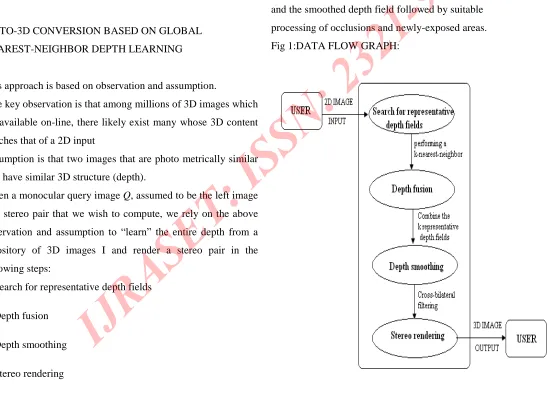
This approach is based on observation and assumption.
The key observation is that among millions of 3D images which
are available on-line, there likely exist many whose 3D content
matches that of a 2D input
Assumption is that two images that are photo metrically similar
also have similar 3D structure (depth).
Given a monocular query image Q, assumed to be the left image
of a stereo pair that we wish to compute, we rely on the above
observation and assumption to “learn” the entire depth from a
repository of 3D images I and render a stereo pair in the
following steps:
1. Search for representative depth fields
2. Depth fusion
3. Depth smoothing
4. Stereo rendering
search for representative depth fields: find k 3D images in the
repository I that have most similar depth to the query image
depth fusion: combine the k representative depth fields.
depth smoothing: process the fused depth field to remove
spurious variations, while preserving depth discontinuities
stereo rendering: generate the right image of a fictitious stereo pair using the monocular query image
and the smoothed depth field followed by suitable
[image:4.612.23.570.260.655.2]processing of occlusions and newly-exposed areas.
Fig2: Search for representative depth fields
KNN
search
There are two types of images in a large 3D image repository:
one that are relevant for determining depth in a 2D query image,
and second that are irrelevant.
Images that are not photo metrically similar to the 2D query
need to be rejected because they are not useful for estimating
depth (as per our assumption).
Although we might miss some depth-relevant images, we are
effectively restricting the number of irrelevant images that could
potentially be more harmful to the 2D-to-3D conversion
process.
The selection of a smaller subset of images provides the added
practical benefit of computational tractability when the size of
the repository is very large.
One method for selecting a useful subset of depth relevant
images from a large repository is to select only the k images that
distance function capturing global image properties such as
color, edges, textures, etc. As this distance function, we use the
Euclidean norm of the difference between histograms of
oriented gradients (HOGs) computed from two images. Each
HOG consists of 144 real values (4×4 blocks with 9 gradient
direction bins) that can be efficiently computed.
Fig3: Depth fusion
In general, none of the NN image + depth pairs (Ii, di), i K
match the query Q accurately. However, the location of some
objects (e.g., furniture) and parts of the background (e.g., walls)
is quite consistent with those in the respective query. If a similar
Fig4:Cross Bi-lateral filtering of depth
While the median-based fusion helps make depth more
consistent globally, the fused depth is overly smooth and locally
inconsistent with the query image due to edge misalignment
between the depth fields of the kNNs and the query image. This,
in turn, often results in the lack of edges in the fused depth
where sharp object boundaries should occur and/or the lack of
fused-depth smoothness where smooth depth is expected.
5. Stero rendering
In order to generate an estimate of the right image b QR from
the monocular query Q, we need to compute a disparity δ from
the estimated depth bd. Assuming that the fictitious image pair
(Q, bQR) was captured by parallel cameras with baseline B and
focal length f , the disparity is simply δ[x, y] = Bf /bd[x], where
x = [x, y]T .
Fig5:Stero rendering
IV. CONCLUSION
In this paper,we discussed on globally estimating the entire
depth field of a query directly from repository of image+depth
pairs using nearest neighbor regression . With the continuously
increasing amount of 3D data on-line and with the rapidly
growing computing power in the cloud, the proposed framework
seems a promising alternative to operator-assisted 2D-to-3D
image and video conversion.
ACKNOWLEDGEMENT
I take this opportunity to express my profound gratitude and
deep regards to my guide Prof. Nagabhushan Katte, Ballari
Institute Of Technology And Management, Bellary for his
REFERENCES
[1] M. Guttmann, L. Wolf, and D. Cohen-Or. Semi-automatic
stereoextraction from video footage. In Proc. IEEE Int. Conf.
ComputerVision, pages 136–142, Oct. 2009.
[2] L. Agnot, W.-J. Huang, and K.-C. Liu. A 2D to 3D video
and imageconversion technique based on a bilateral filter. In
Proc. SPIE Three-Dimensional Image Processing and
Applications, volume 7526, Feb.2010.
[3] R. Phan, R. Rzeszutek, and D. Androutsos. Semi-automatic
2D to3D image conversion using scale-space random walks and
a graphCuts based depth prior. In Proc. IEEE Int. Conf. Image
Processing,
Sept. 2011.
[4] R. Szeliski and P. H. S. Torr. Geometrically constrained
structurefrom motion: Points on planes. In European Workshop
on 3D Structure from Multiple Images of Large-Scale
Environments, pages
171–186, 1998.
[5] M. Subbarao and G. Surya. Depth from defocus: A spatial
domain approach. Intern. J. Comput. Vis., 13:271–294, 1994.
[6] A. Saxena, M. Sun, and A. Ng. Make3D: Learning 3D
scenestructure from a single still image. IEEE Trans. Pattern
Anal.Machine Intell., 31(5):824 –840
[7] A. Torralba, R. Fergus, and W. T. Freeman. 80 million tiny
images:A large data set for nonparametric object and scene
recognition.
IEEE Trans. Pattern Anal. Machine Intell., 30(11):1958–1970,
Nov.2008.
[8] M. Wang, J. Konrad, P. Ishwar, K. Jing, and H. Rowley.
Image
saliency: From intrinsic to extrinsic context. In Proc. IEEE
Conf.Computer Vision Pattern Recognition, pages 417–424,
June 2011.
Machine Intell., 21(8):690–706
[9] J. Konrad, G. Brown, M. Wang, P. Ishwar, C. Wu, and D.
Mukherjee.
Automatic 2D-to-3D image conversion using 3D examples from
the Internet. In Proc. SPIE Stereoscopic Displays and
Applications,
[10] J. Konrad, M. Wang, and P. Ishwar. 2D-to-3D image
conversion bylearning depth from examples. In 3D
Cinematography Workshop
(3DCINE’12) at CVPR’12, pages 16–22, June 2012.
[10] M. Liao, J. Gao, R. Yang, and M. Gong. Video
stereolization:Combining motion analysis with user interaction.
IEEE Trans.
Visualization and Comp
[11] K. Karsch, C. Liu, and S. B. Kang. Depth extraction from
video
using non-parametric sampling. In Proc. European Conf.
Computer
Vision, 2012.