A survey on Energy Efficient Routing Protocols in
Wireless Sensor Network
a
Yashpal Tada,
bManju,
cVikram Singh
aM. Tech Scholar, b Assistant Professor, c Professor
a, c Department of Computer Science
CDLU Sirsa (Haryana), 125055, India
b
Faculty of Engineering & Technology
Mody University of Science & Technology Lakshmangarh (Rajasthan), 332311, India
Abstract— Wireless Sensor Network is a network of sensor nodes without having any central controller. Its growth is expeditiously increasing and that’s why there is an immense field for research in this area. Many routing, power management, and data dissemination protocols have been specifically designed for WSNs where energy awareness is an essential design issue. Routing protocols in WSNs might differ depending on the application and network architecture as there is still no consensus on a fixed communication stack for WSN. Sensors depend entirely on the trust of their battery for power, which cannot be revitalized or substituted. So the design of energy aware protocol is essential in respect to enhance the network lifetime. A WSN can have network structure based or protocol operation based routing protocol .In this paper, a review on network structure based routing protocol in WSNs is carried out. Energy consumption and network life time has been considered as the major issues
Index Terms—Wireless Sensor Networks (WSN), LEACH, PEGASIS, HEED TEEN, APTEEN, and CHIRON.
1.INTRODUCTION
Wireless Sensor Networks (WSNs) are being used in wide range of potential applications such as environment monitoring, military operations, target tracking and surveillance system, vehicle motion control, earthquake detection, patient monitoring systems, pollution control system etc. [1]. WSN is widely used to collect reliable and accurate information in the distance and hazardous environments, and can be used in National Defense, Military Affairs, Industrial Control, Environmental Monitor, Traffic Management, Medical Care, Smart Home [2]-[4] etc. The sensor whose resources are limited is cheap, and depends on battery to supply electricity, so it’s important for routing to efficiently utilize its power in both military and civilian applications such as target tracking, surveillance, and security management. The sensor node has four basic components:
their capabilities for monitoring and control, the sensors are expected to be deployed in vast area. The main applications of sensor network is to periodically gather data from a remote terrain where each node continually senses the environment
2. RELATED WORK
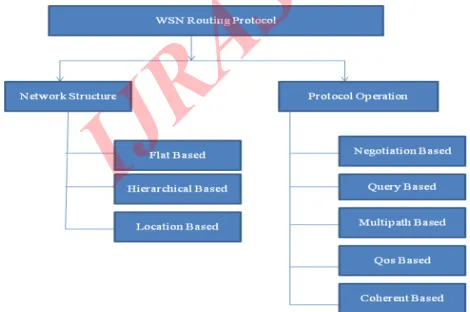
In our related work of research and its routing protocol implementation system. Routing protocols in WSNs might differ depending on the application (Protocol-Operation-based) and network architecture (Network-Structure-(Protocol-Operation-based) as shown in Fig. 1. Many researchers carried out their research in the hierarchical routing. A hierarchical approach breaks the network into clustered layers. LEACH is the first and most popular energy efficient hierarchical clustering algorithm for WSNs that was proposed for reducing power consumption. PEGASIS is an extension of the LEACH protocol, Rather than forming multiple clusters, PEGASIS forms chains from sensor nodes so that each node transmits and receives from a neighbor and only one node is selected from that chain to transmit to the base station (sink). HEED extends the basic scheme of LEACH by using residual energy and node degree or density as a metrics for cluster selection to achieve power balancing [9]. TEEN the sensor network architecture is based on a hierarchical grouping where a closer node from clusters and this process goes on the second level until base station is reached.
3. ROUTING PROTOCOLS
A WSN can have network structure based or protocol operation based routing protocol. Routing protocols in WSNs might differ depending on the application (Protocol-Operation-based) and network architecture (Network-Structure-based) as shown in Fig. 3. Based on the underlying network there are three protocol categories:
A. Flat Based
In this type of routing every node plays the same role and sensor nodes collaborate to perform the sensing task.
B.Hierarchical Based
In the Higher-energy nodes are used to process and send the information, while low-energy nodes are used to perform the sensing in the proximity of the target. The creation of clusters and assigning special tasks to cluster heads can greatly contribute to overall system scalability, lifetime, and energy efficiency. Hierarchical routing is an efficient way to lower energy consumption within a cluster, performing data aggregation and fusion in order to decrease the number of transmitted messages to the sink node.
C.Location-Based
In the sensor nodes are addressed by means of their locations. The distance between neighboring nodes that can be estimated on the basis of incoming signal strengths. Relative coordinates of neighboring nodes can be obtained by exchanging information between neighbors or by communicating with a satellite using GPS. To save energy, some location-based schemes demand that nodes should go to sleep if there is no activity.
Depending on the Protocol Operation we can divide routing protocols in:
I.Multipath-Based
They use multiple paths rather than a single path in order to enhance network performance. For instance the fault tolerance can be increased by maintaining multiple paths between the source and destination at the expense of increased energy consumption and traffic generation.
II.Query-based
The destination nodes propagate a query for data from a node through the network; a node with this data sends the data that matches the query back to the node that initiated it.
III.Negotiation-based
Use negotiation in order to eliminate redundant data transmissions. Communication decisions are also made based on the resources available.
IV.Qos-based
When delivering data, the network balances between energy consumption and data quality through certain QoS metrics as delay, energy or bandwidth.
V. Coherent-based
[image:3.612.60.295.514.670.2]4. HIERARCHICAL PROTOCOLS
In this research paper various hierarchical based routing protocols have been reviewed. Many researchers carried out their research in the hierarchical routing. A hierarchical approach breaks the network into clustered layers. Nodes are grouped into clusters with a cluster head that has the responsibility of routing from the cluster to the other cluster heads or base stations. Data travel from a lower clustered layer to a higher one. Although, it hops from one node to another, but as it hops from one layer to another it covers also larger distances. This moves the data faster to the base station Clustering provides inherent optimization capabilities at the cluster heads [6].
4.1 LOW ENERGY ADAPTIVE CLUSTERING HIERARCHY (LEACH)
LEACH [7] [8] is the first and most popular energy efficient hierarchical clustering algorithm for WSNs that was proposed for reducing power consumption.
The idea is to form clusters of the sensor nodes based on the received signal strength and use local cluster heads as routers to the sink. This will save energy since the transmissions will only be done by such cluster heads rather than all sensor nodes. The three important features of LEACH are:
Localized co-ordination and control for cluster setup.
Randomized cluster head rotation.
[image:4.612.346.544.207.335.2] Local compression to reduce global data communication.
Fig. 4: LEACH Protocol
LEACH divides the network into several clusters of sensors, which are constructed by using localized coordination and control not only to reduce the amount of data that are transmitted to the sink, but also to make routing and data
[image:4.612.71.293.419.615.2]randomize rotation of high-energy CH position rather than selecting in static manner, to give a chance to all sensors to act as CHs and avoid the battery depletion of an individual sensor and die quickly. LEACH uses single-hop routing where each node can transmit directly to the cluster-head and the sink. Therefore, it is not applicable to networks deployed in large regions.
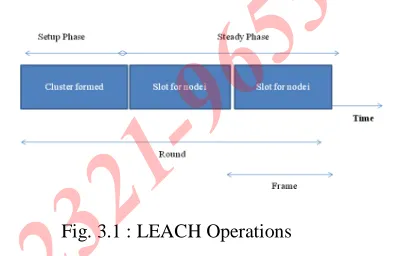
Fig. 3.1 : LEACH Operations
The major characteristics of this Protocol are as follow: 1. It rotates the cluster heads in a randomized fashion to achieve balanced energy consumption,
2. Sensors have synchronized clocks so that they know the beginning of a new cycle.
3. Sensors do not need to know location or distance information.
4.1.2 Efficient-Routing Leach (ER-LEACH) Enhanced Low-energy Adaptive Clustering Hierarchy (E-LEACH): E-LEACH proposes a cluster head selection algorithm for sensor networks that have non-uniform starting energy level among the sensors. It also determines that the required number of cluster heads has to scale as the square root of the total number of sensor nodes to minimize the total energy consumption.
4.1.3 LEACH-Centralized (LEACH-C)
LEACH-C uses a centralized clustering algorithm and same steady-state protocol. During the set-up phase of LEACH-C, each node sends information about current location and energy level to base station (BS). The BS will determine clusters, CH and non-CHs of each cluster. The BS utilizes its global information of the network to produce better clusters that require less energy for data transmission.
4.1.4 Multi-hop LEACH (M-LEACH)
solution proposed here is that the multi-hop approach is followed inside the cluster and outside the cluster. CHs can also perform data fusion to the data receive, allowing a reduction in the total transmitted and forwarded data in the network.
4.2 Power-Efficient Gathering in Sensor Information Systems (PEGASIS)
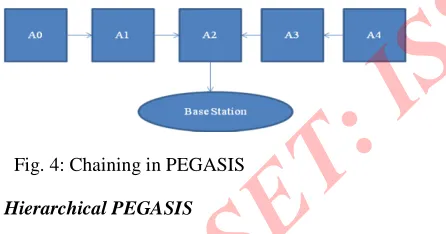
PEGASIS [8] is an extension of the LEACH protocol, Rather than forming multiple clusters, PEGASIS forms chains from sensor nodes so that each node transmits and receives from a neighbor and only one node is selected from that chain to transmit to the base station (sink). Gathered data moves from node to node, aggregated and eventually sent to the base station. The chain construction is performed in a greedy way. As shown in Fig.4 node A0passes its data to node A1. Node A1aggregates node A0’s data with its own and then transmits to the leader. After node A2 passes the token to node A4, node A4 transmits its data to node A3. Node A3 aggregates node
A4’s data with its own and then transmits to the leader. Node
[image:5.612.331.513.278.432.2]A2 waits to receive data from both neighbors and then aggregates its data with its neighbor’s data. Finally, node A2 transmits one message to the base station.
Fig. 4: Chaining in PEGASIS
4.2.1 Hierarchical PEGASIS
An extension to PEGASIS, called Hierarchical-PEGASIS was introduced with the objective of decreasing the delay incurred for packets during transmission to the BS.
4.3 Hybrid Energy-Efficient Distributed Clustering (HEED)
HEED extends the basic scheme of LEACH by using residual energy and node degree or density as a metrics for cluster selection to achieve power balancing [9]. It operates in multi-hop networks, using an adaptive transmission power in the inter-clustering communication. HEED was proposed with four primary goals namely:
Prolonging network lifetime by distributing energy consumption.
number of iterations.
Minimizing control overhead.
Producing well-distributed CHs and compact clusters.
4.4 TEEN and APTEEN Threshold sensitive Energy Efficient sensor Network protocol (TEEN)
[image:5.612.75.298.390.507.2]The sensor network architecture is based on a hierarchical grouping where closer nodes from clusters and this process goes on the second level until base station is reached. TEEN is not good for applications where periodic reports are needed since the user may not get any data at all thresholds are not reached.
Fig.5: Hierarchical Clustering
The Adaptive Threshold sensitive Energy Efficient sensor network protocol (APTEEN).The architecture of APTEEN is same as TEEN. APTEEN supports three different query types: historical, to analyze past data values, one time, to take a snapshot view of the network and persistent to monitor an event for a period of time. Thus, APTEEN is a hybrid clustering-based routing protocol that allows the sensor to send their sensed data periodically and react to any sudden change in the value of the sensed attribute by reporting the corresponding values to their CHs.
4.5Chain Oriented Sensor Network (COSEN)
chain, one node is elected as a leader. In every kind of chains, the chain-leader is elected based on some criteria or measures. Lower level leader nodes are responsible to collect information from lower level chains and send the information towards higher level leader. Higher level leader sends the information to BS.
4.6 Chain Based Hierarchical Routing Protocol (CHIRON)
Chain-based routing is one of most significant routing mechanisms. In such routing scheme, sensor nodes are linked into a single or multiple chains in advance. In data dissemination phase, each node communicates only with its closest neighbor’s, and takes turns to be the chain leader for transmitting the aggregated data to the BS. Even the chain-based routing protocols can effectively balance the node’s energy dissipation, and thus significantly extend the network life-time; they would be easy to cause serious transmission delays and redundant paths, particularly for large sensing areas. Based on the Beam Star [12] concept, the main idea of CHIRON is to split the sensing field into a number of smaller areas, so that it can create multiple shorter chains to reduce the data transmission delay and redundant path, and therefore effectively conserve the node energy and prolong the network lifetime. In CHIRON, the technique of Beam Star is first used to divide the sensing area into several fan-shaped groups. The sensor nodes within each group are then self-organized into a chain for data dissemination. Unlike traditional approaches, instead of taking turns, we consider the node with a maximum residual energy as chain leader candidate.
5.CONCLUSIONS
The protocols discussed in this paper have individual advantages and pitfalls. Based on the topology, the protocol and routing strategies can be applied. The factors affecting cluster formation and CH communication are open issues for future research. Moreover, the process of data aggregation and fusion among clusters is also an interesting problem to explore. One of the main challenges in the design of routing protocols for WSNs is energy efficiency due to the scarce energy resources of sensors. For realization of sensor networks, it is needed to satisfy the constraints introduced by factors such as fault tolerance, scalability, cost, topology change, environment, and power consumption. Routing in sensor networks is a new research area, with a limited but
routing protocols are discussed on the basis of network structure. They have the common objective of trying to extend the lifetime by reducing the energy consumption of the sensor network.
REFERENCES
[1] I.F. Akyildiz, W. Su, Y. Sankar subramaniam and E.
Cayirci, “Wireless Sensor Networks: a survey", Computer
Networks, Vol. 38, pp. 393-422, Mar. 2002.
[2] Saravana kumar.R, Kavitha.M,” Performance Evaluation
of energy aware data centric routing algorithm in wireless
sensor networks”, National level conference on Intelligent
systems and their applications ,held at Sudharsan Engineering College pudukkottai,Tamilnadu, India during 24th and 25th, August-2007.
[3] Lin, J.; Liu, Y.; Ni, L.M. SIDA: Self-organized ID Assignment in Wireless Sensor Networks. In Proceedings of the 4th IEEE International Conference on Mobile Ad-hoc and Sensor Systems Conference (MASS), Pisa, Italy, October, 2007.
[4] Saravana kumar.R,Malaisamy.K,”Energy-Efficient MAC
for WSNs”.National conference on Application of
Emerging Technologies held at Adhiyaman College of Engineering ,Hosur, Tamilnadu, India during 24th and 25thMay 2008.
[5] Eugenio M., “A Survey on Wireless Sensor Networks”,
www lia.deis.unibo.it/Courses/RetiLS/.
[6] Parminder Kaur, Mamta Katiyar,”The Energy-Efficient
Hierarchical Routing Protocols for WSN A Review”, International Journal of Advanced Research in Computer Science and Software Engineering .Vol, 2, Issue 11, Nov. 2012.
[7] W.R.Heinzelman,” Energy-efficient Communication protocol for Wireless microsensor networks ”, Proc. of 33rd Annual Hawaii Inter Cord on System Sciences, Hawaii, and USA: IEEE Computer Society, 2000.
[8] W. Heinzelman, A. Chandrakasan and H. Balakrishnan. “An Application-Specific Protocol Architecture for
Wireless Microsensor Networks,” IEEE Transactions on
Concentric Clustering Scheme for Efficient Energy
Consumption in the PEGASIS,” Proceedings of the 9th
International Conference on Advanced Communication TechnologyVol. 1, pp. 260-265. 2007.
[10] Ossama Younis and Sonia Fahmy” Heed: A hybrid,
Energy-efficient, Distributed Clustering Approach for Ad-hoc Networks”, IEEE Transactions on Mobile Computing, Vol. 3, pp. 366-369, Oct.-Dec. 2004.
[11] Neha Mehndiratta, Manju, and Harish Bedi.”Design
Issues for Routing Protocols in WSNs Based on Classification” International Journal of Application or Innovation in Engineering & Management (IJAIEM)Vol. 2, Issue 3, Mar. 2013 ISSN. 2319 - 4847
[12] N. Tabassum, Q. E. K. M. Mamun, and Q. Urano, “COSEN: A Chain Oriented Sensor Network for Efficient
Data Collection,” Proceedings of the Global
Telecommunications conference,Vol. 6, pp. 3525-3530, 2003.
[13] S. Mao, and Y. T. Hou, “BeamStar: An Edge-Based