Technology (IJRASET)
A Novel Architecture for Sharing Messages
On Heterogeneous SNS
Gaurav Pethkar#1, Akshay Waikar*2, Shweta Phulaware#3
#
IT Department, Savitribai Phule Pune University, Pune, Maharashtra, India
Abstract— Social networking sites are effective way of communication and data sharing all over the world with various users. All this social networking sites allows communication over their site only that is homogeneous communication. For example a gmail user can communicate with other gmail user. So there is need of integrating these social networking sites so that user from one social network can communicate with other social network user. So here we are proposed an integrated social network application which integrates heterogeneous social networks by identifying global relationship among registered users over heterogeneous SNSs. The main advantage of this integrated heterogeneous social network site is to provide different services of different SNSs over a single platform. We are using here I-search mechanism to find online users and also provide efficient path establish feature with low time complexity.
Index terms—SNS , GRM , OpenID , GlobalID, i-search.
I. INTRODUCTION
Today Social Networking Sites (SNS) have become an important part of our daily life. On these sites on daily basis we shares lot of data with our friends. We can say that with these sites around us helped to make the world smaller and always stay connected with different users. Currently so many SNS available today and many more are piling each day. So different users uses different social networking sites. Thus users use many SNSs to share data with friends and family.
A consequence of this a single user registers with multiple SNSs for different social network applications and each having different SNS accounts. As we know each SNS offers different services to users, one key feature shared among SNSs is how they are built around users and users’ existing social networks. Each social network is isolated, therefore users manage their profiles and build relationship separately on different SNSs. Sometimes it happens that the content for the same user in different SNSs may overlap and it becomes a burden for users to manage contents across different SNSs. With growing influence and importance of SNSs many researchers have been working on different methods to connect users and aggregating data across SNSs, Means each SNS no longer stands alone. Consider an example there is an study presented in [1] how social networks connect services allow users to leverage their information on multiple SNSs by using single unique ID to access multiple SNS accounts to publish their contents simultaneously on multiple SNSs. In this context the aggregation of social relationship data has not been well studied. That is the motivational point to proposed this work. Here in our proposed work we are presenting system architecture to integrate heterogeneous SNSs and investigate a model to characterize the social relationships among a large number of users across heterogeneous SNSs.
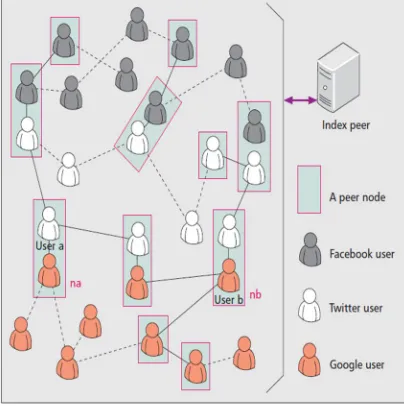
Fig. 1 System architecture of the proposed P2P-iSN.
In above figure the operations of our proposed work are shown. When a peer node is turned on first it reports to the index peer node his online status by using his unique ID of the peer node. Then based on this unique id a index peer node updates the online status of that peer node.
With this proposed architecture allows users from heterogeneous SNSs to communicate without involving any specific SNS and also the integration is independent of any specific social network. We can say that the integration does not incur overhead to the individual social network. Here we develop a Global Relationship Model to assess the strength of the global relationship between two users from heterogeneous SNS and by using this we propose a Searching mechanism which find the social path between two users from heterogeneous SNSs.
II. PROPOSED ARCHITECTURE
We are developing our project using Java, JSP and Servlets as a web project. We are using here Netbeans IDE to develop this application and the database that we are using is MYSQL.
In this section, we have given the details about our proposed system architecture, to integrate heterogeneous social networks. It consists of two kinds of nodes: first one is peer node and the other is index peer node. After this we are presenting a global relationship model and based on this model an isearch mechanism is presented.
A. Peer Node
A peer node is initiated on an end device for a user to access various SNSs, a user can register and login to multiple SNS from this node and its main functionality is to integrate heterogeneous SNSs. To associate these different accounts of the same user from heterogeneous SNSs we are using a unique user ID , we are using here users mobile number as a uniqueid. The concept known as Open ID can serve this purpose although any other uniquely identifiable ID can be used. The main functionality of a peer node is to integrate the heterogeneous SNSs through the Friend List maintenance can be done effectively. After this a Peer nodes can communicate with each other directly and form a peer-to-peer network. Other node is an index peer node which maintains the status of the online peer nodes. The info about index peer node is presented below.
B. Index Peer Node
Technology (IJRASET)
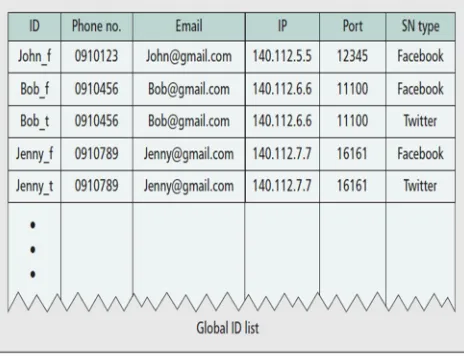
Fig. 2 An example of Global ID list.
An index peer node is a database that maintains the GlobalID list as shown in above figure. As show in the diagram for each online peer node an entry is created in the GlobalID List for the peer node. Just like the friend list GlobalID List consists of three kinds of information that is Personal Information second the Social Network Information and third, Address Information for an online user. Next we have the Global Relationship Method to search for the global relationship between two users across heterogeneous social networks. Here first we find out the strength of two different users over heterogeneous SNSs and then based on this strength we present as i-Search method to find a meaningful directional path within two peer nodes in heterogeneous social networks. The I search algorithm is presented as follws
1) Algorithm 1:iSearch algorithm
Input:s,r,P,Z(P) Output:Pnew,Z(Pnew) a) foreach v: v G - P do
b) if v = r then
c) Pnew←P {s→ v};
d) Z(Pnew) ←Z(P)F(s,v); e) return;
f) else if v is online ,and Z(P)F(s,v) >∆ then g) v.i-search(v,r,P {s→ v}, Z(P)F(s,v));
h) else if v is offline, or Z(P)F(s,v) ≤ ∆ then i) quit;
j) end
k) End
II. CONCLUSION
[2] M. N. Ko et al., “Social-Networks Connect Services,” Computer, vol. 43, Aug. 2010, pp. 37–43.
[3] Zhang, “Privacy and Security for Online Social Networks: Challenges and Opportunities,” IEEE Network, vol. 24, no. 4, July/Aug.2010, pp. 13–18. [4] Mislove , “Measurement and Analysis of Online Social Networks,” Proc. 7th ACM SIGCOMM Conf. Internet Measurement, 2007,pp.29–42.
[5] N. Ellison and D. Boyd, “Social Network Sites: Definition, History, and Scholarship,” J. Computer-Mediated Communication, vol. 13, no. 1, Oct. http://openid.net.
[6] L. Katz, “A New Status Index Derived From Sociometric Analysis,” Psychometrika, vol. 18, no. 1, Mar. 1953, pp. 39–43.
[7] S. B. Ronald, STRUCTURE: A General Purpose Network Analysis Program Providing Sociometric Indices, Cliques, Structural and Role Equivalence, Density Tables, Contagion, Autonomy, Power and Qquilibria in Multiple Network Systems (Version 4.2). New York: Columbia University Press, 1991.
[8] B. Yu and M. P. Singh, “Searching Social Networks,” Proc. 2nd Int’ Joint Conf. Autonomous Agents and Multiagent Systems (AAMAS ’03), 2003, pp. 65–72. [9] N.B. Chang and M. Liu, “Controlled Flooding Search in a Large Network,” IEEE/ACM Trans. Net., vol. 15, no. 2, Apr. 2007, pp. 436–49 [14] S. Jiang et al., “LightFlood: Minimizing Redundant Messages and Maximizing Scope of Peer-to-Peer Search,” IEEE Trans. Parallel and Distributed Systems, vol. 19, no. 5, May 2008, pp. 601–14.
[10] R. Nelson, Probability, Stochastic Processes, and Queueung Theory, Springer Verlag, 1995.
[11] D. J. Watts and S. H. Strogatz, “Collective Dynamics of “Small-World” Networks,” Nature, vol. 393, no. 6684, 1998, pp. 440–42.