M E T H O D
Open Access
DeepCRISPR
: optimized CRISPR guide RNA
design by deep learning
Guohui Chuai
1,2†, Hanhui Ma
5†, Jifang Yan
1,2, Ming Chen
4, Nanfang Hong
1,2, Dongyu Xue
1,2, Chi Zhou
1,2,
Chenyu Zhu
1,2, Ke Chen
1,2, Bin Duan
1,2, Feng Gu
6, Sheng Qu
1,2, Deshuang Huang
3*, Jia Wei
4*and Qi Liu
1,2*Abstract
A major challenge for effective application of CRISPR systems is to accurately predict the single guide RNA (sgRNA) on-target knockout efficacy and off-target profile, which would facilitate the optimized design of sgRNAs with high sensitivity and specificity. Here we presentDeepCRISPR, a comprehensive computational platform to unify sgRNA on-target and off-target site prediction into one framework with deep learning, surpassing available state-of-the-art in silico tools. In addition,DeepCRISPRfully automates the identification of sequence and epigenetic features that may affect sgRNA knockout efficacy in a data-driven manner.DeepCRISPRis available athttp://www.deepcrispr.net/.
Keywords:CRISPR system, Gene knockout, Deep learning, On-targets, Off-targets
Background
CRISPR-based gene knockout is widely implemented in various cell types and organisms. In this system, a single-guide RNA (sgRNA) guides Cas9 proteins to spe-cific genomic targets. Recognition and cleavage occur via complementarity of a 20-nucleotide (nt) sequence within the sgRNA to the genomic target, i.e., the on-target, up-stream of a protospacer adjacent motif (PAM) at its 3′ end [1]. Extensive studies have also demonstrated that multiple mismatches as well as DNA or RNA bulges can be tolerated, resulting in cleavage of unintended genomic sites, termed off-targets [2]. Such a CRISPR-Cas9 endo-nuclease system permits genome editing at nucleotide resolution [3, 4], while a major challenge for its effective application is to accurately predict the sgRNA on-target knockout efficacy and off-target (OT) profile beforehand. Accurate prediction would facilitate the optimized design of sgRNAs by maximizing their on-target efficacy (high sensitivity) and minimizing their off-target effects (high specificity) [1,2,5–7].
Various sgRNA design rules and tools have been devel-oped for sgRNA on-target identification and efficacy prediction. These methods are categorized into three types: (1) alignment-based, where the sgRNAs are aligned from the given genome purely by locating the PAM (CasFinder [8], etc.); (2) hypothesis-driven, where the sgRNA knockout efficacies are scored empirically by considering the impact of genome context factors (E-CRISP [9],CRISPR[6],CHOPCHOP [10], GuideScan [11], etc.); and (3) learning-based, where the sgRNA knockout efficacies are predicted from a training model by considering different features (sgRNA Designer [2], SSC[5],sgRNA Scorer[12,13],CRISPRscan[14], etc.). A benchmark study indicated that the latter two types of tools generally perform better than the alignment-based tool, although the predictions do not scale well in differ-ent cell types [15, 16]. Novel computational methods as well as comprehensive exploration of DNA sequence and epigenetic features affecting sgRNA knockout effi-cacy are required [7,16].
Off-targets are proven to occur in CRISPR system [2, 6, 17]. Although sgRNA-guided Cas9 cutting at a par-ticular site does not necessarily lead to functional con-sequences (such as an in-frame shift mutation) [18], how to accurately and quantitatively detect or predict off-target cleavage sites is still an important issue and remains challenging [19]. Most existing tools use sim-ple sequence alignment with different nucleotide
* Correspondence:[email protected];[email protected];
†Guohui Chuai and Hanhui Ma contributed equally to this work.
3Machine Learning & Systems Biology Lab, School of Electronics and Information Engineering, Tongji University, Shanghai 201804, China 4
R&D Information, Innovation Center China, AstraZeneca, 199 Liangjing Road, Shanghai 201203, China
1Department of Endocrinology & Metabolism, Shanghai Tenth People’s Hospital, Tongji University, Shanghai 20009, China
Full list of author information is available at the end of the article
mismatches to exhaustively search for off-target sites [20]. A few tools predict cleavage efficacy at the mis-matched locus by designing off-target scores (for ex-ample,CFDscore [2],MITscore [6,16,21], etc.). Their prediction results were compared with data generated by whole sgRNA off-target cleavage detection tech-niques like GUIDE-seq [22], Digenome-seq [16, 23, 24], High-throughput genome-wide translocation sequen-cing (HTGTS) [25], direct in situ breaks labeling se-quencing (BLESS) [26], and integration-deficient lentiviral vector capture (IDLV) [27]. These are essen-tially hypothesis-based methods that use empirically de-fined off-target criteria to identify off-target sites. Effective learning-based prediction of the whole gen-ome off-target profile is needed.
Currently, building a learning model for sgRNA efficacy prediction faces several obstacles: (1) data het-erogeneity issues where effective integration is required for data from different cell types and experimental plat-forms. (2) data sparsity issues where the labeled sample size, i.e., the amount of sgRNAs with known efficacies, is relatively small and experimentally expensive to col-lect—insufficiently labeled data makes the current learn-ing models inefficient; (3) data imbalance issues in off-target site prediction—the number of true off-target cleavage sites recognized by whole-genome off-target de-tection techniques is small among all the possible nu-cleotide mismatch loci; (4) the leading sequence and epigenetic features affecting sgRNA efficacy remain un-clear and await further exploration [5].
Recently, several studies have tried sophisticated learn-ing models for on-target or off-target prediction [28– 30], but none of them have addressed these issues thor-oughly. In our study, we present a novel and powerful deep learning framework [31–33] to simultaneously
pre-dict sgRNA on-target knockout efficacy and a
whole-genome off-target cleavage profile that competes favorably with the available state-of-the-art tools. Our approach, calledDeepCRISPR, is based on a carefully de-signed hybrid deep neural network for model training and prediction. To the best of our knowledge, this is the most comprehensive computational platform available to unify on-target and off-target site prediction into one framework with deep learning. We applied a deep un-supervised representation learning technique [32, 34] to automatically learn the underlying representation of sgRNAs using a complete set of genome-wide unlabeled sgRNAs. The learned model was further tuned by a su-pervised deep neural network using the existing labeled sgRNAs. We point out that pre-training of huge amounts of unlabeled sgRNAs can be used to boost the model prediction, which has never been studied in trad-itional sgRNA efficacy prediction. Together, Deep-CRISPR addresses the above challenges with the
following advantages: (1) by considering the epigenetic information in different cell types, it represents different DNA regions from different cell types in a unified fea-ture space and integrates the data from different experi-ments and cell types. Although DeepCRISPR is trained on limited cell type data, we validated that it has a gen-erally good prediction ability when adapting to new cell types. (2) It learns from billions of genome-wide un-labeled sgRNAs to automatically derive a “parent net-work”, thus generating a high-level feature representation simultaneously for sgRNA on-target and off-target design. In this way, DeepCRISPR optimizes sgRNA design for both coding and non-coding regions by considering the unsupervised pre-training of genome-wide sgRNA sequences from these regions. The models with and without pre-training were compared and the superiority of unsupervised pre-training was val-idated. (3) It applies a specific data augmentation tech-nique to generate novel sgRNAs with biologically meaningful labels, thus increasing the labeled training size in sgRNA on-target site prediction. We further vali-dated that such data augmentation indeed improves the prediction performance and makes the training model robust. (4) It further fine-tunes the parent network using the labeled sgRNA data, which helps to boost the predic-tion performance on limited labeled samples. (5) It inte-grates an efficient bootstrapping sampling algorithm with the training procedure, dramatically alleviating the data imbalance issue in off-target site prediction. (6) Fi-nally, it fully automates the identification of sequence and epigenetic features. The model learns which features are important in optimized sgRNA design using limited training samples. The identified features can be used for optimized sgRNA design. This helps to decipher the CRISPR on-target and off-target mechanisms in a much more efficient data-driven manner.
DeepCRISPRis available athttp://www.deepcrispr.net/. The command line code is also available at https://
github.com/bm2-lab/DeepCRISPR and
https://zeno-do.org/record/1246320. The current version of Deep-CRISPR focuses on conventional NGG-based sgRNA design for SpCas9 in humans. It can be easily extended to other Cas9 species or variants and other species. Its on-target and off-target site prediction performances were compared with the available state-of-the-art tools.
Results
TrainingDeepCRISPRfor sgRNA on-target and off-target site prediction
Deep unsupervised learning for sgRNA representation
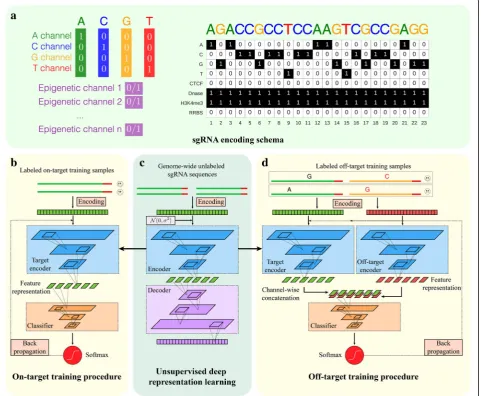
regions. These data account for ~ 0.68 billion sgRNA se-quences with different epigenetic information curated from 13 human cell types (see the “sgRNA encoding with genome and epigenetic features” section). They serve as a large-scale unlabeled sgRNA data source for the following pre-training procedure to derive an effi-cient feature representation of sgRNA. The whole data collection and preprocessing were achieved by using a SPARK-based large-scale data processing architecture with graphic processing unit (GPU) acceleration. Each sgRNA is initially encoded with its sequence and epigen-etic information (see the“sgRNA encoding with genome and epigenetic features” section). Then with these un-labeled sgRNA sequences in hand, we use a deep un-supervised representation learning strategy to train a deep convolutionary denosing neural network (DCDNN)-based autoencoder [35] to automatically learn the underlying meaningful representation of sgRNAs in an unsupervised manner [34] (Fig. 1c; see the
“DCDNN-based autoencoder for representation learn-ing” section). Such a de-noising strategy helps to train the autoencoder to robustly tolerate the noise in the huge amount of sgRNA data. The intuitive rationale to use autoencoder is that the unlabeled data with encoding and decoding can be used to learn an efficient feature representation. Such a learned feature representation will be fitted to the following model building. The net-work trained at this step is termed an unsupervised, pre-trained parent network for further analysis.
A fine-tuned hybrid deep neural network for sgRNA on-target knockout efficacy prediction
We next generated a hybrid deep neural network for sgRNA on-target knockout efficacy prediction, compris-ing two parts. The first part is the former pre-trained DCDNN-based network (parent network), the output of which is used as the input for a convolutionary neural network (CNN; Fig. 1b, c; see the “CNN model with pre-training based fine-tuning” section). The whole hy-brid neural network was then trained based on the la-beled data, i.e., the collected sgRNAs with known on-target knockout efficacies. The training procedure not only learned the weights for the CNN-based work, but also fine-tuned the weights of the parent net-work. Therefore, this strategy uses limited labeled data to tune the original pre-training network weights and it is expected to boost the prediction accuracy (Fig. 1b, c; see the“CNNmodel with pre-training based fine-tuning” section). In our study, the labeled sgRNA dataset contains ~ 0.2 million sgRNAs with known knockout efficacies. This dataset was generated from ~ 15,000 sgRNAs across 1071 genes with known knockout efficacies in a data aug-mentation manner (see the“On-target data sources” sec-tion), like that used for image data processing (see the
“Data augmentation for on-target dataset” section). The final tuned weights for the whole hybrid deep neural net-work were used to predict the on-target knockout efficacy of a new sgRNA. In addition, in order to achieve rigorous evaluations ofDeepCRISPR, both classification and regres-sion models for on-target prediction were built for a com-prehensive comparison.
Extending the model for sgRNA off-target site prediction by reusing the parent network
We also extended the hybrid neural network for sgRNA off-target profile prediction by reusing the pre-trained parent network (Fig. 1c, d). First, we treated a given sgRNA and its one possible off-target locus as a sample pair, and these sample pairs are taken as the off-target training samples. The sample pair was encoded in two parts, where one part represents the encoding of the given sgRNA and the other represents the encoding of its possible off-target locus (Fig.1c; see the “sgRNA en-coding with genome and epigenetic features” section). Such a two-part encoding presents an accurate and com-prehensive representation of an off-target sample by considering the original sgRNA sequence and mis-matched sequence as a whole. During training, each part of the sgRNA off-target sample was fitted into the pre-trained DCDNN-based network, i.e., the parent net-work, for feature representation learning. Next, the out-puts of this parent network were combined together channel-wise for the following CNNclassifier, similar to on-target site prediction (Fig. 1c). In our study, the complete hybrid neural network was trained based on the collected labeled sgRNA off-target datasets contain-ing ~ 160,000 samples (see the “Off-target data sources” section). An efficient bootstrapping algorithm was inte-grated into the batch training of this hybrid network, al-leviating the data imbalance issue in off-target site prediction (Fig.5; see the“Integrating bootstrapping into batch training of deep neural networks to address the data imbalance issue” section). Similar to that of on-target site prediction, the training procedure not only learned the weights for theCNNnetwork, but also tuned the weights of the parent network, resulting in two dif-ferent “baby networks” for two parts of the sgRNA off-target sample. The final tuned weights for the two baby networks as well as theCNNnetwork were used to predict the off-target profile of a given sgRNA. Similarly, in order to achieve rigorous evaluations ofDeepCRISPR, both classification and regression models for off-target prediction were built for a comprehensive comparison.
Comparison ofDeepCRISPRwith state-of-the-art sgRNA on-target efficacy prediction
on-target knockout efficacy benchmark data for humans, including four different cell types: i.e.,hct116[36],hek293t [2],hela [36], andhl60[37]. Note that such datasets were also used by Haeussler et al. [16] for the benchmark study. The whole dataset includes ~ 15,000 sgRNAs with experi-mentally validated known knockout efficacies from 1071 genes. In our study, we formulatedDeepCRISPReither in a classification schema or in a regression schema for a com-prehensive and rigorous comparison. For the classification model, the known knockout efficacy was labeled in a binary way (see the“On-target data sources”section). For the re-gression model, the known knockout efficacy was inte-grated and labeled in a numerical way (see the“On-target data sources” section). Then, eight different testing
scenarios were carefully designed for comprehensive and objective comparisons ofDeepCRISPRwith state-of-the-art tools. Through such comparisons, we provide solid evi-dence that (1) the deep learning models (without unsuper-vised pre-training) are superior to shallow learning models; (2) the unsupervised pre-training strategy boosts model performance; (3) the data augmentation further improves model performance and model robustness; (4)DeepCRISPR generalized generally well in new cell types for sgRNA on-target knockout efficacy prediction; (5)DeepCRISPR ef-ficiently learns the high-level feature representation by avoiding manual feature engineering for sgRNA design, in-dicated by the apple-to-apple comparisons with the retrained sgRNA designer (the gradient-boost-based Fig. 1Implementation details ofDeepCRISPR.asgRNA encoding schema. For a DNA region, the nucleotide sequence is represented by four channels, i.e., the A-channel, C-channel, G-channel, and T-channel, and each epigenetic feature is considered as one channel.bTraining details ofDeepCRISPRfor sgRNA on-target efficacy prediction. TheSoftmaxandIdentityfunctions correspond to classification and regression models, respectively.cUnsupervised deep representation learning based on billions of genome-wide sgRNA sequences.dTraining details ofDeepCRISPRfor sgRNA off-target profile prediction. The
[image:4.595.59.541.91.487.2]classification or regression models) with the same training data, while with different features; (6) DeepCRISPR is ro-bust with superior performance for both classification and regression models.
Testing scenario 1—classification schema
In this test, for the original ~ 15,000 sgRNAs with known knockout efficacies from four cell types, 20% of the data from each cell type were stratified by data labels and used as independent testing sets. The remaining 80% of the data from each cell type were combined to-gether for model training and parameter tuning during the cross-validation process. The deep CNN-based clas-sification model without unsupervised pre-training and data augmentation (denoted as“CNN”) was trained and tested on the independent test data for the four cell
lines, respectively, and compared with eight
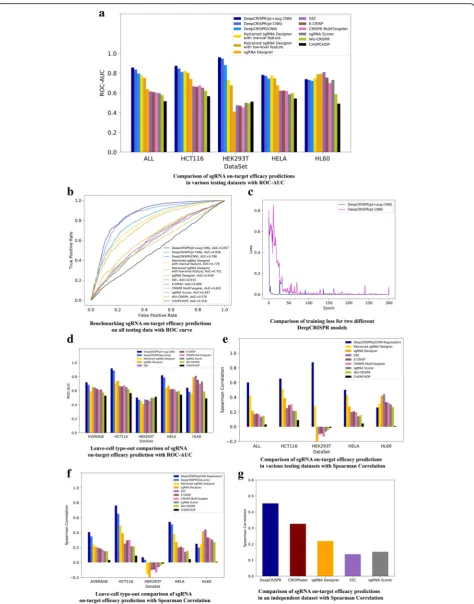
state-of-the-art tools that were trained with human cell line data, includingsgRNA Designer[2],SSC[5], CHOP-CHOP [10], CRISPR MultiTargeter [38], E-CRISP [9], sgRNA Scorer [12], Cas-Designer [39], and WU-CRISPR [40] (Fig. 2a, b). These tools cover all the available methods designed for human sgRNA efficacy prediction, either by a learning model or a hypothesis-based scoring function (see Additional file 1 for a comprehensive list of current tools and the reasons we selected these tools for comparison). The comparison was evaluated using the values from the area under the receiver operating characteristic (ROC) curve (AUC) [41]. The comparison indicated that, on average,DeepCRISPRreached an over-all ROC-AUCof 0.796, outperforming all eight methods with a maximum improvement of ~ 113% over sgRNA Designer[2] (with 0.5 ROC-AUCas the baseline), which is the next highest performing tool (Fig. 2a, b, Additional file2).
Testing scenario 2—classification schema
In this test, we further built our model with unsuper-vised pre-training on ~ 0.68 billion unlabeled sgRNAs (denoted as “pt CNN”). The same training and testing data were used as for testing scenario 1. The overlapping sgRNAs between the training and testing data were re-moved. The pre-trained CNN reached an overall ROC-AUC of 0.836 with a 142% improvement over sgRNA designer (with 0.5 ROC-AUC as the baseline; Fig.2a, b; Additional file2).
Testing scenario 3—classification schema
We further built our final DeepCRISPR model with pre-training-based CNN plus data augmentation (de-noted as “pt + aug CNN”). The training data were aug-mented while the testing data were identical to those of testing scenarios 1 and 2. The overlapping sgRNAs be-tween the training and testing data were removed. For
this case, DeepCRISPR reached an overall ROC-AUC of 0.857, with a 157% improvement over sgRNA designer (with 0.5 ROC-AUC as the baseline; Fig. 2a, b; Add-itional file 2). It can be seen that the improvement in performance was relatively small compared with testing scenario 2, while we found that the loss function during training converged fast and became very robust com-pared with that of testing scenario 2 (Fig.2c). This indi-cates that increasing the label data amount can help to make the model robust and converge fast during the training.
Testing scenario 4—classification schema
specific cell type. As a summary, we conclude that Deep-CRISPR performed generally well in new cell types for sgRNA on-target knockout efficacy prediction.
Testing scenario 5—classification schema
In this test, we provide a more rigorous and solid apples-to-apples comparison ofDeepCRISPR withsgRNA designer, the next best tool during our former tests.
Firstly, we rigorously kept an identical comparison en-vironment forDeepCRISPR andsgRNA designer with the same training and testing data. For this case, we retrained sgRNA Designer (https://github.com/MicrosoftResearch/ Azimuth, a gradient boost classification-based shallow model) with the same augmented labeled dataset as Deep-CRISPRused in testing scenario 3, and also kept the test-ing data identical. Then the followtest-ing two different feature representations were performed: (1) we encoded the sgRNA with our one-hot feature representation (denoted as“retrainedsgRNA designerwith low-level feature”). This model achieved an overallROC-AUCof 0.751 (Fig.2a, b, Additional file2); (2) we encoded the sgRNA with the ori-ginal manually engineered features adopted bysgRNA de-signer(denoted as“retrainedsgRNA designerwith manual feature”). This model achieved an overall ROC-AUC of 0.778 (Fig. 2a, b, Additional file2). Compared with these two different feature representations, it is indicated that the low-level feature encoding is not suitable for shallow models; therefore, the retrained sgRNA designer achieved better performance with manual domain-based feature en-gineering and feature encoding. Nevertheless, these results further indicate that the deep learning model can effi-ciently learn the high-level feature representation from low-level features and compete with the shallow models by avoiding manual feature engineering for sgRNA design. Secondly, we also performed a leave one cell type out comparison of DeepCRISPR with retrained sgRNA de-signerusing our one-hot feature representation. The test was performed on the same training and testing data as those of testing scenario 4 (Fig.2d, Additional file2). It can be seen that, on average, DeepCRISPR still outper-formed retrainedsgRNA designer, indicating its on-target prediction superiority compared to other methods.
Testing scenario 6—regression schema
In this test, we further trained DeepCRISPRin a regres-sion schema with the original numerical sgRNA
knockout efficacies. The data from different experiments were integrated in an elegant way as demonstrated in the“On-target data sources”section. The performance was evaluated with Spearman correlationas adapted in former studies [42]. The whole comparison was performed in a similar way as in testing scenarios 3 and 5, except that the model was trained in a regression way. Also thesgRNA de-signer was retrained in a regression way with the same training and testing data. It can be seen that in this case DeepCRISPRstill outperformed the other methods as eval-uated by Spearman correlation (Fig.2e, Additional file2).
Testing scenario 7—regression schema
We further tested the regression-basedDeepCRISPRin a leave one cell type out way to investigate its generalization ability in new cell types, similar to test scenario 4. For this case DeepCRISPR achieved similar performance to those in a classification schema and out-performed the other methods as evaluated by Spearman correlation (Fig.2f, Additional file2).
Testing scenario 8—regression schema on an independent dataset
Since all the former tests (scenarios 1–7) were per-formed on the four cell types (hct116,hek293t,hela, and hl60) by separating the data for training and testing, in this case we applied an additional dataset which was to-tally independent of our former tests to investigate the on-target prediction performance of DeepCRISPR. This dataset, reported recently by utilizing fluorescent re-porter knock-out assays with verification at selected
en-dogenous loci for sgRNA knockout efficacy
measurement, contains a total of 425 sgRNAs for HEL cells [43]. Both the cell type and data distribution are different to our former tests, and the sgRNAs do not overlap the former datasets. Therefore, it can serve as an ideal independent testing dataset to investigate the generalization ability of DeepCRISPR. In this test, we retrained DeepCRISPRwith only sequence-level features on the original four cell type datasets, since the epigen-etic features of the tested HEL cell type are not available in ENCODE. The retrained DeepCRISPR model was tested on this HEL cell data and compared with sgRNA designer, SSC, sgRNA scorer, and CRISPRator. Surpris-ingly, DeepCRISPR not only significantly outperformed sgRNA designer, the current state-of-the-art on-target
(See figure on previous page.)
Fig. 2Evaluation ofDeepCRISPRfor on-target efficacy prediction.a,bComparison of sgRNA on-target efficacy predictions in a classification schema for various datasets, i.e.,hct116cell line,hek293tcell line,helacell line,hl60cell line, and the overall testing dataset.cComparison of training loss for two differentDeepCRISPRclassification models.dLeave cell type out comparison of sgRNA on-target efficacy prediction in a classification schema.e
Comparison of sgRNA on-target efficacy predictions in a regression schema for various datasets, i.e.,hct116cell line,hek293tcell line,helacell line,hl60
prediction tool, with a nearly twofold improvement mea-sured with Spearmen correlation, but also outperformed CRISPRator, which is designed specifically for this HEL cell dataset [43] (Fig. 2g, Additional file 3). This inde-pendent test further indicates thatDeepCRISPRhas good generalization ability for unseen data, even without the contribution of cell type-specific features.
In summary, for both the classification and regression models, DeepCRISPR generally outperformed alterna-tives for on-target prediction as measured byROC-AUC and Spearman correlation. Also, it has a good cell type generalization ability. In addition, it can be seen that the amount of training data influences model performance, and the potential of deep learning models can be boosted with larger amounts of training data.
Evaluation ofDeepCRISPRfor whole-genome sgRNA off-target profile prediction
We next evaluated the ability of DeepCRISPRto predict off-target sites. For this purpose, we curated the human sgRNA whole-genome off-target profile data detected by GUIDE-seq,Digenome-seq, BLESS, HTGTS, and IDLV. These data include 30 sgRNAs from two different cell types: the HEK 293 cell line and its derivatives (18 sgRNAs) [6, 22, 24–27], and K562 t (12 sgRNAs) [44], accounting for ~ 160,000 possible loci with a maximum of six nucleotide mismatches (see the “Off-target data sources” section).We also formulated DeepCRISPR in a classification and a regression schema for a comprehen-sive and rigorous comparison. For the classification model, the off-target sites are labeled as “1” and the others are labeled as “0” (see the “Off-target data sources” section). For the regression model, the off-target sites are labeled with the targeting efficacies measured with indel frequency detected by different as-says (see the “Off-target data sources” section). Then three different testing scenarios were designed for off-target profile prediction evaluation.
Testing scenario 1
We withheld 20% of the data for each cell type as an in-dependent testing set. The remaining 80% of data were combined together to train our model and tune the pa-rameters during the cross-validation process. Because the whole dataset was highly unbalanced with ~ 700 true off-target sites, an efficient bootstrapping sampling algo-rithm was adapted in the training procedure to alleviate the data imbalance (see the “Integrating bootstrapping into batch training of deep neural networks to address the data imbalance issue” section). As a result, our final trained off-target site prediction model was tested on the independent datasets for each of the two cell lines and compared with four of the current state-of-the-art off-target site prediction tools,CFD score[2],MIT score
[6],CROP-IT[45], andCCTop[46].These tools were de-signed for human sgRNA off-target site prediction using various empirically defined off-target scores. Since the whole dataset is unbalanced, the comparison was
evalu-ated using AUC values from the ROC and
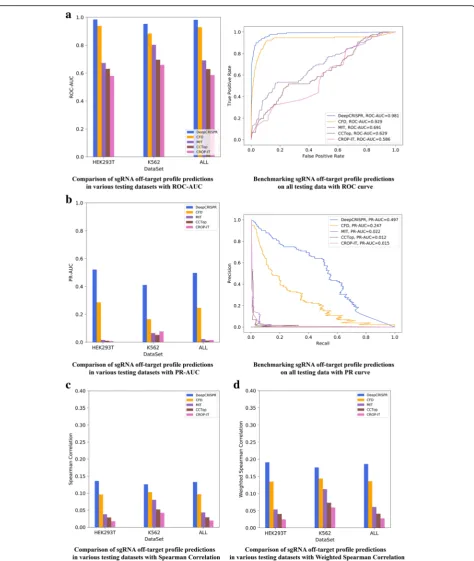
precision-recall curve for the classification model, and Spearman correlation and weighted Spearman correl-ation [42] for the regression model. For a maximum of six nucleotide mismatches, the testing results indicated that DeepCRISPR outperformed all four methods in the two cell types (Fig. 3a-c, Additional file 2). Overall, DeepCRISPR achieved an ROC-AUC of 0.981(Fig. 3a), PR-AUCof 0.497(Fig.3b), Spearman correlation of 0.133 (Fig. 3c) and weighted Spearman correlation of 0.186 (Fig.3c), outperforming the second-best method, i.e., the CFDscore [2] (Fig.3a-c).
It is worth noting that the improvement in off-target prediction withDeepCRISPRis a relatively small margin when compared with the CFD score evaluated with ROC-AUC since the CFD score had already achieved high performance; nevertheless, such improvement is very important since near-zero off-targeting is the ultim-ate goal for all CRISPR-based gene therapies. Also, it should be noted that all the existing tools, including DeepCRISPR, tend to avoid missing true off-target cleav-age sites by weighting higher on positive samples. This also makes sense for CRISPR-based gene therapy, as the penalty of missing a true off-target site is always higher than that of inducing a false positive in off-target site prediction. That is why we adopted the weighted Spear-man correlation proposed by Listgarten et al. [42] to ad-dress such weight asymmetry issues. The weight for each off-target site is set proportional to its rank order according to the corresponding knock-out efficacy mea-sured by indel frequency. Nevertheless, such a weighting schema is actually a compromise for false positives. Therefore, reducing false positives purely from un-weighted data is still required and is very challenging. For this case, it can be seen thatDeepCRISPRgreatly im-proved the PR-AUC value compared to the other methods, indicating that DeepCRISPR can dramatically reduce the false positives during off-target prediction..
Testing scenario 2
Fig. 3Evaluation ofDeepCRISPRfor off-target profile prediction.aComparison of sgRNA off-target profile predictions in a classification schema for various datasets, i.e.,293-related cell types andK562cell line with a maximum of six mismatches. The performance was evaluated withROC-AUC.b
Comparison of sgRNA off-target profile predictions in a classification schema for various datasets, i.e.,293-related cell types andK562cell line with a maximum of six mismatches. The performance was evaluated withPR-AUC.cComparison of sgRNA off-target profile predictions in a regression schema for various datasets, i.e.,293-related cell types andK562cell line with a maximum of six mismatches. The performance was evaluated with Spearman correlation.dComparison of sgRNA off-target profile predictions in a regression schema for various datasets, i.e.,293-related cell types and
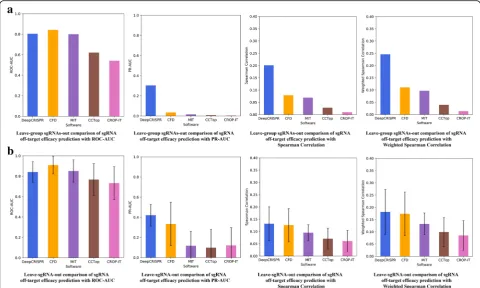
[image:9.595.62.537.83.645.2]DeepCRISPR achieved an average ROC-AUC of 0.804, PR-AUC of 0.303, Spearman correlation of 0.201, and weighted Spearman correlation of 0.246 (Fig. 4a, Add-itional file 2). The ROC-AUC for DeepCRISPR is com-parable to the result with CFD score, while other measurements, especially the PR-AUC (0.303), are sig-nificantly higher than with CFD score (0.034), indicating that DeepCRISPR can help to reduce false positives for unseen sgRNAs in off-target prediction.
Testing scenario 3
In this scenario, for all 30 sgRNAs, we performed 30-fold leave one sgRNA out testing, which is an ex-treme case of the leave sgRNA group out test as shown in testing scenario 2 (Fig.4b). For both classification and regression models, DeepCRISPR achieved an average ROC-AUCof 0.841,PR-AUCof 0.421, Spearman correl-ation of 0.132, and weighted Spearman correlation of 0.181 (Fig. 4b, Additional file 2). In this case, the ROC-AUC of DeepCRISPR is comparable to the result from CFD score, while other measurements, especially PR-AUC(0.421), are higher than withCFD score(0.333).
In summary, for both classification and regression models,DeepCRISPRgenerally outperformedCFDscore, especially with improved performance to reduce false
positives in the highly imbalanced off-target prediction. One thing to note is that the classification model is more suitable for off-target prediction compared to the regression model since in this case we only care about distinguishing off-target sites among others rather than predicting their binding affinities. In addition, the regres-sion model is more sensitive and thus requires more data to train it. The current version ofDeepCRISPRhas only been trained on limited samples as a prototype study. We are expecting to boost DeepCRISPR with more training samples, taking full advantage of deep models compared to shallow models.
Automating feature identification in a learning schema
[image:10.595.57.538.88.376.2]feature saliency map for efficient sgRNA design with optimization [47] based on the trained deep learning model. We allow the trained deep neural network model to tell us what the efficient sgRNAs look like compared to inefficient sgRNAs (see the “Feature identification by deriving a class-specific feature saliency map”section).
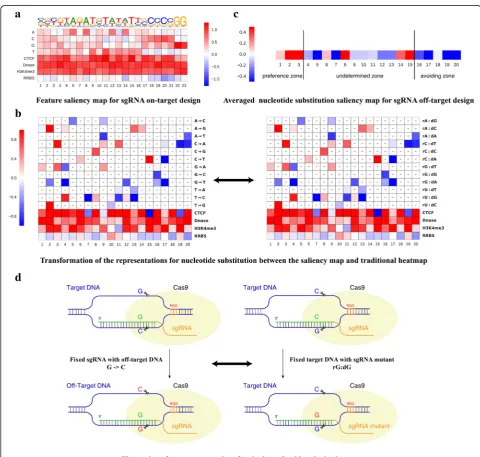
We first generated the feature saliency map for sgRNA on-target site prediction based on the existing training data, as shown in Fig.5a. We obtained a feature saliency
map consistent with previous findings: (1) it has the same preferences in the variable nucleotides of the PAM NGG for high efficacy sgRNA, where cytosine is favored and thymine is disfavored. This is consistent with exist-ing in vitro and in vivo studies [1, 2]. (2) Thymines are disfavored at the four positions closest to the PAM, con-sistent with the fact that multiple uracils in the spacer lead to low sgRNA expression [1]. (3) Position 18 has a consistent preference for cytosine, which is the DNA
Fig. 5Automatic learning sequence and epigenetic features affecting sgRNA on-target and off-target design.aFeature saliency map for sgRNA on-target design.bTransformation of the representations of nucleotide substitution between the saliency map and traditional heatmap.
Hyphensin both maps indicate that the impact of the nucleotide substitution at this position is not statistically significant by a Fisher’s exact test.
[image:11.595.56.537.209.666.2]cleavage site of CRISPR system [5, 37]. (4) It has a gen-eral preference for an open chromatin structure, as indi-cated by the feature saliency map of CTCF, DNase, and H3K4me3. (5) It has a relatively avoidance of DNA methylation for high sgRNA efficacy, as shown by the RRBS assay. This is consistent with a recent study ex-ploring various features for CRISPR off-targets [28]. In summary, nucleotide preferences at specific positions coupled with an open chromatin structure are preferred for optimized sgRNA on-target design.
For off-target site prediction, a detailed feature sali-ency map for 16 possible nucleotide substitutions across 20 positions is presented, by filtering those points with-out statistical significant using a Fisher statistical test (Fig. 5b; see the “Feature identification by deriving a class-specific feature saliency map” section). We also generated an averaged nucleotide substitution rate map to indicate their effect on the occurrence of off-target cleavage (Fig.5c; see“Feature identification by deriving a class-specific feature saliency map” section). We divided this feature map into three nucleotide substitution zones, i.e., off-target preference zone(positions 1–3), un-determined zone(positions 4–15), andoff-target avoiding zone(positions 16–20). Although this map was obtained from limited samples, we observed that the nucleotide mutations occurring near the PAM are prone to avoid off-target sites in a position and nucleotide identity-dependent manner. This is consistent with pre-vious findings that changing the nucleotides far from the PAM usually has little effect on sgRNA efficacy [2, 6]. Previously, two different groups performed extensive in vitro tests on human EMX1 and CD33 genes to generate
different guide RNAs containing possible
single-nucleotide substitutions for off-target studies. Their study indicated that SpCas9 tolerates single-base mismatches in the PAM distal region to a greater extent than in the PAM proximal region [2,6].
Specifically, the learned feature map (Additional file4) gave results consistent with previous studies and new findings.DeepCRISPRidentified a preference for purine:-purine mismatches to avoid off-target sites with statis-tical significance, including the substitution G->C(corresponding to rG:dG in a traditional heatmap, as previously reported [2]) and substitution G->T (corre-sponding to rG:dA in a traditional heatmap) at position 16. Kinetic studies of CRISPR dynamics in living cells also proved that the purine and purine mismatches at position 16 radically reduce binding affinity and dimin-ish cleavage activities [48]. Besides these consistent find-ings, our feature saliency map identified five nucleotide substitutions preferring off-targets in theoff-target pref-erence zone and eight nucleotide substitutions avoiding off-targets in theoff-target avoiding zone(Fig. 5b, c), in-cluding the two nucleotide substitutions G->C and
G->T at position 16 [48]. Future validation of these nu-cleotide substitutions based on large-scale off-target data is expected and the identified factors will become more accurate with more off-target data in the future.
The interpretation of Fig. 5b is different from that of previous studies, which is explained in the "Feature iden-tification by deriving a class-specific feature saliency map" section.
Discussion and conclusions
Here we present DeepCRISPR, an efficient and extend-able computational model for simultaneous prediction of CRISPR sgRNA on-target knockout efficacy and whole genome off-target profiles.DeepCRISPRsurpassed the state-of-the-art tools across a variety of human data-sets with solid evaluation metrics. Importantly, our re-sults indicate that leveraging genome-wide unlabeled sgRNA sequences as well as a deep learning model helps to efficiently learn sgRNA representations and boost the prediction performance. In addition, DeepCRISPR auto-mates the feature identification for sgRNA design in a data-driven manner, facilitating interpretation and opti-mized CRISPR on-target and off-target design.
the full space of off-target cleavage sites. Compared to on-target prediction, this might be inherently difficult since the current off-target raw datasets are not solid. Furthermore, the amount of off-target raw data might be less sufficient than the datasets for on-target prediction. In our study we integrated data from different off-target detection platforms and such a data collection schema is currently well-accepted [1,5].
The main point of our current study is to present DeepCRISPR as the first prototype model that demon-strate the utility of deep learning for optimized sgRNA design. Nevertheless, better noise-free off-target data are waiting to be accumulated. Higher sensitive off-target detection techniques are expected to be developed. Our models can be trained based on these data for improved CRISPR off-target prediction in the future.
In addition, the amount of available sgRNA knockout data is relatively small, which provides a challenge for training a routine deep learning model. A common con-cern with deep models is that they can overfit the train-ing data [31]. Therefore, besides the previous collection of genome-wide sgRNA sequences for unsupervised rep-resentation learning, we carefully designed a hybrid deep network incorporating several other techniques: (1) an efficient data augmentation technique to increase the training sample size; (2) fine-tuning-based improvement of the model’s generalization ability; and (3) efficient batch normalization[31,32] techniques to avoid overfit-ting. By using these techniques, we surpassed the current state-of-the-art tools, both in on-target and off-target site prediction. On the other hand, we are an-ticipating a rapid increase in the amount of CRISPR gen-ome editing data due to the booming popularity of this new technique. For this reason, the performance of DeepCRISPR is expected to be enhanced with the avail-ability of more training data, taking advantage of this powerful deep learning framework. This is a superior feature of DeepCRISPR compared with shallow learning models [32]. We believe that future insights from the deep learning community as well as the data accumula-tion in the genome editing community will lead to en-hancements of DeepCRISPR and CRISPR-based gene editing analysis generally.
Methods
Data collection and processing On-target data sources
The initial on-target dataset contains seed sgRNAs with experimentally validated known knockout efficacy, com-prising ~ 15,000 sgRNAs containing 1071 genes from four different cell lines (hct116 [36], hek293t [2], hela [36], and hl60 [37]) with redundancy removed. The sgRNA knockout efficacy measurements were restricted to experimental assays, where the efficacy is defined as
the log-fold change in measured knockout efficacy. We excluded any other readouts of knockout measurements without in vivo or in vitro experimental validation, such as sequence-based readouts of the frameshift ratio, as their correlations with the true knockout efficiency are unclear [15]. For classification models, we converted sgRNA efficacy to a binary value using a log-fold change of 1 as the cutoff. Such label categorization was also ap-plied previously [5]. For regression models, we adopted a collaborative filtering-based data normalization method, borrowing the idea from the user-item recommendation system [49, 50]. Specifically, a matrix Y is formulated where each row represents one of the experiments and each column represents one sgRNA. yij indicates the jth
sgRNA knock-out efficacy in the ith experiment. First, three types of mean value are calculated, namely, mean values for each row, mean values for each column, and the mean value of the whole matrix. Then the normalized on-target efficacy valuesynormforyijare obtained by
sub-traction of the original on-target efficacy values and the weighted sum of mean values from the related row (mrow) and column (mcolumn) as well as the whole matrix
(mall), which is shown in the following formula:
ynorm¼yij−ðmrowþmcolumnþmallÞ=3 ð1Þ
After calculating the normalized on-target efficacy values integrated from different experiments, a rank-based normalization [2] is performed to obtain the final numerical labels (Additional file5).
Off-target data sources
The off-target profile dataset contained two different cell types: 293-related cell lines (18 sgRNAs) and K562 t (12 sgRNAs) [6, 22, 24–27, 44]. For all 30 sgRNAs, we ob-tained ~ 160,000 possible loci across the whole genome using bowtie2 [51], with a maximum of six nucleotide mismatches. The whole dataset was highly unbalanced, and nearly 1/250 loci was identified as an off-target site (one mismatch, 4; two mismatches, 31; three mis-matches, 121; four mismis-matches, 236; five mismis-matches, 174; six mismatches, 75) with various whole genome off-target detection techniques [22–27] (Additional files6 and 7). For the classification model, the off-target sites are labeled as“1”and the others are labeled as“0”. For the regression model, the off-target sites are labeled and nor-malized with the targeting cleavage frequency (indel fre-quency) detected by different off-target detection assays.
sgRNA encoding with genome and epigenetic features
consider epigenetic information by representing different DNA regions from different cell types with a unified fea-ture space. These epigenetic feafea-tures included CTCF binding information from the ChIP-Seq assay, H3K4me3 position information from the ChIP-Seq assay, chromatin-opening information from the DNase-Seq assay, and DNA methylation information from the RRBS assay, obtained from ENCODE [52]. In our study, we treated a DNA region as a one-row multi-channel pic-ture. For a conventional colored picture, each pixel has three values, namely, red, green, and blue from three channels. For a DNA region“picture”, the nucleotide se-quence is represented by four channels, i.e., the A-channel, C-channel, G-channel, and T-channel, and each epigenetic feature is considered as one channel. As a result, we obtained an eight-channel representation of each DNA region (Fig. 1a). Based on this encoding schema, the current version of DeepCRISPR supports genome-wide sgRNA efficacy prediction for 13 human cell lines (HEK293, MCF-7, K562, HL60, NB4, BE2C, Caco-2, GM06990, Hela, HCT116, LNCap, HepG2, and GM12878) with all required epigenetic information. It can be easily extended to other cell types if the required epigenetic information is provided.
Data augmentation for on-target dataset
The final on-target dataset was generated in a data aug-mentation manner like that used in image data process-ing. Considering that sgRNA with two mismatches in the first two positions from the 5′ end commonly has no effect on cleavage efficacy [1,2], we extended the ori-ginal seeds by changing each one into a new sgRNA with two mismatches in the PAM distal region. These newly generated sgRNAs with the same epigenetic profiles had identical efficacy labels to those of the seeds. This aug-mentation resulted into ~ 0.2 million non-redundant sgRNAs with biologically meaningful knockout efficacies for the training process (Additional file8).
Deep learning techniques
DCDNN-based autoencoder for representation learning DeepCRISPRuses adeep convolutionary denosing neural network (DCDNN)-based autoencoder to learn the underlying representation of sgRNA regions, which con-tain both the DNA nucleotide sequence and epigenetic information. The autoencoder has an encoder and a de-coder, which are in sequential order. Optimization of the autoencoder during training results in the underlying representation of the given sgRNAs [35]. In our study, the input of DeepCRISPR comprises all the sgRNA re-gional information of the whole human genome from 13 cell types collected from ENCODE [52], which accounts for over ~ 0.68 billion data samples (Fig. 1c). Detailed network descriptions are in Additional file9.
CNN model with pre-training-based fine-tuning
Followed by theDCDNN-based autoencoder for sgRNA representation learning, DeepCRISPR adopted a fully convolutional neural network (CNN) model for predict-ing sgRNA efficacy (Fig. 1b-d). DeepCRISPR applies a fine-tuning strategy to train the model by utilizing an autoencoder-based model to be part of the classifier and then tune the whole classifier with labeled data. The general information learned by large-scale unlabeled data can be used to boost the prediction performance. Specifically, we used the encoder part of the DCDNN-based autoencoder as the pre-trained model. For on-target prediction, it contains the pre-trained DCDNN-based encoder as well as the CNN layers, and its input is the sgRNA regional information data. For off-target prediction, it contains two pre-trained DCDNN-based encoders, one merged layer, and CNN layers. The input for the off-target prediction comprises two parts: target sgRNA regional information data and off-target sgRNA regional information data. Each part is fed into a pre-trained DCDNN-based encoder and then their results are merged. The merged result is fed into theCNNlayers to predict off-target sites (Fig.1b-d). De-tailed network descriptions are in Additional file9.
Integrating bootstrapping into batch training of deep neural networks to address the data imbalance issue
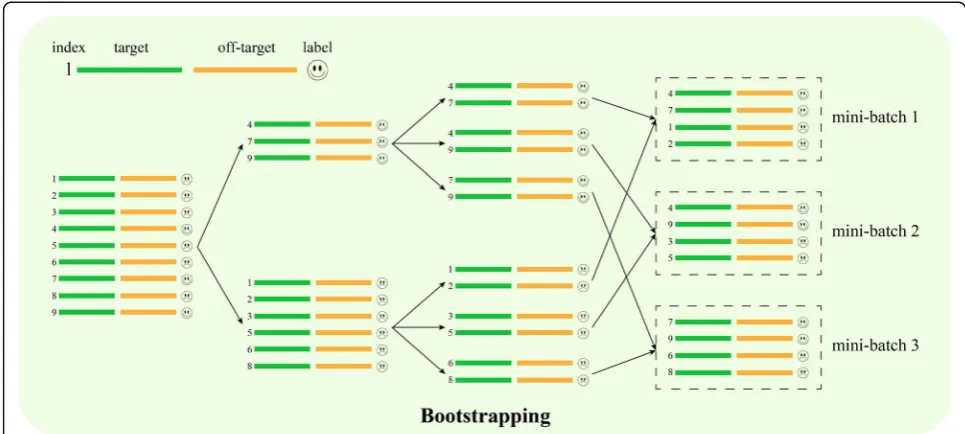
During the training for off-target site prediction, the data were highly unbalanced, i.e., the ratio of known off-target sites and negative off-target sites was approxi-mately 1:250. Highly unbalanced data will probably make the gradient update unstable and eventually cause the model training to fail. To deal with this issue, Deep-CRISPR applied a bootstrapping method to the mini-batches during the training process [32]. A similar idea has also been applied in related shallow learning models [28]. The basic idea of this method is to perform bootstrapping sampling from the minor samples and ob-tain the same amount of samples as major samples at the same time in mini-batches. This strategy ensures that the mini-batches have the same amount of positive samples and negative samples, thus avoiding gradient update instability and substantially boosting the predic-tion performance (Fig.6).
Feature identification by deriving a class-specific feature saliency map
the classc, computed by DeepCRISPR for a guide RNA g; we would like to find an optimized sgRNA, such that the scoreScis high:
argmaxgScð Þg ð2Þ
A locally optimal gcan be found by a gradient ascent method with eq. (1). The basic idea is that we just let the model learn to determine the dominant features based on the training samples related to a specific class. It maximizes the model output with respect to input and the calculated input reveals the optimized result [47]. For the on-target model, the trained deep neural net-work model just tells us what the efficient sgRNAs look like compared to inefficient sgRNAs. For the off-target model, the trained deep neural network model tells us what a pair sample, i.e., <a given sgRNA, off-target> looks like. This is particularly helpful for us to derive the single nucleotide substitution saliency map (Fig.5b). To better understand the off-target site prediction model, we integrated the saliency maps into one substation level map (Fig.5c). Because the number of target sgRNAs for the off-target model is relatively small, we also per-formed a Fisher’s exact test to test the significance of the impact on off-target sites for every nucleotide substitu-tion at different posisubstitu-tions [53].
The interpretation of Fig. 5b is presented in the fol-lowing: (1) traditional experimental studies often fix the DNA locus and generate different sgRNA mutants with single nucleotide substitutions to investigate their effect on cleavage efficacy. In our study, taking advantage of the two-channel encoding for off-target site prediction
mentioned above, the model for off-target interpretation is learned as a whole from the training data. It considers the original sgRNA simultaneously with its correspond-ing detected off-target sites with nucleotide substitutions occurring at different positions. Thus, we can directly infer the impact of nucleotide substitution on off-target prediction. The epigenetic information should also be considered together with nucleotide substitution to in-vestigate the effect on cleavage efficacy. (2) A transform-ation is carried out to compare our saliency map with the traditional heatmap for feature identification, as ex-plained in Fig.5d. The traditional experimental method uses a fixed DNA locus and investigates the binding cleavage efficacy for different sgRNAs with a nucleotide substitution at this locus [2, 6]. Our data-driven model, on the other hand, fixes the given sgRNA by generating different off-target sites detected by whole-genome pro-filing. The cleavage efficacy for a given fixed sgRNA on a different off-target locus is explored. For this reason, rG:dG as presented in a traditional heatmap can be re-ferred to as the G->C substitution presented in our sali-ent map (Fig. 5d). (3) Our data-driven procedure relies on existing training data. If the training data do not cover sufficient substitution samples in a specific pos-ition, the model will generally filter out such features.
Visualization of the off-target profile using Circos plot
We built an integrated web tool, DeepCRISPR, to unify human sgRNA on-target knockout efficacy prediction and off-target profile prediction in one framework. The DeepCRISPR platform has the following functions: (1) for a given sgRNA, DeepCRISPR accurately predicts its
[image:15.595.55.538.485.702.2]possible knockout efficacy at the corresponding DNA loci using a classification model; (2) for a given sgRNA, DeepCRISPR discovers its possible genome-wide off-targets and predicts their potential off-target cleavage efficacies using a classification model.
We also noticed that several tools have assigned a summary off-target score to describe the off-target level of a given sgRNA [2,6,42]. In our study, we also defined the“anti-OT score”, whose range is (0, 1]:
S¼ ln 1 þePðOTiÞ= ln 2 ð3Þ
where ∑() denotes the summation of the occurrence
probability of a potential off-target candidate OTi of a
given sgRNA. A sgRNA having a higher anti-OT score
over another means that this sgRNA has a lower prob-ability to have off-target cleavage across the whole genome.
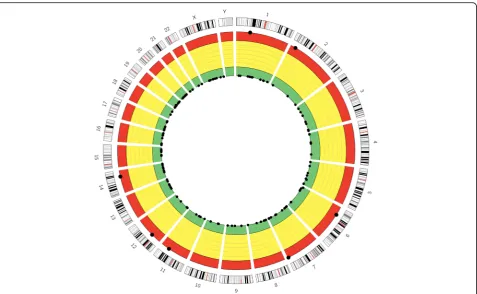
In addition, we also provide a graphical demonstration by visualizing the overall genome-wide off-target profile of a given sgRNA with aCircosplot [54]. From the inner circle to the outer circle, different colors (green, yellow, and red) represent different off-target levels (mild, mod-erate, and severe) (Fig. 7). Such a visualization presents an intuitive way for users to access and evaluate the summary off-target profile of a given sgRNA.
Additional files
Additional file 1:A comprehensive list of hypothesis-based and
learning-based sgRNA on-target design tools and the selected candidates in our comparison study. (XLSX 14 kb)
Additional file 2:Detailed comparison results for sgRNA on-target
efficacy prediction and off-target site prediction. (XLSX 16 kb)
Additional file 3:Comparison of sgRNA on-target efficacy predictions in
an independent dataset with Spearman correlation. (XLSX 48 kb)
Additional file 4:Detailed learned weights for feature saliency map with filtering of those positions without statistical significant by Fisher’s exact test. (XLSX 6 kb)
Additional file 5:The datasets used for the study of sgRNA on-target
efficacy prediction. (XLSX 959 kb)
Additional file 6:The dataset from the human 293-related cell type
used for the study of sgRNA off-target profile prediction. (XLSX 49 kb)
Additional file 7:The dataset from the human K562 cell type used for
the study of sgRNA off-target profile prediction. (XLSX 19 kb)
Additional file 8:Data augmentation for on-target dataset.
(XLSX 2939 kb)
Additional file 9:Supplementary notes. (PDF 339 kb)
Abbreviations
BLESS:Direct in situ breaks labeling sequencing; CNN: Convolutional neural network; HTGTS: High-throughput genome-wide translocation sequencing; IDLV: Integration-deficient lentiviral vector capture; OT: Off-target; PAM: Protospacer adjacent motif; sgRNA: Single-guide RNA
[image:16.595.61.539.86.380.2]Acknowledgments
We thank Prof. Shirley X. Liu and her colleagues in Harvard University for their valuable discussions on in silico sgRNA design. We also thanks
PharmSmartInc. China for helpful support in platform development.
Funding
This work was supported by the National Major Research and Innovation Program of China (grant number 2016YFC1303205, SQ2017YFSF090222), National Natural Science Foundation of China (grant number 61572361, 61732012, 61520106006), Shanghai Rising-Star Program (grant number 16QA1403900) and Shanghai Natural Science Foundation Program (grant number 17ZR1449400).
Availability of data and materials
DeepCRISPRis available athttp://www.deepcrispr.net/. Github source:https://github.com/bm2-lab/DeepCRISPR[55]. zendono source:https://zenodo.org/record/1246320.
DeepCRISPRis licensed under the Apache License 2.0.
Authors’contributions
QL, JW, HHM, DSH, and GHC conceived the method. QL, GHC, JFY, and MC implementedDeepCRISPR. FG, DYX, NFH, CZ, CYZ, KC, and DB processed the data and also helped to implementDeepCRISPR. QL, JW, HHM, SQ, and GHC wrote the manuscript with assistance from the other authors. All authors read and approved the final manuscript.
Competing interests
The authors declare that they have no competing interests.
Publisher’s Note
Springer Nature remains neutral with regard to jurisdictional claims in published maps and institutional affiliations.
Author details
1Department of Endocrinology & Metabolism, Shanghai Tenth People’s Hospital, Tongji University, Shanghai 20009, China.2Bioinformatics Department, School of Life Sciences and Technology, Tongji University, Shanghai 20009, China.3Machine Learning & Systems Biology Lab, School of Electronics and Information Engineering, Tongji University, Shanghai 201804, China.4R&D Information, Innovation Center China, AstraZeneca, 199 Liangjing Road, Shanghai 201203, China.5School of Life Science and Technology, ShanghaiTech University, Shanghai, China.6State Key Laboratory Cultivation Base and Key Laboratory of Vision Science, Ministry of Health and Zhejiang Provincial Key Laboratory of Ophthalmology and Optometry, School of Ophthalmology and Optometry, Eye Hospital, Wenzhou Medical University, Wenzhou, Zhejiang 325027, China.
Received: 17 January 2018 Accepted: 28 May 2018
References
1. Doench JG, Hartenian E, Graham DB, Tothova Z, Hegde M, Smith I, Sullender M, Ebert BL, Xavier RJ, Root DE. Rational design of highly active sgRNAs for CRISPR-Cas9-mediated gene inactivation. Nat Biotechnol. 2014; 32:1262–7.
2. Doench JG, Fusi N, Sullender M, Hegde M, Vaimberg EW, Donovan KF, Smith I, Tothova Z, Wilen C, Orchard R. Optimized sgRNA design to maximize activity and minimize off-target effects of CRISPR-Cas9. Nat Biotechnol. 2016:34(2):184-91.
3. Cong L, Ran FA, Cox D, Lin S, Barretto R, Habib N, Hsu PD, Wu X, Jiang W, Marraffini LA. Multiplex genome engineering using CRISPR/Cas systems. Science. 2013;339:819–23.
4. Doudna JA, Charpentier E. The new frontier of genome engineering with CRISPR-Cas9. Science. 2014;346:1258096.
5. Xu H, Xiao T, Chen C-H, Li W, Meyer C, Wu Q, Wu D, Cong L, Zhang F, Liu JS. Sequence determinants of improved CRISPR sgRNA design. Genome Res. 2015:25(8):1147-57.
6. Hsu PD, Scott DA, Weinstein JA, Ran FA, Konermann S, Agarwala V, Li Y, Fine EJ, Wu X, Shalem O. DNA targeting specificity of RNA-guided Cas9 nucleases. Nat Biotechnol. 2013;31:827–32.
7. Chuai G-h, Wang Q-L, Liu Q. In silico meets in vivo: towards computational CRISPR-based sgRNA design. Trends Biotechnol. 2017;35:12–21.
8. Aach J, Mali P, Church GM. CasFinder: Flexible algorithm for identifying specific Cas9 targets in genomes. bioRxiv. 2014:005074.https://doi.org/10.1101/005074. 9. Heigwer F, Kerr G, Boutros M. E-CRISP: fast CRISPR target site identification.
Nat Methods. 2014;11:122–3.
10. Labun K, Montague TG, Gagnon JA, Thyme SB, Valen E. CHOPCHOP v2: a web tool for the next generation of CRISPR genome engineering. Nucleic Acids Res. 2016;44(Issue W1):gkw398.
11. Perez AR, Pritykin Y, Vidigal JA, Chhangawala S, Zamparo L, Leslie CS, Ventura A. GuideScan software for improved single and paired CRISPR guide RNA design. Nat Biotechnol. 2017:35(4):347-9.
12. Chari R, Mali P, Moosburner M, Church GM. Unraveling CRISPR-Cas9 genome engineering parameters via a library-on-library approach. Nat Methods. 2015;12:823–6.
13. Chari R, Yeo NC, Chavez A, Church GM. sgRNA scorer 2.0: a species-independent model to predict CRISPR/Cas9 activity. ACS Synth Biol. 2017:6(5):902-4. 14. Moreno-Mateos MA, Vejnar CE, Beaudoin J-D, Fernandez JP, Mis EK, Khokha
MK, Giraldez AJ. CRISPRscan: designing highly efficient sgRNAs for CRISPR-Cas9 targeting in vivo. Nat Methods. 2015;12:982–8.
15. Yan J, Chuai G, Zhou C, Zhu C, Yang J, Zhang C, Gu F, Xu H, Wei J, Liu Q. Benchmarking CRISPR on-target sgRNA design. Brief Bioinform. 2017:15:1-4. 16. Haeussler M, Schönig K, Eckert H, Eschstruth A, Mianné J, Renaud J-B,
Schneider-Maunoury S, Shkumatava A, Teboul L, Kent J. Evaluation of off-target and on-off-target scoring algorithms and integration into the guide RNA selection tool CRISPOR. Genome Biol. 2016;17:148.
17. Lee CM, Cradick TJ, Fine EJ, Bao G. Nuclease target site selection for maximizing on-target activity and minimizing off-target effects in genome editing. Mol Ther. 2016;24(3):475-87.
18. O'Geen H, Henry IM, Bhakta MS, Meckler JF, Segal DJ. A genome-wide analysis of Cas9 binding specificity using ChIP-seq and targeted sequence capture. Nucleic Acids Res. 2015;43:3389–404.
19. Fu Y, Foden JA, Khayter C, Maeder ML, Reyon D, Joung JK, Sander JD. High-frequency off-target mutagenesis induced by CRISPR-Cas nucleases in human cells. Nat Biotechnol. 2013;31:822–6.
20. Bae S, Park J, Kim J-S. Cas-OFFinder: a fast and versatile algorithm that searches for potential off-target sites of Cas9 RNA-guided endonucleases. Bioinformatics. 2014;30:1473–5.
21. Ma J, Köster J, Qin Q, Hu S, Li W, Chen C, Cao Q, Wang J, Mei S, Liu Q. CRISPR-DO for genome-wide CRISPR design and optimization. Bioinformatics. 2016;32:3336–8.
22. Tsai SQ, Zheng Z, Nguyen NT, Liebers M, Topkar VV, Thapar V, Wyvekens N, Khayter C, Iafrate AJ, Le LP. GUIDE-seq enables genome-wide profiling of off-target cleavage by CRISPR-Cas nucleases. Nat Biotechnol. 2015;33:187–97. 23. Kim D, Kim S, Kim S, Park J, Jin-Soo K. Genome-wide target specificities of
CRISPR-Cas9 nucleases revealed by multiplex Digenome-seq. Genome Res. 2016:26(3):406-15.
24. Kim D, Bae S, Park J, Kim E, Kim S, Yu HR, Hwang J, Kim J-I, Kim J-S. Digenome-seq: genome-wide profiling of CRISPR-Cas9 off-target effects in human cells. Nat Methods. 2015;12:237–43.
25. Frock RL, Hu J, Meyers RM, Ho Y-J, Kii E, Alt FW. Genome-wide detection of DNA double-stranded breaks induced by engineered nucleases. Nat Biotechnol. 2015;33:179–86.
26. Ran FA, Cong L, Yan WX, Scott DA, Gootenberg JS, Kriz AJ, Zetsche B, Shalem O, Wu X, Makarova KS. In vivo genome editing using Staphylococcus aureus Cas9. Nature. 2015;520:186–91.
27. Wang X, Wang Y, Wu X, Wang J, Wang Y, Qiu Z, Chang T, Huang H, Lin R-J, Yee J-K. Unbiased detection of off-target cleavage by CRISPR-Cas9 and TALENs using integrase-defective lentiviral vectors. Nat Biotechnol. 2015;33:175–8. 28. Abadi S, Yan WX, Amar D, Mayrose I. A machine learning approach for predicting CRISPR-Cas9 cleavage efficiencies and patterns underlying its mechanism of action. PLoS Comput Biol. 2017;13:e1005807.
29. Peng H, Zheng Y, Blumenstein M, Tao D, Li J. CRISPR/Cas9 cleavage efficiency regression through boosting algorithms and Markov sequence profiling. Bioinformatics. 2018:4:1-9.
30. Kim HK, Min S, Song M, Jung S, Choi JW, Kim Y, Lee S, Yoon S, Kim H. Deep learning improves prediction of CRISPR–Cpf1 guide RNA activity. Nat Biotechnol. 2018;36:239.
32. LeCun Y, Bengio Y, Hinton G. Deep learning. Nature. 2015;521:436–44. 33. Zhou J, Troyanskaya OG. Predicting effects of noncoding variants with deep
learning-based sequence model. Nat Methods. 2015;12:931–4.
34. Bengio Y, Courville A, Vincent P. Representation learning: a review and new perspectives. IEEE Trans Pattern Anal Mach Intell. 2013;35:1798–828. 35. Schmidhuber J. Deep learning in neural networks: an overview. Neural
Netw. 2015;61:85–117.
36. Hart T, Chandrashekhar M, Aregger M, Steinhart Z, Brown KR, MacLeod G, Mis M, Zimmermann M, Fradet-Turcotte A, Sun S. High-resolution CRISPR screens reveal fitness genes and genotype-specific cancer liabilities. Cell. 2015;163:1515–26.
37. Wang T, Wei JJ, Sabatini DM, Lander ES. Genetic screens in human cells using the CRISPR-Cas9 system. Science. 2014;343:80–4.
38. Prykhozhij SV, Rajan V, Gaston D, Berman JN. CRISPR multitargeter: a web tool to find common and unique CRISPR single guide RNA targets in a set of similar sequences. PLoS One. 2015;10:e0119372.
39. Park J, Bae S, Kim J-S. Cas-designer: a web-based tool for choice of CRISPR-Cas9 target sites. Bioinformatics. 2015;31:4014–6.
40. Wong N, Liu W, Wang X. WU-CRISPR: characteristics of functional guide RNAs for the CRISPR/Cas9 system. Genome Biol. 2015;16:1–8.
41. Bradley AP. The use of the area under the ROC curve in the evaluation of machine learning algorithms. Pattern Recogn. 1997;30:1145–59. 42. Listgarten J, Weinstein M, Elibol M, Hoang L, Doench J, Fusi N. Predicting
off-target effects for end-to-end CRISPR guide design. bioRxiv. 2016:078253.
https://doi.org/10.1101/078253.
43. Labuhn M, Adams FF, Ng M, Knoess S, Schambach A, Charpentier EM, Schwarzer A, Mateo JL, Klusmann J-H, Heckl D. Refined sgRNA efficacy prediction improves large- and small-scale CRISPR–Cas9 applications. Nucleic Acids Res. 2018;46:1375–85.
44. Cho SW, Kim S, Kim Y, Kweon J, Kim HS, Bae S, Kim J-S. Analysis of off-target effects of CRISPR/Cas-derived RNA-guided endonucleases and nickases. Genome Res. 2014;24:132–41.
45. Singh R, Kuscu C, Quinlan A, Qi Y, Adli M. Cas9-chromatin binding information enables more accurate CRISPR off-target prediction. Nucleic Acids Res. 2015;43:e118.
46. Stemmer M, Thumberger T, del Sol Keyer M, Wittbrodt J, Mateo JL. CCTop: an intuitive, flexible and reliable CRISPR/Cas9 target prediction tool. PLoS One. 2015;10:e0124633.
47. Simonyan K, Vedaldi A, Zisserman A. Deep inside convolutional networks: Visualising image classification models and saliency maps. In: arXiv preprint arXiv:13126034; 2013.
48. Ma H, Tu L-C, Naseri A, Huisman M, Zhang S, Grunwald D, Pederson T. CRISPR-Cas9 nuclear dynamics and target recognition in living cells. J Cell Biol. 2016;214(5):529-37.
49. Wang H, Gu Q, Wei J, Cao Z, Liu Q. Mining drug–disease relationships as a complement to medical genetics-based drug repositioning: where a recommendation system meets genome-wide association studies. Clin Pharmacol Ther. 2015;97:451–4.
50. Badaro G, Hajj H, El-Hajj W, Nachman L. A hybrid approach with collaborative filtering for recommender systems. In: Wireless
Communications and Mobile Computing Conference (IWCMC), 2013 9th International: IEEE; Sardinia, Italy, 2013. p. 349–54.
51. Langmead B, Salzberg SL. Fast gapped-read alignment with bowtie 2. Nat Methods. 2012;9:357–9.
52. Consortium EP. The ENCODE (ENCyclopedia of DNA elements) project. Science. 2004;306:636–40.
53. Upton GJ. Fisher’s exact test. J R Stat Soc. 1992;155(3):395–402.
54. Krzywinski M, Schein J, Birol I, Connors J, Gascoyne R, Horsman D, Jones SJ, Marra MA. Circos: an information aesthetic for comparative genomics. Genome Res. 2009;19:1639–45.