Spyware Detection Using Data Mining
Karishma Pandey#1, Madhura Naik*2, Junaid Qamar #3, Mahendra Patil#4#
Computer Department, Mumbai University
Abstract
—
The systems connected to the network are vulnerable to many malicious programs which threatens the confidentiality, integrity and availability of a system. Many malicious programs such as viruses, worms, trojan horses, adware, scareware exists. A new malicious program has gained momentum known as spyware. Traditional techniques such as Signature-based Detection and Heuristic-based Detection have not performed well in detecting Spyware. Based on the recent studies it has been proven that data mining techniques yield better results than these traditional techniques. This paper presents detection of spyware using data mining approach. Here binary feature extraction takes place from executable files, which is then followed by feature reduction process so that it can be used as training set to generate classifiers. Hence, the generated classifiers classify new and previously unseen binaries as benign files or spywares. Keywords—
Malicious Code, Feature Extraction, N-Gram, CFBE (Common Feature-based Extraction), FBFE (Frequency-based Feature Extraction), Data Mining, Spyware, Naïve Bayes Classification AlgorithmI. INTRODUCTION
Federal Trade Commission Staff Report in USA defines spyware as:
"Software that aids in gathering information about a person or organization without their knowledge and that may send such information to another entity without the consumer's consent, or that influences some control over a computer without the consumer’s knowledge." [1]
Spywares collect information from the user and send it to a third party. They are capable of storing personal details of the user, authentication credentials, saving screenshots, taking images and stealing the user files. Spyware does not necessarily spread in the same way as a virus or worm because infected systems generally do not attempt to transmit or copy the software to other computers. Instead, spyware installs itself on a system by deceiving the user or by exploiting software vulnerabilities. Most spyware is installed without users' knowledge, or by using deceptive tactics. Spyware may try to deceive users by bundling itself with desirable software [2].
Spyware threat has emerged as most complex and sophisticated threat over the past few years. The problems caused by Spyware are now even getting more severe [3]. A spyware application is typically difficult to remove once it has been installed on a computer system and it can seriously degrade system performance and compromise the privacy of the user [4].
II. EXISTINGSOLUTION
Traditionally two approaches have been presented for the purpose of Spyware detection: Signature-based Detection and Heuristic-based Detection. These approaches perform well against known Spyware but have not been proven to be successful at detecting new Spyware [5].
A. Signature-Based Detection
Signature based methods maintain a database consisting of unique strings or specific features called Signatures. For detection it extracts specific features from binaries and compares it with existing database. This method is not good enough to detect new and previously unseen spyware executables.
B. Heuristic-Based Detection
Heuristic classifiers are generated by a group of virus experts to detect new malicious programs. This kind of analysis can be time-consuming and often fails to detect new malicious executables [6].
III.DESIGN
A. Goals Of Application
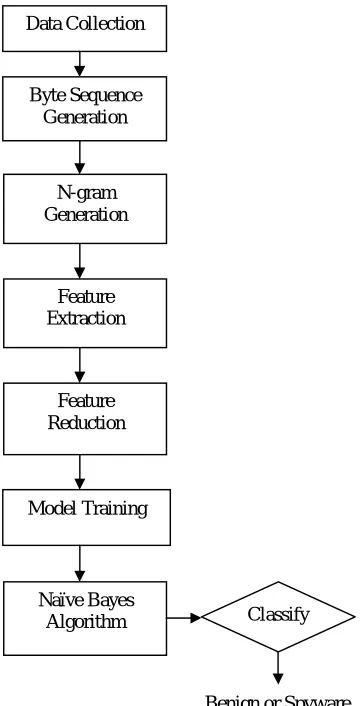
B. Workflow
Fig. 1 Process Flow
IV.IMPLEMENTATION
The steps are described below in a detailed manner for easy understanding.
A. Data Collection
The data set consists of two classes of binary files: Benign files
Spyware files
These files were collected from various sources.
B. Byte Sequence Generation
Here we extract byte sequence into byte array, then convert it into Hexadecimal dumps using Java Programming.
C. N-Gram Generation
The above generated hexadecimal dumps are converted into “n” of fixed size and stored in HashMap, for later updation in the database.
D. Feature Extraction
In this step, we extract the features by using Frequency-based Feature Extraction (FBFE) approach.
E. Feature Reduction
Data Collection Byte Sequence Generation N-gram Generation Feature Extraction Feature Reduction Model Training Naïve Bayes
Algorithm Classify
In one class, only one representation of each feature was considered.
F. Model Training
In this step, the classifier is trained. The frequency of reduced features is read from the database created before and passed to a Java Method. This method implements maximum posterior hypothesis of Naive Bayesian Algorithm to classify the binary executable.
V. CLASSIFIERALGORITHM
The Bayesian Classification represents a supervised learning method as well as a statistical method for classification. This Classification is named after Thomas Bayes (1702-1761), who proposed the Bayes Theorem [7].
A.Bayes Theorem
Bayesian reasoning is applied to decision making and inferential statistics that deals with probability inference. It is used the knowledge of prior events to predict future events [7].
B.Equation:
P(h) : Prior probability of hypothesis h P(D) : Prior probability of training data D P(h/D) : Probability of h given D
P(D/h) : Probability of D given h
C.Maximum a Posteriori (MAP) Hypothesis: Generally we want the most probable hypothesis given the training data hMAP = arg max P (h/D) (where h belongs to H and H is the hypothesis space) [7].
hMAP = arg max
hMAP = arg max P (D/h) P (h)
VI.TESTRESULTS
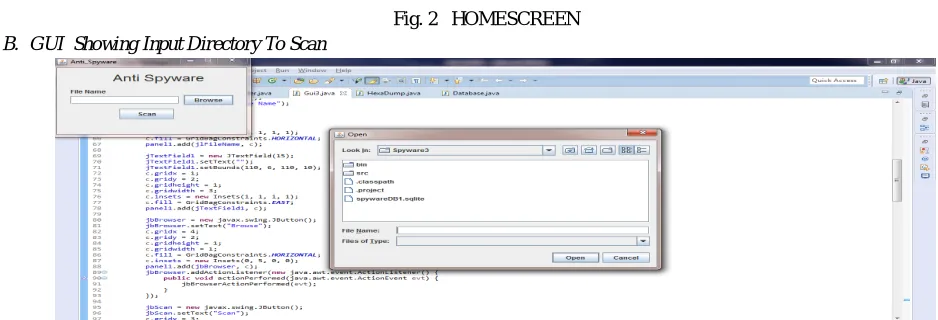
[image:4.612.56.540.319.723.2]A. Graphical User Interface (GUI)
Fig. 2 HOMESCREEN B. GUI Showing Input Directory To Scan
[image:4.612.63.532.555.715.2]C. GUI For Result Where Spyware Is Not Detected
Fig. 4 GUI for Result where Spyware is not detected D. GUI For Result Where Spyware Is Detected
Fig 5 GUI for Result where Spyware is detected
VII. ACKNOWLEDGMENT
[image:5.612.85.529.373.620.2]VIII. CONCLUSION&FUTURESCOPE
In this paper we have proposed and designed a spyware detection system using Data Mining approach that detects new and unseen spyware by scanning the executables. Future work involves collection of a bigger dataset of Spyware and Benign files, implementation of various Classifier Learning Algorithms.
REFERENCES
[1] Federal Trade Commission Staff Report, http://www.ftc.gov/os/2005/03/050307spywarerpt.pdf p.4
[2] http://en.wikipedia.org/wiki/Spyware.
[3] Comparing Anti-Spyware Products – A different Approach, 978-1-4244-8624-3/11/2011 IEEE.
[4] Learning to detect spyware using end user license agreements, Niklas Lavesson, Martin Boldt, Paul Davidsson, Andreas Jacobsson, Springer-Verlag London Limited 2009.
[5] Detection of Spyware by Mining Executable Files, 2010 International Conference on Availability, Reliability and Security 978-0-7695-3965-2/10
© 2010 IEEE, DOI 10.1109/ARES.2010.105.
[6] Data Mining Methods for Detection of New Malicious Executables, 1081-601 1/01 2001 IEEE.