Technology (IJRASET)
Density Based Intelligent Traffic Signal System
Using PIC Microcontroller
G.Kavya*1, B.Saranya*2
Department of Electrical and Electronics Engineering, Kumaraguru College of Technology,Anna university Chennai
Abstract- Nowadays congestion in traffic is a serious issue. The traffic congestion can also be caused by large Red light delays, etc. The delay of respective light is hard coded in the traffic light and it is not dependent on traffic. Therefore for simulating and optimizing traffic control to better accommodate this increasing demand is arises. In this paper the optimization of traffic light controller in a City using microcontroller is done. The system tries to reduce possibilities of traffic jams, caused by traffic lights, to an extent. The microcontroller used in the system is PIC. The system contains IR transmitter and IR receiver which are mounted on the either sides of roads respectively. The IR system gets activated whenever any vehicle passes on road between IR transmitter and IR receiver. Microcontroller controls the IR system and counts number of vehicles passing on road. Microcontroller also store vehicles count in its memory. Based on different vehicles count, the microcontroller takes decision and updates the traffic light delays as a result. The traffic light is situated at a certain distance from the IR system. Thus based on vehicle count, microcontroller defines different ranges for traffic light delays and updates those accordingly. The system records vehicle count in its memory at user predefined recording interval on real time basis. This recorded vehicle count data can be used in future to analyze traffic condition at respective traffic lights connected to the system. For appropriate analysis, the recorded data can be down-loaded to the computer through communication between microcontroller and the computer. Thus administrator on a central station computer can access traffic conditions on any approachable traffic lights and nearby roads to reduce traffic congestions to an extent. In future this system can be used to inform people about different places traffic condition.
Keywords— IR (infrared) sensor, Image processing, Micro-controller, Digital Display
I. INTRODUCTION
Traffic research has the goal to optimize traffic flow of people and goods. As the number of road users constantly increases, and resources provided by current infrastructures are limited, intelligent control of traffic will become a very important issue in the future. However, some limitations to the usage of intelligent traffic control exist. Avoiding traffic jams for example is thought to be beneficial to both environment and economy, but improved traffic-flow may also lead to an increase in demand. There are several models for traffic simulation. In our research we focus on optimization of traffic light controller in a city using IR sensor and developed visual monitoring using PIC microcontroller. Traffic light optimization is a complex problem. Even for single junctions there might be no obvious optimal solution. With multiple junctions, the problem becomes even more complex, as the state of one light influences the flow of traffic towards many other lights. Another complication is the fact that flow of traffic constantly changes, depending on the time of day, the day of the week, and the time of year. Roadwork and accidents further influence complexity and performance. In this paper, we propose two approaches, the first approach - to take data/input/image from object/ subject / vehicle and in the second approach - to process the input data by Computer and Microcontroller and finally display it on the traffic light signal to control the closed loop system.
Technology (IJRASET)
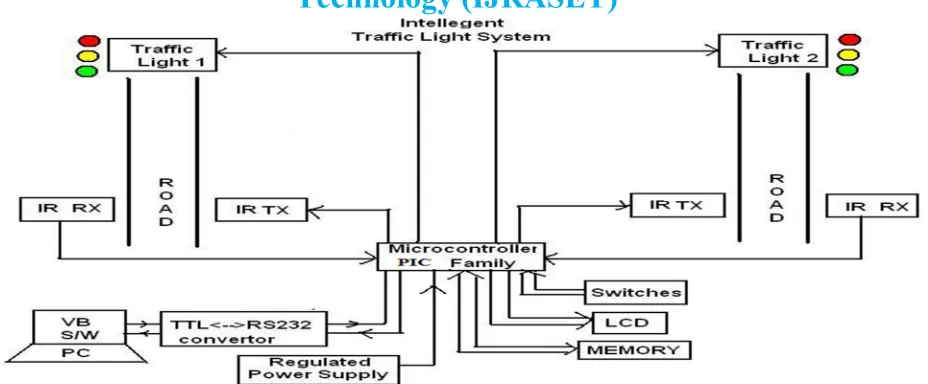
Fig. 1 Block diagram of the System
IR transmitter and receiver will be placed on either side of the road at some distance from the traffic signal.IR Rays passes between the transmitter and receiver continuously. Whenever a vehicle passes between the transmitter and receiver, it blocks the IR rays to pass from transmitter to receiver. So whenever a vehicle blocks the IR rays, the IR sensor consider it as count and it also increments the count value for each vehicle entry. The IR sensor senses the density of the traffic for a regular interval of time in this manner and sends the information to the PIC. The count in the traffic signal can be adjusted by the controller based on the density of traffic received from IR sensor. Then the count is displayed in the seven segment display and decremented till zero and this above procedure continues for regular intervals of time.
III. Design and development of the system
Development of the complete intelligent traffic light control and monitoring system includes lots of study and implementation work. The implementation work of the complete data logger is divided into points discussed below.
A. Infrared Sensors
An infrared sensor is an electronic instrument that is used to sense certain characteristics of its surroundings by either emitting and/or detecting infrared radiation. It is also capable of measuring heat of an object and detecting motion. Infrared waves are not visible to the human eye. In the electromagnetic spectrum, infrared radiation is the region having wavelengths longer than visible light wavelengths, but shorter than microwaves. The infrared region is approximately demarcated from 0.75 to 1000µm. The wavelength region from 0.75 to 3µm is termed as near infrared, the region from 3 to 6µm is termed mid-infrared, and the region higher than 6µm is termed as far infrared. Infrared technology is found in many of our everyday products. For example, TV has an IR detector for interpreting the signal from the remote control. Key benefits of infrared sensors include low power requirements, simple circuitry, and their portable feature.
B. PIC MICROCONTROLLER:
Technology (IJRASET)
4) DC - 200 ns instruction cycle5) Interrupt capability (up to 14 sources) 6) Eight level deep hardware stack
7) Direct, indirect and relative addressing modes
8) Power-on Reset (POR), Power-up Timer (PWRT) and Oscillator Start-up Timer (OST) 9) Watchdog Timer (WDT) with its own on-chip RC oscillator for reliable operation 10) Power saving SLEEP mode
11) Selectable oscillator options
12) Low-power, high-speed CMOS FLASH/EEPROM technology 13) Wide operating voltage range
14) Provides commercial and Industrial temperature ranges 15) Low-power consumption
C. 7-SEGMENT DISPLAY
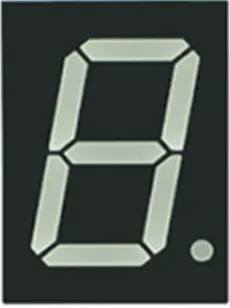
[image:4.612.248.363.344.498.2]An LED or Light Emitting Diode is a solid state optical PN-junction diode which emits light energy in the form of “photons” when it is forward biased by a voltage allowing current to flow across its junction, and in Electronics we call this process electroluminescence.The actual colour of the visible light emitted by an LED, ranging from blue to red to orange, is decided by the spectral wavelength of the emitted light which itself is dependent upon the mixture of the various impurities added to the semiconductor materials used to produce it.
Fig . 2 7-Segment Display
Technology (IJRASET)
IV. INTERFACING CIRCUIT DIAGRAM OF SEVEN SEGMENT WITH PIC16F877A
V. SOFTWARE TOOLS
MPLAB IDE is a software program that runs on a PC to develop applications for Microchip microcontrollers. It is called an Integrated Development Environment, or IDE, because it provides a single integrated “environment” to develop code for embedded microcontrollers. A development system for embedded controllers is a system of programs running on a desktop PC to help write, edit, debug and program code – the intelligence of embedded systems applications – into a microcontroller. MPLAB IDE runs on a PC and contains all the components needed to design and deploy embedded systems applications. The typical tasks for developing an embedded controller application are:
A. Create the high level design. From the features and performance desired, decide which PICmicro or dsPIC device is best suited to the application, then design the associated hardware circuitry. After determining which peripherals and pins control the hardware, write the firmware – the software that will control the hardware aspects of the embedded application. A language tool such as an assembler, which is directly translatable into machine code, or a compiler that allows a more natural language for creating programs should be used to write and edit code. Assemblers and compilers help make the code understandable, allowing function labels to identify code routines with variables that have names associated with their use, and with constructs that help organize the code in a maintainable structure.
B. Compile, assemble and link the software using the assembler and/or compiler and linker to convert your code into “ones and zeroes” – machine code for the PICmicro MCU’s. This machine code will eventually become the firmware (the code programmed into the microcontroller).
C. Test your code. Usually a complex program does not work exactly the way imagined, and “bugs” need to be removed from the design to get proper results. The debugger allows you to see the “ones and zeroes” execute, related to the source code you wrote, with the symbols and function names from your program. Debugging allows you to experiment with your code to see the value of variables at various points in the program, and to do “what if” checks, changing variable values and stepping through routines.
Technology (IJRASET)
count microcontroller decide the traffic light delays for next recording interval. The recorded data can be downloaded to the computer through communication between microcontroller and the computer.
REFERENCES
[1] Ramón Martínez “Smart control system for LEDs traffic-lights based on PLC”. Dpt. de Señales, Sis-temas y Radiocomunicaciones. Universidad Po-litécnica de Madrid ETSI de Telecommunica-tion.Ciudad Universitia s/n.28040 Madrid SPAIN
[2] Bechrakis D. A., Sparis P. D.” A flexible data logging device for wind potential measurements and statistic-al magnitudes”. Democritus university of Thrace, de-partment of electrical and computer engineering, me-chanical engineering laboratory, xanthi, 67 100, Greece
[3] Muhammad Ridwan. „Development of a Low Cost Smart Traffic Controller System”. Department of Me-chanical and Materials Engineering Faculty of Engi-neering and Built Environment Universiti Kebang-saan Malaysia, 43600 Bangi Selangor, Malaysia
[4] Marco Wiering. “Intelligent Traffic Light Control”. Institute of information and computing sciences, utrecht university [5] W. Wen & C. L. Yang. “A dynamic and automatic traffic light control system for solving the road con-gestion problem”.
[6] Cihan Karakuzu. “Fuzzy logic based smart trafficlight simulator design and hardware implementation”. Kocaeli University, Engineering Faculty, Electronics & Tell. Eng. Department, 41070 Veziroglu Yerleskesi, Izmit-Kocaeli, Turkey
[7] Cihan Karakuzu. “Fuzzy logic based smart traffic light simulator design and hardware implementation”. Kocaeli University, Engineering Faculty, Electronics & Tell. Eng. Department, 41070 Veziroglu Yerleskesi, Izmit-Kocaeli, Turkey
[8] Kok, Khiang Tan and Marzuki. “Intelligent Traffic Lights Control by Fuzzy Logic”. Malaysian Journal of Computer Science [9] István Varga. “Design of an Intelligent Traffic- Control System”. Balázs Kulcsár, István Varga, SZTAKI, Hungary [10] A (Mildly) Intelligent Traffic Light System (a Blues-pec tutorial)
[11] “Automatic Traffic Control System”. SMEU Astana Solutions Automatic Traffic Control System.htm ]
[12] P89V51RD2 specification sheet. “Microcontroller with 64K Bytes Flash Memory”. [Online] Available www.philips/devices/microcontroller.com