5
VIII
August 2017
Simulation and Implementation of Pulse
Compression Techniques using Ad6654 for
Atmospheric Radar Applications
Shaik Benarjee1, K.Prasanthi2,Jeldi Kamal Kumar3, M.Durga Rao4 1M.Tech (DECS), 2Assistant Professor , Dept. of ECE,SPMVV (SoET), Tirupathi, India.
3,4Scientist/Engineer-SC, NARL, Gadanki, India.
Abstract: Pulse Compression is a Signal Processing Technique used in Radar systems in order to increase Range Resolution as well as Signal to Noise Ratio (SNR). There are many parameters like number of side lobes, main lobe width, Range Resolution and Peak Sidelobe Level (PSL) to be considered before adapting any Pulse Compression technique. Barker code and Complementary sequences are chosen in order to study Pulse Compression technique for achieving above given parameters. In this paper, a detailed discussion on Barker codes and Complementary codes with proper methodology and simulations are provided. In order to get the essence of these pulse codes, simulations are carried out using MATLAB and results are shown. Implemented Complementary code on sample data acquired using AD6654 board and observed similarity between results obtained during simulation.
Keywords: Pulse Compression, Barker code, Complementary sequences, Range Resolution, Signal to Noise Ratio and Peak SidelobeLeve
I. INTRODUCTION
The word RADAR is an acronym for Radio Detection and Ranging. RADAR uses electromagnetic waves (EM waves) to detect, locate and measure the speed of hard targets like airborne aircrafts, Terrestrial vehicles and soft targets like atmospheric layers with refractive index gradient, electron density variation in Ionosphere. RADAR transmits the EM waves into space and receives the echoes which are reflected back from the target. By applying the signal processing techniques on the received signal the location and velocities of the target can be estimated. Pulse compression is one of the signal processing technique used in Radar systems to have high energy of long duration pulse with the superior range resolution of short duration pulse. The codes which are mostly used in Radar technology are frequency modulated signals (LFM and NLFM) and phase coded signals (Barker, Complementary etc). Atmospheric Radars uses phase coded signals for their application. So the entire discussion is emphasized on phase coded signals in this paper.
II. PULSE COMPRESSION
In pulse compression technic, A pulse having a low peak power with long duration pulse is modulated either in frequency or phase before transmission and the received signal is passed through a filter to accumulate the energy as achieved in case of high peak power with a short duration pulse. The reduction in peak power of a pulse can be achieved by increasing the length or duration of the pulse. But, an increase in the length (or) duration of the pulse reduces range resolution. To avoid the compromise in range resolution, some form of encoding technique must be done within the transmitted pulse, so that it is possible to compress" a longer duration pulse into a shorter one in the receiver using suitable signal processing operation. The easiest form of such encoding is to allow the radar pulse to modulate a waveform that is uncorrelated in time but known at the receiver. A cross-correlation operation at the receiver (using the known transmitted waveform) will compress the long received echo waveform into a shorter waveform. This is due to the time auto-correlation properties of the transmitted waveform, which is maximum at zero-lag and almost zero at lags other than zero. The time autocorrelation of a deterministic function f(t) is given by:
( ) = ∫ ( )f * (t+ ) dt (1) And for random signal X (t), it is given by
III. BINARY PHASE CODES
A transmitted Radar pulse of duration is divided into N sub-pulses of equal duration ᾿ = and each sub-pulse is phase coded in terms of the phase of the carrier.
A. Barker Codes
Barker codes belongs to the family of binary phase codes that produce compressed waveforms with constant sidelobe levels equal to unity. There are seven known Barker sequences in use. Barker codes are popularly known for sharing a unique property i.e. producing main lobes that are higher than the sidelobes by a factor of code length.
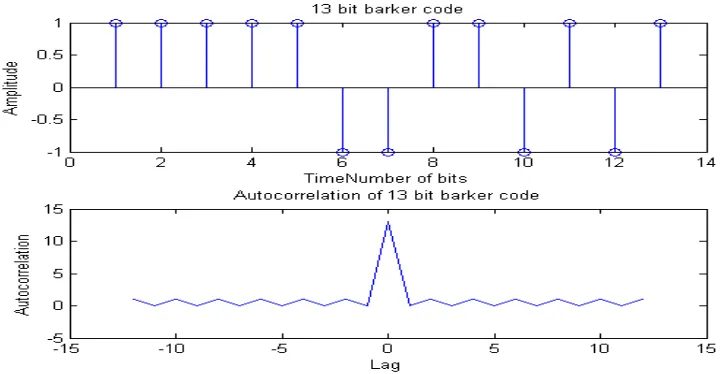
[image:3.612.125.485.202.389.2]In this paper, Barker code of length 13 has been implemented in Matlab as shown in below figure 1.
Figure 1: 13-bit Barker code and its corresponding Autocorrelation
From figure 1 it is observed that, the autocorrelation or matched filtering of 13 bit barker code gives a main lobe of 13 units and side lobe of 1 unit satisfying the unique property of Barker codes. Security is a main concern while adapting Barker codes.
1) Simulations on encoding and decoding of a sinusoidal pulse with a Barker sequence of 13 bit code length
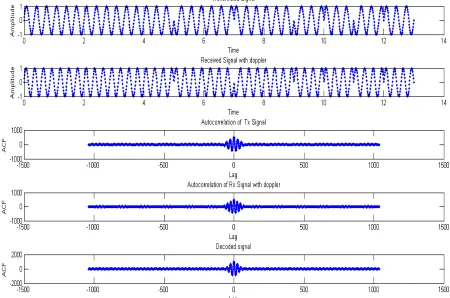
a) The 13-bit Barker code is fed to a product modulator of sine wave gives a BPSK modulated signal at the output as shown in below figure 2.
Figure 2: 13-bit Barker code and its BPSK signal
b) Introduce a Doppler of known frequency to the center frequency and fed the signal to a receiver to decode the received pulse
Figure 3: Introduced Doppler and decoded the received echo w.r.t transmitted pulse by using Autocorrelation
c) Introduce Random Noise to the received echo and decode it w.r.t transmitted signal as shown in below figure 4.
B. Complementary Sequences
[image:5.612.134.476.126.346.2]A complementary code was first discussed by Golay. It consists of two sequences which is having a same length of N whose aperiodic autocorrelation functions have sidelobes equal in magnitude but opposite in sign.
Figure 5: Complementary Sequences of code length 8 and their corresponding Autocorrelations
The sum of two sequences gives a peak of 2N with a zero side lobes. In case of practical, the side lobes are not equal to zero. Due to their low aperiodic autocorrelation function sidelobes they are useful in Radar pulse compression and also in Spread-spectrum applications.
1) Simulations on encoding and decoding methodology of a sinusoidal pulse with a Complementary sequence of 8 bit code length
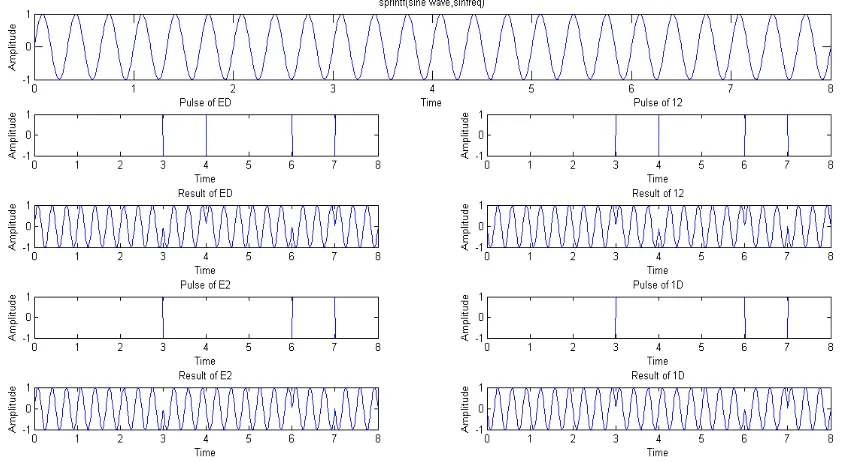
a) The 8–bit Complementary sequences (ED,12,E2 and 1D) are fed to a product modulator of sine wave gives a BPSK modulated
signal at the output as shown in below figure 6.
[image:5.612.96.519.469.700.2]b) Introduce a Doppler of known frequency to the center frequency and fed the signal to a receiver to decode the received pulse w.r.t transmitted signal by using the autocorrelation as shown in below figure 6.
Figure 7: Introduce Doppler and decoded the receive pulse w.r.t transmitted pulse by using Autocorrelation
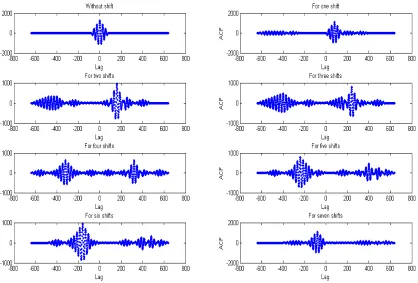
c) Perform decoding operation as shown in figure 8.
[image:6.612.101.519.423.706.2]d) Introduce Random Noise to received echo and decode it w.r.t transmitted pulse as shown in figure 9.
Figure 9: Correlation of transmitted and received signals of 8-bit complementary code added with Gaussian noise
[image:7.612.103.511.325.545.2]IV. HARDWARE IMPLEMENTATION
Figure 10: Hardware Test Set-Up of AD6654
The block diagram of a Hardware Test Set-Up is shown in below figure 11.
[image:7.612.135.481.567.704.2]An input of 53.1 MHz frequency of a sinusoidal signal from a signal generator is passed through a coder which is fed with bi-phase code from TCSG in tandem gives a bi-phase coded signal and other input from a function generator with a clock of 80 MHz frequency, are given to a AD6654 board which samples and down converts the given signal to I and Q signals. The output data is seen in PC which consists of AD6654 software. USB is used as an interface between the AD6654 board and PC.
The signal processing techniques like decoding, coherent integration and FFT operations are performed on I and Q signals acquired from the board.
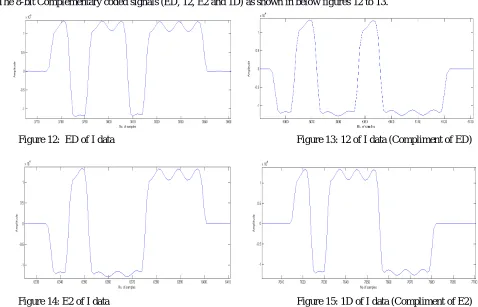
A. The 8-bit Complementary coded signals (ED, 12, E2 and 1D) as shown in below figures 12 to 13.
[image:8.612.61.539.170.477.2]Figure 12: ED of I data Figure 13: 12 of I data (Compliment of ED)
Figure 14: E2 of I data Figure 15: 1D of I data (Compliment of E2)
[image:8.612.163.415.511.651.2]B. Consider 12 sets of pulses of ED, 12, E2 and 1D and Perform autocorrelation as shown in below figure 16.
Figure 16: Correlated data
Where,
Green colour plot indicates the autocorrelation of ED, Blue colour plot indicates the autocorrelation of E2 and
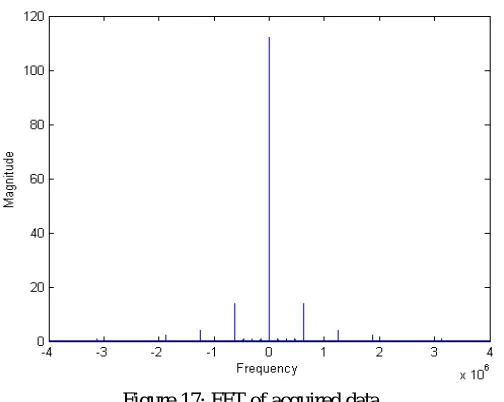
C. Perform Fast Fourier Transform operation as shown in below figure 17.
Figure 17: FFT of acquired data
V. CONCLUSION
The Pulse Compression Techniques like Barker codes and Complementary Sequences are successfully simulated using MATLAB and also implemented with AD6654 board. For improving the SNR, signal processing steps like decoding, Coherent Integration and FFT are performed which are the building blocks of Pulsed Radar for Atmospheric applications.
VI. ACKNOWLEGEMENT
The Second author would like to thank the National Atmospheric Research Laboratory (NARL), Gadanki, India for giving opportunity to carry out her Master’s Internship in RADAR field.
REFERENCES
[1] Charles E. Cook, W.M. Siebert, “The early history of pulse compression Radar”, IEEE Transactions, Vol.24, No.6 November 1988. [2] Merrill I. Skolnik, ‘Introduction to Radar Systems”, third edition, New York: McGraw Hill, pp.339-369, 2001.
[3] Bassem R. Mahafza, Radar Systems Analysis & Design using MATLAB,(2nd ed.), Chapman & Hall/CRC, 2004. [4] F. E. Nathanson, J.P. Reilly, and M.Cohen, “Radar Design Principles (2nd ed.),” Newyork: McGraw-Hill, 1991.
[5] W. F. Gabriel, “Super resolution techniques in the range domain.” In Proceedings of the IEEE International Radar Conference, 43, pp. 1188-1195, July 2007. [6] Kerdock. A.M. R Mayer and D. Bass. “Longest Binary Pulse Compression Codes with given peak sidelobe levels.” Proceeding of IEEE Vol.74. No.2, p-366,
Feb 1986.
[7] J.P. Larvor, "Digital Pulse Compression with Low Range _Sidelobes", Thomson-CSF/SDC, France.
[8] O.Ghebrebrhan, “Possible use of Barker codes in ST radar systems,” in Proc. 5th MST radar Workshop, Aberystwyth, Wales, Jan. 1992, pp. 427-432. [9] M. J. E. Golay,”Complementary series,” I.R.E. Trans. Information Theory, pp. 82-87, 1961.
[10] K. Wakasugi and S.Fukao, “Sidelobe properties of a complementary code used in MST radar observations” IEEE Trans. Geosci. Remote Sensing. Vol.GRS 23, no. 1, pp. 57-59, Jan. 1985.
[11] E.Spano and O.Ghebrebrhan, “Sequences of complementary codes for the optimum decoding of truncated ranges and high sidelobe suppression factors for ST/MST radar systems.” IEEE Trans. Geosci. Remote sensing, vol. 34, pp. 330-345, this issue.’’
[12] ”Sidelobe properties of complementary codes,” Meteorol. Rdsch, 42, pp. 109-114, June 1990.
BIOGRAPHY
Shaik Benarjee: passed B.Tech (Electronics and Communication Engineering) at Annamacharya Institute of Technology & Sciences (AITS), Tirupathi in 2015 and pursuing M.Tech (Digital Electronics and Communication Engineering) at Sri Padmavati Mahila Visvavidyalayam, Tirupathi.
Jeldi Kamal Kumar: born in 1991. Passed B.Tech (Avionics) from IIST, Trivandrum. Joined semi-conductor laboratory, Mohali in November, 2013 and at NARL in December 2014. His areas of interest include development of controllers and health status monitoring software’s for Active Array Radars.