5
IV
April 2017
Technology (IJRASET)
Trust Based Novel Recommendation Regularized
with Item Ratings
R. Priyadharshini1, J. Subathra2, Nivedita K. M3, S. Aravinda Krishnan4 1,2,3,4
SRM University Chennai, India
Abstract: Recommendation is an opinion given by an analyst to his/her client whether the given stock is worth buying or a particular place is worth visiting or not. They use various projections as a basis for issuing recommendations. Item rating is a group of classifications designed to extract information about a quantitative or qualitative attribute. Here we use a scale to reflect the quality of product where user selects the number which is taken into consideration. In order to enhance the novel recommendation model, we propose a trust based recommendation model with item rating where data sparsity and cold start problem are rectified.We make use of personalized social networking to connect people in a commodity so that people can get to know about a product or place in detail by the information shared about it and the user can sort out things according to their needs and specification.
Keywords: TrustSVD, Itemratings, Filtration,Recommendation,Privacy preservance.
1. INTRODUCTION
Recommender systems have been widely used to provide users with high-quality personalized recommendations from a large volume of choices. In order to reduce the data sparsity and cold start problems and their degradation of recommendation performance we use Trust SVD integrates multiple information sources into the recommendation model. An analysis of trust based social network data from four real-world data sets suggests that not only the explicit but also the implicit influence of both ratings and trust should be taken into consideration in a recommendation model. Trust SVD therefore builds on top of a state-of-the-art recommendation algorithm, SVD++ (which uses the explicit and implicit influence of rated items), by further joining both the explicit and implicit influence of trusted[1] and trusting users on the prediction of items for an active user. The proposed technique is to extend SVD++ with social trust information. Experimental results on the four data sets exhibit that Trust SVD achieves better accuracy than other counter parts of recommendation techniques.
A. Role of Apache Server
Apache Server is one of the popular open source software organizations. It is free and commercial friendly - no licensing fees or costs. It runs pretty much on any OS (Linux, Windows and MacOS). It is maintained regularly with the norms. It is one of the most feature rich web servers available. By nomenclature "Apache" is Apache
HTTP Server (sometimes also called Apache httpd - after the name of the process). The other "Apache" server is Apache Tomcat.
B. Role of MySQL
MySQL is a free, open-source database management system (DBMS for short). A DBMS is a system that manages databases and connects them to server. For example, a MySQL database can be used to run a website, to run the database of an ERP or any other software.
II. RELATED WORK
In existing trust based social network provides an alternative view of user preferences rather than item ratings. Find that trust social networks are small-world networks where two random users are socially connected in a small distance, indicating the implication of trust in recommender systems. In fact, it exhibits that incorporating the social trust information of users can improve the performance of recommendations. Recommendation systems involves two main recommendation tasks namely item recommendation and rating prediction. Our work focuses on the rating prediction task while most algorithmic approaches where only designed for either one of the recommendations tasks.
Technology (IJRASET)
data sets [11]. The minning process considers only friend list that stands as a disadvantage.III. PROPOSED SYSTEM
We propose a novel trust-based recommendation model regularized with user trust and item ratings termed Trust SVD. Our approach builds on top of a state-of the- art model SVD++ through which both the explicit and implicit influence of user–item ratings are involved to generate predictions. The user ratings are showed in graphical forum. In the friend of friend recommendation model used, it overcomes the data sparsity and cold start issues. And the mining process produces result to user graphical representations, in the form of overall rating graphical representation and show the relationship between the user and rated user and the individual rating of the particular user graphical representation.
Contents such as Text, Image and Video can be posted by the OSN users to public or friends. The post should be downloaded from OSN Server if user needs to view it. The server triggers both the neighboring devices and initiates a peer to peer mode of communication if the content is available.
The popularity of online social networks (OSNs) such as Facebook, Google Plus and Twitter has greatly increased in recent years. OSNs have become important platforms for the dissemination of news, ideas, opinions, etc. In existing social trust provides an alternative view of user preferences other than item ratings. Find that trust networks are small-world networks where two random users are socially connected in a small distance, indicating the implication of trust in recommender systems. In fact, it has been demonstrated that incorporating the social trust information of users can improve the performance of recommendations. There are two main recommendation tasks in recommender systems, namely item recommendation and rating prediction. Most algorithmic approaches are only designed for either one of the recommendations tasks, and our work focuses on the rating prediction task.
The recommendation methods are usually classified into the three main categories: content-based, collaborative, and hybrid. The various limitations of current recommendation methods and possible extensions can improve recommendation capabilities and make recommender systems applicable to an even broader range of applications is discussed [2]. Providing high quality recommendations is important for online systems to assist users who face a vast number of choices in making effective selection decisions. Collaborative filtering is a widely accepted technique to provide recommendations based on ratings of similar users. But it suffers from several issues like data sparsity and cold start. To address these issues, Gediminas Adomavicius [2] proposes a simple but effective method, namely “Merge”, to incorporate social trust information in providing recommendations. More specifically, ratings of a users trusted neighbors are merged to represent the preference of the user and to find similar other users for generating recommendations.
The major benefits involve high performance ratings in terms of predictive which is more capable of coping with the cold-start situations. Privacy preserving is achieved by searching and transferring the content based on the public/private sharing of posts and by using Pseudo identities. Posts are filtered on a timely manner. It provides social network for chatting, sharing post and multimedia.
[image:3.612.198.458.535.687.2]IV. ARCHITECTURE AND APPROACH
Technology (IJRASET)
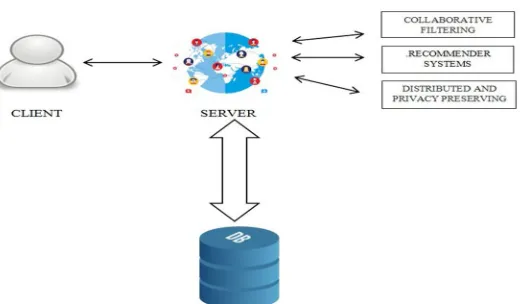
The fig. 1.1 illustration explains the communication between the client and the server. In the front end, the client logs into social networking application where the user’s friend list is tracked, filtered and displayed using collaborative, recommender system, distributed and preserving algorithms. Each algorithm works on different modules which altogether results in prioritizing and recommending trusted news and information through trusted parties. Each and every movement of the user i.e., recommending or sharing information is stored in the database. This helps in no loss of data, less availability of fake information and high response time due to limited and prioritized display of news/information to the user.
[image:4.612.127.523.177.435.2]To achieve this, two important algorithms are used namely- collaborative filtering algorithm and recommender systems algorithm.
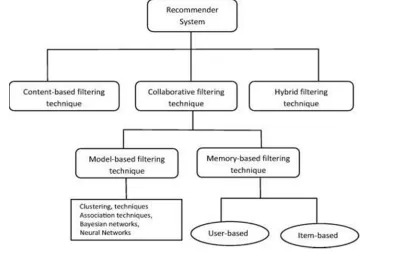
Fig 1.2 Recommender System
A. Recommendations System
Recommendations helps to generate a wide range of algorithms. While user-based or item-based collaborative filtering methods are simple and subliminal, factorization of matrix techniques are effective because they allow us to identify interactions between users and the items, underlying latent features. Mathematical tool for matrix factorization is simply used for playing around with matrices, and is applicable in many scenarios where one would like to find out something hidden under the data.
B. Collaborative Filtering Algorithm
To implement a recommender system Collaborative filtering (CF) is the most popular technique. The idea of CF is that users with similar preferences in the past are likely to favor the same items (e.g., movies, music, books, etc.) in the future. CF is also used in domains such as image processing and bioinformatics. CF stands as domain-independent prediction technique for content that cannot be easily described by metadata such as movies and music. In this technique a database (user-item matrix) is built of preferences for items by users. Users with relevant interest and preferences are then matched to make recommendations by calculating similarities between their profiles. Such users build a group called neighborhood. So the user gets recommended of the items that he/she has not rated before but were already rated by users in their neighborhood. Recommendation produced by CF also involves prediction strategy. Prediction is expressed as a numerical value where Rij - predicted score of item j for the user i, while Recommendation is a list of top N items displayed according to user’s like (Fig. 1.2). The technique of collaborative filtering can be divided into two categories: memory-based and model-based[1], [3].
C. Recommendation Algorithm based on Trust Propagation Mechanism
Technology (IJRASET)
among users [5]. Then we combine it into the collaborative recommendation model based on matrix decomposition by factoring such relationship in order to optimize target function by means of random gradient descent algorithm [7], [13], [15], [16]. It is explained as follows
1) Measurement of Trust: Trust-ability is the degree of trust between users. The primary task is to manage quantitatively trust relationship before trust factors introduced to the collaborative filtering recommendation method[4], as thus to use in the calculation formula.
2) The Rating Prediction Formula of Trust Relationship: bui is a reference offset, an user project preference related terms, the formula is as follows
bui= +bu+bi [5] The above expression bu - user u preference, bi - commodity i preference and represents the average score of project matrix.
To calculate bu and bi formula, least square method is used as follows min
(r ui bu bi)^2 1( bu ^2 bi ^2) [6]
(u ,ieh)uiWhere, b * said deviation of all users and projects score value.
[image:5.612.100.492.314.614.2]D. Class Diagram
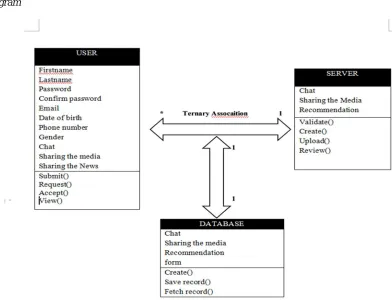
Fig 1.3 Class diagram with associated functions and methods.
Technology (IJRASET)
[image:6.612.88.469.93.298.2]E. Flow Diagram
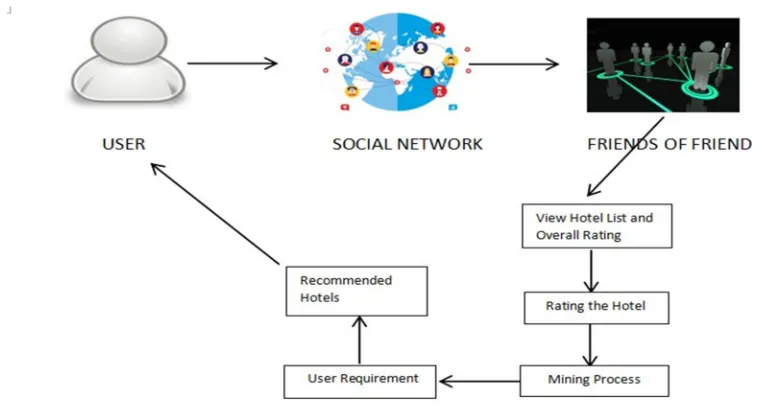
Fig 1.4 Flow diagram of how system works.
V. COMPONENTS
The major components includes the following
A. Social Networking Web Application
In this module, social network is build upon the OSN web application is build as in which new user can register for the services. The user is able to login with his credentials by validating his/her registration fields. The user can set Cover picture, Profile photos and can add friends. The end user account will receive friend request as soon as the user logs in where he/she is provided with two options- accept / reject. The friend list will appear on the right panel of the page where the user will be able to chat with the recipient in private.
B. Sharing Posts with Access Control
This component helps user post News, Images, Video and other information in public. Once the user logs in he/she can view, share, like/dislike, comment, and reply to posts if they have proper access control.
C. User View and Rating
In this Module, the user friends list is collected from social network. The user can view all hotel names and its overall ratings. To search the specified hotel rating information in the database the user can be rated to the selected hotel and its attributes (e.g.: rating overall, rating room, rating cleanliness, etc) fig. 1.4. The hotel rating attributes are updated to the database.
D. Mining Process and Graphical Rating
In this Module, The mining process is performed to filter the hotel list, filter the friends and friends of friends rated hotel list and show them to the user (fig 1.4). The user gives the requirement for hotel (e.g.: cleanliness, room, service, Location, etc). The user preferences are cumulated based on user requirement. If the user is not able to find their friend’s rating/review for a hotel, mining process helps the user to view his/her friends of friends review.
VI. CONCLUSION AND FUTURE WORK
Technology (IJRASET)
REFERENCES[1] G. Guo, J. Zhang, and N. Yorke-Smith, “TrustSVD: Collaborative filtering with both the explicit and implicit influence of user trust and of item ratings,” in Proc. 29th AAAI Conf. Artif. Intell., 2015, pp. 123–129.
[2] G. Adomavicius and A. Tuzhilin, “Toward the next generation of recommender systems: A survey of the state-of-the-art and possible extensions,” IEEE Trans. Know.
[3] Data Eng., vol. 17, no. 6, pp. 734–749, Jun. 2005
[4] F.O. Isinkaye a, *, Y.O. Folajimi b , B.A. Ojokoh c,Recommendation systems: Principles, methods and evaluation a Department of Mathematical Science, Ekiti State University, Ado Ekiti, Nigeria b Department of Computer Science, University of Ibadan, Ibadan, Nigeria c Department of Computer Science, Federal University of Technology
[5] Miao Duan,Collaborative Filtering Recommendation Algorithm based on Trust PropagationInternational Journal of Security and Its Applications Vol.9,o.7(2015),pp.99-108,http://dx.doi.org/10.14257/ijsia.2015.9.7.09
[6] Z. Cai and L. C. Chung, “Trust oriented social commerce collaborative filtering recommendation method”, Computer applications, vol. 1, (2015), pp. 167-171.
[7] J. Zhongtao, “Design and implementation of collaborative filtering algorithm based on the film of personalized recommendation”, Software guide, vol. 1, (2015), pp. 86-88.
[8] Y. Koren, R. Bell, and C. Volinsky, “Matrix factorization techniques for recommender systems,” Computer, vol. 42, no. 8, pp. 30– 37, Aug. 2009. [9] Y. Koren, “Factor in the neighbors: Scalable and accurate collaborative filtering,” ACM Trans. Know. Discovery Data, vol. 4, no. 1, pp. 1:1–1:24, 2010. [10] Y. Koren, “Factorization meets the neighborhood: A multifaceted collaborative filtering model,” in Proc. 14th ACM SIGKDD Int. Conf. Know. Discovery
Data Mining, 2008, pp. 426–434.
[11] G. Guo, J. Zhang, and D. Thalmann, “A simple but effective method to incorporate trusted neighbors in recommender systems,” in Proc. 20th Int. Conf. User Model., Adaptation Personalization, 2012, pp. 114–125
[12] R. Forsati, M. Mahdavi, M. Shamsfard, and M. Sarwat, “Matrix factorization with explicit trust and distrust side information for improved social recommendation,” ACM Trans. Inform. Syst., vol. 32, no. 4, pp. 17:1–17:38, 2014.
[13] G. Guo, J. Zhang, and N. Yorke-Smith, “Leveraging multiviews of trust and similarity to enhance clustering-based recommender systems,” Know.-Based Syst., vol. 74, pp. 14–27, 2015.
[14] W. Yuan, D. Guan, Y. Lee, S. Lee, and S. Hur, “Improved trustaware recommender system using small-worldness of trust networks,” Know.-Based Syst., vol. 23, no. 3, pp. 232–238, 2010.
[15] W. Yao, J. He, G. Huang, and Y. Zhang, “Modeling dual role preferences for Trust-aware recommendation,” in Proc. 37th Int. ACM SIGIR Conf. Res. Develop. Inform. Retrieval, 2014, pp. 975–978.
[16] P. Massa and P. Avesani, “Trust-aware recommender systems,” in Proc. 1st ACM Conf. Recommender Syst., 2007, pp. 17–24.
[17] J. Golbeck, “Generating predictive movie recommendations from trust in social networks,” in Proc. 4th Int. Conf. Trust Manage., 2006, pp. 93–104. [18] J. Liu, T. Zhou and B. Wang, “Research progress in natural science”, personalized recommendation system, vol. 19, no. 1, (2009), pp. 1-15.