P R O T E I N F A M I L Y R E V I E W
Cyclin-dependent kinases
Marcos Malumbres
Summary
Cyclin-dependent kinases (CDKs) are protein kinases characterized by needing a separate subunit - a cyclin - that provides domains essential for enzymatic activity. CDKs play important roles in the control of cell division and modulate transcription in response to several extra- and intracellular cues. The evolutionary expansion of the CDK family in mammals led to the division of CDKs into three cell-cycle-related subfamilies (Cdk1, Cdk4 and Cdk5) and five
transcriptional subfamilies (Cdk7, Cdk8, Cdk9, Cdk11 and Cdk20). Unlike the prototypical Cdc28 kinase of budding yeast, most of these CDKs bind one or a few cyclins, consistent with functional specialization during evolution. This review summarizes how, although CDKs are traditionally separated into cell-cycle or transcriptional CDKs, these activities are frequently combined in many family members. Not surprisingly, deregulation of this family of proteins is a hallmark of several diseases, including cancer, and drug-targeted inhibition of specific members has generated very encouraging results in clinical trials.
Gene organization and evolutionary history Cyclin-dependent kinases (CDKs) are serine/threonine kinases whose activity depends on a regulatory subunit -a cyclin. B-ased on the sequence of the kin-ase dom-ain, CDKs belong to the CMGC group of kinases (named for the initials of some members), along with mitogen-activated protein kinases (MAPKs), glycogen synthase kinase-3 beta (Gsk3β), members of the dual-specificity tyrosine-regulated kinase (DYRK) family and CDK-like kinases [1]. In related kinases such as MAPKs, substrate specificity is conferred by docking sites separated from the catalytic site, whereas CDKs are characterized by de-pendency on separate protein subunits that provide add-itional sequences required for enzymatic activity. To aid nomenclature and analysis of CDKs, proteins belonging
Correspondence:[email protected]
Cell Division and Cancer Group, Spanish National Cancer Research Centre (CNIO), Melchor Fernández Almagro 3, Madrid E-28029, Spain
to this family have been recently renamed as Cdk1 through to Cdk20 [2].
CDKs were first discovered by genetic and biochemical studies in model organisms such as yeasts and frogs (reviewed in [3]). This work established the importance of CDKs in promoting transitions through the cell cycle. In addition, these studies showed that the catalytic sub-unit, the CDK, must associate with a regulatory subsub-unit, the cyclin, whose protein levels are subject to regulation during the cell cycle (this oscillation lent these regulators their cyclin name). Since these pioneer studies con-ducted in the 1980s, the importance of CDKs acting as a major eukaryotic protein kinase family involved in the integration of extracellular and intracellular signals to modulate gene transcription and cell division has been clearly established [3-6].
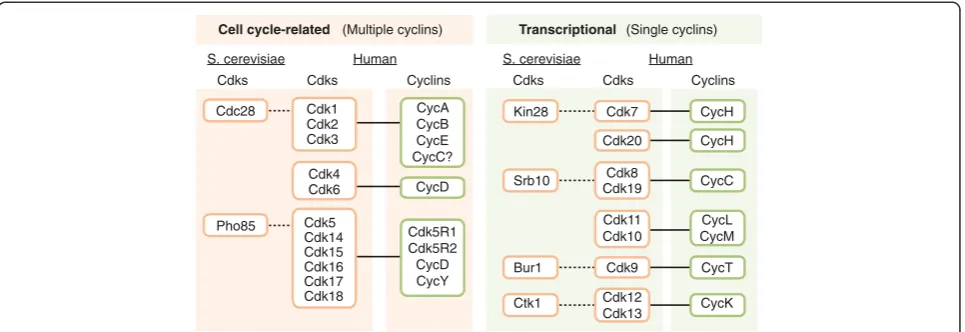
Despite their function in eukaryotic cell division and transcription, CDKs have undergone an extraordinary degree of evolutionary divergence and specialization. Six different CDKs are present in budding yeast (Figure 1). These CDKs can be grouped as, first, CDKs that bind multiple cyclins and can regulate the cell cycle and, sec-ond, CDKs that are activated by a single cyclin and are involved in the regulation of transcription. In the bud-ding yeastSaccharomyces cerevisiae, the first group con-tains Cdc28 and Pho85, each binding nine or ten different cyclins, respectively. This promiscuity forms the basis for their dynamic regulation and their ability to phosphorylate multiple substrates, thus regulating the cell-division cycle in response to different cellular cues. The second group comprises four CDKs - Kin28, Srb10, Bur1 and Ctk1 - each activated by a single specific cyclin (Figure 1). These cyclins are usually not regulated in a cell-cycle-dependent manner, and the members of this second group of CDKs are involved in the control of gene transcription.
The number of CDKs increased during evolution and was marked by a greater expansion of the cell-cycle-related group. Fungi contain 6 to 8 CDKs and 9 to 15 cyclins, whereas flies and echinodermata contain 11 CDKs and 14 cyclins, and human cells have 20 CDKs and 29 cyclins (Box 1) [7]. Evolutionary studies suggest
that CDKs fall into eight subfamilies represented by Cdk1, Cdk4 and Cdk5 (from the yeast cell-cycle-related CDKs), and Cdk7, Cdk8, Cdk9, Cdk11 and Cdk20 (func-tioning as transcriptional CDKs) [7,8] (Figure 2). Like its yeast ortholog, Cdk1 is the only CDK essential for the cell cycle in mammals [9], whereas both Cdk2 and Cdk3 are dispensable [3,10]. Although Pho85 is not essential in yeast, this kinase is required for viability in some
stress conditions, such as growth after starvation. Pho85 displays multiple cell-cycle-related functions as well as regulation of gene expression, metabolism, morphogen-esis, cell polarity and aging; it functions as an integrator of signals such as nutrient availability, DNA damage or other types of stress [11]. Sequencing and functional studies suggest that the mammalian homolog of Pho85 is Cdk5, although these kinases cluster with multiple mammalian kinases of the Cdk5 subfamily, namely Cdk14 to Cdk18. Pho85 can interact with up to 10 cyclins of the Pcl1/Pcl2 or Pho80 groups, whereas mam-malian Cdk5 is activated by non-cyclin proteins, includ-ing Cdk5R1 (p35) and Cdk5R2 (p39). Interestinclud-ingly, other members of the Cdk5 subfamily, such as Cdk14 or Cdk16, are activated by cyclin Y, which is a cyclin closely related to yeast Pcl1/Pcl2 proteins [12,13]. The Cdk4 subfamily is unique as it is only found in eumetazoans, and the members of this family diverge equally from the Cdk1 or Cdk5 subfamilies (Figures 1 and 2) [7]. Other cell-cycle-related subfamilies, such as the Cdk1-related B-type CDKs, are plant specific and are not found in an-imals or fungi [14].
Transcriptional CDKs are more conserved, both in se-quence and function (Figure 1). Yeast Kin28 and human Cdk7 are subunits of transcription factor TFIIH, which is involved in transcription initiation by phosphorylating the Ser5 residue of the RNA polymerase II (RNAPII) C-terminal domain (CTD) at gene promoters. Cdk7 is also able to phosphorylate and activate other CDKs, thus act-ing as a CDK-activatact-ing kinase (CAK; Box 2). Kin28 does not have this activity, which is mediated in yeast by a different kinase unrelated to CDKs, Cak1 [8]. The yeast protein Srb10 is orthologous to human Cdk8 and Cdk19 and is the enzymatic component of the Mediator
Cdk1 Cdk2 Cdk3
Cell cycle-related (Multiple cyclins) Transcriptional (Single cyclins) S. cerevisiae Human
Cdk4 Cdk6
Cdk5 Cdk14 Cdk15 Cdk16 Cdk17 Cdk18
Cdk7
Cdk20
Cdk8 Cdk19
Cdk12 Cdk13 Cdk11 Cdk10
CycH
CycH
CycC
CycT Cdk9
CycK CycL CycM Cdc28
Cyclins Cdks
Cdks
S. cerevisiae Human Cyclins Cdks
Cdks
Pho85
Ctk1 Kin28
Srb10
Bur1 CycA
CycB CycE CycC?
CycD
[image:2.595.58.541.89.255.2]Cdk5R1 Cdk5R2 CycD CycY
Figure 1Comparison of yeast and mammalian CDKs.Cells of the budding yeastSaccharomyces cerevisiaecontain two cell-cycle-related CDKs that are activated by multiple cyclins - Cdc28 and Pho85. Cdk1 is the mammalian ortholog of Cdc28, whereas Cdk5 is considered to be the Pho85 ortholog. The Cdk4/Cdk6 subfamily is not present in yeast. Kin28, Srb10, Bur1 and Ctk1 are the yeast orthologs of Cdk7, Cdk8, Cdk9 and Cdk12, respectively. The Cdk20 and Cdk11/Cdk10 subfamilies are not represented in yeast. Also indicated is the cyclin partner for the mammalian CDKs. CDK, cyclin-dependent kinase.
Box 1. The cyclin family
Cyclins are a large family of approximately 30 proteins varying in
mass from 35 to 90 kDa. These proteins are structurally defined by the presence of the so-called cyclin box, a domain of ap-proximately 100 amino acid residues that forms a stack of five α-helices. Many cyclins have two cyclin boxes, one amino-terminal box for binding to CDKs, and a carboxy-amino-terminal box that is usually required for the proper folding of the cyclin mol-ecule. The cyclin box is also present in other molecules such as the retinoblastoma protein (Rb), the transcription factor TFIIB
and Cables (CDK5 and ABL1 enzyme substrate 1), which are un-likely to function as CDK activators. In general, cyclins show less sequence similarity than the CDKs. The cyclin family contains ap-proximately 29 protein in humans, clustered in 16 subfamilies
and three major groups: group I (cyclin B group: A-, B-, D-, E-, F-, G, J, I and O); group II (cyclin Y group - a partner of the Cdk5 subfamily); and group III (cyclin C group: C, H, K, L and T -major partners of transcriptional CDKs) [7,66]. Cyclin D and cyclin
complex involved in the regulation of RNAPII during transcription [15]. Cdk9 is the yeast Bur1 ortholog, whereas the function of yeast Ctk1 in the phosphoryl-ation of the RNAPII CTD is performed by Cdk12 in
Drosophila and in human cells [16]. The evolutionary
relationship of the Cdk11 and Cdk20 subfamilies to the yeast CDKs is not clear, although these proteins are well conserved [7]. Unlike cyclins for cell-cycle-related ki-nases, the cyclin subunits of transcriptional CDKs do not show significant oscillations in protein levels during the cell cycle, and these transcriptional CDKs are there-fore regulated by protein-protein interactions or other mechanisms. Transcription-related kinases possibly orig-inated after cell-cycle-related CDKs and became more diverse as the complexity of transcription increased [17].
Characteristic structural features
Like other CMGC kinases, CDKs are proline-directed serine/threonine-protein kinases with some preference for the S/T-P-X-K/R sequence as a consequence of the presence of a hydrophobic pocket near the catalytic site that accommodates the proline (position +1). However, the requirement for the basic residue in the +3 position is not maintained in Cdk4 or transcriptional CDKs, which display a less-stringent S/T-P-X consensus. Some other family members such as Cdk7 or Cdk9 are not ne-cessarily proline directed and can also phosphorylate residues in the absence of the +1 proline [18].
Box 2. The CDK-activating kinase complex
The CAK complex (comprising Cdk7, cyclin H and Mat1) phosphorylates the T-loop of all CDKs tested, thus participating
in their activation. Furthermore, this complex can be part of the transcription factor phosphorylating the CTD of RNAPII as well as multiple nuclear receptors such as retinoic acid or thyroid re-ceptors, the estrogen receptorαor the vitamin D receptor
co-activator Ets1 [33]. The CAK complex can also be found associ-ated with an additional subunit of TFIIH - the DNA-dependent helicase Xpd - forming a complex known as CAK-XPD. This com-plex plays a role in the coordination and progression of mitosis,
likely as a consequence of the redistribution of CAK within dif-ferent cell compartments during the late nuclear-division steps [67].
Cdk1 Cdk2
Cdk3
Cdk4 Cdk6 Cdk5
Cdk14 Cdk15 Cdk16 Cdk17 Cdk18
Cdk7
Cdk8
Cdk9 Cdk10
Cdk11p110
Cdk20
Cdk19
Cdk12 Cdk13
Cdk1
Cdk5
Cdk4
Cdk7 Cdk8
Cdk11 Cdk9 Cdk20
Cdk11p58
Kinase domain
Arginine/Serine-rich
Proline-rich Glutamic acid-rich
[image:3.595.58.538.88.380.2]Glutamine-rich
The CDKs range in size from approximately 250 amino acid residues, just encompassing the catalytic serine/ threonine kinase domain, to proteins of more than 1,500 residues, with amino- and/or carboxy-terminal exten-sions of variable lengths (Figure 2). Like all kinases, CDKs have a two-lobed structure. The amino-terminal lobe contains beta-sheets, whereas the carboxy-terminal lobe is rich inα-helices, and the active site is sandwiched in-between. The N-lobe contains a glycine-rich inhibitory element (G-loop) and a unique major helix - the C-helix (containing the PSTAIRE sequence in Cdk1). The C-lobe contains the activation segment, which spans from the DFG motif (D145 in Cdk2; EMBL:AK291941) to the APE motif (E172 in Cdk2) and includes the phosphorylation-sensitive (T160 in Cdk2) residue in the so-called T-loop (Figure 3). In the cyclin-free monomeric form the CDK catalytic cleft is closed by the T-loop, preventing enzym-atic activity. In addition, the activation segment in the C-lobe - a platform for binding of the phospho-acceptor Ser/Thr region of substrates - is partially disordered.
Cyclin-dependent kinase activation
Upon binding of the cyclin to Cdk2, the CDK C-helix packs against one specific helix in the cyclin partner through a sur-face characterized by extensive hydrophobic interactions. Association of cyclins to the C-helix promotes a rotation in the axis of this segment, generating new interactions that are part of the active ATP-binding site. In addition, cyclins take the C-lobe activation segment out of the catalytic site so that the threonine becomes accessible for activating
phosphorylation by CAK (Figure 3). This phospho-threonine acts as a rigidifying hub, stabilizing the activated form of the kinase heterodimer [18,19]. The extent of the CDK-cyclin interface varies in the structure of Cdk4, Cdk9 or yeast Pho85 [18,20,21]. For instance, Cdk2 and cyclin A contact each other at both the N- and C-lobes, whereas the contacts between Cdk4 and cyclin D are limited to the N-lobe, and, unlike Cdk2, the cyclin does not impose an active conformation on the kinase as the Cdk4 ATP-binding site is still inaccessible to its substrates, even in the presence of the cyclin [20,21]. How Cdk4 becomes active is not completely clear, although the binding of the substrate is thought to in-duce the activation segment to open and to fit to the phospho-acceptor site. Some CDKs, such as Cdk5 or its yeast ortholog Pho85, do not require phosphorylation in the activation segment for activity, and these kinase can adopt the correct conformation through other interactions [18].
In addition to the consensus kinase domain, a few CDKs contain additional domains with functional relevance. Cdk16, Cdk17 and Cdk18 (containing a PCTAIRE sequence in the C-helix) are characterized by a conserved catalytic do-main flanked by amino- and carboxy-terminal extensions in-volved in cyclin binding. Phosphorylation of the Cdk16 amino-terminal domain blocks binding to cyclin Y, provid-ing a novel mechanism for regulation of these complexes [22]. In Cdk12 and Cdk13 (characterized by a PITAIRE motif), the kinase domain is localized in the center, and add-itional Arg/Ser-rich motifs in the amino terminus serve as docking sites for the assembly of splicing factors and regula-tors of splicing (Figure 2). These two kinases also contain
C-helix
Activation domain
2 k d C 2
k d
C -Cyclin A
T160ph
C-helix
Activation domain
T160 Catalytic
T14-Y15 T14-Y15
proline-rich motifs, mostly concentrated in their carboxy-terminal region, that serve as binding sites for Src-homology 3 (SH3), WW or profilin-domain-containing proteins [16].
Cyclin-dependent kinase inhibition
The glycine-rich region (G-loop) in the N-lobe is an additional regulatory region as it contains residues (Thr14 and Tyr15 in Cdk2; Figure 3) whose phosphorylation in-hibits kinase activity. Phosphorylation of Thr14 and/or Tyr15 residues by Wee1 and Myt1 kinases inhibits several family members, preventing cell-cycle progression, for instance, in response to DNA damage. Elimination of these phosphates by phosphatases of the Cdc25 family is then required for activation of CDKs and cell-cycle progression [3,23]. Inhibitory phosphorylation at Thr14 and Tyr15 does not result in major changes in the CDK structure, but does inhibit the CDK activity by reducing the affinity of the CDK for its substrates. However, phos-phorylation at Tyr15 seems to be activating in the case of Cdk5, perhaps by improving substrate recognition [18]. These residues are not present in Cdk7, in agreement with
the general belief that this kinase is constitutively active and regulated at different levels.
Cell-cycle-related CDKs can also be negatively regulated by binding to small proteins of the INK4 or Cip/Kip fam-ilies of inhibitors [19,24]. INK4 proteins (p16INK4a, p15INK4b, p18INK4cand p19INK4d) are specific for the Cdk4 subfamily and interact with the monomeric CDKs. They function by distorting the cyclin interface and the ATP-binding pocket, thus preventing activation of Cdk4 and Cdk6 by D-type cyclins or by CAK [24]. Members of the Cip/Kip family of inhibitors (p21Cip1, p27Kip1and p57Kip2) contact both the CDK and cyclin subunits and are able to inhibit CDK-cyclin heterodimers, giving additional levels of regulation once these complexes have already formed [19].
Localization and function Cdk1 and Cdk4 subfamilies
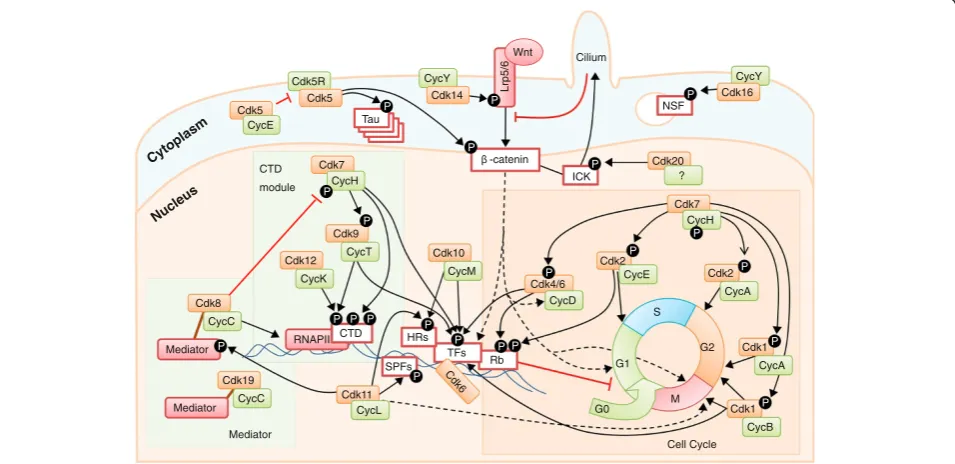
The general picture in mammalian cells is that Cdk4 and Cdk6, upon transcriptional induction of D-type cyclins in response to several mitogenic stimuli, promote entry into the cell cycle (Figure 4) [25]. These kinases
Rb
Cdk1 CycB CycY CycY
Cdk10 CycM
M G2 S
G1
G0 RNAPII CTD
Lrp5/6
Mediator
Cdk19 CycC
TFs SPFs
HRs
Cdk20 ? Cilium
ICK -catenin
Mediator CTD module
Mediator Cdk8
CycC
Cdk12
CycK Cdk2
CycA
Cdk1 CycA Cdk7
CycH
Cell Cycle Cdk7
CycH
Cdk4/6 CycD
Cdk2 CycE
Cdk11
Cdk6
CycL Cdk9
CycT
Cdk14
NSF
Cdk16 Cdk5
CycE Tau
Wnt
Cdk5R Cdk5
Cytoplasm
Nucleus
P
P P
P P P P
P
P
P
P
P P
P P
P
P
P P
P P
[image:5.595.60.538.353.585.2]P
phosphorylate and inactivate the retinoblastoma protein (Rb), an adaptor protein that assembles different protein and protein-DNA complexes that repress transcription in response to a wide range of control mechanisms [25]. In human cells, Rb contains 13 conserved sites that are phosphorylated by CDKs in proliferating cells. Com-plexes between cyclin D and Cdk4 or Cdk6 phosphoryl-ate residues Ser807 and Ser811, priming Rb for further phosphorylation by these or other CDKs at other sites [26]. CDK-dependent inactivation of Rb (or its relatives p107 and p130) results in de-repression of multiple genes encoding proteins required for DNA synthesis (S phase) or mitosis [25]. The activity of Cdk2 might also contribute to this process, although this kinase could have additional functions in DNA replication or DNA repair. Once cells have duplicated their DNA, Cdk1 be-comes activated by A- and B-type cyclins, promoting cellular processes such as centrosome maturation and separation, chromosome condensation and mitotic entry after nuclear envelope breakdown [3]. This simplified view is obscured owing to multiple non-consensus inter-actions between CDKs and cyclins and compensatory roles [6]. For instance, when Cdk4 and Cdk6 are absent, Cdk2 can bind to D-type cyclins [27]. Cdk1 can also bind to cyclin E or cyclin D in the absence of Cdk2 or Cdk4, respectively [9], suggesting a scenario reminiscent of the yeast cell cycle in which Cdc28 is sufficient to in-duce all cell-cycle transitions by interacting with differ-ent cyclins [6].
Cdk5 subfamily and cyclin-Y-related kinases
Despite its similarity to other cell-cycle-related Cdks, Cdk5 is the prototype of what are termed atypical CDKs. This kinase is activated by the non-cyclin proteins Cdk5R1 (p35) or Cdk5R2 (p39), and phosphorylation in the T-loop is not required for its activation [28,29]. Although Cdk5 is expressed in multiple cell types, its activity is thought to be more restricted owing to the expression of its activators p35 and p39 in terminally differentiated cells such as neu-rons [28]. However, in addition to its crucial functions in neuronal biology, Cdk5 plays multiple roles in gene expres-sion, differentiation, angiogenesis and senescence, among others [5,28,29].
Interestingly, the Cdk5 activators carry an amino-terminal myristoylation motif that is required for their membrane targeting (Figure 4). Until recently, Cdk5 was thought to be the only membrane-associated Cdk, but re-cent data suggest that the CDKs Cdk14 to Cdk18 (PFTAIRE and PCTAIRE kinases) display similar activ-ities upon binding to cyclin Y. Like Cdk5, Cdk16 requires no T-loop phosphorylation, suggesting that cyclin Y, like p35, tightly interacts with the activation loop, alleviating the need for an activating phosphorylation [13]. Cyclin Y is also N-myristoylated, and cyclin-Y-dependent recruitment
and activation of Cdk14 at the plasma membrane results in phosphorylation of the Wnt co-receptor Lrp5/Lrp6 (Figure 4). Cdk16 also binds to cyclin Y, and these com-plexes phosphorylate several proteins, including N-ethylmaleimide-sensitive factor (NSF) for the control of exocytosis [30], and are essential for spermatogenesis [22]. The partner CDKs of cyclin Y display overlapping roles
as knockdown of individual CDKs inXenopus embryos
failed to produce a phenotype, whereas depletion of cyc-lin Y and its highly related homolog cyccyc-lin-Y-like re-sulted in a Wnt loss-of-function phenotype [31]. In addition to the relevance of the Wnt pathway in the control of transcription,β-catenin and other Wnt regu-lators localize to centrosomes and/or kinetochores and regulate the formation and orientation of the mitotic spindle and the process of chromosome segregation [31]. In fact, cyclin Y reaches maximum levels at G2-M phase of the cell cycle and is degraded in a ubiquitin-dependent manner, similarly to mitotic cyclins, suggest-ing a crucial role for the cyclin-Y-Wnt pathway dursuggest-ing cell division [12]. It is interesting to note that CDKs and cyclins of this subfamily, such as Cdk17 or cyclin Y, are highly conserved, at levels similar to Cdk1 or cyclin B [13]. In most cases, the cellular relevance of many Cdk5-subfamily members remains to be established.
Control of RNA polymerase II by transcriptional cyclin-dependent kinases
subunit of the positive transcription elongation factor b (P-TEFb) that stimulates elongation. Cdk9 is the ortholog of Bur1, which contributes to phosphorylation of the Ser2 mark at the 5′ends of genes [16,35]. Although Cdk9 was thought to be the major Ser2 kinase required for efficient elongation, recent data suggest that this requirement is mediated by a second substrate of Cdk9, the elongation factor subunit Spt5, whose Cdk9-dependent phosphoryl-ation relieves the early pausing step [35]. Recent studies in
Drosophila and human cells suggest that Cdk12, in com-plex with cyclin K, is the yeast Ctk1 ortholog responsible for most of the Ser2 phosphorylation at the CTD and especially the phosphorylation at promoter-distal regions [36,37]. Depletion of Cdk12 resulted in defective Ser2 phosphorylation at a subset of genes - mostly long and complex ones - but not a change in the rate of global transcription. Cdk12 is specifically required for the transcription of genes involved in the response to DNA damage, establishing a new link between the transcrip-tional machinery and cell-cycle regulation [37]. Cdk1 can also phosphorylate the CTD, and this activity is thought to inhibit transcription, although its physio-logical relevance has not been established. Transcript termination results in dephosphorylation of RNAPII, making it ready for another round of re-initiation. Al-though the control of dephosphorylation is not well understood, several CDK-counteracting phosphatases such as Cdc14 are likely to be involved [38,39].
Cdk8 and its closely related family member Cdk19 as-sociate with C-type cyclins as part of the multi-subunit Mediator complex (Figure 4) [15]. This complex func-tions as a bridge linking gene-specific activators to the general RNAPII transcription machinery at the pro-moter, thus influencing nearly all stages of transcription and coordinating these events with changes in chroma-tin organization. Cdk8 (or Cdk19), along with cyclin C, Med12 and Med13, form the so-called Cdk8 module characteristic of the free Mediator form, devoid of RNAPII. The Cdk8 module responds to several intra-cellular signaling pathways, and it is commonly associ-ated with repression of transcription, although it can also activate transcription [15]. Cdk8 has multiple tar-gets and phosphorylates several transcription factors, affecting their stability and activity. Recent evidence suggests various roles in gene activation in the p53 net-work, the Wnt-β-catenin pathway, the serum-response network and other pathways governed by Smads or the thyroid hormone receptor [40]. Cdk8 also modulates Cdk7 activity by phosphorylating cyclin H, thus imped-ing Cdk7 activity and inhibitimped-ing initiation of transcrip-tion [33]. Finally, Cdk19 associates with similar Mediator complexes, although these complexes are likely to possess a specificity that is yet to be estab-lished [41].
Cdk11 and Cdk20 subfamilies
Cdk11 proteins are the products of two highly related
genes in mammals (CDK11A and CDK11B) encoding
Cdk11Ap110 and Cdk11Bp110 [2], as well as two smaller alternative proteins, Cdk11Ap58and Cdk11Bp58, resulting from translation from an internal ribosome-binding site generated during G2-M phase. Cdk11 binds to L-type cyclins and participates in the coordination between transcription and RNA processing, particularly alterna-tive splicing [42]. In budding yeast, Cdk11 has been shown to be a crucial factor for the interaction of the Cdk8 module with the Mediator complex through phos-phorylation of conserved residues of the Med27 and Med4 Mediator subunits (Figure 4) [43]. Cdk11 also par-ticipates in many other pathways, such as hormone re-ceptor signaling or autophagy [44-46]. The short isoform of Cdk11, Cdk11p58, is specifically expressed at G2-M, and its kinase activity is required for duplication of the centrioles, spindle dynamics and sister chromatid cohe-sion at centromeres during mitosis [47-49]. Lack of Cdk11 results in mitotic defects in mouse embryos, highlighting the crucial role of this ‘transcriptional’ kinase in the cell cycle [3].
Cdk10 is activated by cyclin M, a cyclin mutated in STAR syndrome, a developmental abnormality charac-terized by toe syndactyly, telecanthus and anogenital and renal malformations [50]. Cdk10-cyclin-M phosphory-lates Ets2, promoting its degradation by the proteasome [50]. STAR-associated mutations in the gene encoding cyclin M impair binding of cyclin M to Cdk10, resulting in increased Ets2-dependent transcription of c-Raf and over-activation of the MAPK pathway. In the insect
Helicoverpa armigera, Cdk10 modulates gene transcrip-tion by steroid hormones by promoting the interactranscrip-tion between heat-shock proteins and the ecdysone receptor EcRB1 [51].
Finally, Cdk20 (also known as cell cycle-related kinase (CCRK)) can interact with cyclin H and originally was proposed to have CAK activity for Cdk2, suggesting a close relationship with Cdk7. However, its role as a CAK is controversial [52], and additional data suggest that it functions as an activating kinase for MAK-related kin-ase/intestinal cell kinase (ICK) [53]. Expression of Cdk20 activates β-catenin-TCF signaling to stimulate cell-cycle progression [54], whereas its inhibition results in accu-mulation of ICK at the ciliary tips and prevents cell-cycle entry [55] (Figure 4).
Frontiers
evolution, both CDK and cyclin gene families have inde-pendently undergone a significant number of functional specializations [7]. Many of the interactions between spe-cific mammalian CDKs and cyclins have been reported
in vitro. However, the biochemical promiscuity in CDK-cyclin interactions makes it difficult to evaluate properly the in vivo physiological relevance of specific CDK-cyclin complexes. For instance, Cdk1 is thought to be activated mainly by A- and B-type cyclins but can also bind to, and be activated by, D- or E-type cyclins in the absence of Cdk4/Cdk6 or Cdk2, respectively [9,27,56]. Cdk5 can also bind to D-type cyclins, although to what extent these com-plexes are active or relevantin vivois not clear. The situ-ation is even more complex for the lesser-known family members for which there are no currentin vivodata [2].
Although the comparison of the yeast CDKs has pro-moted the convenient division between transcriptional and cell-cycle activities, the multiple interactions be-tween these two activities in higher eukaryotes makes it difficult to maintain this simple classification. First, tran-scription and cell-cycle progression cannot be opposed as these processes function at different layers in cell biology. Arguably, transcription is a major regulatory pathway required for cell-cycle entry. Major cell-cycle-related kinases such as Cdk4 and Cdk6 mostly function by phosphorylating transcription regulators such as Rb or Smads [3,25], and the archetypal cell-cycle kinase Cdk1 also phosphorylates multiple transcription factors and epigenetic modulators (Figure 4) [5]. By contrast, major‘transcriptional’CDKs such as Cdk7 or Cdk11 dir-ectly control cell-cycle progression, in some instances independently of transcription. Finally, a single CDK can have separate cell-cycle-related and transcriptional activ-ities. As an example, Cdk6 has recently been character-ized as a chromatin factor (Figure 4) that regulates transcription factors involved in angiogenesis or the NF-κB pathway [57,58], a process independent of the clas-sical Cdk4/6-cyclin-D-Rb pathway involved in cell-cycle regulation.
As a consequence of their importance in multiple pro-cesses, CDKs are frequently mutated or deregulated in dis-ease. A classic example is the almost universal deregulation of the CDK-cyclin-Rb pathway in cell-cycle entry during malignant transformation [25]. Underlining the signifi-cance of CDKs, inhibitors of Cdk4 and Cdk6 received in 2013 the Food and Drug Administration ‘breakthrough therapy’ designation for treatment of patients with breast cancer [59]. Other members of the CDK family can also be considered as interesting targets for therapeutics in cancer or other diseases. Cdk5 displays multiple roles in neurodegenerative diseases [28] and in other tissues with relevance to diabetes, cardiovascular disease or cancer [29]. Cdk8 exhibits copy-number gains in colon cancers, and re-cently it has been characterized as a coactivator of the
beta-catenin pathway in colon cancer cell proliferation [60,61]. Cdk10 is a major determinant of resistance to endocrine therapy for breast cancer [62], and inhibition of Cdk12 confers sensitivity to inhibitors of poly (ADP-ribose) polymerases PARP1 and PARP2 [63]. Cdk14 confers motil-ity advantages and metastatic potential in hepatocellular carcinoma motility and metastasis [64,65]. Finally, as indi-cated above, cyclin Y kinases regulate the Wnt pathway [31], providing new therapeutic opportunities that are yet to be explored. Hence, it seems very likely that new targets within the CDK family will be explored in the near future for therapy of cancer or other diseases.
Abbreviations
CAK:CDK-activating kinase; CCRK: Cycle-related kinase; CDK: Cyclin-dependent kinase; CTD: C-terminal domain; DYRK: Dual-specificity tyrosine-regulated kinase; ICK: Intestinal cell kinase; MAPK: Mitogen-activated protein kinase; NSF: N-ethylmaleimide-sensitive factor; PARP: Poly (ADP-ribose) polymerase; P-TEFb: Positive transcription elongation factor b; Rb: Retinoblastoma protein; RNAPII: RNA polymerase II.
Competing interests
The author declares that he has no competing interests.
Acknowledgements
Work in the laboratory of MM is funded by grants from the Spanish Government (MINECO; SAF2012-38215), the OncoCycle Programme (S2010/ BMD-2470) from the Comunidad de Madrid, and the European Union Seventh Framework Programme (MitoSys project; HEALTH-F5-2010-241548).
Published: 30 June 2014
References
1. Manning G, Whyte DB, Martinez R, Hunter T, Sudarsanam S:The protein kinase complement of the human genome.Science2002,298:1912–1934. 2. Malumbres M, Harlow E, Hunt T, Hunter T, Lahti JM, Manning G, Morgan
DO, Tsai LH, Wolgemuth DJ:Cyclin-dependent kinases: a family portrait. Nat Cell Biol2009,11:1275–1276.
3. Malumbres M, Barbacid M:Mammalian cyclin-dependent kinases.Trends Biochem Sci2005,30:630–641.
4. Morgan DO:Cyclin-dependent kinases: engines, clocks, and microprocessors.Annu Rev Cell Dev Biol1997,13:261–291.
5. Lim S, Kaldis P:Cdks, cyclins and CKIs: roles beyond cell cycle regulation. Development2013,140:3079–3093.
6. Malumbres M, Barbacid M:Cell cycle, CDKs and cancer: a changing paradigm.Nat Rev Cancer2009,9:153–166.
7. Cao L, Chen F, Yang X, Xu W, Xie J, Yu L:Phylogenetic analysis of CDK and cyclin proteins in premetazoan lineages.BMC Evol Biol2014,14:10. 8. Liu J, Kipreos ET:Evolution of cyclin-dependent kinases (CDKs) and
CDK-activating kinases (CAKs): differential conservation of CAKs in yeast and metazoa.Mol Biol Evol2000,17:1061–1074.
9. Santamaria D, Barriere C, Cerqueira A, Hunt S, Tardy C, Newton K, Caceres JF, Dubus P, Malumbres M, Barbacid M:Cdk1 is sufficient to drive the mammalian cell cycle.Nature2007,448:811–815.
10. Ortega S, Prieto I, Odajima J, Martin A, Dubus P, Sotillo R, Barbero JL, Malumbres M, Barbacid M:Cyclin-dependent kinase 2 is essential for meiosis but not for mitotic cell division in mice.Nat Genet2003,35:25–31. 11. Huang D, Friesen H, Andrews B:Pho85, a multifunctional cyclin-dependent
protein kinase in budding yeast.Mol Microbiol2007,66:303–314.
12. Davidson G, Shen J, Huang YL, Su Y, Karaulanov E, Bartscherer K, Hassler C, Stannek P, Boutros M, Niehrs C:Cell cycle control of wnt receptor activation.Dev Cell2009,17:788–799.
13. Mikolcevic P, Rainer J, Geley S:Orphan kinases turn eccentric: a new class of cyclin Y-activated, membrane-targeted CDKs.Cell Cycle2012, 11:3758–3768.
15. Carlsten JO, Zhu X, Gustafsson CM:The multitalented Mediator complex. Trends Biochem Sci2013,38:531–537.
16. Kohoutek J, Blazek D:Cyclin K goes with Cdk12 and Cdk13.Cell Div2012, 7:12.
17. Guo Z, Stiller JW:Comparative genomics of cyclin-dependent kinases suggest co-evolution of the RNAP II C-terminal domain and CTD-directed CDKs.BMC Genomics2004,5:69.
18. Echalier A, Endicott JA, Noble ME:Recent developments in cyclin-dependent kinase biochemical and structural studies.Biochim Biophys Acta1804, 2010:511–519.
19. Pavletich NP:Mechanisms of cyclin-dependent kinase regulation: structures of Cdks, their cyclin activators, and Cip and INK4 inhibitors.J Mol Biol1999, 287:821–828.
20. Day PJ, Cleasby A, Tickle IJ, O’Reilly M, Coyle JE, Holding FP, McMenamin RL, Yon J, Chopra R, Lengauer C, Jhoti H:Crystal structure of human CDK4 in complex with a D-type cyclin.Proc Natl Acad Sci U S A2009,106:4166–4170. 21. Takaki T, Echalier A, Brown NR, Hunt T, Endicott JA, Noble ME:The structure
of CDK4/cyclin D3 has implications for models of CDK activation.Proc Natl Acad Sci U S A2009,106:4171–4176.
22. Mikolcevic P, Sigl R, Rauch V, Hess MW, Pfaller K, Barisic M, Pelliniemi LJ, Boesl M, Geley S:Cyclin-dependent kinase 16/PCTAIRE kinase 1 is activated by cyclin Y and is essential for spermatogenesis.Mol Cell Biol 2012,32:868–879.
23. Boutros R, Lobjois V, Ducommun B:CDC25 phosphatases in cancer cells: key players? Good targets?Nat Rev Cancer2007,7:495–507.
24. Jeffrey PD, Tong L, Pavletich NP:Structural basis of inhibition of CDK-cyclin complexes by INK4 inhibitors.Genes Dev2000,14:3115–3125.
25. Malumbres M, Barbacid M:To cycle or not to cycle: a critical decision in cancer.Nat Rev Cancer2001,1:222–231.
26. Rubin SM:Deciphering the retinoblastoma protein phosphorylation code. Trends Biochem Sci2013,38:12–19.
27. Malumbres M, Sotillo R, Santamaria D, Galan J, Cerezo A, Ortega S, Dubus P, Barbacid M:Mammalian cells cycle without the D-type cyclin-dependent kinases Cdk4 and Cdk6.Cell2004,118:493–504.
28. Cheung ZH, Ip NY:Cdk5: a multifaceted kinase in neurodegenerative diseases.Trends Cell Biol2012,22:169–175.
29. Arif A:Extraneuronal activities and regulatory mechanisms of the atypical cyclin-dependent kinase Cdk5.Biochem Pharmacol2012,84:985–993. 30. Liu Y, Cheng K, Gong K, Fu AK, Ip NY:Pctaire1 phosphorylates
N-ethylmaleimide-sensitive fusion protein: implications in the regulation of its hexamerization and exocytosis.J Biol Chem2006,281:9852–9858. 31. Davidson G, Niehrs C:Emerging links between CDK cell cycle regulators
and Wnt signaling.Trends Cell Biol2010,20:453–460.
32. Egloff S, Dienstbier M, Murphy S:Updating the RNA polymerase CTD code: adding gene-specific layers.Trends Genet2012,28:333–341. 33. Egly JM, Coin F:A history of TFIIH: two decades of molecular biology on
a pivotal transcription/repair factor.DNA Repair (Amst)2011,10:714–721. 34. Larochelle S, Amat R, Glover-Cutter K, Sanso M, Zhang C, Allen JJ, Shokat KM,
Bentley DL, Fisher RP:Cyclin-dependent kinase control of the initiation-to-elongation switch of RNA polymerase II.Nat Struct Mol Biol2012, 19:1108–1115.
35. Bres V, Yoh SM, Jones KA:The multi-tasking P-TEFb complex.Curr Opin Cell Biol2008,20:334–340.
36. Bartkowiak B, Liu P, Phatnani HP, Fuda NJ, Cooper JJ, Price DH, Adelman K, Lis JT, Greenleaf AL:CDK12 is a transcription elongation-associated CTD kinase, the metazoan ortholog of yeast Ctk1.Genes Dev2010, 24:2303–2316.
37. Blazek D, Kohoutek J, Bartholomeeusen K, Johansen E, Hulinkova P, Luo Z, Cimermancic P, Ule J, Peterlin BM:The Cyclin K/Cdk12 complex maintains genomic stability via regulation of expression of DNA damage response genes.Genes Dev2011,25:2158–2172.
38. Clemente-Blanco A, Sen N, Mayan-Santos M, Sacristan MP, Graham B, Jarmuz A, Giess A, Webb E, Game L, Eick D, Bueno A, Merkenschlager M, Aragon L: Cdc14 phosphatase promotes segregation of telomeres through repression of RNA polymerase II transcription.Nat Cell Biol2011, 13:1450–1456.
39. Guillamot M, Manchado E, Chiesa M, Gomez-Lopez G, Pisano DG, Sacristan MP, Malumbres M:Cdc14b regulates mammalian RNA polymerase II and represses cell cycle transcription.Sci Rep2011,1:189.
40. Galbraith MD, Donner AJ, Espinosa JM:CDK8: a positive regulator of transcription.Transcription2010,1:4–12.
41. Sato S, Tomomori-Sato C, Parmely TJ, Florens L, Zybailov B, Swanson SK, Banks CA, Jin J, Cai Y, Washburn MP, Conaway JW, Conaway RC:A set of consensus mammalian mediator subunits identified by multidimensional protein identification technology.Mol Cell2004,14:685–691.
42. Hu D, Mayeda A, Trembley JH, Lahti JM, Kidd VJ:CDK11 complexes promote pre-mRNA splicing.J Biol Chem2003,278:8623–8629. 43. Drogat J, Migeot V, Mommaerts E, Mullier C, Dieu M, van Bakel H, Hermand D:
Cdk11-cyclinL controls the assembly of the RNA polymerase II mediator complex.Cell Rep2012,2:1068–1076.
44. Wilkinson S, Croft DR, O’Prey J, Meedendorp A, O’Prey M, Dufes C, Ryan KM: The cyclin-dependent kinase PITSLRE/CDK11 is required for successful autophagy.Autophagy2011,7:1295–1301.
45. Wang Y, Zong H, Chi Y, Hong Y, Yang Y, Zou W, Yun X, Gu J:Repression of estrogen receptor alpha by CDK11p58 through promoting its ubiquitin-proteasome degradation.J Biochem2009,145:331–343.
46. Chi Y, Hong Y, Zong H, Wang Y, Zou W, Yang J, Kong X, Yun X, Gu J: CDK11p58 represses vitamin D receptor-mediated transcriptional activation through promoting its ubiquitin-proteasome degradation.Biochem Biophys Res Commun2009,386:493–498.
47. Petretti C, Savoian M, Montembault E, Glover DM, Prigent C, Giet R:The PITSLRE/CDK11p58 protein kinase promotes centrosome maturation and bipolar spindle formation.EMBO Rep2006,7:418–424.
48. Hu D, Valentine M, Kidd VJ, Lahti JM:CDK11(p58) is required for the maintenance of sister chromatid cohesion.J Cell Sci2007,120:2424–2434. 49. Yokoyama H, Gruss OJ, Rybina S, Caudron M, Schelder M, Wilm M, Mattaj
IW, Karsenti E:Cdk11 is a RanGTP-dependent microtubule stabilization factor that regulates spindle assembly rate.J Cell Biol2008,180:867–875. 50. Guen VJ, Gamble C, Flajolet M, Unger S, Thollet A, Ferandin Y, Superti-Furga
A, Cohen PA, Meijer L, Colas P:CDK10/cyclin M is a protein kinase that controls ETS2 degradation and is deficient in STAR syndrome.Proc Natl Acad Sci U S A2013,110:19525–19530.
51. Liu W, Cai MJ, Wang JX, Zhao XF:In a non-genomic action, steroid hormone 20-hydroxyecdysone induces phosphorylation of cyclin-dependent kinase 10 to promote gene transcription.Endocrinology2014,155:1738–1750. 52. Wohlbold L, Larochelle S, Liao JC, Livshits G, Singer J, Shokat KM, Fisher RP:
The cyclin-dependent kinase (CDK) family member PNQALRE/CCRK supports cell proliferation but has no intrinsic CDK-activating kinase (CAK) activity.Cell Cycle2006,5:546–554.
53. Fu Z, Larson KA, Chitta RK, Parker SA, Turk BE, Lawrence MW, Kaldis P, Galaktionov K, Cohn SM, Shabanowitz J, Hunt DF, Sturgill TW:Identification of yin-yang regulators and a phosphorylation consensus for male germ cell-associated kinase (MAK)-related kinase.Mol Cell Biol2006, 26:8639–8654.
54. Feng H, Cheng AS, Tsang DP, Li MS, Go MY, Cheung YS, Zhao GJ, Ng SS, Lin MC, Yu J, Lai PB, To KF, Sung JJ:Cell cycle-related kinase is a direct androgen receptor-regulated gene that drives beta-catenin/T cell factor-dependent hepatocarcinogenesis.J Clin Invest2011,121:3159–3175.
55. Yang Y, Roine N, Makela TP:CCRK depletion inhibits glioblastoma cell proliferation in a cilium-dependent manner.EMBO Rep2013,14:741–747. 56. Aleem E, Kiyokawa H, Kaldis P:Cdc2-cyclin E complexes regulate the G1/S
phase transition.Nat Cell Biol2005,7:831–836.
57. Kollmann K, Heller G, Schneckenleithner C, Warsch W, Scheicher R, Ott RG, Schafer M, Fajmann S, Schlederer M, Schiefer AI, Reichart U, Mayerhofer M, Hoeller C, Zochbauer-Muller S, Kerjaschki D, Bock C, Kenner L, Hoefler G, Freissmuth M, Green AR, Moriggl R, Busslinger M, Malumbres M, Sexl V:A kinase-independent function of CDK6 links the cell cycle to tumor angiogenesis.Cancer Cell2013,24:167–181.
58. Handschick K, Beuerlein K, Jurida L, Bartkuhn M, Muller H, Soelch J, Weber A, Dittrich-Breiholz O, Schneider H, Scharfe M, Jarek M, Stellzig J, Schmitz ML, Kracht M:Cyclin-dependent kinase 6 is a chromatin-bound cofactor for NF-kappaB-dependent gene expression.Mol Cell2014,53:193–208. 59. Breakthrough therapies.http://www.focr.org/breakthrough-therapies. 60. Firestein R, Bass AJ, Kim SY, Dunn IF, Silver SJ, Guney I, Freed E, Ligon AH,
Vena N, Ogino S, Chheda MG, Tamayo P, Finn S, Shrestha Y, Boehm JS, Jain S, Bojarski E, Mermel C, Barretina J, Chan JA, Baselga J, Tabernero J, Root DE, Fuchs CS, Loda M, Shivdasani RA, Meyerson M, Hahn WC:CDK8 is a colorectal cancer oncogene that regulates beta-catenin activity.Nature2008, 455:547–551.
62. Iorns E, Turner NC, Elliott R, Syed N, Garrone O, Gasco M, Tutt AN, Crook T, Lord CJ, Ashworth A:Identification of CDK10 as an important
determinant of resistance to endocrine therapy for breast cancer.Cancer Cell2008,13:91–104.
63. Bajrami I, Frankum JR, Konde A, Miller RE, Rehman FL, Brough R, Campbell J, Sims D, Rafiq R, Hooper S, Chen L, Kozarewa I, Assiotis I, Fenwick K, Natrajan R, Lord CJ, Ashworth A:Genome-wide profiling of genetic synthetic lethality identifies CDK12 as a novel determinant of PARP1/2 inhibitor sensitivity. Cancer Res2014,74:287–297.
64. Leung WK, Ching AK, Chan AW, Poon TC, Mian H, Wong AS, To KF, Wong N: A novel interplay between oncogenic PFTK1 protein kinase and tumor suppressor TAGLN2 in the control of liver cancer cell motility.Oncogene 2011,30:4464–4475.
65. Huang J, Deng Q, Wang Q, Li KY, Dai JH, Li N, Zhu ZD, Zhou B, Liu XY, Liu RF, Fei QL, Chen H, Cai B, Xiao HS, Qin LX, Han ZG:Exome sequencing of hepatitis B virus-associated hepatocellular carcinoma.Nat Genet2012, 44:1117–1121.
66. Ma Z, Wu Y, Jin J, Yan J, Kuang S, Zhou M, Zhang Y, Guo AY:Phylogenetic analysis reveals the evolution and diversification of cyclins in eukaryotes. Mol Phylogenet Evol2013,66:1002–1010.
67. Chen J, Larochelle S, Li X, Suter B:Xpd/Ercc2 regulates CAK activity and mitotic progression.Nature2003,424:228–232.
doi:10.1186/gb4184

![Figure 3 A three-dimensional view of CDK structure and activation. In monomeric Cdk2 (left; [PDB:1HCL]), the major C-helix (N-lobe) andthe activation domain are close, ensuring that the catalytic pocket is inaccessible](https://thumb-us.123doks.com/thumbv2/123dok_us/8649284.867204/4.595.56.538.459.676/dimensional-structure-activation-monomeric-activation-ensuring-catalytic-inaccessible.webp)