N A N O E X P R E S S
Open Access
Dirac cone in
α-graphdiyne: a first-principles
study
Xiaoning Niu, Xingze Mao, Dezheng Yang, Zhiya Zhang, Mingsu Si
*and Desheng Xue
Abstract
We investigate the Dirac cone inα-graphdiyne, which is a predicted flat one-atom-thick allotrope of carbon using first-principles calculations.α-graphdiyne is derived from graphene where two acetylenic linkages (-C≡C-) are inserted into the single bonds (-C-C-). Thus,α-graphdiyne possesses a larger lattice constant which subsequently affects its electronic properties. Band structures show thatα-graphdiyne exhibits similar Dirac points and cone to graphene. Further, the tight-binding method is used to exploit the linear dispersion in the vicinity of Dirac points. Thanks to the larger lattice constant,α-graphdiyne yields a lower Fermi velocity, which might make itself an ideal material to serve the anomalous integer quantum Hall effect.
Keywords: α-graphdiyne; Dirac cone; First-principles calculation
Background
Band theory was first used to study the band structure of graphene over half a century ago [1], and it demonstrated that graphene is a semimetal with unusual linearly dis-persing electronic excitations called Dirac electron. Such linear dispersion is similar to photons which cannot be described by the Schrödinger equation. In the vicinity of the Dirac point where two bands touch each other at the Fermi energy level, the Hamiltonian obeys the two-dimensional (2D) Dirac equation [2] asH =vFσ· ˆpwith
vFbeing the Fermi velocity,σthe Pauli matrices, andpˆthe
momentum operator. In graphene, the Fermi velocityvF
is 300 times smaller than the speed of light. Hence, many unusual phenomena of quantum electrodynamics can be easily detected because of the much lower speed of car-riers [3]. Within the framework of tight-binding approx-imation, the Fermi velocityvFis proved to be dependent
on both the lattice constant and the hopping energy. In fact, the hopping energy is also associated with the lattice constant. Thus, the Fermi velocity of Dirac cone materi-als might be tunable through changing the corresponding lattice constant.
Recently, it was found that Dirac cones not only occur in the 2D carbon allotropes such as graphene, graphyne,
*Correspondence: [email protected]
Key Laboratory for Magnetism and Magnetic Materials of the Ministry of Education, Lanzhou University, 222 South Tianshui Road, Lanzhou 730000, China
and graphdiyne [4], but also can be detected at inter-faces of topological insulators [5-11]. It is notable that, in 6,6,12-graphyne [4], the conduction electrons turn out to be superior to that in graphene in one preferred direction over the other, which is due to the rectangular lattice. This is a major step in searching for new Dirac cone materials. Therefore, it is proper to pursue the Dirac cone material with tunable Fermi velocity, which will be the focus of future researches.
In this letter, we predict a novel flat one-atom-thick allotrope of carbon by inserting two acetylenic linkages into the single bonds in graphene. According to the nam-ing method used in [4], we assign it asα-graphdiyne. Up to now, no study has been made on α-graphdiyne both experimentally and theoretically. Thus, theoretical inves-tigation on α-graphdiyne is a must before synthesizing it in experiments. Since α-graphdiyne has a larger lat-tice constant, it should have potential applications both in quantum tunneling [12] and in anomalous integer quan-tum Hall effect [13]. In this work, band structures are calculated and a similar Dirac cone to that of graphene is observed. In particular, we introduce a tight-binding model to mimic the hopping energy between the hexago-nal vertices, which realizes the linear dispersion of bands near the Dirac points, allowing the Dirac cone to be studied explicitly.
Methods
To simulate the electronic properties, we employ density functional theory with the generalized gradient approx-imation (GGA) of Perdew-Burke-Ernzerhof (PBE) [14] for the exchange-correlation (XC) potential within the projector augmented wave method, as implemented in VASP [15]. The cutoff energy for plane waves is set to be 500 eV. The vacuum space is at least 15 Å, which is large enough to avoid the interaction between peri-odical images; 15×15×1 and 25×25×1 are used for the
k-grid of geometry optimization and self-consistent cal-culation, respectively. During the geometry optimization, all the atoms in the unit cell were allowed to relax and the convergence of force is set to 0.001 eV/Å.
Results and discussion
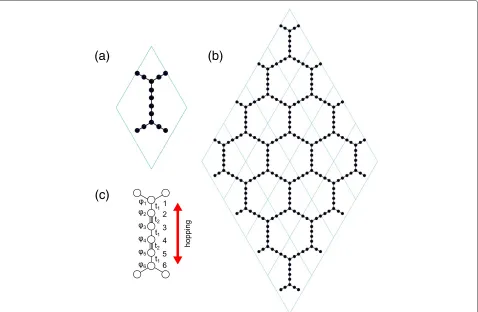
Based on first-principles calculation, the lattice structure ofα-graphdiyne is predicted for the first time, as shown in Figure 1. It clearly shows thatα-graphdiyne has a hexag-onal lattice the same as graphene. The optimized lattice constant is 11.42 Å. This is very insightful. On one hand, it has the largest lattice constant compared with cur-rently known carbon allotropes [16] and thus has a much
smaller density than graphene and other related carbon allotropes. This makes α-graphdiyne a potential candi-date for hydrogen storage [17]. At the same time, the absorbed hydrogen may induce an intrinsic magnetism in the defected system [18,19]. On the other hand, this lattice constant has a very little mismatch with Si(111) surface, that is, one unit cell of α-graphdiyne matches the Si(111)-3×3 unit cell well. This suggests that the high possibility is to growα-graphdiyne epitaxially on Si(111) substrate. After the epitaxial structure is cooled down, one can remove the substrate by chemical etching. In this way, the isolation of monolayer α-graphdiyne might be obtained in experiments.
The band structure and density of states (DOS) of
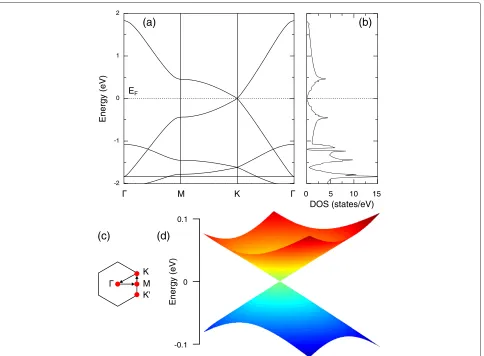
α-graphdiyne are shown in Figure 2a,b, respectively. The most important observations from Figure 2a are the linear dispersion near the K point and the zero DOS at the Fermi energy level. However, the corresponding slope of the Dirac cone is obviously smaller than that of graphene and α-graphyne. This has a big effect on the Fermi velocity, as discussed below. The bonding and antibonding orbitals at the Fermi energy level touch each other and develop two slight flat bands asK approaches
(b)
(a)
[image:2.595.61.539.379.691.2](c)
-2 -1 0 1 2
0.1
0
-0.1
0 5 10
DOS (states/eV)
Energy (eV)
(d)
(a)
M K
Energy (eV)
(c)
M K
K' EF
[image:3.595.59.543.85.441.2]15
(b)
Figure 2Electronic properties ofα-graphdiyne.(a)Band structure and(b)DOS.(c)First Brillouin zone with the letters designating
high-symmetry points.(d)2D Dirac cone representing the valence and conduction bands in the vicinity of theKandKpoints.EFis the Fermi energy.
M, which correspond to the two peaks near the Fermi level in the DOS plot. Similar to the case of graphene and
α-graphyne, the Dirac points are located at the K and K, which means that there are even (six) Dirac points in the Brillouin zone, which is in a striking difference from the odd Dirac points observed in topological insulator Bi2Te3[20].
Due to the breaking symmetry associated with spin-orbit interaction (SOI) in 2D layered materials, a small band gap will be induced at the Dirac points, which can in principle be used to study the quantum spin Hall effect. The energy bands with SOI (not shown for brevity) open a band gap of 22×10−3 meV in α-graphdiyne, and the
magnitude is close to the value of graphene [21].
To understand the nature of the Dirac cone in
α-graphdiyne, we employ the tight-binding method pro-posed in [22], where an effective hopping parameter is introduced. It is notable that there are six carbon atoms along the effective hopping direction in α-graphdiyne, as shown in Figure 1, while only four in α-graphyne.
This makes it more complex to exploitα-graphdiyne than
α-graphyne. To simplify the model, two triple bonds with the hopping parameters t1 and t2 for the single and
triple carbon bonds are taken. The simplified Hamiltonian equations at the carbon triple bond, i.e., sites 2, 3, 4, and 5, are
Eϕ2=Vϕ2+t1ϕ1+t2ϕ3, Eϕ3=Vϕ3+t2ϕ2+t1ϕ4, Eϕ4=Vϕ4+t1ϕ3+t2ϕ5, Eϕ5=Vϕ5+t2ϕ4+t1ϕ6,
(1)
where E and V are the electron and on-site energies, respectively. Based on Equation 1, we can easily obtain
ϕ2=t1
(E−V)ϕ1+t1t2ϕ4
(E−V)2−t2 2
,
ϕ3=
t1t2ϕ1+t1(E−V)ϕ4
(E−V)2−t2 2
,
ϕ4=
t1(E−V)ϕ3+t1t2ϕ6
(E−V)2−t2 2
,
ϕ5=
t1t2ϕ3+t1(E−V)ϕ6
(E−V)2−t2 2
.
When we focus on the electrons near the Dirac cone where E ≈ V, the wave functions are approximately
ϕ2 ∼= −(t1/t2)ϕ4,ϕ3∼= −(t1/t2)ϕ1,ϕ4 = −∼ (t1/t2)ϕ6, and ϕ5∼= −(t1/t2)ϕ3. Thus, the hopping term from site 2 to 1
ist1ϕ2∼= −(t21/t2)ϕ4, from site 3 to 4 ist1ϕ3∼= −(t21/t2)ϕ1,
from site 4 to 3 ist1ϕ4∼= −(t12/t2)ϕ6, and from site 5 to 6
ist1ϕ5∼= −(t21/t2)ϕ3. With the above four hopping terms,
we thus have
t1ϕ2∼=(t13/t22)ϕ6≡ ˜t1ϕ6,
t1ϕ5∼=(t13/t22)ϕ1≡ ˜t1ϕ1,
(3)
which means that the effective direct hopping parameter between sites 1 and 6 is
˜
t1≡(t31/t22). (4)
The obtained effective hopping parameter ˜t1 has the
same sign as t1, which means that pseudospin in α-graphdiyne has the same direction as in graphene. Thus, many perspectives of graphene can be transferred to
α-graphdiyne directly. The magnitude of ˜t1depends on
the hopping parameter t2. Remarkably, it equals t1/t2
times the effective hopping parameter in α-graphyne. Thus, the effective hopping parameter should be smaller inα-graphdiyne than inα-graphyne ast1/t2<1.
Once we obtain the effective hopping parameter ˜t1,
the standard energy-momentum relation can be obtained directly as [1]
E(kx,ky)= ±˜t1
1+4cos(
√ 3 2 kxa)cos(
1
2kya)+4cos 2(1
2kya), (5)
whereais the lattice constant. By fitting the occupied and unoccupied bands in the vicinity of theK point from the first-principles calculations, as illustrated in Figure 2a, the renormalized hopping parameter ˜t1 has a value of 0.45
eV. It is much smaller than the value of approximately 3 eV in graphene, which originates from the larger lat-tice constant inα-graphdiyne. Figure 2c shows the high-symmetry points in the first Brillouin zone. It explicitly shows that the energy bands are degenerate to zero at both KandK points. In Figure 2d, a 2D plot of the Dirac cone ofα-graphdiyne is displayed. Due to the same hexagonal lattice as graphene andα-graphyne, the 2D Dirac cone of
α-graphdiyne exhibits a similar appearance.
It is known that the Fermi velocity plays a vital role in the photoelectric field and crucially dominates the transport properties. Here, we will focus attention on the study of Fermi velocity of α-graphdiyne. The dispersion close to theKandKpoints can be expanded as
E±(q)≈ ±vF|q| +O[|q|2] , (6)
whereqis the momentum measured relative to the Dirac points, ‘±’ the upper and lower Dirac cones, andvF the
Fermi velocity, given byvF = √
3ta/2. With the lattice constanta= 11.42 Å and the effective hopping parameter
˜
t1= 0.45 eV, the slope of the Dirac cone inα-graphdiyne
equals±4.5 eVÅ compared with±28 eVÅ inα-graphyne and±34 eVÅ in graphene [4]. The corresponding Fermi velocity is about 0.11×10⁶ m/s, which is much lower
[image:4.595.60.536.418.702.2]than the value in α-graphyne. From this perspective,
α-graphdiyne, which has a lower Fermi velocity than other known carbon allotropes, will lead to possible applications in quantum electrodynamics, for example, to observe the anomalous integer quantum Hall effect at room temperature [13].
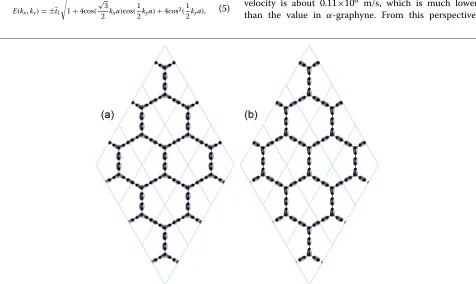
More information including the helical texture of Dirac cone and Berry’s phase are indeed associated with the detailed wave functions. In this work, we instead calculate the two orbitals at the Dirac point as shown in Figure 3. The charge density explicitly exhibits a 180° rotational symmetry, which is consistent with the theoretical con-clusion in the literature [2]. The two orbitals consist of two types of bonds inα-graphdiyne: One is the bonding bonds (Figure 3a) and the other the antibonding bonds (Figure 3b), which are located at the different carbons. As a recent study reported [23], the effective hopping term of the acetylenic linkages is much smaller than the direct hopping between the vertex atoms. This is because the covalent bonds are formed in these acetylenic linkages as illustrated in Figure 3, which subsequently weakens the hopping ability. Thus, the reduced hopping parameter is a natural consequence, which also agrees well with our above tight-binding theory. Future experiments can test this prediction directly.
Conclusions
In conclusion, we have predicted a novel carbon allotrope called α-graphdiyne, which has a similar Dirac cone to that of graphene. The lower Fermi velocity stems from its largest lattice constant compared with other current carbon allotropes. The effective hopping parameter˜t1of
0.45 eV is obtained through fitting the energy bands in the vicinity of Dirac points. The obtained Fermi velocity has a lower value of 0.11×10⁶m/s, which might have potential
applications in quantum electrodynamics.
Competing interests
The authors declare that they have no competing interests.
Authors’ contributions
MSS designed the work and revised the paper. XNN calculated the first-principles results. XZM wrote the manuscript. DZY, ZYZ, and DSX have devoted valuable discussion. All authors read and approved the final manuscript.
Acknowledgements
We would like to thank L. Huang (LZU, Lanzhou) for the valuable discussion. This work was supported by the National Basic Research Program of China under no. 2012CB933101, the Fundamental Research Funds for the Central Universities (no. 2022013zrct01), and the National Science Foundation (51202099 and 51372107).
Received: 12 September 2013 Accepted: 26 October 2013 Published: 9 November 2013
References
1. Wallace PR:The band theory of graphite.Phys Rev1947,71:622–634. 2. Neto AHC, Guinea F, Peres NMR, Novoselov KS, Geim AK:The electronic
properties of graphene.Rev Mod Phys2009,81:109–162.
3. Neto AHC, Guinea F, Peres NMR:Drawing conclusions from graphene. Phys World2006,19:33–37.
4. Malko D, Neiss C, Vines F, Görling A:Competition for graphene graphynes with direction-dependent dirac cones.Phys Rev Lett2012,
108:086804.
5. Fu L, Kane CL, Mele EJ:Topological insulators in three dimensions. Phys Rev Lett2007,98:106803.
6. Takahashi R, Murakami S:Gapless interface states between topological insulators with opposite Dirac velocities.Phys Rev Lett
2011,107:166805.
7. Kane CL, Mele EJ:Quantum spin hall effect in graphene.Phys Rev Lett
2005,95:226801.
8. Kane CL, Mele EJ:Z2 topological order and the quantum spin hall effect.Phys Rev Lett2005,95:146802.
9. Bernevig BA, Zhang SC:Quantum spin hall effect.Phys Rev Lett2006,
96:106802.
10. Moore JE, Balents L:Topological invariants of time-reversal-invariant band structures.Phys Rev B2007,75:121306(R).
11. Zhang H, Liu CX, Zhang SC:Spin-orbital texture in topological insulators.Phys Rev Lett2013,111:066801.
12. He WY, Chu ZD, He L:Chiral tunneling in a twisted graphene bilayer. Phys Rev Lett2013,111:066803.
13. Novoselov KS, Geim AK, Morozov SV, Jiang D, Katsnelson MI, Grigorieva IV, Dubonos SV, Firsov AA:Two-dimensional gas of massless Dirac fermions in graphene.Nature2005,438:197–200.
14. Perdew JP, Burke K, Ernzerhof M:Generalized gradient approximation made simple.Phys Rev Lett1996,77:3865–3868.
15. Kresse G, Furthmüller J:Efficient iterative schemes for ab initio total-energy calculations using a plane-wave basis set.Phys Rev B
1116,54:9–11186.
16. Ivanovskii AL:Graphynes and graphdyines.Prog Solid State Chem2013,
41:1–19.
17. Koo J, Hwang HJ, Kwon Y, Lee H:Graphynes and graphdyines. J Phys Chem C2012,116:20220.
18. Si MS, Li JY, Shi HG, Niu XN, Xue DS:Divacancies in graphitic boron nitride sheets.Europhys Lett2009,86:46002.
19. Li J, Gao D, Niu X, si M, Xue D:g-B3N3C: a novel two-dimensional graphite-like material.Nanoscale Res Lett2012,7:624.
20. Chen YL, Analytis JG, Chu JH, Liu ZK, Mo SK, Qi XL, Zhang HJ, Lu DH, Dai X, Fang Z, Zhang SC, Fisher IR, Hussain Z, Shen ZX:Experimental realization of a three-dimensional topological insulator, Bi2Te3. Science2009,325:178–181.
21. Gmitra M, Konschuh S, Ertler C, Ambrosch-Draxl C, Fabian J:
Band-structure topologies of graphene: spin-orbit coupling effects from first principles.Phys Rev B2009,80:235431.
22. Kim BG, Choi HJ:Graphyne: hexagonal network of carbon with versatile Dirac cones.Phys Rev B2012,86:115435.
23. Huang H, Duan W, Liu Z:The existence/absence of Dirac cones in graphynes.New J Phys2013,15:023004.
doi:10.1186/1556-276X-8-469
Cite this article as:Niuet al.:Dirac cone inα-graphdiyne: a first-principles study.Nanoscale Research Letters20138:469.
Submit your manuscript to a
journal and benefi t from:
7Convenient online submission
7Rigorous peer review
7Immediate publication on acceptance
7Open access: articles freely available online
7High visibility within the fi eld
7Retaining the copyright to your article