N A N O E X P R E S S
Open Access
Calculation of Elastic Bond Constants in
Atomistic Strain Analysis
Haiyuan Chen
1, Juanjuan Wang
1, Eric Ashalley
2, Handong Li
1and Xiaobin Niu
1*Abstract
Strain analysis has significance both for tailoring material properties and designing nanoscale devices. In particular, strain plays a vital role in engineering the growth thermodynamics and kinetics and is applicable for designing optoelectronic devices. In this paper, we present a methodology for establishing the relationship between elastic bond constants and measurable parameters, i.e., Poisson’s ratioνand systematic elastic constantK. At the atomistic level, this approach is within the framework of linear elastic theory and encompasses the neighbor interactions when an atom is introduced to stress. Departing from the force equilibrium equations, the relationships betweenν,
K, and spring constants are successfully established. Both the two-dimensional (2D) square lattice and common three-dimensional (3D) structures are taken into account in the procedure for facilitating, bridging the gap between structural complexity and numerical experiments. A new direction for understanding the physical phenomena in strain engineering is established.
Keywords:Strain analysis; Poisson’s ratio; Elastic bond constant
Background
Strain always acts as a driving force in strain-engineered nanostructure formation [1–7] and plays a crucial role in nanoscale device designing. By manipulating strain-dependent growth kinetic and thermodynamic condi-tions, technically tailoring size, shape, and position of the growing structures becomes accessible. Accordingly, the energy band structures of the tailored structures can thus be modified. When shedding light on device design-ing, in particular, the strain-engineered formation of heterostructures, junctions, and variable composition profiles in quantum dots (QDs) and nanowires (NWs) during epitaxial growth [8, 9], strain provides a key strat-egy for producing optimal nanophotonic and nanoelec-tronic materials, including high-efficiency blue and green light-emitting diodes (LEDs) [10, 11], visible lasers [12–14], and high-efficiency solar cells [15]. Moreover, studies on the strain effect incorporated in two-dimensional (2D) materials [16–18] and topological in-sulators [19–21] also open doors to new classes of
electronic and spintronic devices. Therefore, an under-standing of the strain effects is highly essential.
Many efforts have been devoted to tackling the strain effects within epitaxial systems [22–29]. Among them, finite element (FE) method based on continuum elasti-city and atomistic strain calculations are most com-monly used. The FE method generally developed for macroscopic structures is integral to strain effect studies. However, to obtain accurate results, a smaller grid size is always favorable, which leads to increased computer memory and time. For the atomistic strain calculations, the bonds between atoms are often considered as ideal springs. All through the pioneering work by Keating [28] and other extended works, the empirical or semi-empirical interatomic potentials that are difficult to measure experimentally are always essential for the strain calculation. Thus, in the atomistic calculations, the lack of understanding of the elusive interaction coef-ficients may hinder better comprehension of the elastic properties.
In this work, we establish a connection between the Poisson’s ratio, a measurable elastic constant [30], and the spring constants used in the atomistic strain simula-tions, within the framework of linear elasticity theory. At the atomistic level, Poisson’s effect is caused by
* Correspondence:[email protected]
1State Key Laboratory of Electronic Thin Film and Integrated Devices,
University of Electronic Science and Technology of China, Chengdu 610054, China
Full list of author information is available at the end of the article
infinitesimal displacements of atoms thus the stretching of atomistic bonds within the material lattice to accom-modate the stress. When the bonds in the stress direc-tion are elongated or compressed, their counterpart in the perpendicular direction will be correspondingly shortened or lengthened. Drawing from the atomistic strain method [26], we considered the lattice bonds as ideal springs, connecting all the neighboring atoms and are within elastic deformation limit upon exerting external force. Our description of the elastic constants has a microscopic interpretation that incorporates all nearest and diagonal bond springs. Under the definition of Hooke’s law, the relationship between stress and responded strain is simply built, resulting in force bal-ance equations, which is vital to formulating the rela-tionship between the Poisson’s ratio and the spring constants.
Methods
Focusing on deriving the spring constants in the atomis-tic strain method using the Poisson’s ratio, we give in-sights to building up the formulism for elasticity quantities based on the proposed approach. The explicit methodology presented here aims to develop a useful tool that can provide the inputs for atomistic strain ana-lysis instead of a specific model. Drawing from the linear elasticity, the analytical results will facilitate one to dir-ectly use these inputs for most general crystal structures. Based on the implementation of our derivation, the val-idation of our formulated results is succeeded in our previous studies [27, 31, 32]; the elastic strain is well cal-culated utilizing our derived inputs. In the following der-ivation, both the common two-dimensional (2D) and three-dimensional (3D) crystal lattices are considered in our calculations. In comparison with the effect on atom-istic strain analysis caused by nearest neighbors, some lower order quantities, like bond angle and nonlinear interaction, are ignored in our derivation. Although our result has its limitation when dealing with amorphous materials and systems with strong metallic bonds, it is constructed based on some general crystal lattices. It performs well in most materials with strong chemical bond. The derived explicit results are applicable to numerical calculation and computations, thus paving way for a more detailed exploration of strain-related mechanisms.
Results and Discussion 2D Square Lattice
For a clear and easy to understand example of the gen-eral derivation to obtain the microscopic constants, we start with the 2D square lattice. The 2D square lattice is the most commonly used 2D simulation cell for qualita-tive studies of the general mechanisms. This simple
generic 2D structure should capture the essential steps in the formulation and guide the study for more compli-cated systems.
Assuming that the displacements of atoms, thus the infinitesimal changes of bond lengths, are along the axial direction, Poisson’s ratio ν is often expressed as ν=− dεtrans/dεaxial, where εtrans and εaxial represent the trans-verse and axial strains, respectively. The unit cell of a 2D square system demonstrated in Fig. 1a is composed of four atoms and has two types of spring bonds along the side and diagonal directions, respectively, with constants K1 and K2. By the Poisson’s ratio definition, when a stretching force F is exerted along the y direction, the resulted two length variations along x and y directions are expressed as δ1 and δ2, respectively, in which a represents the lattice constant and δ1,2≪a. The change in diagonal length can be easily obtained by the simple trigonometric function. The total diagonal bond length
is
ffiffiffiffiffiffiffiffiffiffiffiffiffiffiffiffiffiffiffiffiffiffiffiffiffiffiffiffiffiffiffiffiffiffiffiffiffiffiffiffiffiffiffi
aþδ1 ð Þ2þ
aþδ2
ð Þ2
q
. Owing to the minuscule length variations, it can be approximately expressed asffiffiffiffiffiffiffiffiffiffiffiffiffiffiffiffiffiffiffiffiffiffiffiffiffiffiffiffiffiffiffiffiffiffiffiffiffiffiffiffiffiffiffi
aþδ1 ð Þ2þ
aþδ2
ð Þ2
q
≅pffiffiffi2aþδ1þffiffiδ2 2
p by ignoring the
small second-order terms. Thus, the bond length change in the diagonal direction is described as δdiag¼
δ1þδ2 ð Þ=pffiffiffi2.
Next, we separate one atom (upper left in Fig. 1a) in this system and apply force balance analysis, shown in Fig. 1b. We get f1+f3sinθ=F and f2+f3cosθ= 0, in which f1=K1δ1, f2=K1δ2, and f3¼K2δdiag¼K2⋅
δ1þδ2
ð Þ=pffiffiffi2 by Hooke’s law. Since δ1,2≪a, θ≈45°. Solving the above equations, we get the expression of Poisson’s ratio νand the comprehensive elastic constant Kof the whole system along the force direction
ν¼−δ2δ1¼ K2
2K1þK2; ð
1Þ
K¼δ1F ¼2K1ðK1þK2Þ
2K1þK2
ð Þ : ð2Þ
Note that both ν and K are measurable quantities in the lab. By solving the equation sets (1) and (2), finally, we get the relationship betweenK1,2,K, andν
K1¼ K
1þν ; ð3aÞ
K2¼ 2νK
1−ν2: ð3bÞ
Note that ifK2= 0, thenν= 0 andK=K1as needed.
Simple Cubic Lattice
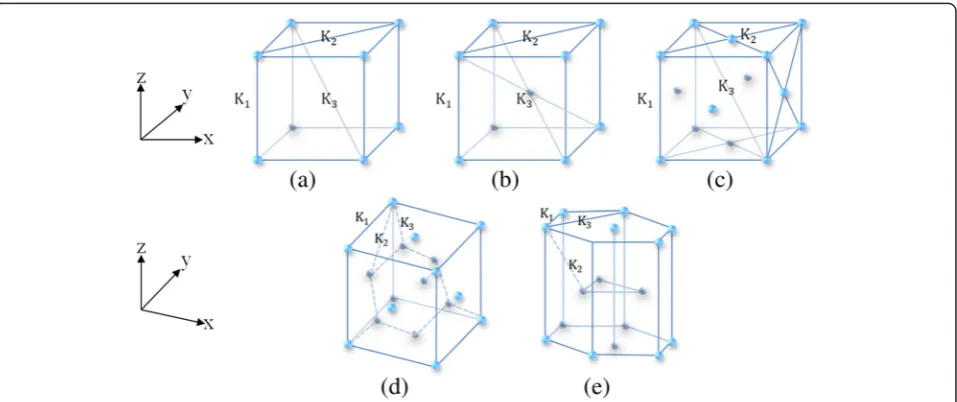
of the Poisson’s ratio for common 3D crystal structures (shown in Fig. 2) following the established procedure.
We commence with choosing the simple cubic (SC) structure illustrated in Fig. 2a. We consider three dis-tinct types of elastic springs along edge, face diagonal, and body diagonal directions, and the three main related coefficients are defined as K1, K2, and K3, respectively. Following the practice used for 2D cases, we set the dis-placement values δz=δ1≪a and δx=δy=δ2≪a, whiles the remaining values in the diagonal directions can be easily derived via geometry analysis.
From equilibrium conditions, the force balance equations are
K1þK2þK3 3
δ1þ K2þ 2K3
3
δ2¼F; ð4aÞ
K2
2 þ
K3 3
δ1þ K1þ 3K2
2 þ
2K3 3
δ2¼0: ð4bÞ
According to Eq. (4b), the Poisson’s ratio is acquired through
ν¼−δ2δ1¼ 3K2þ2K3
6K1þ9K2þ4K3: ð
5Þ
Now, we substituteδ2¼−6K31þ9K2þ2K2þ4K3K3δ1 into Eq. (4a), and the comprehensive elastic constant alongz-axis is Fig. 1aA schematic illustration of 2D square system andbthe selected atom (upper leftina) responded to forces
[image:3.595.59.536.88.308.2] [image:3.595.60.539.514.715.2]K¼δ1F ¼6K1
2þ6K
22þ15K1K2þ6K1K3þ3K2K3
6K1þ9K2þ4K3 :
ð6Þ
It is noticeable here that if K2= 0, then ν¼3K1Kþ23K3;
K¼3K12þ3K1K3
3K1þ2K3 ; if K3= 0, then ν¼
K2
2K1þ3K2; K¼ 2K12þ2K22þ5K1K2
2K1þ3K2 ; and if K2=K3= 0, then ν= 0, K=K1 as required. Although K1, K2, and K3 are not attainable at the same time, the relationship can be used to set up the calculation inputs if one of the interactions is much weaker than the others.
Body-Centered Cubic Lattice
Now, we pay attention to calculating the elastic con-stants of the body-centered cubic (BCC) lattice which is demonstrated in Fig. 2b.
Studying the balanced force conditions using the same definition of displacements, we have
K1þK2þK3 6
δ1þ K2þK3 3
δ2¼F ð7aÞ
inzdirection and
K2
2 þ
K3 6
δ1þ K1þ 3K2
2 þ
K3 3
δ2¼0 ð7bÞ
inxandydirections.
From Eq. (7b), we obtain the Poisson’s ratio,
ν¼−δ2δ1 ¼ 3K2þK3
6K1þ9K2þ2K3: ð
8Þ
Substituting δ2¼−6K13þ9K2Kþ2Kþ23K3δ1 into the balanced condition Eq. (7a), the comprehensive elastic constant alongzdirection is described as
K¼δ1F ¼12K1
2þ12
K22þ30K1K2þ6K1K3þ3K2K3
12K1þ18K2þ4K3 :
ð9Þ
It is observed here that if K2= 0, then ν¼6K1Kþ23K3;
K¼6K12þ3K1K3
6K1þ2K3 ; if K3= 0, then ν¼
K2
2K1þ3K2; K¼ 2K12þ2K22þ5K1K2
2K1þ3K2 ; and if K2=K3= 0, then ν= 0, K=K1 as required. Finally, the connection between the Poisson’s ratio and elastic constant is established for BCC lattice.
Face-Centered Cubic Lattice
Here, we will show insights into establishing the rela-tionship between the Poisson’s ratio and the elastic con-stant of the face-centered cubic (FCC) lattice illustrated in Fig. 2c. Similarly, given the minor length changes in response to external force, we get the Poisson’s ratio by
analyzing the force equilibrium conditions. The balanced equation inzdirection is
K1þK2
2 þ
K3 3
δ1þ K2
2 þ
2K3 3
δ2¼F; ð10aÞ
and inxandydirections, the equation is given as
K2
4 þ
K3 3
δ1þ K1þ 3K2
4 þ
2K3 3
δ2¼0: ð10bÞ
And then, the Poisson’s ratio is expressed as
ν¼−δ2δ1¼ 3K2þ4K3
12K1þ9K2þ8K3: ð
11Þ
Then, we undertake substitution operations, replacing
δ2 with δ2¼−12K31Kþ92þ4K2Kþ83K3δ1 in Eq. (10a). Thus the comprehensive elastic constant along z axis is
K¼δ1F ¼12K1
2þ3K
22þ15K1K2þ12K1K3þ3K2K3
12K1þ9K2þ8K3 :
ð12Þ
Here the observation about the relationship show that if K2= 0, then ν¼3K1Kþ23K3; K¼3K1
2þ3K 1K3
3K1þ2K3 ; if K3= 0, then ν¼ K2
4K1þ3K2; K ¼
4K12þK22þ5K1K2
4K1þ3K2 , and ifK2=K3= 0, thenν= 0,K=K1as required. Here the related equations about Poisson’s ratio and elastic constant are built up.
Diamond Lattice
Now we consider the elastic constants of diamond lattice generally adopted in many materials, includingα-tin, the semiconductors silicon and germanium, and silicon/ger-manium alloys in any proportion. The diamond struc-ture is sketched in Fig. 2(d), and we also define three various spring bond constants along the nearest bond di-rections, which are labeled asK1,K2, andK3respectively. Apparently, the force balance equations are
K1þK2
2 þ
K3 12
δ1þ K2
2 þ
K3 6
δ2¼F ð13aÞ
in z direction, and
K2
2 þ
K3 6
δ1þ K1þ 3K2
2 þ
K3 3
δ2¼0 ð13bÞ
in x and y direction.
According to Eq. (13b) above, Poisson’s ratio is written as
ν¼−δ2δ1¼ 3K2þK3
12K1þ9K2þ2K3: ð
14Þ
Next, we replace δ2 in Eq. (13a) with δ2¼− 3K2þK3
K¼δ1F ¼48K1
2þ12K
22þ60K1K2þ12K1K3þ3K2K3
48K1þ36K2þ8K3 :
ð15Þ
It is recognized that if K2= 0, then ν¼12KK1þ23 K3; K ¼12K12þ3K1K3
12K1þ2K3 , if K3= 0, then ν¼
K2
4K1þ3K2; K¼ 4K12þK22þ5K1K2
4K1þ3K2 , and ifK2=K3= 0, thenν= 0,K=K1as re-quired. Finally, we attain the relationship between Pois-son’s ratio and elastic constant for diamond lattice.
Hexagonal Close-Packed Lattice
We will concentrate on creating the formulation of Pois-son’s ratio and elastic constants for hexagonal close-packed (HCP) lattice, which exist in many single element metals, such as Magnesium (Mg), Titanium (Ti), Haf-nium (Hf ), and Zinc (Zn). There are three different spring bond constants shown in Fig. 2. Here, we still chose Cartesian coordinates in order to facilitate the calculation.
In accordance with the same definition of tiny length changes, we obtain the force balance equations
K1þK2
2 þ
K3 9
δ1þ K2
2 þ
2K3 9
δ2¼F ð16aÞ
inzdirection and
K2
4 þ
K3 9
δ1þ K1þ 3K2
4 þ
2K3 9
δ2¼0 ð16bÞ
inxandydirections.
Through Eq. (16b), we get the expression for the Poisson’s ratio
ν¼−δ2δ1 ¼ 9K2þ4K3
36K1þ27K2þ8K3: ð
17Þ
Now, we replace δ2¼−36K19Kþ272þ4KK2þ83 K3δ1 in the bal-anced condition Eq. (16a), and then the comprehensive elastic constant alongzdirection is written as
K¼δ1F ¼36K1
2þ9K
22þ45K1K2þ12K1K3þ3K2K3
36K1þ27K2þ8K3 :
ð18Þ
Notably, from the above equations, we see that ifK2= 0, then ν¼ K3
9K1þ2K3; K ¼
9K12þ3K1K3
9K1þ2K3 ; if K3= 0, then K¼ 4K12þK22þ5K1K2
4K1þ3K2 ; and if K2=K3= 0, then ν= 0, K=K1 as required.
Consequently, we have established the correlations be-tween the Poisson’s ratio and spring bond constant for all the 3D systems exemplified in Fig. 2.
Conclusions
We successfully proposed a methodology calculating the spring constants between neighbored atoms in atomistic strain analysis, using quantifiable physical quantities, i.e., Poisson’s ratio νand comprehensive elastic constant K. This method describes the neighbored atom interactions with different spring bonds and gives insight into the force balance conditions, which contribute to obtaining the plausible results. The 2D square lattice and the or-dinary 3D lattices are explicated. This derivation process gives a straightforward view of understanding the elastic constant connections in these systems and is evidentially useful for numerical calculation and computations. This will pave way for a more detailed exploration of strain-engineered nanostructure formation and functionaliza-tion of electronic devices.
Competing Interests
The authors declare that they have no competing interests.
Authors’Contributions
HC conceived the derivations and wrote the manuscript. JW assisted with the calculations and manuscript preparation. EA and HL revised the manuscript. XN conceived the study, revised the manuscript, and supervised the work. All authors read and approved the final manuscript.
Authors’Information
XN received his Ph.D. degree in Materials Science and Engineering from the University of California, Los Angeles in 2008. Since 2014, he has been appointed as a Professor at the University of Electronic Science and Technology of China, Chengdu, China. His research interest lies in the modeling and simulation of materials from the atomic to mesoscopic scales.
Acknowledgements
The work is supported by the National Natural Science Foundation of China (Grant Nos. 11104010 and 61474014). We are grateful to Prof. Feng Liu and Prof. Anil Virkar for helpful discussions.
Author details
1State Key Laboratory of Electronic Thin Film and Integrated Devices,
University of Electronic Science and Technology of China, Chengdu 610054, China.2Institute of Fundamental and Frontier Sciences, University of Electronic Science and Technology of China, Chengdu 610054, China.
Received: 22 August 2015 Accepted: 7 October 2015
References
1. Liu F, Lagally MG (1997) Self-organized nanoscale structures in Si/Ge films. Surf Sci 386(1–3):169–181. doi:10.1016/s0039-6028(97)00303-8
2. Medeiros-Ribeiro G, Bratkovski AM, Kamins TI, Ohlberg DAA, Williams RS (1998) Shape transition of germanium nanocrystals on a silicon (001) surface from pyramids to domes. Science 279(5349):353–355. doi:10.1126/ science.279.5349.353
3. Moison JM, Houzay F, Barthe F, Leprince L, Andre E, Vatel O (1994) Self-organized growth of regular nanometer-scale InAs dots on GaAs. Appl Phys Lett 64(2):196–198. doi:10.1063/1.111502
4. Xie QH, Madhukar A, Chen P, Kobayashi NP (1995) Vertically self-organized InAs quantum box islands on GaAs(100). Phys Rev Lett 75(13):2542–2545. doi:10.1103/PhysRevLett.75.2542
5. Tersoff J, Teichert C, Lagally MG (1996) Self-organization in growth of quantum dot superlattices. Phys Rev Lett 76(10):1675–1678. doi:10.1103/PhysRevLett.76.1675
7. Ross FM, Tersoff J, Tromp RM (1998) Coarsening of self-assembled Ge quantum dots on Si(001). Phys Rev Lett 80(5):984–987. doi:10.1103/ PhysRevLett.80.984
8. Utrilla AD, Ulloa JM, Guzman A, Hierro A (2014) Long-wavelength room-temperature luminescence from InAs/GaAs quantum dots with an optimized GaAsSbN capping layer. Nanoscale Res Lett 9:36. doi:10.1186/1556-276x-9-36
9. Persichetti L, Sgarlata A, Mori S, Notarianni M, Cherubini V, Fanfoni M, Motta N, Balzarotti A (2014) Beneficial defects: exploiting the intrinsic polishing-induced wafer roughness for the catalyst-free growth of Ge in-plane nanowires. Nanoscale Res Lett 9:358. doi:10.1186/1556-276x-9-358 10. Duan XF, Huang Y, Cui Y, Wang JF, Lieber CM (2001) Indium phosphide
nanowires as building blocks for nanoscale electronic and optoelectronic devices. Nature 409(6816):66–69. doi:10.1038/35051047
11. Zhong ZH, Qian F, Wang DL, Lieber CM (2003) Synthesis of p-type gallium nitride nanowires for electronic and photonic nanodevices. Nano Lett 3(3):343–346. doi:10.1021/nl034003w
12. Huang MH, Mao S, Feick H, Yan HQ, Wu YY, Kind H, Weber E, Russo R, Yang P (2001) Room-temperature ultraviolet nanowire nanolasers. Science 292(5523):1897–1899. doi:10.1126/science.1060367
13. Duan XF, Huang Y, Agarwal R, Lieber CM (2003) Single-nanowire electrically driven lasers. Nature 421(6920):241–245. doi:10.1038/nature01353 14. Zhuo N, Liu FQ, Zhang JC, Wang LJ, Liu JQ, Zhai SQ, Wang ZG (2014)
Quantum dot cascade laser. Nanoscale Res Lett 9(1):144. doi:10.1186/1556-276x-9-144
15. Tian BZ, Zheng XL, Kempa TJ, Fang Y, Yu NF, Yu GH, Huang J, Lieber CM (2007) Coaxial silicon nanowires as solar cells and nanoelectronic power sources. Nature 449(7164):885–U8. doi:10.1038/nature06181
16. Bae S, Kim H, Lee Y, Xu XF, Park JS, Zheng Y, Balakrishnan J, Lei T, Kim HR, Song YI, Kim YJ, Kim KS, Ozyilmaz B, Ahn JH, Hong BH, Iijima S (2010) Roll-to-roll production of 30-inch graphene films for transparent electrodes. Nat Nanotechnol 5(8):574–578. doi:10.1038/nnano.2010.132
17. Bertolazzi S, Brivio J, Kis A (2011) Stretching and breaking of ultrathin MoS2. ACS Nano 5(12):9703–9709. doi:10.1021/nn203879f
18. Kliros GS (2014) Analytical modeling of uniaxial strain effects on the performance of double-gate graphene nanoribbon field-effect transistors. Nanoscale Res Lett 9:65. doi:10.1186/1556-276x-9-65
19. Brune C, Liu CX, Novik EG, Hankiewicz EM, Buhmann H, Chen YL, Qi XL, Shen ZX, Zhang SC, Molenkamp LW (2011) Quantum hall effect from the topological surface states of strained bulk HgTe. Phys Rev Lett 106:12. doi:10.1103/PhysRevLett.106.126803
20. Young SM, Chowdhury S, Walter EJ, Mele EJ, Kane CL, Rappe AM (2011) Theoretical investigation of the evolution of the topological phase of Bi2Se3 under mechanical strain. Phys Rev B 84:8. doi:10.1103/PhysRevB.84.085106 21. Liu Y, Li YY, Rajput S, Gilks D, Lari L, Galindo PL, Weinert M, Lazarov VK, Li L
(2014) Tuning Dirac states by strain in the topological insulator Bi2Se3. Nat Phys 10(4):294–299. doi:10.1038/nphys2898
22. Caflisch RE, Lee YJ, Shu S, Xiao YX, Xu J (2006) An application of multigrid methods for a discrete elastic model for epitaxial systems. J Comput Phys 219(2):697–714. doi:10.1016/j.jcp.2006.04.007
23. Johnson HT, Freund LB (1997) Mechanics of coherent and dislocated island morphologies in strained epitaxial material systems. J Appl Phys 81(9):6081–6090. doi:10.1063/1.364357
24. Niu XB, Lee YJ, Caflisch RE, Ratsch C (2008) Optimal capping layer thickness for stacked quantum dots. Phys Rev Lett 101:8. doi:10.1103/ PhysRevLett.101.086103
25. Benabbas T, Francois P, Androussi Y, Lefebvre A (1996) Stress relaxation in highly strained InAs/GaAs structures as studied by finite element analysis and transmission electron microscopy. J Appl Phys 80(5):2763–2767. doi:10.1063/1.363193
26. Schindler AC, Gyure MF, Simms GD, Vvedensky DD, Caflisch RE, Connell C, Luo E (2003) Theory of strain relaxation in heteroepitaxial systems. Phys Rev B 67(7):14. doi:10.1103/PhysRevB.67.075316
27. Niu XB, Stringfellow GB, Liu F (2011) Nonequilibrium composition profiles of alloy quantum dots and their correlation with the growth mode. Phys Rev Lett 107:7. doi:10.1103/PhysRevLett.107.076101
28. Keating PN (1966) Effect of invariance requirements on the elastic strain energy of crystals with application to the diamond structure. Phys Rev 145(2):637–645
29. Conesa-Boj S, Boioli F, Russo-Averchi E, Dunand S, Heiss M, Rueffer D, Wyrsch N, Ballif C, Miglio L, Morral AF (2014) Plastic and Elastic Strain Fields in GaAs/Si Core-Shell Nanowires. Nano Lett. 2014 14(4):1859-1864. doi:10.1021/nl4046312
30. Landau LD, Lifshitz E (1986) Theory of elasticity. Course Theor Phys 7:3 31. Niu X, Stringfellow GB, Liu F (2011) Phase separation in strained epitaxial
InGaN islands. Appl Phys Lett 99:21. doi:10.1063/1.3662927
32. Niu XB, Stringfellow GB, Lee YJ, Liu F (2012) Simulation of self-assembled compositional core-shell structures in InxGa1-xN nanowires. Phys Rev B 85:16. doi:10.1103/PhysRevB.85.165316
Submit your manuscript to a
journal and benefi t from:
7Convenient online submission
7Rigorous peer review
7Immediate publication on acceptance
7Open access: articles freely available online
7High visibility within the fi eld
7Retaining the copyright to your article