Modeling of Fuel Elements Cycling System in Pebble Bed
Reactor Based on Timed Places Control Petri Nets
*
Hongbing Liu1, Peng Shen1, Dong Du1, Xin Wang2, Haiquan Zhang2
1
Department of Mechanical Engineering, Tsinghua University, Beijing, China
2
Institute of Nuclear and New Energy Technology, Tsinghua University, Beijing, China Email: [email protected]
Received January, 2013
ABSTRACT
Pebble bed reactors use cycling scheme of spherical fuel elements relying on fuel elements cycling system (FECS). The structure and control logic of FECS are very complex. Each control link has strict requirements on time and sequence. This increases the difficulties of description and analysis. In this paper, timed places control Petri nets (TPCPN) is ap-plied for the modeling of FECS. On this basis the simulation of two important processes, namely uploading fuel ele-ments into the core for the first time and emptying the core is finished by simulation software Arena. The results show that as TPCPN is able to describe different kinds of logic relationship and has time properties and control properties, it’s very suitable for the modeling and analysis of FECS.
Keywords: Timed Places Control Petri nets (TPCPN); Arena; Pebble Bed Reactors; Fuel Elements Cycling System
(FECS)
1. Introduction
In recent years, the concept of the fourth generation of advanced nuclear energy systems is put forward in the world. Pebble bed HTGR is considered to be the pre- ferred technology for the fourth generation of advanced nuclear energy systems [1,2]. Pebble bed reactors use cycling scheme of spherical fuel elements. Its running process can be summarized as following: spherical fuel elements are uploaded from the reactor core and trans- ported in the near equal diameter pipeline; the burn-up measurement device measures the burn-up of the element; if the element has reached the target burn-up, or say it’s a spent element, it will be transported to the spent elements tank; if not, the element will be lifted up to return to the core; new fuel elements with the same number of the spent elements will be uploaded into the core at the same time. The realization of the running relies on a very im- portant support system of the reactor, namely fuel ele- ments cycling system (FECS) [3]. The control logic of FECS is very complex. Each control link has strict re- quirements on time and sequence. So it’s difficult to de- scribe it with natural languages, flowcharts, etc.
Petri nets (PN) is a powerful graphical modeling tool. It has a strict mathematical basis as well as intuitive graphical expression. Relationship such as parallel, con- current and conflict can be described very well with Petri
nets [4]. Control Petri nets (CPN) can describe some easy control systems. Multi-level description of complex con- trol systems can also be realized with the concepts of macro-place and macro-transition [5]. However, many control systems cannot be described with PN or CPN because the systems have requires on time.
In order to describe and analyze the control logic of FECS accurately, timed places control Petri nets (TPCPN) is used for the modeling of FECS. On this basis some simulations are done to analyze the operation process, including uploading fuel elements into the core for the first time and emptying the core. The results show that as TPCPN has the advantages on describing complex con- trol system and contains time properties, it can describe the control logic of FECS very accurately. It also facili- tates the simulation with software Arena.
2. The Function of Fuel Elements Cycling
System (FECS)
The structure of FECS is very complex. The key features of FECS include uploading fuel elements into the core for the first time, the main cycling, uploading new fuel elements into the core, discharging the spent elements from the core and emptying the core.
succession. Then they will be transported through the lifting system for the spent elements (lifting system B) to the spent elements tank.
The reliable operation of FECS relies on a variety of devices and media, including more than 50 sets of deliv- ery devices, more than 100 counters, nearly 200 elec- tronic gauges, more than 1000 meters of pipeline, etc.
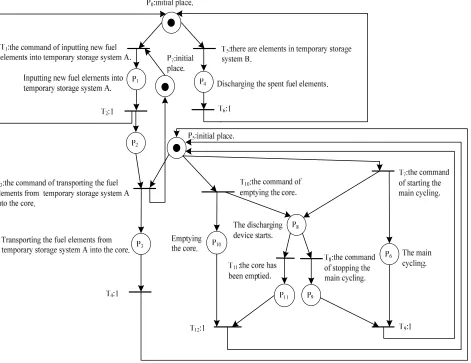
cycling (P6) and emptying the core (P10).
The TPCPN model of the head control room is shown
in Figure 1. The relationship between the subsystems
can be seen clearly from it, including parallel, concurrent, conflict and so on. For example, as both of P1 and P4
[image:2.595.67.538.355.718.2]need to use the gas changing system, they cannot be car- ried out at the same time. In this case, an initial place
Figure 2. The TPCPN model of the main cycling (TPCPN2).
named P0 is used to avoid the two subsystems running
simultaneously. Likewise, P5 can avoid P3, P6 and P10
running simultaneously.
3.2. The Timed Places Control Petri Nets Model of the Main Cycling
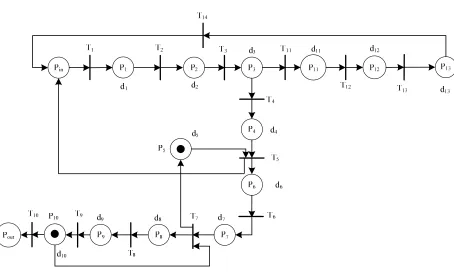
The TPCPN model of the main cycling is shown in
Figure 2. When P6 in TPCPN1 gets a token, Pin is given
a token. Then the main cycling starts. If there are fuel elements before the single conveyer (T1), one of the
elements will be transported to the next section of the pipeline by the single conveyer (P1). When counter A
detects the signal of the element passing by (T2), the
burn-up measurement device begins to measure the burn-up of the element after a period of time(P2, P3). If
the element has not reached the target burn-up (T4)and
there are no elements in lifting system A(P5), the element
will be transported to lifting system A by the locator(P6).
When counter B detects the signal of the element passing by (T6), the stop device will let the element into the core
after a period of time (P7, P8). Then the stop device
returns to the former status(P9). If the element has
reached the target burn-up and there are no elements in temporary storage system B(T11), the distribution system
will connect with temporary storage system B (P11). Then
the element is transported to temporary storage system B(P12). When counter C detects the signal of the element
passing by(T13), the distribution system will return to the
former status to connect with lifting system A(P13). Then
the judgment that whether there are elements before the single conveyer starts again.
When the command of stopping the main cycling is received, T8 in PN1 is fired. Then the discharge device is
turned off. If there are no elements in the pipeline, T10 in
PN2 is fired. Pout gets a token and gives out the signal
that the main cycling is over.
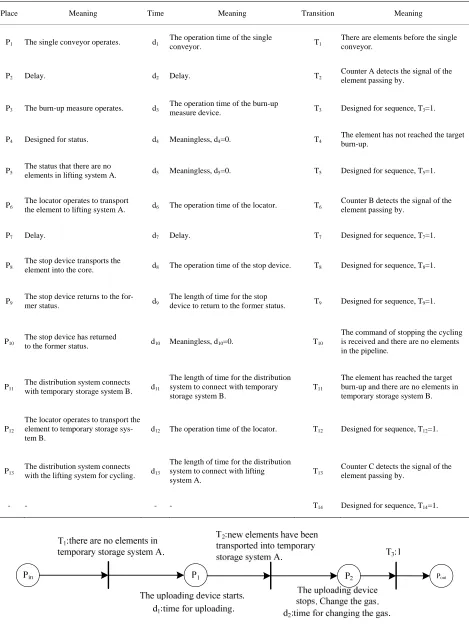
The meanings of the places, transitions and time used in Figure 2 are listed in Table 1.
3.3. The Other Timed Places Control Petri Nets Models
The TPCPN models of the other processes are shown in
Figures 3-6, including inputting the new fuel elements into temporary storage system A, transporting the fuel elements from temporary storage system A into the core, discharging the spent fuel elements and emptying the core. The operation process will not be discussed in de- tail any more.
4. The Simulation of Fuel Elements Cycling
System with Arena
P5 The status that there are no
elements in lifting system A. d5 Meaningless, d5=0. T5 Designed for sequence, T5=1.
P6 The locator operates to transport
the element to lifting system A. d6 The operation time of the locator. T6
Counter B detects the signal of the element passing by.
P7 Delay. d7 Delay. T7 Designed for sequence, T7=1.
P8 The stop device transports the
element into the core. d8 The operation time of the stop device. T8 Designed for sequence, T8=1.
P9 The stop device returns to the
for-mer status. d9
The length of time for the stop
device to return to the former status. T9 Designed for sequence, T9=1.
P10 The stop device has returned
to the former status. d10 Meaningless, d10=0. T10
The command of stopping the cycling is received and there are no elements in the pipeline.
P11 The distribution system connects with temporary storage system B. d11
The length of time for the distribution system to connect with temporary storage system B.
T11
The element has reached the target burn-up and there are no elements in temporary storage system B.
P12
The locator operates to transport the element to temporary storage sys-tem B.
d12 The operation time of the locator. T12 Designed for sequence, T12=1.
P13 The distribution system connects with the lifting system for cycling. d13
The length of time for the distribution system to connect with lifting system A.
T13 Counter C detects the signal of the element passing by.
[image:4.595.63.532.101.727.2]- - - - T14 Designed for sequence, T14=1.
Figure 4. The TPCPN model of transporting the fuel elements from temporary storage system A into the core (TPCPN4).
Figure 5. The TPCPN model of discharging the spent fuel elements (TPCPN5).
Figure 6. The TPCPN model of emptying the core (TPCPN6).
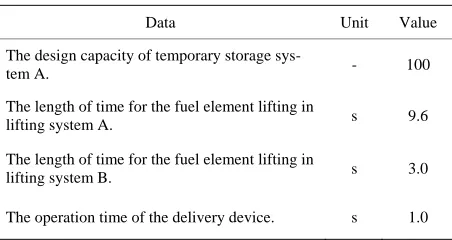
Table 2. Some input data for simulation.
Data Unit Value
The design capacity of temporary storage
sys-tem A. - 100
The length of time for the fuel element lifting in
lifting system A. s 9.6
The length of time for the fuel element lifting in
lifting system B. s 3.0
The operation time of the delivery device. s 1.0
4.1. The Simulation of Uploading Fuel Elements into the Core for the First Time with Arena
During this stage, 6 thousand to 12 thousand fuel elements will be uploaded into the core. The processes of inputting the new fuel elements into temporary storage system A and transporting the fuel elements from temporary storage system A into the core will be carried out. The gas needn’t be changed.
[image:5.595.63.524.418.572.2] [image:5.595.60.286.616.736.2]fuel elements into th
able 3 that as the
[image:6.595.58.287.449.569.2]nu
able 3. The relationship between the number of elements
the number of the minimum time the time it costs used for the lifting process of the fuel elements. This method can realize several elements lifted together. The process of lifting is steady. Thus the lifting and trans- porting efficiency is much higher.
The task is to upload 10 thousand
e core. If the maximum utilization rate of lifting system A is limited to below 90%, the relationship between the number of elements lifted together and the time it costs to finish the task is listed in Table 3.
A conclusion can be got from T
mber of elements lifted together increases, there is a marked decrease in the minimum time between each two groups. The time required to finish the task is reduced.
T
lifted together and the time it costs to finish the task.
elements lifted together
period between each two groups (min)
to finish the task (h)
1 9.3 15.50
2 5.3 8.83
3 4.0 6.67
4 3.4 5.67
5 2.9 4.83
aximum speed of
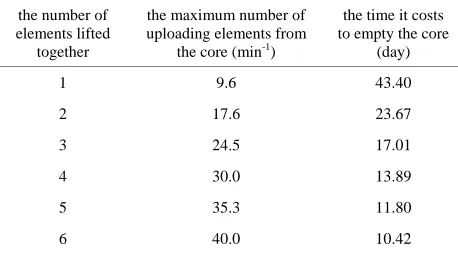
be emptied in a shorter time.
quirements on TPCPN has time properties and con-an describe the control logic
accu-orld Development of Temperature Gas-cooled Reactor,” Chinese Journal of Nuclear Science and Engi-neering, 2000(
[image:6.595.57.286.607.734.2]gdes.2009.02.023
able 4. The simulation result of emptying the core with
mber of the maximum number of the time it costs T
GTPL. the nu elements lifted
together
uploading elements from the core (min-1)
to empty the core (day)
1 9.6 43.40
2 17.6 23.67
3 24.5 17.01
4 30.0 13.89
5 35.3 11.80
6 40.0 10.42
It can be seen from Table 4 that the m
uploading elements from the core increases as the number of elements lifted together increases. In this way the core can
5. Conclusions
FECS of pebble bed reactors has very complex control logic. Every control link has very strict ac
time and sequence. trol properties. It c
rately. So it’s very suitable for the modeling of FECS. In addition the simulation of FECS can be conducted to analyze the control logic. This provides the basis for the design optimization of reactors.
REFERENCES
[1] Z. X. Wu and Z. Y. Zhang, “W clear Power System and High
3), pp. 211-219.
[2] Z. Y. Zhang, Z. X. Wu, D. Z. Wang, et al., “Current Status and Technical Description of Chinese 2×250 MWth HTR-PM Demonstration Plant,” Nuclear Engi-neering and Design, Vol. 239, No. 7, 2009, pp. 1212-1219. doi:10.1016/j.nucen
[3] P. Shen, D. Du, G. L. Guo, et al., “Research on Pneu-matic Transportation of Fuel Elements in Pebble Bed Re-actor,” Power and Energy Engineering Conference (AP-PEEC), Shanghai, China, 2012.
[4] T. Murata, “Petri Nets - Properties, Analysis and Appli-cations,” Proceedings of the IEEE, Vol. 77, No. 4, 1989, pp. 541-580. doi:10.1109/5.24143
[5] Z. D. Han, J. G. Liu and S. Luo Sheng, “Design Method of Control System for HTGR Fuel Handling Process with Control Petri Net,” Nuclear Power Engineering, Vol. 29, No. 1, 2008, pp. 14-18.
ed Reactor,” CHN Patent No. 1075-1080.
[7] P. Shen, D. Du, H. B. Liu, et al., “A Method of Grouped Tandem Fuel Elements of Pneumatic Transportation in
Pebble B