High Dimensional Dataset Compression Using
Principal Components
Michael B. Richman1, Andrew E. Mercer2, Lance M. Leslie1, Charles A. Doswell III3, Chad M. Shafer4
1School of Meteorology, University of Oklahoma, Norman, USA 2Department of Geosciences, Mississippi State University, Starkville, USA 3Cooperative Institute for Mesoscale Meteorological Studies, Norman, USA 4Department of Earth Sciences, University of South Alabama, Mobile, USA
Email: [email protected]
Received May 11, 2013; revised June 11, 2013; accepted June 18,2013
Copyright © 2013 Michael B. Richman et al. This is an open access article distributed under the Creative Commons Attribution
Li-cense, which permits unrestricted use, distribution, and reproduction in any medium, provided the original work is properly cited.
ABSTRACT
Until recently, computational power was insufficient to diagonalize atmospheric datasets of order 108 - 109 elements.
Eigenanalysis of tens of thousands of variables now can achieve massive data compression for spatial fields with strong correlation properties. Application of eigenanalysis to 26,394 variable dimensions, for three severe weather datasets (tornado, hail and wind) retains 9 - 11 principal components explaining 42% - 52% of the variability. Rotated principal components (RPCs) detect localized coherent data variance structures for each outbreak type and are related to stan- dardized anomalies of the meteorological fields. Our analyses of the RPC loadings and scores show that these graphical displays can efficiently reduce and interpret large datasets. Data is analyzed 24 hours prior to severe weather as a fore- casting aid. RPC loadings of sea-level pressure fields show different morphology loadings for each outbreak type. Analysis of low level moisture and temperature RPCs suggests moisture fields for hail and wind which are more related than for tornado outbreaks. Consequently, these patterns can identify precursors of severe weather and discriminate between tornadic and non-tornadic outbreaks.
Keywords: Data Compression; Eigenanalysis; Computational Complexity; Severe Weather; Rotated Principal
Components
1. Introduction
Principal Component Analysis (PCA) has been used ex- tensively in the atmospheric sciences for over 60 years [1-4]. The value of PCA in atmospheric sciences applica- tions stems from the compact description of space-time- variable datasets into two graphical displays that convey the dominant patterns of space variation and their associ- ated time behavior. One challenge of using PCA is its high computational time complexity. Numerical models often measure variables on grids of L latitudes by M lon- gitudes by N vertical levels, with LxMxN gridpoints, with model output at T times. This leads to a data matrix of either T x (LxMxN) or (LxMxN) x T for each model va-
riable, P.Since LxMxN is often of order 108, an eigende-
composition of the model output can be a daunting task,
since PCA requires O((LxMxNxP)3) computations. With
ten variables typically being analyzed simultaneously,
this can lead to matrix diagonalizations of the order 109.
The models are expected to exceed 1010 in the near future.
mension of the data matrix, leading to a limited number of eigenmodes. In the present application, we seek to analyze the (LxMxNxP) dimension to determine group- ings of those variables that have similar time evolutions for severe weather outbreak types [9-12]. In so doing, we obtain modes of variability in the three-dimensional at- mosphere that corresponds to 24 hours prior to the onset of severe weather, useful to forecasters. Forecasting se- vere weather a day before it occurs is controlled largely by atmospheric spatial scales exceeding approximately 2000 km in distance (referred to by meteorologists as sy- noptic scale or larger). Data over such an area represent a nearly instantaneous snap-shot of the state of the atmos- phere and the features at this scale tend to persist long enough to enhance predictability. If the validity of eigen- structures at these space scales is established, they can be investigated as precursors of the outbreaks. Knowledge of such patterns can assist in forecasting the location of the severe weather a day or more in advance of the out- break, thereby providing the potential to reduce casual- ties.
2. Data and Methods
2.1. Defining Outbreaks
Prior to formulating composites of the different outbreak types, a formal definition of each outbreak type was re- quired. Following the ranking methods outlined in [13], the N15 ranking index of outbreaks was used to assess significant tornado outbreaks. In particular, outbreaks with an N15 ranking index of 2 or higher that included 6 or more Storm Prediction Center (SPC) tornado reports were considered as “major” tornado outbreaks. However, since the N15 ranking index was developed based on cri- teria relevant for tornado outbreak severity (e.g. the num- ber of tornadoes that cause death, the number of signifi- cant tornadoes, etc.), using this scheme for ranking hail and wind-dominated outbreaks was not appropriate. Since no formal ranking approach exists for these outbreak types, a simple relationship comparing the number of wind reports and hail reports was utilized to define each group. In particular, outbreaks whose number of wind re- ports exceeded three times the number of hail reports that had an N15 ranking of less than 2 (thereby excluding them from the tornado group) were considered “major” wind outbreaks, while outbreaks with three times the number of hail reports as wind reports with an N15 index < 2 were considered “major” hail outbreaks. Through the use of these criteria, sets of 79 tornado outbreaks, 131 wind outbreaks, and 245 hail outbreaks were defined for the time dimension.
2.2. Data and Analysis Procedure
High dimensional studies require some modification of
the typical eigenanalysis methodology. Prior to the data reduction, rather than examining scalar values, graphical methods are employed where possible. The steps in the analysis are: (1) decision on the type of analysis dictated by research question, (2) sampling available data, (3) qua- lity control and missing data, (4) remapping the data to an unbiased grid, (5) scaling the data, if necessary, (6) formation of a similarity matrix, (7) diagonalization of si- milarity matrix, (8) selecting a range of the number of eigenvectors, (9) formation of unrotated principal com- ponent loadings, (10) rotation of different numbers (from step 7) of unrotated PC loadings to select the most ap- propriate number of rotated PC loading vectors, (11) ex- traction of rotated PC scores and (12) physical interpreta- tion of the results.
Step 1. Our research goal is to identify recurring pat- terns of atmospheric variables associated with tornado, hail and wind severe weather outbreaks. This is a space- time analysis of the three-dimensional atmosphere and we form a multilevel set of grids in the data matrices, with the spatial gridpoint values of the variables as col- umns and the outbreak cases as rows. The NCEP/NCAR reanalysis project (NNRP) [14] provides three-dimensio- nal global reanalyses of numerous meteorological vari- ables, relevant to severe weather formation. The dataset
is defined by a horizontal (LxM) 2.5˚ latitude-longitude
grid spacing with 17 vertical levels (N) and over the en- tire globe at 6 hour time intervals from 1948 to present. For this study, three-dimensional fields of geopotential height, specific humidity, zonal and meridional wind com- ponents, were obtained for a study domain centered on
North America (Figure 1) for each outbreak type. Four
of the variables: geopotential height, temperature, zonal and meridional wind were measured at all 17 levels (4 × 17 = 68 of the 83 variables). The specific humidity data are not provided at pressure levels less than 300 hPa; therefore, the eight levels closest to the surface were se- lected. Additionally, there were seven surface variables (mean sea-level pressure, surface pressure, temperature, zonal and meridional wind components for a total of 68 + 8 + 7 = 83 variables for each gridpoint. Variables were obtained 24 hours prior to the valid time of the outbreak
to construct each outbreak type matrix (i.e., tornado, hail,
wind). Hence, these matrices provide information on the pre-outbreak atmosphere, a time frame that is particularly useful to severe weather forecasters or pattern recogni- tion algorithms looking for outbreak precursors.
Step 2. Data from the beginning of the NNRP record until the last date available were used in this study. There- fore, our sample is the finite population of all reanalysis data.
Step 4. The NNRP are provided on a latitude-longitude
grid (Figure 1(a)). The goal of the analyses is to provide
modes of variability of the spatial coherence of the data. Owing to the poleward convergence of the longitude lin- es in the NNRP data, there is an artificial inflation of as-
sociation among nearby gridpoints (i.e., their covariances)
that is a function of latitude. As eigenanalysis is a de- composition of the variance structure of the data, it is necessary to remove this source of bias by interpolating
to a Fibonacci grid [15] (Figure 1(b)), by providing
equally spaced gridpoints over the entire domain (318 Fi- bonacci gridpoints). Three final datasets resulted from these analyses, consisting of all gridpoints (ordered lon- gitude-latitude-level-variable) along the columns of each matrix (26,394 columns) and the events on the rows (numbers match number of outbreaks of each type). This defines an S-mode analysis [16].
Step 5. Because the variables have vastly different
units and values (e.g. specific humidity ~ 1 × 10⁻³ kg/kg
versus geopotential height at 500 hPa ~ 5400 m), the data were pre-standardized through z-score calculations ateach vertical level and for each variable prior to place
(a)
(b)
Figure 1. The study domain on the original NNRP grid (a) and on the Fibonacci grid (b).
ment in the data matrices that were to be eigenanalyzed. Since the data were standardized to a zero mean and unit standard deviation at each vertical level to account for the varied units and large variation in the values as a function of pressure level, values in the data matrices are
standardized anomalies (Z).
Step 6. As values in the data matrices are standardized
anomalies (Z) from the mean (step 5), similarity is mea-
sured by forming correlation matrices (R) of order 26,394.
Three correlation matrices are formed for tornado, hail and wind outbreaks.
Step 7. Each correlation matrix was decomposed into a
square matrix of eigenvectors (V) and associated diago-
nal matrix of eigenvalues (D), given by the decomposi-
tion
T
R VDV (1)
Step 8. The rank of the eigenvector matrix is equal to
the smaller of the number of gridpoints (n) or number of
observations (m) minus 1. Because there were m = 79
observations for tornado outbreaks, only 78 eigenvalues were nonzero and 78 eigenvectors were extracted. Simi-larly, 244 (130) non-zero eigenvalues existed for the hail (wind) outbreaks. The goal of this stage of the analysis is to create a set of basis vectors that compress the original
variability in R into a new reference frame. It is possible
to plot the n elements of each eigenvector (V) on spatial
maps; however, the patterns in V do not result in any
localization of the spatial variance, nor do they represent
well the variability in R [16].
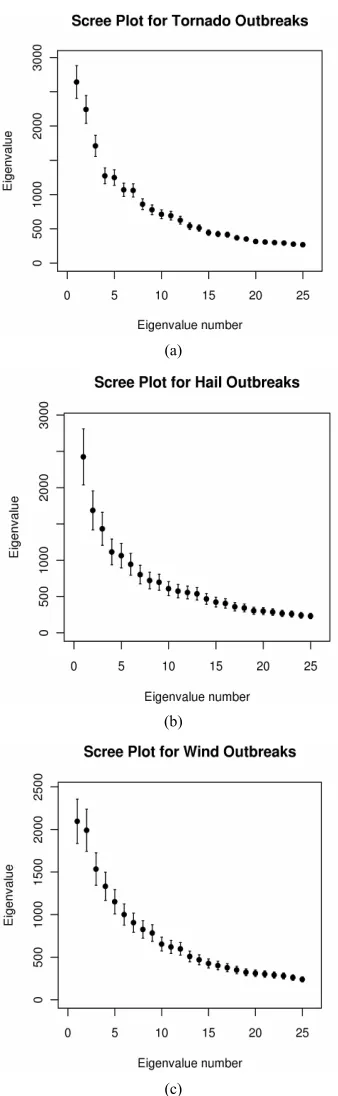
For high dimensional problems, interpretation requires that the analyst must explain the relationships among many thousands of variables for each eigenvector retain- ed. The eigenvectors are ordered indexed by decreasing eigenvalue. Many of the 78 eigenvectors depict small- scale (sub-synoptic scale) signals with variance proper- ties indistinguishable from noise, having very small ei- genvalues. We truncate the number of principal compo- nents to represent only that variance associated with sy- noptic scales or larger that correspond to spatial patterns present in the 26,394 × 26,394 correlation matrix, using a two step process. First, the magnitudes of the eigenvalues are examined and those with relatively large eigenvalues
are retained to yield a subset of l principal component
loading vectors. The value l is selected by implementing
the scree [17] and standard error tests [4] to provide a vi- sual estimate of the approximate number of non-degen-
erate eigenvectors to retain. Figure 2 shows the results of
[image:3.595.59.285.368.703.2](a)
(b)
[image:4.595.87.256.79.627.2](c)
Figure 2. Scree test plots of eigenvalue number against ei- genvalue magnitudes for tornadoes (a), hail (b) and wind (c) outbreaks. The error bars represent the 95% CI for each eigenvalue.
Owing to the aforementioned degeneracy, a number of
roots retained, l, is selected liberally, intentionally repre-
senting more than the ideal number of roots, k, associated
with the signals representing spatial scales of at least the
synoptic-scale.
Step 9. As the magnitude of the eigenvector elements
varies as a function of the number of variables (n), the
eigenvectors (V) were scaled by the square root of the
corresponding eigenvalue, VD1/2 to create principal com-
ponent loadings (A). Doing so converts the eigenvectors
to units of the similarity matrix (i.e., correlations) with a
known range and permits the data to be expressed as
T
Z FA (2)
where the vectors in F represent the new set of basis
functions, known as principal component scores and A is
the matrix of weights that relates the original standard-
ized data (Z) to F. The vectors in A contain elements that
are correlation coefficients between Z and F.
Step 10. To assess the coherency gained through loca-
lization of the signal, the l vectors identified in A are
post-processed by linearly transforming them to a new
set of vectors, B, known as rotated principal component
(RPC) loadings. The rotation of PC loadings simplifies or localizes the variables by finding the orientation of the PCs that results in many of the variables having small projections or loading values and other variables having large projections. Such simplified loadings correspond better with the correlation structure of the data [16], en- hancing physical interpretation. The rotation process can be summarized by the equation
B AT (3)
where T is an invertible kxk orthonormal transformation
matrix that represents a rotation of the reference frame into a position that results in the greatest simplification in
the vectors of B. Then from (3)
T T T
BB ATT A AAT (4)
and from (1) and (2), B represents the similarity matrix
or data set as does A. Moreover, an infinite number of
transformation matrices will satisfy (4); therefore, some additional constraint is required. For high dimensional
problems, it is desirable to find T that simplifies each
vector, B, as much as the data permit. Doing so allows
for a smaller subset of variables (as opposed to tens of
thousands) to be interpreted for each column of B. For
our problem, the column vectors in B are plotted on a
spatial map, and the simplification corresponds to detect- ing localizations of coherent signal in standardized ano- maly patterns that recur often in the correlation structure of the variables. The rotation algorithm used in this ana- lysis is Varimax [16]. Varimax is termed an “orthogonal”
rotation, indicating the transformation matrix (T) in (3) is
orthogonal as TTT = I. The Varimax simplification algo-
rithm maximizes the variance, of the PC loadings,
and is given by
2 v
2
i b
2
22 2 2 2
2
1 1 1 1
1 1
k k n n
j ij
j j i i
v v b b
n n
ij
This algorithm proceeds with a planar rotation of all possible pairs of PC loading vectors and maximizing
in (5). Once the final is achieved, the solution is
simplified in the sense that each column of B corre-
sponds to the solution that maximizes simultaneously the
number of near-zero loadings and large load-
ings , while minimizing the number of moderate
magnitude loadings. Values of i near-zero explain lit-
tle variance, , for a given PC loading vector j in B and
those variables with near-zero loadings, for a given PC loading vector, do not need to be interpreted. This solu- tions that result from a Varimax rotation are character- ized by groups of variables having high magnitude load- ings on one PC and other groups of variables with high magnitude loadings on a different PC loading vector.
Since j1 for the correlation-based analysis,
most of the variable’s variance is accounted for in a Va- rimax solution, when the loadings are large.
2 v 2
v
bij 0b
bij1b k i b
2 i 1Given the high dimensionality of the problem (the
26,394 row entries in B) the larger the number of near-
zero and large i , the more binary (simpler) solution
leads to easier the interpretation loadings in a Varimax solution. The simplicity of the solution is seen by inspec-tion of the density funcinspec-tions for the PC loadings before
and after rotation. Figure 3 shows the empirical probabi-
lity density functions (PDFs) concentration of near-zero loadings for the rotated solution in comparison to the unrotated solution for the first PC for tornado outbreaks.
The improved simplicity, seen in Figure 3, is document-
ed in Table 1 for all PCs and outbreak types by examin-
ing the kurtosis of the loadings before and after rotation. Most unrotated PC loading vectors had platy-kurtotic or mesokurtotic distributions; whereas, after rotation, the di-
stributions become leptokurtotic (Table 1), reflecting the
more simplified (peaked) distributions. When the columns
of Varimax loadings are mapped to the grid (Figure 1(b)),
b s
PC Loading Magnitude Tornado PC Loading Density
-1.0 0.0 0.5 2.0 Pr o b a b ility ( P e rce n t)
-0.5 0.0 0.5 1.0
red = unrotated blue = rotated
1.
0
[image:5.595.309.538.111.338.2]1.5
Figure 3. Empirical PDFs for PC loading vector 1 unrotated (red) and Varimax rotated (blue).
Table 1. Kurtosis statistics for PC loading vectors of tor- nado, hail and wind outbreaks.
Unrotated Kurtosis Rotated Kurtosis PC
Tornado Hail Wind Tornado Hail Wind
1 −0.51 −0.10 −0.05 0.66 0.72 1.15
2 −0.40 −0.21 −0.31 0.75 1.43 1.37
3 −0.52 −0.12 −0.56 0.32 2.14 1.41
4 −0.45 −0.14 −0.18 0.84 1.15 1.14
5 0.12 −0.21 −0.20 2.32 0.83 1.37
6 0.96 0.26 −0.16 1.65 0.55 0.13
7 −0.09 −0.24 −0.27 0.52 1.31 1.72
8 −0.44 0.03 0.25 0.45 2.18 1..01
9 −0.30 −0.05 −0.14 1.02 1.09 1.47
10 0.14 -- −0.18 0.31 -- 0.54
11 -- -- −0.21 -- -- 3.13
the large loadings are grouped in isolated clusters with areas on near-zero loadings between the clusters, accor- ding to the correlation structure of the data. This process of rotation and mapping makes analyzing high dimen- sional problems tractable and is amenable to physical in- terpretation.
The spatial properties of each vector in B depend on
the number of rotated PC vectors retained (l). Therefore,
it is critical to select the optimal number of vectors, k,
that correspond to data signal and reject small-scale noise
from eigenvalues k + 1 to the dimension associated with
the order on R.
To accomplish that goal, the matrix A is transformed
to B for a variable number of retained RPC vectors (i.e.,
2 to l). Each solution, based on a different number of
RPCs, yields a different set of patterns when the elements
of B are mapped back to the Fibonacci grid. We require a
set k < l that captures as much coherent large scale signal
as possible that matches the patterns embedded within R.
The one set of k PC loadings that relates best to the cor-
relation matrix generating them is determined and the
number of PCs retained is set to k.
The process, outlined in [18], and refined in [16], se-
lects each vector in B and identifies the location or grid-
point associated with the largest absolute RPC loading. Next, the RPC loading vector is matched to the vector in
R corresponding to the gridpoint identified with the ma-
ximum absolute loading. This method incorporates the
logic that the solution associated with k PCs must have
spatial structures that match optimally to those spatial
structures in R. An additional advantage to post-process-
[image:5.595.61.287.531.705.2]position to eigenvector degeneracy [18]. The two vectors are matched, through the congruence coefficient [16], a scalar quantity that is the uncentered correlation coeffi- cient (or the cosine of the geometric angle between the two vectors). The congruence coefficient measures both phase and magnitude match. The values of congruence
range from −1 to +1, with +1 being a perfect match. The
application of the congruence coefficient in this manner
provides an objective procedure to select k objectively.
For the tornadic outbreak set, the Varimax solution with
the optimum match occurred as k = 10 (average congru-
ence was 0.90) associated with 51.5% of the explained variance, for the hail outbreak set the optimum match
was at k = 9 (average congruence was 0.91) with 41.2%
of the explained variance and for the wind data set, k =
11 (average congruence was 0.92) with 48.9% of the ex- plained variance. Thus, among these datasets, the data compression was impressive (12.8%, 3.6% and 8.5% of the basis vectors associated with non-zero eigenvalues of tornadoes, hail and wind outbreaks accounted for 51.5%, 41.2% and 48.9% of the total variance, respectively).
Step 11. Once the spatial patterns have been identified, the projections of the standardized data on the loadings are calculated to obtain the amount of each RPC pattern associated with each outbreak (e.g., how much of RPC 1 exists in the outbreak 1 for tornadoes?). To accomplish
this, the RPC scores (F) are calculated as
T 1
F ZB B B (6)
The PC scores are in units of standard deviations from the mean.
Step 12. A physical interpretation of the standardized anomaly fields associated with each mode involves mul- tiplying the PC score is by the PC loading [7]. For exam- ple, a negative anomaly in a RPC loading map of geopo- tential multiplied by a negative PC score gives the inter- pretation of a positive height anomaly. Interpretation of the graphical and mapped RPC loadings and time series of the RPC scores will now be presented.
3. Interpretation of RPCA of Severe
Weather Outbreak Types
3.1. Scatterplot Analysis of RPC Loadings
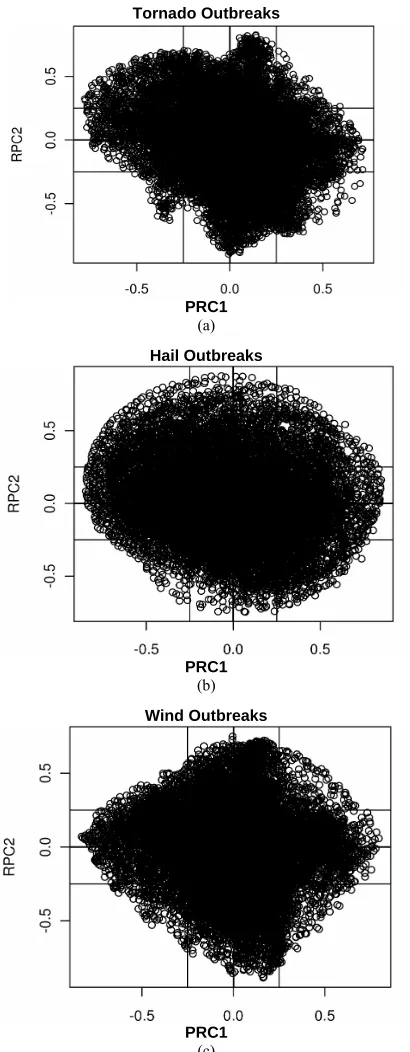
Normally, for datasets with a small number of variables, the RPC loadings are inspected in a table and similarities noted. However, in the present analysis, there are 26,394 elements for each loading vector, making a tabular in-spection of each element intractable. To assess the co-herence of the loadings for such a large number of ele-ments requires a graphical technique that plots the RPC loadings for each vector retained as a biplot or scatterplot. The goal is to investigate whether the variables cluster into coherent groups that can be interpreted when
mapped back to the Fibonacci grid. Because PC (or RPC) loading values of < |0.25| are considered essentially sam- pling deviations from zero [19], those variables exist in a hyperplane of width ± 0.25. Interpretation of the scatter- plots of the pairs of PC loadings (the first two for each
outbreak type are shown in Figure 4) indicates that the
Tornado Outbreaks
PRC1 (a)
Hail Outbreaks
PRC1 (b)
Wind Outbreaks
[image:6.595.320.525.169.695.2]PRC1 (c)
majority of variables exist close to the origin of the graph, within the hyperplane.
For the tornado outbreaks (Figure 4), there is a clear
orientation of variables along the RPC axes in the x- and y-axis directions, suggesting well-defined modes of va- riation as the axes represent the RPCs. In contrast, the hail outbreaks exhibit more of a “bulls-eye” pattern with the highest concentration in the hyperplane and less dis-
tinct clustering along the RPC axes (Figure 4). This con-
figuration of variables is indicative of the lower variance
explained in hail events. The wind outbreaks plot (Fig-
ure 4) has a configuration of clustering along the RPC
axes, consistent with the higher amount of variance ex-
plained with fewer PCs retained. Overall, Figure 4 de-
monstrates that modes of variation have clusters of vari- ables that can be investigated further in spatial analyses of the RPC loadings plotted on the Fibonacci grids and the associated time series graphics.
3.2. Interpretation of the RPC Loading Maps for Each Outbreak Type
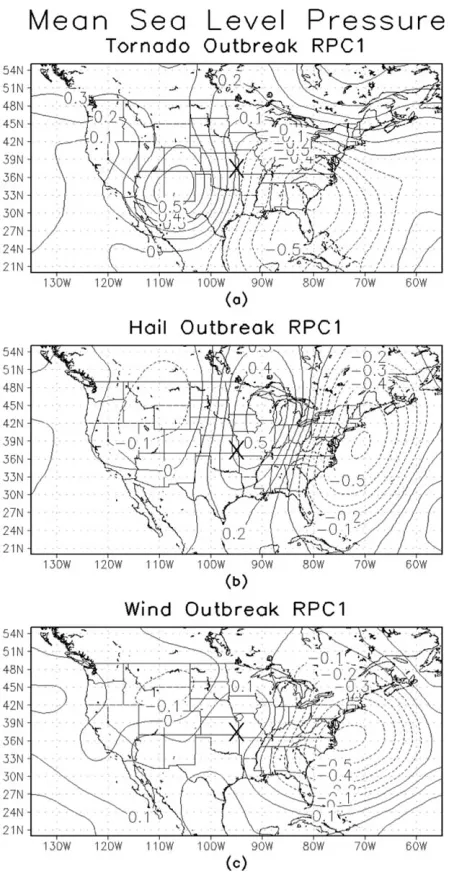
[image:7.595.311.536.82.518.2]The outbreak RPC loadings can be interpreted when plot- ted to the Fibonacci grids and then isoplethed to produce fields of the variables. As there are 83 variables per out- break type, three outbreak types with 9, 10 and 11 RPCs, that is 83 × 30 maps of PC loadings. Since the atmos- phere is sampled for many variables in 3-dimensions, it is possible to examine many additional vertical slice maps. We will present just a small fraction of the results to il- lustrate the differences in the physical meteorological variables as a function of outbreak type. The mean sea- level pressure for the three outbreak types is shown in
Figure 5. Convective storms are often linked to cyclones
that are associated with relatively low pressure. Such cy- clones induce low-level convergence and the associated vertical motion. It is important to note that these maps are generated for data that were collected 24 hours prior to the onset of the outbreak. Hence these are precursor fields. Additionally, the grid the data are placed on was moved to be centered on the outbreak centroid. Therefore,
the “X” in Figure 5 in southeastern Kansas, meant to
show the center of the outbreak is not referenced to the specific geographical location; rather, the map is provid- ed to convey an idea of the spatial scale and configura- tions of the RPC loading anomalies relative to the center of the outbreak.
Tornado outbreaks (Figure 5(a)) are characterized by
negative RPC loadings to the east of the outbreak and positive loadings to the west of the outbreak. Since the sign of the loadings is arbitrary, there is ambiguity in the
sign of the anomalies in Figure 5 and the RPC scores
must be examined for each outbreak to assign a sign to that case. For tornadic outbreak cases with positive large
Figure 5. RPC loadings of mean sea level pressure for tor- nado (a), hail (b) and wind outbreaks (c).
magnitude RPC scores, the physical interpretation would be anomalously high pressure to the east and anomalous- ly low pressure to the west. Conversely, for cases with large negative RPC scores, the interpretation would be anomalously high pressure to the east and anomalously low pressure to the west. Twenty-four hours prior to the tornado outbreaks, the center of the outbreak is on a zero line between the two anomalies. In contrast, for hail out-
breaks (Figure 5(b)), there is a tripole pattern of sea-le-
for a large magnitude positive or negative sign and inde- xing the RPC loading sign accordingly. Unlike the pre- vious two outbreak maps, the wind outbreaks have a much weaker gradient of RPC loadings in the east-west
direction (Figure 5(c)) with the center of the outbreak
located in an area of weakly positive PC loadings. Recall, in the discussion of hyperplanes, any PC loading with an absolute magnitude of less than 0.25 is considered essen- tially zero. Therefore, the loadings to the west of the cen- ter of the outbreak correspond to near-zero anomalous
pressure. Examination of the three plots in Figure 5 sug-
gests that the sea-level pressure patterns, associated with the three outbreak types 24 hours prior to the onset of the outbreak, have different in spatial structures.
Another ingredient in severe weather outbreaks is the availability of moisture for convection. The measure of moisture used in this study is specific humidity at the 850
hPa level and is shown for the three outbreak types in Fi-
gure 6. As was the case for the sea-level pressure, these
moisture data were collected 24 hours prior to the onset of the outbreak. Unlike the pressure fields, the moisture fields have a more common pattern with smaller differ-ences in the patterns for outbreak types. For tornado
out-breaks (Figure 6(a)) the RPC pattern has a negative ano-
maly to the southwest of the outbreak centroid, indicative of drier than average air in that location. Since the sign of the loadings is arbitrary, the sign of the anomalies re- quires inspecting the RPC score for any given outbreak. If that score has a large positive value, the pattern on the map is likely to be found. Alternately, for cases with large negative RPC scores, the interpretation would be ano- malously moist region to the southwest of the outbreak. The leading RPC specific humidity pattern associated
with hail outbreaks (Figure 6(b)) indicates a spatially ex-
tensive anomaly centered to the east northeast of the out- break center with a strong PC loading gradient over the outbreak area. The wind outbreak RPC of specific humi-
dity (Figure 6(c)) has a spatially extensive anomaly of
loadings centered to the east of the outbreak centroid. The difference between the hail and wind outbreak pat- terns is the lack of a strong gradient in the latter. The third field being investigated is air temperature at 850
hPa (Figure 7). Since 850 hPa is situated relatively low
in the troposphere, it gives an indication of low-level thermal properties. The change in the pattern over time is considered important for assessing the instability of the atmosphere. As for the previous two fields, these tempe- rature data were collected 24 hours prior to the onset of the outbreak. The leading RPC loadings for the tempera-
ture field taken from the tornado outbreaks (Figure 7(a))
has a negative anomaly to the south of the outbreak cen- troid, indicative of cooler than average air in that location. Additionally, about 1500 km to the west of the outbreak center, there is a region of positive RPC loadings, indi-
Figure 6. RPC loadings of 850 hPa specific humidity for tor- nado (a), hail (b) and wind outbreaks (c).
cative of anomalously warm air. As before, since the sign of the loadings is arbitrary, the sign of the anomalies re- quires inspecting the RPC score for any given outbreak. If that score has a large positive value, the pattern on the map is likely to be found. Alternately, for cases with large negative RPC scores, the interpretation would be anomalously warm region to the south of the outbreak and a cool anomaly to the west. The leading RPC 850 hPa temperature pattern associated with hail outbreaks (Figure 7(b)) and wind outbreaks (Figure 7(c)) have si-
Figure 7. RPC loadings of 850 hPa temperatures for tor- nado (a), hail (b) and wind outbreaks (c).
3.3. Interpretation of RPC Score Time Series for Each Outbreak Type
Because this is a multi-field PCA, the RPC scores aver- age all the fields in (6) with equal weight to generate standardized scores; fields with fewer levels, such as the surface variables will be represented less than those fields with 17 levels. Typically, examining the extreme
positive (scores ≥ 1) and negative values (scores ≤ −1)
and then identifying the outbreak cases that correspond to the extreme values facilitate interpretation of the RPC
scores. The tornado outbreak RPC 1 score plot (Figure 8)
indicates there are multiple outbreaks that have patterns
similar to the RPC 1 loadings. The first RPC score clas- sifies 12 (of the 79) cases (15.2%) as having spatial con- figurations of the standardized anomaly patterns of the
variables similar to the maps shows in Figures 5-7. Only
3 of the outbreaks occurred with the spatial patterns of opposite signs to those shown in the aforementioned fig- ures.
As suggested by the lower degree of clustering for the
scatterplots of PC loadings for hail (Figure 4(b)), the
hail outbreak RPC 1 score plot (Figure 9) reveals a more
variable pattern compared to the tornado outbreaks. The hail outbreak scores have 41 cases (16.7%) with scores greater than or equal to 1 and 16 cases (6.5%) with
scores less than or equal to −1. There is evidence in the
meteorological literature that hail events can occur with varied atmospheric patterns [20]. The events with ex- treme scores can have their standardized anomalies com-
pared to the spatial patterns in Figures 5-7.
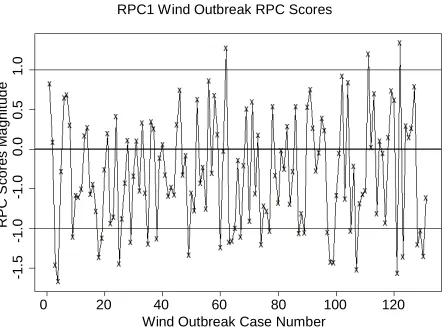
The wind outbreak RPC 1 score plot (Figure 10) shows
that most of the extreme score cases (29% or 22.1%) had
values less than or equal to −1 and only 3 cases (2.3%) had
scores greater than of equal to 1. As the majority of
Tomado Outbreak Case Number RPC1 Tornado Outbreak RPC Scores
0 20 40 60 80
-1
1
2
R
P
C
S
c
or
es
Ma
gni
tud
e
Figure 8. RPC scores for the 79 tornado outbreaks.
Hail Outbreak Case Number RPC1 Hail Outbreak RPC Scores
0 50 100 150 200 250
2
R
P
C
S
c
or
es
Ma
gni
tud
e
1
0
-1
[image:9.595.313.537.369.524.2] [image:9.595.311.534.551.719.2]Wind Outbreak Case Number RPC1 Wind Outbreak RPC Scores
0 20 40 60 80 100 120
-1.
5
-1.
0
-1
.0
0.0
0.5
1.0
R
P
C
S
c
or
es
Ma
gni
tud
[image:10.595.63.286.85.249.2]e
Figure 10. RPC scores for the 131 wind outbreak cases.
the scores are negative, the patterns shown for the load-
ings (Figures 5-7) should have the signs multiplied by
−1 for proper interpretation of those cases associated
with the negative scores.
4. Conclusions
As observation systems generate increasingly dense da- tasets in space and time, the spatial correlations of the fields can be characterized by the efficient data compres- sion provided by principal component analysis. Until re- cently, computational power was insufficient to diagona- lize the massive data sets of the three-dimensional atmo-
sphere, as currently they are of order 108 - 109 elements
and will increase further to 1010 elements and greater in
the near future. The exception has been in situations where the number of cases was relatively small and the analyst was interested in time domain decomposition. We have shown that eigenanalysis of tens of thousands of variables is now achievable. The data reduction achi- eved in the present analyses diagonalize correlation ma- trices of order 26,394 dimensions and retain approxima- tely 10 principal components for close to 50% of the va- riability explained. These principal components are rotat- ed to find the localized coherent variance structures in the data. The RPCs are related to standardized anomalies of the meteorological fields analyzed. Our analyses of the RPC loadings and scores indicate these graphical dis- plays are useful to interpret large datasets in an efficient manner. The results of the rotated PCs for defined out- break types build upon our previous research [9-12] by indicating that the atmospheric variables investigated ex- hibit different spatial configurations for each outbreak type.
The challenge is how to use the output of such analy- ses to improve forecasting of severe weather events. By examining fields of key meteorological variables at lead times (e.g., 24 hours) sufficient to allow for societal re- sponse prior to these outbreaks, we have created a poten-
tially useful product. The next step is to devise a pattern recognition system that compares model predictions of the atmosphere to the patterns produced in this work.
5. Acknowledgements
All of the authors involved in this research were support- ed in part by the National Science Foundation Grant AGS 0831359.
REFERENCES
[1] E. N. Lorenz, “Empirical Orthogonal Functions and Stati- stical Weather Prediction,” Science Report 1, Department of Meteorology, Massachusetts Institute of Technology, 1956.
http://www.o3d.org/abracco/Atlantic/Lorenz1956.pdf [2] J. E. Kutzbach, “Empirical Eigenvectors of Sea-Level
Pressure, Surface Temperature, and Precipitation Com- plexes over North America,” Journal of Applied Meteor- ology, Vol. 6, No. 5, 1967, pp. 791-802.
http://dx.doi.org/10.1175/1520-0450(1967)006<0791:EE OSLP>2.0.CO;2
[3] A. G. Barnston and R. E. Livezey, “Classification, Seaso- nality and Persistence of Low-Frequency Atmospheric Circulation Patterns,” Monthly Weather Review, Vol. 115,
No. 6, 1987, pp. 1083-1126.
http://dx.doi.org/10.1175/1520-0493(1987)115<1083:CS APOL>2.0.CO;2
[4] G. R. North, R. Gerald, T. L. Bell, R. F. Cahalan and F. J. Moeng, “Sampling Errors in the Estimation of Empirical Orthogonal Functions,” Monthly Weather Review, Vol.
110, No. 7, 1982, pp. 699-706.
http://dx.doi.org/10.1175/1520-0493(1982)110<0699:SEI TEO>2.0.CO;2
[5] M. Kim, D. Kim and S. Lee, “Face Recognition Using the Embedded HMM with Second-Order Block-Specific Ob- servations,” Pattern Recognition, Vol. 36, No. 11, 2003,
pp. 2723-2735.
http://dx.doi.org/10.1016/S0031-3203(03)00137-7 [6] H. Moon and P. J. Phillips, “Computational and Perfor-
mance Aspects of PCA-Based Face Recognition Algori- thms,” Perception, Vol. 30, No. 3, 2001, pp. 303-321.
http://dx.doi.org/10.1068/p2896
[7] R. H. Compagnucci and M. B. Richman, “Can Principal Component Analysis Provide Atmospheric Circulation or Teleconnection Patterns?” International Journal of Cli- matology, Vol. 28, No. 6, 2008, pp. 703-726.
http://dx.doi.org/10.1002/joc.1574
[8] G. H. Golub and C. F. Van Loan, “Matrix Computations,” 3rd Edition, John Hopkins, Baltimore, 1996.
[9] A. E. Mercer, C. M. Shafer, C. A. Doswell III, L. M. Le- slie and M. B. Richman, “Objective Classification of Tor- nadic and Nontornadic Severe Weather Outbreaks,” Mon- thly Weather Review, Vol. 137, No. 12, 2009, pp. 4355-
4368. http://dx.doi.org/10.1175/2009MWR2897.1 [10] C. M. Shafer, A. E. Mercer, L. M. Leslie, M. B. Richman
lations of Tornadic and Nontornadic Outbreaks Occurring in the Spring and Fall,” Monthly Weather Review, Vol. 138, No. 11, 2010, pp. 4098-4119.
http://dx.doi.org/10.1175/2010MWR3269.1
[11] C. M. Shafer, A. E. Mercer, M. B. Richman, L. M. Leslie and C. A. Doswell III, “An Assessment of Areal Cover- age of Severe Weather Parameters for Severe Weather Outbreak Diagnosis,” Weather and Forecasting, Vol. 27,
No. 4, 2012, pp. 809-831.
http://dx.doi.org/10.1175/WAF-D-11-00142.1
[12] A. E. Mercer, C. M. Shafer, C. A. Doswell III, L. M. Le- slie and M. B. Richman, “Synoptic Composites of Torna- dic and Nontornadic Outbreaks,” Monthly Weather Re- view, Vol. 140, No. 8, 2012, pp. 2590-2608.
http://dx.doi.org/10.1175/MWR-D-12-00029.1
[13] C. M. Shafer and C. A. Doswell III, “A Multivariate In- dex for Ranking and Classifying Severe Weather Out- breaks,” Electronic Journal of Severe Storms Meteorol- ogy, Vol. 5, No. 1, 2010, pp. 1-28.
[14] E. Kalnay, M. Kanamitsu, R. Kistler, W. Collins, D. Dea- ven, L. Gandin, M. Iredell, S. Saha, G. White, J. Woollen, Y. Zhu, M. Chelliah, W. Ebisuzaki, W. Higgins, J. Jano- wiak, K. C. Mo, C. Ropelewski, J. Wang, A. Leetmaa, R. Reynolds, R. Jenne and D. Joseph, “The NCEP/NCAR 40-Year Reanalysis Project,” Bulletin of the American Meteorological Society, Vol. 77, No. 3, 1996, pp. 437-
471.
http://dx.doi.org/10.1175/1520-0477(1996)077<0437:TN YRP>2.0.CO;2
[15] R. Swinbank and J. Purser, “Fibonacci Grids: A Novel Approach to Global Modelling,” Quarterly Journal of the Royal Meteorological Society, Vol. 132, No. 619, 2006,
pp. 1769-1793. http://dx.doi.org/10.1256/qj.05.227 [16] M. B. Richman, “Review Paper. Rotation of Principal Com-
ponents,” International Journal of Climatology, Vol. 6,
No. 3, 1986, pp. 293-335.
http://dx.doi.org/10.1002/joc.3370060305
[17] D. S. Wilks, “Statistical Methods in the Atmospheric Sci- ences,” 3rd Edition, Academic Press, Amsterdam, 2011. [18] M. B. Richman and P. J. Lamb, “Climatic Pattern Analy-
sis of 3- and 7-day Summer Rainfall in the Central United States: Some Methodological Considerations and a Re- gionalization,” Journal ofClimate and Applied Meteoro- logy, Vol. 24, No. 12, 1985, pp. 1325-1343.
http://dx.doi.org/10.1175/1520-0450(1985)024<1325:CP AOTA>2.0.CO;2
[19] M. B. Richman and X.-F. Gong, “Relationships between the Definition of the Hyperplane Width to the Fidelity of Principal Component Loading Patterns,” Journal ofCli- mate, Vol. 12, No. 6, 1999, pp. 1557-1576.
http://dx.doi.org/10.1175/1520-0442(1999)012<1557:RB TDOT>2.0.CO;2