Ad Hoc On-Demand Multipath Distance Vector Routing
Protocol Based on Node State
Jieying Zhou, Heng Xu, Zhaodong Qin, Yanhao Peng, Chun Lei
School of Information Science and Technology, Sun Yat-sen University, Guangzhou, China Email: [email protected]
Received June 2013
ABSTRACT
To improve the performance of Ad hoc on-demand multipath distance vector (AOMDV) protocol, we proposed NS- AOMDV which is short for “AOMDV based on node state”. In NS-AOMDV, we introduce node state to improve AOMDV’s performance in selecting main path. In route discovery process, the routing update rule calculates the node weight of each path and sorts the path weight by descending value in route list, and we choose the path which has the largest path weight for data transmission. NS-AOMDV also uses the technology of route request (RREQ) packet delay forwarding and energy threshold to ease network congestion, limit the RREQ broadcast storm, and avoid low energy nodes to participate in the establishment of the path. The results of simulation show that NS-AOMDV can effectively improve the networks’ packets delivery rate, through put and normalized routing overhead in the situation of dynamic network topology and heavy load.
Keywords: Ad Hoc; AOMDV; Node State; Path Weight; Packet Delay Forwarding; Energy Threshold
1. Introduction
Mobile ad hoc network is a self-organized and special wireless communication network, which is made up of some mobile nodes by using distributed protocols. Since each node in ad hoc network has the function of the host and router, it has the characteristics of flexibility and convenience in deployment. In the situation of no fixed network infrastructure, mobile ad hoc network can com-municate with each other by using multi-hop way, and provide the convenience to some special occasions such as medical, meeting, military and so on. Routing protocol [1] plays an important role in the communication be- tween nodes. And the research of it has become a hot spot.
This paper discusses the existing defects when the AOMDV [2,3] selects the main path. We introduce NS- AOMDV, a protocol based on node state that can effec-tively improve the performance of AOMDV.
The rest of the paper is organized as follows. Section 2 describes the related work. In Section 3, we make some network model assumptions. The design of NS-AOMDV is showed in Section 4, and its performance is evaluated and compared with AOMDV and AODV [4] in Section 5. At last, we make a short conclusion in Section 6.
2. Related Work
The main idea in AOMDV is to compute multiple paths
during route discovery procedure for contending link fail- ure [5]. When AOMDV builds multiple paths, it will se-lect the main path for data transmission which is based on the time of routing establishment. The earliest one will be regarded the best one, and only when the main path is down other paths can be effective. In fact, a large number of studies indicate that the aforementioned scheme is not necessarily the best path. Mobile nodes, which usual- ly due to residual energy are too low or under heavy load and other factors, seriously affect the performance of the network. In order to improve the performance, we pro- pose the novel NS-AOMDV protocol based on existing AOMDV. First, we consider the rate of node residual energy and idle buffer queue as the weight of node. Second, in route discovery process, the routing update rules cal- culate the node weight of each path and sort the path weight by descending value of path weight in route list, and we choose the path which has the largest path weight to transmit data packets. At the same time, the protocol uses the technology of RREQ delay forwarding [6] and energy threshold to ease network congestion, limit the RREQ broadcast storm, and avoid low energy nodes to participate in the establishment of the path.
3. Network Model Assumptions
some network model assumptions:
We assume the ad hoc network is an undirected graph ,
G=<N L>, where N is the number of nodes in
the network, and L represents the number of link. In this network, each node owns the ability of receiv-ing and forwardreceiv-ing data.
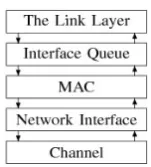
Every node is made up of some network compo-nents. These components include a network interface, the MAC layer, interface queue, link layer and the module for node receiving information and processing information, etc. Mobile node information can got through these artifacts.
In the network, each mobile node is peer-to-peer, shares radio channel, and uses the IEEE 802.11 protocol in MAC layer.
4. NS-AOMDV Design
4.1. The State Parameters of The Node
1) Residual Energy Rate
This paper first defines residual energy rate e ti( ), which refers to the residual energy level of the node
n
at a certain time of t. The formula is shown as follows:( ) ( ) i i
initial E t e t
E
= . (1)
Where, e ti( ) is the residual energy of the node at time t, and Einitial is the initial energy of it. We can eas-ily find that e ti( ) indicates one node’s level of energy consumption. At the same time, this parameter also can indirectly reflect the location of a node in the network. In the network, each node produces energy consumption due to sensing the signal of the neighbor nodes around. Then excessive power consumption means large node density of one node in the case of common communication ser-vice. As a result, it can be concluded that it’s under heavy load in the process of communication.
2) The Idle Rate of Buffer Queue
The idle rate of buffer queue is expressed by the for-mula below:
max
max ( )
( ) i
i
L L t
l t
L −
= . (2)
Where, L ti( ) is defined as the length of the buffer queue at time t. Lmax means the maximum length of the buffer queue. This formula reflects the congestion status of the network. The smaller available buffer queue length means more data packets need to be processed and worse network congestion.
[image:2.595.386.462.81.165.2]In ad hoc networks, a mobile node can be considered as a consist of the network interface, the MAC layer, interface queue, the link layer and the modules of receiv-ing and processreceiv-ing information, as shown in Figure 1. It shows the MAC layer and the link layer; when a node in
Figure 1. Diagram for mobile node structure.
the transmitted data packet, the data stream is usually required in the node interface queue filter delete processing. Therefore, we get the idle rate of buffer queue by calcu-lating the length of the interface queue, namely we utilize the bottom of the interface queue information to reflect the network status.
3) Node Weight
To some extent, two state parameters above reflect the status of the network. In this paper, we will take both of them into consideration, and propose a new definition which is called Node Weight (NW). The formula is shown as follows:
( ) ( ) ( )
i i i
NW t =αe t +βl t . (3)
Where, α β+ =1(0≤ ≤α 1,0≤ ≤β 1), if α β> , the residual energy rate is the main consideration. If α β< , we contend the idle rate of buffer queue as the main in-fluencing factor.
4.2. Selecting The Main Path
First, we define Path Weight (PW) as the least NW of all nodes on a path. Its computation formula is as follows:
( ) {min ( ( )) | }
i i
PW t = NW t i∈NODE . (4)
( ) i
PW t is the path weight at time t, and NODE is the set of nodes on a path. Because we need to take the level of every path into consideration when we select the main path, it includes two important steps: updating path weight and selecting the main path.
1) Updating Path Weight
Updating node weight occurs in the time of routing updating. Meanwhile, we can get path weight of every path. NS-AOMDV is similar to AOMDV, and its main difference is that NS-AOMDV needs to update node weight in the step of updating route.
2) Selecting The Main Path
The main idea in AOMDV is to compute multiple paths during route discovery procedure for contending link fail-ure. When AOMDV creates multiple paths between source node and destination node, only the path based on some metric is chosen for data transmission.
ignore the state of the node’s own level and other factors. Nodes, which own the low level of residual energy and heavy load, may exist in the primary path. If so, this path is very likely to be disconnected because of energy dep-letion.
Compared to AOMDV, NS-AOMDV firstly utilizes the forward path on which the first RREP packet arrives at source node earliest for data transmission. When mul-tiple RREP packets arrive at the source node, it will util-ize the path which owns the largest PW recorded in the routing table for data transmission. Because PWs are in descending order in route table, we can always select the path of largest PW every time. The formula is as follows:
max{ ( ) | }
list p
route = PW t p∈PATH . (5)
Where, routelist represents the path for data trans-mission and PATH is the set of paths in routing table.
4.3. Technology of RREQ Delay Forwarding
In the route discovery procedure, we can also control those intermediate nodes with heavy load to delay forwarding RREQ packet, based on the level of NW. Its main goal is to allow a node with lighter load to be quickly involved in setting up the path. Its main purpose is to make a lighter load node to participate in the establishment of the path quickly. Also the node with heavy load can participate in the establishment of the path again when the network status improves. In this way, network traffic is balanced and network congestion is avoided efficiently. The paths will be relatively independent at the same time. We get the RREQ delay forwarding time based on the formula below:
, ( ) 0.5
( )
, ( ) 0.5 ( )
c i
i c
i i
T NW t
delay t T
NW t NW t > = ≤
. (6)
Where, delay ti( ) is the time for intermediate node i forwarding RREQ packet. In AOMDV, Tc is the time that set for forwarding the RREQ packet by default. If
( ) 0.5 i
NW t > , it reflects the node owns light load. So if ( ) 0.5
i
NW t < , it means the node is busy now, it should delay forward this RREQ packet.
4.4. Technology of Energy Threshold
It’s very dangerous while the intermediate node owns low level of energy and it also needs to forward RREQ packet simultaneously. If you accidentally use it to estab-lish one route, it will easily lead to the emergence of network segmentation. In order to avoid selecting this kind of nodes involved in the route setup, we set up an energy threshold Ethreshold to exclude them. The energy threshold size setting refers to the Ref. [7] setting method.
Ref. [7] points out that one node’s energy level is classi-fied as a “discarded” level, and its survival time will be estimated less than 10s when the residual energy of it is less than 10% of the initial. We propose to set the energy threshold 20% based on this. In the process of interme-diate node processing RREQ packet, only when its own residual energy rate is larger than Ethreshold, will it for-wards the RREQ packet.
5. Performance Evaluation
To evaluate the performance of NS-AOMDV, we com-pare it with AODV and AOMDV by using NS2.34. In the process of simulation, we assume every protocol shares the same model and node configuration. Their initial pa-rameters are shown in Table 1. Also we assume α = β = 0.5. We evaluate the performance of NS-AOMDV through four metrics below:
Packet delivery rate Throughput
The normalized routing overhead The average end-to-end delay
5.1. Simulation Scenario 1: Varying Mobility
We set the speed of sending packets 1 packet/s. Pause time for the node is 10 seconds. The maximum number of connections between the nodes is 20. The maximum moving speed of the node changes in 5 m/s, 10 m/s, 15 m/s, 20 m/s, 25 m/s, 30 m/s.
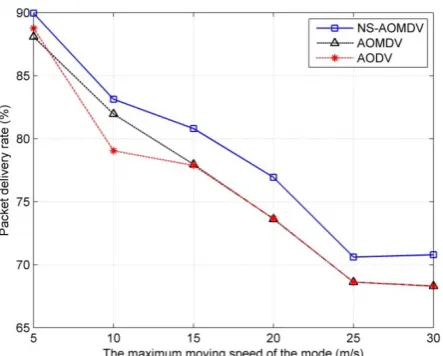
[image:3.595.308.539.543.737.2]Figure 2 plots packet delivery rate against the maxi-mum moving speed. The graph demonstrates packet de-livery rate of the three protocols are significantly reduced with the increase of node maximum speed. But NS- AOMDV has a higher packet delivery rate than the other two. The reasons for NS-AOMDV’s better performance are shown as follows:
Table 1. Initial parameters for node configuration.
Parameter Value
Dimensions 1000 m × 1000 m
Number of nodes 30
Source type CBR
Antenna Type Omnidirectional Spread type TwoRayGround Wireless channel capacity 2 Mb/s
Communication radius 250 m Packet size 512 bytes Initial Energy 60 J Transmission power 1.3 W
Reception power 0.8 W
Buffer size 50
MAC Layer IEEE802.11b DCF Transport Layer UDP
Figure 2. Packet delivery rate as the changes of the maxi-mum moving speed of the node.
Comprehensive consideration of residual energy rate and idle rate of buffer queue in selecting the main path.
Setting energy threshold avoids the nodes with lower energy participating in the construction of the path.
These measures ensure the main path more robust and data transmission more reliable.
Figure 3 reflects the network throughput varies with the changes of speed. When the mobile nodes speed up, throughput of the three agreements declines significantly. Because NS-AOMDV employs the technology of RREQ delay forwarding, it limits the broadcast storm of RREQ, eases the network congestion and balances network traf-fic. It also takes the length of buffer queue in the process of selecting the main path. All aforementioned schemes causes higher throughput.
Figure 4 shows the normalized routing overhead in-creases with the increase of maximum moving speed. Due to path failure, AODV needs to re-route discovery process, which corresponding increases routing overhead simul-taneously. In the other two protocols, NS-AOMDV owns higher normalized routing overhead at the speed of 20 m/s. Overall, NS-AOMDV is better than AOMDV. The main reason is that NS-AOMDV sets the energy thre-shold, forces some node with low energy not to forward RREQ packets and reduces the amount of control packets sent. On the other hand, RREQ delay forwarding improves the ratio for node processing RREQ packets, optimizes the forwarding mechanism, and avoids some unnecessary routing overheads.
Figure 5 demonstrates that the average end-to-end de-lay has a tendency to increase with the acceleration of the maximum speed of the mobile node. i.e., the instability of the network topology causes that time for data trans-mission and processing increases. Because AODV has no
[image:4.595.311.534.86.261.2]Figure 3. Throughput as the changes of the maximum moving speed of the node.
Figure 4. Normalized routing overhead as the changes of the maximum moving speed of the node.
[image:4.595.311.537.303.485.2] [image:4.595.309.538.525.704.2]alternate path, it needs to re-route discovery process and consume a certain period of time when the primary link is broken. In multi-path protocols, there are more advan-tages in this aspect. The average end-to-end delay of NS-AOMDV is larger than AOMDV. On the one hand, in the process of forwarding RREQ packet, NS-AOMDV needs delay forwarding according to the state of the node. Therefore it spends extra time. On the other hand, in se-lecting a path for data transmission, NS-AOMDV focus-es on the reliability, while AOMDV focusfocus-es on the time. So NS-AOMDV makes a certain sacrifice in the average end-to-end delay.
5.2. Simulation Scenario 2: Varying Pause Time
We set the speed of sending packets 1 packet/s. The maxi-mum number of connections between the nodes is 20. The maximum moving speed of the node is 10 m/s. The pause time of the node changes in 0 second, 20 seconds, 40 seconds, 60 seconds, 80 seconds, 100 seconds.
Figure 6 shows packet delivery rate is low when net-work topology changes rapidly. Packets delivery rate in-creases with the augment of node’s pause time. Since the introduction of node weight, NS-AOMDV ensures the selected path robust enough. Especially when the net-work tends to be stable, NS-AOMDV shows better per-formance than the others.
Figure 7 demonstrates that throughput augments sig-nificantly when the pause time increases dramatically. The introduction of node weight and technology of RREQ delay forwarding, which balances the utilization of vari-ous nodes in the network, improves the performance of throughput.
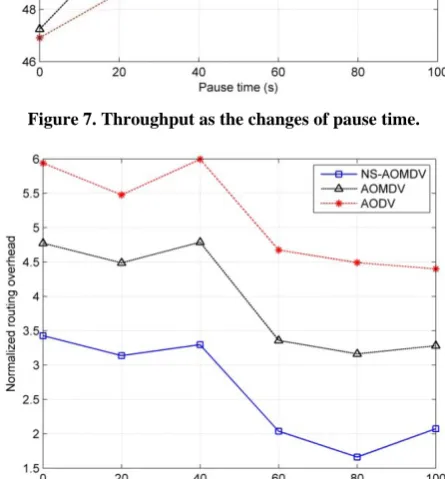
Figure 8 shows the changes in normalized routing overhead. There is a decreasing trend in the normalized routing overhead of the three protocols. This illustrates that with the increase of pause time, the rate for the des-tination node successfully accepting the request packet improves. With the changes of pause time, the normalized routing overhead changes slightly, which shows the per-formance of the three protocols on routing overhead is relatively stable. Similarly, AODV’s bigger routing over-head is mainly caused by several route discovery processes, and the local repair mechanism also requires a certain overhead. The setting of energy threshold decreases the control packets sent by low-energy node. At the same time, the delay forwarding RREQ enhances the efficien-cy for node processing route request packet. It makes the NS-AOMDV protocol performs better than AOMDV in this aspect.
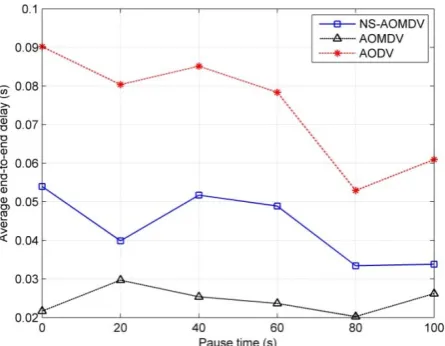
[image:5.595.312.536.84.262.2]Figure 9 shows that when the node pause time in-creases, the end-to-end delay of the network tends to de-crease, but brings in some volatility due to the change of node mobility. It also tells us that AODV has a large gap with the other two. The main reason for the gap is re-
[image:5.595.312.536.296.479.2]Figure 6. Packet delivery rate as the changes of pause time.
Figure 7. Throughput as the changes of pause time.
Figure 8. Normalized routing overhead as the changes of pause time.
[image:5.595.311.534.422.662.2]Figure 9. Average end-to-end delay as the changes of pause time.
two types of multi-path routing protocol, NS-AOMDV’s end-to-end delay is still longer than AOMDV. This fur-ther illustrates delay forwarding RREQ and selecting the main path need some extra time.
From the simulation results of two scenarios, we can conclude that most performances of the network will get different degrees of improvement when network topolo-gy tends to be flattened. As for overall performance, AODV performs worse than AOMDV and NS-AOMDV espe-cially in time delay and normalized routing overhead. For two multi-path protocols, NS-AOMDV is generally bet-ter than AOMDV.
6. Conclusion
In this paper, a novel multipath distance vector routing protocol, NS-AOMDV, for MANETs is proposed to im-prove some performances of present AOMDV. In the process of building transmission path, we synthetically
consider the residual energy rate and the idle rate of buf-fer queue. And we introduce the technology of RREQ delay forwarding and energy threshold in route discovery. Also we update the information of the nodes on the path, and choose the path of maximum node weight for data transmission.
REFERENCES
[1] Z. Chen, L. Guan, X. Wang and X. Fan, “Ad hoc On-demand Multipath Distance Vector routing with Backup Route Update Mechanism,” IEEE 14th Interna-tional Conference on High Performance Computing and Communications, 2012, pp. 908-913.
[2] K. Marina and R. Samir, “On-Demand Multipath Dis- tance Vector Routing in Ad Hoc Networks,” Internation- al Conference on Network Protocols, 2001, pp. 14-23. [3] K. Marina and R. Samir, “Ad Hoc on-Demand Multipath
Distance Vector Routing,” Wireless Communications and Mobile Computing, 2006, pp. 969-988.
[4] E. Charles, M. Elizabeth, “Ad-Hoc on Demand Distance Vector Routing,” The IEEE Workshop on Mobile Compu-ting Systems and Applications, New Orleans, 1999, pp. 90-100.
[5] X. Li, S. Zhi and S. Xin, “Ad-Hoc Multipath Routing Protocol Based on Load Balance and Location Informa-tion,” Wireless Communications & Signal Processing
(WCSP), 2009, pp. 1-4.
[6] M. Tekaya, N. Tabbane and S. Tabbane, “Multipath Routing Mechanism with Load Balancing in Ad Hoc Network,” International Conference on Computer Engi-neering and Systems (ICCES), 2010, pp. 67-72.