
http://dx.doi.org/10.4236/ijcns.2013.612054
Use of Dynamical Systems Modeling to Hybrid
Cloud Database
Evgeniy V. Pluzhnik, Evgeny V. Nikulchev Moscow Technological Institute (WTU), Moscow, Russia
Email: [email protected], [email protected]
Received August 23,2013; revised September 23, 2013; accepted September 30, 2013
Copyright © 2013 Evgeniy V. Pluzhnik, Evgeny V. Nikulchev. This is an open access article distributed under the Creative Com-mons Attribution License, which permits unrestricted use, distribution, and reproduction in any medium, provided the original work is properly cited.
ABSTRACT
In the article, an experiment is aimed at clarifying the transfer efficiency of the database in the cloud infrastructure. The system was added to the control unit, which has guided the database search in the local part or in the cloud. It is shown that the time data acquisition remains unchanged as a result of modification. Suggestions have been made about the use of the theory of dynamic systems to hybrid cloud database. The present work is aimed at attracting the attention of spe-cialists in the field of cloud database to the apparatus control theory. The experiment presented in this article allows the use of the description of the known methods for solving important practical problems.
Keywords: Hybrid Cloud Database; Cloud Computing; Time of Query; Dynamical Systems; Control Theory
1. Introduction
Under cloud computing, as a rule, understanding Internet services provided by specialized data centers in the form of hardware and software system, or a distributed com-puting system consisting of a set of interconnected vir-tual machines, allows dynamic compute resources to provide a certain level of service [1].
Currently, cloud services are evolving, and there is a question about the transfer efficiency of existing systems and databases in the cloud. Obviously, to get a win, it is necessary to develop criteria for the transfer efficiency systems. The disadvantage of systems that operate in the clouds is the attachment to the communication channels. This paper describes an experiment for proving the op-posite of a certain class of systems. The object of inves-tigation used semi-structured data with a large database. In the scientific and educational environment, as a rule, such data—these articles, tutorials, tests, etc., are widely used in systems [2].
The purpose of the article is to adequately describe the processes in cloud databases in the choice of the mathe-matical apparatus.
Publications in the field of query optimization in cloud data centers are conducted in the last two or three years. It may be noted in these studies [3-6]. In connection with the optimization of queries, there are quite a number of
problems: problems of query transformation to a more effective non-procedural representation (logic optimiza-tion), the problem of choosing a set of alternative proce-dural query execution plans, and problems of cost esti-mates for the selected query execution plan, etc. The problems associated with the logical query optimization have created a direction called semantic optimization. So many researchers study problems on valuations of pro-cedural query execution plans.
To optimize queries, model graph theory, algorithm theory and other methods of discrete mathematics were traditionally used. They cannot get the correct assess-ment of conformity of theoretical research into practical implementations in the cloud technologies. This is large- ly due to the fundamentally different building informa-tion systems—it is not only the distributed data ware-house, but also the use of virtualization with dynamic re- allocation of resources, the use of communication chan-nels with different bandwidths for query processing, vari-ous platform features. All these have led to the search for new tool’s description of database management systems.
of traditional formal models and optimization tools. And only then it provides a brief overview of the successful use of dynamic models for cloud resource management. Our proposal to use for the design and optimization of the database is made new.
The article has the following structure. The first sec-tion presents the results of an experiment, which show the ordinary practical result of cloud technologies. This result cannot be explained by classical theories in the field of search queries to databases. From the point of view of the main provisions of the models based on graph theory and the theory of algorithms, the imposition of the database to the external system must include addi-tional time costs associated with the increase in complex-ity of the query through the add-on module, as well as the loss of the data transfer. This increase was not ob-served in this experiment.
The second section of the proposed use is as a mathe-matical model in the dynamic representation of state space with feedback. Control theory was used in tele-communication systems recently. Our team of dynamic models has been used for solving problems of modeling of network traffic (this model is given as an example in the article [7]).
In conclusion, the optimization problem formulated queries to databases in the cloud, which can be solved by the proposed system.
2. Experiment
The experiment represents the production of databases in a hybrid cloud based on a complex search query. The results were compared with the requests of the local cli-ent-server system with the same subject databases.
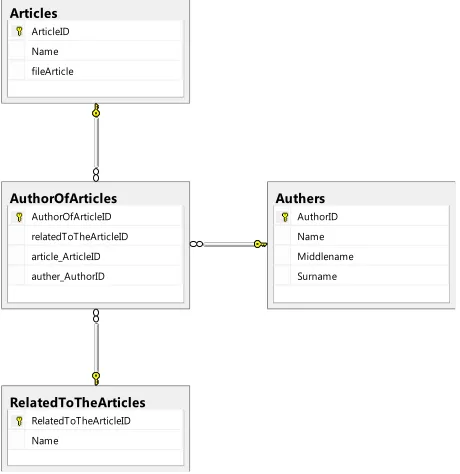
In the table “Articles” are stored articles, article size from 100 KB to 3 MB. In the table “Authers” provides data to the author. Table “Author of Articles” website links with the article. One article may be one main author and several co-authors. In the test load can be from 0 to 9 coauthors. The article shall be in the format docx. Size articles: a maximum—3 MB, Minimum—0.1 MB.
In a local database (articlesLocal) data about authors and articles are stored in a relational database MS SQL Server (see Figure 1). The occupied memory on the da-tabase server (articlesLocal) 26667,25 MB.
The structure of the hybrid database is shown in Fig-ure 2.
In a hybrid DB (articlesHybrid) information about the authors and articles in the local database to MS SQL Server, and the article body—cloud storage Azure Stor-age. The occupied memory on the database server (arti-clesHybrid) 47,08 Mb, in the cloud, about 27 GB.
Interaction with the local database is organized by the following way:
Articles
ArticleID Name fileArticle
Authers
AuthorID Name Middlename Surname
AuthorOfArticles
AuthorOfArticleID relatedToTheArticleID article_ArticleID auther_AuthorID
RelatedToTheArticles
[image:2.595.309.539.87.324.2]RelatedToTheArticleID Name
Figure 1. Database “articlesLocal”.
Windows Azure ArticlelD
AuthorOfArticlelD AuthorlD
RelatedToTheArticlelD HArticles
HAuthorOfArticles HAuthers
HRelatedToTheArticles Name
Name Middlename Surname
Name
[image:2.595.307.538.96.586.2]relatedToTheArticleID article_ArticleID auther_AuthorID
Figure 2. Database “articlesHybrid”.
1) The client application accesses the service to re-quest articles for the parameter as a parameter was elected by the author of the article.
2) Service calls to the database to SQL Server. 3) SQL returns metadata and text articles service. 4) The service sends the result to the client request. Interaction with the local database as follows. Working with hybrid storage:
of the article).
2) Service calls to the database to SQL Server. 3) SQL returns service metadata of articles and ad-dresses to which the texts are in Windows Azure.
4) The client receives from the service metadata of ar-ticles and addresses.
5) According to the obtained addresses the client ac-cesses the cloud storage and receives text articles.
Results
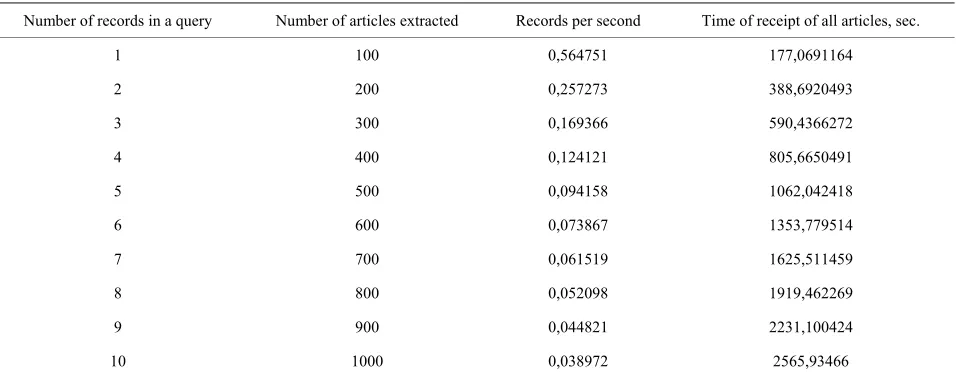
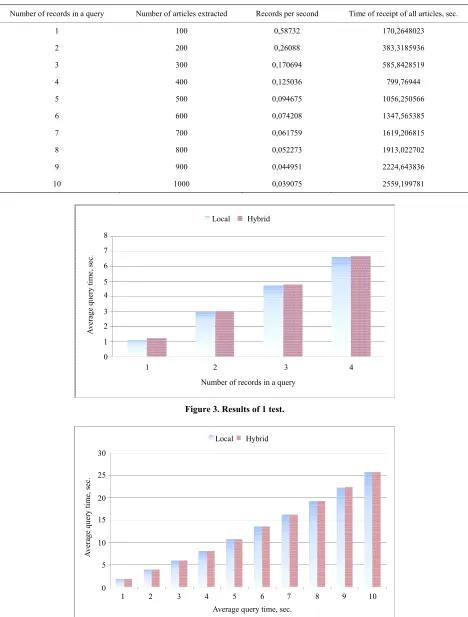
[image:3.595.55.540.317.403.2]Tests were carried out queries to databases on mining of articles. The results of the first experiment are shown in Table 1, 2 and in Figure 3, the second in Table 3, 4 and Figure 4.
The experiment demonstrates the effectiveness of cloud storage for systems using semistructured database.
Based on the results we can conclude that, for the time evaluation of database queries application of graph the-ory will not be effective. Resources used in the process-ing of queries on the local server structure other than in an external cloud storage.
3. Used to Control System Theory for Cloud
Database
3.1. Оverview
It is proposed to use to evaluate the performance of sys-tems operating in hybrid environments, to use the termi-nology and methods of system analysis. That certainly is not new, at the levels of service PaaS [1] cloud infra-structure is widely used concept of automatic control, automatic allocation of resources using the methods of dynamics.
Table 1. Test 1—queries to local databases.
Number of records in a query Number of articles extracted Records per second Time of receipt of all articles, sec.
1 100 0.908074 110,1231453
2 200 0.335978 297,6383233
3 300 0.21054 474,969978
[image:3.595.58.539.431.516.2]4 400 0.150936 662,533218
Table 2. Test 1—queries to hybrid databases.
Number of records in a query Number of articles extracted Records per second Time of receipt of all articles, sec.
1 100 0,826204 121,0354227
2 200 0,329768 303,2433013
3 300 0,208225 480,2488007
[image:3.595.61.539.544.732.2]4 400 0,149446 669,136332
Table 3. Test 2—queries to hybrid databases.
Number of records in a query Number of articles extracted Records per second Time of receipt of all articles, sec.
1 100 0,564751 177,0691164
2 200 0,257273 388,6920493
3 300 0,169366 590,4366272
4 400 0,124121 805,6650491
5 500 0,094158 1062,042418
6 600 0,073867 1353,779514
7 700 0,061519 1625,511459
8 800 0,052098 1919,462269
9 900 0,044821 2231,100424
Table 4. Test 2—queries to local databases.
Number of records in a query Number of articles extracted Records per second Time of receipt of all articles, sec.
1 100 0,58732 170,2648023
2 200 0,26088 383,3185936
3 300 0,170694 585,8428519
4 400 0,125036 799,76944
5 500 0,094675 1056,250566
6 600 0,074208 1347,565385
7 700 0,061759 1619,206815
8 800 0,052273 1913,022702
9 900 0,044951 2224,643836
10 1000 0,039075 2559,199781
1 2 3 4
Number of records in a query 0
Local Hybrid
A
ver
ag
e
qu
er
y t
im
e, s
ec.
1 2 3 4 5 6 7 8
Figure 3. Results of 1 test.
1 2 3 4 5 6 7 8 9 10
Average query time, sec. 0
5 10 15 20 25 30
Local Hybrid
A
vera
ge q
ue
ry
tim
e,
sec.
[image:4.595.55.540.102.519.2]For information systems are intuitive terminology of structural complexity, observability, reachability of these information systems. [8,9, etc.]. That means all of the many well-developed tools and control theory can be applied to study the parameters of information systems.
Given the logic of the cloud computing is difficult to determine the effectiveness of the algorithms. Virtualiza-tion and scalability of resources may unexpectedly greatly speed up the algorithms, as in our experimental example. That's a probably will help identify methods of system identification.
In general, it can be noted that the transfer system is necessary to develop a stable structure, the study of the characteristics of reliability, observability. Decomposi-tion of the local and cloud components should be based on the methods of structural complexity of systems analysis.
The dynamic descriptions in the form of approxima-tion of differential equaapproxima-tions with the vector control were used in the different tasks that are close to the considered in the article. In [10] the processes that include real-time embedded systems. You can also note the earlier article for managing web servers [11], and virtualized data cen-ters [12].
In previous works, such as [13], an approach that as-sumes that the cloud can be modeled as a Multi-In- put-Multi-Output (MIMO), the system is implemented for capacity control in the cloud. However, the design of the regulars and identification systems do not allow the full use of these ideas. In the work [14] proposed to use Single-Input-Single-Output (SISO) systems with the in-troduction of the notion proportional thresholding.
The original paper [15] is devoted to the construction of a dynamic model of linked servers in the cloud. The important results of this work are the introduction of the concept of positive feedback, the theoretical proof of the stability of the model, the use of passive systems.
The closest in terms of models of our article [16]. This article describes how to identify patterns in the problem space and formulated the principles of the use of auto-matic control cloud resources.
3.2. Main Provisions
Let us consider basic positions which presence constitute grounds for an approach to the control system theory and dynamic models.
Transients. Consider a distributed database in the cloud.
In cloud databases exist feature is that there are software or hardware routing. They store data on how the virtual machine on which pieces of data is stored, how much is in the public, private cloud which determines the level of security and other service information. In fact, even the same type of incoming query is converted in each case to
a different scenario and route maps and depends on the model structure, and communication channels.
Input and output parameters for the study are the pa-rameters characterizing the cloud computing system re-sources—CPU usage is at a given time, channel load, the control signals on the state of the virtual machines and clusters. In some cases, you can consider the input of a query that can be measured, for example, in the perfect disjunctive normal form.
An important assumption! The system cannot be con-sidered only at a single query, there is a constant stream of requests. The system can be retrieved, then released. Therefore the state of the system at time t + 1 depends on
the query, and the current state at time t. In addition,
there are natural constraints imposed by the width of channels, the number of free processors, the amount of free memory, etc.
As you know, in control theory it is transient response of the system to a single signal. A single signal is usually scaled signal outputting system to normal operation, i.e. changes settings when turned on. It is easy to get in a situation where the “bad structure of the clouds” will be oscillatory processes. It will be in a situation where the growth will stimulate queries rotation system increases and decreases in resources. Perhaps monotonous output to normal. All of this means that you must modeling and solution of the classical problems for which was estab-lished control theory—stability analysis in the design of feedback systems, the synthesis of optimal controllers, control software.
Feedback. The presence of feedback, first defined by
the need to consider the current state of the virtual ma-chine workload. As was done in [2]. Secondly for dis-tributed databases final data are delivered to the client via the cloud environment, and information about the end of the query to be delivered to the central system. It is un-derstood that the presence of more feedbacks charged already narrow communication channels and may in-crease the processing time. This is one more argument in favor of the control systems for the optimization of feedback.
Feature of the cloud is positive feedback.
Basic model. The base model offers classic model is
approximated by the following difference equations,
1
x t Ax t Bu t
,
where
1, , ,2T n
x x x x – n-dimensional vector of
the system states under given constraints n
x X R ,
– m-dimensional vector of controls under given constraints , t – discrete time
instan.
1, , ,2
T m
u u
u u
m
u U R
to be adequate.
It should be admitted, however, that in some cases, and in the case of non-linear soedli their identification is justified [7,18].
Structural connections. It is natural that when you transfer to the cloud structure of the databases and route data retrieval becomes difficult. In the simple example given in the first part of the beginning of this article was introduced by an additional block that separates the search request in the private and public cloud. We do not want to overload the informative presentation so we will not give your example. Here is another example taken from [13], which is shown in Figure 5. If we draw the required feedbacks, it will overload picture. So even at the top level representation of cloud databases becomes difficult to follow without mathematical methods for the structural stability of the system. Therefore connected to the structure of the system requires the solution of tasks, known for the theory of management—sustainability assessment framework, assessment of structural com-plexity, etc.
4. Conclusions
In the article an experiment is aimed at clarifying the transfer efficiency of the database in the cloud infra-structure. The system was added to the control unit, which has guided the database search in the local part or in the cloud. It is shown that, as a result of transport, the time data acquisition remains unchanged.
Suggestions have been made about the use of the the- ory of dynamic systems for the analysis of information systems which use distributed resources and conveyor principle of data processing.
The present work is aimed at attracting the attention of specialists in the field of cloud database to the apparatus control theory. The experiment presented in this article allows the use of the description of the known methods for solving important practical problems. In conclusion, it allows to formulate them.
Investigation of the stability of systems—the most im-
portant solution for the presence of feedback in distrib- uted systems with disabilities through the communication channel, was limited by safe access to the data, as well as scalable resources under peak load.
The study of controllability—for complex structured
systems, the problem of controllability in a given time interval, and the task of reachability and observability are not obvious without the pilot study; the use of the pro-posed model allows the use of famous mathematical tool solutions.
Designing effective systems—for large databases with
complex levels of access and distributed in different sys-tems with different hardware and software support, as it is observed in a hybrid cloud infrastructure.
Optimization—in terms of predetermined criteria of
quality construction of effective systems. Modeling can occur both at the design stage, and the step change of the existing systems, when requirements were changed.
User
MySQL
Usage Manegement
Mechanism
Ruby/Rails Application
Amazon S3
Amazon EC2
Node
Eucalyptus
Cloud Controller
[image:6.595.121.478.458.721.2]Node
Figure 5. Example cloud database [13].
For example, transfer system in the cloud environment is an interesting and urgent task.
REFERENCES
[1] R. Buyya, R. N. Calheiros and X. R. Li, “Autonomic Cloud Computing: Open Challenges and Architectural Element,” 3rd International Conference Emerging Ap- plications of Information Technology (EAIT), Kolkata, 30 November 2012, pp. 3-10.
[2] S. Abiteboul, “Querying Semi-Structured Data,” Pro-ceedings of 6th International Conference on Database Theory—ICDT’97, Delphi, 8-10 January 1997, pp. 1-18. [3] Y. N. Silva, P. Larson and J. Zhou, “Exploiting Common
Sub-Expressions for Cloud Query Processing,” 2012 28th IEEE International Conference on Data Engineering (ICDE), Washington DC, 1-5 April 2012, pp. 1337-1348. [4] P. Jurczyk and L. Xiong, “Dynamic Query Processing for p2p Data Services in the Cloud,” Database and Expert Systems Applications, Springer, Berlin, Heidelberg, 2009, pp. 396-411.
[5] X. Wang, X. Liu, L. Fan and X. Jia, “A Decentralized Virtual Machine Migration Approach of Data Centers for Cloud Computing,” Mathematical Problems in Engi- neering, Vol. 2013, 2013, Article ID: 878542.
[6] E. Sithole, A. McConnell, S. McClean, G. Parr, B. Scot-ney, A. Moore and D. Bustard, “Cache Performance Mo- dels for Quality of Service Compliance in Storage Clouds,” Journal of Cloud Computing: Advances, Systems and Ap- plications, Vol. 2. No. 1, 2013, pp. 1-24.
http://dx.doi.org/10.1186/2192-113X-2-1
[7] E. Nikulchev and O. Kozlov, “Identification of Structural Model for Chaotic Systems,” Journal of Modern Physics, Vol. 4. No. 10, 2013, pp. 1381-1392.
http://dx.doi.org/10.4236/jmp.2013.410166
[8] Z. D. Sun and S. S. Ge, “Analysis and Synthesis of Swi- tched Linear Control Systems,” Automatica, Vol. 41, No. 2, 2005, pp. 181-195.
http://dx.doi.org/10.1016/j.automatica.2004.09.015 [9] Y. Ohta, H. Maeda and S. Kodama, “Reachability,
Ob-servability, and Realizability of Continuous-Time Posi-tive Systems Read,” SIAM Journal on Control and Opti-mization, Vol. 22, No. 2, 1984, pp. 171-180.
http://dx.doi.org/10.1137/0322013
[10] C. Lu, X. Wang and X. Koutsoukos, “Feedback Utiliza-tion Control in Distributed Real-Time Systems with End-to-End Tasks,” IEEE Transactions on Parallel and Distributed Systems, Vol. 16. No. 6, 2005, pp. 550-561. http://dx.doi.org/10.1109/TPDS.2005.73
[11] Y. Diao, N. Gandhi, J. L. Hellerstein, S. Parekh and D. M. Tilbury, “Using MIMO Feedback Control to Enforce Policies for Interrelated Metrics with Application to the Apache Web Server,” 2002 IEEE Network Operations and Management Symposium, 2002, pp. 219-234. [12] W. Xu, X. Zhu, S. Singhal and Z. Wang, “Predictive
Con-trol for Dynamic Resource Allocation in Enterprise Data Centers,” 10th IEEE/IFIP 2006 Network Operations and Management Symposium, 2006, pp. 115-126.
[13] V. Nandina, J. M. Luna, E. J. Nava, C. C. Lamb, G. L. Heileman and C. T. Abdallah, “Policy-Based Security Provisioning and Performance Control in the Cloud,” In-ternational Conference on Cloud Computing and Services Science (CLOSER 2013), SciTePress, 2013, pp. 502-508. [14] R. Nathuji, A. Kansal and A. Ghaffarkhah, “Q-Clouds: Managing Performance Interference Effects for QoS- Aware Clouds,” Proceedings of the ACM European Soci-ety in Systems Conference, Paris, 2010, pp. 237-250. [15] H. Lim, S. Babu, J. Chase and S. Parekh, “Automated
control in cloud computing: Challenges and opportuni-ties,” Proceedings of the 1st Workshop on Automatic Control for Datacenters & Clouds, Barcelona, 2009, pp. 13-18.
[16] M. D. Lemmon, “Towards a Passivity Framework for Power Control and Response Time Management in Cloud Computing,” Proceedings of 7th International Workshop on Feedback Computing, San Jose, 2012
[17] J. M. Luna and C. T. Abdallah, “Control in Computing Systems: Part I,” 2011 IEEE International Symposium on Computer-Aided Control System Design (CACSD), Den-ver, 28-30 September 2011, pp. 25-31.
http://dx.doi.org/10.1109/CACSD.2011.6044541
Appendix. Querying the Database
A1. HardwareThe client computer from which the requests were made: Type—Notebook ASUS U36SD,
Processor—Core i5 2500 MHz, Processor core - 2, Мemory—4096 MB DDR3 1333 MHz,
Storage capacity (HDD) 750 GB, Drive interface—Serial ATA
The server on which the local database and the local part of the hybrid storage:
Processor—Intel Atom d525 1800 MHz, Proc. core - 2, Мemory—4096 MB DDR3,
Volume drive (HDD)—750 GB, Drive interface—Serial ATA.
Internet connection—Channel capacity 100 Mbit/s Cloud storage: Windows Azure,
Version storage—Locally excessive, Territory server locations—Eastern Europe.
A2. Software
Client—installed operating system is Win 8 64, Application winForm, written in C # by using Lan-guage-Integrated Query LINQ.
Server—installed operating system is Windows Server 2012, database server - MS SQL Server 2012.
A3. Local Database
Request for 10 articles selected author. LINQ:
var auther = bd. Authers. Include (“Author Of Articles. article”). First (item => item. AuthorID == autherID); var article = auther. Author of Articles. Take (countArti-cle);
SQL:
SELECT TOP 10 * FROM [articlesLocal]. [dbo]. [Authers]
JOIN [articlesLocal].[dbo].[AuthorOfArticles] ON [AuthorOfArticles].[auther_AuthorID] =
[Authers].[AuthorID] LEFT JOIN [articlesLocal].[dbo].[Articles]
ON [AuthorOfArticles].[article_ArticleID] = [Articles].[ArticleID] WHERE [Authers].[AuthorID] = VARautherID
A4. Hybrid Cloud Database
Request for 10 articles selected author. LINQ
var auther = bd. Authers. Include(“Author Of Articles. article”). First (item => item. AuthorID == autherID);
var article = auther. Author of Articles. Take (count Article);
SQL
SELECT TOP 10 * FROM [articlesHybrid] [dbo]. [HAuthers]
JOIN [articlesHybrid].[dbo].[HAuthorOfArticles] ON [HAuthorOfArticles].[auther_AuthorID] =
[HAuthers].[AuthorID] LEFT JOIN [articlesHybrid].[dbo].[HArticles]
ON [HAuthorOfArticles].[RelatedToTheArticleID] = [HArticles].[ArticleID] WHERE [HAuthers].[AuthorID] =
VARautherID
Request to the cloud storage to extract text articles on the specified address
public Stream GetRecord(string id, string
TableName = “Article”)
{ try
{
CloudBlobContainer conteiner =
Client. GetContainerReference (TableName. ToLower());
CloudBlockBlob blod =
conteiner. Get Block BlobReference (id. To Lower());
return blod.OpenRead(); }
catch (Exception ex) {
MessageBox.Show(“error: “ + TableName
+ “ “ + id.ToString() + “ “ + ex.Message);
}
return null; }
privatestaticCloudBlobClient client; public static CloudBlobClient Client {
get {
if (client == null)
{
CloudStorageAccount storageAccount =
CloudStorageAccount.Parse
(contectionString.ToString()); client =
storageAc-count.CreateCloudBlobClient(); }
return client; }
![Figure 5. Example cloud database [13].](https://thumb-us.123doks.com/thumbv2/123dok_us/7942669.750970/6.595.121.478.458.721/figure-example-cloud-database.webp)
