DEVELOPING THE KNOWLEDGE-BASED HUMAN RESOURCES THAT
SUPPORT THE IMPLEMENTATION OF THE NATIONAL DUAL
TRAINING SYSTEM (NDTS): EVALUATION OF TVET TEACHER’S
COMPETENCY AT MARA TRAINING INSTITUTIONS
MAHAZANI ALI
This thesis is submitted in fulfilment of the award requirements for the Degree of Doctor of Philosophy in Technical Education
Faculty of Technical and Vocational Education Universiti Tun Hussein Onn Malaysia
in collaboration with
Institut Technik Und Bildung (ITB) Universitat Bremen, Germany
ABSTRACT
v
ABSTRAK
TABLE OF CONTENTS
DECLARATION ii
ACKNOWLEDGEMENT iii
ABSTRACT iv
ABSTRAK v
TABLE OF CONTENTS vi
LIST OF TABLES x
LIST OF FIGURES xiv
LIST OF EQUATIONS xvi
LIST OF ACRONYMS xvii
LIST OF ANNEX xviii
1 CHAPTER 1
1.1 Background of the study 1
1.2 TVET-teacher training in Malaysia 2
1.3 Transformation of TVET in Malaysia 3
1.4 Current TVET status 5
1.4.1 TVET-teacher competency 5
1.4.2 Human-resource status 6
1.5 Problem statements 7
1.6 Research goals 11
1.7 Research question 12
1.7.1 Research question one 13
1.7.2 Research question two 14
1.7.3 Research question three 15
1.7.4 Research question four 16
1.7.5 Research question five 17
1.7.6 Research question six 18
1.8 Hypotheses 18
1.8.1 Hypothesis one 18
1.8.2 Hypothesis two 19
1.8.3 Hypothesis three 19
1.8.4 Hypothesis four 19
1.8.5 Hypothesis five 19
1.9 Significance of study 20
1.10Framework of the study 21
vii
26 CHAPTER 2
2.1 Introduction 26
2.2 Holistic overview of TVET globally 28
2.3 TVET in Malaysia 30
2.3.1 The issues and challenges TVET in Malaysia 33 2.3.2 Recruitment of TVET-teacher in Malaysia 35
2.3.3 System (Institutions and curricula) 36
2.3.4 TVET in MARA 39
2.4 National Dual Training System (NDTS) 42
2.4.1 NDTS in Malaysia 42
2.4.2 NDTS in MARA 44
2.5 Knowledge-based human resources in Malaysia for NDTS
implementation 45
2.5.1 Concept of the knowledge-based human resource 46 2.5.2 Role of TVET-teacher as the knowledge-based human resource 47 2.5.3 Needs of knowledge-based human resources for NDTS 49 2.5.4 Strategies for developing knowledge-based human resources 52
2.5.5 Lesson learned at MARA institution 54
2.6 Model of TVET-teacher competency 57
2.6.1 Definition of competency 57
2.6.2 Concept of competency 58
2.6.3 TVET-teacher competency profile model for MARA 60 2.6.4 Overview on teacher competency and teacher standard 62 2.6.5 Reference models of teacher competency 63 2.7 Comparison of TVET-teacher standard among countries 66
2.7.1 Australia 68
2.7.2 United Kingdom 69
2.7.3 New Zealand 70
2.7.4 Canada 71
2.7.5 United States of America 72
2.7.6 Germany 73
2.7.7 Malaysia 73
2.7.8 Philippine 74
2.8 TVET-teacher competency and evaluation 74
2.8.1 Approaches for competency evaluating 74
2.8.2 Development instrument for evaluating competency 76
2.9 Competency profiling for the TVET-teachers 76
2.9.1 Significance of competency profile 77
2.9.2 TVET-teacher competency profile at MARA 78 2.9.3 The ITB approach for developing vocational profile 79 2.10Career development for the TVET-teachers at MARA 80
2.11Training pathway for the TVET-teachers at MARA institutions 81
84 CHAPTER 3
3.1 Overview of chapter 84
3.2 Research design 87
3.2.1 Triangulation 89
3.2.2 Delphi technique 91
3.2.3 Analysis phase: Literature review 93
3.2.4 Design phase: Expert review 94
3.2.5 Development phase: Item validation 98
3.2.6 Development phase: Expert review 98
3.2.7 Development phase: Pilot study and finalised instrument 99
3.2.8 Implementation phase: Field study 100
3.3 Conceptual framework 102
3.4 Scope of study and research population 105
3.5 Respondents 105
3.5.1 Nomination process 106
3.5.2 Census 107
3.5.3 Simple random sampling 107
3.6 Research instrument 108
3.7 Procedure for conducting the study 117
3.8 Test used for data analysis 118
3.8.1 Quantitative data analysis 119
3.8.2 Qualitative data analysis 123
3.8.3 Interpretation of teacher competency 123
3.9 Ethical consideration and limitation 124
3.10Chapter summary 125
126 CHAPTER 4
4.1 Introduction 126
4.2 Analysis of demographic data 129
4.2.1 Distribution of TVET institutions 129
4.2.2 Demographic profile for Malaysian TVET-teacher 129 4.2.3 Demographic Profile for MARA TVET-teacher 130 4.2.4 Demographic profile for expert panellist 131
4.2.5 Demographic profile for interviewee 132
4.3 Elements of competencies for TVET-teacher 133
4.3.1 Finding from Delphi round one: Focus group one & two 135 4.3.2 Findings from questionnaire validation 142
4.3.3 Delphi round two: Focus group three 150
ix
4.4.4 TVET-teacher competency profile 165
4.4.5 New Established Empirical Based Competency Profile for
TVET-teacher in MARA 175
4.5 TVET-teacher competency at MARA 178
4.5.1 Level of MARA TVET-teacher competency 179 4.5.2 Significant difference of MARA teacher competency level between
TSE and SVE 194
4.6 TVET-teacher competency gaps 195
4.6.1 Gaps of TVET-teacher competency between MARA institutions (IKM) and other TVET institutions in Malaysia 197 4.6.2 Gaps of TVET-teacher competency among different TVET
institutions in Malaysia 198
4.6.3 Gaps among the institutions in the MARA 200 4.6.4 Multi Linear Regression between Dependent Variable and
Independent Variable 202
4.7 Training needs for TVET-teacher 207
4.7.1 Analyses of quantitative questionnaires 207 4.7.2 Analyses of qualitative questionnaires 208 4.7.3 Analyses of structured interview (teacher training needs) 210 4.8 Framework for career development and training pathway 212 4.8.1 Competency areas for teacher grade 29 215
4.8.2 Competency area for teacher grade 36 216
4.8.3 Competency area for teacher grade 38 221
4.8.4 Competency area for expert teacher 222
4.9 Chapter summary 223
224 CHAPTER 5
5.1 Introduction 224
5.2 Structured summary of the research 226
5.3 Discussion 228
5.3.1 Elements of TVET-teacher competency 231
5.3.2 The new empirical based competency profile for MARA
TVET-teacher 235
5.3.3 TVET-teacher competency at MARA institution 244 5.3.4 TVET-teacher competency gaps, their strength and weakness 247
5.3.5 TVET-teacher-training needs 250
5.3.6 Framework for TVET-teacher career development and training
pathway 253
5.4 Summary of findings 256
5.5 Limitation of the study 259
5.6 Implication, tentative recommendations and future research 260
5.7 Conclusion 262
REFERENCES 266
LIST OF TABLES
Table 2.1: List of reviewed model, agency and country 67
Table 3.1: Phase, methods and instruments 89
Table 3.2: Focus group panel 1: General competency 95
Table 3.3: Focus group panel 2: Technical competency 96 Table 3.4: Focus group panel 3: TVET-teacher competency 97
Table 3.5: Selection of participants 106
Table 3.6: Teacher competencies and questionnaires coding 109
Table 3.7: Level of technical competency 114
Table 3.8: Level of learning and methodological competency 115 Table 3.9: Level of human and social competency (except English & ICT) 116 Table 3.10: Level of human and social competency (English language) 116 Table 3.11: Level of human and social competency (ICT) 117
Table 3.12: Step and timeline of study 118
Table 3.13: KMO measure values classification 122
Table 3.14: Analysis procedure, data type, statistical test, and expected results 122
Table 3.15: Level and score of competency 123
Table 4.1: Distribution institutions 129
Table 4.2: Demographic profile for Malaysian TVET-teacher 130 Table 4.3: Demographic profile for MARA TVET-teacher 131 Table 4.4: Demographic profile for the expert panellist 132 Table 4.5: Demographic profile for the interviewee 132 Table 4.6: Summary of findings for elements of competencies validation 133 Table 4.7: Elements of competencies that were dropped and added 134
Table 4.8: TVET-teacher competencies (General) 137
Table 4.9: TVET-teacher competencies (Technical) 139
Table 4.10: Result of survey questionnaires (Technical competencies) 144 Table 4.11: Percentage of agreement on general competencies 148 Table 4.12: Elements of TVET-teacher competencies 150
Table 4.13: Core competencies by clusters 151
Table 4.14: Cluster of technical competencies 152
xi
Table 4.16: Cluster of human and social competencies 154 Table 4.17: Result analysis of structured interview (Elements of competencies) 156 Table 4.18: Reliability statistics for TSE and SVE 160
Table 4.19: A result of KMO and Bartlett’s test 161
Table 4.20: Principal component analysis 162
Table 4.21: Distribution of TVET-teacher competency 163 Table 4.22: Mean score for the level of cores competencies 165 Table 4.23: Mean score for the level of clusters competencies 166 Table 4.24: Mean score for the level of ‘Application of basic electrical theory’
competency 167
Table 4.25: Mean score for the level of ‘Understanding electrical act, regulation and
safety & health’ competency 167
Table 4.26: Mean score for the level of ‘LV electrical supply system installation’
competency 168
Table 4.27: Mean score for the level of ‘Electrical lighting system installation’
competency 168
Table 4.28: Mean score for the level of ‘Electrical protecting system installation’
competency 169
Table 4.29: Mean score for the level of ‘Motor control system installation’
competency 170
Table 4.30: Mean score for the Level of ‘Perform maintenance, troubleshooting and
repair works’ competency 170
Table 4.31: Mean score for the level of ‘Preparation of teaching materials’
competency 171
Table 4.32: Mean score for the level of ‘Teaching subject’ competency 171 Table 4.33: Mean score for the level of ‘Workshop and classroom management’
competency 172
Table 4.34: Mean score for the level of ‘Evaluation and assessement of student's
performance’ competency 172
Table 4.35: Mean score for the level of ‘Application of research and development’
competency 173
Table 4.36: Mean score for the level of ‘Student management’ competency 173 Table 4.37: Mean score for the level of ‘Program management’ competency 174 Table 4.38: Mean score for the level of ‘Demonstration of professional knowledge
and skills’ competency 174
Table 4.42: Level of core of competency for TSE and SVE 180
Table 4.43: Mean score for cluster of competency 180
Table 4.44: Mean score for ‘Application of basic electrical theory’ competency 181 Table 4.45: Mean score for ‘Understanding electrical act, regulation and safety &
health’ competency 182
Table 4.46: Mean score for ‘LV electrical supply system installation’ competency183 Table 4.47: Mean score for ‘Electrical lighting system installation’competency 184 Table 4.48: Mean score for ‘Electrical protecting system installation’ competency185 Table 4.49: Mean score for ‘Motor control system installation’ competency 186 Table 4.50: Mean score for ‘Perform maintenance, troubleshooting and repair works’
competency 187
Table 4.51: Mean score for ‘Preparation of teaching materials’ competency 187 Table 4.52: Mean score for ‘Teaching subject’ competency 188 Table 4.53: Mean score for ‘Workshop and classroom management’ competency 188 Table 4.54: Mean score for ‘Evaluation and assessment of student's performance’
competency 189
Table 4.55: Mean score for ‘Application of research and development’ competency 190 Table 4.56: Mean score for ‘Student management’ competency 191 Table 4.57: Mean score for ‘Program management’ competency 192 Table 4.58: Mean score for ‘Demonstration of professional knowledge and skills’
competency 192
Table 4.59: Mean score for ‘Mastery of English language’ competency 193 Table 4.60: Mean score for ‘Mastery of ICT’ competency 193 Table 4.61: Mean score for the level of competency for supervisor and teacher
self-evaluation 194
Table 4.62: A t-test for MARA teacher competency between TSE and SVE 195
Table 4.63: Results TVET-teacher competency gaps 197
Table 4.64: Mean score of TVET-teacher competency between MARA institutions
(IKM) and other TVET institutions 197
Table 4.65: A test for significant difference between MARA institutions (IKM) and
other institutions 198
Table 4.66: Mean score of TVET-teacher competency for different TVET institution
in Malaysia 198
Table 4.67: Robust test of equality of mean 199
xiii
Table 4.71: The Durbin-Watson statistic for TVET-teacher competency and the
predictors 203
Table 4.72: Correlation table between TVET-teacher competency and independent
variables 204
Table4.73: Collinearity statistics 205
Table 4.74: The Durbin-Watson statistic (Model 3) 206
Table 4.75: A test for significant relationship between TVET-teacher competency and teacher of different grade, age and year of experience 206 Table 4.76: Summary of Multiple Regression analysis of TVET-teacher competency
of different grade, age and year of experience 206
Table 4.77: Summary of teacher’s training needs 207
Table 4.78: Teacher’s training needs derived from statistical analysis 208 Table 4.79: Teacher’s training needs derived from questionnaires 210 Table 4.80: Analysis of structured interviews (Teacher training needs) 211 Table 4.81: A descriptive statistic for 112 elements of competency 212
LIST OF FIGURES
Figure 1.1: ITB-University Bremen Occupational Competency Model 13
Figure 1.2: Framework of the study 22
Figure 1.3: Model of structure of the thesis 25
Figure 2.1: MQF based on qualification level and educational pathway 38
Figure 2.2: MARA educational pathway 41
Figure 2.3: NDTS in Malaysia 44
Figure 2.4: Malaysia's workforce transformation 49
Figure 2.5: Retraining model 51
Figure 2.6: Factors contributing to human resource development 52
Figure 2.7: Training and development master plan 54
Figure 2.8: TVET-teacher competency profile model for MARA 61 Figure 2.9: Model 1-Bjekic & Zlatić Model of teacher competency 64 Figure 2.10: Model 2-European model of teacher professional competency 64 Figure 2.11: Model 3-Knowledge-based occupational competency 66 Figure 2.12: ITB Model for developing vocational profile 80 Figure 2.13: Current career development and training pathway in MARA 81
Figure 3.1: Instructional design model 88
Figure 3.2: Development of competency profile (Modified Delphi method) 93
Figure 3.3: Flowchart for conducting field tests 102
Figure 3.4: Conceptual framework of the study 104
Figure 3.5: Steps for conducting the study 118
Figure 4.1: Preliminary TVET-teacher competency profile 158
Figure 4.2: Factor analysis: Scree plot 162
Figure 4.3: Normal Q-Q plot for technical competency 164 Figure 4.4: Normal Q-Q plot for learning and methodological competency 164 Figure 4.5: Normal Q-Q plot for human and social competency 165 Figure 4.6: Framework of the cores competency for MARA TVET-teacher 176 Figure 4.7: The empirical based ‘technical’ competency profile for MARA
TVET-teacher 176
Figure 4.8: The empirical based ‘learning and methodological’ competency profile
xv
Figure 4.9: The empirical based ‘human and social’ competency profile for MARA
TVET-teacher 177
Figure 4.10: The new empirical based TVET-teacher competency profile 178 Figure 4.11: Normal P-P Plot of Regression Standardised Residual 203 Figure 4.12: Scatter plot of Studentized Residual and Unstandardized Predicted
Value 204
Figure 4.13: Q-Q normal plot 205
Figure 4.14: Career development and training pathway for MARA TVET-teacher 214 Figure 4.15: Career development and training pathway (grade 29) 216 Figure 4.16: Career development and training pathway (grade 36) 220 Figure 4.17: Career development and training pathway (grade 38) 222 Figure 4.18: Career development and training pathway (expert teacher) 223 Figure 5.1: The new empirical based TVET-teacher competency profile 237 Figure 5.2: Preliminary TVET-teacher competency profile 241
Figure 5.3: Individual report card 252
Figure 5.4: A framework for career development and training pathway for MARA
LIST OF EQUATIONS
Equation 3.1: Null hypothesis for equal mean (one way ANOVA) 120 Equation 3.2: Alternative hypothesis for equal mean (one way ANOVA) 120 Equation 3.3: Null hypothesis for equal mean (t-test)) 120 Equation 3.4: Alternative hypothesis for equal mean (t-test) 120
Equation 4.1: Basic model of linear regression 202
xvii
LIST OF ACRONYMS
BKT Bahagian Kemahiran dan Teknikal MARA (MARA Vocational and Technical Division
DSD Department of skills development HR Human resource
HRM Human resource management
ICT Information communication technology
IKBN Institut Kemahiran Belia Negara (National Youth Skills Institute) IKM Institut Kemahiran MARA (MARA Vocational Institute)
ILP Institut Latihan Perindustrian (Industrial Training Institute) IPGKPT Institut Perguruan Guru Kementerian Pengajian Tinggi (Institute
of Technical Education Campus)
KKTM Kolej Kemahiran Tinggi MARA (MARA High Technical College) MARA Majlis Amanah Rakyat (Council for Indigenous People)
MCE Malaysia Certificate Education MOE Ministry of Education
MQA Malaysia Qualification Agency MQF Malaysia Qualification Framework
MRSM Maktab Rendah Sains MARA (MARA Junior Science College) MYS Ministry Youth and Sport
NDTS National Dual Training System
NOCC National Occupational Core Curriculum NOSS National Occupational Skills Standard
PMR Penilaian Menengah Rendah (Lower Secondary Examination) SKM Sijil Kemahiran Malaysia (Malaysia Skills Certificate)
SME Semi-Medium Entreprise
SPM Sijil Pelajaran Malaysia (Malaysia Certificate of Education) SPSS Statistical Package for Social Science
SVE Supervisor’s evaluation TNA Training needs analysis TSE Teacher’s self-evaluation TTC TVET-teacher’ competency
LIST OF ANNEX
Annex 1 Sample Questionnaires 293
Annex 2 Sample Interview Script 306
Annex 3 Letter of Approval 307
Annex 4 Glossary for TVET-teacher competency profile 308
CHAPTER 1
COMPETENCY PROFILE FOR MARA TVET-TEACHER: ESTABLISHING THE CONTEXT AND RATIONAL
This chapter provides the background of the study followed by the overview of Technical Vocational Education and Training (TVET) teacher training, and transformation of TVET in Malaysia. In addition, it also provides the current status in TVET such as TVET-teacher competency and human-resource status. Furthermore, it discusses some issues in TVET and then lists out the research goals that lead to the formation of the research questions. In addition to the six research questions; five hypotheses were established for research question three (3) and four (4). Then, it also outlines the significance of the study. Next, the research framework that gives a clear picture on how this study will be carried out is also included. Lastly, it also provides the structure of this thesis and how it will be presented.
1.1Background of the study
This mixed method study will address the issue on the development of an empirical based competency profile for the MARA TVET-teachers. A triangulation mixed method's design will be used, a type of design in which difference but complementary data will be collected on the same topic. In this study, a modified Delphi process will be used in gathering both qualitative and quantitative data.
Previously, Nelson (2001) used a Delphi-based methodology to identify the competencies needed by SMEs who become TVET practitioners. She recommends for future study this method suitable for the development of competency profile:
develop one for TVET practitioners. TVET practitioners who have taught in both educations and industry could evaluate the competencies and come to a consensus on those required (Nelson, 2001, p4).
Consequently, to keep TVET curricula is current and relevant to industrial requirements, TVET-teachers and instructors need to be at the very least well informed on the methodology of analysing occupational competency needs directly and empirically in the world of work. In line with these suggestions, the researcher believes a similar approach for the development of profile competency for Malaysian TVET to be used.
The first reason for collecting qualitative data is that there are no existing instruments to evaluate teacher competency and that instrument needed to be developed based on qualitative views of panels (Morales, 2005). Second reason for collecting both quantities and qualitative data is to bring together the strength of both forms of research (Creswell & Clark, 2007) to review numerous literatures of competency models, listed competencies required, compare results, validate results and corroborate results. Based on the two reasons, the researcher decided to adopt a modified-Delphi methodology for carrying out this study.
1.2TVET-teacher training in Malaysia
The National Education System in Malaysia was established in 1957 through the Education Ordinance 1957. The system for school level consists of pre-school education at age’s four to six, primary education at age’s seven to twelve, secondary education at ages thirteen to seventeen and post-secondary education at ages eighteen and above.
The teacher education and training for TVET in Malaysia initially are established to train the secondary school teachers only. Later, in line with the suggestion from the Razak Declaration about vocational and technical education, a technical teacher trainee’s college was suggested to be built in 1962.
3
this Technical Teacher Training College is upgraded to offer courses at degree level beginning the year 2006. After a while, the college became known as the National Institute of Technical Teachers.
On the other hand, the recruitments of teachers for post-secondary education were from industries and graduates from universities or the institution of higher learning such as polytechnics, MARA Vocational Institutes, Industrial Training Institutes, and National Youth Skill Training Institutes. Technical vocational education and training at post-secondary education initially, only focused on low achiever students. In fact, most of this group of students are not highly interested in academic-based education, but prefer doing practical ‘hands on’ jobs, rather than memorizing or reading many books. Later down the years, TVET in Malaysia becomes a national agenda where; TVET is currently considered an alternative for further education.
Universiti Tun Hussein Onn Malaysia (UTHM) formerly known as Polytechnic Staff Training Centre, established on September 16 of the year 1993 is one of the institutions that are responsible to train TVET-teacher in Malaysia. In the past, UTHM only focuses in technical skills and academic knowledge in their curricula. However, in present, UTHM is responsible in creating a human resource with soft-skills such as communication, leadership, entrepreneurship, ICT, R&D, social skills and many others. Because of that, UTHM plays a pivotal role in training and producing a competent TVET-teacher in various technical and vocational fields as well as engineering graduates.
1.3Transformation of TVET in Malaysia
Transformation of TVET in Malaysia in the year 2013 leads a difference perspective among Malaysian. Consequently, TVET in Malaysia is no longer treated as second-class education. In line with this transformation, TVET-students could be able to graduate at early at ages sixteen with a diploma certificate level. It follows that; this new transformation will attract students as they are exposed to basic vocational subject at their early ages of thirteen. Later, they should be able to choose majors skills as their preference until they are graduated.
sixty-nine technical high schools to vocational high school. After all, students at the vocational high school are expected to enhance not only their competency and knowledge but also to enhance their innovation and creativity. According to Deputy Prime Minister of Malaysia during an interview with Bernama on September 9th 2012:
…the Vocational Education Transformation (VET) Program, aimed at strengthening further Malaysia's vocational education, will be implemented in 2013…the Program was being implemented to support the national economic transformation agenda in churning out skilled and trained manpower…efforts to develop the trained manpower required has yet to meet the government's aspiration, although vocational education long was established in Malaysia (Yassin, 2012).
The emphasis on improving the quality of TVET in Malaysia is particularly prominent in order to contribute to a national consensus on high income. National Philosophy of Education outlines a number of criteria in which; it will produce individuals who are balances and harmonious their physical, emotional, intellectual and spiritual quotient. Evidence from the Vocational Education Transformation Plan outline, five key strategies to mainstreaming TVET in Malaysia. The strategies are; the transformation of the TVET curriculum; the transformation of the TVET institutions; Collaboration with strategic partners in the industry; Transformation of the TVET assessment; and Transformation of the TVET organisation. This transformation also leads to affect changes in the economic, social and political in themselves, society, and country. The researcher view is that, TVET in Malaysia becomes a highly serious agenda because it can produce the knowledge based human resource; a pool of semi-killed worker, skilled worker and a professional for the country.
5
1.4Current TVET status
Any analysis of trends and issues in Europe is faced with the wide diversity of historical developments and of institutions, which can be observed between European countries. This diversity is particularly striking in the area of TVET, which is closely related to the overall educational system. TVET systems are expected to meet new requirements, which result from the combination of three interrelated factors; the worldwide diffusion of information technologies, economic competition, and changes in work organisation (Bertrand, 1998). In respect of these factors, this section outlines the status of research related to the TVET-teacher competency and human-resource status.
1.4.1 TVET-teacher competency
The German Education Council stipulated two areas of competency for all teachers, namely; specialized competency and pedagogical competency (Bauer, 2007). Further clarification fromBertrand (1998), the concept of competency tends to prevail on the more traditional notion of skills. He noted the employers tended to put more emphasis on the overall competency of individuals and especially on their ability to communicate, to solve problems and to work in teams rather than on their essentially technical skills. The researcher view is that, the major challenge is not so much to train the TVET-teacher for the utilization of new technologies, but rather for doing the kinds of work that the technology cannot perform, i.e. those, which require adaptability, creativeness and a human relationship. From this point, we should know what elements of the competencies require by them to perform their duties as a TVET-teacher. Consequently, the following paragraph discussed TVET-teacher competency from different scholars.
On the other hand, Kurnia, Dittrich, & Ilhamdaniah (2013) claims, it is mandatory, that TVET-teacher; to include the relevant knowledge at work places, to include the teaching of the methodologies, to run research, and to be able to analyses work places or work processes. Meanwhile, Sam (2012) points out TVET-teachers need to have relevant training qualifications, pedagogical competent and having the occupational skills. Indeed, Abebe (2010) coined the technical competencies, teaching methodology competencies, and personal and social competencies are required by TVET-teacher for their personal development in the future.
Further, Valli & Ariev (2002) claims on assessing student, integrating students, organize and manage the classroom efficiently, and provide learning pathway also prerequisite by TVET-teacher. Then, an analysis of teacher standard form Texas State Board of Education revealed that teacher could have a competency to operate teaching aids, and manage workshop & classroom and help students (Texas State Board of Education, 1997).
In conclusion, some common elements of competencies were found. The elements of competencies are; manage classroom and workshop (Valli & Ariev, 2002;Texas State Board of Education, 1997), manage student (Valli & Ariev, 2002; Texas State Board of Education, 1997), pedagogical and training competency (Sam, 2012; Deitmer & Heineman, 2003), professional (Deitmer & Heineman, 2003; Md Yunos, 2010), social (Abebe, 2010; Deitmer & Heineman, 2003; Md Yunos, 2010), and teaching competencies (Abebe, 2010; Kurnia, Dittrich, & Ilhamdaniah, 2013). The detail discussion of the competency will be discussed in the section 2.6.
1.4.2 Human-resource status
7
Consequently, TVET-teachers are increasingly involved in the shaping of TVET processes and the TVET system according to the needs of society and economy. They also have to assume a growing responsibility for the societal development. In order to develop the required quality of TVET teacher education, all available resources have to be used, such as the academic excellence of universities in research and development, the knowledge and competency of the economic sectors, and the perspectives that lie in the international exchange of knowledge and experiences.
Indeed, due to the rapid change of the world economy, Malaysia will need to develop its human resource to achieve a high-income nation status. It is necessary to enhance competencies among Malaysian to increase their employability. Thus, the Tenth Malaysia Plan emphasis on mainstreaming and broadening access to quality TVET and enhancing the competencies of TVET graduates (The Tenth Malaysia Plan: 2011-2015, 2010). For that reasons, four strategies will be adopted to mainstream and broaden access to quality TVET as Malaysia improve the perception on TVET, developing highly effective TVET-teacher, revising TVET curriculum, and streaming the delivery of TVET. Further, the TVET institutions must produce highly skills (competent) graduates, who are able to create, innovate, and exploit new idea as well as apply and develop technologies.
1.5Problem statements
According to various researches, many teachers lack competency in the subjects they teach. According to research by MERIC (2008), employers are facing lack of competencies and deficiencies in specific technical skills among their employees. This phenomenon is also faced by TVET-teachers in Malaysia, especially at MARA institutions. As a result, most of them felt unprepared in the classroom during their teaching session. Similar finding was discovered from the informal survey during the recruitment of new teacher conducted at IKM Kuching in 2007; fresh graduate teachers interviewed are identified to have a lacking in teaching competency. In addition, previous research done by Northwest Policy Centre (Agriculture & Food-Processing Industry Skill Gap Analysis, 2002) found that competency among employee was a major issue; about sixty percent of them were lacked academic skills. One-third was lacked communication skills, while one quarter was lacked on their occupational skills (Agriculture & Food-Processing Industry Skill Gap Analysis, 2002).
Next, Lauglo (2006) acknowledged that TVET human resources are chronically lacking in many countries. He points out there was a problem of ensuring the recruitment of the prospective teachers. Majority of them were fresh graduates, and they do not have working experience either in teaching or related technical area. As a result, they could not deliver the teaching processes effectively and were not capable of performing a practical job.
Similarly, the lack of qualified teacher is also happening in Malaysia and the neighbouring countries, as stated by Omar & Paryono (2008); there are lacked of qualified TVET-teacher in many countries like Brunei, Lao, Malaysia, Philippines and Thailand. Further clarification from Omar & Paryono (2008), they found that inadequate knowledge, skills and lack of industrial experience of TVET-teachers were considered as one of the major issue in Philippines and Loas.
9
In Malaysia, graduates from TVET institution have difficulties in finding job in government sector. They are not recognised to work as a TVET-teacher since most institutions owned by government. Currently, most TVET-teachers working in the government are from universities with engineering qualification. Further, the non-engineering graduates such as those who possess the skills, vocational or technology qualifications are not recognised for working with government as a TVET-teacher in Malaysia.
Consequently, Bauer (2007) insists that, there is a weak practical orientation during the study of the subject matter. He added there is a missing connection between studies of educational and social science and concrete teaching practice. It was found that, the study course at university did not provide practical pedagogical skills as required by the TVET-teacher during their real job (Bauer, 2007) and the sophistication of technology in the industry is not in line with the content of teaching in institutions (Md. Nasir, et. al, 2011). This phenomenon, also happening in Malaysia because the existing TVET-teachers are resistance with the changing of a new technology, some of them are not willing to go for re-training due to a personal problem, and some are not ready for re-training.
While O'Hanlon-Rose (2008) argued that skill shortage, and implicitly the skills gap, created through economies, demographic and social-culture change was a highly topical issue. He defined skill gaps as occur where existing employees (TVET-teacher) do not have the required qualifications (competency), experience and specialised skills to meet the skills needs for an occupation. Furthermore, Malaysian industries frequently complaints of mismatch between the skills required and
those possessed by graduates (George, 2006)
Besides that, there is no framework or competency profile being developed among the TVET-teachers who are teaching in vocational or technical education in Malaysia (Ghazali, 2008). In addition, Goh (2011) in her study has agreed there is no TVET-teacher standard (competency profile) developed empirically in Malaysia. Goh (2011) emphasis that:
Further, Bauer (2007) believed the number of literature within this field was not countable. However, a precise theoretically founded and empirically based professional profile (competency profile) of TVET-teacher does not exist. Bauer & Gollmann pointed out two issues;
First, profile being developed not substantiated by theory and supported from a basis of empirical investigations. Second, there were no comprehensive (or empirical) audits of the current position been carried out with regard to the quality, and the effects on the learning processes initiated by TVET-teachers (Bauer & Gollmann, 2008, p386).
Currently, a proper training pathway for TVET-teachers in MARA is not available. As a result, teacher’s training Programd is not properly planned, and sometimes it has depended on the officers in charge. There is a case whereby the teachers do not apply what they had learned because the trainings were not relevant to their current job. For example, they are sending to attend courses related to the development of curriculum, but their current job is industry's liaison. Sometimes they repeated the same courses they already attended. The selections of teachers attending courses are made without a proper planning.
Meanwhile, Omar & Paryono (2008) found great issues and problems that relate to TVET in various countries in Asia such as in Indonesia, Philippine, Vietnam, Malaysia, Cambodia and Brunei. It is true that, from their findings:
…the absence of national competency standard in Indonesia…there is a weak linkage between TVET institutions and industries found in Philippine…the deficiencies in curricular and instructional materials… there are inadequate TVET schools and institution (Omar & Paryono, 2008, p6).
Finally, Omar & Paryono (2008) coined the irrelevant TVET program is an issue in Cambodia, while, unsystematic staff development in Brunei. In order to improve TVET, they suggest TVET-teachers must be support to; upgrade their qualification; provide continuous training, and re-training. Institution need to; develop appropriate curriculum, develop capacity building (competency profile), design teacher-training program, develop teaching and learning resources evaluate teacher’s competencies, and in lining the program base one industrial need. Overall, the issues could be summarising as follows:
11
ii. Skills mismatch -There are skill gaps for existing TVET-teacher because they do not have the requires qualifications. Further, the universities do not provide practical pedagogical skills as required by the TVET-teacher. There is weak practical orientation during the study of the subject matter. Thus, some countries are still struggling to employ teachers with the relevant knowledge and skills.
iii. Recognition -Recognition of TVET graduate is low;
iv. TVET-teacher competency profile -There is no framework or competency profile being developed empirically and the absence of competency standard in some countries.
v. Staff development -Unsystematic staff development in some country like Malaysia. No proper training path for TVET-teachers in MARA is available. The existing teachers are resistance of a new technology, not willing for re-training or not ready for re-re-training.
vi. Training provider -Inadequate in TVET schools and institutions in some countries.
Based on the issues highlighted, some questions need to be resolved. Wisniewski et.al. (2003) have added:
The need for developing key occupational competencies based on a considerably better integration of both general subjects and subjects of vocational theory and practice required often-closer cooperation between all teachers and trainers in a vocational school (Wisniewski et.al., 2003, p29).
Therefore, the development of a more sustainable competency profile TVET-teacher is crucial in order to develop the knowledge-based human resources that support the implementation of NDTS, especially in the context of MARA in Malaysia. The next sections (1.6 and 1.7), will discuss research goals and define a research question for the study.
1.6Research goals
As a consequence of the research problem and current TVET status, this study sought to
achieve six major goals. The purpose of this study is to explore expert panels,
TVET-teachers and student's views with the intent of using this information to develop
i. To develop a model for TVET-teacher competency profile;
ii. To validate the TVET-teacher competency profile being developed; iii. To evaluate the level of competency among the TVET-teacher; iv. To identify TVET-teacher competency gaps;
v. To identify TVET-teacher training needs; and
vi. To develop a framework for career development and training pathway.
1.7Research question
In alignment with the researcher interest in developing an empirical based competency profile for the establishment of the framework for career development and training pathway of TVET-teacher at MARA, this study contributes to the research in science education by answering the following research questions. In pursuance on some challenges confronting the issues and problems regarding technical vocational education and training mention in previous chapter, this study sought answers to and is structured around six main research questions. The research
questions are discussed as follows:
i. What are the elements of competencies required for TVET-teacher?
ii. How is the empirical based competency profile for MARA TVET-teacher in Malaysia?
iii. How are the TVET-teacher competency levels at MARA institution (IKM) in Malaysia?’
iv. What are the gaps of TVET-teacher competency between MARA institution (IKM) and other TVET institutions; their current strength and weakness? v. How are the trainings needed for TVET-teachers at MARA?
vi. How are the frameworks for career development and training pathway of TVET-teachers in MARA institution?
13
1.7.1 Research question one
This section will explain the first research question;
‘What are the elements of competencies required for TVET-teacher?’
This research question attempted to identify what are the elements of competencies that are required by TVET-teacher, especially at MARA. Before answering this research question, first we should understand the concept of competency. International Labour Organisation (ILO) provides a good categorisation of competency, that distinguishes between three approaches; competency as the ability to carry out tasks, personal attributes (attitudes and abilities), and the ‘holistic competency’ that includes the two previous ones (A 40 questions of labour competency, 2008).
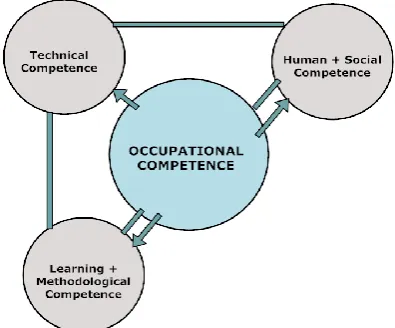
In Malaysia, Department of Skill Development (DSD) use the German Occupational Competency Model as shown in figure 1.1, as a basic component required by the knowledge-based human resources.
[image:29.595.286.484.379.543.2]OC = TC + LMC + HSC
Figure 1.1: ITB-University Bremen Occupational Competency Model (Source: Bader; Spöttl, ITB-University Bremen)
methodological. Few models been developed recently, but all the models focused only on either general competency or technical competency separately.
Based on that model, the researcher also continued to review teacher standards from available models as a basic for developing MARA TVET-teacher competency profile. Many models available but the researcher only limited to twelve models from eight countries because these countries were major player in TVET.
1.7.2 Research question two
This section will explain the second research question;
‘How is the empirical based competency profile for MARA TVET-teacher in
Malaysia?’
This research question intended to establish the best possible method on how the empirical based competency profile for MARA TVET-teacher will be developed and validated. Several methods for developing a competency profile from the different perspective were reviewed. Wayne & Simpson (2013) has proposed four methods of competency profile development; expert panel brainstorming session, survey, interview and review worker’s material and outputs. Davren (2010) does not deny that a competency profile could be developed through effective engagement and consultation with expert workshops and survey via email. Black & Riesen (2001) acknowledges of using the similar method in developing competency profile that involves; the collecting data through the brainstorming session, summarising and structuring, first validating by panels, synthesising and integrating, and second validating by panels. All scholars are agreed, the process of developing and validating the profile are involved in more than two stages.
15
competency need for current human-resource development (HRD) of master's degree graduate students in Korea.
The researcher wholeheartedly endorsed, based on above literatures and recommendation, a modified Delphi methodology is identified as a suitable method for this study. The detail's explanation of a modified Delphi methodology will be discussed in section 3.2.2.
1.7.3 Research question three
This section will explain the third research question;
‘How are the TVET-teacher competency levels at MARA institution (IKM) in Malaysia?’
Measuring a teacher's competency is recognised as an important requisite to improve student’s performance, teacher self-appraisal, and benchmarking teacher-teaching competency (Goh, 2011). Jones (1989) coined that the student ratings of a teacher's personality and teaching competency are significantly related. Besides that, there was a growing interest in assessing teacher competency prompted by demand for quality assurance and for greater recognition of the teaching profession (Vermunt & Verloop, 1999).
Although, various instruments have been developed to assess teachers at various stages in their professional careers in the context of selection, certification, and professional development (Dwyer, 1998), in some extend, the requirements of competency measurement instruments vary depending on the purpose of the assessment (Roelofs & Sanders, 2007).
Therefore, in this study, the teacher competencies will be evaluated using two methods; teacher self-evaluation (TSE) and supervisor evaluation (SVE). Because of the lack of literature-derived consensus on the best instrument, the researcher intents to develop his own instrument for teacher evaluation. The instruments were based on the elements of competencies found in the first research question and was further used to construct a teacher self-evaluation and supervisor evaluation questionnaires.
rubric scale because the set criterion is clearly defined as the range of acceptable or unacceptable performance and hence, it will reduce bias. Besides that, the criteria provide descriptions of each level of performance in terms of what teachers are able to do. Thus, we could assign labels (e.g., expert/mastery, proficient, moderate, basic and entry/novice) to these levels. According to Zimmaro (2004), rubric scale:
…a systematic scoring guideline to evaluate performance (in these case teacher competencies) using a detailed description of performance standards thus it will provide consistent scores across all teachers, and allows assessors to be more aware of the expectations for performance and consequently, improve their performance (Zimmaro, 2004, p1).
1.7.4 Research question four
This section will explain the fourth research question;
‘What are the gaps of TVET-teacher competency between MARA institution
(IKM) and other TVET institutions; their current strength and weakness?’
The question attempted to identify teacher gaps namely; between MARA institution (IKM) and other institutions TVET institution in Malaysia, among different TVET institutions, and between the centres of the MARA institutions. This research question is also attempted to predict the significant predictors of TVET-teacher competencies in respect to teacher grade, age and year of experiences.
The absence of such a measurement and evaluation of teacher competency, it would be a challenge to address the gaps of their competencies and very difficult to plan a strategy for improving the effectiveness of their teaching. Later, it was the belief that the teacher participated in many professional development activities but had no specific measure of those activities and their effectiveness as they related to their teaching performance.
Bridging the gap between professional development training and classroom application was not always clearly identified or measurable. The competency profile develops for the TVET-teacher would provide a mechanism for measuring their strengths and weaknesses.
17
1.7.5 Research question five
This section will explain the fifth research question;
‘How are the trainings needed for TVET-teachers at MARA?’
Result from the analysis gap in the fourth research question is intent on identify TVET-teacher training need that answers this research question. According to Wojcicki (2003):
…identifying teacher competency and rating them, teachers would be able to detect their particular strengths and weaknesses… and then map out a specific professional development plan for themselves (Wojcicki, 2003, p60).
Further clarification by Miller & Osinski (2002); claim that the training analysis is an importance function in the training and development activity. In addition, other scholar coins that the training need analysis (TNA) is also a mechanism that measures teacher effectiveness (Tasie, 2011). Swist (2000) does not deny that training needs analysis is conducted to determine; what training is relevant, what training will improve performance, and if training makes a difference. It is also intent on distinguish training needs from organisational problems and to link improved job performance with the organisation's goal.
Equally important, Miller & Osinski (2002) point-up need's assessment can be categorised into organisational analysis, task analysis and individual analysis. Indeed, some of the objectives for training needs are not only limited for identifying performance discrepancies, but teachers could be identifying their weaknesses and looking at the areas of improvement. This also links to an identified need for professional development in relation to student evaluations. In addition, teachers are generally accepting of formal student evaluations and they many see their potential for improvements (Spiller & Harris, 2013).
1.7.6 Research question six
This section will explain the sixth research question;
‘How are the frameworks for career development and training pathway of
TVET-teachers in MARA institution?’
The study of gap analysis and teacher-training needs will help MARA to propose a compulsory in-service training program for the teachers; so that it will elevate the capacity of their knowledge and skills based on three components; technical competency, human and social competency, and learning and methodology competency. Therefore, MARA should develop a framework for career development and training pathway for the TVET-teachers.
The establishment of the teacher evaluation system and the professional development system (frameworks for career development and training) is necessary for developing teacher competency and building up long-term teacher effectiveness (Yin & Kwok, 1996). Moreover, the framework is an aid in selecting professional development activities related to teaching responsibilities (Pennsylvania Adult Teacher Competencies, 2001). Consequently, the establishments of the framework for career development and training pathway of the TVET- teacher are significant and relevant.
1.8Hypotheses
In addition to the six research questions; five hypotheses were established for research question three (3) and four (4).
1.8.1 Hypothesis one
19
1.8.2 Hypothesis two
H0: There is no significant difference in TVET-teacher competency gaps between MARA institution (IKM) and other TVET institutions in Malaysia.
HA: There is a significant difference in TVET-teacher competency gaps between MARA institution (IKM) and other TVET institutions in Malaysia.
1.8.3 Hypothesis three
H0: There are no significant differences in TVET-teacher competency gaps among TVET-institutions (IKBN, Giat MARA, Community College, IKM, ILP and other registered TVET centre) in Malaysia.
HA: There are significant differences in TVET-teacher competency gaps among TVET-institutions (IKBN, Giat MARA, Community College, IKM, ILP and other registered TVET centre) in Malaysia.
1.8.4 Hypothesis four
H0: There are no significant differences in TVET-teacher competency gaps among IKM in MARA.
HA: There are significant differences in TVET-teacher competency gaps among IKM in MARA.
1.8.5 Hypothesis five
H0: There are no significant relationship between TVET-teacher competency and teacher of difference grade, age and year of experience.
1.9Significance of study
This study is significance and has its novelty as it represents, as far as the researcher has been able to ascertain, the first scholarly focuses on developing empirical based competency profile for TVET-teacher (an electrical teacher) for MARA in Malaysia. The development of the profile involved several stages; It established a list of elements of competency, validated the competency required and evaluate TVET-teacher competency.
Of equal importance, the establishment of competency profile provides a valuable tool for identifying specified skills, knowledge, attitude, and behaviour necessary to fulfilling a task, activity or career as the TVET-teacher at others TVET institutions in Malaysia. This profile provides a complete picture of the TVET-teacher’s attribute, competencies, and serves as a tool for the communicating expectation of a TVET-teacher, development of curriculum that aligns with needs of the profession of TVET-teacher and assessing learning consistent with stakeholder expectation.
Although the primary focus of this study will be on the establishment of an empirical based competency profile for TVET-teacher, it is anticipated the findings of this study will be applicable to other teachers and TVET institutions. The competency profile develops for the teacher would provide a means by which they could gauge their strengths and weaknesses. This competency profile also offers educational and assessment benefits in such that will be used as a powerful guide to providers of professional education (Hager, 1993). Because it purposes to evaluate teacher competency, identify their competency gap and proposed a compulsory training.
21
Overall, the profile could be useful as a mechanism for identifying the training needs of teacher and assessment of the monetary value of applied learning and behaviour, a tool to assist in the selection and development of staff, and a mechanism to facilitate training, development and learning, making a measurable increase to performance and profits. This system has been accepted by big corporate organisations like PETRONAS in Malaysia, but not well established in the TVET institutions. Therefore, it has great commercialization potential in the TVET industry. It has the potential to serve as a benchmark study of current practice. To this end, it should prove of interest and value to practising managers and those seeking to improve the quality of training and their human resource, especially in TVET.
1.10 Framework of the study
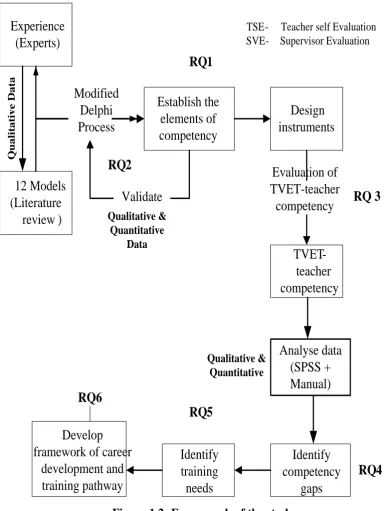
Since the main purpose of this study is to develop an empirical based competency profile for TVET-teacher in MARA institution, all the relevance research question needs to be answered. Figure 1.2 shows the framework of this study on every stage during the competency profile development. It was clearly shown that the modified-Delphi process is used throughout this study would answer all the research questions. Elements of competency are derived as a result of the modified-Delphi process. During this process, both qualitative and quantitative data were analysed. Qualitative data is gathers from the expert panels based upon their knowledge and experiences. Besides that, the input of qualitative data in the Delphi process is gathered from literature reviews.
This framework explained the whole study research that involved the development of competency profile, evaluation of TVET-teacher competency, the analysis of TVET-teacher competency gaps, the analysis of TVET-teacher training needs, and the establishment of the framework of career development and training pathway. During the development stage, the TVET-teacher competency profile based upon the elements of the competencies is established and verified.
Lastly, the career development framework is established based upon the training needs as a result of competency gap analysis. The last stage towards the establishment of framework of career development and training pathway will answer three research questions RQ4, RQ5 and RQ6.
12 Models
(Literature
review )
Experience
(Experts)
Establish the
elements of
competency
Modified
Delphi
Process
Design
instruments
Validate
TVET-teacher
competency
Evaluation of
TVET-teacher
competency
Identify
competency
gaps
Analyse data
(SPSS +
Manual)
RQ 3
RQ2
RQ1
RQ4
Identify
training
needs
Develop
framework of career
development and
training pathway
RQ5
RQ6
TSE - Teacher self Evaluation SVE - Supervisor Evaluation
[image:38.595.115.503.182.694.2]Q u a li ta ti v e D a ta Qualitative & Quantitative Data Qualitative & Quantitative
23
1.11 Structure of the thesis
Easterby-Smith, Thorpe, & Lowe (1991) suggested a thesis could have a unified structure. The structures of this thesis follow the outline introduced by Perry (1998). Firstly, Chapter 1 introduces the core research problem and then `sets the scene' and outlines the path that the examiner will travel towards the thesis' conclusion. The research itself as describe in each chapter are arranged as follows:
i. The research problem and propositions/hypotheses arising from the body of knowledge developed during previous research (Chapter 2);
ii. Methods used in this research to collect data about the hypotheses (Chapter 3); iii. Results of applying those methods in this research (Chapter 4);
iv. Discussion, interpretation of the findings and conclusions about the propositions/hypotheses and research problem based on the result's finding, including their place in the body of knowledge outlined previously (Chapter 5). This thesis was arranged in such that introduced overall picture of the research in Chapter 1. That included the background of the study, brief discussion of TVET-teacher training in Malaysia, transformation of TVET in Malaysia, overview the current research status on teacher competency and human resource, discuss problem statements, outline the research goals, define research questions, outline the significant to the study, explain the framework of the study, and lastly outline the structure of the thesis.
models of teacher competency. It further compared several TVET-teacher standards among countries, overview TVET-teacher competency and evaluation and competency profiling for the TVET-teachers, discuss the career development and training pathway for the TVET-teachers at MARA institutions, and lastly, give the summary for this chapter.
Chapter 3 obviously described the research methodology. It specifies the paradigm within which the study is located, its overall design, the conceptual framework, scope of study and research population, respondent, research instrument, data collections, test used for data analysis, and ethical consideration and limitation. In research design, it obviously explains the theory of triangulation, Delphi studied method, and the A-D-D-I (Analysis-Design-Development-Implementation) research designs phases. The chapter also explains sample setting, data collection and instrument, procedure for data analysis, and interpretation of teacher competency level. The procedures for data collection and analysis, and further highlights the validity and reliability measures adopted. Issues relating to research ethics (e.g. participants’ rights to confidentiality, anonymity and informed consent) and how these were handled in this study are also discussed in this chapter. Data analysis procedure for each research question was evidently shown in table, together with the type of statistical test and expected results. This chapter ends with the interpretation of teacher competency.
Chapter 4 present and discuss the results of the analyses performed in chapter three and relate the findings to the literature reviewed in chapter two. The flow of this chapter is arranged according to the analysis of demographic data, the analyses of the results that seek answers to the six-research question, and the summarisation of the chapter.
Chapter 5 provides a comprehensive discussion and interpretation of the findings. This chapter attempts to realise the six goal of this study by seeking answers to
266
REFERENCES
EDUCON 2011, Preparing TVET Educators for Next Generation. (2011).
Conference Report. Kuala Lumpur: Department of Polytecnic, Ministry of Education Malaysia.
Evans, N., Whitehouse, H., & Hickey, R. (2012). Pre-service Teachers’ Conceptions of Education for Sustainability. Australian Journal of Teacher Education, 37(7), 1-12.
Garavan, T. N., & McGuire, D. (2001). Competencies and workplace learning. Journal of Workplace Learning, 13(4), 144-163.
A 40 questions of labour competency. (2008). Retrieved data from CINTERFOR(ILO Latin America):
http://www.cinterfor.org.uy/public/english/region/ampro/cinterfor/temas/com plab/xxxx/index.htm
A modular curriculum. (2009). Retrieved May 24, 2011, from British Bible School : http://www.britishbibleschool.com/curriculum/modular/modular.html
A National Framework for Professional Standards for Teaching. (2003). Published Standard. Victoria, Australia: Institute for Teaching and School Leadership. Abebe, A. (2010). Influences of Individual and Contextual Factors onImproving the Professional Development of TVET Teachers in Ethiopia . Published PhD Thesis. Kaiserslautern: Technische Universität Kaiserslautern.
Accreditation of New Scheme Teachers in NSW Government Schools Policy. (2012). New South Wales: New South Wales Goverment.
Agriculture & Food Processing Industry Skill Gap Analysis. (2002). Washington: University of Washington.
Agusyana, Y., & Yusoff, S. (2010). Intepretation of Script Data and Research with SPSS 19. Sri Kembangan, Malaysia: Synergy Media.
Alhasan, N. U., & Tyabo, A. (2013). Revitalizing Technical and Vocational Education (TVET) for Youth Empowerment and Sustainable Developmen. Journal of Educational and Social Research, 3 (4), 149-154.
Ali, A. (2001). Incentive and initiative provided for the implementation of employability skills in TVET: The Malaysian Experience. Sixth Saudi technical conference & exhibition. Riyadh.
Ali, M. (2005). Developing the K-Based Human Resources: A Study of Industrial Electronic Technology Curriculum at Kolej Kemahiran Tinggi MARA Pasir Mas. Unpublished Thesis. Shah Alam: UiTM Shah Alam.
Ali, M. (2008). Development the K-based Human Resources: Overview the Industrial Technology Education at MARA Training Institute. The Second International Symposium on Educational Cooperation for "Industrial Technology Education" (pp. 487-496). Kariya-city, Aichi: Aichi University of Education.
Ali, M., Kaprawi, N., & Razzaly, W. (2010). Developmet of a New Empirical Based Competency Profile for Malaysian Vocational Education and Training Instructors. Proceedings of the 1st UPI International Conference on
Technical and Vocational Education and Training (pp. 108-117). Bandung: Universiti Pendidikan Indonesia.
Allee, V. (1997). Twelve Principles of Knowledge Managemant. Training and Development. Journal of Knowledge Managemant, 11(3), 71-75.
Altbach, P. G. (Fall 2003). The Costs and Benefits of World-Class Universities. International Higher Education.
Ambe, B. A., & Agbor, C. E. (2014). Assessment of Teacher's Professional Competence, Teacher's Teaching Experience on the Implementation of Environmental Education Curriculum in Cross River State, Nigeria. Journal of Educational and Social Research, 521-527.
Anderson, J. D. (2006). Qualitative and Quantitative research. COE Imperial. Ariadurai, S. A., & Manohanthan, R. (2008). Instructional Strategies in Teaching
268
Arter, J. (1993). Designing scoring rubrics for performance assessments: The heart of the matter. Portland: Northwest Regional Education Laboratory.
ASCO 4311-11 Australian General Electrician. (2009). Fact Sheet. Australia: National Training Information Service.
Atwater, L. (1998). The advantages and pitfalls of self-assessment in organizations. In J. Smither, Performance appraisal: State of the art in practice (pp. 331-369). San Francisvo: Jossey-Bass Publishers.
Bauer, W. (2007). International Perpective on Teacher and Lecturer in TVE. University Bremen-ITB Buletin.
Bauer, W., & Gollmann, P. (2008). Vocational Training Research for the Professionalisation of Vocational School Teacher. Bremen: ITB, Uni-Bremen.
Bertrand, O. (1998). Trend and Issues in Vocational Education and Training: A Perspective from Europe. Retrieved from Organisation of Ibroamerican States of Education, Science and Culture Website:
http://www.oei.org.co/iberfop/mexico4.htm#1
Beyer, B. K. (1995). Critical thinking. Bloomington, IN: Phi Delta Kappa Educational Foundation.
Bhargava, A. (2008). Research, Development and Commercialisation: Implications for Malaysia's High Education Sector. National Higher Education
Conference 2008. Kuala Lumpur: Asian Executive Programs Sdn. Bhd. Birnbaum, R. (2007, Spring). No World-Class University Left Behind. Retrieved
October 28, 2008, from International Journal Education, online edition: http://www.bc.edu/bc_org/avp/soe/cihe/newsletter/Number47/p7_Birnbaum.h tm
Bjekic, D., & Zlatić, L. (2006). Effects of professional activities on the teachers’ communication competences development. Co-operative Partnerships in Teacher Education: Proceedings of the31st Annual ATEE Conference (pp. 163-172). Portorož, Slovenia: Association of Teacher Education in Europe. BKT. (2007). Instrument for class monitoring TVET-teacher. Unpublish manual.
Kuala Lumpur: Technical and Vocational Division, MARA.