International Journal of Emerging Technology and Advanced Engineering
Website: www.ijetae.com (ISSN 2250-2459, ISO 9001:2008 Certified Journal, Volume 3, Issue 4, April 2013)
460
Influence of Working Fluid on the Performance of a Single
Loop Pulsating Heat Pipe
Ch. Sreenivasa Rao
1, AVSSKS Gupta
2, K. Rama Narasimha
3,
1 Madanapalle Institute of Technology & Science, Madanapalle, Andhrapradhesh, 517325
2 JNTU College of Engineering, Hyderabad, Andhra Pradesh, 500082
3 Centre for Emerging Technologies, Jain University, Bangalore, Karnataka, 562112
Abstract—Thermal management is the challenge of the day in electronic product development. Several cooling methods are employed to cool the electronic devices. Pulsating Heat Pipe (PHP) is being explored for electronic components cooling with promising results. In the present work, the experimental studies are carried out on a single loop PHP made of brass tubes with ID 1.5mm and OD 2 mm to analyse the characteristics of PHP. The transient and steady state experiments are conducted for various heat loads, fill ratio and working fluids. Acetone and Propanol are used as working fluids during the experimentation. The performance parameters of PHP like thermal resistance and heat transfer coefficient are evaluated. The results showed that Acetone exhibits better heat transfer characteristics of PHP compared to Propanol.
Keywords—Electronic cabinet cooling, Pulsating Heat Pipe, Experimental Studies, Thermal performance
1. INTRODUCTION
Downsizing of personal computers and advancing performance of processors has paved way for the development of micro miniature heat pipes to transfer heat from chips to heat sinks. The oscillating or pulsating heat pipe (PHP) is another promising heat transfer device for applications like electronic cabinet cooling. It is simple in structure with a coil filled with certain working fluid in it and extended from the heat source to sink. PHP does not contain wick structure to return the condensate back to the evaporator section unlike a common heat pipe. Instead, PHP uses the technique of transporting the working fluid by means of differential pressure across vapour plugs from evaporator to condenser and back. The vapour formed at the evaporator is pushed towards the condenser in the form of discrete vapour bubbles amidst pockets of fluid. The vapour gets condensed at the condenser and gives the heat and returns to evaporator to complete the cycle. The heat transfer in a PHP is due to the sensible heat and latent heat combination. PHP, first proposed by Akachi [1] as a passive cooling device is
gaining attention of many investigators. Although heat pipe technology is well established, the open literature available on PHPs is limited. The numerical studies on PHP reported in the literature are limited to the estimation of slug displacements in a PHP. Further the mathematical models proposed in the literature on PHP require experimental verification [2, 3 and 11]. In a few experimental investigations, the temperature variations in multiple-loop PHP have been measured and reported [4, 5, 6, 7 and 8]. Results of single loop PHP are also reported in few literatures [9 and 10]. The pattern of temperature variation and the related effect on the performance of PHP is to be explored in the light of physics. The pulsating motion of the fluid in a PHP warrants detailed investigations. The effect of working fluid and fill ratio on the performance of PHP is another area which requires detailed investigation. In the present work, the experimental studies are carried out on a single loop PHP made of brass to analyse the characteristics of PHP in the light of physics. Transient and steady state experiments are conducted at various heat loads and fill ratios with Acetone and Propanol as working fluids. The performance indicators such as thermal resistance and heat transfer coefficient are evaluated and analysed.
2. EXPERIMENTATION
2.1 Instrumentation made with the Experimental setup
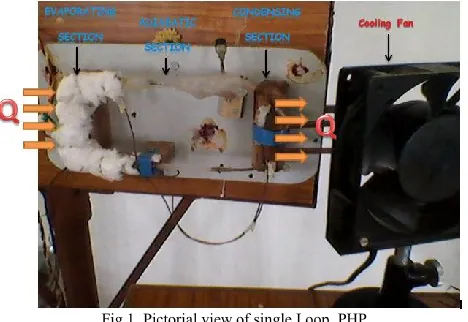
The basic components used in PHP are brass tubes, glass tubes, silicon rubber tubes, a non return valve, a tape heater and thermocouples.
International Journal of Emerging Technology and Advanced Engineering
Website: www.ijetae.com (ISSN 2250-2459, ISO 9001:2008 Certified Journal, Volume 3, Issue 4, April 2013)
461 The glass tube is made of borosil, which can resist temperature up to 1200°C. Silicon tubes with inner diameter 2 mm are used as the connectors between glass and copper tubes. They can resist temperatures up to 400° C. In order to maintain unidirectional fluid flow, a non-return valve is used. The valve is made of stainless steel and has inner diameter of 5mm. The ball and seating arrangement is used with a ball diameter of 4 mm.
Six ‗K- type‘ thermocouples are used for temperature measurement. The thermocouples can measure temperature up to 1260° C. The wire diameter of the thermocouples is 1mm and four thermocouples are connected in the evaporator section and two in condenser section at equal distances. A temperature data logger is used to record the temperatures at different locations.
A tape heater of 25 W capacity is attached to the evaporator section and acts as the source of heat input.
[image:2.612.335.553.305.470.2]The experimental setup is worked with two working fluids viz., Acetone and Propanol. The working fluid is injected into the heat pipe using a syringe.
Fig.1. Pictorial view of single Loop PHP
2.2 Experimental Procedure
Before conducting the experiment, it is ensured that there is no fluid inside the tubes. The required amount of working fluid is then filled through a syringe by opening one end of the non-return valve such that the fluid directly enters the evaporator section. Now the air is filled through the filling valve provided on the brass tube using another syringe. This is done to ensure simultaneous formation of liquid slug and vapour plug. The display unit is switched ON and the required wattage is set. A fan arrangement is used for cooling the fluid in the condenser section. The transient experiments are conducted and the various temperatures are recorded from the temperature data ogger. The experiments are continued till steady state is reached.
The measurement has inherent uncertainties. The thermocouple – temperature display system has an uncertainty of ± 2% of full scale. The manual reading of temperature with varying time contains an error of about 1% of reading.
3. RESULTS AND DISCUSSIONS
[image:2.612.51.285.368.529.2]Transient experiments have been conducted with different working fluids i.e., Acetone and Propanol and variations of temperature with time are recorded. The experiments are continued till steady state is reached.
Fig. 2. Transient evaporator temperature plot for Acetone at FR = 70%
Fig. 2 shows the variation of evaporator wall temperature with time for Acetone at a fill ratio of 70%. From Fig. 2, it can be seen that the variation of evaporator temperature with respect to time is periodic in nature at steady state. As there is a continuous pressure pulsation during the flow in a PHP, the evaporator temperature versus time curve is periodic in nature. It is also clear that the fluctuations in the evaporator temperature are more at higher heat input of 9 W. It is also clear that the system takes more time to reach the steady state at higher heat input of 9 W.
International Journal of Emerging Technology and Advanced Engineering
Website: www.ijetae.com (ISSN 2250-2459, ISO 9001:2008 Certified Journal, Volume 3, Issue 4, April 2013)
[image:3.612.324.553.132.297.2]462 Thus only the metal part of the PHP gets heated up which results in higher values of condenser temperature at lower heat input.
[image:3.612.48.275.155.491.2]Fig. 3. Transient condenser temperature plot for Acetone
Fig. 4. Temperature difference plot for Acetone
Figure 4 shows the variation of temperature difference between evaporator and condenser with time at different heat inputs for Acetone at a fill ratio of 70%. It is observed from the figure that the temperature difference between evaporator and condenser is considerably less at lower heat input of 8 W.
Fig. 5 shows the variation of temperature difference between evaporator and condenser with time for Acetone and Propanol. The temperature difference variation is considerably less for Acetone when compared to Propanol. During the course of present work, transient experiments are conducted for different fill ratio ranging from 60% to 90%.
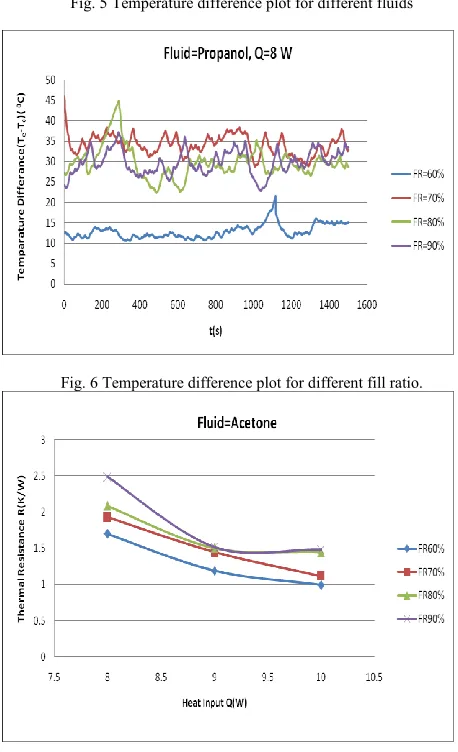
[image:3.612.47.272.181.293.2]Fig. 6 shows the temperature difference between evaporator and condenser at different fill ratios for Propanol at a heat load of 8 W. From the figure it is clear that the temperature difference between the evaporator and condenser is lower at a lower fill ratio of 60%. At lower fill ratio, more vapour phase exists in the tube with a consequent decrease in the temperature difference between evaporator and condenser.
Fig. 5 Temperature difference plot for different fluids
Fig. 6 Temperature difference plot for different fill ratio.
[image:3.612.323.552.309.685.2] [image:3.612.46.274.317.442.2]International Journal of Emerging Technology and Advanced Engineering
Website: www.ijetae.com (ISSN 2250-2459, ISO 9001:2008 Certified Journal, Volume 3, Issue 4, April 2013)
463 The Thermal Resistance of PHP is given by Rama
Narasimha, [9]
Q
T
T
R
e
c (K/W) (1)Fig. 7 shows the variation of thermal resistance with heat load for Acetone at different fill ratios. From the figure it is clear that the thermal resistance decreases with increase in heat input at all fill ratios considered. The fill ratio of 60% exhibits the lower values of thermal resistance compared to higher fill ratios. As the temperature difference between evaporator and condenser is less at lower fill ratio of 60% (Fig. 6), the magnitude of thermal resistance is also less. This shows that the heat transfer characteristics in a PHP are better at lower fill ratios. Fig.8 shows the variation of thermal resistance with heat load at steady state for Acetone and Propanol at a fill ratio of 70%.It is observed that the thermal resistance decreases with increase in heat load for both Acetone and Propanol. However, it is clear that the magnitude of thermal resistance is lower for Acetone compared to Propanol. As the temperature difference between evaporator and condenser is less for Acetone, the thermal resistance is also less.
Fig.8. Effect of Working Fluid on Thermal Resistance for Acetone at FR = 70%
The Convective heat transfer co-efficient of PHP is given byRama Narasimha, [9]
) (Te Tc A
Q h
W /m² K (2)
Fig. 9 shows the variation of heat transfer coefficient with varying heat load for Acetone at different fill ratios. From the figure, it is seen that the heat transfer coefficient increases with increase in heat load at all fill ratios. Higher values of heat transfer co-efficient can be seen at a lower fill ratio of 60% which indicates better performance of PHP.
Fig.9 Effect of fill ratio on Heat Transfer Coefficient for Acetone
Fig.10 Effect of Working Fluid on Heat Transfer coefficient at FR = 70%
International Journal of Emerging Technology and Advanced Engineering
Website: www.ijetae.com (ISSN 2250-2459, ISO 9001:2008 Certified Journal, Volume 3, Issue 4, April 2013)
464 4. CONCLUSIONS
In the present work, the experimental investigations are carried out on a single loop PHP. The effects of heat input, working fluid and fill ratio on the performance of PHP are studied.
Following conclusions are drawn from the present experimentation:
The evaporator and condenser wall temperature variation with time is found to be periodic.
The temperature difference between evaporator and condenser at steady state is found to be less for Acetone compared to Propanol.
Acetone is observed to be more suitable working fluid for PHP operation under different operating conditions.
At a fill ratio of 60%, the PHP is found to exhibit better heat transfer characteristics.
REFERENCES
1. Akachi, H., Structure Of Heat Pipe, US patent, 4921041, 1990
2. Shafii, B. M., Faghri, A., Zhang, Y., Thermal modeling of unlooped pulsating heat pipes, Journal of Heat Transfer Vol. 123, No. 6, 2001, pp. 1159-1172.
3. Zhang, Y., Faghri, A., Heat Transfer in a pulsating heat pipe with open end, International Journal of Heat Mass Transfer, Vol. 45, No. 4, 2002, pp. 755-764.
4. Cai, Q., Chung-lung Chen, Julie F. Asfia, ―Operating Characteristic Investigations in Pulsating Heat Pipe‖, journal of heat transfer, vol. 128, 2006, pp.1329-1334.
5. Charoensawan, P., Khandekar, S., Groll, M. and Terdtoon, P.,‖Closed loop pulsating heat pipes, part-A; Parametric experimental investigations‖, Applied Thermal engineering, Vol.23 No.6, 2001, pp.2009-2020.
6. Khandekar, S., ―Multiple Quasi- Steady States in a Closed Loop Pulsating Heat Pipe‖, NTUS-IITK 2nd joint workshop in mechanical, Aerospace and Industrial Engineering, April 5-6, 2008, IIT, Kanpur, India.
7. Khandekar, S., ―Thermo Hydrodynamics of Pulsating Heat Pipes, Ph.D Dissertation, University of Stuttgart, Germany, 2004.
8. Meena, P., Rittidech, S., Tammasaeng, P,‖ Effect of inner Diameter and inclination angles on operation limit of closed-loop Oscillating heat pipes with check valves‖, American journal of Applied Sciences, vol. 1, No.2,2008,pp.100-103. 9. Rama Narasimha, K., ―Studies on Pulsating Heat pipes‖ Ph
D Dissertation, Visveswaraya Technological University, India, 2009
10. Rama Narasimha, K., Rajagopal, M.S., Sridhara, S.N., ―Influence of Heat Input, Working Fluid and Evacuation Level on the Performance of a Pulsating Heat Pipe‖ Journal
of Applied Fluid Mechanics, Vol. 5, No. 2, Issue 10, 2012, Accepted for Publication.