On new footnotes to Shingo
Koskela, LJ
Title On new footnotes to Shingo
Authors Koskela, LJ
Type Conference or Workshop Item
URL This version is available at: http://usir.salford.ac.uk/9423/
Published Date 2001
USIR is a digital collection of the research output of the University of Salford. Where copyright permits, full text material held in the repository is made freely available online and can be read, downloaded and copied for noncommercial private study or research purposes. Please check the manuscript for any further copyright restrictions.
ON NEW FOOTNOTES TO SHINGO
Lauri Koskela1
ABSTRACT
The Toyota Production System (TPS) has continually inspired scholars of production management to a search for its essence. Two new interpretations have recently been advanced.
Firstly, Johnston has argued that conventional production management is based on an approach to management called management-as-planning. The central assumption is that intentional activity is based on a representation of the world. Thus, management is essentially about planning, i.e. manipulation of that representation. Instead, the TPS is essentially based on an approach called management-as-organizing. Here it is assumed that human activity is inherently situated, i.e. a response to the situation in question.
Secondly, Spear and Bowen have claimed that the key to understand the TPS is the idea of the scientific method. When a production standard is defined, it also establishes a hypothesis that can be tested. Thus, they seem to emphasize the approach of management-as-learning as the foundational idea behind the TPS.
It is shown that while providing fresh and deeper understanding to management in the TPS, these interpretations are partial and can be positioned inside the view on production management presented by Shingo. In fact, based on Shingo and other extant analysis, it can be argued that there are four approaches to management that are applied in tight coupling and synergistically in the TPS: management-as-organizing, management-as-planning, management-as-adhering and management-as-learning. It is concluded that the superiority of the TPS in comparison to its rivals is founded not only on a better theory of production, but also on a better theory of management.
KEY WORDS
Toyota production system, management, organizing, planning, adhering, learning.
1
INTRODUCTION
The Toyota Production System (TPS) has continually inspired scholars of production management to a search for its essence. There have been two lines of inquiry2. The first is
production-centered. Earlier, the author has presented, based on the seminal analysis of Shingo (1988), a theoretical approach called TFV model (Koskela 2000), which can be claimed to provide a theoretical explanation for various features of the TPS. According to this model it is the simultaneous application of the transformation and flow view to production (and, to a lesser extent, the value generation view) that has stimulated the emergence of the TPS. Also the interpretation of Womack and Jones (1996) belongs largely to this line3.
However, this paper focuses on a second, management-centered4 line of inquiry. While the first roots of this line can again be found from Shingo (1988), two new theoretical interpretations have only recently started to direct more attention to management theories underlying the TPS.
Firstly, Johnston (1995) has argued that conventional production management is based on an approach to management called management-as-planning. The central assumption is that intentional activity is based on a representation of the world. Thus, management is essentially about planning, i.e. manipulation of that representation. Instead, the TPS is essentially based on an approach called management-as-organizing. Here it is assumed that human activity is inherently situated, i.e. a response to the situation in question.
Secondly, Spear and Bowen (1999) have claimed that the key to understand the TPS is the idea of the scientific method. When a production standard is defined, it also establishes a hypothesis that can be tested. Thus, they seem to emphasize an approach that is called here management-as-learning as the foundational idea behind the TPS.
The findings of Johnston are seemingly in stark contrast with Spear and Bowen. While Johnston finds that in the TPS, the operations of large assembly shops are managed with a minimum of detailed planning, Spear and Bowen assert that activities and production flows are rigidly pre-specified. This paper purports to show that while providing fresh and deeper understanding to management, these interpretations are partial and can both be positioned inside the view on production management presented by Shingo. Thus, it seems that advances of production management just consist of a series of footnotes to Shingo5.
The paper is structured as follows. The arguments of Johnston, and Spear and Bowen are respectively presented in the two first sections. The following section tries to integrate these views, and other related arguments, into a wider hypothesis on the management theory of the Toyota Production System, based on the views of Shingo. Finally, conclusions are drawn from the discussions presented.
2
That there have been two lines of inquiry, one focusing on management and the other on production, does not as such mean that there are two separate domains for research. Rather, it could be argued that these two domains are intimately intertwined: a particular theory of production tends to be associated with a theory of management that is consistent with it. However, the clarification of such interrelations is a task for future research.
3
Of the five well-known principles of lean thinking as defined by Womack and Jones (1996), four are production-centered, and one (Pursue perfection) is management-centered.
4
Note that we are here dealing with management at the level of operations management, rather than with management in general.
5
THE ARGUMENT OF JOHNSTON: MANUFACTURING PRACTICES ARE MADE TACIT IN THE TPS
COMPUTER AIDED PRODUCTION MANAGEMENT VS. TOYOTA PRODUCTION SYSTEM The starting point in Johnston's (Johnston 1995, Johnston & Brennan 1996) argument is a comparison between computer aided production management, such as MRP II, and the TPS6. Let us recapitulate the salient features of MRP II and the TPS, following Johnston.
In MRP II, the company's manufacturing processes for the products made are represented in the Product Structure database, furthermore the stocks of materials and intermediary products are modeled, as well as customer orders (or assumed demand). Based on these models, a Master Production Schedule is prepared and revised periodically. On a more frequent basis, often weekly, an operational level schedule for the initiation of purchase and production orders is prepared. This schedule is given to purchase and production personnel. This method has been very influential and widely known. However, it has been very difficult for companies to orderly implement it. Among the problems are the following. The method is sensitive to inaccuracies in forecasts or product data. Variations required by customers or quality defects that require rework are problematic to handle. Frequently events arise that corrupt the plan at a faster rate than that at which it is practical to re-plan. The model stops at the point where schedules are handed to personnel. A huge amount of non-value-adding work is required to enter all the data needed into the computer.
Instead, in the TPS, the operations of even large assembly shops are managed with a minimum of planning, this being achieved by the adoption of a number of changes in the way production is organized with respect to plant layout (production cells organized according to the flow of production), management structures (self-managing, multi-skilled production teams) and information systems (production order through simple manual signals from a downstream stage). This kind of production systems have been found to be efficient and responsive to customer requirements.
MANAGEMENT-AS-PLANNING AND MANAGEMENT-AS-ORGANIZING
The central argument of Johnston is that conventional production management is based on an approach to management called management-as-planning, whereas the TPS is based on another approach called management-as-organizing. Let us briefly present these approaches, based on Johnston's (Johnston 1995 and 2000, Johnston & Brennan 1996) overviews.
In management-as-planning, the core assumption is that intentional activity is based on a representation of the world. Thus, management is essentially about planning, i.e. manipulation of that representation. Here, management at the operations level is seen to consist of the creation, revision and implementation of plans. This approach to management views a strong causal connection between the actions of management and outcomes of the organization. By assuming that translating a plan into action is a simple process, it takes plan production to be essentially synonymous with action.
Since the 1980's, this approach has been increasingly criticized. There are several strands in the critique against the management-as-planning model. First, it has been held that it not generally possible to maintain a complete and up-to-date representation of the world and intended action (i.e. plan) in it. Secondly, this model assumes that the organization consists of a management part and an effector part. This leads to a centralized
6
mode of management. Thirdly, the plans push tasks to execution without taking the status of the production system into account. The two last aspects mean that this model “leaves the task of management essentially uncoupled from everyday activity” (Johnston & Brennan 1996). Fourthly, the model does not acknowledge that practices (say, of production) do not necessarily require an external representation.
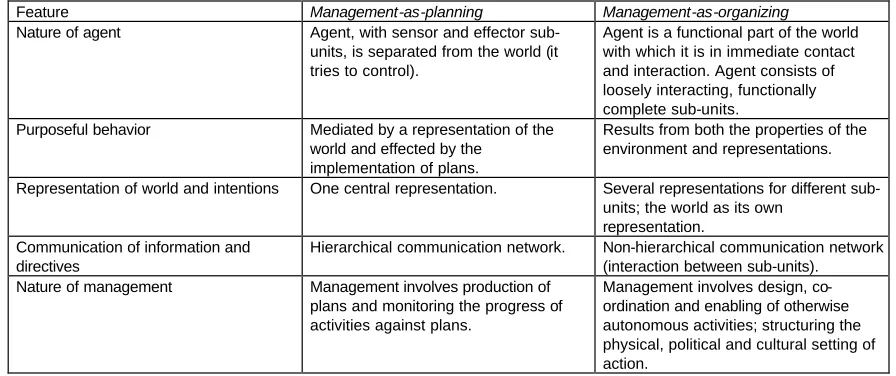
Instead, the TPS is essentially based on an approach called management-as-organizing. Here it is assumed that human activity is inherently situated, i.e. a response to the situation in question. Thus, the structured nature of the environment may contribute to purposeful acting. Another important difference to the management-as-planning model is that the agent consists of modular, interacting sub-units, i.e. they are capable of sensing, planning and acting. Instead on central representation, it is assumed here that there are several representations for different sub-units. On the other hand, the world may act as its own representation. Communication is non-hierarchical, based on interaction between sub-units. In this approach, management involves design, co-ordination and enabling of otherwise autonomous activities. Especially, management is focused on structuring the physical, political and cultural setting of action.
[image:5.595.64.512.420.608.2]It is important to note that it is not a question of internally consistent theories, but of theoretical orientations, that have implicitly been used. An overview on them is given in Table 1. Also it is noteworthy that the approach of management-as-organizing is not exclusive; rather representations and plans are accepted as one possible basis of purposeful action.
Table 1. The approaches of planning and management-as-organizing (based on Johnston’s overviews).
Feature Management-as-planning Management-as-organizing
Nature of agent Agent, with sensor and effector sub-units, is separated from the world (it tries to control).
Agent is a functional part of the world with which it is in immediate contact and interaction. Agent consists of loosely interacting, functionally complete sub-units.
Purposeful behavior Mediated by a representation of the world and effected by the
implementation of plans.
Results from both the properties of the environment and representations.
Representation of world and intentions One central representation. Several representations for different sub-units; the world as its own
representation. Communication of information and
directives
Hierarchical communication network. Non-hierarchical communication network (interaction between sub-units). Nature of management Management involves production of
plans and monitoring the progress of activities against plans.
Management involves design, co-ordination and enabling of otherwise autonomous activities; structuring the physical, political and cultural setting of action.
DISCUSSION
The analysis of Johnston gives a theoretical explanation for the difference between push and pull systems in production control, elegantly characterized by Hopp and Spearman (1996) as follows: "Push systems schedule the release of work, while pull systems
authorize the release of work on the basis of system status." Simply, push systems operate on the basis of the plan, while pull systems take the situation into account. The first paper of Johnston (1995) must be considered as seminal in this regard.
structuring of environment in the TPS aims at making the productive situation transparent and practices visible (this does not exclude the possibility of part of practices being tacit). In order to justify this argument, let us analyze visual management, a part of the method arsenal of the TPS.
Visual management
Already Stalk and Hout (1990) observed that companies practicing time compression had adopted an objective to make the production process transparent and observable for facilitation of control and improvement: “to make the main flow of operations from start to finish visible and comprehensible to all employees”. This can be achieved by making the process directly observable through organizational and physical means, measurements, and public display of information.
Later on, Galsworth (1997) has defined a visual workplace, resulting from visual management, as follows:
A visual workplace is a work environment that is explaining, ordering, self-regulating, and self-improving - where what is supposed to happen does happen, on time, every time, day and night.
In a theoretical sense, transparency means a separation of the network of information and the hierarchical structure of order giving (Greif 1991), which in classical organization theory are identical. The goal is thus to substitute self-control for formal control and related information gathering.
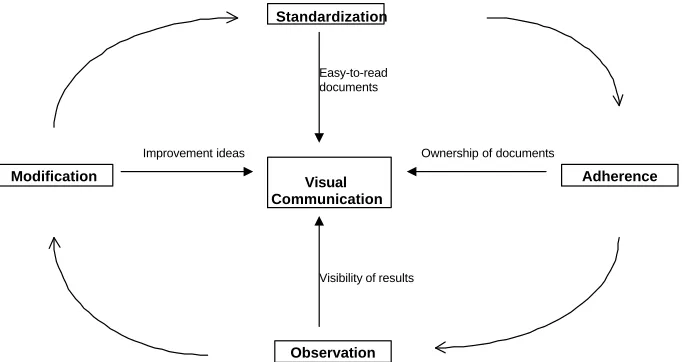
Interestingly, all authors on visual management stress the role of standards (Figure 1): a standard is a point of reference that simultaneously provides the group with a point to adhere to and a point of departure (Greif 1991).
Adherence Modification
Observation Standardization
Visual Communication
Easy-to-read documents
Improvement ideas Ownership of documents
[image:6.595.147.488.434.615.2]Visibility of results
Figure 1. Standards, visual communications and improvement according to Greif (1991).
THE ARGUMENT OF SPEAR AND BOWEN: THE TPS CREATES A COMMUNITY OF SCIENTISTS
MANAGEMENT-AS-LEARNING
The central argument of Spear and Bowen (1999) is that whenever Toyota defines a specification, it is establishing sets of hypotheses that can be tested. Thus, the scientific method is followed.
Spear and Bowen assert that this scientific experimentation is realized through four tacit rules, which form the essence of the TPS - its DNA:
Rule 1. All work shall be highly specified as to content, sequence, timing, and outcome.
Rule 2. Every customer-supplier connection must be direct, and there must be an unambiguous yes-or-no way to send requests and receive responses.
Rule 3. The pathway for every product and service must be simple and direct.
Rule 4. Any improvement must be made in accordance with the scientific methods, under the guidance of a teacher, at the lowest possible level in the organization.
It is also asserted that all these rules require built-in tests to signal problems automatically. This continual response to problems is the key aspect.
By requiring to follow a highly standardized method of work, Rule 1 forces to test two hypotheses: first, whether the person in question is capable of performing correctly and second, whether performing the activity creates the specified outcome. On the other hand, thanks to the detailed specification of the task, it is instantly clear when the worker deviates from the specification. Rule 1 is followed, beyond routine activities, also in complex and infrequent activities.
Rule 2 is typically realized through kanban cards, for part requests, and andon cords, for assistance requests. When encountering a problem, a worker is expected to call for assistance immediately, and the designated assistant is likewise supposed to intervene without delay. In this way, problems are shared and solved company-wide.
Rule 3 stipulates that every product follows a pre-specified path: parts do not flow to a next available workstation but to a specific workstation. Here the implied hypotheses are that every supplier connected to the pathway is necessary, and any supplier not connected is not necessary.
Rule 4 implies a massive investment to learning. All managers are expected to be able to do the jobs of everyone they supervise. They are also expected to be able to teach their workers how to solve problems in the scientific method. In addition, there are a number of internal consultants in the Toyota Group.
These rules have also organizational impacts: they create, by pushing problem-solving to the lowest possible level, an organization with a nested modular structure, where one part can be changed without unduly interfering with other parts. This produces the paradoxical combination of rigid specification and flexibility and creativity.
DISCUSSION
Standardization
The essence of Rules 1 and 3 has in prior literature been mainly discussed under the notion of standard - a term used by Spear and Bowen only incidentally.
The ultimate question is: Why do we need standardization of operations? Maybe the oldest motivation is from the originators of Scientific Management, Taylor and Gilbreth. Productivity increases when even the least experienced worker is using the One Best Way of doing the job, without wasteful motions. This is mentioned also by Monden (1994) in his analysis of the TPS as one of three motivations. The second reason is to achieve line balancing among all processes. The third goal is to achieve the minimum quantity of work-in-process. Both of these two lastly mentioned benefits are based on increased predictability of operations. This can be generalized: standardization increases consistency and reduces thus variability, the universal enemy in production (Hopp & Spearman 1996).
Then we have the issue of learning. As Spear and Bowen present as their key argument, deviations from a standard provide a rich possibility of learning. However, there is a second argument. Each standard can be seen as a starting point for further improvement (Nakamura 1993), an explicit hypothesis of best practice that has to be constantly challenged. Without a standard, we would not readily know what we are trying to improve7.
It is worth noting that the results of Adler et al. (1999) corroborate the findings of Spear and Bowen regarding the use of standardization both in routine and in non-routine activities.
Visual management
Rule 2 is in the domain of visual management, discussed above. However, also Rules 1, 3 and 4 are actually either realizing visual management or facilitated by it.
Scientific method
Neither can we accept much novelty in the scientific method described by Spear and Bowen in Rule 4. It must be interpreted as a systematic use of the Deming cycle of Plan, Do, Check, Act, originally suggested by Shewhart (1931). It has been widely known8 in Japan since 1950. Also the current Western view is that effective TQM teaches employees how to apply science to improve every-day decision-making (Wruck & Jensen 1994). However, the innovative aspect found by Spear and Bowen is that all operations are treated as hypothesis testing, rather than those specified as experimentation in advance.
Comparison to process discipline
All in all, the merits of the exposé of the TPS by Spear and Bowen can be made clear by comparing the TPS to a novel Western approach to manufacturing, process discipline9 (Edelson & Bennett 1998), which also focuses on standardization and the scientific method.
7
Says Imai (1986): "There can be no improvement where there are no standards. The starting point in any improvement is to know exactly where one stands."
8
Says Deming (Walton 1986): "The Shewhart cycle was on the blackboard for top management for every conference beginning in 1950 in Japan. I taught it to engineers - hundreds of them - that first hot summer. More the next summer, six months later, and more six months after that. And the year after that, again and again."
9
However, both standardization and the scientific method are applied in a centralized manner in process discipline, and there is little emphasis on a learning process based on analysis of root causes for deviations10. Neither is visual management applied in process discipline. Thus, the hypothesis arises that at least in discrete manufacturing, process discipline is less effective than the TPS.
WHAT IS THE MANAGEMENT THEORY OF THE TPS?
What, then should be held as the management theory of the TPS, based on the considerations above? Firstly, we have to note that the above-mentioned contradiction between Johnston and Spear and Bowen is mostly terminological. By planning, Johnston means such issues as which parts are needed, when and by whom11? Instead, Spear and Bowen concentrate on the actual work methods to be used and the configuration of the material flow12. Thus, it is not inconsistent to accept the core theses in both sources. However, for seeking further theoretical clarification, let us investigate to which extent these recent contributions match with the views of Shingo on a theory of production management.
SHINGO'S VIEW ON MANAGEMENT
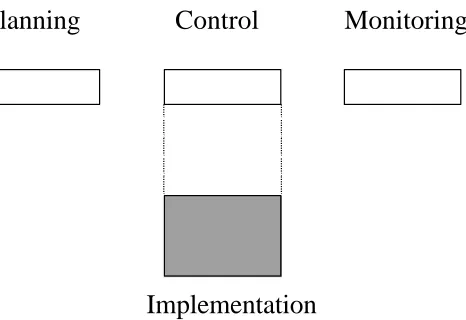
Shingo (1988) divides management into three chronological aspects or functions: planning, control (with implementation as its flip side), and monitoring (Figure 1). Let us analyze the essence of these functions, as defined by him:
• Planning establishes a static structure. Itcreates the standards to be used as guidelines for implementation. Planning should thus be done in advance.
• Control is a dynamic activity involving instructing, motivating, and maintaining so that implementation will be according to plan. Control is performed by managers but also by workers. Furthermore, mechanical means, like poka-yoke may be used for enhancing control.
• Implementation: Processes and operations are implemented as planned. (Implementation is not a managerial function13, but is presented here for clarity).
• Monitoring is done after implementation is completed. The results of implementation are compared with the standards established during planning. Deficiencies in implementation, control, and planning are looked for. Lessons learnt are used in the next planning cycle.
10
Admittedly, the industrial context of process plants where process discipline has originated often requires centralized approach: it is indeed not appropriate to encourage autonomous experiments by different groups in a paper mill or a nuclear power plant, where there is one big process affected by a multitude of inputs.
11
This kind of "quantitative management" has largely been the realm of Western production control up to now.
12
This could be called "qualitative management".
13
Planning
Control
Monitoring
[image:10.595.183.416.92.252.2]Implementation
Figure 1. Chronological aspects, or functions of management according to Shingo (1988).
How should we interpret theoretically this view of Shingo? Firstly, we can observe that Shingo subscribes to the view that management involves making a representation of the production - a plan. However, by planning Shingo refers both to production system design and (action) planning proper14. According to him, improved planning has a decisive effect: control becomes easy, and the control system may be simple. A high level of production benefit can be expected.
Secondly, Shingo criticizes the view that management is only or essentially about planning (Shingo 1988, p 301): "There is a tendency in Europe and the United States to believe that only the planning and organizing function needs to be perfected". Furthermore (p. 23): "…the control function of management is missing in Western management philosophies." He asks whether this kind of omission is the result of ignorance about actual conditions on production shop floors or an attachment to theoretical rather than fact-based pursuits (p. 301).
Thirdly, according to Shingo, improvement15, realized through monitoring, is an essential part of production. It involves correcting whatever deficiency in planning, control and implementation function is causing the problem observed.
Thus, it seems that there are four approaches to management, three of which have also been discussed and illuminated by Johnston and Spear and Bowen. Let us call these management-as-organizing, management-as-planning, management-as-adhering16 and management-as-learning. The outputs of these functions are characterized in Table 2.
Table 2. Functions of management and their outputs in the TPS.
Function of management Output
14
"Planning or organizing means establishing basic process plans and conditions of operation. How well this organizing function is carried out determines the basic level of productivity and quality". (Shingo 1988, p. 300).
15
It should be added that Shingo sees two other types of improvement. Firstly, fundamental improvement: "Thus we can begin to achieve innovative overall improvements only by improving not our techniques but the higher-level systems they support and, still higher, the concepts and premises that justify them." (Shingo 1988, p. 36). Secondly, goal-based improvement: "…the most important thing in making improvements is the relentless pursuit of goals" (p. 207).
16
Management-as-organizing (Physical and organizational) production system
Management-as-planning Representation of intended production activities (plans and standards) Management-as-adhering Realization of production activities as intended (implementation) Management-as-learning Improvement of the production system, plans and standards, as well as
implementation
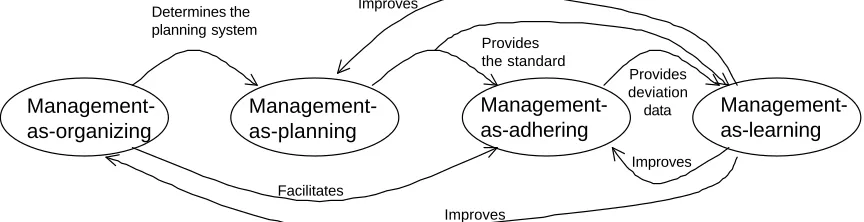
The primary interrelations between these functions in the TPS are depicted in Figure 2. Organizing17 creates the (simple) planning system and facilitates adhering by providing a structured environment (especially visual workplace). Planning provides a standard both for adhering and learning. And learning improves, starting from the standard or deviations to it, all other functions. Thus, the crucial difference between the TPS and the conventional production system is that these four functions are tightly coupled and synergistically applied in the TPS, whereas in conventional production they are weakly linked.
Management-as-organizing
Management-as-planning
Management-as-adhering
Management-as-learning
Improves
Improves Improves
Facilitates
Provides the standard Determines the
planning system
[image:11.595.73.505.299.410.2]Provides deviation data
Figure 2 Interaction between managerial functions in the TPS.
CONCLUSIONS
It is concluded that the superiority of the TPS in comparison to its rivals is founded not only on a better theory of production, but also on a better theory of management. In consequence of this, the Toyota production system has a better plan (in the meaning of plan materialized in the production system, and the production plan proper), better adherence to the plan, and more improvement accruing from each production run than the conventional Western production system.
It should be clear that the management theory of the TPS – or operations management in general – is not yet mature. We have here an interesting and important research frontier that has been largely neglected. Let us mention some interesting topics for further research. We need more empirical studies on what actually happens in the TPS. We need to structure our theoretical knowledge into testable hypotheses, as suggested by Burbidge (1990). We need to test whether the management theory, as presented, is general enough for facilitating the development of new production systems in different industries and settings (Lillrank 1995). Especially, it has to be studied, how this theory should be interpreted in non-routine, uncertain and unique production settings18.
17
Here, for shortness, we speak about organizing instead of management-as-organizing, and correspondingly with regard to other managerial functions.
18
REFERENCES
Adler, Paul S. Goldoftas, B. & Levine, David (1999) Flexibility Versus Efficiency? A Case Study of Model Changeovers in the Toyota Production System. Organization Science, Vol. 10, No. 1, pp. 43-68.
Ballard, Glenn & Howell, Gregory (1998) Shielding Production: Essential Step in Production Control. Journal of Construction Engineering and Management, Vol. 124, No. 1, pp. 11 - 17.
Burbidge, John L. (1990) Production control: a universal conceptual framework.
Production Planning & Control, Vol. 1, No. 1, pp. 3 - 16.
Edelson, Norman M. & Bennett, Carole L. (1998) Process Discipline. Quality Resources, New York. 216 p.
Galsworth, Gwendolyn (1997) Visual Systems: harnessing the power of a visual workplace. AMACOM, New York. 320 p.
Greif, Michel (1991) The Visual Factory. Productivity Press, Cambridge. 281 p.
Hopp, Wallace & Spearman, Mark. (1996). Factory Physics: Foundations of Manufacturing Management. Irwin/McGraw-Hill, Boston. 668 p.
Imai, Masaaki (1986) Kaizen, the key to Japan’s competitive success. Random House, New York. 259 p.
Johnston, R.B. (1995) Making manufacturing practices tacit: a case study of computer aided production management and lean production. J. Opl. Res. Soc. 46, 1174-1183. Johnston, R.B. & Brennan, M. (1996) Planning or Organizing: the Implications of Theories
of Activity for Management of Operations. Omega, Int. J. Mgmt. Sc., Vol. 24, No. 4, pp. 367-384.
Johnston, R.B. (2000) Situated Action, Structuration and Actor-Network Theory: An Integrative Perspective. ECIS 2001 the 9th European Conference on Information Systems, Bled, Slovenia (under review).
Koskela, Lauri (2000). An exploration towards a production theory and its application to construction. Espoo, VTT Building Technology. 296 p. VTT Publications; 408. WWW:
http://www.inf.vtt.fi/pdf/publications/2000/P408.pdf
Lillrank, Paul (1995) The Transfer of Management Innovations from Japan. Organization Studies, 16/6, pp. 971 - 989.
Monden, Yasuhiro (1994) Toyota Production System. Second Edition. Chapman & Hall, London. 423 p.
Nakamura, S. (1993) The New Standardization. Productivity, Portland, OR. 268 p. Shewhart, W.A. (1931) Economic Control of Quality of Manufactured Product. Van
Nostrand, New York. 501 p.
Shingo, Sh. (1988). Non-stock production. Productivity Press, Cambridge, Ma. 454 p. Spear, Steven & Bowen, H. Kent (1999) Decoding the DNA of the Toyota Production
System. Harvard Business Review, September-October, pp. 97-106.
Stalk, G. Jr. & Hout, T.M. (1990) Competing against time. Free Press, New York. 285 p.
Walton, Mary (1986) The Deming Management Method. Putnam, New York. 262 p. Womack, James P. & Jones, Daniel T. (1996) Lean Thinking. Simon & Schuster, New
York. 350 p.
Wruck, Karen H. & Jensen, Michael (1994) Science, specific knowledge, and Total Quality Management. Journal of Accounting and Economics, Vol. 18, pp. 247-287.