Blackboard to support the teaching of
engineering undergraduates
Laws, EM
Title A pilot programme into the use of Blackboard to support the teaching of engineering undergraduates
Authors Laws, EM
Type Conference or Workshop Item
URL This version is available at: http://usir.salford.ac.uk/1194/ Published Date 2002
USIR is a digital collection of the research output of the University of Salford. Where copyright permits, full text material held in the repository is made freely available online and can be read, downloaded and copied for noncommercial private study or research purposes. Please check the manuscript for any further copyright restrictions.
A Pilot Programme into the Use of Blackboard to Support the
Teaching of Engineering Undergraduates
Elizabeth M Laws, [email protected]
Abstract
Supporting engineering students throughout their studies places a heavy demand on academic staff. Increasingly, to meet the challenge of widening participation, it is necessary to provide help beyond the scheduled lecture and tutorial periods and to cope with a range of student abilities particularly in those topics which are mathematically based. An efficient and effective way of providing this is through E-learning and at Salford, the Blackboard Web portal has been used to provide this support. Through the use of Blackboard a convenient and effective means of enhancing and improving student learning has evolved. The visual impact of presenting teaching materials using PowerPoint has been evaluated and using this medium an opportunity for students to re-play a lecture in their own time has been provided. These presentations have been integrated into Blackboard.
Introduction
The teaching of engineering undergraduates is demanding with typical class contact hours being considerably greater than for other degree subjects. Level 1 on most programmes includes an element of revision as students from differing backgrounds and educational systems are brought to the same end-point in preparation for more demanding topics at levels 2 and 3. With widening participation high on the agenda of all Institutions increasingly disparate student cohorts are faced and increasingly the need to be able to cope with a wide student ability range is required. Unfortunately as these pressures are faced, both external and internal constraints restrict the time that can be devoted to the teaching of students as staff strive to meet other demands on their time, for example research and the increasingly financial imperative of generating more revenue. Thus, at a time when students need more direct support, it is likely that the majority of staff have less time to allocate to them.
ISBN 0902896660
The First Step
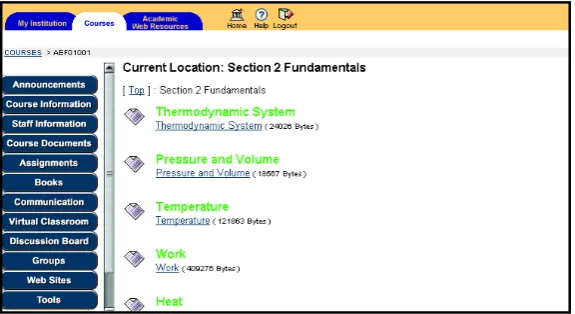
[image:3.595.186.474.192.349.2]The approach adopted was a simple one, the hard-copy material which was already provided for students in the form of printed material was simply re-packaged in small sections using Adobe Acrobat and posted to Blackboard. The advantage of this was that immediately any restriction to black and white was eliminated and colour could be retained. Thus in the E-learning environment it was possible to present material so that it had visual impact with important concepts or equations emphasised.
Figure 1: Blackboard 5.5 Entry Screen
(2) Pressure, p
The pressure, p, is defined as the force ex
erted by the system on unit area of the boundary in a direction normal to the section of the boundary.
-2 Force
0 ( ) (Units: Nm ) Area
The pressure at a point is the: t Area
Note that we are not concerned with the interpretation of pressure as the change in momentum of molecules impacting on the system boundary as in the kinetic theory of gases i.e. we take the MACROSCOPIC view rather than the MICROSCOPIC of the system.
Microscopic - dimensions of the order of the molecular size or smaller
Figure 2: Sample Material Page
Another advantage of the Virtual Learning Environment (VLE) was, almost paradoxically, the relationship and rapport that could be developed between lecturer and student. Whilst on the one hand the move to a VLE distanced physically, the deliverer and the student the communication provided through the VLE had distinct and identifiable advantages over traditional delivery methods. For the lecturer it was possible to interrogate the system to find out who had (or had not,) done what and when. Through observation of the results of the on-line assessments provided it was possible to judge the progress of individual students and if necessary provide tailored support and guidance to address at an early stage areas of difficulty. For the student the facility to easily contact the lecturer via e-mail through the VLE to ask for help was a definite bonus enabling even the most reluctant student to seek help.
For the two level 1 modules for which Blackboard was used in the academic year 2000-2001, Engineering Thermodynamics and Fluid Mechanics, the following priorities were identified:
The provision of all the course notes packaged in a form readily accessible to students;
The inclusion of the tutorial exercises followed some time later by the corresponding solutions;
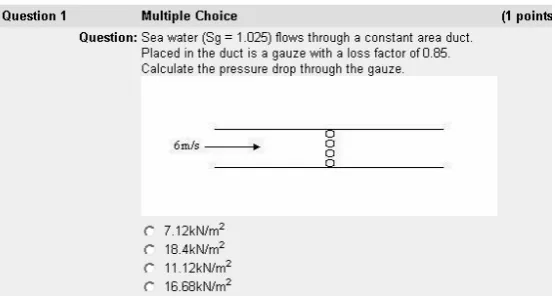
On-line assessments which were scheduled to fit in with the appropriate stage of the module delivery;
Access to past examination papers as the end of module approached; A re-vamp of the site after completion of the module so that any
student who failed could obtain support over the summer vacation in preparation for the re-sit examinations in September.
Figure 3: Staff Entry Page Blackboard 5.5
Early Feedback
The results obtained from the first module supported through Blackboard were encouraging. Many students commented favourably on the support they had received through Blackboard in the module evaluation. Whilst not every student with access to the resource used it the analysis of the examination results at the end of semester 1 was very positive. No user of Blackboard failed the module and the module average of those using Blackboard was 15% higher than those who chose not to use it. A steady use of Blackboard throughout the semester was evident with a definite crescendo prior to the examination date. Over the Christmas vacation period whilst students were at home and revising there was a continued use of the site.
ISBN 0902896660
Exam Results of Blackboard Users (Engineering Thermodynamics)
0 50 100
0 100 200 300
Blackboard Accesses
Ex
a
m
M
a
rk
s
[image:5.595.178.456.594.743.2]Semester 1 Level 1
Figure 4: Correlation between Blackboard Usage and Examination Performance Module Average 51% Blackboard Users 59.5% Non-Blackboard Users 45%.
Fluid Mechanics, taught in semester 2, was the second module for which Blackboard was used. A similar site was produced and slightly more adventurous assessments were attempted. In addition, the laboratory programme for which self-running PowerPoint presentations had been prepared previously was also built into the Blackboard site. This enabled students to study the laboratory exercises prior to the scheduled laboratory session and arrive fully prepared and able to make good use of their laboratory time. Again a steady take up of users throughout the module was established and a good correlation between Blackboard usage and module success demonstrated.
Further Developments
ISBN 0902896660
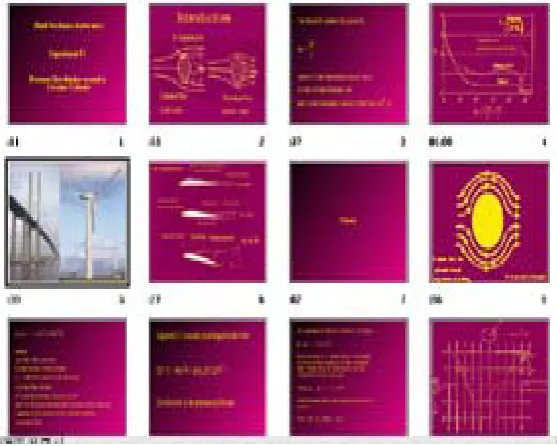
Figure 6: Fluid Mechanics Module Laboratory Presentation Available through Blackboard
There was also time to review other E-learning sites and to provide useful Web access links into the Blackboard sites to include an element of interactivity. Whilst the Web is a tremendous resource for students it can be extremely time consuming to locate a particular site and evaluate its usefulness. Blackboard provided a means of building in web links that dovetailed closely with the module content. This facility was found to be particularly useful in the support of the level 2 module Aerofluid Dynamics E2.1. This module, taught to both Aeronautical and Mechanical Engineering students, which ran for the first time in semester 1 for the academic year 2001-2002, replacing two previous modules - Fluid Mechanics E2.1, which was taught to Mechanical Engineering students and Aerodynamics E2.1 taught to Aeronautical Engineering students.
The essential elements of both of these earlier modules were the same, ideal potential flow and one-dimensional compressible flow theory. The economy of scale by teaching the two cohorts in common was considered to be advantageous hence the move to the common module entitled Aerofluid Dynamics. In preparing the Blackboard module to support Aerofluid Dynamics in addition to providing the course notes, tutorials and solutions and the PowerPoint versions of the laboratory exercises some effort was placed into finding appropriate web sites and links to which students could turn to easily. Through these links an element of interactivity could be built into the site which added both stimulation, interest and the ability for students to test out particular applications ‘live’. As an example the Fluid Mechanics site proved to be an ideal support resource allowing students to run Java applets covering both compressible and potential flows.
module was underpinned by the earlier modules of Fluid Mechanics and Engineering Thermodynamics the level 2 students still retained access to the level 1 sites so that if they needed to revise any level 1 material they could use Blackboard to do so. In addition to the site for Aerofluids, a site was also developed to support the Design Enterprise undertaken at level 2. In this activity students work in groups to fulfill a particular design brief. The ability provided through Blackboard to organise students in groups and to enable them to communicate via e-mail and to transfer material within their group improved the running of this module. Even when a student was absent from a scheduled group meeting (often a source of internal friction), they had no excuse for failing to produce the required deliverable.
Figure 7: Group Management Facility Offered in Blackboard
Surveying the usage of the Aerofluids site during semester 1 of the 2001-2002 academic year showed a steady take up of use spread throughout the week with a reduced, though still significant, level of usage at weekends. Looking at the time of day that these accesses occur revealed the interesting phenomenon that a small number students used the resource either very late at night or during the early hours of the morning. Studying the parts of the site used by students on the Aerofluids module the majority confined their attention to the main content and communication areas. Whereas for the Aircraft Design Enterprise as might be anticipated much more use of both the group areas and communication areas was evident. Whilst the only material placed in the course document section was the project brief the students used the site to communicate and to engage and extract source information from the web sites built in to the site. A similar nocturnal trend to usage was displayed.
Further Developments
Once involved with e-learning the literature on the topic became relevant. As a newcomer support was obtained from Horton (2000). With the benefit of hindsight it was found that the strategy recommended in Horton had been followed, albeit inadvertently.
ISBN 0902896660
in Figure 8, it may be the case that the 'finished product' never fully materialises since continual changes to module content occur over time and a stable position will never be
wholly sustainable. In the author's experience this is the main advantage to be gained from the content developer being also the instructor/teacher of the module so that changes to material can be initiated easily.
High-level design
Detailed design
Rough
prototype Finishedproduct
Re-analyse
Analyse
Test Design
Re-build Build
Figure 8: The Design Cycle And Process (Horton)
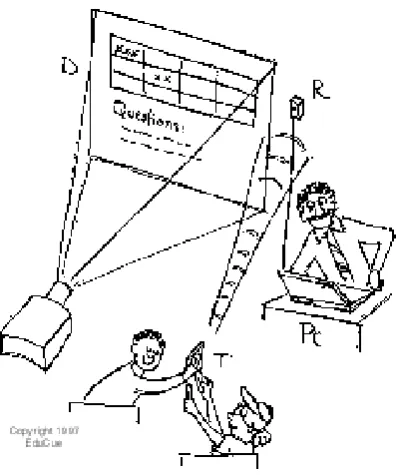
The PRS System
Figure 9: The PRS System (Educue)
Evaluation of the Impact of PowerPoint
Having identified that retention of colour added impact to material a decision was made to deliver lectures through PowerPoint enabling the use of full colour and the ability to use animation and transition effects. This was used throughout the academic year 2002-2003 at both level 1 and level 2. The students’ reaction was monitored through questionnaires issued on a regular basis throughout each semester. It was found that students responded favorably to this teaching medium and that even mathematically demanding material was well received when presented in this way. For example when cancelling terms in complex equations using Blackboard the terms could be made to vanish using animation effects which enabled the students to understand more easily the analysis being undertaken.
Many students expressed the view that both interest and understanding was enhanced throughout the delivery of the lecture. Some commented that the use of PowerPoint could restrict spontaneity and a solution was arrived at where lectures were delivered using PowerPoint but tutorials using overheads.
ISBN 0902896660
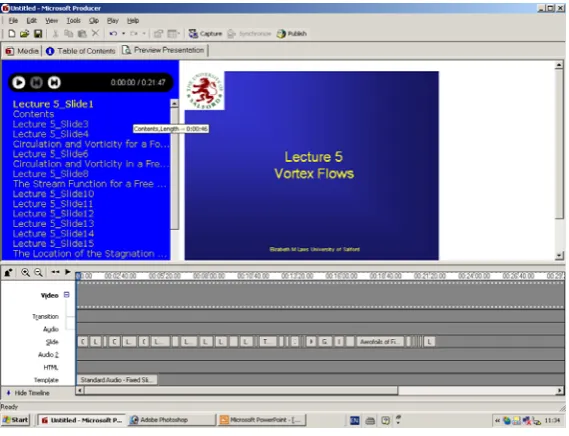
The integration was achieved by the use of a package which is part of the XP Office suite called MS Producer. This replaces the PowerPoint Viewer provided with earlier Office versions. Figure 10 gives a screen shot from MS Producer showing the import of PowerPoint with the corresponding sound files. It would also be possible to add video content. The advantage of packaging the presentations through Producer is that each title from a slide in PowerPoint appears as an itemised list as shown in Figure 10. When the presentation is ‘produced’ as shown in Figure 11 the list of titles appears alongside the PowerPoint slides with the sound playing in the background. The student would have the opportunity to click on a particular slide title and the presentation would jump to that point in the lecture. Therefore it was not necessary to listen to the entire re-run of a lecture, if only a part of it was unclear a particular section could be selected. Even if an entire lecture were to be re-played the time involved is typically 20 minutes. Thus the material presented in a 50-minute standard lecture when stripped of the additional material, digressions and explanations usually occurring in face-to-face lecturing reduces to a 20 minute recorded presentation.
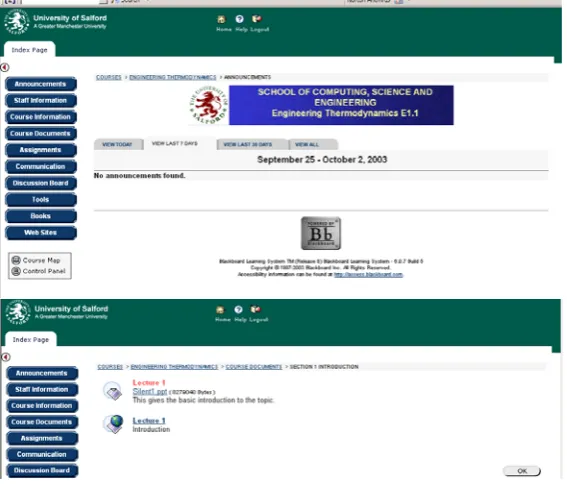
[image:11.595.175.460.411.629.2]For the academic year 2003-4 with the adoption of Blackboard 6 the sites have been changed again and the PowerPoint lectures have been added to the site as shown in Figure 12. Both the silent versions and the versions with embedded sound have been included to allow for students using a PC without a sound card or without a recent version of Windows Media Player installed with which sound was unavailable.
Figure 11: Produced Version of Presentations from MS Producer
[image:12.595.171.455.472.714.2]ISBN 0902896660
Learning Styles
During the induction week new students were asked to complete two different learning styles questionnaires one developed by Felder and Silverman (1988) and the other termed the VARK developed by Fleming (1995,2001). Analysis of the results of these questionnaires in both the academic year 2002-2003 and 2003-2004 showed that the majority of students had a medium-to-strong preference for a visual style of learning. Only a minority did not demonstrate at least a mild preference for a visual mode of learning. This was considered to be one reason that explained why the PowerPoint presentations had been so effective.
Student Attendance
Throughout the academic year 2002-2003 regular monitoring of student attendance was maintained and an attempt to correlate this with student performance was made. This showed clearly that whilst regular attendance does not guarantee good performance, poor performance correlates strongly with poor attendance. Whilst student attendance is clearly to be encouraged, there may be certain valid reasons why students are not present, illness being one. For many students, the conflict between paid employment (an increasing financial necessity,) and regular attendance is real. Student ability to access material outside the timetabled class contact periods is one major benefit of the approach adopted here, which is likely to be of increasing use.
Conclusions
Positive benefits have been identified linked to the use of an e-learning support strategy to assist in engineering education. These benefits have been demonstrated both in terms of improved student performance, interest and in general engagement with the learning process. Whilst the initial work involved in adopting an e-learning strategy is considerable, the ability to re-use, enhance and further develop the material over time, gives lasting benefits which in the medium-long term more than repays the time outlaid in development.
The overall effectiveness of the work described here is intrinsically linked to the student learning process. Whatever the material provided by the lecturer, unless it meets the needs and engages the interests of the students, it will not be of any lasting practical benefit. Balancing the conflicts of teaching and learning and transferring ownership for learning from lecturer to student is the challenge facing our profession.
References
Blackboard http://www.Blackboard.com PRS http://www.educue.com
W.HortonDesigning Web-Based Training, Wiley, ISBN 0-471-35614-X
Felder, R Reaching the second tier. Learning and teaching styles in college science education Journal of College Science Teaching 23 (5) 1993 http://www2.ncus/edu Felder, R & Silverman, LK Learning and teaching styles in engineering education
Engineering Education 78(7) 1988, p676
R.M. Felder and L.K. Silverman, Learning and Teaching Styles in Engineering
R.M. Felder, Reaching the Second Tier: Learning and Teaching Styles in College Science Education, J. College Science Teaching, 23(5), 286-290 (1993). An updated presentation of the Felder-Silverman model.
R.M. Felder, G.N. Felder, and E.J. Dietz, A Longitudinal Study of Engineering Student Performance and Retention. V. Comparisons with Traditionally-Taught Students
Journal of Engineering Education, 87(4), 469-480 (1998). Performance and attitude
differences between students taught with an active/cooperative learning model and students taught with a traditional instructor-centered model.
Fleming, N.D. & Mills, C. (1992). "Not Another Inventory, Rather a Catalyst for Reflection," To Improve the Academy. Vol. 11 (1992): 137-155
http://www.vark-learn.com/documents/not_another_inventory.pdf
Fleming, ND ‘I’m different; not dumb. Modes of presentation (V.A.R.K) in the tertiary Classroom’ HERDSA Volume 18 1995 www.vark-learn.com