Journal of Chemical and Pharmaceutical Research, 2014, 6(6):2860-2866
Research Article
CODEN(USA) : JCPRC5
ISSN : 0975-7384
A selective ensemble classification method on microarray data
Tao Chen
School of Mathematics and Computer Science, Shaanxi University of Technology, Hanzhong Shaanxi, China
_____________________________________________________________________________________________
ABSTRACT
For the characteristics of small samples and high dimension of microarray data, this paper proposes a selective ensemble method teaching-learning-based optimization based to classify microarray data. Firstly, in order to remove irrelevant genes with classification task, reliefF algorithm is used to reduce original gene set, and then a new training set is produced from orginal training set according to top-ranked genes obtained. Secondly, multiple bootstrap training subsets are produced based on bagging algorithm on above obtained training set to train base classifiers. Finally, multiple base classifiers are selected by using teaching-learning-based optimization to build an ensemble classifier. Experimental results on eight microarray datasets show our proposed method is effective and efficient for microarray data classification.
Key words: Microarray data; selective ensemble; reliefF; bagging; teaching-learning-based optimization
_____________________________________________________________________________________________
INTRODUCTION
The diagnosis of complex genetic diseases like cancer has conventionally been done based on the non-molecular characteristics like kind of tumor tissue, pathological characteristics and clinical phase. DNA microarray technology has concerned great attention in both the scientific and in industrial areas. Numerous examinations have been presented on the usage of microarray gene expression examination for molecular categorization of cancer. Several machine learning techniques have been used to classify microarray data [1].
However, due to the characteristics of small samples and high dimension of microarray data, and many existing irrelevant and redundant genes. It is leads to poor classification performance for most machine learning methods. In order to solve this problem and improve classification performance, ensemble technology was introduced to the area of data classification and obtain greatly success [2].
Ensemble learning is a machine learning paradigm where multiple learners are trained to solve the same problem [3-5]. In contrast to ordinary machine learning approaches which try to learn one hypothesis from training data, ensemble methods try to construct a set of hypotheses and combine them to use. An ensemble contains a number of learners which are usually called base learners. The generalization ability of an ensemble is usually much stronger than that of base learners. In 1995, Krogh indicated that the generalization error of ensemble is equal to average generalization error of individual minus the average differences of individual. Therefore, to enhance the generalization performance of ensemble, we should not only maximize the generalization ability of base classifiers, but also increase the differences between the various base classifiers [6-7]. Bagging [8] and boosting [9] are most common ensemble algorithms and achieve higher performance.
Teaching-learning-based optimization is a novel intelligent optimization algorithm based on population [10-11].TLBO simulates the behavior of teaching and learning in a class to improve academic performance of learners. Compare with genetic algorithm, particle swarm, harmony Search and differential Evolution, the biggest advantage of Tlbo is that it does not require any specific parameter to be set.Moreover, it has other several merits, such as fast convergent rate, simple principle and globe optimization, etc .
This paper proposes a selective ensemble method and it composes of three phases. The first phase is produces a new training set reduced from original training set by using reliefF algorithm [12]. In the second phase, multiple training subsets are produced by using bootstrap technology, and then multiple base classifiers are trained on above every training subset. The three phase, a set of base classifiers are selected by using teaching-learning-based optimization and combined to build an ensemble by weighted voting. In order to evaluate effectiveness of our proposed method, eight benchmark microarray datasets are selected and used in our experiment.
EXPERIMENTAL SECTION ReliefF algorithm:
ReliefF is an extended and more robust version of the original Relief algorithm [12]. In contrast to many heuristic measures for feature selection, ReliefF does not assume conditional independence of the variables. The main idea of ReliefF is to estimate the quality of features based on how good their values discriminate between samples that are close. Consecutively random samples are drawn from the data set. Each time the k nearest neighbors of the same class and the opposite class are determined. Based on these neighboring cases the weights of the attributes are adjusted. As within the two previous algorithms the variables are ranked and different models are built by dropping the variable with the smallest weight. The remaining part of the selection procedure is completely analogous to the one followed in the two previous methods. Although the ReliefF algorithm is computationally more expensive and complex than the previous techniques, the cost of an exhaustive search is still much higher.
Bagging algorithm:
Bagging derived from bootstrap aggregation, was the first effective method of ensemble learning and is one of the simplest methods of arching [8]. The meta-algorithm, which is a special case of model averaging, was originally designed for classification and is usually applied to decision tree models, but it can be used with any type of model for classification or regression. The method uses multiple versions of a training set by using the bootstrap, i.e. sampling with replacement. Each of these datasets is used to train a different model. The outputs of the models are combined by averaging (in the case of regression) or voting (in the case of classification) to create a single output.
Bagging trains a number of base learners each from a different bootstrap sample by calling a base learning algorithm. A bootstrap sample is obtained by subsampling the training data set with replacement, where the size of a sample is as the same as that of the training data set. Thus, for a bootstrap sample, some training examples may appear but some may not, where the probability that an example appears at least once is about 0.632. After obtaining the base learners, Bagging combines them by majority voting and the most-voted class is predicted.
Teaching-learning-based optimization:
Teaching-Learning-Based optimization (TLBO) is a novel heuristic optimization algorithm based on nature [10-11]. The main idea of TLBO is to make use of the effect of the influence of a teacher on the output of learners in a class to achieve optimization purpose. The TLBO include two stages: “teaching” stage and “learning” stage. Teaching stage is that the learners (students) learn from teacher, and learning stage is that the learners (students) learn from one another. The biggest advantage of Tlbo is that it does not require any specific parameter to be set, moreover, it has other several merits, such as fast convergent rate, simple principle and globe optimization, etc .
In this paper, a set of base classifiers are selected from all the base classifiers by using teaching-learning-based optimization and the algorithm is as follows.
Algorithm: Base classifiers selection based on TLBO
Input: Training setS, Testing setT, all the base classifiers f f1, 2,...,fDand weight of base classifiers w w1, 2,...wD
Output: base classifiers selected
2 1, ,... ,
i i in
f f f and ensemble classification Step 1: Initialize parameters.
population size NP ,number of generations G ,the number of all base classifiers D Step 2 :Initialize the population
1,1 1,2 1, 1
2,1 2,2 2, 2
,1 , 2 ,
D
D
NP NP NP D
NP
x x x
X
x x x
X pop
x x x
X é ù é ù ê ú ê ú ê ú ê ú ê ú ê ú
=ê ú= ê ú
ê ú
ê ú
ê ú
ê ú
ê ú ê ú
ë û ë û
K
K
M M M M
M
K
.where Xi={xi,1,xi, 2,...,xi D, }is a binary vector that represent the ith individual
in pop,xi j, Î {0,1}. Each individual indicates a set of base classifiers selected. If the ith classifiers is selected ,the ith
position of Xiis 1; while if the ith classifiers is not selected , the ith position ofXiis 0. Step 3: Calculate the fitness of each individual inpop.
According individualXi,a set of base classifiers are selected and ensembled by weighted voting, and the
ensemble classification accuracy is expressed as f X( i),that is fitness of the ith individual, so we calculate the fitness
of all the individuals
1
2
( ) ( )
( NP) f X f X fitness f X é ù ê ú ê ú ê ú
= ê ú
ê ú
ê ú
ê ú
ë û
M .
Step 4: For i=1: G
(1) “Teaching” phase
(a) Calculate the difference.
First ,the mean of population popis calculate and expressed as M=[m m1, 2,KmD],where
, 1
NP
i k i
k
m x NP
=
=
å
;Second ,find the best individual from pop as teacher
1 2
( i) max{ ( ), ( ), ( NP)}
teacher i f X f X f X f X
X = X = K ;
Third, the difference between Mand Xteacher is expressed asDifference=rand(1, ) (D ×Xteacher- TF M× ),
whereTF=round(1+rand(1, )(2D - 1))Î {1, 2}; (b) For j=1: NP
Xj¢= Xj+Difference;
calculate fitness f X ¢( j);
if f X( j¢ >) f X( j)
Xj=X ¢j End if
End For; (2) “Learning” phase For j=1: NP
Randomly select another individual Xk,such that k¹ j; If f X( j)> f X( k)
*
(1, ) ( )
j j j k
X = X +rand D ×X - X
Else *
(1, ) ( )
j j k j
X = X +rand D ×X - X
End If
Calculate fitnessf X( j*);
if f X( j*)> f X( j) *
j j
X = X
End if; End For; End For;
Step 5: Output base classifiers selected and ensemble classification.
A new population is generated after G times iteration, we find the best individual
1 2
( i) max{ ( ), ( ), ( NP)}
best i f X f X f X f X
X = X = K and the best fitnessf X( best),where Xbestrepresent a set of base classifiers selected
ensemble learning. The success of bagging algorithm is to produce training subsets with diversity by using bootstrap technology, therefore diversity of base classifiers is obtained by using bagging algorithm. For improving accuracy of base classifiers, ReliefF is effective method because it can remove irrelevant genes from original genes set to improve classification performance. In addition, TLBO is employed to select a set of base classifiers to build ensemble because of advantages of TLBO. According to above analysis, a selective ensemble based on TLBO is proposed for classifying microarray data. The concrete steps of our proposed method is given as follows.
Step1.Gene reduction
ReliefF algorithm is applied to remove irrelevant genes from original gene set, and a set of genes is build to produce a reduced training set from original training set. This step can improve accuracy of classification because of removing of irrelevant genes.
Step2. Production of base classifiers
Mutiple training subsets are obtained by using bootstrap technology to train classifiers. Because training subsets have much diversity, base classifiers trained have diversity.
Step3.Selection of base classifiers
A set of base classifiers are selected by using TLBO to decrease storage space and computation time. Step4.Ensemble of base classifiers selected
Base classifiers selected are ensemble by weighted voting to classify new samples.
Experimental data and methods:
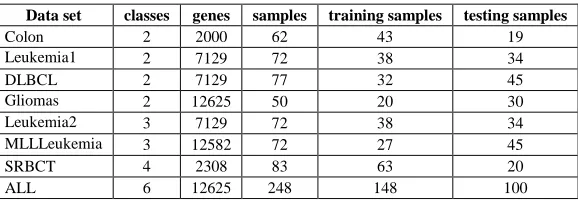
[image:4.595.163.452.353.453.2]To evaluate performance of our proposed method, eight benchmark microarray datasets are selected and used in our experiments. The nine datasets are described in table 1.
Table 1 nine benchmark cancer microarray datasets
Data set classes genes samples training samples testing samples
Colon 2 2000 62 43 19
Leukemia1 2 7129 72 38 34
DLBCL 2 7129 77 32 45
Gliomas 2 12625 50 20 30
Leukemia2 3 7129 72 38 34
MLLLeukemia 3 12582 72 27 45
SRBCT 4 2308 83 63 20
ALL 6 12625 248 148 100
In addition, in order to comparison superiority of our proposed method, four method (original, bagging, adaboost and ReliefF+bagging) are implemented. In our experiment, support vector machine with RBF (RBF-SVM) is employed as classifier. To ensure the results of different methods does not happen by chance, the experiments are repeated 30 times independently, and results of 30 times are averaged as final experimental results.
Experimental results and analysis:
Many studies show the number of base classifiers in ensemble can also affect performance of ensemble algorithm. Therefore, the number of base classifiers is equal to10, 20, 30, 40 and 50 in our experiment, respectively.
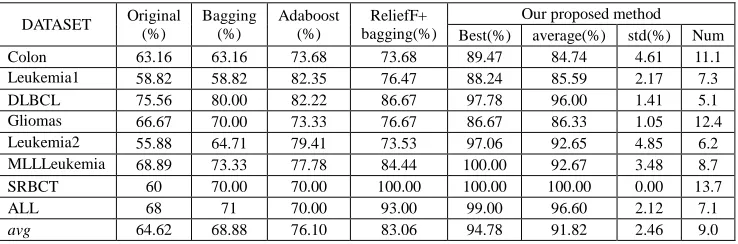
Table 2-6 give the results of different methods on nine datasets when number of base classifiers is equal to 10,20,30,40 and 50, respectively. The “best” and “average” of our proposed method are given because randomness of TLBO. The “best” and “average” represents the best results and average results of 30 times experiments. The“std” represents standard deviation of 30 times experimental results. The “Num” represents average number of base classifiers selected by using TLBO in 30 times experiments.
We find that phenomenon of reflecting from table 2-6 is similar. It is easy to find that the classification accuracy of our proposed method is obviously higher than other methods. Especially, our proposed method outperforms ReliefF+bagging and it indicates selective ensemble based on TLBO is effective for improving performance of ensemble.
Table 4 is analyzed as a sample and results are given as follows. Table 4 displays the comparison of different methods on nine datasets when number of base classifiers is equal to 30.It is obviously that the classification accuracy of our proposed method is the highest in five methods according to table 4 and it indicates our proposed method is effective for microarray data classification.
11.06% than other methods. For Leukemia1, classification accuracy of our proposed method achieves 85.59%, which is improved at least 3.24% than other methods. For DLBCL, classification accuracy of our proposed method achieves 96%, which is improved at least 9.33% than other methods. For Gliomas, classification accuracy of our proposed method achieves 86.33%, which is improved at least 9.66% than other methods. For Leukemia2, classification accuracy of our proposed method achieves 92.65%, which is improved at least 13.24% than other methods. For MLLLeukemia, classification accuracy of our proposed method achieves 92.67%, which is improved at least 8.23% than other methods. For ALL, classification accuracy of our proposed method achieves 92.44%, which is improved at least 7.79% than other methods. Only on SRBCT, classification accuracy of our proposed method and ReliefF+bagging are same and achieve 100%, which is improved at least 30% than other three methods. Compare with ReliefF+bagging method, the classification accuracy of our proposed method is improved 11.06%,9.12%,9.33%,9.66%,19.12%,8.23% and 3.6% on Colon, Leukemia1,DLBCL,Gliomas,Leukemia2, MLLLeukemia,ALL, respectively. For SRBCT, the result of the two methods are same. In general, our proposed method outperforms ReliefF+bagging and it indicates selective ensemble based on TLBO is effective for improving classification performance.
[image:5.595.121.493.320.442.2]In table 4, “avg” represents summarized result which is calculates by averaging the accuracy over all datasets. The classification accuracy of our proposed method is the highest and achieves 91.82%, which is 27.2%, 22.94%,15.72% and 8.76% high than that of four methods, respectively. In addition, the average number of base classifiers selected for 30 is 9, about 0.3 (9/30).
Table 2 The results of different methods (the number of all the base classifiers is equal to 10)
DATASET Original
(%)
Bagging (%)
Adaboost (%)
ReliefF+ bagging(%)
Our proposed method
Best(%) average(%) std(%) Num
Colon 63.16 63.1
6
78.95 73.68 89.47 82.63 3.55 4.2
Leukemia1 58.82 58.82 67.65 76.47 88.24 85.59 2.17 2.6
DLBCL 75.56 71.11 55.56 73.33 97.78 92.22 3.51 2.5
Gliomas 66.67 56.67 73.33 76.67 86.67 85.67 1.61 3.5
Leukemia2 55.88 61.76 64.71 73.53 94.12 87.65 4.96 2.4
MLLLeukemia 68.89 84.44 66.67 88.89 95.56 91.11 2.10 3.5
SRBCT 60 60.00 75.00 95.00 100.00 99.50 1.58 4.4
ALL 68 68 86.00 93.00 98.00 96.60 1.26 2.7
[image:5.595.124.492.467.588.2]avg 64.62 65.50 70.98 81.32 93.73 90.12 2.59 3.2
Table 3 The results of different methods (the number of all the base classifiers is equal to 20)
DATASET Original
(%)
Bagging (%)
Adaboost (%)
ReliefF+ bagging(%)
Our proposed method
Best(%) average(%) std(%) Num
Colon 63.16 63.16 73.68 73.68 89.47 83.68 2.99 8.7
Leukemia1 58.82 58.82 85.29 76.47 88.24 86.76 1.55 3.3
DLBCL 75.56 88.89 82.22 77.78 97.78 95.78 1.95 3.5
Gliomas 66.67 76.67 70.00 76.67 86.67 86.00 2.11 6.6
Leukemia2 55.88 70.59 73.53 85.29 97.06 90.88 4.03 4.9
MLLLeukemia 68.89 66.67 77.78 82.22 95.56 91.11 2.10 6.6
SRBCT 60 65.00 75.00 90.00 100.00 100.00 0.00 9.3
ALL 68 70 80.00 93.00 99.00 97.60 1.43 4.7
avg 64.62 69.98 77.19 81.89 94.22 91.48 2.02 6.0
Table 4 The results of different methods (the number of all the base classifiers is equal to 30)
DATASET Original (%) Bagging (%) Adaboost (%) bagging(%) ReliefF+ Our proposed method
Best(%) average(%) std(%) Num
Colon 63.16 63.16 73.68 73.68 89.47 84.74 4.61 11.1
Leukemia1 58.82 58.82 82.35 76.47 88.24 85.59 2.17 7.3
DLBCL 75.56 80.00 82.22 86.67 97.78 96.00 1.41 5.1
Gliomas 66.67 70.00 73.33 76.67 86.67 86.33 1.05 12.4
Leukemia2 55.88 64.71 79.41 73.53 97.06 92.65 4.85 6.2
MLLLeukemia 68.89 73.33 77.78 84.44 100.00 92.67 3.48 8.7
SRBCT 60 70.00 70.00 100.00 100.00 100.00 0.00 13.7
ALL 68 71 70.00 93.00 99.00 96.60 2.12 7.1
[image:5.595.123.492.613.735.2]Table 5 The results of different methods (the number of all the base classifiers is equal to 40)
DATASET Original
(%)
Bagging (%)
Adaboost (%)
ReliefF+ bagging(%)
Our proposed method
best(%) average(%) std(%) Num
Colon 63.16 63.16 63.16 73.68 89.47 84.21 4.30 15.1
Leukemia1 58.82 58.82 64.71 76.47 85.29 83.24 1.42 15.8
DLBCL 75.56 75.56 64.44 80.00 95.56 92.00 4.22 10.4
Gliomas 66.67 76.67 63.33 73.33 86.67 86.33 1.05 14.7
Leukemia2 55.88 64.71 61.76 76.47 100.00 90.59 5.15 11.9
MLLLeukemia 68.89 73.33 71.11 88.89 91.11 90.00 1.17 18.2
SRBCT 60 65.00 80.00 95.00 100.00 100.00 0.00 21.3
ALL 68 72 83.00 93.00 99.00 97.20 2.15 8.9
[image:6.595.124.492.236.359.2]avg 64.62 68.66 68.94 82.11 93.39 90.45 2.43 14.5
Table 6 The results of different methods (the number of all the base classifiers is equal to 50)
DATASET Original
(%)
Bagging (%)
Adaboost (%)
ReliefF+ bagging(%)
Our proposed method
best(%) average(%) std(%) Num
Colon 63.16 63.16 78.95 73.68 89.47 84.21 2.48 21.1
Leukemia1 58.82 58.82 73.53 76.47 82.35 82.35 0.00 20.5
DLBCL 75.56 80.00 80.00 75.56 100.00 95.56 4.91 10.5
Gliomas 66.67 83.33 66.67 76.67 86.67 86.00 1.41 17.9
Leukemia2 55.88 64.71 70.59 73.53 97.06 89.12 4.17 15
MLLLeukemia 68.89 75.56 75.56 84.44 93.33 90.00 1.89 20.7
SRBCT 60 70.00 85.00 95.00 100.00 100.00 0.00 23.1
ALL 68 73 82.00 93.00 99.00 96.60 1.90 14.6
avg 64.62 71.07 76.54 81.04 93.49 90.48 2.09 17.9
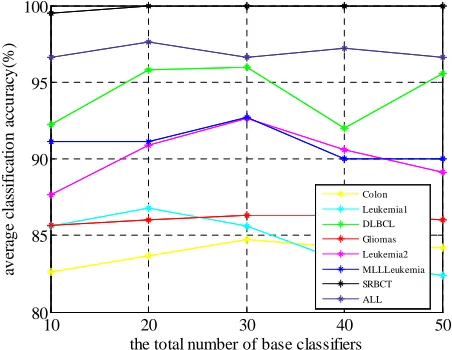
Fig 1 displays the influence of number of base classifiers on classification accuracy. We find accuracy does not monotonously increase with number of base classifiers. The classification accuracy of our proposed method achieves the highest when number of base classifiers is about 20 or 30.
10 20 30 40 50
80 85 90 95 100
the total number of base classifiers
av
er
ag
e
cl
as
si
fi
ca
ti
o
n
a
cc
u
ra
cy
(%
)
Colon Leukemia1 DLBCL Gliomas Leukemia2 MLLLeukemia SRBCT ALL
Fig 1 the influence of the number of base classifiers on classification performance
CONCLUSION
This paper proposes a selective ensemble method to classify microarray data. ReliefF algorithm is used to remove irrelevant genes to improve classification performance. Training subsets produced by bootstrap technology have large diversity and base classifiers trained have diversity. TLBO is applied to select a set of base classifiers to build an ensemble. Experimental results show our proposed method not only improve classification accuracy ,but also decrease computation time and storage space. Therefore our proposed method is effective and efficient for microarray data classification.
Acknowledgement
[image:6.595.193.419.417.592.2]REFERENCES
[1] Wang Shu-Lin, Li X., Zhang S, et al. Computers in Biology and Medicine, 2010, 40(2), 179-189 [2] Shi L, Xi L. , M X. ,et al, Applied Soft Computing, 2011,11(8),5674-5683
[3] Zhao Hui. International Journal of Security and Its Applications, 2013,7(5),193-204 [4] Chen Tao. Application Research of Computers.2011,28(1),139-141
[5] Zhou Zhi-Hua. Rough Sets, Fuzzy Sets, Data Mining, and Granular Computing. 2003, 476-483 [6] Chen Tao. Journal of Computer Applications,2011,31(5),1331-1335
[7] Chen Tao, Hong Zeng-Lin. Software Engineering and Knowledge Engineering: Theory and Practice,
2012,585-592
[8] Breiman L. Mach. Learn. 1996, 24(1),123–140 [9] Schapire R.. Mach. Learn. 1990 ,l5 (2),197–227
[10] Rao R V, Savsani V J, Vakharia D P. Information Sciences, 2012,183(1),1-15 [11] Rao R V, Savsani V J, Vakharia D P. Computer-Aided Design, 2011,43(3),303-315
[12]Kononenko I.Proceedings of the European conference on machine learning, Lecture notes in computer