Journal of Chemical and Pharmaceutical Research, 2014, 6(6):2178-2185
Research Article
ISSN : 0975-7384
CODEN(USA) : JCPRC5
The characters recognition method of license plate based on LSSVM
Wu Jie
1,2, Song Xiaoru
2and Wang Lei
31
State Key Laboratory for Manufacturing Systems Engineering, Xi’an Jiaotong University, Xi’an, China
2
School of Electronic and Information Engineering, Xi’an Technological University, Xi’an, China
3
Department of Basis, Xi’an Railway Vocational & Technical Institute, Xi’an, P.R.China
_____________________________________________________________________________________________
ABSTRACT
It is the extremely important to the intelligence traffic that the automation characters recognition of license plate system. The LSSVM has been successfully adopted to make a multi-class classifier on the small samples, nonlinear data. It is presented the LSSVM model methodology on the characters recognition system in the paper. A typical characters recognition of license plate system is composed of the license location, characters extracted and character recognition. The improved genetic algorithm is applied to the optimized selection parameters on the LSSVM model. It put emphasis on the parameter optimization LSSVM model of the characters recognition method of license plate system in the paper. Experiments showed the method is not only feasible, but also have high accuracy, good stability, better computational speed and good generalization ability. The results indicates that the LSSVM strategy improve recognition rate and therefore has more practicability.
Key words: recognition of license plate; Information fusion; improved genetic algorithm
_____________________________________________________________________________________________
INTRODUCTION
It is very important that the automation characters recognition of license plate system in the intelligent traffic. A typical characters recognition of license plate system is composed of the license location, characters extracted and character recognition [6]. The character recognition method is the license plate segmented character recognition. It is including the Chinese characters, letter and digit recognition. The Chinese standard license plate, for example, constitute that the first character is the Chinese character, the second one is the letter, the third is the letter or digital, the fourth to seventh character is the digital. Now the template match, NN and statistical classification have been applied in the characters recognition of license plate system. But its recognition rate and believability is incomplete because of the actual dirty, abrasion license plate.
In reference [1] plate positioning method is divided into the direct method, texture detection, color image vehicle license plate location method based on vector quantization method. The method between DTNN (discrete-time cellular neural network) and the Fuzzy logic is put forward in reference [2]. However, the fuzzy control can be lost much information and assigned the weight subjectively. The means is the more common neural network. But NN algorithm converged slowly and was easily trapped into a local minimum, and the sliding-mode control did not meet the online modification. Further, there are other means in some references. Such as mathematical morphology, wavelet transform etc. Considered the relative merits of previous models, a RS-LSSVM predictive model for AUV is put forward in this paper.
signal processing and non-linear regression estimation [4]. The LSSVM (Least Squares Support Vector Machines) was proposed by Suykens and Vandewalle in 1999, and has been employed in chaotic time series prediction. The most important difference between SVM and LSSVM is that LSSVM uses a set of linear equations for training while SVM uses a quadratic optimization problem. It improves the solution efficiency of the model, decreases the difficulty to solve the problem [2]. Above all things, the automation characters recognition of license plate system based on LSSVM model is presented in the paper.
The rest of the paper is organized as follows. The LSSVM model is presented in the section 2. It is including the LSSVM nonlinear model and the parameter optimization problem, parameter selection by the improved genetic algorithm. The next section is the key. The section 3 shows the characters recognition method based on LSSVM. it is including the characters recognition pretreatment, characteristic vectors extracted and the character recognition. The experiment and simulation analysis is in the section 4. In section 5, conclusions are drawn.
1. LSSVM MODEL ALGORITHM
2.1 LSSVM nonlinear model
The LSSVM evolves from the SVM, changes the inequality constraints of a SVM into a set of equality constraints, and it forces the SSE (Sum of Squared Error) loss function to become an experience loss function of the training set. In this case, the problem has become one of solving a linear programming problem [4].This can be specifically described as follows:
Given the following training set:
{
x y
i, i}, i=1,2,3,…,N.Where
x
i∈
R
n,y
i∈
R
, andx
iis the ith data point in input space andy
iis corresponding output value, i=1,…,N, where N is the number of training samples in the training set. The Least Squares Support Vector Machines regression algorithm tries to map the training set in input space to a higher dimension feature space by a non-linear mappingφ
( )
x
) and constructs the optimal linear regression function in this feature space. The LSSVM regression model is of the form:( )
sgn[
T( )
]
y x
=
w
φ
x
+
b
(1)Where
φ
( )
x
is the classification of the LSSVM model optimization problem: 21
1
1
min ( , )
2
2
N T
i i
J w e
w w
C
e
=
=
+
∑
σ.τ.[
( )
] 1
i T
i i
y w
ϕ
x
+ = −
b
e
ι=1,2, ,Ν (2)Where
i
e
∈
R
is the error between actual output and predictive output of the i-th input data, C is a positivereal constant.
A Lagrange functional was introduced to solving the optimization question. It can change the optimization to the unconstrained.
( , , ; )
L w b e a =
1
( , )
{ [(
( )
]
}
i
N
T
i i i
i
J w e
α
y
w
ϕ
x
b
e
=
−
∑
+ +
(3)In it,
α
i∈
R
is Lagrange multipliers. Partial derivatives is 0 between L and the w, b, ie
,α
i according to theKarush-Kuhn-Tucker(KKT). The middle variables w, i
e
are eliminated, the following linear system is obtained:1
0
0
s
I
b
Y
η
α
γ
−
=
Ω +
(4)Where
Ω∈
R
N N× ,Ω =
kmφ
T(
x
k) (
φ
x
m)
;Y
=
[ ,
y
1L
,
y
N]
T;η
is a N-dimensional row vector (η
=[1…N]);
α α
=
[ ,
1L
a
N]
;I is an identity matrix and s is a N-dimensional column vector (s
=
[1
L
N
]
T).1
( )
( ) ( )
N T i i
y x
α φ
x
φ
x
b
=
=
∑
+
(5)Where α and b are solutions of Eq.(4).
Using a kernel function method
( , )
T( ) ( )
i i
K x x
=
φ
x
φ
x
(6)The nonlinear prediction model is the form:
1
( )
( ,
)
N
i i j
i
y x
α
K x x
b
=
=
∑
+
(7)The polynomial and RBF kernels are common types of kernels in regression problems [5]. In the study the RBF kernel function (8) has been used.
2 2
( ,
i j)
exp(
i j/ 2
)
K x x
=
−
x
−
x
δ
(8)Where
δ
is the kernel factor (the width of the kernel function).2.2 The Optimization Problem of the LSSVM Model
The regularized parameter C and the kernel factor
δ
are very important to the good fitting results in the LSSVM. The fitting error relation is presented by C. The bigger C is the better fitting degree of relationship, but the less generalization ability; Kernel factorδ
is the relation among the support vectors. Too big or too small can lead to the too bigger fitting and predictive error. So, one algorithm has to research to find the optimal parameter on LSSVM model.The coding mechanism of improved genetic algorithms can improve capacity of the global search and convergence rate. The initial population randomly is produced to the multiplicity species group. It can improve convergence rate and capacity of global searching optimal solution remarkable [9].
(1) Selection Operator
The proportion selection operator is fixed in the paper. The individual number of the species group is N. The ith
fitness is
f
i. So the probability of the individual is selected is:1
/
N
i i k
k
P
f
f
=
=
∑
(9)(2) Crossover Operator
The species group crossover operation is realized by the one point crossover operator. The one point crossover operation is only set one cross point in the individual code. Then the 2 couple part of chromosome exchange at the point. The Fig. 1 is the one point crossover operation.
Fig. 1 The schematic diagram of one point crossover operation
(3) Mutation Operator
The self-adapting mutation probability operator
P
m is the formula (10). TheP
m is increased when the individualthe lower than the average fitness values. The convergence property is ensured. At the same time, the species group is multiplicity.
1 2 max 1
max
1
(
)(
)
[image:4.595.257.348.381.702.2],
...,
m m
m avg
avg m
m
P
P
f
f
P
f
f
f
f
P
P
f
f
−
−
−
≥
−
=
<
(10)
Where, f is the individual fitness values;
f
avg is the average fitness values of the every generation;f
max is themaximal fitness values. The
P
m1=
0.1
,P
m2=
0.01
is fixed in the paper. (4) Elitist ModelIn the IGA a certain amount of excellent older generation is direct into the next one. It can protect the excellent individual from destroyed accidental in the copy, crossover and the mutation. The optimization is probabilistic global convergence. It is the effective methods to the strengthen stability and the convergence of the algorithm.
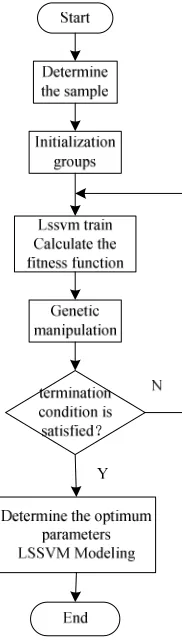
2.3 The LSSVM Steps of the IGA
The characters recognition of license plate system on the LSSVM parameters is optimized by the IGA. Step 1 Initialization state, LSSVM model, the parameters of the IGA and so on;
Step 2 Initialization objective function value is computed;
Step 3 Determine whether to end condition. If so, the output is put; Or else it goes into the step 4; Step 4 The fitness value is computed, selected, crossover and mutation;
Step 5 the younger generation objective function value is get and repeatedly go into the next generation groups, and turn to the step 3.
LSSVM model optimization based on IGA flow chart is shown in Fig. 2.
Fig. 2 the LSSVM model optimization based on GA flow chart
function of the genetic algorithm to be evaluated. The fitness and the average fitness of the best individual in the population continues are to improve through the repeated genetic manipulation and evaluation of each generation of individuals, until the fitness of the best individual reaches a limit value or the fitness of the best individual and the average fitness of the group is no longer significant change. The iteration process is end.
2.4 The LSSVM Steps of the IGA
The C and
δ
2are need to optimized in the LSSVM. There are 30 individual. Each individual has two random species group and they are the first group. The train samples are dividing into the formal training and the assisted training, at the same time it is to avoid the over fitting. The objective function is the two high accuracy plus of the two training. In the initial phase of the genetic search, the two training samples are increased simultaneously. The high accuracy increased of the formal training samples is more slowly with the genetic search goes. One string search is end when the formal training samples accuracy is more increased; the assisted training samples accuracy is decreased. The truth-value code method can be genetic search in the greater space [9]. It can simplify the computational complexity and increase of operation efficiency in the paper.2. THE CHARACTERS RECOGNITION METHOD BASED ON LSSVM
3.1 The Characters Recognition Pretreatment
The original character is nonuniform or character stroke unclear, because of the environment lighting, the vehicle’s motion, the camera shaking and the focus setting. The bad weather, for example, the whole light of the license plate characters is lark or the shadow arises in bright light easily. So the characters recognition pretreatment has to do. Firstly the gray stretching of the character is to increase the picture contrast. Then the binarization is realized by the iteration method. After then it is the character thinning. At last the character is normalized to a 32*24 picture [6].
3.2 Characteristic Vectors Extracted
The digital is more weight in the license plate characters. The first to third character direct select the normalize information as the characteristic vector, the fourth to seventh character is the interlace pixel to increase recognition speed, according to the allocation. Namely the former character is a 16*12 picture as the characteristic vector extracted and the latter is a 32*24 one.
3.3 Character Recognition
LSSVM mainly dispose of a two-class classification problem. There are two main solutions in a two-class classification problem of the SVM extending to the multi-class classification. One is the composing several two-class classifications into the multi-class one. It can realize the “one to one” and “one to many”. The other is only one LSSVM, which can realize the multi-class classification. The first solution is adopted in the paper. Firstly the all class is divided into a two-class classification, and the subclass is divided into the other secondary subclass and so on, until the whole node is including only one character. The algorithm can overcome the inseparable problem. The K-1 LSSVM classifier has to instruct to the K classification. There are four LSSVM classifiers in the recognition system according to the location and the characteristic of the license plate characters. They are the Chinese character, letter, digital and the letter-digital classifier. The RBF kernel function (8) has been used in the paper according to the experiment. The digital classifier, for instance, instructed an assembly classifier based on the binary tree. Expect for the root, each layer has one leaf node. Namely it is the recognition number. There are two leaf nodes in the last layer.
It is all 9 sub-classifiers. The each leaf node is
y
i=
1
, and the other one isy
i= −
1
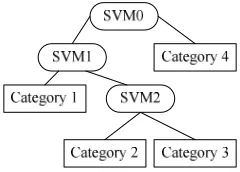
. The corresponding classifier is get by means of the each computed a and b. At last the digital character is classified and recognized.More the involved to classify are in the recognition of license plate characters. It will be waste a lot of useful information in the identification process if take advantage of one-on-one strategy in the classification of two-class combination. And the less effective is in identified. But about one-to-many strategy, a lot of support vector machine classifier should be constructed. it will be increased the workload of the testing phase. So it is to solve the many types of license plate recognition problem that the binary tree structure based on a priori knowledge of the combination of multiple binary LSSVM. It is LSSVM decision tree. For example, a 4-class problem for license plate recognition LSSVM decision tree model is showed in Fig 3.
(b) Prior knowledge LSSVM decision tree
Fig. 3 LSSVM decision tree model
Fig.3(a) is the no prior knowledge LSSVM decision tree configuration. The priori knowledge of the LSSVM decision tree model is shown in Fig.3 (b) is used to improve the recognition speed. An optimal test speed of LSSVM decision tree is to guide the division of the leaf node to construct by a priori knowledge about the license plate characters. The use of LSSVM classifier is determined in accordance with the order of the optimal binary tree. For example, more case of some certain character is “SHAN” on the license plate. The categories 4 “SHAN” in the license plate can define. At first the “SHAN” license plate is to be sorted out to accelerate LSSVM classification speed by the highest level of classification SVM0 in the LSSVM decision tree.
Number in the license plate recognition, for example, the license plate digital image is as a feature vector during the license plate number to identify the training. And then the Least Squares Support Vector Machines classifier function in the in each category twenty-two structure when the feature vector is as the input of support vector machine. For example, more than one class Least Squares Support Vector Machines classifier for classification need to constructed for 0 to 9 the 10 digits. In the test, the first training phase structure of the classifier are to be sorted according to a certain order. Least Squares Support Vector Machines classification mechanism is to minimizing the empirical risk and VC confidence. So the smaller classification is the higher priority when these classifications descending order in accordance with the empirical risk and VC confidence. After the completion of the sort the feature vector of the test sample is put to the first generation of the highest priority classification. It can be eliminated based on the results of the other half of the classification. And so on. It can saved out a lot not avoid duplication of work in the second-class combination of classification. The efficiency of license plate recognition is improved greatly.
3. EXPERIMENT AND SIMULATION ANALYSIS
4.1 The parameters optimized by the IGA
To solve the optimal parameter, the C and
δ
2are coded based on the real coding. The optimization interval is (0, 50) and (0, 500) respectively. Get the number of the initial population is 30 in the improved genetic algorithm. The crossover probability is 0.9, the mutation probability is 0.033, and the maximum iterations are 1000. The accuracyrate of the optimization model is 91.7%. The 140 training samples are done. The experiment showed the
δ
2value is less 100, the corresponding recognition accuracy rate decreased gradually in the 4 classifier models. When theδ
2 value is more than 100, the corresponding recognition accuracy rate increases first and then decreases. The peak point is the optimal parameter. The 4 optimal classifier models are showed in the Tab. 1.Tab. 1 The 4 optimal classifier models
C δ2 Recognition
accuracy rate Chinese character classifier 10 500 94.8%
digital classifier 10 300 97.9%
letter classifier 10 300 96.4%
letter-digital classifier 10 300 95.5%
4.2 The experiment of the LSSVM model recognition
[image:6.595.191.422.593.664.2]Tab. 2 the result of character recognition
Character Classifier
Training Samples
Test Samples
Recognition Time
Recognition Rate
False Accept Rate Chinese character 160 40 18.6ms 87.3% 8.5%
letter 240 60 19.7 ms 92.4% 4.7%
digital 800 200 17.9 ms 95.1% 2.3%
letter-digital 240 60 22.8 ms 91.5% 6.9%
The experiments are showed the recognition classifier have bias on position probability. The more involved training samples number, the better recognition probability in the predictive samples. For Example the more Chinese character “Shan”, the better recognition probability in the Chinese character classifier. In the actual predictive samples there are a large number of Chinese character “Shan”. It is improved the correct rate greatly.
Tab. 3 comparing the experiments result
method conventional SVM
conventional LSSVM
IGA optimized LSSVM
accuracy rate Training 97.62% 95.24% 97.14% Test 96.43% 92.86% 95.71% the average recognition time(s) 0.963 0.624 0.512
The Tab. 3 showed the conventional SVM is more accuracy rate than the conventional LSSVM, because of the SVM classifier is the convex quadratic programming. But the more data need to the most computing resource. The LSSVM speed is quicker than it, and the less computing resource. The multi-class classification parameters are optimized by IGA in the paper. The balance arithmetic speed and accuracy rate is get. At the same time it is better classifier generalization ability.
CONCLUSION
The LSSVM has been successfully adopted to make a multi-class classifier on the small samples, nonlinear data. It is suitable for the Characters Recognition of the license plate characters. The test results are in influenced extremely by the parameters C and
δ
2. These parameters are optimized by the IGA. The improved genetic algorithm is the coding mechanism. The initial population randomly is produced to the multiplicity species group. It makes the improved capacity of the global search and convergence rate. The IGA optimized LSSVM can structured the multi-class classifier. The experiments are showed the recognition classifier is feasible. And it has the higher recognition accuracy rate and the recognition speed. The experiments are showed the character recognition speed is about average 19.23ms per character in the LSSVM model.Acknowledgments
The project is financially supported the Education Department of Shaanxi Provincial Government Research Project and the Xi'An Science and Technology Bureau Project. The authors wish to thank them. The parts of experiment have been done by their help and support. And the authors would like to express my gratitude to my friends who had helped me!
REFERENCES
[1] Zhang Guoyun,Zhang Jing. Proceedings of the CSEE, v.8, n.25, pp. 100-104, 2005 [2] J A K Suykens,J Vandewalle. Neural Processing Letter, v.9, pp:293-300. 1999 [3] AN H S,Xu D. IEEE Transactions on Neural Networks, v.3, n.18, pp. 722-731, 2007
[4] Sung moon C, Sang H O, Soo-Young L. Neural Information Processing Letters and Reviews. v.2, n.3, pp.47-51,
2004.
[5] Zhao X H,Wang G,Zhao K K,Tan D J. Mining Science and Technology, v.2, n.19, pp: 194-198, 2009. [6] Song wei,Zhang xianmin. Microcomputer Applications. v.10, n.22, pp.31-34, 2006.
[7] Ren Jun. Journal of Zhejiang University (liberal arts ed). v.12, n.29, pp.2016-2020, 2006. [8] Penghui. Tsinghua Science and Technology, , pp.945-949, 1997.
[9] Yu Nan.Computer Development & Applications, v.1, n.22, pp.23-29, 2009. (in Chinese). [10] Ustun B, Melssen W J, Oudenhuijzen M, et al. Analytica Chimica Acta, pp. 292-305, 2010.
[11] Suykens J A K. Nonlinear modeling and support vector machines//Proceedings of the IEEE Conference on Instrumentation and Measurement Technology. Piscataway, NJ, USA IEEE, pp.287-294, 2011.
Unit-Linking Pulse Coupled Neural Network. ICONIP, Part V, LNCS 7667, pp. 100–108. 2012.