International Journal of Emerging Technology and Advanced Engineering
Website: www.ijetae.com (ISSN 2250-2459, Volume 2, Issue 4, April 2012)694
A Low Space Bit-Plane Slicing Based Image Storage Method using
Extended JPEG Format
Santanu Halder
1, Debotosh Bhattacharjee
2, Mita Nasipuri
2, Dipak Kumar Basu
21 Department of Computer Science and Engineering, Govt. College of Engineering and Textile Technology, Berhampore, India
Email: [email protected]
2Department of Computer Science and Engineering, Jadavpur University, Kolkata, 700032, India
Email: {[email protected], [email protected], [email protected]}
*Former Professor
Abstract— In this paper, we propose a novel bit-plane slicing based lossy image compression technique in Extended JPEG format which takes less storage space than JPEG format with no visual degradation. One of its main features is to find out and discard those particular bits which are not responsible for the color and texture information of the image, which allows storing the image with less number of bits which saves the storage space and also improves the data transmission rate for the image. The proposed method has been tested on 450 images and in most of the cases the images take very less storage space than the normal jpg images.
Index Terms— Psychovisual Redundancy, Bit-Plane Slicing, JPEG format, Extended JPEG format
I. INTRODUCTION
An image is essentially a 2-D signal processed by the human visual system. The signals, representing images, are usually in analog form. However, for processing, storage and transmission by computer applications, they are converted from analog to digital form. A digital image is basically a 2-Dimensional array of pixel intensities. There are a lot of works available in literature on both lossless and lossy image compression techniques [1-7]. Image compression addresses the problem of reducing the amount of data required to represent a digital image while keeping the resolution and the visual quality of the reconstructed image as close to the original image as possible. It is a process intended to yield a compact representation of an image, thereby reducing the image storage/transmission requirements. Image compression techniques reduce the number of bits required to represent an image by taking advantage of the three basic data redundancies:
1. Coding Redundancy 2. Interpixel Redundancy 3. Psychovisual Redundancy.
Coding redundancy is present when less than optimal code words are used. Interpixel redundancy results from correlations between the pixels of an image. Psychovisual redundancy is due to data that is ignored by the human visual system (i.e. visually non essential information).
The proposed work concentrates on the Psychovisual redundancy to reduce the required storage space for an image.
An inverse process called decompression (decoding) is applied to the compressed data to get the reconstructed image. The benefits of compression can be summarized as follows:
1. It reduces the data transmission cost as less number of data is to be transferred over network.
2. It not only reduces storage requirements but also overall execution time.
3. It also reduces the probability of transmission errors since fewer bits are transferred.
4. It also provides a level of security against illicit monitoring.
The image compression techniques are broadly classified into two categories depending on whether or not an exact replica of the original image could be reconstructed using the compressed image. These are:
1. Lossless technique 2. Lossy technique
The proposed work focuses on a lossy compression technique based on bit plane slicing method.
A) Related Work
International Journal of Emerging Technology and Advanced Engineering
Website: www.ijetae.com (ISSN 2250-2459, Volume 2, Issue 4, April 2012)695
Color space transform
Sampling
Level shifting
DCT transformation
Quantization
Zig-zag encoding
Run length encoding
Frequency encoding
B) Our Approach
In this paper, we develop a new bit plane slice based lossy compression technique, called Extended JPEG compression method, which is very efficient to store an image using less number of bits. It not only saves storage space but also reduces data transmission cost over the network. The proposed work first compresses the image using JPEG format and then apply the proposed bit plane slicing based lossy compression technique to further compress the image with no visual degradation. The steps for the compression technique are summarized as follows:
Step 1: Read the input image file in jpg format.
Step 2: If the image is color one, then find its gray level image.
Step 3: Get the bit plane images of the gray level image for Bit 0 (LSB) to Bit 7 (MSB).
Step 4: Discard those bits for which the bit plane images contribute very little information and thus no visual degradation.
This paper is organized as follows: The Section II describes the Bit-Plane slicing method. The Section III describes the image compression technique. The Section IV depicts the method to decompress the image. Section V shows the experimental results and finally Section VI concludes and remarks about some of the aspects analyzed in this paper.
II. BIT-PLANE SLICING METHOD
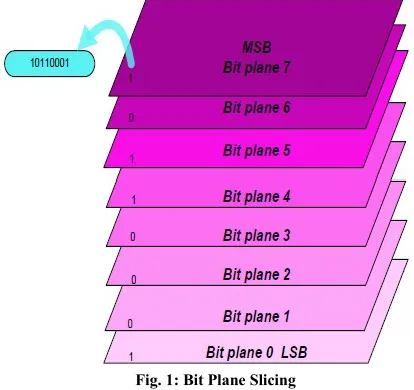
[image:2.612.342.549.120.315.2]Bit-Plane Slicing is a technique in which the image is sliced at different planes. It ranges from Bit level 0 which is the least significant bit (LSB) to Bit level 7 which is the most significant bit (MSB) as shown in Fig. 1.
Fig. 1: Bit Plane Slicing
It is clear that the intensity value of each pixel can be represented by an 8-bit binary vector (b7, b6, b5, b4, b3, b2, b1, b0) bk, where k is from 0 to 7 and each bk is either “0” or“1”. In this case, an image may be considered as an overlay of eight bit-planes. Each bit-plane can be thought of as a two tone image and can be represented by a binary matrix [9] [10].
The formation of bit plane is given by Eq. (1).
(
,
)]
2
1
[
2
1
)
,
(
i
j
R
floor
I
i
j
IBP
k k………(1)
Where I(i,j) = original image, IBPk(i,j) = bit-plane
information for bit k, R = remainder.
Fig. 2 shows the bit plane images for bit 0 (LSB) to bit 7 (MSB) of some images.
(a)
k=0 k=1 k=2 k=3
[image:2.612.326.566.552.711.2]International Journal of Emerging Technology and Advanced Engineering
Website: www.ijetae.com (ISSN 2250-2459, Volume 2, Issue 4, April 2012)696
k=4 k=5 k=6 k=7
(a4) (a6) (a7) (a8)
(b)
k=0 k=1 k=2 k=3
(b0) (b1) (b2) (b3)
k=4 k=5 k=6 k=7
[image:3.612.48.293.108.407.2](b4) (b5) (b6) (b7)
Fig. 2: Some Images and their Bit Plane Images
Now, for the image of Fig. 2(a), bit plane images with k=0, k=1 and k=2 does not contribute so much information in image formation. Experimental result shows that the image can be stored with the information provided by bit3 to bit7 only keeping the originality of the image unchanged. Thus number of bits per pixel can be reduced to 5 from 8 which save more storage space. Similarly, the image of Fig. 2(b) can be stored omitting the information for bit 0 and bit 1 and hence the number of bits per pixel for this image can be reduced to 6 bits from 8 bits.
III. IMAGE COMPRESSION
This section describes the method to compress an image in Extended JPEG format. First the image, which is already compressed in JPEG format, is taken and then Algorithm 1 is applied to get the compressed image in proposed format.
Algorithm 1
Algorithm Image Compression
// I is source image and I1 is compressed image. Let I is a color image. Factor = 2j where 0 ≤ j ≤ 7.
{
Input an Image I.
Set Threshold = T and Factor = 256. Do
{
for each row i of image I {
for each column j of image I {
I1(i,j,1) = I(i,j,1)/Factor; // Set R values I1(i,j,2) = I(i,j,2)/Factor; // Set G values I1(i,j,3) = I(i,j,3)/Factor; // Set B values }
}
Calculate the Euclidean distance D between I and I1 Factor = Factor/2;
}while(D>T); }//End of Algorithm
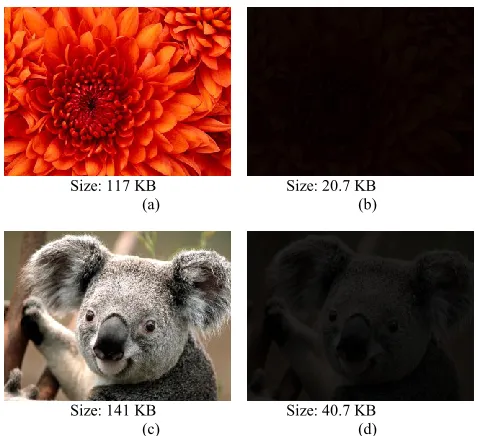
Fig. 3 shows some images after applying Algorithm1. Each image is tagged with the size of the image.
Size: 117 KB Size: 20.7 KB
(a) (b)
Size: 141 KB Size: 40.7 KB
(c) (d)
Fig. 3: Some Color Images and their compressed images after applying Algorithm 1. (a) Original Images in JPEG format (b) Compressed images in Extended JPEG format after applying
Algorithm 1
IV. IMAGE DECOMPRESSION
Image decompression is a technique to reconstruct the original images from the compressed ones. In section III, the proposed method for Extended JPEG format on any JPEG image has been discussed. In this section, the method to decompress the image in Extended JPEG format is illustrated. Algorithm 2 depicts the process.
Algorithm 2
[image:3.612.325.564.329.547.2]International Journal of Emerging Technology and Advanced Engineering
Website: www.ijetae.com (ISSN 2250-2459, Volume 2, Issue 4, April 2012)697 // I1 is compressed image and I2 is retrieved image. Let I1 is a color image.
{
Input a compressed image I1. for each row i of image I1 {
for each column j of image I1 {
I2(i,j,1) = I1(i,j,1)*Factor; // Regain R values I2(i,j,2) = I1(i,j,2)*Factor; // Regain G values I2(i,j,3) = I1(i,j,3)*Factor; // Regain B values }
}
[image:4.612.322.550.145.703.2]}//End of Algorithm
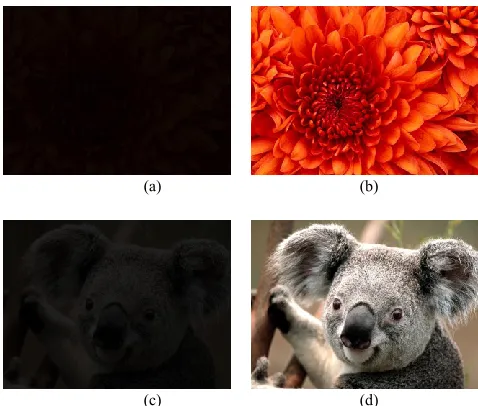
Fig. 4 shows some retrieved images from the compressed images using Algorithm 2.
(a) (b)
(c) (d)
Fig. 4: Some compressed Images followed by the retrieved images using Algorithm 2. (a) Compressed Images using Algorithm 1 (b)
Decompressed Images using Algorithm 2
V. EXPERIMENTAL RESULTS
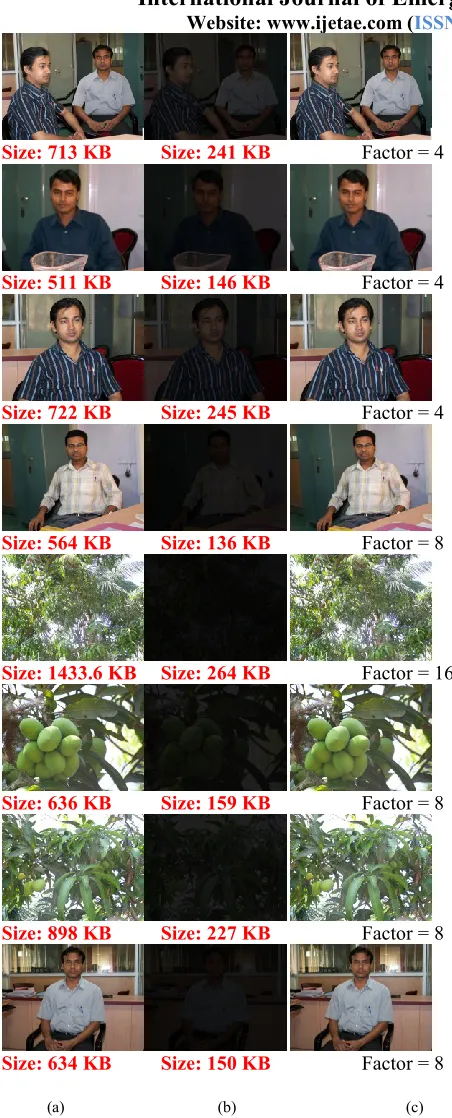
For testing the proposed method, we had about 450 images with different intensity levels. Some images are taken from the standard images provided by Windows sample pictures. Other images are taken from our own database DB-JU-I. The method has been tested using Matlab 6.0. Some results are shown in Fig. 5. Each image is associated with size required to store the image. Factor = 2j
indicates that j LSB bits can be discarded as their bit plane slicing images don’t contribute too much information in image formation.
Alternatively, discarding that j LSB bits doesn’t degrade the visual effect of the image.
Size: 892 KB Size: 241 KB Factor = 8
Size: 988 KB Size: 133 KB Factor = 16
Size: 120 KB Size: 48.5 KB Factor = 4
Size: 90.8 KB Size: 38.8 KB Factor = 4
Size: 83.9 KB Size: 27.3 KB Factor = 8
Size: 104 KB Size: 29 KB Factor = 8
Size: 684 KB Size: 181 KB Factor = 8
[image:4.612.47.286.330.533.2]International Journal of Emerging Technology and Advanced Engineering
Website: www.ijetae.com (ISSN 2250-2459, Volume 2, Issue 4, April 2012)698
Size: 713 KB Size: 241 KB Factor = 4
Size: 511 KB Size: 146 KB Factor = 4
Size: 722 KB Size: 245 KB Factor = 4
Size: 564 KB Size: 136 KB Factor = 8
Size: 1433.6 KB Size: 264 KB Factor = 16
Size: 636 KB Size: 159 KB Factor = 8
Size: 898 KB Size: 227 KB Factor = 8
Size: 634 KB Size: 150 KB Factor = 8
(a) (b) (c)
Fig. 5: Some results after compression of images using JPEG method and Extended JPEG method with required storage space. (a) Original images stored in JPEG format (b) Compressed images using Extended JPEG format (c) Decompressed Images those are compressed using Extended
JPEG format
Fig. 6 shows the comparison result of Extended JPEG format Vs JPEG format in terms of Storage space.
Performance of Extended JPEG Format Vs JPEG Format in terms of Storage Space
0 200 400 600 800 1000 1200 1400 1600
1 3 5 7 9 11 13 15 17 19 21 23 25 27 29 31 33 35 37 Image Number
S
tora
ge
S
pa
ce
(
in
K
B
)
[image:5.612.46.272.99.658.2]JPEG Format Extended JPEG Format
Fig. 6: Comparison result of Extended JPEG format Vs JPEG format in terms of storage space
VI. CONCLUSION
In this paper, we propose a novel bit plane slicing based lossy compression technique which takes much less storage space than jpeg compression. Given an image in JPEG format, we first convert it into gray level image (if the image is color one) followed by finding its bit plane images for bit 0 to bit 7, discard those bits for which the bit plane images don’t give so much information by dividing the pixel intensities by a factor of 2j and thereby store the
image as compressed one. For decompression, the pixel intensities are regained by the reverse process. Our approach is tested on a database including about 450 images. This work can be useful for the image compression with no visual degradation.
ACKNOWLEDGMENT
[image:5.612.327.576.152.280.2]International Journal of Emerging Technology and Advanced Engineering
Website: www.ijetae.com (ISSN 2250-2459, Volume 2, Issue 4, April 2012)699 REFERENCES
[1] Ming Yang & Nikolaos Bourbakis ,“An Overview of Lossless Digital Image Compression Techniques,” Circuits & Systems, 2005 48th Midwest Symposium, vol. 2 IEEE ,pp 1099-1102,7 – 10 Aug, 2005.
[2] Milos Klima, Karel Fliegel, “Image Compression Techniques in the field of security Technology: Examples and Discussion”, Security Technology, 2004, 38th Annual 2004 International Carnahan Conference, pp 278-284,11-14 Oct., 2004.
[3] Ismail Avcibas, Nasir Memon, Bulent Sankur, Khalid Sayood, “A Progressive Lossless / Near Lossless Image Compression Algorithm”, IEEE Signal Processing Letters, vol. 9, No. 10, pp 312-314, October 2002.
[4] C.K. Li and H.Yuen, “A High Performance Image Compression Technique For Multimedia Applications”, IEEE Transactions on Consumer Electronics, Vol. 42, no. 2, pp 239-243, 2 May 1996. [5] Wen Shiung Chen, en- HuiYang & Zhen Zhang, “ A New Efficient
Image Compression Technique with Index- Matching Vector Quantization,” Consumer Electronics, IEEE Transactions, Vol. 43, Issue 2, pp 173- 182, May 1997.
[6] David H. Kil and Fances Bongjoo Shin, “Reduced Dimension Image Compression And its Applications”, Image Processing, 1995, Proceedings of International Conference, Vol. 3, pp 500-503, 23-26 Oct., 1995.
[7] Vo Dinh Minh Nhat, Sung Young Lee, “Two- Dimensional Weighted PCA algorithm for Face Recognition”, Proceedings 2005 IEEE International Symposium on Computational Intelligence in Robotics and Automation, pp 219-223, June 27-30,2005, Espoo, Finland.
[8] Malay K. Pakhira, Computer Graphics Multimedia and Animation 2nd Ed, PHI.
[9] R. C. Gonzalez, and R. E. Woods, Digital Image Processing 2nd ed., Prentice Hall, Inc., New Jercy.