Journal of Chemical and Pharmaceutical Research, 2015, 7(8):897-906
Research Article
ISSN : 0975-7384
CODEN(USA) : JCPRC5
Sorption behavior of heavy metal ions using a terpolymeric resin and its
composite: Synthesis, characterization and ion-exchange studies
K.
Riaz Ahamed
*,
G. Velmurugan and
Kanagaraj
PG & Research Department of Chemistry, Jamal Mohamed College (Autonomous), Tiruchirappalli, Tamil Nadu, India
_____________________________________________________________________________________________
ABSTRACT
The ion-exchange technique has been involved for the removal of heavy metal from different aqueous solution. The
terpolymer resin was synthesized by condensation polymerization of o-toludine and 8-hydroxyquinoline with formaldehyde resin using dimetylformamide (DMF) as a reaction medium in 1:1:2 ratio at 130°C for 6 Hrs. The composite was prepared by terpolymer and activated charcoal. The structure of the prepared Terpolymer resin and composite were established by the elemental analysis and other spectral studies such as FTIR and NMR(1H&13C). The surface morphology of the adsorbents have been determined by SEM. The prepared adsorbents were subjected to removal of selective metal ions like Cu2+, Zn2+, Co2+, Pb2+ in different electrolyte concentrations, different pH ranges and different rates by Batch equilibrium method. The results revolved that, the terpolymer and its composite have good adsorbents. The adsorbents were an effective metal ion removal for Zn2+ than other metal ions. The metal ion capacity of the adsorbents also compared with other commercial resin.
Keywords: Terpolymer resin, Composite, Ion-Exchange, Batch equilibrium
_____________________________________________________________________________________________
INTRODUCTION
K.
Riaz Ahamed
et al
J. Chem. Pharm. Res., 2015, 7(8):897-906
_____________________________________________________________________________________
and ethylenediamine with formaldehyde in the presence of acid medium, terpolymer resin employing removal of various metal ions with different electrolytes, wide pH and rate [6]. A chelating resin have been synthesized by reacting 2,2-dihydroxybiphenyl with urea and formaldehyde in presence of 2M HCl as reaction medium to involve removal of selective metal ions by using ion- exchange method [7]. 4-hydroxyacetophenone, oxamide and formaldehyde copolymer prepared by condensation of 4-hydroxyactophenone and oxamide with formaldehyde in the presence of an acid catalyst proved to be a selective chelation ion-exchange for certain metals reported by W.B. Gurunule and Co-workers [8]. To synthesized a novel terpolymer resin by 2-amino-6-nitro-benzothiazole and semicarbazide with formaldehyde (BSF) by solution condensation technique. This resin was good ion-exchange behavior for removal of selected metal ion like Fe2+, Cu2+, Ni2+, Co2+, Zn2+, Cd2+ and Pb2+ using batch equilibrium technique with different electrolyte concentrations, pH ranges and time intervals [9]. 8-hydroxyquinoline 5-sulfonic acid, oxamide and formaldehyde has been synthesized from polycondensation technique. The synthesized resin has been involved removal of heavy metals by batch equilibrium method. The polymeric resin adsorbed for higher selectivity for Fe3+, Cu2+, and Ni2+ ions than for Co2+, Zn2+, Cd2+, and Pb2+ ions [10]. A comparative account was carried out between the commercial activated carbon, chitosan and chitosan/activated carbon composite for the enhanced of cadmium ions from aqueous solution. pH solution is very important factor for the removal of heavy metal ions [11]. A novel comparative study was done between a synthesized terpolymer and its composite for the removal of heavy metals. The order of removal of heavy metal ions by the terpolymer and composite is Zn2+> Cu2+> Co2+> Pb2+> Cd2+ and Pb2+> Cd2+> Cu2+> Co2+> Zn2+ respectively[ 12].
It is clear from the literature, the o-toludine and 8-hydroxyquinoline with formaldehyde resin type of terpolymer have not been synthesized for its chelation ion exchange properties. Hence it is planned to synthesize the o-toludine and 8-hydroxyquinoline with formaldehyde resin terpolymer by condensation polymerization technique. The novel composite was prepared by activated charcoal and terpolymer. The prepared adsorbents were characterized by elemental analysis, spectral studies to identify the functional groups present in it and to establish the structure of the resin and also study with morphology of the adsorbents. The ion-exchange properties of the terpolymer and its composite for the removal of specific metal ions were carried out by batch equilibrium method. The results were compared with the earlier literatures and commercially available resins.
EXPERIMENTAL SECTION
Materials
o-toludine and 8-hydroxyquinoline with formaldehyde were used as purchased from Merck, India. Heavy metal ion solutions such as Cu2+, Zn2+, Co2+, Pb2+ were prepared by its nitrate salts from Sigma Aldrich. The other chemicals and solvents procured from Merck were used as received without further purification.
Synthesis of terpolymer
Scheme 1. Synthetic route of THF terpolymer
Elemental, spectral and SEM analyses
The proportion of elements likes that C, H and N was analyzed using an Elementar instrument (Model Vario EL III, Germany). The functional groups of the adsorbents have been established by FTIR spectra scanned in KBr pellets on a Bruker (Model Tensor27, MA, USA) spectrophotometer and the (1H & 13C) NMR spectra were recorded using Bruker 400 MHz, MA, USA in DMSO-d6 as a solvent for the nature of the hydrogen and carbon present in the
resin. The surface morphology of the synthesized compound was determined by Jeol scanning electron microscope (Hitachi Model S-3000H, Tokyo, Japan) at different magnification.
Ion-exchange studies
Analysis of metal ion uptake at different electrolytes
A batch equilibrium method was adopted to determine the metal ion uptake of specific metal ions like Cu2+, Zn2+, Pb2+ and Co2+ 25mg of the polymer sample was taken in a pre cleaned glass bottles and 25ml of electrolytes like NaCl, NaNO3 and NaClO4 at various concentrations viz 0.1, 0.5, and 1.0 M are added in to it. This solution was
K.
Riaz Ahamed
et al
J. Chem. Pharm. Res., 2015, 7(8):897-906
_____________________________________________________________________________________
Where, Q is the ion-exchange capacity, V is the volume of the metal ion, C0 is the initial concentration, is the
final concentration, M is the weight of the polymer/composite
Analysis of metal ions at different pH
The metal uptake was used at various pH range between 1.5 to 5.0 of the adsorbent and the aqueous solution were determined in the presence of 0.1 M NaCl at 25°C.
= −
Where, Q is the ion-exchange capacity, V is the volume of the metal ion, C0 is the initial concentration, is the final
concentration, M is the weight of the polymer/composite
Analysis of rate of metal ion uptake
To estimate the time required to reach the state of equilibrium under the experimental conditions, a series of experiments were made to estimate the amount of metal ion uptake by the terpolymer at require time intervals, 25 mg of the adsorbents samples was mechanically stirred with 25 mL of 1 M NaCl and titrated against Na2EDTA. The
rate of metal ion uptake is showed as the percentage of the amount of metal ion uptake after a specific time related to that in the state of equilibrium. The Percentage of metal ion was calculated by,
% = − × 100
RESULTS AND DISCUSSION
Elemental analysis
From the elemental data, the empirical formula of the terpolymer found to be C19H18N2O.
The percentage of the elements present in the terpolymer was concluded by the calculated and experimental values found for carbon is 78.59, hydrogen is 6.25, nitrogen is 9.65, and oxygen is 5.51. which are in good agreement with each other. The values of elemental analysis confirm the proposed structure of the terpolymer presented in scheme 1.
Spectral studies FTIR spectral analysis
The structure of synthesized resin was analyzed by FTIR spectrum of THF is depicted in Fig.1. A broad peak appeared in the region of 3423.21 cm-1 is assigned to the amine group of Ar-NH and -OH merged in the terpolymer. A peak appeared at 2855 cm-1is attributed to aromatic ring stretching modes. A peak appeared in the region at 2925 cm-1 is attributed to >CH2 linkage present in the terpolymer. The FTIR spectrum of composite is showed in Figure 2.
From the figure, the composite slightly changes from terpolymer. The specific adsorption band at 3358.21 was caused by –NH bridge from terpolymer . The adsorption of band around 2858.97 can be attributed to aromatic ring stretching (C-H) present in the terpolymer. A band at 2928 indicates -CH2 stretching involved in the terpolymer.
K.
Riaz Ahamed
et al
J. Chem. Pharm. Res., 2015, 7(8):897-906
_____________________________________________________________________________________
NMR spectral analysis
The 1H NMR spectrum of the THF terpolymer resin are depicted in Figure.3. The resonance signal at 9.5 ppm is assigned to the -OH of quinoline ring. The signals appeared in the region of 7.0–7.6 ppm are attributed to all the protons of the aromatic ring. The methylene proton of -CH2 bridge was assigned at 5.03 [14].
Fig.3 1H NMR spectra of THF terpolymer
The 13C NMR spectrum of the terpolymer is shown in Figure. 4. The spectrum of THF resin shows the corresponding peaks at 112.84, 117.03, 119.15, 129.54, 130.21, 135.6 ppm with respect to C1 to C6 of the aromatic ring. The peak observed at 54.86 ppm to indicates the–CH2 bridge in the terpolymer.
Surface analysis
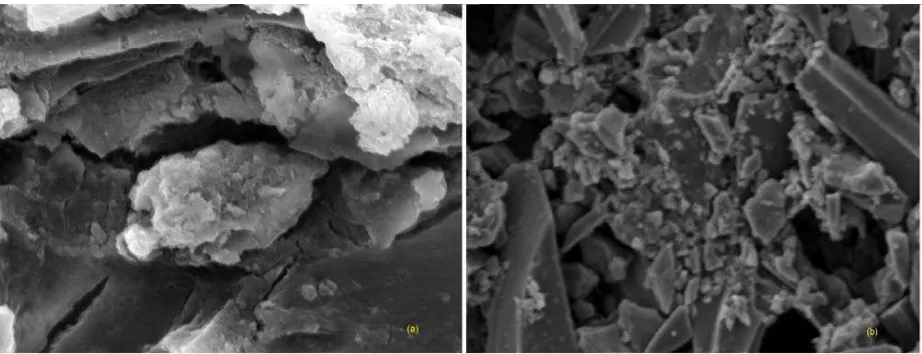
The surface morphology of the terpolymer and composite have been investigated by SEM analysis. The SEM images are depicted in the Figure. 5. The surface morphology of the terpolymer was found to be fracture based surface shown in Fig. 5 (a). The figure Fig. 5 (a) shows that, the terpolymer surface having closed packed arrangement surface more active sites. The SEM photograph of the composite is shown in Fig. 5 (b), from the figure the surface morphology of the composite different from terpolymer. Which is evidence for formation of composite. The surface morphology of the composite having more active sites and different pores size present on the surface compared to terpolymer. This is implies that increasing the surface area, increasing the larger number of cavities for composite. from this images, the terpolymer and composite have better metal ion removal capacity [ 12].
[image:7.595.72.533.216.393.2]Fig.5 SEM photographs of (a) TCF terpolymer, (b) composite
Table 1. Effect of metal ion uptake by THF terpolymer & its composite
M2+(NO
3)2 = 0.1 M; volume = 2 mL; volume of electrolyte = 25 mL; weight of resin = 25 mg; time = 24 h; room temperature
Ion-exchange studies
Effect of metal ion uptake in different electrolytes with variation in concentrations
The chelating ion-exchange property of the terpolymer and composite were measured by batch equilibrium method involving Co2+, Cu2+, Pb2+ and Zn2+ ions in various electrolytes viz. NaCl, NaNO3 and NaClO4 with different
concentration of 0.1, 0.5 and 1.0 M. The results are presented in Table-1. From the data it is observed that the
Metal ions
Concentration of electrolytes (mol L-1)
Metal ion uptake in the presence of electrolytes (m.mol/g)
NaCl NaNO3 NaClO4
THF Composite THF Composite THF Composite
Pb2+
0.1 0.748 0.932 1.208 1.315 0.756 0.812 0.5 0.831 1.08 1.328 1.486 0.832 1.08
1 1.504 1.732 1.631 1.845 0.916 1.256
Cu2+
0.1 0.856 1.232 1.142 1.384 1.108 1.235 0.5 2.574 2.645 1.231 1.745 1.642 1.853 1 2.731 2.832 1.8 2.08 1.9 2.132
Co2+
0.1 0.758 0.965 0.654 1.345 0.635 0.875 0.5 0.972 1.08 1.708 1.516 1.514 1.6
1 1.608 1.831 2.425 1.915 1.636 1.723
Zn2+
0.1 1.504 1.874 1.346 1.543 1.718 1.854 0.5 2.672 2.756 1.822 2.08 1.915 2.08
K.
Riaz Ahamed
et al
J. Chem. Pharm. Res., 2015, 7(8):897-906
_____________________________________________________________________________________
Zn2+. This may be due to the relative weak chelation of metal ions with the electrolytes. Furthermore, the large size of the metal ions was slowly through in to the terpolymer surface. Hence Zn2+can easily removed by the terpolymer and its composite. the terpolymer and composite can acts as a better ion-exchanger. The comparative account study was involved terpolymer and its composite, from the results the composite has higher metal ion uptake compared to terpolymer. Which is may be due to the large surface area and more active sites on the surface. Hence, the order of the selective metal ion uptake were found to be Zn2+ > Cu2+ > Co2+> Pb2+ .
Analysis of metal ions removal at different pH
The effect of pH is very important role of the ion- exchange process. The ion-exchange behaviour of the terpolymer and composite have been investigated by the influence of the different pH range at 1.5 to 5. The purpose of the using pH, to avoid the precipitation of the meal ion [17]. The effect of pH, the amount of metal ion uptake between the two phase are given in Table 2&3. At low pH, increases the concentration of the H+ ion compete with metal ion on the surface. The amount of metal ion uptake by the adsorbents increases with increasing pH [18]. At low pH, the metal ion cannot easily enter in to the active sites due to higher concentration of H+ ions. From the observed results the terpolymer and composite takes up Zn2+ ions more effectively than the other metal ions. This is may be due to the low concentration of H+ ions and stability constant of the adsorbents and metal ion complexes [12 ]. Further Pb2+ ions have lower metal ion uptake by the terpolymer and composite. This can be explained as the weak stabilization energy of the metal complex formed from these ions. In this investigation it is observed that the order of metal ion were found to be Zn2+ > Cu2+ > Co2+> Pb2+ by terpolymer and composite.
Table 2. Metal ion uptake at different pH by THF terpolymer
Metal ions
Metal ion uptake (m.mol/g) pH of the medium
1.5 2 3 4 5 6 Pb2+ 0.325 0.564 0.652 0.937 1.118 1.342 Cu2+ 0.623 0.914 1.23 1.324 1.625 1.73 Co2+ 0.425 0.615 1.08 1.238 1.52 1.653 Zn2+ 0.64 0.78 0.915 1.08 1.923 2.312
M2+(NO3)2 = 0.1 M; volume = 2 mL; NaCl= 1 M; volume = 25 mL; weight of resin = 25 mg; time = 24 h; room temperature
Table 3. Metal ion uptake at different pH by composite
Metal ions
Metal ion uptake (m.mol/g) pH of the medium
1.5 2 3 4 5 6 Pb2+ 0.415 0.545 0.712 0.925 1.08 1.735 Cu2+ 0.523 0.634 0.915 1.12 1.512 1.954 Co2+ 0.4 0.512 0.632 0.815 1.23 1.832 Zn2+ 0.654 0.831 1.08 1.214 1.832 2.454
M2+(NO
3)2 = 0.1 M; volume = 2 mL; NaCl= 1 M; volume = 25 mL; weight of resin = 25 mg; time = 24 h; room temperature
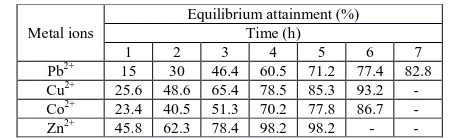
Analysis of metal ions removal at different rate
Table 4. Rate of metal ion uptake by THF terpolymer
Metal ions
Equilibrium attainment (%) Time (h)
1 2 3 4 5 6 7 Pb2+ 13 35.3 47.8 56.7 67.4 75 83 Cu2+ 15.5 25 48.7 56.4 68.7 80.2 88.6 Co2+ 13.8 38.4 46.7 59.8 68.4 76.8 84.1 Zn2+ 34 52 95 95 - - -
M2+(NO
[image:9.595.183.408.224.293.2]3)2 = 0.1 M; volume = 2 mL; NaCl= 1 M; volume = 25 mL; weight of resin = 25 mg; time = 24 h; room temperature
Table 5. Rate of metal ion uptake by composite
Metal ions
Equilibrium attainment (%) Time (h)
1 2 3 4 5 6 7 Pb2+ 15 30 46.4 60.5 71.2 77.4 82.8 Cu2+ 25.6 48.6 65.4 78.5 85.3 93.2 - Co2+ 23.4 40.5 51.3 70.2 77.8 86.7 - Zn2+ 45.8 62.3 78.4 98.2 98.2 - -
M2+(NO
3)2 = 0.1 M; volume = 2 mL; NaCl= 1 M; volume = 25 mL; weight of resin = 25 mg; time = 24 h; room temperature
CONCLUSION
A new terpolymer and composite were successfully carried out by polycondensation technique. The synthesized adsorbents were characterized by various spectral analysis. Using FTIR and surface morphology data were confirmed formation composite. The prepared adsorbents to involved removal of selective toxic heavy metal ( Co2+, Cu2+, Pb2+ and Zn2+ ) ions by batch studies. Sorption capacity of the adsorbents varied by the influence of nature and pH. The terpolymer and its composite have higher metal ion uptake. Which may be due to different pores size, large surface area. The results evolved that the terpolymer and its composite were found to be higher metal ion uptake for Zn2+ ion than other metal ion. This is indicates strong stability constant of the adsorbents with metal ion. Moreover, the comparative account was found, the composite has higher metal ion uptake than terpolymer. Hence, the terpolymer and composite can act as better ion-exchanger for metal ion removal.
Acknowledgement
The authors thank the Management and Principal of Jamal Mohamed College (Autonomous), Tiruchirappalli, Tamil Nadu for their support and encouragement.
REFERENCES
[1]. R Hasanzadeh; P N Moghadam; N Samadi; S A Rezaei. J. App. Polym. Sci., DOI:10.10002/APP.36793, 2013. [2]. H Valle; J Sánchez; B L Rivas. J. App. Polym. Sci., 10.1002/app.41272, 2014.
[3]. M A Riswan Ahamed; R S Azarudeen; M Karunakaran; A R Burkanudeen. Iran. PolymJ., 2010, 19, (8), 635-646.
[4]. A Burkanudeen; M Karunakaran; Orien. J. Chem., 2002, 18, 65-68.
[5]. S Samal; R R Das; R K Dey; S Acharya. J. App. Polym. Sci., 2000, 77, (5), 967- 981.
[6]. M A Riswan Ahamed; R Subha; D Jeyakumar; A R Burkanudeen. Polym. Int., DOI 10.1002/pi.4768, 2014. [7]. L J Paliwal; M M Jadhao; N S Bhave. Desalination., 2009, 250, 120-129.
[8]. W B Gurnule; P K Rahangdale; L J Paliwal; R B Kharat. J. App. Polym. Sci., 2003, 89. (3), 787 - 790,
[9]. M A Riswan Ahamed; R S Azarudeen; R Subha; A R Burkanudeen. Polym. Bull., 2014, 71, (12), 3209–3235. [10]. R N Singru; W B Gurnule. J. App. Polym. Sci., 2010, 116, 3356–3366.
K.
Riaz Ahamed
et al
J. Chem. Pharm. Res., 2015, 7(8):897-906
_____________________________________________________________________________________
[16]. R S Azarudeen; M A Riswan Ahamed; R Subhad; A R Burkanudeen. J. Chem. Tech. Bio., 2014, DOI 10.1002/jctb.4528.
[17]. M Riswan Ahamed; R Azarudeen; M Karunakaran; T Karikalan; R Manikandan; A Burkanudeen. Int. J. Chem. Environ. Eng., 2010, 1, (1), 7-12.
[18]. X Sun; X Huang; X Liao; B Shi. J. Hazard. Mater., 2011, 186, 1058–1063, [19]. D B Patle; W B Gurnule. Arabian. J. Chem., doi:10.1016/j.arabjc.2011.07.013