THE DEVELOPMENT OF ENERGY EFFICIENCY
ESTIMATION SYSTEM FOR DOMESTIC HOUSING
BY USING QUALITY FUNCTION DEPLOYMENT
APPROACH
KHAIRUNNISA BINTI A. RAHMAN
THE DEVELOPMENT OF ENERGY EFFICIENCY ESTIMATION SYSTEM FOR DOMESTIC HOUSING BY USING QUALITY FUNCTION DEPLOYMENT
APPROACH
KHAIRUNNISA BINTI A. RAHMAN
A thesis submitted in
fulfillment of the requirement for the award of the Doctor of Philosophy
Faculty of Mechanical and Manufacturing Engineering Universiti Tun Hussein Onn Malaysia
iii
In the name of Allah. The Most Gracious, The Most Merciful.
For my beloved father and mother,
Haji A. Rahman Bin Pawiroh and Hajah Natijah Binti Md Noh
My dearest husband,
Associate ProfessorDr. Abdul Mutalib Bin Hj. Leman
and
My precious sons,
Muhammad Aiman Fahmi
Muhammad Arif Haiqal
Muhammad Amir Hakimi
Muhammad Ilham Irfaan
Muhammad Izzudin Naufal
iv
D
ACKNOWLEDGEMENT
In the name of Allah, Most Gracious, Most Merciful.
Alhamdulillah, all praise to Allah, the Most Beneficent and the Most Merciful, who has given me the strength and grace to conduct this study.
I would like to take this opportunity to put on record, my heartfelt thanks and deep appreciation to my supervisor, Professor Emeritus Ir. Hj. Mohammad Zainal Bin Hj. Md. Yusof, and co-supervisors, Dr. Azian Binti Hariri and Associate Professor Dr Hj. Mohd Najib Bin Hj. Mohd Salleh, for their extraordinary patience, enduring optimism, guidance, invaluable advice and assistance in this study.
I also like to extend my gratitude to the Ministry of the Education Malaysia for giving me the opportunity to pursue my study in this field. I would also like to thank all academics which I had inspiring discussions and who have shared their thoughts. Also to my postgraduate friends. They have assisted me in giving advices, ideas, and technical support to this research.
v
ABSTRACT
vi
ABSTRAK
vii
mengurangkan sehingga 30% daripada penggunaan tenaga sebulan. Dengan mengambilkira pengetahuan dan amalan di kalangan pengguna, EEES telah berjaya dibangunkan dengan menggunakan pendekatan kaedah QFD, dan sistem ini juga membenarkan pengguna untuk menguruskan sendiri penggunaan tenaga dengan mengganggarkan kecekapan tenaga dan peratusan penjimatan tenaga.
viii
CONTENTS
DECLARATION ii
DEDICATION iii
ACKNOWLEDGEMENT iv
ABSTRACT v
ABSTRAK vi
LIST OF TABLES xvi
LIST OF FIGURES xix
LIST OF SYSMBOLS AND ABBREVIATIONS xxiii
LIST OF APPENDICES xxv
CHAPTER 1 INTRODUCTION 1
1.1 Overview 1 1.2 Background of the Study 1 1.3 Problem Statement 5
1.4 Research Questions 9
1.5 Objectives of the Study 9
ix
1.7 Significance of the Study 10
1.7.1 Government 11
1.7.2 Residents 11
1.8 Limitations 12
1.9 Organization of the Thesis 12
1.10 Summary 14
CHAPTER 2 LITERATURE REVIEW 15
2.1 Overview 15
2.2 Issues and Challenges of Energy 15
2.3 Electricity Generation 22
2.4 Energy Efficiency 25
2.4.1 Energy Efficiency Initiative in Malaysia 28
2.4.2 Energy Efficiency in Residential Buildings 30
2.4.3 Energy Efficiency Tools in Improving EE 32
2.4.4 Energy Efficiency Index (EEI) 34
2.5 Energy Efficiency Standards and Labelling (S&L) 37
2.5.1 Minimum Energy Performance Standards (MEPS) 39
2.6 Energy Awareness 42
2.6.1 Awareness Campaign 44
2.7 Green Technology in Malaysia 45
x
2.8 Energy Efficiency for Sustainable Development 49
2.9 Quality Function Deployment (QFD) 51
2.9.1 The QFD Process 54
2.9.2 Formulation of House of Quality 55
2.10 Summary 59
CHAPTER 3 METHODOLOGY 60
3.1 Overview 60
3.2 Research Framework 60
3.3 Phase 1: Energy Survey 64
3.3.1 Development of Questionnaires 64
3.3.2 Sample Selection from Population 69
3.3.3 Data Analysis of Energy Survey 71
3.4 Phase 2: Energy Efficiency Testing and Measurement 72
3.4.1 Technical / Equipment Preparation 72
3.4.2 Energy Efficiency Testing and Measurement 72
3.4.3 Flowchart of the Process 72
3.4.4 The Measuring of Equipment 73
3.4.5 Data Analysis for Energy Efficiency Testing and
Measurement 75
3.5 Phase 3: System Development 81
3.5.1 Development of System Based on System
xi
3.5.2 QFD Procedures 84
3.6 Energy Estimation Analysis in EEES 91
3.6.1 Appliances Energy Estimation Calculation 92
3.6.2 Energy Consumption Solution 95
3.7 System Verification 97
3.8 Summary 98
CHAPTER 4 RESULTS AND DATA ANALYSIS 100
4.1 Overview 100
4.2 Results of Energy Survey 100
4.2.1 Pilot Test 101
4.2.2 Demographic Profile 101
4.2.3 Variables Measurement 109
4.2.4 Pearson Correlation Analysis 110
4.2.5 Phi and Cramer’s V Analysis 115
4.2.6 Statistics on Electrical Appliances 117
4.3 Energy Efficiency Testing and Measurement 119
4.3.1 Refrigerators 119
4.3.2 Analysis of Refrigerators 120
4.3.3 Air Conditioners 122
4.3.4 Analysis of Air Conditioner 123
xii
4.3.6 Analysis of Fans 125
4.3.7 Lamps 126
4.3.8 Analysis of Lamps 127
4.3.9 Televisions 128
4.3.10Analysis of Televisions 129
4.4 Summary 131
CHAPTER 5 EEES SYSTEM DEVELOPMENT 132
5.1 Overview 132
5.2 System Development 132
5.2.1 Consumer Awareness Survey Analysis 133
5.2.2 Quality Function Deployment Analysis 135
5.3 Development of the EEES 142
5.4 System Components 143
5.5 System Requirement 144
5.6 System Design 145
5.7 System Implementation 150
5.7.1 Database 151
5.7.2 Interface 154
5.8 System Testing and Analysis 165
5.9 Getting the System Started 166
xiii
5.10.1Analysis of Energy Consumption by Using EEES 168
5.10.2Analysis of EEES Usage for 30 Respondents 174
5.11 Summary 181
CHAPTER 6 CONCLUSIONS AND RECOMMENDATIONS 182
6.1 Overview 182
6.2 Conclusions 183
6.3 Recommendations 183
6.4 Main Contributions 184
REFERENCES 187
APPENDICES 201
xiv
LIST OF TABLES
1.1 Comparison from previous researches related to energy
management on energy efficiency 8
2.1 EPP for Oil, Gas and Energy Sector 18
2.2 Summary of researches on energy efficiency related issues 27 2.3 The key institution of energy sector in Malaysia 29
2.4 Recent studies on energy efficiency 33
2.5 Parameters affecting energy use in buildings 36 2.6 Energy use, Carbon emission, Standard and Labelling
summary for selected Asia Pacific and ASEAN countries 40 2.7 The awareness campaign by Government of Malaysia for 2014 44 2.8 The lists of countries with their green/sustainable building
indicators/measures 49
3.1 The relationship of the energy survey questionnaire with the existing validated questionnaire 68
3.2 Validity by expertise 68
3.3 Sample size table 70
3.4 MS Standards for five electrical appliances 75 3.5 Star rating for refrigerator 76 3.6 Star rating for cooling capacity < 4.5 kW 77 3.7 Star rating for cooling capacity 4.5 kW≤ Cooling capacity
≤ 7.1 kW 78
xv
3.12 Scale Criteria 1 to 5 in this study 85 3.13 Primary and secondary factors for “voice of customer” 87
3.14 Technical requirement 88
3.15 The development phase, instrument and approaches, and detail
documentation 90
3.16 Electricity Tariff in Malaysia 93 3.17 Energy consumption by appliances summary 95 3.18 Distribution of energy consumption estimation by appliances
for 5% saving potential 96
3.19 Difference of energy consumption after implementation of
energy saving solution by EEES 96
4.1 Cronbach’s Alpha results 101 4.2 Number of people living in the house 103 4.3 Age group of the family 103 4.4 Number of employed people in the house 105 4.5 Distribution of housing type 106 4.6 Distribution of estimated house size 107 4.7 Distribution of house ownership 107 4.8 Distribution of number of rooms 108 4.9 Mean, Variance and Standard Deviation 109 4.10 Correlation of knowledge and practice 111 4.11 Correlation of Star Rating appliances and knowledge 112 4.12 Correlation of Star Rating appliances and practice 113 4.13 Correlation of knowledge with other variables 113 4.14 Correlation of practice with other variables 114 4.15 Phi and Cramer’s V between average electricity bill
and the number of people 115 4.16 Phi and Cramer’s V between average electricity bill and house
estimation size 116
4.17 Measurements for refrigerators 120 4.18 Measurement for air conditioners for an hour 123 4.19 Measurement of fans for an hour 125 4.20 Measurement of lamps for an hour 126
xvi
4.22 Measurement of televisions for an hour 128 4.23 Summary of measurement on Star Rated electrical appliances 130 5.1 Mean score and standard deviation of 10 items for Knowledge 134 5.2 Mean score and standard deviation of 15 items for Practice 134 5.3 Thirty respondents involved in Pilot Test 135 5.4 Croanbach’s Alpha values for pilot test of QFD questionnaire 135 5.5 The symbol of relationship in this study 136 5.6 Relative important result for customer requirements 137 5.7 The customer requirement derived from QFD analysis 138 5.8 The technical requirement derived from QFD analysis 139 5.9 System development phases and processes. 142 5.10 Distribution of energy consumption by appliances 170 5.11 Difference between estimated energy consumption with
actual energy consumption 171
5.12 Distribution of energy consumption estimation by appliances
for 10% saving potential 171
5.13 Difference of energy consumption after implementing of energy
saving solution by EEES 172
5.14 The tabulation of electricity bills for 3 months observation 174 5.15 Percentage of reduction of energy usage between first and
second month and between second and third month of
observation 176
5.16 The percentage of reduction in electricity bill between second
and third month 178
xvii
LIST OF FIGURES
1.1 Gross Domestic Product and Population 3
1.2 Final energy demand by four important sectors in Malaysia 3
1.3 Electricity usage by appliances category between Malaysian household 5
1.4 The organization of the thesis 13
2.1 Pillars of the New Energy Policy 19
2.2 National Energy Efficiency Action Plan 21
2.3 Five Key initiatives for energy efficiency programs 21
2.4 Energy consumption analysis from 1993 – 2013 24
2.5 Share of electricity consumption by sectors in 2013 25
2.6 Distribution of electricity users in Peninsular Malaysia for 2013 30 2.7 The breakdown of energy consumption in residential buildings in some major cities in Malaysia 31
2.8 The EE label specification 39
2.9 EE issues highlighted in New Energy Policy in the Tenth Malaysia Plan 41
2.10 SWITCH! Campaign by WECAM 45
2.11 Four phases of QFD approach 54
2.12 Processes of QFD 54
2.13 Six parts of HoQ 56
2.14 House of Quality 57
3.1 Research framework 61
3.2 Flow chart of the study 64
3.3 Flowchart of questionnaire development 65
xviii
3.6 Comparison on how digital clamp multimeter and ordinary
multimeter works 74
3.7 System Development Life Cycle (SDLC) process 82
3.8 The flow chart of QFD procedure 84
3.9 Flow chart of the process 89
3.10 Flowchart of EEE operation 91
3.11 Energy estimation analysis in EEES 92
3.12 Flowchart of the system verification process 98
4.1 Distribution of number of people living in the house 102
4.2 Composition of the respondents by home leader’s occupation 104
4.3 Distribution of monthly household income 105
4.4 Average Electricity Bill 108
4.5 Normal Q-Q Plot of knowledge 110
4.6 Normal Q-Q Plot of practice 111
4.7 Association between average electricity bill and number of people 116
4.8 Association between average electricity bill and house estimation size 117
4.9 Distribution of energy usage by electrical appliances in residential house 118
4.10 Distribution of the brand selection decisions for the purchase of the electrical appliances 119
4.11 Refrigerators with a capacity of 200-299 litres 121
4.12 Refrigerators with a capacity of 300-399 litres 121
4.13 Refrigerator with a capacity of 400-499 litres 122
4.14 Energy consumption for air conditioner 1 hp 124
4.15 Energy consumption for air conditioner 1.5 hp 124
4.16 Energy consumption for fans for a year 126
4.17 Energy consumption for lamps for a year 128
4.18 Energy consumption for televisions for a year 129
4.19 Energy conservation between MEPS and non-MEPS electrical appliances for refrigerators, air conditioners and televisions 130
5.1 House of Quality 141
xix
5.3 System requirements 144
5.4 Input: Module of consumer’s profile 146
5.5 Input: Module of residential information 147
5.6 Input: Module of electrical appliances details 147
5.7 Input: Module of energy consumption analysis 148
5.8 Output: Module of EE solution 148
5.9 Process flowchart 149
5.10 Data processing flow of the system 149
5.11 Flowchart of the EEES 150
5.12 Table created for database 152
5.13 Database by using MySQL 152
5.14 Example of the database table created in MySQL 153
5.15 Example of database table that can be updated by administrator 153 5.16 Example of source code of the database 154
5.17 Java Eclipse Juno 155
5.18 Blank pages for interface design 155
5.19 The interface for Log In page 156
5.20 Four main pages in EEES 157
5.21 User Interface 1: Respondent Background 157
5.22 User Interface 2: Residence Information 158
5.23 User Interface 3: Electrical Appliances Information 158
5.24 The list of appliances that displayed in Electrical Appliances Information page 159
5.25 User Interface 4: Electricity Bill Analysis 160
5.26 Log in page for admin 160
5.27 First page of admin (Main) 161
5.28 Page that display in “user” 161
5.29 Four types of search engine to generate the report 162
5.30 Generate report: Search by reference number 162
5.31 Generate report: Search by name 162
5.32 Generate report: Search by house size 163
5.33 Generate report: Search by type of housing 163
5.34 Updating appliances 164
xx
5.36 Updating electrical appliances by model of appliances 164
5.37 System testing and analysis process flow 165
5.38 Electricity bill of previous month (December 2015) 173
5.39 Electricity bill of current month (January 2016) 173
5.40 Energy consumption for three months 175
5.41 Percentage of reduction and increased of electricity bill 177
xxi
LIST OF SYMBOLS AND ABBREVIATIONS
kWh kilo Watts hour
σ2 Variance
σX Standard Deviation
∑ Summation
r Correlation
µ Mean score
n Sample size
N Size
p Significant level
Amp Ampere Voltage
mb/d million barrels a day
Btu British thermal unit
Mtoe Million Tons of Oil Equivalent
kWh/m2/year kilo Watt hours per square metre per year
W Input power
V voltage
Pon Power at on mode
Pps Power at passive standby mode Pas Power at active standby mode Tas Time on active standby mode (hour) COP Coefficient of Performance
hp Horsepower
EEF Energy Efficiency Factor
EER Energy Efficiency Ratio
xxii
AC Alternating Current
APEC Asia-Pacific Economic Co-operation APERC Asia Pacific Energy Research Centre
AWER Association of Water and Energy Research Malaysia
CO2 Carbon Dioxide
COA Certificate of Approval
DC Direct Current
EC Energy Consumption
EE Energy Efficiency
EEES Energy Efficiency Estimation System
EEI Energy Efficiency Index
EEIB Building Energy Index
ESCO Energy saving company
ETP Economic Transformation Program
GB Green Building
GBI Green Building Index
GDP Gross Domestic Product
GHG Green House Gases
GIS Geographic Information System
HoQ House of Quality
GUI Graphical User Interface
IDE Integrated Development Environment
IEA International Energy Agency
IPP Independent Power Producer
KeTTHA Ministry of Energy, Water and Green Technology LEEDTM Leadership in Energy and Environmental Design NEEAP National Energy Efficiency Action Plan
NKEA National Key Economic Areas
MEPS Minimum Energy Performance Standards
MHTPI Green Technology and the Climate Change Council
MySQL Hyper Text Markup Language (HTML)
OGE Oil, Gas and Energy
PHP Hypertext Preprocessor
xxiii
RE Renewable Energy
RM Ringgit Malaysia
SEDA Sustainable Energy Development Authority Malaysia
SD Sustainable Development
ST Energy Commission (Suruhanjaya Tenaga)
S&L Standard and Labelling
TNB Tenaga Nasional Berhad
USGBC United State Green Buiding Council
xxiv
LIST OF APPENDICES
APPENDIX TITLE PAGE
A Electricity Tariff Schedule 202
B Questionnaire of Energy Survey 208 C Questionnaire of Quality Function Deployment 216 D Raw Data of QFD 222
E QFD Analysis 235
1CHAPTER 1
INTRODUCTION
1.1 Overview
This chapter explains the background of the study. The introduction to energy efficiency (EE) is presented, together with the related issues. This chapter discusses the problem statement for the study based on the background provided, as well as the resulting objectives, significance of the study, the scope of the study and its limitations. This chapter also highlights the management of the whole thesis.
1.2 Background of the Study
2
expansion of renewable energy, and the generation of electricity in the future are very much in the centre of energy discussions. The improvement in EE and the redesigning of power generation must go hand in hand. According to the International Energy Agency (IEA) (2015), the global share of electricity provided by renewable energy could reach 30% by 2035. The remaining 70% will have to be met by conventional sources of energy. However, these conventional sources of energy supply are finite, their costs are on the rise and the impact of their use is damaging to the climate (Tricoire, 2013).
The shortage of hydrocarbon fuel sources, the preservation of energy and stringent emission regulations for the future have been formidable challenges for industries worldwide. However, petroleum, which is a finite source, has been identified as a major source of pollution in the worldwide ecosystem, particularly carbon dioxide (CO2), as this gas creates an atmospheric greenhouse effect that has been linked to global warming and climate change. In Malaysia, the role of the Ministry of Energy, Green Technology and Water (KeTTHA) is to formulate policies and strategies in order to reduce CO2 emissions by up to 40% between 2005 and 2020. The Green Technology and Climate Change Council (MTHPI) is adopting the implementation of green technology to reduce atmospheric greenhouse gases linked to global warming and climate change.
3
[image:27.595.140.498.236.449.2]is projected to grow at 3.9% per year, reaching 98.7 Mtoe in 2030, nearly three times the 2002 level. The industrial sector will have the highest growth rate of 4.3%, followed by the transport sector at 3.9%, the residential sector at 3.1%, and the commercial sector at 2.7%. Figure 1.1 shows the gross domestic product and population, while Figure 1.2 shows the final energy demand between the year 1980 to the year of 2030 by the four main sectors in Malaysia (Asia Pacific Energy Research Centre (APERC), 2006).
Figure 1.1: Gross Domestic Product and Population (APERC, 2006)
4
The electricity demand of Malaysia will increase by 4.7% per year over the outlook period, to reach 274 TWh in 2030. The growth in demand is heavily influenced by the strong demand from the industrial sector, which is projected to increase at 5.4% annually over the outlook period. The electricity demand for the residential sector will also experience a strong growth of 4.9% per year due to improved living standards. The per capita electricity demand is projected to more than double from 2002 to reach 7,571 kWh/person in 2030, higher than the average of 6,833 kWh/person for the APEC region. Hence, Malaysia has embarked on its new economic development plan by introducing the ETP, which consists of 12 areas, with oil, gas and energy being one of those areas. The oil, gas and energy National Key Economic Areas (NKEA) also includes power generation, transmission and distribution. In 2009, energy contributed approximately RM16 billion to the GDP. The industry is governed by KeTTHA and is regulated by the Energy Commission (ST). Electricity is supplied by Tenaga Nasional Berhad (TNB) and a number of other major independent power producers (IPPs).
5
Figure 1.3: Electricity usage by appliances category between Malaysian household and Malaysian government building (Energy Commission, 2010)
Figure 1.3 shows the electricity usage of Malaysian households and government buildings according to the categories of appliances. From the figure, it shows that cooling (44%) was the most usage for both categories and followed by refrigerator (21%) for household and lighting (24%) for government building. After heating or cooling, water heating is typically the largest energy user in the home. Water heating (11%) was the biggest usage for household for appliance that not included in rebate program. As homes have become more energy efficient over the past 20 years, the percentage of energy used for water heating has steadily increased. In the two decades since the first federal standards took effect, water heater efficiency has steadily increased. As important, industry is bringing out new technologies that promise much greater efficiency such as heat pump electric, and “tankless” and “hybrid” gas in both condensing and non-condensing formats.
1.3 Problem Statement
6
are part of an energy management program. A common approach in dealing with EE is to improve the energy management program (Al-Mofleh et al., 2009). A preliminary study of energy consumption should be carried out before developing an energy awareness program. Consumer behaviour with regard to energy awareness should be considered. Zhang et. al. (2011) conducted an in-depth study on how to reduce energy consumption in China. They discovered that there were problems with energy audit and energy management, and they suggested five solutions to strengthen the supervision and management of energy consumption and to reduce unnecessary wastage of energy. Besides, L. Zhang et al. (2010) suggested that energy be managed by calculating and analysing the energy-based ecological footprint and determining the capacity of energy consumption. In addition, Pérez-Romero, Gallardo-Lozano, and Romero-Cadaval (2013) developed a local energy management unit (LEMU) for the management of energy consumption for residential applications. The system allows the user to demand an optimized constant power to the grid, which, in turn, is lower than the maximum peak power that can be demanded by the user. However, the energy survey and consumer behaviour analysis were not specified in this study.
energy-7
saving performance of buildings. There are three aspects to the requirements of this system, namely perception layer, network layer, and application layer. Another research conducted by Tsuji et al. (2006) used a monitoring project to collect end-use electric power, city gas consumption and ambient and room temperature measurements. The study proposed that further research be conducted to understand the nature of energy consumption in residential buildings in order to reduce the use of energy.
8
Table 1.1: Comparison from previous researches related to energy management on energy efficiency
Year Energy
Management type Energy Survey Energy Awareness (behaviour) Design Method Energy Calculation/ Analysis Verification
2006 Energy
consumption information system
(Ueno et al, 2006)
×
×
(Online) × ×
2010 Energy Analysis - Energy-based ecological footprint
model (Zhang et. al, 2010)
× × × (Energy Analysis) ×
2011 Energy Monitoring (Wei & Li, 2011)
× × × (Sensor network and computer information) × ×
2013 Energy System – LEMU (Pérez-romero et. al, 2013) × × × Ethernet connection (using TCP/IP protocol) ×
2013 Energy System – Spatial Information
Management System (Abdul Rasam et.
al, 2013) × × × (Spatial or geographic information system (GIS) technology)
2014 Smart Monitoring
(D’Oca et. al, 2014) ×
×
Hardware
(Meter)
2016 Energy System - (EEES) (K.A Rahman et.
al, 2016) (QFD Approach)
Although many systems have been created to help consumers reduce energy consumption in residential areas, focus should be given to the needs of users based on consumer requirements. Therefore, several other aspects that need to be considered:
9
iii) The growing deployment of energy management programs will provide more opportunities for consumers to save energy at home, but there are still very few programs that allow users to self-manage energy consumption by estimating energy efficiency and the energy saving percentage that is useful to both residential owners and also building designers/ engineers. To address that gap, this study proposed an energy estimation system based on a preliminary survey of energy awareness among consumers.
1.4 Research Questions
From the background of the stated problems, several questions that need to be asked or addressed:
i. Does the consumer have the knowledge and practice with regard to energy awareness to implement the energy efficiency approach?
ii. Is there any energy efficiency system or program that was developed by considering the voice of customer to determine the related characteristic? iii. Is there any system or program that can be implemented to indicate the
estimation of energy efficiency and the energy saving percentage in order to reduce electricity bills that is useful to both residential owners and also building designers/ engineers?
1.5 Objectives of the Study
It is claimed that EE is both a global and a national issue. Malaysians should be aware about green energy for sustainable development. This study was carried out to determine the commitment and the need to participate in energy efficiency. The objectives of this study were as follows:
(i) To investigate the energy awareness of consumers by means of two components: knowledge and practice in residential buildings.
10
(iii) To develop the Energy Efficiency Estimation System (EEES) that is useful to both residential owners and also building designers/ engineers.
1.6 Scope of the Study
This study consisted of three major phases, namely an energy survey, EE testing and measurement, and system development. For the first phase (energy survey), the respondents were distributed randomly to selected area located in the Peninsular Malaysia. The study involved gathering data and measuring the EE of residential houses. Furthermore, this study was aimed at developing an EEES for consumers that can be implemented in the common Malaysian scene. The respondents were required to answer questions regarding energy consumption based on their home appliances and monthly electricity bills for their houses. In addition, their electricity bills for three months were collected as evidence for this study.
In second phase, the testing and measurement of the five types of the electrical appliances was conducted in order to obtain the comparisons between the electrical appliances where the MEPS standard was applied and when the same standard was not applied as well.
The final stage is system development where the system was developed by using QFD approach. A set of QFD questionnaire was distributed to a group of 184 respondents to get the feedback of system requirement for developing the EEES. The QFD analysis is the approach in the system design that has been used in order to determine the customer requirement and technical requirement. The system was created through the use of PHP for scripting, JAVA for interface and MySQL for the database. Thirty houses were selected for system verification in Larkin, Johore. This step consists three phase which is observation and introduction, monitoring and verification results.
1.7 Significance of the Study
11
1.7.1 Government
In order to realize the target to reduce energy consumption among domestic consumers, the government has implemented many initiatives, especially for energy management. The proposed EEES is one of the methods of energy management that can be used to achieve this target. Furthermore, the EEES can be upgraded for use by industries as well as to provide more benefits for the country. On the other hand, EE is the key element to ensuring that energy usage and tariffs remain stable for domestic and commercial users. The government will be making it mandatory for manufacturers to produce energy efficient products and provide consumers with the opportunity to use products with a high level of energy efficiency. For the time being, only appliances with a rating from two stars and five stars rated appliances are allowed to be sold in Malaysian markets.
1.7.2 Residents
12
1.8 Limitations
The KPI for the Entry Point Project (EPP) are savings targets for government buildings, sales targets for energy-efficient electrical appliances, co-generation targets for electricity, and implementation targets for an improved energy-regulatory framework. However, only savings targets for government buildings and sales targets for energy-efficient electrical appliances were considered in this study. This is because only these two targets are directly related to the EEES. The implementation of the EEES can help to achieve the savings targets not only for residential buildings but also for government buildings, and also the use of the EEES can raise the awareness of consumers to use more high energy efficient electrical appliances in order to reduce the consumption of energy in the home. This is reflected in the star-rated purchase of appliances
1.9 Organization of the Thesis
13
Figure 1.4: The organization of the thesis
Chapter 1 discusses the background of the problem (i.e. the background of the world issues on energy, the Malaysian scenario on energy issues and the 12-Entry Point Project (EPP) for oil, gas and energy, problem statement, research questions, research objectives and goals, significance of the study and also the limitations. A figure showing the organization of the thesis is also presented in this chapter.
Chapter 2 presents an extensive literature review regarding EE, sustainable development and the green technology approach. This chapter also investigates the utilization of the Quality Function Deployment (QFD) and the systems development application.
Chapter 3 explains the research methodology and procedures. It defines the formulation of the research design and also the research flow. Apart from that, the chapter explains the needs and requirements of the research. The research was developed using the QFD technique and the ‘Voice of the Customer’ (VoC), and the
Introduction CHAPTER 1 Literature Review CHAPTER 2 Research Methodology CHAPTER 3 Research Procedure Conclusions CHAPTER 6 Recommendation Consumer Awareness CHAPTER 5 Development of EEES QFD Verification Analysis Energy Survey Analysis CHAPTER 4
EE Testing & Measurement
14
questionnaire has been used as the data collection method. The systems development life cycle (SDLC) method was used to develop the system.
The data collection and analysis was discussed in Chapter 4. This chapter discusses the research findings. The discussions are considered from every angle and the outcome of the research study is presented. The analysis of the energy survey is clearly discussed, together with the results of the EE testing and measurements that were carried out. The calculation of the energy saving potential in the EEES is also clearly discussed.
Chapter 5 elaborates on the development of the system. The development phase of the EEES is described in detail. The use of the QFD approach is clearly discussed. The development and verification of the system are discussed further in this chapter. The verification of the system is also presented in this chapter.
The conclusion and recommendations for future work are elaborated on in Chapter 6. The merits of the research are critically assessed and suggestions are made as to possible and future research work. Finally, the key issues described in the thesis pertaining to the development of the EEES are summarized and also a conclusion is drawn as to the overall research work.
1.10 Summary
2CHAPTER 2
LITERATURE REVIEW
2.1 Overview
Chapter two outlines the literature that has been gathered in relation to this study. The background information is summarized and references are highlighted based on the extensive literature search. This review includes findings from recently published studies on EE, the important issues that are related to EE, the correlation between EE and green technology, and also the relationship between both issues with sustainable development. This chapter also highlights how the current study is related to and contributes to the existing knowledge.
2.2 Issues and Challenges of Energy
on-16
going challenge is to ensure that energy is consistently available and affordable. Energy is being used in industries, buildings and services or as fuel for transport for economic development and prosperity. Without improvements in EE, Europe would probably use four or more times as much energy today to produce the same GDP (IEA, 2015). EE has created businesses and jobs and reduced waste, pollution and costs. It has been a good investment for the economy. Looking to the future, the need for greater energy efficiency is glaring, and this was most recently highlighted by the IEA in its World Energy Outlook 2012 (IEA, 2012).
China and India are among the two biggest players in refining; whose significant expansion in capacity is a major, if underreported, component of their surging economies and their growing export muscle regionally and globally. The IEA forecasts that China will increase its refining capacity by as much as 2.9 million barrels a day (mb/d) over the next five years, but other observers, including the Chinese oil giant, PetroChina, are seeing a growth of as much as 5mb/d to 15mb/d by 2015. Meanwhile, the Indian capacity has already increased by almost 50% in the last five year (Bosoni, 2013).
The energy crisis often refers to one of the energy sources that is being used at a certain time and place, particularly, those that supply national electricity grids or are used as fuel in vehicles. The decade of the 1970s was a period of limited economic growth due in part to the energy crisis. The economies of the major industrial countries of the world, particularly the United States, Canada, Western Europe, Japan, Australia, and New Zealand, were seriously affected, and these countries faced substantial petroleum shortages, real and perceived, as well as elevated prices. The two worst crises of this period were the oil crisis in 1973, and the energy crisis in 1979, which were caused by disruptions to exports from the Middle East (Mark, 2004), together with tensions in the Middle East, the falling value of the US dollar, dwindling oil reserves, concerns over peak oil prices, and oil price speculations. This scenario slipped over into the energy crisis of the 2000s, which saw the price of oil increase in 2008.
17
efficiency. Today, the country has set efficiency standards for everything from light bulbs to electric motors and has decreased its dependence on oil by more than 65%.
On the other hand, EE is part of the national identity in Japan. Just before a meeting of the Group of Eight leading industrialised countries in 2008, then-Prime Minister Yasuo Fukuda proudly stated, “Superior technology and a national spirit of
avoiding waste give Japan the world’s most energy efficient structure.” In the wake of the 2011 Fukushima Daiichi nuclear accident, efficiency mandates have helped Japan to work through a difficult rebalancing of its national energy portfolio (Melissa, 2013).
In the United States, California has realised impressive efficiency gains primarily through the implementation of building codes in the 1960s and 1970s. As a result of this and other policies, the state has been recording near-constant per-capita electricity use since 1973. Moving forward, international efforts enable researchers and industries around the globe to share the lessons learned. For instance, in a binational effort to decrease the amount of energy required to fuel India’s growth, the United States-India Joint Clean Energy R&D Centre’s Energy Efficiency of Buildings consortium developed ways to use information technology and building control systems in commercial and high-rise residential buildings (Melissa, 2013). The US Green Building Council established the Leadership in Energy and Environmental Design (LEEDTM) rating system to assess the performance of a whole building. The rating system measures the efficiency and performance of a building with respect to the site design, EE, water consumption, material usage and indoor environmental quality (USGBC, 2014).
In the case of Malaysia, the oil price is set by the government and it has been subsidised by the government since the 1970s. Despite the fact that Malaysia is an oil exporting country, it also imports oil from other countries. Therefore, the oil crisis has also had a major impact on Malaysia, including electrical energy. The surplus of the exporting value over the importing value makes Malaysia a net oil exporting country (Jalil, Ghani, & Duasa, 2008).
18
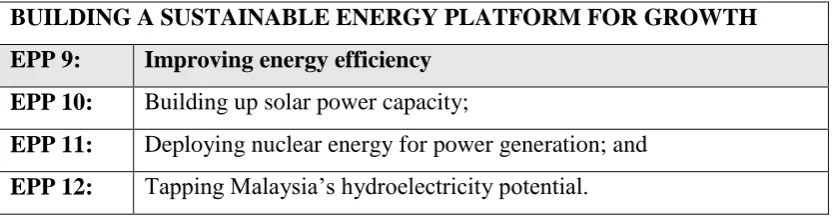
[image:42.595.114.531.297.406.2]of tourists visiting Malaysia will give rise to an increase in the usage of energy. To achieve this target, the government and the oil, gas and energy industries are focusing on four thrusts: sustaining oil and gas production, enhancing downstream growth, making Malaysia the number one Asian hub for oilfield services, and building a sustainable energy platform for growth. Table 2.1 shows EPP 9 to EPP 12: building a sustainable energy platform for growth in 12 EPPs for the oil, gas and energy sectors. From the table, improving the EE was highlighted as one of the main pillars in EPP 9 that must be improved (ETP, 2014).
Table 2.1: EPP for Oil, Gas and Energy Sector (ETP, 2014)
BUILDING A SUSTAINABLE ENERGY PLATFORM FOR GROWTH EPP 9: Improving energy efficiency
EPP 10: Building up solar power capacity;
EPP 11: Deploying nuclear energy for power generation; and EPP 12: Tapping Malaysia’s hydroelectricity potential.
19
Figure 2.1: Pillars of the New Energy Policy (The Economic Planning Unit, 2010)
20
is quite critical for consumers. The awareness of energy consumption and the efficient use of energy can help users to overcome this problem. Consumers should have knowledge about EE and practise it. The finding have the same agreement with Syed Hussain, Ismail & Md Noh (2013) which is knowledge is one of the main components to be taken into consideration when implementing energy saving awareness programs. Subsequently, Abdul Majid & Ibrahim Udale (2011) highlighted the need for households to practise energy saving behaviour in order to achieve EE. Thus, these two factors, knowledge and practice, must be given high attention in ensuring the enhancement of awareness among consumers. Furthermore, many campaigns have also been carried out through the media to disseminate this information, but the extent of the consumer’s knowledge about EE and its practice is still in question. It is also necessary to highlight how energy can be used efficiently and the methods that can be used, especially for residential building, where most of the consumers are housewives, and in public areas.
21
Figure 2.2: National Energy Efficiency Action Plan (KeTTHA, 2014a)
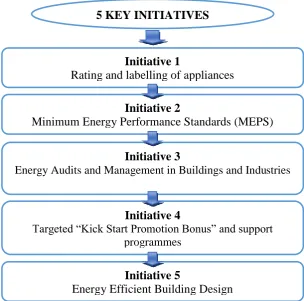
Malaysia’s Energy Efficiency Action Plan contains 17 specific EE programs, covering three sectors that are to be implemented over a 10-year period. The programs can be grouped into five key initiatives in relation to the design of the programs, as shown in Figure 2.3.
Figure 2.3: Five Key Initiatives for energy efficiency programs (KeTTHA, 2014b) 5 KEY INITIATIVES
Initiative 2
Minimum Energy Performance Standards (MEPS)
Initiative 3
Energy Audits and Management in Buildings and Industries Initiative 1
Rating and labelling of appliances
Initiative 4
Targeted “Kick Start Promotion Bonus” and support programmes
Initiative 5
[image:45.595.166.471.405.706.2]22
In order to realize these strategies, the aspects of environmental conservation should be given priority. There should be less impact on the environment and a reduction in greenhouse gas (GHG) emissions. The total reduction in GHG emissions at the end of the plan is projected to be equivalent to 40 million tonnes of CO2. A total reduction of the equivalent of 96 million tonnes of CO2 will be achieved over the lifetime of the energy-efficient technologies that will be adopted and adapted from the implementation of the plan. For new and existing buildings, programs will be undertaken to demonstrate energy efficient design features. This will be in the form of demonstrations and show-case projects within various types of building.
With the country’s GDP forecasted to grow at an average rate of 5% per annum (from 2010 to 2020), the demand for energy was projected to grow at 3.6% per annum until 2016. While the energy mix in Malaysia is still largely based on fossil fuels, the vision of the government is to achieve some level of energy security and autonomy for the country. The Sustainable Energy Development Authority (SEDA) of Malaysia, through the Ministry of Energy, Green Technology and Water (KeTTHA), believes that sustainable energy forms the basis for countries to achieve both energy security and autonomy (SEDA, 2013).
Coal, being the cheapest and most abundantly available fossil fuel, will always have a role in the energy mix of a particular country. Malaysia’s coal resources to date are estimated to be around 1,050 million tons of various qualities, ranging from lignite to anthracite, and from bituminous to sub-bituminous coal, of which bituminous coal forms the bulk of this amount. The Government is planning to generate 30% of its electricity over the next decade through hydropower to reduce the adverse effects from the use of fossil fuels.
2.3 Electricity Generation
23
electrical energy generated was 103.2 TWh, and the demand is expected to increase by 4.7% per annum to 274 TWh by the year 2030. Strong demands from the industrial and residential sectors are influencing Malaysia as it steps into becoming an industrialized nation, whereby the per capita electricity demand is expected to reach 7571 kWh/person in the year 2030 (APERC, 2016). In 2014, the main export products were electrical and electronic products, which made up approximately 33% of the total exports, while petroleum products made up 9.2% and liquefied natural gas (LNG) 8.4% (APERC, 2015).
Malaysia relies mainly on domestic power generation for its electricity supply, with 74% of the natural gas, 88% of the coal, and all the hydropower being used for the generation of electricity. Electricity, at 49%, is the biggest form of end-use energy, followed by oil products (41%), natural gas (7%) and coal (3%). Each main end-use sector, including the transportation sector, industrial sector and domestic sector (residential, commercial and agriculture), account for approximately one-third of the energy consumption (C. Chong et al., 2015).
Electricity generation is the key transformation sector in the energy system of Malaysia as electricity accounts for 45.6% of the total end-use energy consumption in Malaysia, and if the transportation sector is deducted from the end-use sectors, the share of electricity would have increased to 67.1% in 2011. Hence, the electricity generation approach has a significant impact on the energy supply structure of Malaysia. The electricity generation structure has experienced significant changes twice. In the first instance, natural gas replaced 70% of oil products and became the major fuel in power plants; in the second instance, coal replaced nearly half of the natural gas and has become the major fuel for electricity generation (C. Chong et al., 2015)
24
consumption by sector from 1993 to 2013. The total energy used increased by almost 65% from 1993 to 2013. This shows that Malaysia has been experiencing high energy demand in recent decades.
Figure 2.4: Energy consumption analysis from 1993 - 2013 (Energy Commission, 2015)
187
REFERENCES
Ackley, D. H., Hinton, G. E., & Sejnowski, T. J. (1986). A learning algorithm for boltzmann machines. Cognitive Science, 9 (1), pp. 147-169.
(APERC), A. P. E. R. C. (2015). APEC Energy Overview 2015. Retrieved from http://aperc.ieej.or.jp/file/2016/5/31/APEC+Energy+Overview+2015.pdf
2012 Household Energy Consumption Survey: Final Report. (2013). Tallinn.
A Rahman, K., Leman, A. M., Mansor, L. H., Yusof, M. Z. M., & Salleh, M. N. M. (2016). Energy Efficiency : The Implementation of MEPS Application on Home Appliances for Residential. In The International Conference on Green Design and Manufacture 2016 (IConGDM 2016) (pp. 1–8). Phuket. http://doi.org/10.1051/matecconf/20167801058
A Rahman, K., Leman, A. M., Yusof, M. Z. M., Mubin, M. F., & Salleh, M. N. M. (2016). Energy Consumption Analysis Based On Energy Efficiency Approach: A Case of Suburban Area. In International UNIMAS STEM 9th Engineering Conference 2016 (EnCon2016).
A Rahman, K., Md Yusof, M. Z., Mohd Salleh, M. N., & Leman, A. M. (2015). Implementation of Energy Efficiency Standards and Labelling For Household Electrical Appliances : A Comparison among Asian Countries. Chemical Engineering Transactions, 45, 1663–1668. http://doi.org/10.3303/CET1545278 A Rahman, K., Yusof, M. Z. M., Leman, A. M., & Salleh, M. N. M. (2015). Electrical
Safety: How to Avoid the Overload Current by Using energy Efficiency Approach. Jurnal of Occupational Safety and Health (NIOSH), 12(1), 233–238. A Rahman, K., Yusof, M. Z. M., Salleh, M. N. M., & Leman, A. M. (2015). The
Implementation of Energy Efficiency Standards and Energy Labels for Refregerator - Freezers In Malaysia : A Review. In National Innovation and Invention Competition Through Exhibition (iCompEx’15).
188
Energy Consumption by Using Energy Efficiency Approach for Household Electrical Appliances : A Comparison between Malaysia and South Korea. ARPN Journal of Engineering and Applied Sciences, 11(June). Retrieved from http://www.arpnjournals.com/jeas/volume_11_2016.htm
A. Rahman, K., Yusof, M. Z. ., Salleh, M. N. ., & Leman, A. M. (2015). A Review on Implementation of MEPS as A Standard and Labelling (S&L) Program in Malaysia. In Technology and Innovation National Conference Proceedings (TECHON 2015) (pp. 551–562). Sarawak, Malaysia: Polythecnic of Mukah, Sarawak.
Abdul Latif, S. (2012). Understanding Energy Efficiency. TenagaLink: Energy Efficient, 7–11.
Abdul Majid, N. H., & Ibrahim Udale, H. (2011). The Challenges of Energy Efficiency Practice in the Nigerian Households. In Third International Conference on Applied Energy (pp. 1471–1482).
Abdul Rasam, A. R., Hanif, F. A., Samad, A. M., & Hadi, R. A. (2013). Spatial Information Management System for Building Energy Consumption. In IEEE (Ed.), 3rd International Conference on System Engineering and Technology (pp. 19–20). Shah Alam, Malaysia: IEEE.
Abu Bakar, N. N., Hassan, M. Y., Abdullah, H., Rahman, H. A., Abdullah, M. P., Hussin, F., & Bandi, M. (2013). Sustainable Energy Management Practices and Its Effect on EEI : A Study on University Buildings. In Proceedings of Global Engineering, Science and Technology Conference (pp. 1–11). Dubai.
Abu Bakar, N. N., Hassan, M. Y., Abdullah, H., Rahman, H. A., Abdullah, M. P., Hussin, F., & Bandi, M. (2015). Energy efficiency index as an indicator for measuring building energy performance: A review. Renewable and Sustainable Energy Reviews, 44, 1–11. http://doi.org/10.1016/j.rser.2014.12.018
Akao, Y. (1990a). Quality Function Deployment (QFD): Integrating Customer Requirements into Product Design.
Akao, Y. (1990b). Quality Function Deployment: Integrating Customer Requirements into Product Design. New York: Productivity Press.
Akao, Y. (1997). Past, Present, and Future. In International Symposium on QFD (pp. 1–12).
189
http://doi.org/10.1016/j.energy.2008.10.005
Arghira, N., Hawarah, L., Ploix, S., & Jacomino, M. (2012). Prediction of appliances energy use in smart homes. Energy, 48(1), 128–134. http://doi.org/10.1016/j.energy.2012.04.010
Asia Pacific Energy Research Centre (APERC). (2006). Energy demand and supply
Outlook. Retrieved from
http://www.ieej.or.jp/aperc/2006pdf/Outlook2006/Whole_Rep
Asia Pacific Energy Research Centre (APERC). (2010). APEC Energy Overview 2009. Retrieved from http://aperc.ieej.or.jp/file/2010/9/25/Overview2009.pdf
Asia Pacific Energy Research Centre (APERC). (2016). APEC Energy Demand and
Supply Outlook 6th Edition. Retrieved from
http://aperc.ieej.or.jp/publications/reports/outlook.php
Association, & of Water and Energy Research Malaysia (AWER). (2012). Energy Efficiency in Malaysia- Sustainable Production and Consumption: Phasing-out
Malaysia’s Non-Enegy Efficient Products. Malaysia. Retrieved from www.awer.org.my
Aun, A. C. S. Green Building index-MS125 (2008). Malaysia.
Aun, C. S. (2004). Energy Efficiency: Designing Low Energy Buildings Using Energy 10. In CPD Seminar. Malaysia: Pertubuhan Arkitek Malaysia.
AWER. (2012, April). Malaysia and ASEAN Must Speed Up Energy Efficiency Implementations to Avoid Being Dumping Ground of Non-Energy Efficient
Products. Malaysia. Retrieved from
http://www.awer.org.my/?pgid=home&cid=197
AWER. (2014). Kenaikan Tarif Eletrik. Retrieved from http://www.awer.org.my/ Aziz, M. B. A., Zain, Z. M., Baki, S. R. M. S., & Hadi, R. A. (2012). Air-conditioning
energy consumption of an education building and it’s building energy index: A case study in engineering complex, UiTM Shah Alam, Selangor. In 2012 IEEE Control and System Graduate Research Colloquium (ICSGRC 2012) (pp. 175– 180). http://doi.org/10.1109/ICSGRC.2012.6287157
Barnett, W. D., & Raja, M. K. (1995). Application of QFD to the software development process. International Journal of Quality & Reliability Management, 12(6), 24–42.
190
Birt, B. J., Newsham, G. R., Beausoleil-Morrison, I., Armstrong, M. M., Saldanha, N., & Rowlands, I. H. (2012). Disaggregating categories of electrical energy end-use from whole-house hourly data. Energy and Buildings, 50, 93–102. http://doi.org/10.1016/j.enbuild.2012.03.025
Boehm, B. (1989). Software Risk Management. In 2nd European Software Engineering Conference (ESEC’89) (pp. 1–19). http://doi.org/doi:10.1007/3-540-51635-2_29.
Bosoni, T. (2013). Asia: The New Hub For Oil Refining. The Journal of the International Energy Agency, (4), 31.
BP Group. (2014). BP Energy Outlook 2035.
Büyüközkan, G., & Feyzioğlu, O. (2005). Group decision making to better respond customer needs in software development. Computers & Industrial Engineering,
48, 427–441. http://doi.org/10.1016/j.cie.2005.01.007
CETDEM. (2015). Increasing Awareness & Building Capacity of Urban Malaysians on Sustainable Energy Options. Retrieved from http://cetdem.org.my/wordpress/?page_id=2600
Chan, L., & Wu, M. (2002). Quality function deployment : A literature review.
European Journal of Operational Research, 143, 463–497.
Chan, S. K. (2009). Green Building Index MS1525: Code of Practice on Energy Efficiency and Use of Renewwable Energy for Non-Residential Buildings. Chen, J., & Chen, J. C. (2001). QFD-Based Technical Textbook Evaluation -
Procedure and Case Study. Journal of Industrial Technology, 18(1).
Chong, C., Ni, W., Ma, L., Liu, P., & Li, Z. (2015). The use of energy in Malaysia: Tracing energy flows from primary source to end use. Energies, 8(4), 2828–2866. http://doi.org/10.3390/en8042828
Chong, Y. ., & Chen, C. H. (2009). Human-centric product conceptualization using a design space framework. Advanced Engineering Informatics, 23(No. 2), 149– 156.
Chua, S. C., & Oh, T. H. (2011). Green progress and prospect in Malaysia. Renewable
and Sustainable Energy Reviews, 15(6), 2850–2861.
http://doi.org/10.1016/j.rser.2011.03.008
CLASP. (2014). No Title. Retrieved from www.clasponline.org
Clausing, D., & Pugh, S. (1991). Enhanced quality function deployment. In
191
Massachusetts.
Cohen, J. . (1988). Statistical power analysis for the behavioral sciences (2nd edn)
(2nd ed.). Hillsdale, NJ: Lawrence Erlbaum Associates.
Creswell, J. W. (2012). Educational research: Planning, conducting, and evaluating quantitative and qualitative research. Educational Research (Vol. 3).
D’Oca, S., Corgnati, S. P., & Buso, T. (2014). Smart meters and energy savings in Italy: Determining the effectiveness of persuasive communication in dwellings.
Energy Research & Social Science, 3, 131–142.
http://doi.org/10.1016/j.erss.2014.07.015
De Almeida, A., Fonseca, P., Schlomann, B., & Feilberg, N. (2011). Characterization of the household electricity consumption in the EU, potential energy savings and specific policy recommendations. Energy and Buildings, 43(8), 1884–1894. http://doi.org/10.1016/j.enbuild.2011.03.027
Delano, G., Parnell, G. S., Smith, C., & Vance, M. (2000). Quality function deployment and decision analysis: a R & D case study. International Journal of Operation and Production Management, 20(5).
Dennis, A., Wixom, B. A., & Roth, R. M. (2006). System Analysis Design (3rd Editio). New Jersey: Wiley and Sons.
Dennis, A., Wixom, B. H., & Roth, R. M. (2012). System Analysis & Design (5th ed.). USA: John Wiley & Sons, Inc.
Department of Standards Malaysia. MALAYSIAN STANDARDS MS2574:2014 - Minimum Energy Performance Standards (MEPS) for fan, Pub. L. No. ICS:97.020 (2014). Malaysia.
Department of Standards Malaysia. MALAYSIAN STANDARDS MS2576:2014 - Minimum Energy Performance Standards (MEPS) for television, Pub. L. No. ICS:97.200 (2014). Malaysia.
Department of Standards Malaysia. MALAYSIAN STANDARDS MS2595:2014 - Minimum Energy Performance Standards (MEPS) for refrigerator, Pub. L. No. ICS: 97.040.30 (2014). Malaysia.
Department of Standards Malaysia. MALAYSIAN STANDARDS MS2597:2014 - Minimum Energy Performance Standards (MEPS) for air conditioners, Pub. L. No. ICS:91.140.30 (2014). Malaysia.
192
ICS:29.140.99 (2014). Malaysia.
Economic Transformation Programme. (2014). ETP Annual Report 2015. Malaysia.
Retrieved from
http://etp.pemandu.gov.my/annualreport2014/upload/04_NKEA02_ENG_OGE. pdf
Energy Commission. (2013a). Annual Report for 2013.
Energy Commission. (2013b). National Energy Balance 2013. Retrieved from www.meih.st.gov.my
Energy Commission. (2013c). Peninsular Malaysia Electricity Supply Industry Outlook 2013. Putrajaya.
Energy Commission. (2014). Energy Commission. Retrieved from http://www.st.gov.my/
Energy Commission. (2015). Malaysia Energy Statistics Handbook 2015. Putrajaya. Retrieved from www.st.gov.my
Engelbrektsson, P., & Soderman, M. (2004). The use and perception of methods and product representation in product development. Journal of Engineering Design,
15(No. 2), 141–154.
Environment and Energy Branch. (2014). Presentation for The Prime Minister’s
Green Tech and Climate Change Council Meeting: Realising The 3 Key Benefits.
Kuala Lumpur, Malaysia. Retrieved from
http://architecturemalaysia.com/Files/Pool/26_141210_1354305430_7_energy_ efficiency_policy_reviews_and_proposals_aug_2014.pdf
Field, A. (2009). Discovering Statistics Using SPSS. SAGE Publications (2nd ed.). SAGE Publications.
Fischer, C. (2008). Feedback on household electricity consumption : a tool for saving energy ? Energy Efficiency, (May). http://doi.org/10.1007/s12053-008-9009-7 Fowler, F. J. (2014). Survey Research Methods (5th ed.). Los Angeles: Los Angeles:
Sage Publication, Inc.
Fragidis, G., & Olschewski, D. (2015). Consumer awareness and engagement for energy efficiency solutions. Berlin. Retrieved from http://dareed.eu
Geller, H., Harrington, P., Rosenfeld, A. H., Tanishima, S., & Unander, F. (2006). Polices for increasing energy efficiency: Thirty years of experience in OECD
countries. Energy Policy, 34(5), 556–573.
193
González, A. B. R., Díaz, J. J. V., Caama˜no, A. J., & Wilby, M. R. (2011). Towards a universal energy efficiency index for buildings. Energy and Buildings, 43(4), 980–987. http://doi.org/10.1016/j.enbuild.2010.12.023
González, A. B. R., Díaz, J. J. V., Caamano, A. J., & Wilby, M. R. (2011). Towards a universal energy efficiency index for buildings. Energy and Buildings, 43(4), 980–987. http://doi.org/10.1016/j.enbuild.2010.12.023
Govers, C. P. M. (1996). What and how about quality function deployment (QFD).
Int. J. Production Economics, 46-47, 575–585.
Gravetter, F. ., & Wallnau, L. B. (2004). Statistics for the behavioral sciences (6th edn) (6th ed.). Belmont, CA: Wadsworth.
Greening, L. A., Greene, D. L., & Difiglio, C. (2000). Energy efficiency and consumption - the rebound effect - a survey. Energy Policy, 28, 389–401.
Han, C.-H., Kim, J. K., Choi, S., & Kim, S. H. (1998). Determination of Information System Development Priority Using Quality Function Development. Computers & Industrial Engineering, 35(October 1998), 241–244. http://doi.org/10.1016/S0360-8352(98)00074-6
Heravi, G., & Qaemi, M. (2014). Energy performance of buildings: The evaluation of design and construction measures concerning building energy efficiency in Iran.
Energy and Buildings, 75, 456–464. http://doi.org/10.1016/j.enbuild.2014.02.035 Hsu, C.-L., & Yang, S.-Y. (2010). Active & Intelligent Energy-Saving System
Designed with WSN modules and Efficiency Analysis.
Hurst, N. (2012). Energy efficiency rating systems for housing: an Australian perspective. International Journal of Housing Markets and Analysis, 5(4), 361– 376. http://doi.org/10.1108/17538271211268501
Hussaini, I. U., & Abdul Majid, N. H. (2014). Human behaviour in household energy use and the implications of energy efficiency delivery: A case of Bauchi, Nigeria.
International Journal of Energy Sector Management, 8(2), 230–239. http://doi.org/10.1108/IJESM-10-2013-0005
International Energy Agency (IEA). (2012). World Energy Outlook 2012.
International Energy Agency (IEA). (2015). International Energy Agency. Retrieved from http://www.iea.org
194
Field of Research: Macroeconomics, 1–31.
Kaundinya, D., Balachandra, P., & Ravindranath, N. (2009). Grid-connected versus stand- alone energy systems for decentralized power – a review of literature.
Renewable and Sustainable Energy Reviews, 13(8), 2041–2050. http://doi.org/DOI: 10.1016/j.rser.2009.02.002
Kavousian, A., Rajagopal, R., & Fischer, M. (2013). Determinants of residential electricity consumption : Using smart meter data to examine the effect of climate, building characteristics, appliance stock, and occupants ’ behavior. Energy, 55, 184–194. http://doi.org/10.1016/j.energy.2013.03.086
Kemp-Hesterman, A., Glick, S., & Cross, J. E. (2014). Reducing electrical energy consumption through behaviour changes. Journal of Facilities Management,
12(1), 4–17. http://doi.org/10.1108/JFM-02-2013-0006 KeTTHA. (2014a). National Energy Efficiency Action Plan. KeTTHA. (2014b). National Energy Efficiency Action Plan.
Koo, C., Hong, T., Lee, M., & Seon Park, H. (2014). Development of a new energy efficiency rating system for existing residential buildings. Energy Policy, 68, 218–231. http://doi.org/10.1016/j.enpol.2013.12.068
Leman, A. M., A Rahman, K., Zakaria, M. F., Salleh, M. N. M., & Yusof, M. Z. M. (2015). Energy Consumption and Management in Sub-Urban Area. In 2015 International Conference on Alternative Energy in Developing Countries and
Emerging Economies (AEDCEE 2015) (pp. 385–386).
Leman, A. M., A. Rahman, K., Chong, H. J., Mohd Salleh, M. N., & Md Yusof, M. Z. (2017). Energy Efficiency System Development. In The International Conference on Green Design and Manufacture 2017 (IConGDM 2017) (pp. 1– 8). Krabi.
Leman, A. M., Omar, A. R., Jung, W., & Yusof, M. Z. M. (2012). The development of an industrial air pollution monitoring system for safety and health enhancement and a sustainable work environment using QFD approach. Asian Journal on Quality, 11(2), 165–182. http://doi.org/10.1108/15982681011075970
Lockamy, A., & Khurana, A. (1995). Quality function deployment: total quality management for new product design. International Journal of Quality & Reliability Management, 12(6), 73–84.