Munich Personal RePEc Archive
Potential implications of labour market
opening in Germany and Austria on
emigration from Poland
Strzelecki, Paweł and Wyszynski, Robert
National Bank of Poland, Warsaw School of Economics, Institute of
Statistics and Demography
April 2011
Online at
https://mpra.ub.uni-muenchen.de/32586/
Potential implications of labour market opening in Germany and Austria
on emigration from Poland
Robert Wyszyński*, Paweł Strzelecki**
Abstract:
The aim of this study is to present the characteristic of present-day migrants and the potential for possible migration after the opening of the labour markets in Austria and Germany. The econometric analysis shows that differences in unemployment rates between sending and receiving countries were the most important for changes in the emigration from Poland in the period 2002-2009. Mostly due to persistence of these differences the intruduction of the open-door policy by two last EU countries in the spring of 2011 can intensify the further emigration flows from Poland.
Data concerning the structure of the present emigration in Germany indicate that emigrants from Poland are mainly persons with vocational and secondary education, working primarily in the sections of services (e.g. health care and social assistance, accommodation and catering). There is also a relatively high percentage of persons employed in agriculture and the construction sector. These sectors will probably continue to be the most frequent workplace for emigrants, where the internal supply of work seems insufficient to meet the needs of this part of the German economy. The current limitations push better educated emigrants from Poland to work mainly as specialists in the sectors of economy preferred by Germany or as self-employed persons. The caps applied by German authorities concerning the number of Polish employees on secondment under the framework of the cross-border provision of services remain underused. Moreover, German data (which do not cover persons holding dual nationality) indicate that for the time being emigration from Poland is, to a large extent, circulatory by nature. Examples of other EU countries which already opened their labour markets indicate that the removal of barriers to access may increase emigration in the first year, but the differences and changes in unemployment rates among countries are a much more important factor for migratory flows, particularly at a later stage. The opening of labour markets in Germany and Austria may contribute to a change in the nature of the present short-term to a more permanent migration from Poland.
The first part of the study presents information on the existing work limitations for Poles in Germany and the characteristics of the present emigrants from Poland to Germany and Austria. The second part discusses determinants of emigration in 2002-2009, putting a special emphasis on those countries which already managed to open their labour markets for the „new‟ EU members. The third part delivers the estimates of possible emigration changes from Poland to Germany and Austria that are going to happen after 1 May 2011.
JEL: F22, J61
Keywords: labour migration, open-door policy, Poland, Germany, determinants of migration
*National Bank of Poland
1. To-date emigration and working conditions in Austria and Germany
The purpose of this part is to present regulations in force, which are to be lifted by 2011 and the characteristics of present-day emigrants in Germany. The fact that these considerations focus mainly on Germany is justified by the dominant role this country plays in migratory flows from Poland.
1.1 Labour migration to Germany and Austria – estimates and regulations1
Estimates of the number of emigrants may be made both on the basis of the country where the outflow is taking place and data collected in the country that receives emigrants while remembering that the country where emigrants reside usually has more precise statistics. In the case of Germany, the estimation of the number of emigrants is complicated by the fact that persons holding dual nationality are treated as emigrants in the Polish estimates, while the German offices treat them as German nationals, not immigrants from Poland. Therefore, it is not surprising that the estimates made by the Polish Central Statistical Office (CSO) and the Federal Statistical Office differ significantly in their estimates of the number of migrants from Poland in Germany (see Chart 1). However, till 2009 the changes in estimates were similar. In 2009, GUS estimates indicated a strong return migration, while German data until the middle of 2010 showed a slight increase in the number of emigrants from Poland.
According to German data (Statistisches Bundesamt 2010), (Bundesregierung 2010), it is estimated that at the end of 2009 there were almost 400 thousand2 Poles in Germany, which accounted for ca. 69.1% of the total number of foreigners arriving form new EU Member States (i.e. ca. 576 thousand persons from Estonia, Lithuania, Latvia, the Czech Republic, Poland, Hungary, Slovakia and Slovenia). As of 30 June 2010, there were ca. 408 thousand Poles (MPiPS 2010) in the Central Register of Foreigners in Germany. The Polish CSO (GUS 2010) puts the number at 415 thousand Poles residing temporarily (more than 3 months) in Germany at the end of 2009. The Polish CSO and Austrian Statistical Office estimates are practically coincident for 2009 and amount to ca. 37-38 thousand persons 3. As general migration statistics show, the significance of the outflow of employees to Austria is incomparably smaller for the Polish labour market than in the case of emigration to Germany. Therefore, the main emphasis of the analysis presented below has been firmly put on Germany.
1
Due to a relatively much larger impact of the German labour market, most information contained in this Chapter relates to the opening of the labour market in Germany.
2
According to Bundesagentur für Arbeit (BfA) data (Bundesagentur für Arbeit 2010a), at the end of June 2009 ca. 95 thousand persons holding Polish nationality held the status of employees covered by mandatory social security system. Moreover, some of them could have been self-employed persons, but no official estimates (by nationality) on this issue are available.
3
Chart 1.
Estimates by the Polish CSO and the statistical offices of Germany and Austria of the number of Polish nationals in these countries
Source: The Polish, German and Austrian statistical offices
The rise in the number of emigrants from Poland residing in EU countries, including in particular Germany and Austria, may be primarily related to Poland‟s entry to the EU, which even under the binding transitional regulations in respect of the labour markets in some of the
countries greatly facilitated emigrants‟ mobility and taking up residence in the EU. The target
level of access to the EU internal market related to the entry to the EU implied the prospect of benefitting from a full freedom of movement of goods, services, persons and capital.
In order to give time to the new Member States to adapt their legislation to acquis
communautaire, the majority of the „old‟ Union states (except the United Kingdom, Ireland
and Sweden) introduced, however, transitional periods for the freedom of movement of persons (meaning movement of labour). The transitional regulations allowed to postpone a full opening of the labour market by a maximum 7 years (the so called „2+3+3‟ rule),
although only two countries from the „old‟ 15 states considered there was a need to take full
advantage of such a period. Austria and Germany decided to maintain transitional periods till 30 April 2011. Additionally, these countries were granted the right to limit the freedom of movement of services in the transitional period in the so-called vulnerable sectors of the economy, like construction and related branches (Lorenz 2010), cleaning services (inside industrial buildings, fixed inventory, means of transport), as well as interior decorating.
Poles may provide services, practically without limitations, in the „vulnerable‟ sectors if the
type of business entity they represent is sole proprietorship (owned and run by one individual, with economic activity registered in Poland) or an entity employing persons, but in this case the total number of employees sent from Poland to Germany in order to provide such services is limited by a quota established by Germany.4 The cross-border provision of services in Germany is possible for Polish entities only on the basis of a contract for specific work (providing employees is not allowed). According to the data gathered by the Ministry of Labour and Social Policy (MPiPS 2010) the German–established quota for man-months concerning the provision of construction services was not fully used (in June 2010, the utilization was ca. 42% of the quota for the whole year).
Available official data (see Table 1) indicate that emigration on the basis of the bilateral agreements in force covers mainly seasonal workers from Poland employed in agriculture (ca.
4
On the basis of the Polish-German agreement of 31 January 1990.
294 385 430 450 490 490 415 318 327 292 327 362 385 394 399 408 250 300 350 400 450 500
2002 2003 2004 2005 2006 2007 2008 2009 VI.06
in t h o u s a n d p e rs o n s
Polish Central Statistical Office German Federal Statistical Office
11
15 25
34
39 40 38
22 22 27 31 33 35 37 37 10 20 30 40 50
2002 2003 2004 2005 2006 2007 2008 2009
in t h o u s a n d p e rs o n s
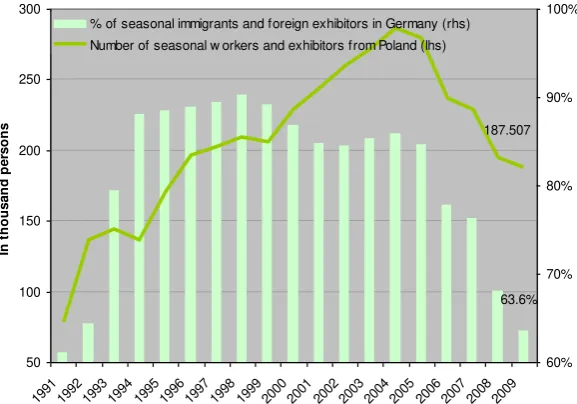
180 thousand persons in 2009), whereas historic data indicate that permits for seasonal work in Germany were becoming ever less popular among Poles, starting from 2005 (see Chart 2).
Moreover, foreign entities providing services in Germany are obliged – and will continue to be obliged also after the expiration of transitional periods – to abide by the provisions of the Law on the Posting of Workers (Arbeitnehmer-Entsendegesetz), implementing the provisions of a EU recommendation concerning sending employees abroad. Under this Law, foreign employers are compelled to secure minimum employment standards (in particular setting a minimum wage) to cross-border employees performing their work in Germany. Initially, the provisions of this Law protected the construction sector and related braches from „cheap‟ competition. At present, this group of (cross-border provision) services includes cleaning, laundry, mining and quarrying, waste management and waste disposal, city cleaning, post office services, security services, continuous education. A minimum wage has not been set for the last three sectors. Starting from April 2009, the scope of „protected‟ sectors was enhanced to include the care of the elderly and sick persons (Lorenz 2010:18).
Basically, Poles may now open own firms with a registered office in Germany; however, if they want to employ Polish employees, they are obliged to abide by transitional regulations concerning the German labour market. According to data provided by the Federal Craftsmen Association, 28,100 registered Polish nationals were registered with the German craftsmanship office at the end of 2009 (an increase by 6% y/y). Till 30 April 2011, bilateral agreements and internal regulations also remain in force. They offered Polish employees and German employers relatively many opportunities of employment, inter alia, in the case of:
a) managerial staff
b) scientists and university teachers, IT specialists, c) highly qualified persons, if it is in public interest, d) so-called key personnel
e) in a limited time-frame: students, seasonal workers, guest-workers (quota), entertainment show support, cross-border workers, specialized cooks,
f) domestic help and babysitters, nurses and in all other places where no suitable
employee from Germany or „old‟ Union countries can be found (see Annex 1).5
In recent years (since 1 January 2009), driven by the needs of the local labour market, Germany has extended the permissible time for the employment of seasonal worker from 4 to 6 months. Starting from January 2010, foreigners have also been allowed to provide care directly to infirm persons, without the necessity to prove qualifications corresponding to the professional preparation of a German nurse (MPiPS 2010). Starting from January 2011, Germany abolished the obligation to apply for work permit in the case of seasonal employment in agriculture and forestry, fruit and vegetable cultivation as well as accommodation and catering for EU nationals from Estonia, Latvia, Lithuania, Poland, Slovakia, Slovenia, Czech Republic and Hungary6.
5
From 1 January 2005, the document that authorizes its holder to take a job is a residence certificate in order that enables the holder to seek employment, issued by the German registration office after consultation with the job centre ((Bundesagentur fuer Arbeit). In some cases, e.g. managerial staff with general power of attorney or proxy, students who take a job during a holiday season, the permit of a job centre is not required.
6
Table 1
Selected forms of employment of Poles in Germany on the basis of hitherto binding bilateral agreements (data for 2009)
Employment on the basis of: 2009
Work permit For the first time 22 585
(Germ. Arbeitsgenehmigung) Subsequent 10 102 Continuation 7 890
Permit pursuant to proceedings (Germ.
Arbeitserlaubnisverfahren)
Seasonal workers 184 241 of which: accommodation 4 531 and catering 179 710 Exhibitors 3 266 Domestic help 238
Work contract 5 678
Source: (Bundesagentur für Arbeit 2010b), (Lorenz 2010)
Chart 2
Seasonal workers from Poland and exhibitors* in Germany (1991-2009)
*In German statistics, seasonal workers are treated on par also with persons working in Germany as representatives of company delegations preparing presentations for exhibitions and fairs
Source: (Bundesministerium des Innern 2011)
63.6% 187.507
50 100 150 200 250 300
1991 1992 1993 1994 1995 1996 1997 1998 1999 2000 2001 2002 2003 2004 2005 2006 2007 2008 2009
In
t
h
o
u
s
a
n
d
p
e
rs
o
n
s
60% 70% 80% 90% 100% % of seasonal immigrants and foreign exhibitors in Germany (rhs)
1.2 Characteristic of emigration to Germany based on NBP and BAEL data
On the basis of fundamental data sets7 held by the NBP it is possible to characterize present-day emigrants to Germany. It is important insofar as - provided no changes of the structure of demand for labour in Germany occur - it may be extrapolated that future economic emigration from Poland to Germany can be similar.
Present-day emigration in Germany is specific in comparison with emigration to other EU-15 countries, as Poland and Germany have a common border, a long history of relations and problems in defining emigration due to dual nationality of some citizens. Surveys of emigrants carried out by the NBP in Germany indicate that the share of persons with dual – Polish and German – nationality amounts to ca. 20% of emigrants, which is a value comparable to the difference between the estimates of Polish and German statistical offices and results mainly from the non-inclusion of persons with dual nationality in German estimates. It can therefore be assumed that a group of 20% of emigrants from Poland is already not (and was not in the past) subject to limitations on the German labour market, since the emigrants from this group were treated as German nationals.
[image:7.595.95.500.503.628.2]Labour Force Survey (LFS) data concerning the features of persons who are absent from Polish households due to their trip abroad indicate that those persons are, on average, slightly older and less educated than persons who emigrated to other countries. These data are congruent with the results of NBP surveys. The comparison of data on emigrants in the United Kingdom and the Netherlands, which have also been collected by the NBP, and data on emigrants in Germany shows a common feature of the emigration to Germany which is a high percentage of persons with basic vocational and primary education (see Table 2). Moreover, emigrants in Germany more often than emigrants in the United Kingdom used to live in the countryside and small towns before they travelled to Germany (see Table 3).
Table 2
The structure of education of Polish emigrants in Germany, United Kingdom and the Netherlands according to education level (statistically significant results* that have been commented upon are in grey and bold)
Germany UK Netherlands
Primary 9% 4% 3%
Basic vocational 25% 14% 20% Secondary vocational 25% 27% 26% Secondary general 21% 29% 27% Tertiary – private university graduate 3% 7% 4% Tertiary – public (state) university graduate 16% 18% 19% No response/response refused 0% 0% 1%
*The differences between percentages in the examined samples are statistically significant (at significance level of 0.05), if they are bigger or equal to 3 p.p. (this rule is applicable to comparisons in Tables 2-8).
Source: NBP surveys 2010
7
Among educational fields which are most popular among emigrants to Germany (as compared
with other countries) the dominant ones are: „engineering, manufacturing processes and
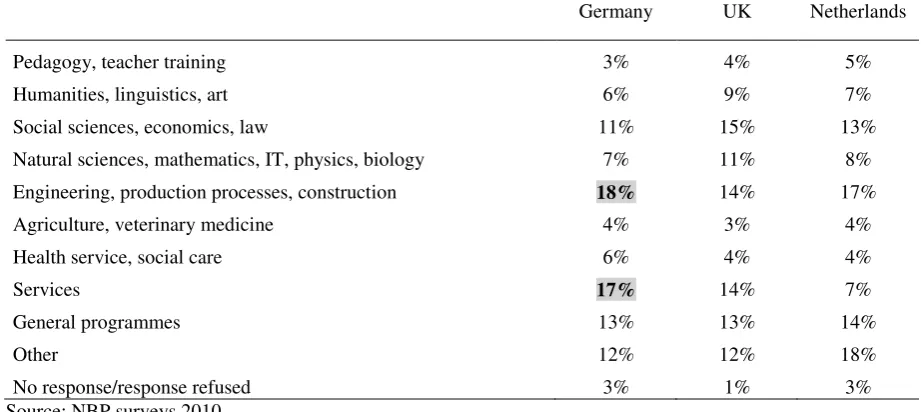
construction‟ as well as generally defined „services‟ (see Table 4). The percentage of persons
educated with the engineering and construction profile is markedly higher than among emigrants in the United Kingdom, while the percentage of persons educated in services is visibly higher both in comparison with the United Kingdom and the Netherlands.
[image:8.595.124.475.275.405.2]In comparison with other destination countries, persons living in Germany work in construction and health care/social assistance much more often (see Table 5). Work in agriculture among emigrants in Germany is much more frequent than among emigrants in the United Kingdom, but much less frequent than among emigrants in the Netherlands.
Table 3
The structure of Polish emigrants to Germany, United Kingdom and the Netherlands according to the size of place of residence in Poland before departure
Germany UK Netherlands Countryside 25% 16% 25% Town up to 20 thousand inhabitants 16% 12% 11% Town 21-50 thousand inhabitants 14% 14% 15% Town 51-100 thousand inhabitants 11% 14% 13% Town 101-250 thousand inhabitants 10% 16% 13% Town 251-500 thousand inhabitants 7% 13% 10% Town 501 thousand inhabitants and more 11% 13% 10% No response/response refused 5% 2% 2% Source: NBP surveys 2010
Table 4
The structure of education of Polish emigrants to Germany, United Kingdom and the Netherlands according to education profile
Germany UK Netherlands Pedagogy, teacher training 3% 4% 5% Humanities, linguistics, art 6% 9% 7% Social sciences, economics, law 11% 15% 13% Natural sciences, mathematics, IT, physics, biology 7% 11% 8% Engineering, production processes, construction 18% 14% 17% Agriculture, veterinary medicine 4% 3% 4% Health service, social care 6% 4% 4%
Services 17% 14% 7%
General programmes 13% 13% 14%
Other 12% 12% 18%
[image:8.595.68.529.475.681.2]Table 5
The structure of the Polish emigrant community in Germany, United Kingdom and the Netherlands according to economy sectors in which they work
Germany UK Netherlands No work performed 4% 3% 2% Agriculture/horticulture/hunting/forestry 10% 4% 34% Industry 11% 28% 14% Construction 20% 6% 15% Trade/repairs 6% 9% 3% Hotel industry/gastronomy 10% 19% 7% Transportation/warehouse management 3% 7% 12% Financial intermediation 1% 1% 0% Real estate service and enterprise servicing 2% 1% 0% Administration 2% 3% 1% IT/telecommunications 2% 2% 1% Education 2% 2% 1% Health care/social assistance 12% 7% 1%
Other 14% 8% 8%
No response/response refused 1% 1% 1% \Source: NBP surveys 2010
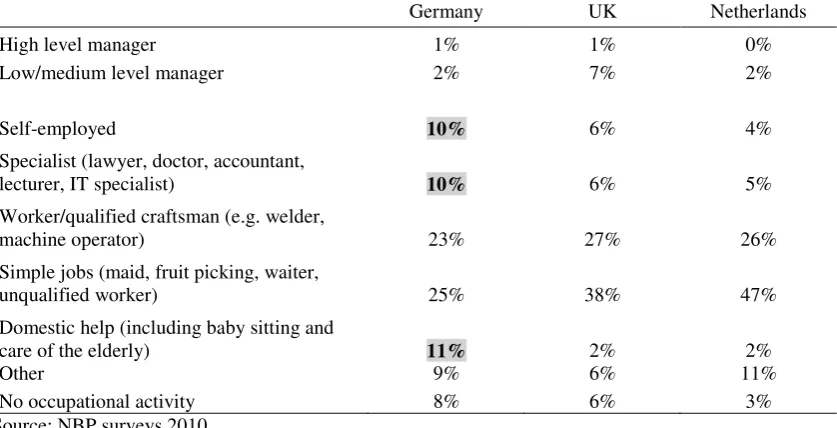
Survey data point out (see Table 6) that in comparison with the United Kingdom there is a significantly lower percentage of emigrants employed as managers of lower and medium level, whereas the percentage of specialists, entrepreneurs and self-employed persons is greater. This may be the result of the hitherto barriers concerning access to the German labour market8 but may also be related to relatively smaller opportunities for promotion among emigrants (glass-ceiling).
Table 6
The structure of Polish emigrant community in Germany, United Kingdom and the Netherlands according to occupied posts
Germany UK Netherlands High level manager 1% 1% 0% Low/medium level manager 2% 7% 2%
Self-employed 10% 6% 4% Specialist (lawyer, doctor, accountant,
lecturer, IT specialist) 10% 6% 5% Worker/qualified craftsman (e.g. welder,
machine operator) 23% 27% 26% Simple jobs (maid, fruit picking, waiter,
unqualified worker) 25% 38% 47% Domestic help (including baby sitting and
care of the elderly) 11% 2% 2%
Other 9% 6% 11%
No occupational activity 8% 6% 3% Source: NBP surveys 2010
Data concerning the duration of emigrants‟ stay abroad and their future plans also point to a stratification of emigrants in Germany (see Table 7). On the one hand, a relatively high percentage of persons declare permanent residence in Germany (ca. 40%). On this account,
8
[image:9.595.75.494.450.664.2]emigration is more similar to declarations by persons remaining in the United Kingdom (who did not return to Poland during the crisis). On the other hand, there is a relatively high percentage of persons declaring they want to return to Poland within one year, which may indicate a big share of circulatory migration (consisting in residence in Poland and cyclic income-earning trips abroad). On this account, part of the emigrant community resembles emigration to the Netherlands, which, to a great extent, is of such nature.
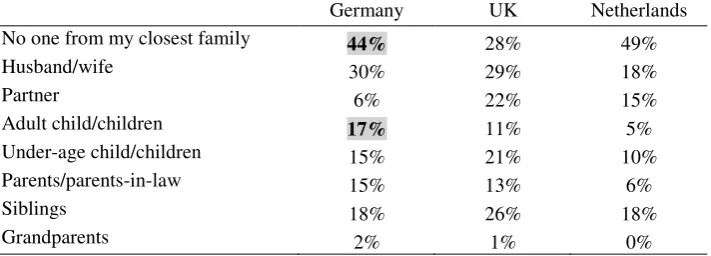
Data concerning family members abroad (see Table 8) confirm that present-day emigration in Germany mainly consists of short-term trips to work, not infrequently of parents with grown-up children, while it is to a relatively insignificant extent related to whole families moving to Germany, a phenomenon nowadays observed more often in the United Kingdom.
[image:10.595.111.483.369.487.2]According to the survey most emigrants from Poland work in Germany legally, which may be assessed on the basis of the fact that they pay health insurance contributions. Survey data indicate that ca. 70% of them benefit from health insurance in Germany. It is a figure close to that characteristic for emigration to the Netherlands, but lower than that for emigration to the United Kingdom (77%).
Table 7
The structure of planned further stay abroad of persons in Germany, United Kingdom and the Netherlands
Germany UK Netherlands Shorter than 3 months 5% 2% 6% 3-6 months 5% 3% 7% 7-12 months 5% 4% 8% More than 1 year – up to 3 years 12% 17% 18% More than 3 years but not permanent 29% 33% 25% Permanent 42% 40% 35% No response/response refused 1% 1% 1% Source: NBP surveys 2010
Table 8
Polish emigrants’ responses to questions concerning their close relatives living with them abroad in Germany, United Kingdom and the Netherlands
[image:10.595.122.478.552.680.2]2. Factors influencing migratory flows after the opening of the labour markets
This section presents the analysis of factors which influence migratory flows and it attempts to answer the question about the possible impact of the opening of the labour market based on the experience from the period after Poland‟s entry into the EU. Economic conditions which accompanied the opening of the labour markets of subsequent EU countries for workers from Poland are described in the first part of this chapter. Then the econometric model is used to quantify the impact of the most important factors on the basis of available data.
Before embarking on the analysis of economic factors influencing migrations, it is worth noting that whether the opening the labour market for workers from Poland will have or have not an impact on the intensity of emigration to Germany and Austria depends not only on changes in law (de jure) but also on the de facto situation. Firstly, if despite formal limitations, emigrants from Poland can perform the majority of work they seek abroad, the change consisting in the lifting of those limitations will not constitute a big shock. The problem of the limitations in performing work by Polish emigrants in Germany has been discussed more broadly in Section 1.1 with the conclusion that in practice current limitations are rather not painful for labour emigration. Secondly, the opening of the labour market may also lead to the legalization of many persons working illegally, which may improve the statistics but is not related to additional migratory flows. Data presented in Section 1.2 indicate, however, that the majority of Poles are already working legally in Germany and an
additional „legalization‟ will have a rather limited impact.
The analyses presented in this section assess the impact of the opening of the market solely on the basis of migratory flows observed in the past into countries with diversified emigrant communities.
2.1 Emigration in 2004-2009 and the economic factors
The literature on the economic factors that explain the directions and intensity of labour migration often mentions the following incentives to migration between states: (1) differences in obtainable wages (or income) in various countries of persons with the same skills, (2) differences in job opportunities (measured e.g. by differences in unemployment rate) and (3) elimination of legal or administrative barriers to migration and work abroad. Moreover, according to the literature on the subject, migratory movements, to a large extent, usually concern young and mobile people (aged 18-35).
According to GUS estimates, the number of Poles residing in EU countries increased from 460 thousand to more than 1.6 million in 2002-2009 (see Table 9). It seems that the abrupt intensification of labour emigration after Poland‟s entry into the EU in 2004 resulted partly from the above-mentioned factors.
Table 9
The number of de facto emigrants (Polish nationals staying outside Poland more than 3 months) according to official GUS estimates (in thousands, total and in selected EU countries). The countries and periods of free labour migration flows are marked in grey
Census ‘02 2004 2005 2006 2007 2008 2009
Total 786 1 000 1 450 1 950 2 270 2 210 1 870 EU 461 770 1 200 1 610 1 925 1 887 1 635
Labour market open since 2004:
Great Britain 24 150 340 580 690 650 555 Ireland 2 15 76 120 200 180 140 Sweden 6 11 17 25 27 29 31
Labour market open since 2006:
Spain 14 26 37 44 80 83 84 Portugal 0 1 1 1 1 1 1 Finland 0 0 1 3 4 4 3 Greece 10 13 17 20 20 20 16 Italy 39 59 70 85 87 88 85
Labour market open since 2007:
Netherlands 10 23 43 55 98 108 84
Labour market open since 2008:
France 21 30 44 49 55 56 47
Labour market open since 2009:
Belgium 14 13 21 28 31 33 34 Denmark 0 0 0 0 17 19 20
Labour market open since 2011:
Austria 11 15 25 34 39 40 38 Germany 294 385 430 450 490 490 415 Source: NBP data, own calculations
Secondly, at the beginning of the 21st century, the unemployment rate in Poland was among the highest in Europe and reached 20% at the end of 2002 (see Chart 3). The unemployment rate among graduates was twice as high. Since that time the situation has changed radically. The unemployment rate (based on Labour Force Survey data) in Poland dropped to single digit figures, and the escalation of the crisis in Western Europe led to a situation where the unemployment rate in Poland is currently lower than in many destination countries of emigration from Poland.
One of the main reasons usually used to explain the labour emigration from Poland to the countries of Western Europe previously observed departure from Poland was also exerted by significant differences in wages adjusted for the exchange rate and cost of living(see Chart 4). These differences still persist but the sharp increase in average wage in the Polish economy in 2007-2008 as well as fluctuations of the euro and pound sterling exchange rate have altered the impact of this factor on emigration flows (e.g. the appreciation of the zloty prior to the crisis and a drop in its value during the crisis, the depreciation trend of the pound sterling exchange rate) .
Chart 3
Unemployment rates in Poland and selected EU countries
Source: Eurostat, own calculations
Chart 4
Purchasing power (PPP) of net wages of a person earning 70% of a country’s average9 in selected EU countries in comparison to analogous wage in Poland
Source: Eurostat, own calculations
Chart 5
Mobile Polish population (persons aged 20-35) in millions
Source: Eurostat, own calculations
9
The level of wages characteristic for workers with relatively lower wages, which is characteristic for most emigrants because they are usually employed in jobs that requires relatively lower qualifications
0 2 4 6 8 10 12 14 16 18 20
2002 2004 2005 2006 2007 2008 2009
Poland Austria UK Germany Irland Netherlands France Sweden
0 0.5 1 1.5 2 2.5 3 3.5 4
2002
2008
8 8.5 9 9.5 10
The comparison of data concerning the number of Polish emigrants abroad and the time-frame of the opening of the labour markets by particular countries indicates that:
the opening of the labour market in some cases led to an almost abrupt increase in the number of emigrants (as exemplified by the United Kingdom and Ireland in 2004-2007 and the Netherlands in 2004-2007-2008). On the other hand the opening of the labour market in countries like Sweden, Italy or Portugal has not contributed to any additional emigration flows
the increase in the number of emigrants could take place even despite restrictions (e.g. Germany in 2002-2007, Belgium in 2005-2007) ;
an open labour market did not guarantee emigrants stayed on when the unemployment rate was rising to levels higher than in their home country (almost in all countries with open labour markets after 2008). Some countries even witnessed a large return migration to Poland;
a fall in the intensity of emigration to EU countries was clearly correlated with a drop in the unemployment rate in Poland;
The general research on migration underline the relevance of country-specific features like: language, labour market institutions, taxation system, job finding opportunities in the sectors where emigrants work most often, etc. The comparison of emigration from Poland to Ireland and Sweden can be the practical example of the importance of those factors. ( the opening of the labour market in Sweden led to a much less intensive migration than to Ireland despite the fact that this country is geographically much closer to Poland).
2.2. Analysis of the impact of changes in selected factors on changes in the number of emigrants
As mentioned above, in 2002-2009 many diverse factors had influenced simultanously the emigration from Poland. In this section, a panel regression model10 was used in order to assess the statistical and economic significance of each of these factors. The annual percentage change in the number of Polish emigrants in a given country (r_mig) was chosen as the explained (dependent) variable, while the explanatory variables are as follows:
1) the difference between the unemployment rate in a given country and in Poland in percentage points (u_comp),
2) a dummy variable corresponding to the year of the opening of the labour market (entry),
3) a dummy variable denoting whether the labour market is open in a given year (open)
4) a variable calculated as the ratio of the monthly net wage (in units of purchasing power PPS) in a given country to the corresponding wage in Poland (also in units of purchasing power PPS) in a given year (w_pps_c).
5) a variable calculated as the ratio of the monthly net wage in euro in a given country to the corresponding wage in Poland in a given year also calculated in euro (w_eur_c)
6) a variable marking the demographic trend – annual changes in the population of persons in the age of the biggest mobility, i.e. 20-35 years of age, in Poland
(demo_trend)
10
7) variables denoting differences in unemployment rates in countries with labour market open to Poles (zero in the remaining ones) –u_open and differences in unemployment rates in comparison to Poland in countries with labour markets closed to Poles –
u_closed.
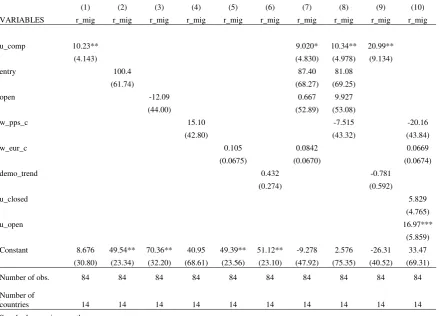
[image:15.595.74.514.267.583.2]The results of the regression indicate that the only variable with statistically significant and positive impact on migration intensity consisted of differences in the unemployment rate between countries and changes in the subsequent periods. The difference in unemployment rate of 1 percentage point between Poland and a given country resulted in an increase in the number of emigrants during the year, on average, by ca. 10% (models 1, 7 and 8) ceteris paribus.
Table 10
Results of panel regression model for EU14 countries (EU15 countries excluding Luxembourg) (1) (2) (3) (4) (5) (6) (7) (8) (9) (10) VARIABLES r_mig r_mig r_mig r_mig r_mig r_mig r_mig r_mig r_mig r_mig
u_comp 10.23** 9.020* 10.34** 20.99** (4.143) (4.830) (4.978) (9.134)
entry 100.4 87.40 81.08
(61.74) (68.27) (69.25)
open -12.09 0.667 9.927
(44.00) (52.89) (53.08)
w_pps_c 15.10 -7.515 -20.16
(42.80) (43.32) (43.84)
w_eur_c 0.105 0.0842 0.0669
(0.0675) (0.0670) (0.0674)
demo_trend 0.432 -0.781
(0.274) (0.592)
u_closed 5.829
(4.765)
u_open 16.97***
(5.859) Constant 8.676 49.54** 70.36** 40.95 49.39** 51.12** -9.278 2.576 -26.31 33.47 (30.80) (23.34) (32.20) (68.61) (23.56) (23.10) (47.92) (75.35) (40.52) (69.31) Number of obs. 84 84 84 84 84 84 84 84 84 84 Number of
countries 14 14 14 14 14 14 14 14 14 14 Standard errors in parentheses
*** p<0.01, ** p<0.05, * p<0.1
Source: Own calculations
The remaining variables in the model turned out to be statistically insignificant at the significance levels lower than 0.1. This resulted both from a relatively small sample and relatively high variation of variables.
It is worth noting that despite the absence of statistical significance, parameters describing the influence of differences in wages in comparison with Poland and denoting an openness of labour markets had a positive signs. ,. The variable denoting differences in wages in euro
(w_eur_c) could be considered as significant at the significance level of 0.12, while the
The demographic trend turned out to be insignificant as a variable that explains the changes in the number of emigrants in individual countries. Similarly, the existence of an open labour market (open) did not affect the change in the number of emigrants significantly.
The interesting conclusion is also the fact that introducing interaction between the rate of unemployment and an open labour market – the division into the impact of unemployment in countries with an open and closed labour market affects the results significantly. The impact of differences in the unemployment rate in countries with an open labour market is much stronger than the impact of the differences in unemployment rates in the total sample. It means that the impact of unemployment rates in countries with a closed labour market was week and statistically insignificant (at the significance level lower than 0.1).
Summing up, it can be said that regression results indicate that differences in the level of unemployment rates was the main factor which explained the migratory flows from Poland to EU countries in 2002-2009. According to the theory that differences in wages between countries should also affect emigration but the model results do not delivered significant proves for that influence. The impact of unemployment rates was limited in countries with closed labour markets, while being clearly more significant in countries with open labour markets. It implies that after the opening of the labour market in Germany and Austria a more intensive emigration should be expected as a result of lower unemployment in these countries in comparison with the unemployment currently observed in Poland. Assuming that the difference between the unemployment rate in Poland and Germany amounts to ca. 3 p.p. and between Poland and Austria ca. 5p.p., the increase in emigration caused by unemployment to these two countries would amount to 90 thousand persons assuming these countries have closed labour markets, and 240 thousand assuming the opening of the labour market will intensify the impact of differences in the unemployment rate.
3. Discussion on the expected outflows of labour force to Germany after the opening of the labour market in 2011
3.1 Estimates of migratory potential
The flow of emigrants from Poland after the opening of German labour market is a topic of lively discussions both in Poland and in Germany. In the case of Poland, the discussion is held mainly in the press and includes experts‟ opinions on the scale of possible additional migration. The estimates by Polish experts vary, oscillating in the range of 200 thousand – 600 thousand, however, their main flaw lies in the absence of more accurate information concerning the definition (in most cases, nobody knows whether at stake are changes in the net emigration or emigration flows without returns taken into account) and the estimates horizon.11 Apart from fairly general statements, these estimates contain no information on the occupational structure of potential emigration to Germany and Austria.
In Germany, similarly as before 2004, i.e. prior to the accession of new member states to the EU, research was conducted to assess the scale and structure of the future inflow of foreign labour force resources. Keeping in mind the past experience of the EU countries that had earlier fully liberalized access to their labour markets, one takes a more critical approach towards estimates with regard to emigration from Eastern and Central Europe than 7 years ago.12 Admittedly, a variety of forecasts – usually based on very general estimates prepared for specific institutions13 – is published in German newspapers and Polish press alike, Basically it seems, however, that researchers who study the labour market find it now slightly easier to objectively assess the potential costs and benefits arising from the opening of the labour market. In the new migration wave, German economists, in particular, see a factor contributing to the rejuvenation of its labour force resources (Baas i Brücker 2010), (Baas,
Brücker, i Hauptmann 2010) and (Brücker i Jahn 2010). The group of emigrants represents
relatively young age cohorts, and, at the same time, exhibits a high labour market participation rate. While the effects of the lifting of restrictions on employment of Poles by German employers do not raise much concern, lifting restrictions on quotas
(Entsendegesetz14) for staff employed in Poland and delegated to Germany (Lorenz 2010),
seems to be a bigger unknown for Germany, especially that there are no reliable empirical data15 in this respect.
Recent estimations of the inflow of a new wave of emigrants to Germany point out the weakness of econometric forecasts that cannot take account of the present institutional changes due to objective reasons. In particular, the authors point to the possible impact of flows of migrants from one destination country to another, as was the case with Germany, the
11
Currently available estimates include i.a. BNP Paribas forecasts (Dybula 2010) of September 2010 on the inflow of around 500 thousand persons from Poland in 2011-2015 to the German labour market or estimates of the Polish Embassy in Berlin published in newspapers (Blaszczak 2011) that predict an outflow in the range of 300 thousand - 400 thousand persons.
12
Before the accession to the EU, long-term estimates predicted an outflow of people from the new EU Member States amounting to ca. 3-5% of the population of the country of origin, which corresponded to the total annual emigration of ca. 250 thousand to 400 thousand persons from all the acceding countries (for a review of earlier forecasts see: (Stiller i Wyszynski 2006).
13
For example, the regional sickness insurance fund AOK estimates a potential inflow of Poles at ca. 400 thousand to 500 thousand in the years 2011-2014.
14
The Law on the Posting of Workers of 20 April 2009 (Arbeitnehmer-Entsendegesetz (AEntG)).
15
United Kingdom and Ireland. According to the (Baas i Brücker 2010) estimates migratory inflows up to 2020 are based on national data (data derived from national census or Labour Force Surveys, the equivalent of the Polish BAEL), and the main variable determining migratory potential is the disparity of average income between the sending country and the receiving country. The results show a rise in migratory potential from all new EU Member States to all EU-15 states from 2.4 million persons in 2010 to 3.9 million in 2020, at the annual rate of 250 thousand persons at the beginning to 100 thousand at the end of the surveyed period. Assuming that Germany would account for 45% of new migration (the middle of the three forecasted scenarios under consideration), the number of emigrants in Germany would grow from ca. 630 thousand in 2010 to 1.5 million in 2020 (at the annual rate of ca. 100 thousand at the beginning to ca. 40 thousand in 2020).
However, the above estimate is based on the assumption (made, inter alia, by the IMF) of a global economic recovery undisturbed by any major shock. Therefore, this estimate is highly uncertain as unexpected shocks may reduce the scale of the outflow of labour force from Eastern and Central Europe. Moreover, the scale of emigration from Poland to Germany may be curbed by the existing group of Polish migrants, represented in great numbers, that according to (Baas i Brücker 2010), will carry the brunt of major adjustments (mainly in the form of a decrease in average income levels) connected with the additional inflow of Poles and the substitution effect between the „old‟ and „new‟ migrants. The issue of the recognition of Polish diplomas also remains unsolved, which may discourage particularly certain qualified workers. On the other hand, these forecasts do not take into account the possibility of legalizing the hitherto employment by some foreigners who have already been working in Germany.16
3.2. Determinants of the demand for migrants
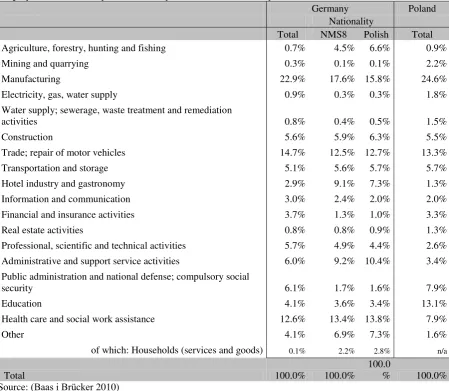
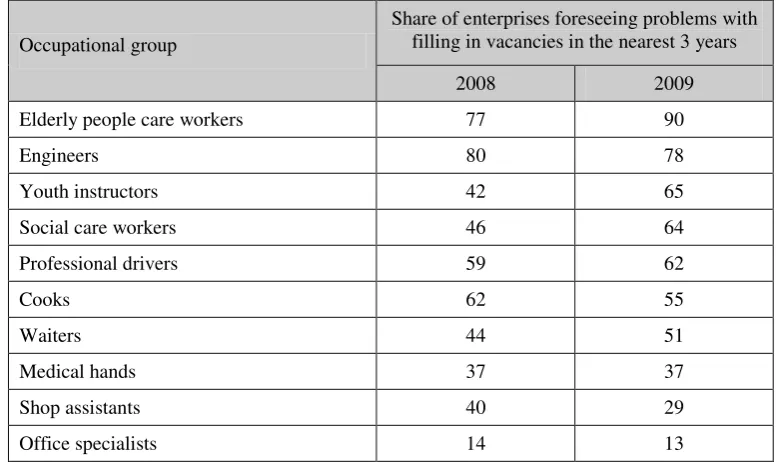
The structure of the outflow of labour force from Poland will primarily depend on the well established migration patterns as well as the demand reported by German employers, which is hard to be met by internal labour force resources (Heckmann et al. 2010). The latter group of factors is, undoubtedly, the consequence of structural transformation in Germany (including, the ageing of society). The present employment structure of Poles in Germany17 is shown in Table 11. These results are confirmed by data from NBP surveys on emigrants, namely that a relatively large percentage of Poles in relation to Germany‟s total employment structure, is employed in agriculture, accommodation, catering, administrative and support service activities as well as in health care and social care. The category “Other” also includes services provided by households (e.g. child care), whose share in the employment structure is also relatively high in the case of Polish citizens. The differences in the employment structure between local population and migrants are, in part, the evidence of complementarity of the work provided by a significant number of foreigners.
16
In addition, (Baas i Brücker 2010) foresee – using an equilibrium model they have designed for this purpose – that the new wave of migration from the new EU Member States may have some impact on the industrial structure of the German economy in the coming years. The three analyzed scenarios suggest an over proportionally large increase in the share of such services as administration, education, health care as well as services to households. The share of the sector of industry is also expected to grow. On the other hand, the share of agriculture, financial services and services related to real estate transactions as well as transportation, information and communication is likely to decrease.
17
Table 11
Employment in Germany and Poland by sections and nationality (December 2009)
Germany Poland
Nationality
Total NMS8 Polish Total Agriculture, forestry, hunting and fishing 0.7% 4.5% 6.6% 0.9% Mining and quarrying 0.3% 0.1% 0.1% 2.2% Manufacturing 22.9% 17.6% 15.8% 24.6% Electricity, gas, water supply 0.9% 0.3% 0.3% 1.8% Water supply; sewerage, waste treatment and remediation
activities 0.8% 0.4% 0.5% 1.5% Construction 5.6% 5.9% 6.3% 5.5% Trade; repair of motor vehicles 14.7% 12.5% 12.7% 13.3% Transportation and storage 5.1% 5.6% 5.7% 5.7% Hotel industry and gastronomy 2.9% 9.1% 7.3% 1.3% Information and communication 3.0% 2.4% 2.0% 2.0% Financial and insurance activities 3.7% 1.3% 1.0% 3.3% Real estate activities 0.8% 0.8% 0.9% 1.3% Professional, scientific and technical activities 5.7% 4.9% 4.4% 2.6% Administrative and support service activities 6.0% 9.2% 10.4% 3.4% Public administration and national defense; compulsory social
security 6.1% 1.7% 1.6% 7.9% Education 4.1% 3.6% 3.4% 13.1% Health care and social work assistance 12.6% 13.4% 13.8% 7.9% Other 4.1% 6.9% 7.3% 1.6% of which: Households (services and goods) 0.1% 2.2% 2.8% n/a
Total 100.0% 100.0% 100.0
% 100.0% Source: (Baas i Brücker 2010)
Table 12
Selected results of the IAB survey on the demand for work in Germany (2008, 2009)
Occupational group
Share of enterprises foreseeing problems with filling in vacancies in the nearest 3 years
2008 2009 Elderly people care workers 77 90
Engineers 80 78
Youth instructors 42 65 Social care workers 46 64 Professional drivers 59 62
Cooks 62 55
Waiters 44 51
Medical hands 37 37 Shop assistants 40 29 Office specialists 14 13 Source: (Heckmann et al. 2010)
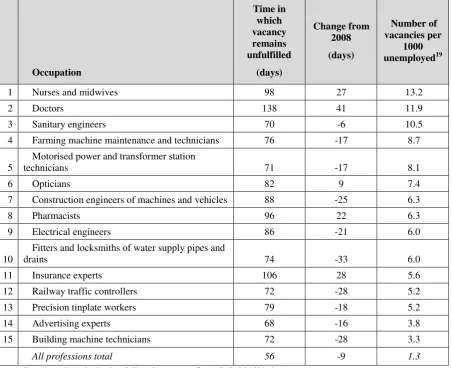
Information on German labour market developments concerning demand for work in December 2010 is also provided by the statistical data of the BfA describing the average time a vacancy remains unfulfilled (broken down by occupations and sections) (see Table 13).18 They show that presently German employers face the biggest problems with filling positions in the health care sector, which is evidenced by a high LM tightness index as well as the longest period among all occupations in which a vacancy remains open. The already long period in which job openings at German job centers for doctors and nurses usually remain open increased in the past two years (by 41 and 27 days, respectively). Problems with filling vacancies are also experienced in the category of engineers and technical workers in the construction sector and in the power network industry. The list of „needed urgently‟ occupations also includes elderly people care workers and social care workers (23rd place) and pharmacists (8th place). Compared to 2008, the average time of filling a vacancy by insurance specialists and pharmacists has also increased substantially (by 28 and 22 days, respectively). On the other hand, it seems that employers seeking engineers and other technical workers may now have fewer problems than 2 years ago.
18
Table 13
Time a vacancy remains unfulfilled and the LM tightness index for selected occupations in Germany (December 2010)
Occupation
Time in which vacancy remains unfulfilled
(days)
Change from 2008 (days)
Number of vacancies per
1000 unemployed19
1 Nurses and midwives 98 27 13.2 2 Doctors 138 41 11.9 3 Sanitary engineers 70 -6 10.5 4 Farming machine maintenance and technicians 76 -17 8.7
5
Motorised power and transformer station
technicians 71 -17 8.1 6 Opticians 82 9 7.4 7 Construction engineers of machines and vehicles 88 -25 6.3 8 Pharmacists 96 22 6.3 9 Electrical engineers 86 -21 6.0
10
Fitters and locksmiths of water supply pipes and
drains 74 -33 6.0
11 Insurance experts 106 28 5.6 12 Railway traffic controllers 72 -28 5.2 13 Precision tinplate workers 79 -18 5.2 14 Advertising experts 68 -16 3.8 15 Building machine technicians 72 -28 3.3
All professions total 56 -9 1.3
Source: Developed on the basis of (Bundesagentur für Arbeit 2010b)data
When broken down by (relatively aggregated) branches of the economy, differences do not seem so remarkable as when broken down by occupations (see Chart 6). Throughout the past year, the waiting time of job openings for workers increased most in the following sections: public administration, education and health care (by 8 days, on average). However, it decreased in manufacturing and the provision of temporary staff (so-called
Arbeitnehmerüberlassung). The general tendency, however, starting from the middle of the past year seems to a marked upward tendency.
19
Chart 6
Average time of vacancy reported to a job centre in Germany remaining unfulfilled, by branches of the economy (Jan. 2009-Dec. 2010)
Source: Developed on the basis of (Bundesagentur für Arbeit 2010b) data
3.3. Changes of migration flows after the opening of the labour markets in Germany and Austria – concluding remarks
Overall assessment of the scale of additional emigration to Germany and Austria following the opening of their labour markets depends on the assumptions taken. Probably this is the main reason behind the variability of the expert estimates of changes in emigration before 1st of May 2011. The aim of this paper was not the estimation of the particular number of additional emigrants but the analysis of the factors influencing migration flows and the description of the characteristic features of present emigrants in comparison with the demand on the German labour market. According to the results obtained in Chapter 2.2 an additional significant increase in the number of emigrants related to the opening of German and Austrian labour markets may result from a larger impact of unemployment rate differentials between Poland and migration destinations. Still, the additional effect of the opening of the labour market (the „novelty effect‟), which used to be, on average, positive but after 2005 occurred on a larger scale only in the Netherlands, remains unknown.
Moreover, some factors that may have had a considerable impact on the results were not accounted for in regression. These were social and cultural factors (Duszczyk 2011) – language, the openness of the receiving society towards foreigners, a developed migratory network as a result of centuries-long tradition of income-earning trips from Poland to Germany; at the end of 2009, nearly 1.3 million persons, of which 585 thousand were Germans, had migratory experience connected with Poland (Bundesministerium des Innern 2011). In the context of the above results, the comparison of developments in the Polish and
20 30 40 50 60 70 80 90 Jan 2009 Feb 2009 Mar 2009 Apr 2009 May 2009 Jun 2009 Jul 2009 Aug 2009 Sep 2009 Oct 2009 Nov 2009 Dec 2009 Jan 2010 Feb 2010 Mar 2010 Apr 2010 May 2010 Jun 2010 Jul 2010 Aug 2010 Sep 2010 Oct 2010 Nov 2010 Dec 2010 Days Total
Agriculture, forestry, hunting and fishing Manufacturing
Construction
Hotel industry and gastronomy
Public administration, education and health care 3-month mov. av. (Agriculture, forestry...) 3-month mov. av. (Manufacturing) 3-month mov. av. (Construction)
German labour markets will be of major significance for the emigration to Germany after its labour market has been opened.
In terms of income, Germany seems to be more attractive for emigrants than the majority of the other EU countries. However, the average wages are now not as attractive as in the United Kingdom, or in the Netherlands in the period before the crisis. The results of regression show that the impact of the income factor in the short-term is limited. Following the opening of the labour markets in Germany and Austria, an increase in labour migration from Poland may be expected due to the elimination of the entry barrier to some emigrants, and the „novelty effect‟ that encourages some people to migrate to these countries. The legalization of the work of hitherto-illegal immigrants can be also expected but the data presented in chapter 1.2 suggest that even in 2010 the share of shadow employment in Germany was not very differnet from observed in the countries with open labour markets. The popularity of labour emigration to Germany in the short term may be, however, constrained by the command of the German language. Data from the survey “Social Diagnosis 2009” (Kotowska i Strzelecki 2009) indicate that the active knowledge of English is proven by around 18% of Poles, while active knowledge of German is confirmed by around 8% of Poles. These data may indicate that trips aimed at independently finding jobs in Germany may be more difficult for young people than trips to England and Ireland in the past.
Assuming that the nationality composition of migration to Germany will follow a similar pattern (the share of Poles among emigrants from EU-8 countries will remain at the level (Statistisches Bundesamt 2010) of around 70%), additional migratory flows from Poland may amount to around 50-70 thousand a year in the first years after the labour market has been opened. The impact of the labour market opening is likely to be more visible in the changes in the nature of present-day migration from predominantly short-term to more residential. The analysis of the labour demand in Germany by occupation leads to the conclusion that the occupational group that seems most attractive from the point of view of German economy needs in the coming years is healthcare workers, elderly people care workers and social care workers. The demand for engineers and technical workers, including those related to the construction sector, may continue to remain relatively high.
References
Baas, Timo, Herbert Brücker, i Andreas Hauptmann. 2010. „Labor Mobility in the Enlarged
EU: Who Wins, Who Loses?” [in:] EU Labor Markets After Post-Enlargement Migration.
Heidelberg, Dordrecht, London, New York: M. Kahanec, K. F. Zimmermann.
Baas, Timo, i Herbert Brücker. 2010. Wirkungen der Zuwanderungen aus den neuen mittel- und osteuropäischen EU-Staaten auf Arbeitsmarkt und Gesamtwirtschaft.
Blaszczak, Anita. 2011. „Niemcy czekają na fachowców”. Rzeczpospolita, styczeń 30
Pobrano kwiecień 15, 2011 (http://www.rp.pl/artykul/602453.html).
Brücker, Herbert, i Elke J. Jahn. 2010. Einheimische Arbeitskräfte gewinnen durch
Zuwanderung. Bielefeld: Institut für Arbeitsmarkt- und Berufsforschung.
Bundesagentur für Arbeit. 2010a. Analyse der gemeldeten Arbeitsstellen. Bundesagentur für
Arbeit.
Bundesagentur für Arbeit. 2010b. Analyse der gemeldeten Arbeitsstellen nach Berufen
(Engpassanalyse). Bundesagentur für Arbeit.
Bundesagentur für Arbeit. 2010c. „Merkblatt für Arbeitgeber zur Vermittlung und Beschäftigung ausländischer Saisonarbeitnehmer und Schaustellergehilfen”.
Bundesministerium des Innern. 2011. Migrationsbericht des Bundesamtes für Migration und
Flüchtlinge im Auftrag der Bundesregierung. Migrationsbericht 2009. Bundesministerium
des Innern, Bundesamt fürMigration und Flüchtlinge.
Bundesregierung. 2010. 8. Bericht der Beauftragten der Bundesregierung für Migration,
Flüchtlinge und Integration über die Lage der Ausländerinnen und Ausländer in Deutschland.
Die Beauftragte der Bundesregierung für Migration, Flüchtlinge und Integration.
Duszczyk, Maciej. 2011. The end of transition period - Can Poland expect a new wave of
emigration? Institute of Social Policy.
Dybula, Michal. 2010. „Germany:Change Coming”. [in:] Market Mover 30 September 2010,
BNP Paribas (bnpparibasinvestindia.com/files/0930_MM.pdf)
GUS. 2010. „Informacja o rozmiarach i kierunkach emigracji z Polski w latach 2004-2009”. Pobrano marzec 15, 2011 (http://www.stat.gov.pl/gus/5840_3583_PLK_HTML.htm).
Heckmann, Markus, Anja Kettner, Martina Rebien, i Kurt Vogler-Ludwig. 2010.
Stellenbesetzungen in Zeiten der Krise. Bielefeld: Institut für Arbeitsmarkt- und
Berufsforschung.
Holda, Marcin, Katarzyna Saczuk, Pawel Strzelecki, i Robert Wyszynski. 2011. Settlers and Guests - Determinants of the Plans of Return Migration from UK and Ireland to Poland in the
(http://ideas.repec.org/p/nbp/nbpmis/84.html).
Kotowska, Irena, i Pawel Strzelecki. 2009. „Rynek Pracy”. S. 116-137 w Diagnoza Spoleczna
2009. Warunki i jakosc zycia Polakow. Raport. Warszawa: Rada Monitoring Spolecznego
Pobrano kwiecień 3, 2011
(http://www.diagnoza.com/pliki/raporty/Diagnoza_raport_2009.pdf).
Lorenz, Frank. 2010. Arbeitnehmerfreizügigkeit und Dienstleistungsfreiheit in der
Europäischen Union - Rechtliche Rahmenbedingungen und politischer Handlungsbedarf.
MPiPS. 2010. „Informacja w sprawie zatrudnienia obywateli polskich w państwach
Europejskiego Obszaru Gospodarczego i Szwajcarii oraz obywateli państw EOG w Polsce”.
Pobrano listopad 15, 2010 (http://www.mpips.gov.pl/analizy-i-raporty/monitoring-przeplywu-pracownikow-miedzy-polska-a-panstwami-europejskiego-obszaru-gospodarczego/).
MPiPS. 2009. „Warunki zatrudnienia obywateli polskich w Niemczech”. Pobrano kwiecień 1,
2011 (http://www.mpips.gov.pl/index.php?gid=619).
Statistisches Bundesamt. 2010. Bevölkerung und Erwerbstätigkeit –Ausländische
Bevölkerung –Ergebnisse des Ausländerzentralregisters. Wiesbaden: Statistisches Bundesamt.
Stiller, Silvia, i Robert Wyszynski. 2006. „Arbeitskräftemobilität in der erweiterten EU -
Migrationsmotive und -potenziale”. [in:] Sozialraum Europa, Schnittpunkte von Forschung
Annex 1. Information about the restrictions for employment of emigrants from Poland in Germany and Austria before 1st May 201120
Before 1 May 2011 Polish nationals could be employed in Germany in the following cases:
managerial staff of an enterprise seated in Germany, holding general power of attorney or proxy;
scientists and university teachers;
IT and communication technology specialists;
highly qualified specialists if it is in the public interest;
key personnel of an enterprise in Germany, including specialists with special professional qualifications necessary for the business activity of an enterprise;
students with a command of German, in the 18-35 age group, who take temporary jobs during holidays – up to 3 months over a 12-month period;
seasonal workers in agriculture, forestry, fruit- and vegetable processing, in the hotel industry, food services industry, in sawmills for a period of up to 4 months in the calendar year;
assistants for travelling shows, up to 9 months in the calendar year;
guest-workers with a command of German, in the 18-40 age group; on the basis of the Polish-German agreement of 7 June 1990 on the employment of guest-workers with the purpose of enhancing their professional and linguistic qualifications; within the quota (1,000 persons); for a period of up to 12 months, with the option to extend this period by another 6 months; guest-workers may take jobs only in their acquired professions;
cross-border workers if the person resides in the region of the Polish borderland with Germany and returns to Poland on a daily basis, or works in Germany only two days a week, and the place of employment is the designated region of the borderland (on the German side);
domestic help in households of persons who require care, for a period of up to 3 years; care of children and domestic work (employment of au-pair); applied to persons of up to 25 years of age, with the basic knowledge of the German language;
specialized cooks for work in specialized restaurants, for a period of up to 4 years; nurses with qualifications corresponding to the German requirements for this occupation and with a sufficient command of the German language;
Polish nationals could also be employed in Germany in cases when there were no candidates, either from Germany or other „old‟ EU Member State, for a given position.
20