ISSN Online: 2156-8278 ISSN Print: 2156-8251
A Comparative Study of Heavy Metal
Concentration in Different Layers of Tannery
Vicinity Soil and Near Agricultural Soil
Ashiqur Rahaman*, Jahan Sadia Afroze, Khairul Bashar, Md. Farhad Ali, Md. Razib Hosen
Institute of Leather Engineering and Technology, University of Dhaka, Dhaka, Bangladesh
Abstract
This research was conducted to bring out the appropriate level of heavy metal con-tamination in soil at the site of Buriganga river bank near the Hazaribagh tannery area and the normal agricultural area to evaluate heavy metal contamination in soil due to untreated tannery effluents. AAS flame method was used to determine the concentration of Chromium (Cr), lead (Pb), Cadmium (Cd), Zinc (Zn) in several depths of the soil. Results showed that, the heavy metal concentration in soil at the site of Buriganga river bank in the tannery vicinity and normal agricultural area sig-nificantly varies, such as Cr varies (561.71 - 31.23) mg/kg, Zn varies (158.23 - 73.5), Pb varies (70.58 - 24) and Cd varies (2.25 - 0.71) mg/kg in the river bank as well as in the normal agricultural area Cr varies (27.869 - 24.5416) mg/kg, Zn varies (134.167 - 28), Pb varies (25.76 - 22.49) and Cd varies (1.30 - 0.64) mg/kg. The study indicated that heavy metals concentration was found to be significantly higher in river bank soils than in the normal agricultural area. This metal concentration in soil is respon-sible for the promotion of toxicity in agricultural products. Therefore, the human health and environment are affected by these areas.
Keywords
Heavy Metal, Soil, Contamination, Tannery Area, Agricultural Area
1. Introduction
In recent years, environment and health related problem by heavy metal has become a major concern [1]. As soil is a crucial component of rural and urban environments, the role of heavy metals in the soil system is increasingly becoming an issue of global con-cern [2]. The pollution of heavy metals in soil undesirably affects its physicochemical How to cite this paper: Rahaman, A.,
Afroze, J.S., Bashar, K., Ali, Md.F. and Ho-sen, Md.R. (2016) A Comparative Study of Heavy Metal Concentration in Different Layers of Tannery Vicinity Soil and Near Agricultural Soil. American Journal of Ana-lytical Chemistry, 7, 880-889.
http://dx.doi.org/10.4236/ajac.2016.712075
Received: October 7, 2016 Accepted: December 9, 2016 Published: December 12, 2016
Copyright © 2016 by authors and Scientific Research Publishing Inc. This work is licensed under the Creative Commons Attribution International License (CC BY 4.0).
criteria important to infertility and low yield of crops due to their toxicity [3]. Nowa-days, with the development of the global economy, soil contamination by heavy metal has gradually increased, resulting in the deterioration of the environment [4]. This soil is tainted by heavy metals through the irrigation system; resulting toxicity is entering into the food chain which affects the food quality and safety [5]. Contamination of soil by heavy metal due to tannery waste becomes a worldwide problem [6]. Wastewater from tanneries, industries or other sources carries a large amount of toxic heavy metals such as Ca, Fe, Mg, Na, Ni, Cr, Cd, Pb, Zn etc. which are responsible for the contami-nation of agricultural soil [7].
In Bangladesh, Tannery is an important foreign currency sector. There are 214 tan-neries in Bangladesh and among them, 200 are located in Hazaribagh near the bank of Buriganga river, covering an area of 25ha and the rest of them are located many other districts [8]. The tanneries in Hazaribagh are posing a grave threat to the environment. During tanning operation, many chemicals such as NaCl, H2SO4, Ca(OH)2, Cr(SO4)3, dyes are extensively used in which the leather takes only 50% - 60% of the applied chemical and rest of them discharge as effluents [9]. Most of the tanneries in Hazari-bagh do not have effluent treatment facilities. These tanneries dispose of their untreated effluent directly to open drain which finally connect to Buriganga River and discharge about 12,000 m3∙d−1 untreated effluents [10]. Some researchers demonstrated that dur-ing peak period about 14,910 m3∙d−1, off-peak period about 9100 m3∙d−1 effluent dis-charge from tanneries [8]. Consequently, distribution of heavy metals has taken from the untreated effluent to rivers, soil, water and crops [11].
Heavy metal in soils may go into the body directly through ingestion, skin contact etc. Heavy Metals in agricultural soils are absorbed and accumulated by crops. Ingest-ing heavy metals by soil-crop system is a major way of damagIngest-ing human health [12].
The aim of this research was the assessment of heavy metals (Cr, Pd, Zn, Cd) in tan-nery effluent-affected land and compared the results with the concentration of heavy metals in unaffected soil.
2. Materials and Methods
2.1. Study Area
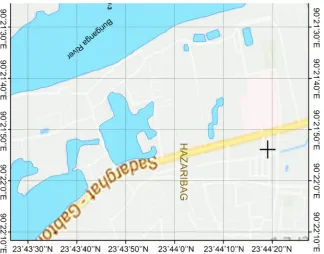
Figure 1. A real view of the sampling area with marked sample point.
2.2. Sampling
In the month of April 2016, the soil samples were collected from the sampling sites with the help of a stainless steel Ekman Grab Sampler and transferred to a pre-cleaned plas-tic container. The samples were collected from three different layers of different depth at each point. The first layer is the surface layer (0 - 15 cm) and the others are 15 - 30 cm and 30 - 45 cm below from the surface level. After collecting the soil samples were washed, weighed and dried in an oven at 105˚C until acquiring constant weight. After cooling in a desiccator all the samples were grounded and thoroughly homogenized by agate mortar and pastel. The powdered soil samples were finally stored in pre-cleaned dry glass bottles and preserved in a desiccator for further analysis.
2.3. Digestion of Soil Sample
For the quantitative analysis of Cr, Pb, Cd and Zn soil samples were digested following ISO 11466 thermal heating method. At the first 3 g of each grounded samples were weighed and taken into beakers. Then the weighed samples were moistened with 1 ml distilled water. After that 21 ml, HCl and 7 ml HNO3 were added drop by drop and then 15 ml of dilute HNO3 (0.5 M) was added to each beaker and the samples were al-lowed to stand at room temperature. Each mixture was then refluxed on a heating plate for two hours and was filtered through filter paper (Whitman no 40) after cooling and kept at room temperature for further determination
2.4. Total Heavy Metals Concentration Measurement
Science (CARS), the University of Dhaka for the subsequent analysis for metals Cr, Pb, Cd and Zn with a Perkin-Elmer atomic absorption spectrometer (Model-An Analyst 800, USA). Cd (Wavelength 228.8 nm), Cr (Wavelength 357.9 nm), Pb (Wavelength 283.3 nm), and Zn (Wavelength 213.9 nm) specific hollow cathode lamp was used to analyze the samples. The instrument has a minimum detection limit of 0.01 mg/L for Cd, 0.10 mg/L for Cr, 0.20 mg/L for Pb and 0.01 mg/L for Zn in the flame method. Samples were aspirated through nebulizer and absorbance was measured with a blank as reference. Calibration curve was obtained using standard samples (containing 0.2, 0.4, 0.6, 0.8 and 1.0 mg/L for Cd; 0.2, 0.5, 1.0, 2.0 and 4.0 mg/L for Cr; 0.5, 1.0, 2.0, 4.0 and 8.0 mg/L for Pb and 0.2, 0.4, 0.6, 0.8, 1.0 and 2.0 mg/L for Zn). The correlation coefficient was found for Cd 0.999, Cr 0.994, Pb 0.999 and for Zn 0.999.
3. Result and Discussion
From the investigation, it was found that Cr concentrations of soils in the vicinity of Hazaribagh tannery are rather high and in the most cases, these exceeded the maximum permissible limits. The result recorded highest values of heavy metal content at the dumping point and lowest values in the soil of Agricultural area. The heavy metal con-tent was found most abundantly in the surface layers and the values decreased with the increase of depth and distance except a few exceptions.
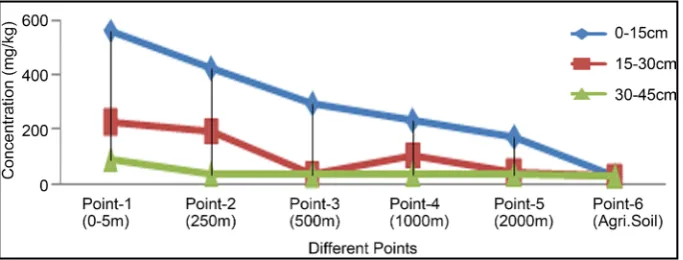
According to the (Figure 2) it is noticed that in the case of Tannery vicinity soil, Cr content was found most abundant (561.71 mg/kg) in the surface layer of point 1 (dumping point) and least abundant (31.23 mg/kg) in 30 - 45 cm depth of point 5. In surface layer, values for Cr content ranged from 561.71 to 170.83 mg/kg, in 15 - 30 cm depth, it ranged from 220.89 to 34.2 mg/kg and in 30 - 45 cm depth the range was from 90.09 to 28.72 mg/kg (Table 1). While in the case of Agricultural area soil, Cr content in surface layer, 15 - 30 cm and 30 - 45 cm depth is found 27.867, 26.0416 and 24.54166 mg/kg respectively (Table 2).
[image:4.595.203.545.559.689.2]From the result, it is evident that Cr content in the Tannery vicinity of similar layer decreased with the increase of distant from the dumping point and also with the in-crease of depth at each point except few exceptions. In the surface layer, the rate of de-creasing with distance was much higher than two other layers. In comparison with the
Table 1. Heavy metal content in tannery area soil.
Sampling Points the surface level (cm) Depth of layers from (mg/kg) Cr (mg/kg) Pb (mg/kg) Cd (mg/kg) Zn
Point-1 0 - 15 561.71 70.58 2.25 158.23
15 - 30 220.89 42.95 1.28 118.52
30 - 45 90.09 26.61 0.88 98.73
Point-2 0 - 15 423.43 65.21 2.01 137.31
15 - 30 191.73 38.90 1.26 107.65 30 - 45 33.25 26.29 0.98 101.48
Point-3 0 - 15 290.67 31.09 1.12 73.5
15 - 30 34.20 26.31 0.898 121.33 30 - 45 28.72 26.50 0.7660 107.33
Point-4 0 - 15 230.15 30.73 1.01 107.23
15 - 30 98.88 27.29 0.97 115.66 30 - 45 33.33 24.37 0.81 103.15
Point-5 0 - 15 170.83 27.97 0.93 123.72
15 - 30 35.63 26.44 0.80 129.25 30 - 45 31.23 28.29 0.71 115.88 Maximum permissible limit
recommended by EC (1986) [13] mg/kg 50 mg/kg 300 mg/kg 3 −
Table 2. Heavy metal content in agricultural area soil.
Sampling Points Depth of layers from the surface level (cm)
Cr (mg/kg)
Pb (mg/kg)
Cd (mg/kg)
Zn (mg/kg)
Soil of agricultural area
0 - 15 27.867 23.60 0.64 28
15 - 30 26.0416 25.76 0.82 134.167
30 - 45 24.54166 22.49 1.30 80.5 Maximum permissible limit
recommended by EC (1986) [13] mg/kg 50 mg/kg 300 mg/kg 3 −
Agricultural area soil, in every case Cr concentration in the tannery vicinity soil is found higher than that of the agricultural area. In Tannery vicinity, in the surface layer of each point, the value of Cr content exceeded the permissible limit that is 50 mg/kg recommended by EC (1986) [13]. But Agricultural Area soil did not exceed that limit.
The high content of Cr in the surface layer of tannery vicinity soil may be due to pollution from various industrial wastes such as Cr pigment and untreated tannery wastes, electroplating sludge, leather manufacturing wastes, and municipal sewage sludge etc. [7].
Cr contamination in the soils could also be due to waste consisting of Pb-Cr batte-ries, colored polythene bags, discarded plastic materials and empty paint containers
[image:5.595.192.553.427.529.2]Cr is toxic and carcinogenic and long-term exposure to Cr can cause liver and kidney damage [15].
Cr can also alter genetic materials and cause cancer. Other health problems that area used by Cr are Skin rashes, Upset stomachs, and ulcers, Respiratory problems, wea-kened immune systems, Alteration of genetic material, Lung cancer and Death [16].
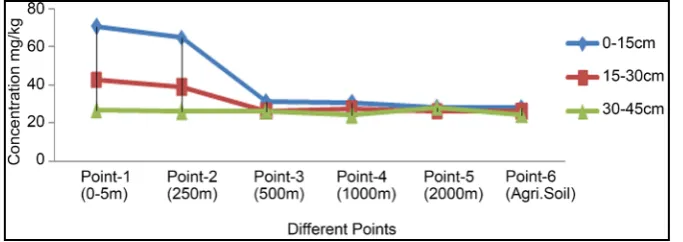
Pb is the second prevalent element in this study. In the case of Tannery vicinity, Pb content was found most abundant (70.58 mg/kg) in the surface layer of point 1 (dump-ing point) and least abundant (24.37 mg/kg) in 30 - 45 cm depth of point 4. In surface layer, values for Pb content ranged from 70.58 to 27.97 mg/kg, in 15 - 30 cm depth, it ranged from 42.95 to 26.31 mg/kg and in 30 - 45 cm depth the range was from 28.29 to 24.37 mg/kg. While in the case of Agricultural area soil, Pb content in the surface layer, 15 - 30 cm and 30 - 45 cm depth was found 27.87, 26.04 and 2 4.54 mg/kg respectively (Figure 3).
Also for Pb content in the Tannery vicinity soil of similar layer, the values decreased with the increase of distance from the dumping point and also with the increase of depth at each point except few exceptions. In the surface layer, the rate of decreasing with distance was much higher than two other layers. While it is compared with the Agricultural area soil, in every layer Pd concentration in the tannery vicinity soil is found higher than that of the agricultural area except 30 - 45 cm depth of point 4 which has value (24.37 mg/kg) higher than Agricultural Area soil (24.54 mg/kg) of the same layer. Neither Tannery vicinity soil nor Agricultural Area soil at any layer in this study exceeded the permissible limit for Pb that is 300 mg/kg recommended by EC (1986)
[13].
The high content of Pb content near the dumping point may be due to the discharge of Pb-containing untreated tannery effluent.
The presence of Pb in soil may also due to the release of Pb by automobiles and other industries in the area. This Pb can be deposited on soil and water, thus reaching hu-mans via the food chain [17].
Pb in the soils could also be from automobile exhaust fumes as well as dry cell batte-ries, sewage effluents, runoff of wastes and atmospheric depositions [18].
[image:6.595.204.546.569.690.2]Pb exposure has effects like disruption of the biosynthesis of hemoglobin and ane-mia, increase in blood pressure, Kidney damage, Miscarriages and subtle abortions,
Disruption of nervous methods, Brain injury, Declined fertility of men through sperm harm, Reduced education abilities of children, Behavioral disruptions of children, such as aggression, imprudent behavior and hyperactivity [16].
When Cd was taken into consideration, the content was found most abundant (2.25 mg/kg) in the surface layer of point 1 (dumping point) and least abundant (0.71 mg/kg) in 30 - 45 cm depth of point 5 in case of Tannery vicinity. In surface layer, values for Cd content ranged from 2.25 to 0.93 mg/kg, in 15 - 30 cm depth it ranged from 1.28 to 0.8 mg/kg and in 30 - 45 cm depth the range was from 0.98 to 0.71 mg/kg. While in the case of Agricultural area soil, Cd content in surface layer, 15 - 30 cm and 30 - 45 cm depth is found 0.64, 0.82 and 1.3 mg/kg respectively (Figure 4).
At Point-3, Point-4 and Point-5, the concentration of Cd was more or less similar. In surface layer and 25 - 30 cm depth of tannery vicinity soil concentration of Cd de-creased with the increase of distance from the dumping point. The result was not simi-lar when 30 - 45 cm depth was considered as such regusimi-larity in the values was not found there. Like Cr and Pb, the concentration of Cd also decreased with the increase of depth at each point in the tannery vicinity. But this was not the case for Agricultural area soil as the result was opposite there.
For surface layer, Cd content in each point of the Tannery vicinity was found higher than that of Agricultural area. Same was the case for 15 - 30 cm depth except in Point-5 that has a value (0.80 mg/kg) than that of Agricultural area soil (0.82 mg/kg). But unlike Cr and Pb, Cd content in 30 - 45 cm depth of Agricultural area soil was found higher than that of each point in the Tannery vicinity soil.
At any layer of any point in both Tannery vicinity soil and Agricultural area soil, Cd content did not exceed the maximum permissible limit (3.0 mg/kg) recommended by EC (1986) [13].
The Cd is brought to soils with the application of phosphoric fertilizers. Application of a lot of phosphate fertilizers and compound fertilizers increases Cd in soils constant-ly [4].
Other sources of Cd could be paint, plastics, ceramics and glass manufacture indus-try [7].
The Cd is highly poisonous and even at very little concentrations, chronic exposure to this metal can prime to anemia, insomnia, cardiovascular diseases as well as hyper-tension [19].
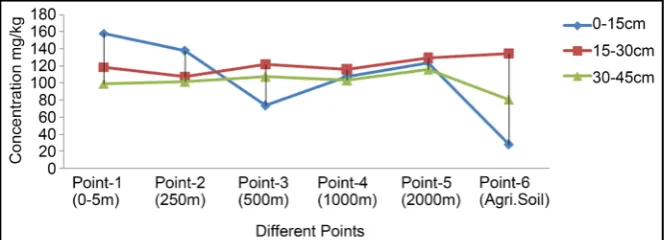
Similarly for Zn, In the case of Tannery vicinity, the metal content was found most abundant (158.23 mg/kg) in the surface layer of point 1 (dumping point) and least ab-undant (73.5 mg/kg) in the surface layer of point 3. In surface layer, values of Zn con-tent varied from 158.23 to 73.5 mg/kg, in 15 - 30 cm depth it varied from 129.25 to 107.65 mg/kg and in 30 - 45 cm depth the range was from 115.88 to 98.73 mg/kg. While in the case of Agricultural area soil, Zn content in the surface layer, 15 - 30 cm and 30 - 45 cm depth was found 28.0, 134.17 and 80.5 mg/kg respectively (Figure 5).
Figure 4. Concentration of Cd in Soil samples of different distance and depth.
Figure 5. Concentration of Zn in Soil samples of different distance and Depth.
increases towards the dumping point as well as away from the dumping point. Whereas in 15 - 30 cm and 30 - 45 cm depth values of Cr content are irregular.
It is also noticed that in the case of the surface layer and 30 - 45 cm depth, Agricul-tural Area soil has lower Zn content Tannery vicinity soil at each point. But the result is opposite for 15 - 30 cm depth as Agricultural Area soil shows higher Zn content than that of Tannery vicinity soil.
The main sources of Zn contamination are industries as well as the use of liquid manure, composted materials and agrochemicals like fertilizers as well as pesticides in agriculture [6].
Zn is an essential trace element for the growth of humans, animals and plants but is potentially dangerous for the biosphere when present in high concentrations [18]. High doses of Zn show poisonous and carcinogenic effects and consequence in neurologic as well as hematological complications, hypertension, and kidney and liver function dis-orders [20].
4. Conclusion
[image:8.595.207.541.237.357.2]Tannery industries every day. A significant amount of Pb, Cd and Zn has also been found in the soil of this area. These heavy metals are deposited and accumulated in soil and uptake by vegetables and other foodstuffs grown in this area which ultimately get into human body through the food chain. This results in various adverse effect on hu-man and animal health as Cr, Pb and Cd are highly toxic and carcinogenic in nature. So authority concerned should take immediate actions in this matter to prevent such pol-lution by heavy metals.
References
[1] Latif, S.A., Hossain, S.M., Uddin, M.S., Hafiz, M.A., Islam, M.A. and Mubin, M.S.H. (2008) Studies on Environmental Pollution in Bangladesh Using Reactor Based Neutron Activa-tion Analysis Technique. International Conference on Research Reactors: Safe Management
and Effective Utilization, Citeseer.
[2] del Mar López, T., Aide, T.M. and Thomlinson, J.R. (2001) Urban Expansion and the Loss of Prime Agricultural Lands in Puerto Rico. AMBIO: A Journal of the Human Environ-ment, 30, 49-54. https://doi.org/10.1579/0044-7447-30.1.49
[3] Khan, M.S., Zaidi, A., Wani, P.A. and Oves, M. (2009) Role of Plant Growth Promoting Rhizobacteria in the Remediation of Metal Contaminated Soils. Environmental Chemistry
Letters, 7, 1-19. https://doi.org/10.1007/s10311-008-0155-0
[4] Su, C., Jiang, L. and Zhang, W. (2014) A Review on Heavy Metal Contamination in the Soil Worldwide: Situation, Impact and Remediation Techniques. Environmental Skeptics and
Critics, 3, 24-38.
[5] Muchuweti, M., Birkett, J.W., Chinyanga, E., Zvauya, R., Scrimshaw, M.D. and Lester, J.N. (2006) Heavy Metal Content of Vegetables Irrigated with Mixtures of Wastewater and Se-wage Sludge in Zimbabwe: Implications for Human Health. Agriculture, Ecosystems &
En-vironment, 112, 41-48. https://doi.org/10.1016/j.agee.2005.04.028
[6] Gowd, S.S., Reddy, M.R. and Govil, P. (2010) Assessment of Heavy Metal Contamination in Soils at Jajmau (Kanpur) and Unnao Industrial Areas of the Ganga Plain, Uttar Pradesh, India. Journal of Hazardous Materials, 174, 113-121.
https://doi.org/10.1016/j.jhazmat.2009.09.024
[7] Rahman, S.H., Khanam, D., Adyel, T.M., Islam, M.S., Ahsan, M.A. and Akbor, M.A. (2012) Assessment of Heavy Metal Contamination of Agricultural Soil around Dhaka Export Processing Zone (DEPZ), Bangladesh: Implication of Seasonal Variation and Indices.
Ap-plied Sciences, 2, 584-601. https://doi.org/10.3390/app2030584
[8] Huq, S.I. (1998) Critical Environmental Issues Relating to Tanning Industries in Bangla-desh. Aciar Proceedings, Coimbatore, 31 January-4 February 1998.
[9] Afzal, M., Shabir, G., Iqbal, S., Mustafa, T., Khan, Q.M. and Khalid, Z.M. (2014) Assess-ment of Heavy Metal Contamination in Soil and Groundwater at Leather Industrial Area of Kasur, Pakistan. CLEAN—Soil, Air, Water, 42, 1133-1139.
https://doi.org/10.1002/clen.201100715
[10] Chowdhury, M., Mostafa, M.G., Biswas, T.K. and Saha, A.K. (2013) Treatment of Leather Industrial Effluents by Filtration and Coagulation Processes. Water Resources and Industry, 3, 11-22. https://doi.org/10.1016/j.wri.2013.05.002
[12] Aelion, C.M., Davis, H.T., McDermott, S. and Lawson, A.B. (2008) Metal Concentrations in Rural Topsoil in South Carolina: Potential for Human Health Impact. Science of the Total
Environment, 402, 149-156. https://doi.org/10.1016/j.scitotenv.2008.04.043
[13] Council Directive (1986) Council Directive on the Protection of the Environment, and in Particular of the Soil, When Sewage Sludge Is Used in Agriculture. Offic. J. Eur. Comm, 181, 0006-0012.
[14] Jung, C., Matsuto, T. and Tanaka, N. (2006) Flow Analysis of Metals in a Municipal Solid Waste Management System. Waste Management, 26, 1337-1348.
https://doi.org/10.1016/j.wasman.2005.11.018
[15] Mondol, M., Chamon, A.S., Faiz, B. and Elahi, S.F. (2011) Seasonal Variation of Heavy Metal Concentrations in Water and Plant Samples around Tejgaon Industrial Area of Ban-gladesh. Journal of Bangladesh Academy of Sciences, 35, 19-41.
https://doi.org/10.3329/jbas.v35i1.7968
[16] Islam, S., Islam, F., Bakar, M.A., Das, S. and Bhuiyan, H.R. (2013) Heavy Metals Concentra-tion at Different Tannery Wastewater Canal of Chittagong City in Bangladesh.
Internation-al JournInternation-al of Agriculture, Environment and Biotechnology, 6, 355-362.
https://doi.org/10.5958/j.2230-732X.6.3.003
[17] Järup, L. (2003) Hazards of Heavy Metal Contamination. British Medical Bulletin, 68, 167- 182. https://doi.org/10.1093/bmb/ldg032
[18] Adaikpoh, E.O. (2013) Distribution and Enrichment of Heavy Metals in Soils from Waste Dump Sites within Imoru and Environs, Southwest Nigeria.
[19] Sharma, R., Agrawal, M. and Marshall, F. (2006) Heavy Metal Contamination in Vegetables Grown in Wastewater Irrigated Areas of Varanasi, India. Bulletin of Environmental
Con-tamination and Toxicology, 77, 312-318. https://doi.org/10.1007/s00128-006-1065-0
[20] Rao, M., Gopalkrishnan, R. and Venkatesh, B. (2001) Medical Geology—An Emerging Field in Environmental Science. National Symposium on Role of Earth Sciences, Lucknow, 2-4 November 2001.
Submit or recommend next manuscript to SCIRP and we will provide best service for you:
Accepting pre-submission inquiries through Email, Facebook, LinkedIn, Twitter, etc. A wide selection of journals (inclusive of 9 subjects, more than 200 journals)
Providing 24-hour high-quality service User-friendly online submission system Fair and swift peer-review system
Efficient typesetting and proofreading procedure
Display of the result of downloads and visits, as well as the number of cited articles Maximum dissemination of your research work