C O M M I S S I O N OF THE EUROPEAN COMMUNITIES
nuclear science and technology
ON THE DETERMINATION OF THE Pu 240
IN SOLID WASTE CONTAINERS BY SPONTANEOUS
FISSION NEUTRON MEASUREMENTS
APPLICATION TO REPROCESSING PLANT WASTE
by
R. BERG, G. BIRKHOFF, L BONDAR, G. BUSCA, J. LEY, R. SWENNEN
1975
EUR 5158 e
This document is published by the Commission of the European Communities. Neither the Commission of the European Communities, its contractors nor any person acting on their behalf:
make any warranty or representation, express or implied, with respect to the accuracy, completeness, or usefulness of the information contained in this document, or that the use of any information, apparatus, method or process disclosed in this document may not infringe privately owned rights; or assume any liability with respect to the use of, or for damages resulting from the use of any information, apparatus, method or process disclosed in this document.
This publication is on sale at the addresses listed on page 3 of cover.
This report contains information disseminated by the Commission of the European Communities in application of the Treaty establishing the European Atomic Energy Community.
Published by the Commission of the European Communities Directorate General
"Scientific and Technical Information and Information Management"
29, rue Aldringen
EUR 5158 e ETR 280
ON T H E DETERMINATION OF T H E Pu 240 IN SOLID WASTE CON-TAINERS BY SPONTANEOUS FISSION NEUTRON MEASUREMENTS. APPLICATION TO REPROCESSING PLANT WASTE by R. BERG (**), G. B I R K H O F F (*), L. BONDAR (*), G. BUSCA (***), J. LEY (*), R. SWENNEN (**)
(*) Euratom, ìspra (**) Eurochemic, Mol
(***) Euratom Safeguards Directorate, Luxembourg Commission of the European Communities
Joint Nuclear Research Centre - Ispra Establishment (Italy) Luxembourg, September 1974 - 50 Pages - 18 Figures - B.Fr, 85.—
A non-destructive measurement system for the passive assay of plutonium in solid waste drums is described. The fission neutrons from Pu-240 spon-taneous fissions are measured with a system consisting of a flexible well-type counter built up of six modular units, each containing three ^He-counter tubes of 50 cm length, either coupled to a variable dead-time counter containing pulse
EUR 5158 e ETR 280
ON T H E DETERMINATION OF T H E Pu 240 IN SOLID WASTE CON-TAINERS BY SPONTANEOUS FISSION NEUTRON MEASUREMENTS. APPLICATION TO REPROCESSING PLANT WASTE by R. BERG (**), G. B I R K H O F F (*), L. BONDAR (*), G. BUSCA (***), J. LEY (*), R. SWENNEN (**)
(*) Euratom, Ispra (**) Eurochemic, Mol
(***) Euratom Safeguards Directorate, Luxembourg Commission of the European Communities
Joint Nuclear Research Centre - Ispra Establishment (Italy) Luxembourg, September 1974 - 50 Pages - IS Figures - B.Fr. 85.—
A non-destructive measurement system for the passive assay of plutonium in solid waste drums is described. The fission neutrons from Pu-240 spon-taneous fissions are measured with a system consisting of a flexible well-type counter built up of six modular units, each containing three ^He-counter tubes of 50 cm length, either coupled to a variable dead-time counter containing pulse
EUR 5158 e ETR 280
ON T H E DETERMINATION OF T H E Pu 240 IN SOLID WASTE CON. TAINERS BY SPONTANEOUS FISSION NEUTRON MEASUREMENTS-APPLICATION TO REPROCESSING PLANT WASTE by R. B E R G (**), G. B I R K H O F F (*), L. BONDAR (*), G. BUSCA (***), J. LEY (*), R. S W E N N E N (**)
(*) Euratom, Ispra (**) Eurochemic, Mol
(***) Euratom Safeguards Directorate, Luxembourg Commission of the European Communities
Joint Nuclear Research Centre - Ispra Establishment (Italy) Luxembourg, September 1974 - 50 Pages - 18 Figures - B.Fr. 85.—
A non-destructive measurement system for the passive assay of plutonium in solid waste drums is described. The fission neutrons from Pu-240 spon-taneous fissions are measured with a system consisting of a flexible well-type counter built up of six modular units, each containing three 3Hc-counter tubes
counter (VDC).
The system was calibrated with PuÛ2 standards of known isotopie compo-sition, distributed evenly and locally in matrix materials closely corresponding to the matrix material expected in real waste drums. Calibration extended from sub-gram quantities of plutonium to several hundred grams of plutonium. Actual waste drums were measured, of which some contained substantial amounts of fission products giving rise to high gamma doses and others unidentified (a, n)-sources, resulting in a high neutron background. The experimental results from calibration runs are presented along with the results on the actual solid waste drums originating from the oxide production chain of the reprocessing plant. The total amount of plutonium in a drum is obtained from isotopie composition estimates.
The theoretical background and the mathematical outline of the theory is given.
amplification, -shaping and -discrimination chains for the six neutron detection units, or to a small computer (SK memory) able to do time correlation analyses of the pulse output from the detector units. The computerized part was meant to serve mainly as a reference method for the variable dead-time counter (VDC).
The sj'stem was calibrated with PuÛ2 standards of known isotopie compo-sition, distributed evenly and locally in matrix materials closely corresponding to the matrix material expected in real waste drums. Calibration extended from sub-gram quantities of plutonium to several hundred grams of plutonium.
Actual waste drums were measured, of which some contained substantial amounts of fission products giving rise to high gamma doses and others unidentified (a, n)-sources, resulting in a high neutron background. The experimental results from calibration runs are presented along with the results on the actual solid waste drums originating from the oxide production chain of the reprocessing plant. The total amount of plutonium in a drum is obtained from isotopie composition estimates.
The theoretical background and the mathematical outline of the theory is given.
amplification, -shaping and -discrimination chains for the six neutron detection units, or to a small computer (8K memory) able to do time correlation analyses of the pulse output from the detector units. The computerized part was meant to serve mainly as a reference method for the variable dead-time counter (VDC).
The system was calibrated with PuO£ standards of known isotopie compo-sition, distributed evenly and localty in matrix materials closely corresponding to the matrix material expected in real waste drums. Calibration extended from sub-gram quantities of plutonium to several hundred grams of plutonium.
Actual waste drums were measured, of which some contained substantial amounts of fission products giving rise to high gamma doses and others unidentified (a, n)-sources, resulting in a high neutron background. The experimental results from calibration runs are presented along with the
cesults on the actual solid waste drums originating from the oxide production rhain of the reprocessing plant. The total amount of plutonium in a drum is obtained from isotopie composition estimates.
C O M M I S S I O N OF THE EUROPEAN C O M M U N I T I E S
nuclear science and technology
ON THE DETERMINATION OF THE Pu 240
IN SOLID WASTE CONTAINERS BY SPONTANEOUS
FISSION NEUTRON MEASUREMENTS
APPLICATION TO REPROCESSING PLANT WASTE
by
G. BIRKHOFF, L. BONDAR, J. LEY (Euratom, Ispra) R. BERG, R. SWENNEN (Eurochemic, Mol)
G. BUSCA (Euratom Safeguards Directorate, Luxembourg)
Joint Nuclear Research Centre Ispra Establishment - Italy
counter built up of six modular units, each containing three ^He-counter tubes of 50 cm length, either coupled to a variable dead-time counter containing pulse amplification, -shaping and -discrimination chains for the six neutron detection units, or to a small computer (8K memory) able to do time correlation analyses of the pulse output from the detector units. The computerized part was meant to serve mainly as a reference method for the variable dead-time counter (VDC).
The system was calibrated with PuÛ2 standards of known isotopie compo-sition, distributed evenly and locally in matrix materials closely corresponding to the matrix material expected in real waste drums. Calibration extended from sub-gram quantities of plutonium to several hundred grams of plutonium.
Actual waste drums were measured, of which some contained substantial amounts of fission products giving rise to high gamma doses and others unidentified (a, n)-sources, resulting in a high neutron background. The experimental results from calibration runs are presented along with the results on the actual solid waste drums originating from the oxide production chain of the reprocessing plant. The total amount of plutonium in a drum is obtained from isotopie composition estimates.
3
-L I S T O F C O N T E N T S P a g e
I N T R O D U C T I O N 0
1. D E S C R I P T I O N O F T H E I N S T R U M E N T A T I O N 7 1. 1 N e u t r o n D e t e c t o r A s s e m b l y f o r W a s t e D r u m s 7 1. 2 V a r i a b l e D e a d - t i m e C o u n t e r (VDC) 8 1. 3 " C o m p u t e r i z e d S y s t e m " f o r T i m e C o r r e l a t i o n
A n a l y s i s of F i s s i o n N e u t r o n s ' 2 2. M E A S U R E M E N T S WITH S T A N D A R D S A M P L E S IN
30 1. D R U M S 14
40
2. 1 D e t e r m i n a t i o n of F ^ '■>
2. 2 D e t e r m i n a t i o n of t h e L i n e a r C o r r e l a t i o n F a c t o r s b . 17
1 '
2. 3 C a l i b r a t i o n C u r v e s 18 2. 3 . 1 N e u t r o n M u l t i p l i c a t i o n E f f e c t s 20 2. 3 . 2 M a t r i x E f f e c t s 22 3. M E A S U R E M E N T S W I T H UNKNOWN Q U A N T I T I E S O F P U
IN 30 1. D R U M S 22
3. 1 R e s u l t s 23
3 . 2 D i s c u s s i o n of t h e R e s u l t s 24
4 . C O N C L U S I O N S 27
5. L I S T O F R E F E R E N C E S 2 8
6. T A B L E S 2 9
- 5
INTRODUCTION
Several non-destructive techniques for the determination of Pu in solid waste based on gamma spectroscopy with a N a ( l ) - c r y s t a l
(1. 2)
have been d e s c r i b e d . As solid waste d r u m a s s a y for pluto-nium became n e c e s s a r y at EUROCHEMIC, the same techniques w e r e applied. It soon became evident however, that this technique was not applicable at a r e p r o c e s s i n g plant treating a wide variety of fuels (PWR, BWR, LWR) with a large variation in burn-up, giving plutonium with a wide range of isotopie compositions.
The next step at EUROCHEMIC was therefore the use of a high resolution Ge(Li)-detector coupled to a 1024-channel a n a l y z e r with which it was possible to scan a waste d r u m and:
a) to "identify" the plutonium by estimating the probable isotopie composition,
b) to m e a s u r e the content of plutonium by using selected gamma . lines of Pu-239 and
c) to apply c o r r e c t i o n s for gamma absorption in the m a t r i x m a t e -r i a l by evaluating lines of diffe-rent ene-rgy f-rom the same isotope.
Extensive description of a s i m i l a r technique is published in ref. (3).
The r e s u l t s obtained by these m e a s u r e m e n t s at EUROCHEMIC were routinely communicated to the EURATOM Safeguards I n s p e c -tion Agency in Luxembourg.
The s o m e t i m e s a l a r m i n g l y high quantities of plutonium reported in these waste d r u m s suggested to the Agency that other, indepen-dent n o n - d e s t r u c t i v e techniques should be applied for control.
w a s r e a s o n a b l y h o m o g e n e o u s l y d i s t r i b u t e d in m a t e r i a l w h e r e the g a m m a r a y a t t e n u a t i o n would not be too high ( a v e r a g e a t o m i c n u m -b e r < 10).
P u O m i g h t p a s s u n d e t e c t e d by the g a m m a s p e c t r o m e t r i c t e c h -n i q u e if s u f f i c i e -n t l y s h i e l d e d .
E v i d e n t l y , t h i s p r o b l e m i s not so s e r i o u s for p a s s i v e n e u t r o n a s s a y . On the c o n t r a r y , t h i s t e c h n i q u e is m u c h m o r e s e n s i t i v e to low a t o m i c n u m b e r m a t e r i a l s . T i l l now g a m m a - and n e u t r o n a s s a y a r e c o m p l e m e n t a r y t e c h n i q u e s a n d f r o m a s a f e g u a r d s p o i n t of v i e w both should be a p p l i e d , g a m m a - s p e c t r o s c o p y for e s t a b l i s h i n g the i s o t o p i e c o m p o s i t i o n of the m a t e r i a l and n e u t r o n a s s a y for the t o t a l q u a n t i t y .
In the b e s t i n t e r e s t of s a f e g u a r d s a n d r e p r o c e s s i n g p l a n t a c c o u n t a b i l i t y , a c o o p e r a t i o n w a s e s t a b l i s h e d b e t w e e n E U R A T O M , L u x e m b o u r g ; E U R A T O M , I s p r a a n d E U R O C H E M I C with t h e a i m to m e a -s u r e a -s m a n y a c t u a l w a -s t e d r u m -s a -s p o -s -s i b l e w i t h p a -s -s i v e n e u t r o n a s s a y t e c h n i q u e s .
In C h a p t e r 1 the d e s c r i p t i o n of the e q u i p m e n t i n v o l v e d is g i v e n . T h i s c h a p t e r c o n t a i n s a l l r e l e v a n t i n f o r m a t i o n a b o u t t h e p e r f o r m a n c e of the d e t e c t i o n a n d the t i m e c o r r e l a t i o n a n a l y s i s s y s t e m s . E m p h a s i s is g i v e n to p r o b l e m s of the d e t e c t o r r e s p o n s e u n d e r v a r i o u s c o n -d i t i o n s of s a m p l e s an-d m a t r i x m a t e r i a l s an-d to t h e i n f l u e n c e of high count r a t e s on the c o i n c i d e n c e r a t e for i n t e g r a l a u t o c o r r e l a t i o n t e c h
-n i q u e s (VDC - a-nd o t h e r c o i -n c i d e -n c e t e c h -n i q u e s ) . T h e s e p r o b l e m s a r e f r e q u e n t l y i g n o r e d in p r a c t i c e , but t h i s d o e s not m e a n t h a t t h e y a r e n e g l i g i b l e !
diffi-cult neutron self-multiplication effect is included. M e a s u r e m e n t s with r e p r o c e s s i n g plant waste d r u m s a r e reported in Chapter 3.
Conclusions from all reported e x p e r i m e n t s a r e listed in Chap-t e r 4.
1. DESCRIPTION OF THE INSTRUMENTATION
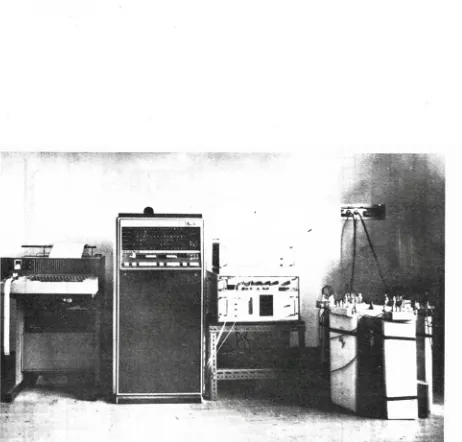
A g e n e r a l view of the passive neutron a s s a y equipment, which was used for m e a s u r e m e n t s with 30 1 waste d r u m s is shown in Fig. 1 and a block d i a g r a m of the s a m e is given in Fig. 2.
The various components and units of the instrumentation will be d e s c r i b e d h e r e a f t e r .
1. 1 Neutron Detector A s s e m b l y for Waste D r u m s
The neutron detector is built up of six modular units. These units a r e held together by two f r a m e s in such a way that they form a hexa-gonal well counter, in which a waste d r u m of m a x i m u m 34 cm dia-m e t e r and 43 cdia-m height can be placed. Top cover and bottodia-m of the well a r e made of polyethylene plates of 6. 2 cm t h i c k n e s s . Photographs of the a s s e m b l y a r e shown in Fig. 3.
3
of t h e c o u n t e r w e l l for f i s s i o n n e u t r o n s a r e shown in F i g . 4. In F i g . 5 the c o u n t e r r e s p o n s e f u n c t i o n s f (R) and f ( H / 2 ) , r e s p e c t i v e l y a v e r a g e d o v e r r a d i u s R, and h e i g h t Η of c y l i n d e r s a r e p l o t t e d .
T h e s e c u r v e s s e r v e for the e v a l u a t i o n of the m e a n c o u n t i n g effi c i e n c y of c y l i n d r i c a l d r u m s of v a r i o u s s i z e s .
The effect of m o d e r a t i n g m a t r i x m a t e r i a l on the s p a t i a l r e s p o n s e of the c o u n t e r a s s e m b l y is d e m o n s t r a t e d in F i g . 6 for d r u m s of v a r i o u s d i a m e t e r s and 38 c m h e i g h t , filled w i t h p o l y e t h y l e n e g r a i n s of 0. 6 g / c m d e n s i t y . T h e s e c u r v e s a l l o w for the e s t i m a t i o n of the effect of a s t r o n g l y m o d e r a t i n g m a t r i x on the c o u n t i n g e f f i c i e n c y . H e a v y m a t r i x m a t e r i a l h a s a m u c h s m a l l e r i n f l u e n c e on t h e c o u n t e r r e s p o n s e . F o r e x a m p l e , a f i s s i o n n e u t r o n s o u r c e (Cf-252) h a s b e e n put in the c e n t r e of a l e a d c y l i n d e r of 1 5 c m d i a m e t e r and 17 c m h e i g h t (ca. 30 kg) and t h i s g a v e a r e l a t i v e i n c r e a s e in t h e c o u n t i n g e f f i c i e n c y of about 8%.
T h e s p e c t r a l r e s p o n s e function n o r m a l i z e d to the C f - 2 5 2 f i s s i o n n e u t r o n e n e r g y is g i v e n in F i g . 7. A n e u t r o n d e c a y c u r v e i s shown in F i g . 8 f r o m w h i c h the n e u t r o n d i e - a w a y t i m e of the d e t e c t o r a s s e m b l y h a s b e e n d e t e r m i n e d a s (30. 0 + 0. 3 ) / u s . T h e r e is no m e a s u r a b l e i n f l u e n c e of m a t r i x m a t e r i a l on the d i e - a w a y t i m e . F i n a l l y , in F i g . 9 the a b s o l u t e f i s s i o n n e u t r o n c o u n t i n g e f f i c i e n c y ε ( 0 ) i n
t h e c e n t r e of the w e l l is p l o t t e d a s a function of d i s c r i m i n a t o r s e t t i n g s of t h e V D C - u n i t u s i n g 1830 V d e t e c t o r b i a s v o l t a g e .
1. 2 V a r i a b l e D e a d - T i m e C o u n t e r (VDC)
9
-chains for six neutron detector units, a pulse mixing circuit and one fast and four slow pulse counters with nominal d e a d - t i m e s τ . = 16/us, 32/us, 64 us and 128 u s . The d e a d - t i m e l o s s e s of the different pulse counters a r e analyzed in t e r m s of count r a t e s of neutrons from spontaneous fissioning nuclides, in this case e s s e n tially of P u - 2 4 0 . The relationship between the fission neutron count rate and the m e a s u r e d count r a t e s C^ can be established by a simple consideration of the various components of the count r a t e s and their balance.
Let us call
40 a be
C the count rate of the fast pulse counter and C and C and C o o o o
respectively the spontaneous fission neutron, (a, n) and background count r a t e s of which C is composed, we have:
c =
c
4 0+ c
a+
c
b go o o o
With analogous definitions we write the equations for the count r a t e s
C. of the pulse counters with the d e a d - t i m eι ι X. a s :
c. =
c
4 0+
c
a+ c
b g40
In o r d e r to d e t e r m i n e C from C and C „ we consider the
fol-° fol-° 4 0 X
lowing balance of count r a t e s . F r o m C counts p e r unit time a part 40 ° (C. ) will t r i g g e r the counter (i) with dead time %.. Because the
fission neutrons a r e emitted in groups (at the a v e r a g e 2. 2 p e r event), 40 40
t h e r e will be a fraction F . of C. c o r r e l a t e d with the t r i g g e r pulses
40 * X
C. which we call the "true coincidence count r a t e " . ι
40
Moreover, t h e r e will be a loss of C.T.C counts due to the
dead-1 i o
t i m e τ . of the counter (i), which we call "accidental coincidence
h o
count r a t e " . Analogous relationships a r e obtained for C , C and b b o o C , C. respectively, but F . and F . a r e z e r o , unless neutron m u l
-1 1 1 1
we have;
40 . 4 0 , , „ 4 0 . „ 4 0 . .
C = C . ( 1 + F . ) + C.T.C ( 1 . a)
ο ι i l i o
c« = c «
O 1
c
b g=
c
b go 1
+ C . T . Ca
1 1 o
+ C . T . Cb g
1 1 o
( l . b )
( l . c )
40 40
C = C. + C F + C.T.C (2)
O 1 1 1 1 1 o
F r o m eq. ( l . a ) and (2) we obtain
. / C \ 1 + F4 0
i l F .
i
C4 0 = K.X. (3. a)
O l i
with
1+F4 0
K
i.-¿Γ
(4)
F .
1
c
X
i
mCo-T^-.-
Co'
Γ
<
5>
i i τ . 7Γ
i C .
1
K. can be d e t e r m i n e d by a c a l i b r a t i o n m e a s u r e m e n t with a s m a l l
1 40
Pu— 240 s a m p l e (metallic plutonium) w h e r e C and X. can be m e a
o ι
s u r e d d i r e c t l y . It can a l s o be c a l c u l a t e d from n u c l e a r p a r a m e t e r s
(fission n e u t r o n e m i s s i o n multiplicity) and i n s t r u m e n t a l p a r a m e t e r s
(counting efficiency and d i e a w a y time) a s shown in ref. (6). T h e
effective d e a d t i m e τ . i s equal to the n o m i n a l d e a d t i m e ( τ . ) m i n u s
1 1o
the d i s c r i m i n a t o r p a r a l y s i s t i m e θ , a v e r a g e d o v e r the six counting c h a i n s . The a v e r a g e d θ i s obtained from the eq. (6).
A
CO T , C
(6) l C , θ , 1C θ
ok k o
11
θ t h e p a r a l y s i s t i m e of c h a i n k, a n d
k 6
C
'•■I
n = } C t h e t o t a l p u l s e r a t e . T h u s θ b e c o m e s :6 c^
°k
Στ
Ck=l *
c° k \
°
k j ^ _ — k k ( 7 )
c
: > -°
k°4-\
k = l ^ 'i-(
CO k ° kC
F o r s y m m e t r i c d i s t r i b u t i o n of t h e p u l s e r a t e , i. e. C = ~7~ a n d
■&, = C o n s t Ξ ·& , w e o b t a i n ■& = 1 / 6 A .
k o o
θ d e p e n d s on t h e p u l s e s h a p e a n d t h e d i s c r i m i n a t i o n l e v e l , a s s h o w n Jtc
i n F i g . 1 1 . In F i g . 12 a r e p l o t t e d t h e e f f e c t i v e τ . - v a l u e s a p p l i c a b l e C x
f o r s y m m e t r i c d i s t r i b u t i o n of t h e p u l s e s (C = —r~, θ , = c o n s t = ■& )
o o k o
a s a f u n c t i o n of t h e d i s c r i m i n a t o r s e t t i n g s . T h e s e v a l u e s a r e d e r i v e d
f r o m m e a s u r e m e n t s w i t h a p u r e ( a , n) s o u r c e . E q . (5) g i v e s for t h i s
c a s e
i o
F o r a s y m m e t r i c d i s t r i b u t i o n s of t h e p u l s e s , f o r m u l a (7) c a n b e
u s e d f o r c o r r e c t i o n s .
τ ^ = Ti + Δθ
Δ θ = (J θ - θ )
6 ο
40
U n f o r t u n a t e l y , F . a n d t h e r e f o r e Κ., d e p e n d on t h e c o u n t r a t e C.
ι ι ι
i t s e l f . T h i s i s d u e t o t h e f a c t t h a t t h e h i g h e r t h e c o u n t r a t e , t h e m o r e
p r o b a b l e i s t h e c a s e t h a t a s p o n t a n e o u s f i s s i o n e v e n t o c c u r s d u r i n g
t h e c l o s u r e of t h e c o u n t e r (i). T h e n a f r a c t i o n of t h e e m i t t e d n e u t r o n
40
surviving fraction and accordingly F . becomes s m a l l e r . This effect is taken into account by a linear c o r r e c t i o n t e r m given be low
K.(C.) = K. (1 + b.C.) (9)
1 1 ί ο 1 1
It is m o r e convenient to include this c o r r e c t i o n t e r m into the X. ι
X. = X.(l + b.C.) (10)
ί ο 1 1 1
and to write
40
C = Κ . Χ . 11)
O IO IO
where Κ. is now a constant.
i o
The dependence of b. on the neutron die-away time 1 of the d e t e c tor is shown in Fig. 13. These c u r v e s have been obtained from Monte Carlo simulation of the VDC by m e a n s of the computerized s y s t e m for time c o r r e l a t i o n a n a l y s i s , which is d e s c r i b e d in the following s e c tion.
The e x p e r i m e n t a l determination of the b.-values is explained in section 2. 2 in connection with the calibration of the i n s t r u m e n t .
1. 3 "Computerized S y s t e m " for Time C o r r e l a t i o n Analysis of F i s s i o n Neutrons
13
T h e " s i m u l a t i o n " is p e r f o r m e d by the M o n t e C a r l o - m e t h o d . Input d a t a a r e :
i) s o u r c e p a r a m e t e r s : a m o u n t , h a l f - l i f e , p r o b a b i l i t y d i s t r i b u t i o n function of n e u t r o n e m i s s i o n m u l t i p l i c i t y (p - d i s t r i b u t i o n ) of s p o n t a n e o u s n e u t r o n e m i t t e r s ( s p o n t a n e o u s f i s s i o n o r ( a , n ) - r e a c t i o n s ) ,
ii) m u l t i p l i c a t i o n p a r a m e t e r s : p r o b a b i l i t i e s for i n d u c e d f i s s i o n r e a c t i o n s in f i s s i l e i s o t o p e s of the s a m p l e and the r e s p e c t i v e n e u t r o n e m i s s i o n m u l t i p l i c i t i e s for the v a r i o u s s o u r c e s ,
iii) n e u t r o n d e t e c t o r p a r a m e t e r s : d e t e c t i o n p r o b a b i l i t i e s and d i e -a w -a y t i m e of n e u t r o n s f r o m the v -a r i o u s s o u r c e s .
Output d a t a a r e :
i) T i m e d i s t r i b u t i o n of n e u t r o n d e t e c t i o n p u l s e s ,
ii) T i m e c o r r e l a t i o n a n a l y s i s a s Ros si-<A - m e t h o d , V D C - m e t h o d and o t h e r w e l l known p u l s e c o r r e l a t i o n m e t h o d s .
A s c h e m a t i c flow d i a g r a m is s h o w n in F i g . 14. In the c a s e of a " m e a s u r e m e n t " , the t i m e d i s t r i b u t i o n of n e u t r o n d e t e c t i o n p u l s e s i s p r o d u c e d by a c o n v e r t e r , w h i c h c o n v e r t s the d e t e c t o r p u l s e s in t h e i r
r e a l a r r i v a l t i m e . 8 I n p u t s for d e t e c t o r p u l s e s a r e p r o v i d e d and e a c h of t h e m i s l a b e l l e d ( 1 , 2 , . . . , 8). T h e d a t a ( t i m e ) a r e s t o r e d f i r s t l y in a n 8 - s t a g e buffer m e m o r y f r o m w h i c h t h e y a r e t r a n s f e r r e d into t h e 8 K - m e m o r y of the m i n i - c o m p u t e r ( L A B E N 70). The buffer m e m o r y a c t s a s a " d e - r a n d o m i z e r " of the t i m e - d i s t r i b u t i o n of p u l s e s a n d a l l o w s for r e d u c t i o n of s i g n a l l o s s e s d u r i n g the t r a n s f e r c y c l e s into the c o m p u t e r m e m o r y . A b l o c k d i a g r a m of t h i s i n s t r u m e n t a t i o n i s g i v e n in F i g . 1 5 .
of n e u t r o n d e t e c t i o n p u l s e s . T h i s is done by s u m m i n g up a l l p u l s e s within a t i m e i n t e r v a l , At, w h i c h follows e a c h i n d i v i d u a l d e t e c t o r
p u l s e and s u b t r a c t i o n of the u n c o r r e l a t e d c o u n t s w i t h i n Δ t, w h i c h a r e c o m p u t e d f r o m the t o t a l count r a t e C a s C At. In the p i c t u r e
r o o
of a c o i n c i d e n c e c o u n t e r , and t h i s is a l s o t r u e for the VDC, t h i s would m e a n t h a t any d e t e c t o r p u l s e m a y open a c o i n c i d e n c e g a t e o r c l o s e a l l p u l s e c o u n t e r s (i) r e s p e c t i v e l y . In t h i s w a y t h e r e would be no n e e d for c o r r e c t i o n e i t h e r for t r u e c o i n c i d e n c e l o s s e s , d u r i n g the t i m e the c o i n c i d e n c e g a t e w a s o p e n e d o r the input of p u l s e c o u n t e r w a s c l o s e d r e s p e c t i v e l y , o r for the v a r i a t i o n of the F . ( c o r r e l a t e d c o u n t s p e r p u l s e due to f i s s i o n n e u t r o n s ) with count r a t e C. ( l i n e a r c o r r e c t i o n f a c t o r b . ) . T h i s f e a t u r e of the R o s s i - c c t e c h n i q u e is t h e r e f o r e a p o s s i b i l i t y for t e s t i n g the c o r r e c t i o n f o r m u l a of the VDC m e t h o d . T h e s e c o n d w e a k p o i n t of the VDC is the v a r i a t i o n of the d e a d t i m e s ( τ . ) due to u n s y m m e t r i c r e p a r t i t i o n of the d e t e c t o r p u l s e s a m o n g the 6 p u l s e c o u n t i n g c h a i n s . A l s o t h i s u n c e r t a i n t y is e l i m i n a t e d in the R o s s i - α a n a l y s i s , j u s t by i n t r o d u c i n g a b l a n k of 4 / u s e c at the b e g i n n i n g of the t i m e i n t e r v a l At to be a n a l y z e d .
2. M E A S U R E M E N T S WITH S T A N D A R D S A M P L E S IN 30 L. DRUMS
T h e m e a s u r e m e n t s w i t h known ( P u O j s a m p l e s s e r v e d for t h e d e t e r m i n a t i o n s of
40
i) F = a v e r a g e n u m b e r of n e u t r o n d e t e c t o r p u l s e s c o r r e l a t e d with
oo
the f i r s t n e u t r o n d e t e c t o r p u l s e f r o m a P u - 2 4 0 s p o n t a n e o u s f i s s i o n e v e n t ( i n t e g r a l a u t o c o r r e l a t i o n ) .
ii) b . Ξ l i n e a r c o r r e c t i o n f a c t o r s ,
iii) c a l i b r a t i o n c u r v e s for the VDC i n s t r u m e n t a n d t h e c o m p u t e r i z e d s y s t e m .
T h e s t a n d a r d s a m p l e s c o v e r e d the r a n g e of P u - 2 4 0 e q u i v a l e n t 40
m a s s (m ) b e t w e e n 0. 09 g and 54 g.
40 e q
15
„ k , . 4 0 . k .„ Αητ—\ F . 1+F. k n
40 4 0 \ i ι m o ,_>
m = m ) —TT.. :— —— —— (12) eq / „40 , , „ k 40 40 K '
H V'F. 1+F. m n
k ι ι o
(k includes 40)
upper index 40, k stays for Pu240 ór isotope named "k" r e s p e c tively.
40 k
m ' = mass of spontaneous fission isotope Pu240 or "k" respec tively.
numb e tively. 40 k
n ' = number of neutrons emitted per g of Pu240 or "k" r e s p e c
40 k
F. ' = correlated counts per trigger of counter with deadtime τ . by a Pu240 neutron or "k" neutron respectively.
k 40
If F . ~ F . that means: all isotopes have nearly the same fission
1 1
neutron multiplicities, we can simplify eq. (12) as k
40 40 \ " mk no
^ e q = m
Σ
' ~^^~¿ (12.a)k n m o_
40 40 m n
k o
This condition is nearly fulfilled for all isotopes of our interest, i . e . Pu238, Pu242 and U238.
The Pustandard samples were put into normal 30 1 drums and mixed up with typical matrix m a t e r i a l s , like gloves, cleaning papers, etc.
40 2. 1 Determination of F
oo 40
F ^ is defined by the equations (13) and (14)
-
τ / ι
„40 „40 , i/ x . „40 ,. _ .
F . = F w . ( l e ) = F . α . (ι = 1,2, 3, 4) w. ^ 1
1 CO 1 CO ι ι
(13)
40
the s a m e fission event. F o r the d e s c r i b e d equipment w. i s v e r y
c l o s e to 1;
. _
F
4° a . +1
F
4V +1
C = Χ Γη ì = Xk °°¿n ( k ^ i ) <14>
io F4 0 a k0 F4 O a <χ> ι co k
from which we obtain
Xk X. 1 7 ^ "
ο ίο Α.,
i k
*t°=nt^t- = t— ^
io k0 k i kX- oc ·
IO 1
with y., = —— and A = —
' i k Xk ik ak
The y., a r e the ratios of d e a d - t i m e c o r r e c t e d t r u e coincidence í k
count r a t e s Χ. / Χ , , a c c o r d i n g t o eq. (10). io ko
The a . (or A.., ) can be c a l c u l a t e d from the known τ . and 1 o r
l k λ 40
they can be d e t e r m i n e d d i r e c t l y from m e a s u r e m e n t s of the F . with
a s m a l l P u m e t a l s a m p l e (low count r a t e , no ( a , n) r e a c t i o n s ) from
the following r e l a t i o n s h i p s , d e r i v e d from eq. (3):
4 0
c
4 0< i - c
4V )
1
40 i
α· F
(iv)
F4 0
for τ , / 1 >> 1 we have cc « 1, F « F and α. 3 —— ·
Κ. Κ. iC 1 .„^r U
F
co
40
The p a r a m e t e r F itself i s defined by the following f o r m u l a :
Ν
Σ ν
2C-Mñf-^
40
-!
d«)
Z
v P
v
17
w h e r e ρ is the p r o b a b i l i t y of emitting V n e u t r o n s in a fission r T-, 4 0
event of P u
40
In p r i n c i p l e the m e a s u r e m e n t of F allows the m a t r i x effect,
CO '
i. e. the influence of the m a t r i x m a t e r i a l on the detection efficien 40
cy ε > to which F is d i r e c t l y p r o p o r t i o n a l , to be e s t i m a t e d . 40 °°
However, the F d e t e r m i n e d by the y., and Α., m e a s u r e m e n t s ac·
oo ' ' í k í k
cording to f o r m u l a (15) is v e r y s e n s i t i v e to the u n c e r t a i n t i e s of
those q u a n t i t i e s ôy., , δ Α r e s p e c t i v e l y .
^ L c V i K »
i k<<>»*>
The b e h a v i o u r of this function in the r a n g e 1 ^ ε ^ 0 . 03 is shown
in F i g . 1 6.
G e n e r a l l y , the Α.Ί can be d e t e r m i n e d to about δΑ., = + 0. 01.
i k í k —
The u n c e r t a i n t y of the y m a y a l s o be about ôy., = + 0. 01 for not
too high count r a t e s (C ). Under such conditions the r e l a t i v e u n c e r 40°
tainty of the a c t u a l F = 0. 066 (for ε = 0. 062) a m o u n t s to about
O F4 0
F
CO
40
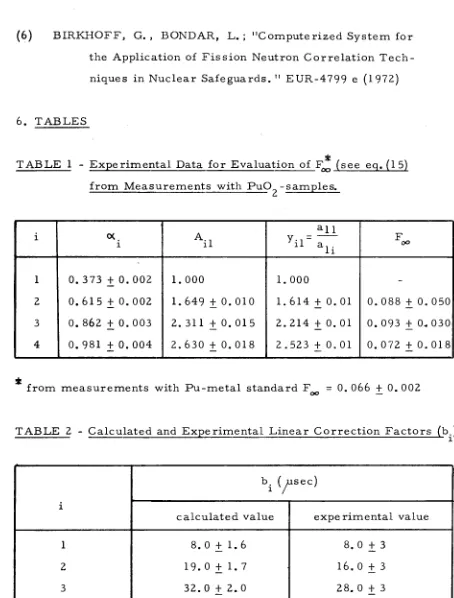
The p r e c i s i o n of the F ^ m e a s u r e m e n t can be i m p r o v e d signifi cantly, by r a i s i n g the d e t e c t o r efficiency ε. In Table I the m e a s u r e d
40
CL ., A. , y. and F v a l u e s a r e s u m m a r i z e d .
2. 2 D e t e r m i n a t i o n of the L i n e a r C o r r e c t i o n F a c t o r s b.
: 1
The l i n e a r c o r r e c t i o n factor b . t a k e s into account the v a r i a t i o n of
40 1
(y )
V yi kyC . 1 + b . C .
( 2 0 ) (y ) " 1+b. C,
i k ' o k k
V c
b
i = c-l(rT-
<1+bk
ck
)-
1J
<
2 1»
ι ^ ík ·*
o
X.
w h e r e (y ) „ m e a n s rr— f o r C .
il·- C . A ι
í k i k
X.
a n d (y ) m e a n s rr e x t r a p o l a t e d f o r C . = 0. ( s e e F i g . 17)
ik o Χ ι
k
F o r k s l , w e h a v e b, C, < b . C . << 1 a n d b, d o e s not n e e d t o be
k k i i k
k n o w n v e r y e x a c t l y , for t h e d e t e r m i n a t i o n of t h e b . (i = 2, 3, 4 ) . In f a c t b w a s d e t e r m i n e d d i r e c t l y f r o m X m e a s u r e m e n t s w i t h a
1c κ
s m a l l P u m e t a l s a m p l e a s a f u n c t i o n of t h e c o u n t r a t e C, , w h i c h k
w a s v a r i e d by a d d i n g ( a , n) s o u r c e n e u t r o n s . T h e s e e x p e r i m e n t a l r e s u l t s a g r e e d v e r y w e l l w i t h a M o n t e C a r l o c a l c u l a t i o n by m e a n s of t h e c o m p u t e r i z e d s y s t e m .
T h e e x p e r i m e n t a l b . v a l u e s a r e d e r i v e d f r o m t h e p l o t s X . / X a s f u n c t i o n s of C. of F i g . 1 7 .
A s u m m a r y of t h e e x p e r i m e n t a l a n d M o n t e C a r l o r e s u l t s i s g i v e n in T a b l e 2.
2. 3 C a l i b r a t i o n C u r v e s
C a l i b r a t i o n c u r v e s for V D C a n d R o s s i t e c h n i q u e s a r e g i v e n i n F i g . 1 8.
L e a s t s q u a r e s f i t s to p o l y n o m i a l s s h o w e d t h a t t h e b e s t f i t t i n g func t i o n s a r e of t h e t y p e
4 0 2
m = a . + a , . X . + a_..X. for VDC t e c h n i q u e a n d e q oi l i ι ¿ ι ι
40 2
19
-All curves from VDC-techniques a r e essentially of the s a m e shape. This is m o r e directly d e m o n s t r a t e d by the best-fitting p a r a m e t e r s , for which the following equations m u s t hold:
a . = a . (22)
01 ok x '
a
'2k 2 i \ , a1. li
Equivalence between VDC and R o s s i - α -techniques is checked by analogous conditions:
a . = a
οι οα
2 ( 2 3 )
a_ = a . A
2a 2 lVai·
2. 3. 1 N e u t r o n Multiplication Effects
Neutron m u l t i p l i c a t i o n by induced fission p r o c e s s e s , in P u 2 3 9
and P u 2 4 1 m a i n l y , changes the n e u t r o n e m i s s i o n m u l t i p l i c i t y . Both
the spontaneous fission and the ( a . n ) n e u t r o n s a r e contributing to
this effect. An exact t r e a t m e n t of this p r o b l e m is v e r y difficult and
it is u n r e s o l v a b l e for unknown s a m p l e s . N e v e r t h e l e s s , a working
hypothesis for e s t i m a t i n g the magnitude of t h i s effect can be e s t a
b l i s h e d . In the c a s e of PuO_ s t a n d a r d s a m p l e s , the r a t i o of s p o n t a
neous fission to ( OC, n) n e u t r o n e m i s s i o n and t h e r e f o r e X . / C Ξ r. is is os ι n e a r l y c o n s t a n t . The production of induced fission n e u t r o n s ,
Ps = ($. v2 f. V )s
should be p r o p o r t i o n a l to the s q u a r e of the P u m a s s , b e c a u s e both
the m e a n n e u t r o n flux φ and the m e a n induced fission c r o s s section
2 fV a r e p r o p o r t i o n a l to the P u m a s s (V m e a n s the volume of the s a m p l e ) .
In the c a s e of P u w a s t e , the a s s u m p t i o n about the constant s p o n t a
neous fission to (α, n) n e u t r o n e m i s s i o n r a t i o cannot be m a i n t a i n e d ,
but we m a y account for this by a c o r r e c t i o n factor on the n e u t r o n flux.
If we a s s u m e that the n e u t r o n flux φ is p r o p o r t i o n a l to the count r a t e
C , this flux c o r r e c t i o n factor is equal to the r a t i o of the count r a t e
C of the unknown s a m p l e to the count r a t e C of the s t a n d a r d s a m p l e .
o r os r
The p r o d u c t i o n of induced fission n e u t r o n s in the unknown s a m p l e can
be w r i t t e n t h e r e f o r e a s
C ? C C
P = P .
7^ - k m
¿ 7r - = k m S . ^
(24)
S C C 1 Λ..
OS OS 1
If we f u r t h e r a s s u m e that the c o i n c i d e n c e count r a t e , Δ X., due to ι
induced fission e v e n t s , is p r o p o r t i o n a l to P , we obtain
ΔΧ. =ΔΧ. -p.— * p . , . · m —— = P>.m r. rr— (25)
ι is C 2i C 2ι ι X.
- 21
2
w h e r e ΔΧ. = Ρ,.m i s t h e c o i n c i d e n c e c o u n t r a t e d u e to i n d u c e d i s 2i
f i s s i o n s in t h e s t a n d a r d s a m p l e .
T h e r e l a t i o n s h i p b e t w e e n ρ a n d t h e b e s t f i t t i n g p a r a m e t e r s of t h e c a l i b r a t i o n c u r v e s a , , a n d a_.. i s o b t a i n e d f r o m t h e e q u a t i o n s
li ¿ι ^
(a . ~ 0, ρ . ~ 0 n e g l e c t e d ) v o i ~ * o i ~ B '
2
m = a . . X . + a . X . (26)
l i ι ¿ι ι 2
X. = p , . m + p _ . m (27)
i l i ¿ ι
o r
1 " 2
Pl i
p2 i (28)
4 p2 i 2 1
F o r r ^ X . = 4 p _ . . a . . X . « 1 ( p . . = ) 2 ι r2 i li ι v j rli a , .
Pl i h
t h e r o o t e x p r e s s i o n of e q u a t i o n (28) c a n be e x p a n d e d in a T a y l o r s e r i e s i g n o r i n g t h e t h i r d o r d e r t e r m . C o m p a r i s o n of c o e f f i c i e n t s g i v e s
a 2i P 2 i K T
ai i
In a l l a s s u m p t i o n s m e n t i o n e d a b o v e , t h e c o r r e c t i o n f o r t h e n e u t r o n m u l t i p l i c a t i o n e f f e c t of u n k n o w n s a m p l e s , i. e . t h e d i f f e r e n c e r e l a t i v e t o s t a n d a r d s a m p l e s i s e q u a l t o
C C
Am4° = a x f ( l - - £ - ) = a X?(l-r.==S) (29) e q ¿ i i C ¿ i i ìX.
o s i
40 T h e v a r i o u s p a r a m e t e r s for t h e c a l c u l a t i o n of AX. a n d Δ m a r e
i e q
s u m m a r i z e d in T a b l e 3.
a n d on t h e d i s t r i b u t i o n of t h e f i s s i l e m a t e r i a l w i t h i n t h e m a t r i x . F r o m c a s e to c a s e t h e r e m i g h t be a v a r i a t i o n of m u l t i p l i c a t i o n effect by o r d e r of m a g n i t u d e .
2. 3 . 2 M a t r i x E f f e c t s
T h e i n f l u e n c e of a p o l y e t h y l e n e m a t r i x w h i c h i s o n e of t h e s t r o n g e s t m o d e r a t i n g m e d i a , on t h e c o u n t i n g e f f i c i e n c y of t h e d e t e c t o r a s s e m b l y , i s s h o w n in F i g . 6, e s p e c i a l l y by t h e c u r v e ε (R)/e (0) f. (R).
F r o m t h i s c u r v e one c a n e s t i m a t e t h e m a x i m u m p o s s i b l e v a r i a t i o n of t h e c o u n t i n g e f f i c i e n c y for a g i v e n n e t w e i g h t of t h e w a s t e d r u m , j u s t a s s u m i n g t h a t a l l t h e m a t r i x m a t e r i a l in t h e w a s t e i s c o m p o s e d of h i g h l y m o d e r a t i n g m a t e r i a l s . If a v a r i a t i o n of t h e c o u n t i n g e f f i c i e n c y w i t h i n + 10% ( c o r r e s p o n d i n g t o + 20% v a r i a t i o n of t h e c a l i b r a t i o n c u r v e s ) i s c o n s i d e r e d a s t o l e r a b l e , t h e n e t w e i g h t of t h e w a s t e d r u m s h o u l d not e x c e e d 3 k g . On t h e o t h e r h a n d , w e a k l y m o d e r a t i n g m a t r i x d o e s not p e r t u r b s o m u c h t h e c o u n t i n g e f f i c i e n c y . A m u l t i p l e of t h e 3 kg l i m i t c a n be a l l o w e d f o r h i g h Ζ m a t e r i a l s a s m a t r i x , l i k e F e , Cu, P b , e t c . w i t h o u t e x c e e d i n g t h e + 10% l i m i t f o r t h e v a r i a t i o n of t h e c o u n t i n g e f f i c i e n c y . T h e r e f o r e , it i s h i g h l y d e s i r a b l e to m e a s u r e t h e c o u n t i n g e f f i c i e n c y d i r e c t l y . A p o s s i b i l i t y of s u c h a m e a s u r e m e n t i s e x p l a i n e d in t h e s e c t i o n 2. 1. O w i n g t o t h e d e p e n d e n c e of t h e p r e c i s i o n of t h i s m e t h o d on t h e c o u n t i n g e f f i c i e n c y i t s e l f , a s
s h o w n in F i g . 16, t h i s m e t h o d i s r e s t r i c t e d t o h i g h e f f i c i e n c y d e t e c t o r s . M o r e o v e r , o w i n g t o t h e i n c r e a s e of s y s t e m a t i c e r r o r s of t h e c o i n c i d e n c e c o u n t r a t i o s ( X . / X , ) w i t h c o u n t r a t e C , t h i s m e t h o d i s
■i k ο ,
a l s o l i m i t e d t o low c o u n t r a t e s of a b o u t s m a l l e r t h a n 5. 1 0 c p s . T h e s e l i m i t a t i o n s of t h e m e t h o d a r e a n y h o w a d a p t e d to t h e p r o b l e m , b e c a u s e w a s t e m a t e r i a l s c o n t a i n g e n e r a l l y s m a l l a m o u n t s of P u .
3. M E A S U R E M E N T S WITH UNKNOWN Q U A N T I T I E S O F P u IN 30 1 W A S T E D R U M S
23
d r u m s have been performed during a period of about 3 months. No calibrations of the i n s t r u m e n t s were done during this period. As far as the VDC instrument is concerned, no breakdown has been observed. On the other hand, an electronic defect of the "fast data acquisition unit" ( d e - r a n d o m i z e r ) was discovered after 1 month operating t i m e . This defect caused systematic e r r o r s in the a n a lysis and it was detected because of d i s c r e p a n c i e s between the VDC and R o s s i - a ( c o m p u t e r ) r e s u l t s . F o r this r e a s o n the " d e - r a n d o m i z e r " had to be r e p a i r e d and the 18 most interesting waste d r u m s were r e -m e a s u r e d . These -m e a s u r e -m e n t s finally s e r v e for c o -m p a r i s o n b e tween the Ros s i - α method (reference method) and the VDC method. It is c l e a r that this c o m p a r i s o n gives a d i r e c t answer about the v a lidity of the VDC analysis method.
3. 1 Results
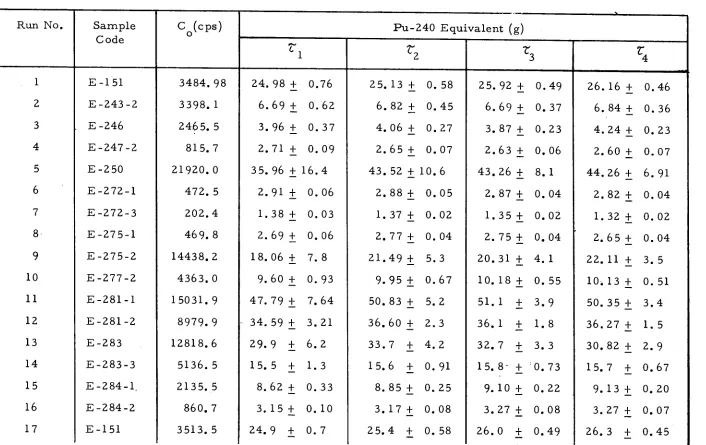
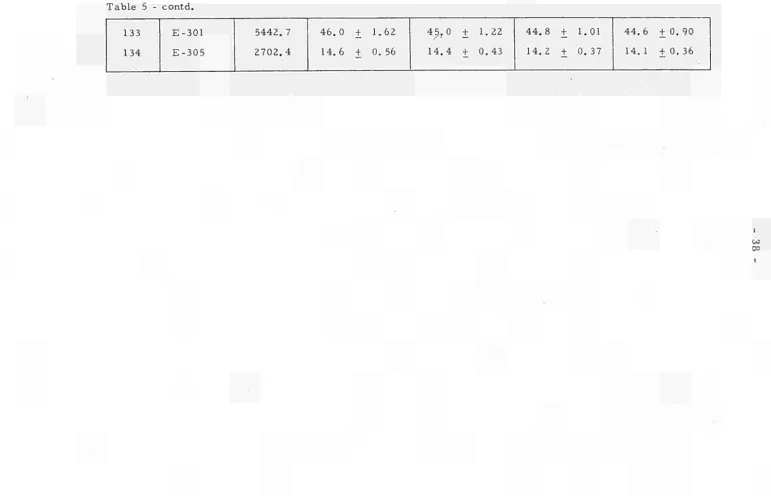
The r e s u l t s of the analysis of all 134 m e a s u r e m e n t s a r e s u m m a rized in Tables 4 and 5.
In Table 4 the r e s u l t s of 1 8 m e a s u r e m e n t s for c o m p a r i s o n between VDC and R o s s i - α analysis a r e given. Table 5 r e p r e s e n t s the VDC r e s u l t s for all m e a s u r e m e n t s which have been m a d e . The data a r e p r e s e n t e d in the s a m e sequence as they have been m e a s u r e d over a 3 months ' period. Some of the waste d r u m s have been m e a s u r e d s e v e r a l t i m e s , for example d r u m code E 281-2 has been m e a s u r e d 4 t i m e s during 3 months and no drift of the r e s u l t s is observed. The quoted e r r o r limits a r e the sum of t h r e e s o u r c e s of e r r o r :
i) counting s t a t i s t i c s Δ,Χ.
ii) uncertainty and variation of the effective counter dead t i m e s Δ?Χ.
iii) uncertainty of the linear c o r r e c t i o n factor b..
A,X. is calculated from the standard e r r o r of the count rate C ,
l i o
which is equal to Λ/C and from the s t a t i s t i c a l e r r o r of the dead o
e r r o r s we obtain:
rl + C . b . / A / C - Λ / C - C .
Α Λ = ± Γ - ^
l i Α( «/ε--
°
°
iii
(30)
1 1 / 17^ o 0 1
~ V ^ o "
1C.T.
w h e r e t m e a n s the t o t a l counting t i m e ,
A?X. and Δ,Χ. a r e obtained from e r r o r p r o p a g a t i o n of Δτ. and Ab.
« 1 -5 1 i l
r e s p e c t i v e l y .
Δ
Λ
= +
-(Α)(
ι + Ε
Λ>Η
(31)
Δ _ Χ . = + ±u X . A b . (32)
3 1 — 1 + C . b . 1 1
1 1
û X ^ K U ^ i 1+ Ι Δ ^ Ι +
| Δ
3Χ
ί| ) (33)
F r o m AX. we calculate the uncertainty of the Pu eq. m a s s as
A m = + (a AX- + 2a Χ ΔΧ.) (34)
1 1 1 ¿ - - 1 1 1
•where a,, and a_. a r e the p a r a m e t e r s of a b e s t fitting p a r a b o l a to
li Zi
the c a l i b r a t i o n c u r v e s .
No c o r r e c t i o n s have been applied for n e u t r o n m u l t i p l i c a t i o n and
m a t r i x e f f e c t s . The m e t h o d s for e s t i m a t i n g t h e s e effects, (as e x
plained in s e c t i o n s 2. 3. 1 and 2. 3. 2) a r e not sufficiently a c c u r a t e .
3. 2 D i s c u s s i o n of the R e s u l t s
The i m p o r t a n t q u e s t i o n c o n c e r n i n g the validity of the VDC c o n
cept for t i m e c o r r e l a t i o n a n a l y s i s h a s been r i g o r o u s l y t e s t e d by the
c o m p a r i s o n with a s t a n d a r d m e t h o d , the Ros s i α t e c h n i q u e . The
t i m e c o r r e l a t i o n a n a l y s i s of the w a s t e m e a s u r e m e n t s a l s o is an e x
t r e m e l y h a r d t e s t i n g in so far a s the n e u t r o n e m i s s i o n r a t e of s o m e
of the w a s t e d r u m s is v e r y high and in addition the r a t i o of c o r r e l a
ted to u n c o r r e l a t e d counts is v e r y low. F o r i n s t a n c e the w a s t e d r u m 4
25
to u n c o r r e l a t e d counts was about 80% s m a l l e r as compared to the P u O? standard s a m p l e s .
The r e s u l t s of the c o m p a r i s o n between the VDC and R o s s i - α analy s i s , as given in Table 3, show that both methods a r e fully equiva lent, because t h e r e is a complete a g r e e m e n t of all r e s u l t s within the e r r o r l i m i t s . Generally, the e r r o r limits of the VDC analysis a r e d e c r e a s i n g with increasing d e a d - t i m e T.. T h e r e is also a c e r tain s y s t e m a t i c "drifting" of the values for the Pu equivalent m a s s which is growing up with τ . . This effect is due to the systematic variation of the effective d e a d - t i m e τ . , for u n s y m m e t r i c r e p a r t i tion of the count rate C among the six pulses counting chains, as explained in section 1.2. This variation Δθ is always negative and tends to u n d e r e s t i m a t e the coincidence count rate X. by
ι AX. = - C.C Δ θ .
1 I O
This e r r o r is generally increasing with the count r a t e C and r e l a tively d e c r e a s i n g with increasing τ .
The second important point is the reproducibility of the r e s u l t s and also this point has been checked rigorously for the VDC. The r e s u l t s of VDC m e a s u r e m e n t s in Table 4 d e m o n s t r a t e that t h e r e is full a g r e e m e n t within the quoted e r r o r limits for all m e a s u r e m e n t s during a 3 months ' operation without recalibration of the i n s t r u m e n t s without rejecting any data of m e a s u r e m e n t s which were routinely made and p r o c e s s e d .
c u r v e s . In the plot of the variation of the detector r e s p o n s e as a function of quantity of polyethylene as m a t r i x m a t e r i a l in Fig. 6 we see an oscillation of this function from positive to z e r o and fi nally to negative p e r t u r b a t i o n s , with increasing amount of m a t r i x m a t e r i a l . This behaviour is a c h a r a c t e r i s t i c of the detection a s sembly. It is quite reasonable to set the tolerance level of the m a t r i x effect equal to the m a x i m u m positive perturbation, which is about 10%o and to set the m a x i m u m net weight limit at the negative perturbation of -10%>, which is equal to about 3 kg. The m a x i m u m bias can be calculated from the actual distribution of the net weight between 0 and 3 kg just by taking a weighted average over the p e r turbation functions in F i g . 6. Moreover, it m u s t be kept in mind, that a variation of the detection probability (response) by + 10%o r e s u l t s in about + 20%> perturbation of the coincidence count r a t e , i. e. of the calibration factor.
The next step would be to d e t e r m i n e the m a t r i x perturbation of the waste d r u m s which exceed the 3 kg limit. F o r this purpose we consider the determination of F according to eq. (15). Here we need a precision for F at least within + 10%o. This could be
ob-r CO —
tained by a detection head with at least 0. 2 counting efficiency as shown in section 2. 1 and Fig. 16. This possibility will be investi gated in detail. The p r e s e n t detection head with 0. 062 counting effi ciency is not suitable for the required p r e c i s i o n of F .
CO
A difficult point is the neutron multiplication effect; from what has been explained in section 2. 3. 1, it might be important for waste d r u m s with large Pu content and high neutron flux. An e x t r e m e e x a m ple for this problem is the d r u m E 250 (50 g P u - 240 - equivalent and
4
2. 2x10 cps).
27
In reality t h e r e will always be a superposition of both the self-multiplication and the m a t r i x effects, which s o m e t i m e s may add up or compensate each other. No c l e a r statement is possible from the e x p e r i m e n t a l data.
4. CONCLUSIONS
The r e p o r t e d m e a s u r e m e n t s of the Pu-240 content in waste d r u m s from the EUROCHEMIC r e p r o c e s s i n g plant r e p r e s e n t a s e v e r e test on the usefulness of p a s s i v e neutron a s s a y techniques. The analysis of the e x p e r i m e n t a l data allows for the definitions of the capabilities and limitations of the i n s t r u m e n t s involved in this e x e r c i s e .
1. The VDC method is equivalent to the R o s s i - α method for all in vestigated waste d r u m s , corresponding to a m a x i m u m neutron
4
count rate of 2. 2x10 cps.
2. The VDC instrument has proved the highest degree of stability and operational reliability.
3. The m a t r i x effect can be e s t i m a t e d from the net weight of the waste d r u m s . Detailed investigations a r e required for the evaluation of the c o r r e c t i o n s from e x p e r i m e n t a l data. The p r o c e d u r e is explained in section 2. 3. 2 of this paper.
4. The neutron multiplication effect is a s e v e r e source of e r r o r for d r u m s with large amount of Pu and high neutron flux.
5. The detection limit of the VDC method is about 1 mg Pu-240 equi valent for a 1 5 ' m e a s u r i n g time and low background of e p i t h e r m a l and fast neutrons.
6. F o r a m a x i m u m of 3 kg of any kind of m a t r i x m a t e r i a l and a m a x i -4
F o r the d r u m s m e a s u r e d in t h i s w o r k , EUROCHEMIC had
a good e s t i m a t e of t h e i r isotopie c o m p o s i t i o n , both f r o m a d m i
n i s t r a t i v e c o n t r o l ( d r u m o r i g i n , t i m e of filling the d r u m , m a s s
s p e c t r o m e t r i c data on the m a t e r i a l at the exit points) and from
high r e s o l u t i o n g a m m a s p e c t r o m e t r i c m e a s u r e m e n t s on d r u m s
and s t a n d a r d s (see ref. (3)).
T h u s , the m e a s u r e m e n t s p e r f o r m e d in this w o r k c a n be u s e d
with confidence for a c c o u n t a b i l i t y and s a f e g u a r d s p u r p o s e s , s i n c e
the t o t a l plutonium content is obtained by m u l t i p l y i n g the found
P u 2 4 0 content with the a p p r o p r i a t e f a c t o r .
5. LIST OF R E F E R E N C E S
(1) C O L E , H . A . ; "An A u t o m a t i c D r u m Scanning S y s t e m for
the M e a s u r e m e n t of P l u t o n i u m in W a s t e . " N u c l . Inst.
Meth. , 65 (1968) 45
(2) FONTAINE, Α., BAUDE, L . é t a l . ; " L a Détection du P l u
t o n i u m dans des F u t s de D é c h e t s Solides C o m p a c t a b l e s . "
C E A R 3 7 2 5
(3) CLINE, S. E . ; "A R e l a t i v e l y Simple and P r e c i s e Technique
for the A s s a y of P l u t o n i u m W a s t e . " ANCR1055 (1972)
(4) B I R K H O F F , G . , BONDAR, ΙΛ , C O P P O , N . , LEY, J . ,
NOTEA, A. ; "Application of C o r r e l a t i o n Methods for Non
D e s t r u c t i v e M e a s u r e m e n t s of Spontaneous F i s s i o n I s o
t o p e s in Mixed F u e l s . " I A E A S M 1 3 3 / 2 2 (1970)
(5) BIRKHOFF, G. , BONDAR, L . , C O P P O , Ν. ; " V a r i a b l e
D e a d T i m e N e u t r o n C o u n t e r for T a m p e r R e s i s t a n t
M e a s u r e m e n t s of Spontaneous F i s s i o n N e u t r o n s . "
29
-(6) BIRKHOFF, G., BONDAR, L. ; "Computerized System for the Application of F i s s i o n Neutron C o r r e l a t i o n T e c h -niques in Nuclear Safeguards. " EUR-4799 e (1972)
6. TABLES
TABLE 1 - E x p e r i m e n t a l Data for Evaluation of F ^ (see eq. (15) from M e a s u r e m e n t s with PuO - s a m p l e s .
i
1 2
3 4
ex.
1
0.373 + 0.002
0.615 + 0.002 0. 862 + 0.003 0.981 + 0.004
Ai l
1.000
1.649 + 0. 010
2. 311 + 0. 015 2.630 + 0.018
al l yi l ~ a . .
l i
1.000
1.614 + 0.01 2.214 + 0. 01 2.523 + 0.01
Fo o
0.088 + 0.050 0. 093 + 0.030 0.072 + 0.018
[image:33.595.62.516.48.646.2]from m e a s u r e m e n t s with P u - m e t a l standard F = 0 . 066 + 0. 002
TABLE 2 - Calculated and E x p e r i m e n t a l Linear C o r r e c t i o n F a c t o r s (b.)
1
1
2
3
4
b. ( u s e e )
calculated value
8.0 + 1.6 19.0 + 1.7
32.0 + 2.0 42.0 + 2. 0
e x p e r i m e n t a l value
8.0 + 3 16.0 + 3 28. 0 + 3
[image:33.595.63.524.479.682.2]i
1
2
3
4
R o s s i - «
a
H fe
s e cl
0 . 6 0 5 6
0 . 3 7 5 2
0 . 2 7 3 6
0 . 2 4 0 0
0 . 3 3 2 4
a
2i [
g SeC]
- 0 . 0 0 0 8 8
- 0 . 0 0 0 3 4
- 0. 00018
- 0 . 0 0 0 1 3
- 0 . 0 0 0 1 5
P
2i [g"
2 s e c _ 1]
0 . 0 0 3 9 6
0 . 0 0 6 4 7
0. 0088
0 . 0 0 9 4
0 . 0 0 4 0 8
r .
1
0 . 0 1 5 5
0. 0251
0 . 0 3 4 2
0 . 0 3 8 7
0 . 0 2 5 5
CO
T A B L E 4 C O M P A R I S O N O F V D C A N D R O S S I * T E C H N I Q U E S
R u n N o .
1 2 3 4 5 6 7 8 9 10 11 12 13 14 15 16 17 18
S a m p l e C o d e
E 250 E 2 7 2 2 E 2 4 3 3 E 2 8 1 2 E 2 4 4 3 E 2 5 5 2 E 2 4 5 E 2 8 3 2 E 137 E 2 4 3 2 E 2 7 7 2 E 1 8 3 2 E 2 7 1 2 E 2 0 8 1 E 2 6 9 1 E 174 E 301 E 3 0 5
CQ( c p s )
2 2 , 1 0 0 . 5 2 2 , 4 0 1 . 8 1 2 , 9 4 4 . 2 8, 7 2 0 . 3 1, 9 5 9 . 4 2 , 6 2 6 . 4 4 , 8 7 7 . 9 3 , 1 4 3 . 0 9 4 9 . 0 3 , 4 2 5 . 9 4 , 3 7 4 . 6 6 , 6 7 0 . 2 1 , 3 9 9 . 3 1 , 8 1 9 . 1 4 , 9 2 3 . 0 1 , 4 3 7 . 3 5, 4 4 2 . 8 2, 7 0 2 . 4
18
V m
i = l
18
Z
m
i=3
ri
4 5 . 6 + 4 5 . 2 + 1 6 . 8 + 3 3 . 9 + 9 . 0 1 + 6. 69 + 1 6 . 3 + 7. 10 + 4 . 8 9 + 5. 70 + 8 . 9 4 + 2 8 . 2 + 8. 13 + 9 . 4 7 + 2 9 . 0 + 6 . 2 9 + 4 6 . 9 + 1 3 . 7 +
3 4 0 . 1 8 . 5 1 9 . 0 6 . 3 3 . 5 0 . 34 0 . 4 6 1. 26 0 . 60 ■ 0. 15 0 . 6 6 0 . 9 9 2. 2 0 . 23 0 . 3 1 8 1 . 4 4 0. 23 1.9 0 . 55
8 g 9 3 %
2 5 0 . 0 g 96 %
P u 2 4 0 e q u i v a l e
V D C R e s u l
Lz
5 0 . 4 + 1 2 . 8 5 1 . 9 + 1 3 . 2 1 8. 9 + 4 . 3 3 4 . 3 + 2 . 5 9. 11 + 0 . 2 6 6. 86 + 0. 35 1 6 . 7 + 0 . 9 3 6. 71 + 0 . 4 4 4 . 96 + 0 . 12 6 . 2 0 + 0 . 4 9 9 . 1 9 + 0 . 7 2 2 7 . 9 + 1.6
8. 16 + 0. 18 9. 70 + 0 . 2 5 2 9 . 9 + 1 . 0 1 6. 4 8 + 0. 18 4 5 . 9 + 1 . 5 1 3 . 5 + 0 . 4 2
3 5 6 . 8 g 97 r»
2 5 4 . 5 g 9 8 %
at m a s s (g]
ts f o r
"3
5 0 . 8 + 5 2 . 4 + 20. 3 + 3 4 . 9 + 9. 14 + 6. 92 + 1 6 . 7 + 7. 32 + 4 . 81 + 6. 25 + 9 . 2 5 + 2 9 . 3 + 8. 40 + 9 . 9 0 + 2 9 . 8 + 6 . 4 6 + 4 5 . 77 + 1 3 . 3 +
3 6 1 . 8 9 . 8 10.
3 . 4 2 . 0 0 . 23 0 . 30 0. 72 0 . 38 0 . 10 0 . 4 1 0. 60 1. 3 0. 16 0 . 22 0 . 91 0 . 16 1.2 0 . 36
g 9 8 %
2 5 8 . 6 9 9 %
tí
L
4 5 3 . 8 + 8. 3 4 5 . 9 + 8 . 4 2 1 . 6 + 3 . 0 3 6 . 8 + 1 . 8 9 . 0 2 + 0. 23 6 . 8 5 + 0 . 3 0 1 7 . 0 + 0 . 7 1 7. 21 + 0 . 37 4 . 9 0 + 0 . 1 1 5 . 4 9 + 0 . 4 0 9 . 3 6 + 0. 57 2 7 . 9 + 1.2
8. 59 + 0 . 17 9 . 9 8 + 0 . 2 2 2 9 . 6 + 0 . 8 2 6 . 72 + 0 . 16 4 5 . 5 + 1.0
1 3 . 4 + 0 . 3 5
3 5 9 . 6 g 9 8 %
2 5 9 . 9 g 1 0 0 %
R o s s i Λ R e s u l t s
5 1 . 1 + 5 . 9 5 6 . 5 + 4 . 1 1 8 . 0 + 2 . 2 3 6 . 9 + 1.2 9 . 1 9 + 0 . 2 3 6 . 6 8 + 0 . 3 2 1 7 . 0 + 0 . 6 4 7. 07 + 0 . 39 4 . 87 + 0 . 11 5 . 9 3 + 0 . 4 3 9 . 9 5 + 0 . 5 7 3 0 . 1 + 0 . 9 0 8 . 7 2 + 0 . 1 7 9. 81 + 0 . 22 3 0 . 3 + 0 . 6 2 6 . 7 6 + 0 . 17 4 5 . 8 + 0 . 6 7 1 3 . 6 + 0 . 3 2
3 6 8 . 3 g 1 0 0 %
2 6 0 . 6 g 1 0 0 %
R u n N o . 1 2 3 4 5 6 7 8 9 10 11 12 13 14 15 16 17
S a m p l e C o d e
E 1 5 1 E 2 4 3 2 . E 2 4 6
E 2 4 7 2 E 2 5 0 E 2 7 2 1 E 2 7 2 3 E 2 7 5 1 E 2 7 5 2 E 2 7 7 2 E 2 8 1 1 E 2 8 1 2 E 2 8 3 E 2 8 3 3 E 2 8 4 1 , E 2 8 4 2 E Í 5 1
C ( c p s ) o '
3 4 8 4 . 9 8 3 3 9 8 . 1 2 4 6 5 . 5 8 1 5 . 7 2 1 9 2 0 . 0 4 7 2 . 5 2 0 2 . 4 4 6 9 . 8 1 4 4 3 8 . 2 4 3 6 3 . 0 1 5 0 3 1 . 9 8 9 7 9 . 9 1 2 8 1 8 . 6 5 1 3 6 . 5 2 1 3 5 . 5 8 6 0 . 7 3 5 1 3 . 5
r i
2 4 . 9 8 + 6 . 6 9 + 3 . 9 6 + 2 . 7 1 + 3 5. 96 + 2 . 9 1 + 1 . 3 8 + 2 . 6 9 + 1 8 . 0 6 + 9 . 6 0 + 4 7 . 79 + • 3 4 . 5 9 + 2 9 . 9 + 1 5 . 5 + 8 . 6 2 + 3 . 15 + 2 4 . 9 +
0.76 0 . 6 2 0 . 3 7 0 . 0 9 1 6 . 4
0 . 0 6 0 . 0 3 0 . 0 6 7 . 8 0. 93 7 . 6 4 3 . 2 1 6 . 2 1.3 0 . 3 3 0. 10 0. 7
P u 2 4 0 E q u i v a l e n t (g) V
2
2 5 . 13 + 6 . 82 + 4 . 0 6 + 2 . 6 5 + 4 3 . 5 2 + 2 . 8 8 + 1.37 + 2 . 7 7 + 2 1 . 4 9 + 9 . 9 5 + 5 0 . 8 3 + 3 6 . 6 0 + 3 3 . 7 + 1 5 . 6 + 8 . 8 5 + 3 . 1 7 + 2 5 . 4 Ι
Ο. 58 0 . 4 5 0 . 2 7 0 . 0 7 1 0 . 6
0 . 0 5 0. 02 0. 04 5 . 3 0 . 6 7 5 . 2 2 . 3 4 . 2 0 . 9 1 0 . 2 5 0. 08 0. 58
τ
2 5 . 9 2 + 6 . 6 9 + 3 . 8 7 + 2 . 6 3 + 4 3 . 2 6 + 2 . 8 7 + 1 . 3 5 + 2 . 75 + 2 0 . 3 1 + 1 0 . 18 + 5 1 . 1 + 3 6 . 1 + 3 2 . 7 + 1 5 . 8 + 9 . 1 0 + 3 . 2 7 + 2 6 . 0 + t
3
0 . 4 9 0 . 3 7 0 . 2 3 0 . 0 6 8 . 1 0 . 0 4 0 . 0 2 0 . 0 4 4 . 1 0 . 55 3 . 9 1.8 3 . 3 0 . 7 3 0. 22 0 . 0 8 0 . 4 9
^^^^
Γ4
2 6 . 1 6 + 6 . 8 4 + 4 . 2 4 + 2 . 6 0 + 4 4 . 2 6 + 2 . 8 2 + 1.32 + 2 . 6 5 + 2 2 . 11 + 1 0 . 1 3 + 5 0 . 3 5 + 3 6 . 2 7 + 3 0 . 8 2 + 1 5 . 7 + 9 . 1 3 + 3 . 2 7 + 2 6 . 3 +
0 . 4 6 0 . 3 6 0 . 2 3 0 . 0 7 6 . 9 1 0 . 0 4 0 . 0 2 0 . 0 4 3 . 5 0. 51 3 . 4 1 . 5 2 . 9 0 . 6 7 0. 20 0 . 0 7 0 . 4 5
co
[image:36.842.70.776.93.538.2]T a b l e 5 - c o n t d . 18 19 20 21 22 23 24 25 26 27 28 29 30 31 32 33 34 35 36 37 38 39 40
E - 2 4 3 - 2
E - 2 4 6
E - 2 4 7 - 2
E - 2 5 0
E - 2 7 2 - 1
E - 2 7 2 - 3
E - 2 7 5 - 1
E - 2 7 5 - 2
E - 2 7 7 - 2
E - 2 8 1 - 1
E - 2 8 1 - 2
E - 2 8 3
E - 2 8 4 - 1
E - 2 8 4 - 2
E - 2 8 3 - 3
E - 2 7 4 - 1
E - 1 3 0
E - 2 5 5 - 2
E - 2 7 4 - 2
E - 2 7 7 *
E - 2 6 9 - 1
E - 1 9 9 - 1 E - 2 7 7 - 1
3 4 0 9 . 7
2 4 6 5 . 1
824. 5
2 1 6 7 7 . 7
4 7 4 . 6
2 0 2 . 3
4 7 2 . 6 14438. 3
4 3 8 9 . 8 1 5 0 6 1 . 8
9 0 4 1 . 3
1 2 8 6 6 . 0
2 1 2 1 . 3
8 7 1 . 4
5 1 9 1 . 5
5 7 4 . 4
3 9 4 . 3
2 5 5 7 . 8
7 6 2 8 . 1
2 2 5 7 . 3
4 8 7 8 . 2
3 2 2 . 1
8 4 8 . 8
6 . 2 9 +
3 . 8 9 +
2. 56 +
4 6 . 2 +
2 . 8 3 +
1.37 +
2 . 8 4 +
1 5 . 0 +
10. 3 +
5 2 . 9 + 3 4 . 6 +
2 9 . 5 +
8. 51 +
3 . 3 2 +
1 5 . 2 +
2 . 6 6 +
2. 33 +
7 . 3 8 +
13. 1 +
5.41 +
2 9 . 6 +
1.98 +
1. 82 + 0 . 6 2
0. 37
0. 09
1 5 . 2
0 . 0 6
0 . 0 3
0. 06
7 . 8
0. 95
7 . 4
3 . 2
6. 2 0. 32 0. 10 1.3 0. 07 0. 05
0 . 4 1
2 . 4
0. 33
1. 24
0. 04
0 . 0 9
6 . 6 3 +
3 . 9 4 +
2 . 5 9 + 4 8 . 0 +
2 . 8 4 +
1 . 3 4 +
2 . 7 2 +
1 8 . 9 + 1 0 . 2 +
5 3 . 2 +
3 5 . 4 +
3 2 . 3 +
8 . 5 1 +
3 . 2 3 +
1 5 . 8 +
2 . 6 0 +
2 . 2 1 +
7 . 2 5 +
1 3 . 8 +
5 . 4 9 +
30. 0 +
1.96 + 1.82 +
0 . 4 5
0 . 2 7
0 . 0 7 5
10. 2
0. 05
0. 02
0 . 0 4
5 . 3
0. 68
5 . 2
2 . 3
4 . 3
0. 25
0. 08
0 . 9 2
0. 05
0. 04
0. 30
1.7
0. 25
0 . 9 2
0. 03
0. 07
6. 71 + · 0 . 3 7
3. 96 + 0 . 2 3
2 . 6 0 + 0. 07
4 6 . 6 + 7 . 8 1
2. 82 + 0. 04
1. 32 + 0 . 0 2
2. 73 + 0 . 0 4
2 1 . 8 + 4 . 1
1 0 . 3 + 0 . 5 6
5 3 . 0 + 3 . 9
3 5 . 6 + 1.8
3 2 . 6 + 3 . 3
8. 51 + 0 . 2 1
3 . 2 6 + 0. 07
1 6 . 1 + 0 . 7 5
2 . 6 0 + 0. 05
2 . 2 0 + 0 . 0 3
7 . 2 2 + 0. 26
1 3 . 9 f 1.3 5 . 4 0 + 0 . 2 1
3 0 . 4 + 0 . 7 6
1.97 + 0. 03
1.82 + 0 . 0 6
6 . 7 6 +
4 . 4 1 +
2. 56 +
50. 5 +
2 . 8 3 +
. 1.32 +
2 . 7 0 +
1 7 . 9 + 1 0 . 4 +
5 2 . 6 +
3 5 . 8 +
3 2 . 6 +
8 . 7 7 +
3 . 3 1 +
1 6 . 2 +
2 . 6 9 + 2 . 2 2 +
7. 15 + 14. 1 +
5 . 3 3 +
3 0 . 4 +
1.96 + 1.82 +
0 . 3 6
0 . 2 3
0 . 0 7
6. 54
0 . 0 4
0 . 0 2
0. 04
3 . 6
0. 52 3 . 4
1.6
2 . 9 0 . 0 2
0 . 0 7
0 . 6 8
0 . 6 8
0 . 0 3
0 . 2 5
1.2
0 . 2 1
0 . 6 8
[image:37.842.141.781.60.540.2]