83
Chapter 11
Urban Community Behavioral on the Traffic Light and Implementation of
Intelligence Traffic Control System
Agus Sofwan1,a, Agus Priyono2,b, Atjep Sudaryanto3,c
1
Fakultas Teknologi Industri ISTN, Jl.M.Kahfi II, Jagakarsa Jak. Sel
2
Sekolah Pascasarjana ISTN, Jl.M.Kahfi II, Jagakarsa Jaksel
3
Fak. Tek Sipil Perencanaan, Jl.M.Kahfi II, Jagakarsa Jaksel
a
[email protected],[email protected],[email protected]
Abstract. Communities behavioral in relation to the traffic, especially in intersections have nearly the same
conditions. It often occurs when the red is still lit, motorists and tend not to care about the traffic regulations. Discipline lack is the main cause of violations. ITCS Application requires a high level of discipline of the user. This control would make the timing of lights in accordance with the density of vehicles on the road condition goals. ITCS is programmed to accurately provide time to switch the provision of lights and at the same time the camera will capture images of traffic violators and send the results to the police station for further action. The methodology was conducted using a literature and field research including data collection and on compared to conditions after the ITCS implementation. This will be a positive impact in application traffic police strictly enforce sanctions for speeding tickets indiscriminately.
Keywords: Behavior, Community, Camera Control, Riders discipline, Traffic Lights Control.
I. Introduction
In the transport system has two important aspects, namely the transportation facilities and infrastructure. If the transport facilities are not matched by the availability of transport infrastructure (road network) will give problems of transportation. Jakarta as the capital of the Republic of Indonesia, in terms of number and road users, is currently experiencing rapid growth, leading to increased demand for transportation infrastructure. From the literature study about the traffic problems that occur in traffic management, some problems in general, especially those that occur in big cities today, such as Depok or Medan. In both cities can be identified, that the traffic problem often occurs. (M Lubis, 2007, A.Priyono et.all, 2014).
1.1. On The Road
Some of the many problems that often occur on the side of the road and even in a crowded area like the market or education area resulting in bottlenecks, among others:
Along the road there are parking private vehicles and freight vehicles were irregular.
Because at the region crowded with passengers, then stopped the vehicles of public transport stops outside the predetermined area.
84
The development of the market visitors or terminal and inadequate access to the parking area that is outsidethe road and terminals, especially the direction of turn to the market and bus terminal as well as the inadequacy of the capacity thus causing the long queue to enter into or exit.
Mixing of diverse types of vehicles are motor vehicles and motor as well as the transport of passengers and goods in the limited streets.
The high volume of market visitors growing with available road capacity static or ratio.
[image:2.595.182.444.224.418.2]This is illustrated in Fig. 1 below, which was parked along the road some private cars and motor vehicle body so narrow lanes of vehicle traffic. This Situation is shown every day in Depok City as urban city. It can be bad image for this community.
Fig. 1 Irregularities in the park on the road
This others is illustrated in Fig. 2 below, which was indicated the unregulated crossing. This can be wrong education for next generation, like child and student.
[image:2.595.177.431.519.710.2]85
I.2 The Crossroads
Some problems occurred at the intersections which resulted in bottlenecks, including:
The high number of conflicts in the region and a priority system inadequate.
The poor Geometric roads and poor sight distance.
Poor traffic flow canalization system.
Not exactly a program lights green in the traffic light.
The high ratio of the number of vehicles on the road compared to the capacity of one or more main track.
The high volume of vehicles that turn right.
[image:3.595.165.445.295.475.2]The above problems need to be resolved because it can cause traffic congestion, stress on road users and it can lead to accidents that endanger users and surrounding communities, as shown in Fig. 3 below. This Situation will be caused accidents or chaos on the street.
Fig. 3chaotic in traffic at a crossroads.
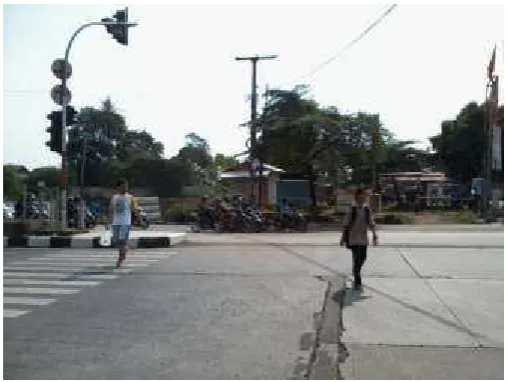
The Behavior of Driver on the crossroad must regulated by Traffic Light. Besides that, The Driver must have discipline character. Without this Character will be shown in Fig. 4. The Driver and Motorist stopped on outside area of Traffic Light. This Situation will be caused accidents or chaos on the street and very dangerous for the traffic flow.
[image:3.595.177.431.577.752.2]86
One of the important traffic problems to be resolved is the problem that occurred at a crossroads. Therefore, various methods are used to provide convenience to road users, especially at peak times such as the time of departure (morning) or time back (afternoon) from the office and time for lunch and Friday prayer time. Intersection location created with the aim to reduce the potential for conflict between one vehicle to another at the same time providing maximum comfort and ease of movement of the rate for vehicles coming from various positions.
According to the Ministry of Transportation Directorate General of Land Transportation (Abubakar, 1996), the intersection is a node on the network where the streets meet and intersect the vehicle track. The traffic on each branch of junction moves together with the other traffic. Intersections are the most important factor in determining the capacity and journey times in a road network, especially in urban areas with dense vehicle volume and height as well as in Depok. The intersection should be used together by the users, so that the intersection should be designed carefully, efficiency, safety, working speed, operating cost, and capacity.Traffic movements happened and their sequence can be handled in various ways. It depends on the type of intersection is required (Khisty JC. And KB Lall., 2003). This involves two things: technical and non-technical terms.
Break through the traffic light at the time of the red light in Jakarta seems to be a phenomenon that is assessed by most motorists as something normal if concerned not crashed into other people. Not only that, often many motorists were deliberately against the flow of traffic on the main road, because they want to save travel time, avoid traffic jams, or the nearer distance and other reasons that could be used as justification (AM. Fahham, 2014).
In the records of the Indonesian National Police (Polri), the number of deaths due to accidents in 2013 was 25 114 people. The magnitude of the numbers of deaths from such accidents should make motorists aware that changing behavior was better. Thus a motorist can comply with traffic lights, not against the traffic flow, not using mobile phones while driving, do not break through train doorstop, not running red lights, do not violate the rights of pedestrians, and so on as regulated in Republic Indonesia Number 22, 2009 regarding traffic and Road Transportation (AM Fahham, 2014).
In fact, various estimates suggest that if there is no way to anticipate the systematic and intelligent, then the problem of congestion will continue to be a very complex problem. It does not only interfere with the community activity but can also create problems in other sectors such as economic and social (Early Anggraini, 2013). Should any violation of traffic rules on the road can be given according to the rules applicable sanctions for violating law. Law No. 22 of 2009, article 105 explains that every person who uses obliged to behave in an orderly way and prevent things that could obstruct, endanger the security and safety of traffic and road transportation, or which can cause damage to roads and traffic jams.
1.3 Impact Traffic Jam
As a result of the traffic problems happened as described above, then the most serious effects. From one of the problems that traffic congestion occurs, causing some of the consequences is:
a. Environmental impact because of air pollution exhaust fumes which can damage the health of road users and the surrounding community. This is caused the vehicle which stopped or hindered in the long term due to traffic congestion. This is caused the vehicle which stopped or hindered in the long term due to traffic congestion.
87
c. Economic Impact where in 2010, there were direct economic losses of Rp. 45 198 trillion (DKI Jakarta, 2011) due to the wasteful use of fuel and waste of energy. That Impact increased drastically compared to the situation in 2008 which amounted to a total of Rp. 28.1 trillion (DKI Jakarta, 2011).
d. Increased vehicle travel time, distance becomes shorter, the air pollution and traffic accidents that cause disability or death.
II. Research Methodology
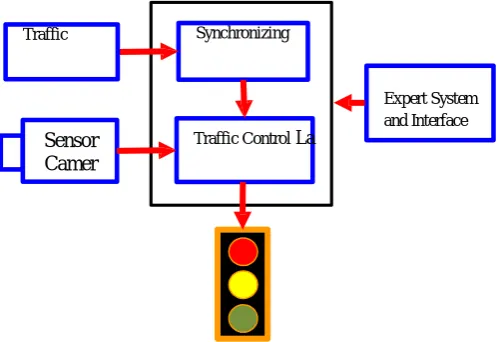
Distributive control systems engineering intelligent traffic in urban areas with many intersections is divided into four components. There are sensor video cameras, synchronizing control system, the traffic control using artificial intelligence and the expert system and user interface.
Sensor video cameras are as first component for recording Traffic Information document. The second component is a control system that is used in charge of synchronizing between adjacent intersections. The third component is the traffic control using an artificial intelligence. The fourth component is the expert system and interface. This study of control system is made in stages with the following steps:
- The first step is the equipment design with a camera sensor application. This camera is used to record the surrounding traffic situation and the determination of control rules.
- The second step is to design the expert systems application. The artificial intelligence using includes neural networks and genetic algorithms. It also discussed relating to the control of traffic lights at the intersection.
- The third step is to manufacture the control system simulation by taking a sample of a T-junction. In this case been the junction between the Margonda with Juanda Street in Depok.
- The fourth step as the last step is the study of the impact caused by the application of the intelligent control system.
Fig. 5 shows the parts of the control system concept are made. (Agus Priyono et al., 2005).
Traffic Synchronizing
Expert System
Sensor Camer
Traffic ControlLa
[image:5.595.191.443.519.690.2]and Interface
88
Of progress in the field of Information and communication technology has resulted in a new branch in the field of Transportation. Several years ago, some projects Intelligent Transportation System (ITS) has been created and is operated in one area or areas in developed countries like the United States and Europe. Basically, intelligent traffic control system is a system that uses communication and information technology (ICT) as well as artificial intelligence to solve the traffic problems. The purpose of the implementation of the system is to obtain a systematic approach in the use of transportation facilities in the present or in the future. One of the components of the ITS system is the advanced traffic management systems (ATMs). This system provides the foundation for creating adaptive traffic control systems are more alert and able to work in real time. The ATMs goal is to control traffic lights at intersections, traffic control and integrated highway traffic management area such as in cities with many intersections. This system is known as the Urban Traffic Control Systems, (UTCs). Rule of the urban traffic light control is one example of a complex control system and require advanced concepts approach.
In its development, traffic control systems in urban developed along with the development of information and communication technology such. Third generation control system, can operate on line and using a calculation directly with each intersection control that operates independently to determine the calculation time by approximately continuously (Lan & Davis 1999). The third generation system is controlled by a distributive system approach in real time. In a distributive system, the local computer determines the phase of work time and time approximately based on traffic demand and is able to make adjustments to the local computer at another intersection adjacent. Distributive control system at the present time is regarded as the city's traffic control system is the best (Agus Priyono, 2005). Approach the distributive control system is to divide the task of managing the traffic problems that occur in complex control circuit to control a series of smaller ones. In this way, the problem can usually be solved individually by using the model in parallel strategies by local control computers. Distributive control systems provide better opportunities for every intersection in resolving problems. At the same time send information about the status, future strategies and the timing of time for a vehicle leaving the crossover to other neighboring local control him.
In the urban traffic control system, traffic data analysis of real-time is a target in the design of a modern transport system. Therefore, real-time adaptive traffic signal control system is an important part in the modern system. Analysis of the data traffic should describe the same picture as when a human (a police officer) reports the state and take the traffic parameters such as queues of vehicles, volume and vehicle speed calculation (Siyal & Fathy, 1999). In the strategy manufacture to control the traffic lights, the number of queues of vehicles and traffic volumes are critical inputs to the optimization of the calculation of working time traffic lights to turn on, both for systems that work offline or online (Lan & Davis 1999).
In the process, the system intelligently control traffic lights can be combined with the cameras using to monitor traffic violations such as shooting online from the plate number of vehicles running red lights, picture of the situation and conditions in the intersection. In addition, it can also record events such as accidents and so on and then report directly to the control room in the office of the traffic police. This system can also be added with the ability to detect the condition of the road surface as well as damage to the highways (traffic surveillance) which can be connected to the control room in the office of the Regional Public Works Department.
III. Results and Discussions
89
In the simulation time specified range approximately taken between 80-150 seconds, whereas the estimated time of red and green lights lit set at 2 seconds. It was based on the calculation of genetic algorithms after getting information from neural networks are calculated based on the length of the queue of vehicles in each track intersection. While working time yellow lights set of 2 seconds. From the study it was found that the existing control system compared with the simulation can be seen in Table 1 and 2 below.
From Table 1, related to the percentage ratio of the average travel time of vehicles in the traffic jam conditions, it was found that the average travel time is 66.64 seconds, while using a simulation system was found sebesar 24.68 seconds. In this case, the simulation can improve average travel time of 62.96% compared to existing systems. However, in circumstances not jammed, the average travel time is generated in the research, the system has is 20.84 seconds while the simulation result is 45.63 seconds. In this condition, the simulation results have average time larger trip 118.95% compared to existing systems.
Table 2 describes the average time the vehicle stops at a standstill state. The average time a vehicle stopped on the condition of the existing system was 97.72 seconds while the result of the simulation is 38.11 seconds. In this case, the simulation can improve the average vehicle stopped by 61% compared to existing systems.
In the current circumstances, the average time a vehicle stops on the results of research using existing systems is 17:22 seconds while the results of the simulation is 88.33 seconds. For this situation, the result of the simulation is 412.95% larger than the existing systems. The above results illustrate that the simulation results in a standstill state, the control system simulation gives better results in terms of average percentage of vehicle travel time and the average percentage of vehicles stopped. These results, will give effect to the improvement of the comfort of the rider, thereby reducing the stress caused long they have to wait for a red light is still lit while on the road that intersects there is no queue of vehicles.
IV. Conclusions
The conclusion goes here. In such circumstances it is quite simply placed a police officer to a crossroad, because traffic lights control system is sufficient to represent the presence of other police officers. Moreover, when the camera shows a good performance in photographing number plates or motor vehicles violating traffic rules by running red lights, which is expected to provide a deterrent effect, because it can directly be given penalties when they extend the vehicle registration. This study, still needs further research after the intelligent traffic control system based on artificial intelligence is implemented directly in the field or real traffic light. This research could be developed not only to regulate traffic lights, but for the purposes of surveillances and can be used for reduce congestion on adjacent intersections in urban areas are jammed like in Depok, Jakarta, Bandung, Medan and Surabaya as well as in cities other large by utilizing GPS technology. However, that application becomes more influential impact on the behavior of motorists is certainly necessary sample orderly behavior by officials as well as a firm stance in upholding the rules.
References
[1]. Abubakar, 1996“Menuju Lalulintas dan Angkutan Jalan yang Tertib”, Direktorat Perhubungan Darat,
Jakarta.
90
[3]. Agus Priyono, Muhammad Ridwan, Ahmad Jais Alias, Riza Atiq O. K. Rahmat, Azmi Hassan, & Mohd. Alauddin Mohd. Ali, 2005a“Penggunaan Penggugusan Subtraktif bagi Menjana peraturan Kabur,”
Jurnal Kejuruteraan, Universiti Kebangsaan MalaysiaNo. 17 : pp. 47-58.
[4]. Diah Setyowati Ayuningtyas, Guritnaningsih A. Santoso, 2007 “Hubungan Antara Intensi Untuk Mematuhi Rambu-Rambu Lalu Llntas Dengan Perilaku Melanggar Lalu Llntas Pada Supir Bus di Jakarta”,JPS Vol. 13 No. 01 Januari 2007.
[5]. Dini Anggraini, 2013 “Studi Tentang Perilaku Pengendara Kendaraan Bermotor Di Kota Samarinda”,
eJournal Sosiatri-Sosiologi, 1 (1): 10-19 ISSN 0000-0000, ejournal.sos.fisip-unmul.org © Copyright
2013.
[6]. Khisty, J.C., dan Lall, K.B,. (2003), ”Dasar-Dasar Rekayasa Transportasi”,Penerbit Erlangga, Jakarta.
[7]. Lan C.J. & Davis G.A., 1999 “Real-time Estimation of Turning Movement Proportions from Partial Counts on Urban Networks”Transportation Research, Part C 7: pp. 305-327.
[8]. Marwan Lubis, 2007“Studi Manajemen Lalu Lintas Meningkatkan Kinerja Jaringan Jalan Pada Daerah Lingkar Dalam Kota Medan”,Tesis Magister Sains di Sekolah Pascasarjana Universitas Sumatera Utara,
USU Repository © 2008
[9]. Muchaddam Fahham, 2013 “Lampu Merah”, Pusat Pengkajian, Pengolahan Data dan Informasi
(P3DI) Setjen DPR RI diunduh dari alamat http://www.publicapos.com/opini/737-lampu-merah pada
04/08/2014, jam 09.06 WIB.
[10]. Pemerintah Provinsi DKI Jakarta, 2011 “Laporan Realisasi Anggaran 2011 – 2012”, diunduh dari laman http://www.jakarta.go.id/v2/news/2014/09/laporan-realisasi-anggaran-2011-2012#.VCruKb76lSV, pada 22 September 2014.
[11]. Siyal M.Y. & Fathy M., 1999 “Image Processing Techniques for Real-Time Qualitative Road Traffic Data Analysis”Real-Time Imaging, vol. 5: pp. 271–278.
[12]. Tribun news.com, 2014 “Jumlah Korban Tewas Akibat Kecelakaan Lalu Lintas Tahun 2013 Menurun”, http://www.tribunnews.com/nasional/2014/01/26/jumlah-korban-tewas-akibat-kecelakaan-lalu-lintas-tahun-2013-menurun, diunduh pada 20 Februari 2014.