Journal of Criminal Law and Criminology
Volume 47 | Issue 6
Article 14
1957
Modern Printing Processes
Lucile P. Lacy
Follow this and additional works at:
https://scholarlycommons.law.northwestern.edu/jclc
Part of the
Criminal Law Commons
,
Criminology Commons
, and the
Criminology and Criminal
Justice Commons
This Criminology is brought to you for free and open access by Northwestern University School of Law Scholarly Commons. It has been accepted for inclusion in Journal of Criminal Law and Criminology by an authorized editor of Northwestern University School of Law Scholarly Commons.
Recommended Citation
MODERN PRINTING PROCESSES
LUCILE P. LACY
The author is an examiner of questioned documents in Houston, Texas, where she is associated with her husband, George J. Lacy. Mrs. Lacy is a graduate of the Uni-versity of Houston and has completed additional graduate work in the field of science. Her present article is based upon a paper presented at the 1956 annual meeting of the American Society of Questioned Document Examiners.-EDITOR.
Although a problem involving only printing seldom confronts the Questioned Document Examiner, the questions arise: "Is there a possibility that we might oc-casionally fail to discover some significant fact, which is contained in the printed portion of a questioned document?" "Would it not be possible for a forger to print
a letterhead or a form over a genuine signature?"
Careful examination and comparison of the printed portion of a questioned docu-ment with printing of known date might well prove to be of date significance; pos-sibly by proving to be of different runs evidenced by wear and mutilation of the type face and depth of impression, or by proving to be a completely different printing process. Therefore, in an effort to better understand the results produced by present day printing processes, the following paragraphs will attempt to describe the various processes in general, and some of their possible identifying characteristics.
METHODS OF PRINTING
According to historians the first attempt to multiply impressions was made by the Japanese about the eighth century. Gradual progress was made there and in the European countries, and in the fifteenth century the inventions of Johann Guten-berg of Germany (movable type, alloy for making type face, ink for printing, ad-justable mold) produced the predecessor of modern printing processes.
Today, some authorities describe five basic methods of printing: they are: I. Relief -A process where ink is applied to a raised surface, which in turn is applied to paper, i.e. rubber stamp and letterpress printing. II. Planographic-A process where ink is applied to a dead level plate which has been chemically treated, i.e. lithograph, offset. III. Intaglio-A process where ink is flooded into an image which has been cut out or etched, i.e. engraving, etching, gravure. IV. Stencil-A process where the letters or image are holes cut in a sheet, or a sheet is made more porous in the area of the letters, and ink is applied to paper through the holes or porous areas, i.e. mimeograph etc. V. Photography-A process where light instead of ink hits the paper, and darkens the paper where it hits, i.e. photocopy, etc.
I. RELIEF
MODERN PRINTING PROCESSES
of the newer printing processes, and is thought by some to be unexcelled in the re-production of photographs-but this is quite debatable.
There are essentially only two steps in letterpress printing; the setting of the type or making. of cuts for illustrations and then printing from them. However, there are many ways of accomplishing these two steps. For many years typesetting was done by hand, but this is of course a slow and cumbersome process and is seldom used today. In fact in this age of specialization, we not only find great complicated ma-chines automatically setting type, but we find corporations who do nothing but set type and furnish it to the printers.
The setting of type for letterpress printing is usually done on the Monotype type-setting ,machine or the Linotype machine or its closest cousin the Intertype. The Monotype machine produces new fresh type for each job; the type being melted down after each job. The keyboard operator of the Monotype types the manuscript much the same as on a typewriter. A perforated paper roll is produced, and this paper roll in turn is put on the casting machine which automatically selects the matrices which cast the type singly (not in lines), puts it into lines, and then into the shallow metal tray or drawer known as the galley. A device near the keyboard operator indicates how many "ems" (an em is the square of the body of any size type) the line is short, which he indicates by pressing a key, and the machine automatically justifies the right margin by casting the type of each line backward.
The keyboard operator of the Linotype typesetting machine (Intertype is practi-cally the same) sits at the keyboard, and when a key is touched, a matrix or mold drops into place in the line being set. When the line is complete, molten metal is forced against it and a linotype slug is produced, ready for printing. The right margin is justified by addition of slugs or spacebands. The machine automatically sends the matrix or mold back to its particular magazine.
After a frame of type has been set, duplicate plates are very often made for use in the actual printing process. By using the duplicate plates, if the plate is damaged in any 'way it can be easily replaced by making another from the original setting of type. Some of the methods of making duplicate plates are as follows.
Electrotype-A sheet of wax is placed over the type and forced down into the form,
under. pressure, making an exact likeness of the type and cuts. Copper is then de-posited electrolytically on this wax mold and later backed with lead. (Other materials such as vinyl or tenaplate and the like may be used.)
Stereotype-A process used by most newspapers which is the cheapest means of
making a metal duplicate printing plate. A special composition paper mat is forced down over the type and cuts; then melted metal is poured on the paper mat mold to produce a new metal printing surface. Some of the disadvantages of this method are the loss of detail, they show wear quite readily, and there is a certain amount of stretch or shrinkage, both when the mat is made and when the metal is cast.
Rubber-Rubber plates are seldom used because they must be precision made. However, they are used for printing on non-absorbent material such as plastic, tel-lophane, and the like. Sometimes plates are made of linoleum, wood, and the like.
After the type has been set and the duplicate plates made (if they are to be used), the next step in letterpress printing is the actual printing process. The printing presses
LUCILE P. LACY
used today are made on one of three principles. 1. The platen or "flatbed press" opens and closes like a clam shell; it has raised type on one flat surface and the paper on another flat surface, and the two are pressed together. Small hand presses are generally platen presses. 2. Cylinder presses roll the paper around a cylinder and then across the flat surface of inked type. 3. Rotary presses pass the paper between two cylinders, one of which holds the curved printing plates.
The Multigraph is an office duplicating machine which prints from raised surfaces, on the same principle as the letterpress. On this machine printing is done from a large drum which is equipped with parallel slots, into which metal type is inserted. Illustrations can also be used if made into special curved plates. The type is then covered with a wide inked ribbon and moved over the paper. The finished product very closely resembles typing. The Multigraph drum may also be inked with an ink roller (eliminating the use of the inked ribbon), and when this is done it becomes a small printing press.
II. PLANOGRAPHIC
Lithography is probably the most well known printing process which employs the principle of putting ink on a chemically treated surface. It was discovered in Munich in the eighteenth century by Senefelder. Orginally lithographs were made by drawing the design with a grease pencil on a flat litho stone (which is a special type of lime-stone from Bavaria). The lime-stone, having a special affinity for water absorbed water, but water was repelled by the area on which the drawing had been made with grease pencil; then greasy ink was placed on the design and paper pressed against it. During the nineteenth century great improvements were made in lithography, and as a result "lithography" in the strictest meaning of the term, has almost vanished today.
The commercial application of lithography as we know it today is known as Offset. The principle of the application of ink to a chemically treated surface is still used, but the process is more complex, much faster and more flexible and effective. In this Offset process, the copy is placed in front of a big camera and photographed, so that the film is the exact size that the final result is to be. The film is in turn placed over a sensitized plate (made of paper, albumen or chemically treated metal), and exposed to a strong light. By photochemical action the image is transferred to the plate. As a result, the image (the area to be printed) is receptive to greasy ink, and the remaining area is receptive to water. The inked surface prints on to a rubber blanket or roller, which in turn prints on to the paper.
The Multilith is a small offset press made especially for office use. It can produce anything that can be lettered, typed, traced, or drawn on the paper or metal plates from which the machine prints.
III. INTAGLIO
There are essentially four types of printing which employ the Intaglio principle of placing ink in an area which has been cut out or etched.
Gravure-This is a process in which the ink in recessed or sunken letters is drawn
MODERN PRINTING PROCFSSFS
slightly fuzzy edges. The printing is done from large copper plates or copper covered cylinders, on presses of two kinds; sheet fed gravure presses (for runs of 10,000 to
100,000) and web-fed Rotogravure presses for longer runs. The copper plates or cylinders are produced by making film positives of the art work to be reproduced. They are quite expensive to make, but when once prepared, the cost of running them is comparatively low.
Engraving-This is a process in which the paper is forced into the sunken areas of a
metal plate where the ink is. A special metal plate is made by the artist who re-moves or scratches areas in the metal itself, into which the ink is placed. The actual printing process is very slow, and after the paper is removed from the plate, time must be allowed for the drying of the ink to prevent smudging.
Thermograpy-A cheap substitute for engraving is Thermography. Printing from
ordinary type is done in the ordinary letterpress way, but while the ink is still wet, a special powder which adheres to the ink is sprinkled on it and then heated. The result is raised lettering, and when shaded letters are used, it closely resembles engraving.
Etching-The artist draws an image on a paraffined copper plate, then uses acid to
etch or eat away the copper where the strokes have penetrated the paraffin.
IV. STENCIL
The letters or images are holes cut in a sheet or the sheet is made more porous in the area of the letters. With some letters such as 0 and A where it is necessary to support the centers of letters, a lattice is necessary. In mimeograph stencil this lattice is paper; in silk screen process, it is a piece of fine bolting silk.
Mimeograph-Stencil sheets on which the copy is typed or drawn are made of a
porous base tissue, covered with a coating which is impervious to ink. The typing or drawing pushes the coating aside and exposes the porous tissue. This stencil is-wrapped around an inked cylinder and the cylinder is rolled across the paper, forcing the ink through the porous parts of the stencil. Drawings and signatures can be put on Mimeograph stencils by using an illuminated drawing board and wire loop or ball point stylus. More intricate drawings may be placed on a regular mimeograph stencil by special photochemical printing equipment.
V. PHOTOGRAPHY
Some authorities say photography is a printing process. However, it would seem to the writer that it is more of an adjunct to the printing industry, than an actual print-ing process as the term is generally used. In addition to the photographic procedures heretofore mentioned as a part of actual printing processes, there are some duplicat-ing processes which employ photography, but which in the writer's opinion should not be given the dignity of the term "printing".
Photocopy-Negatives are usually made on paper instead of film, and as the term is generally used, refers to copies made on machines which can only produce actual size copies. Many of the duplicating machines used in offices today employ the prin-ciple of photocopying, in various ways. Some processes (such as Diazo) make use of chemically sensitized sheets of paper capable of forming a dye when exposed to a combining agent; some processes make use of heat (Thermo-Fax), and others employ
LUCILE P. LACY
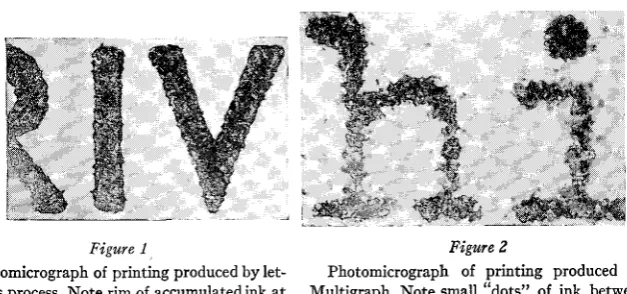
Figure 1 Figure 2
Photomicrograph of printing produced by let- Photomicrograph of printing produced by terpress process. Note rim of accumulated ink at Multigraph. Note small "dots" of ink between
edges of letters, letters.
the various principles of electricity such as the photoelectric cell, electrically charged plates and ink, and the like. The making of blueprints is also a photocopying process. Photostat-Essentially a "photocopy", but it can enlarge or reduce the image. It produces readable negatives, and uses photographic paper instead of film.
PRINTING OF ILLUSTRATIONS
Half-tone-The object is placed before a photoengraving camera which has between
the lens and the negative, a plate glass on which are blackened lines making a screen which may vary from 50 to 200 lines to the inch. The negative which is produced breaks the image up into dots; large dots where the light was strong, and small dots where the light was weak. Shading depends on the size of the dots. A sensitized copper or zinc plate is then exposed to the negative and the surface hardens where the light gets through the negative. The unhardened surface is then washed away, and the bare metal is etched with acid. These half-tone images may be used in most all printing processes.
Photogelatin or Collotype-A so-called screenless printing process for reproducing
half-tones, which is said to be particularly suitable for copying old documents be-cause it reproduces every flaw. As just described, a negative is made, light is passed through the negative on to a gelatin covered plate; the gelatin hardens in proportion to the amount of light. When moistened the unhardened portions get wetter than the hardened portions, and when inked the wetter portions accept less ink.
Line Copy or Cuts-In line cuts for commercial printing, the design is transferred
photographically to zinc or copper plate, then acid is used to etch away the metal not protected by the design. Shading depends on the width and spacing of the lines and may be done by the artist or by the Ben Day process.
IDENTIFYING CHARACTERISTICS OF PINTNG
19371
~MODkRN
PRINlYNG RC SRPhotomicrograph of uff et iniig. Middi and outside portions of letters of practicay same densty,
result of research and experimentation on the subject, and discussion of the matter with printers of long experience, the writer has arrived at the following conclusions
By microscopic examination comparison, and study of letterpress printing, the edges of the letters will be found to be more sharply defined than in offset printing. (See Figure 1.) Also, at the extreme edge of the letters there may be found a more or less well defined "rim" or accumulation of ink. Careful microscopic study and mean-urement may reveal different "runs" of letterpress printing, which have been made from the same set-up; the type face may exhibit evidences of damage andthespacig and alignment may be different, due to pressure applied by the frame; also, the-letter
ing may be in a slightly different position on the page.
In Multigraph printing with an inked ribbon, the letters appear much theame as if done on the conventional typewriter with the conventional ribbon' however, there are usually evidences of ribbon impressions between the letters (see Figure 2), If run by inking the ipe directly, multigraphing may have the appearanceof lette-press printing, butm the line spacing in multigraphiug is always uniformand the-right margin is not justifie. Multigrphing may sometimes have an added charactristic of the presence of one or more Unduly light or heavy lines.brought about hy the improper placing o:a slug in the machine.
In offset printing te edges of the letters are more irregular than in etrpress(see Figure 3). The ortion and the edges of the letters are more or less of he same0ddle, density, and there is no indentaion of ie paper in the area of the prilnted-lers, asis sometimes found n letteprssprinting.
Multilith is essentia t same proess as offset, and if properly done c'n not he
differentiated from offset,
Engraved stone lithographyk prods sharper, finer, and more detailed pinting than present day offset prcess (se; e Figure4).
[image:7.454.30.380.36.285.2]LUCILE P. LACY
r igure 5
Photomicrograph of gravure printing. Note uniform irregularity of edges
Gravure art work can generally be identified by the microscopic appearance of a very fine screen. Gravure letter printing can be identified by the somewhat uniform irregularity of the edges of the letters caused by the screen (see Figure 5).
With engraving the letters are raised and the back side of the paper shows def-inite evidence of stretching.
Thermography produces raised letters which are "shiny", with no evidence on the back of the paper of stretching.