Journal of Criminal Law and Criminology
Volume 64 | Issue 4
Article 10
1974
Inner Containment and Delinquency
Gary F. Jensen
Follow this and additional works at:
https://scholarlycommons.law.northwestern.edu/jclc
Part of the
Criminal Law Commons
,
Criminology Commons
, and the
Criminology and Criminal
Justice Commons
This Criminology is brought to you for free and open access by Northwestern University School of Law Scholarly Commons. It has been accepted for inclusion in Journal of Criminal Law and Criminology by an authorized editor of Northwestern University School of Law Scholarly Commons.
Recommended Citation
Tax JoNwAL or CaNmAx LAw & Cxnmeoaooy
Copyright a 1973 by Northwestern University School of Law
CRIMINOLOGY
INNER CONTAINMENT AND DELINQUENCY
GARY F. JENSEN*
Introduction
A central question confronting delinquency theory and research over the years has been the maintenance of non-delinquent behavior patterns in social environments thought to be highly con-ducive to delinquency. One of the most widely noted and reprinted attempts to deal with this issue has been the work of Walter Reckless and the "containment theorists," I who have introduced
the notion of "inner containment" to explain varia-ble responses to criminogenic situations. Inner con-tainment is vaguely defined as referring to the "inner ability" of a person to direct himself, or to "inner strengths" which help a person resist "de-flection" from conventional norms, and supposedly encompasses a variety of related psychological and social-psychological concepts such as "self-con-trol," "good self-concept," "ego strength," "well-developed superego" and "high resistance to diver-sions." Most of the containment theorists' research related to this issue has centered around the "self-concept" as an element of inner containment, "in-sulating" boys in the slum against the adversities of family, class position and neighborhood. How-ever, several critiques2 of such research have iden-tified serious deficiencies in both the theoretical presentation of the containment perspective, and
in the methodology of the self-concept research as well. Some of the methodological shortcomings totally negate the relevance of much of the data
* Assistant Professor, Department of Sociology, University of North Carolina, Chapel Hill.
The data utilized in this paper were collected by the Survey Research Center (University of California, Berkeley) under the direction of Alan B. Wilson. The author is greatly indebted to the Center, and especially, Travis Hirschi for making the data available.
I Reckless, A New Theory of Delinquency and Crime,
in JuvNu DELINQUENcY 223 (R. Giallombardo ed. 1966); Reckless and Dinitz, Pioneering with the
Self-Concept as a Vulnerability Factor in Delinquency, 58 J.
CRm. 2 L.C. & P.S. 515 (1967).
C. SCHRAG, CR AND JusncE: AmERicA STYLE
(1971); Jensen, Containment and Delinquency, 2 U. WASH. J. SocioLoGY 1 (1970); Tangri and Schwartz,
Delinquency and the Self-Concept Variable, 58 J. CRas.
L. C. -& P. S. 182 (1967).
gathered to the conclusions reached by containment theorists. The present paper attempts to avoid some of these problems by delineating the basic "inner containment" hypothesis, outlining the minimum requirements of a test of the hypothesis and, finally, carrying out such a test using survey data from a large random sample of black and white male adolescents.
The Inner Contaimnent Hypothesis
As noted above, Reckless and others have been concerned with identifying a "self factor" to ex-plain why some persons do and others do not re-spond to the same situation in the same way. They claim to have "some tangible evidence that a good self concept... veers slum boys away from de-linquency, while a poor self concept gives the slum boy no resistance to deviancy, delinquent com-panions, or delinquent sub-culture," and that "components of self-strength, such as a favorable concept of self, act as an inner buffer or inner con-tainment against deviancy, distraction, lure and pressures." 3 The sense in which such elements of inner containment insulate boys from adversities is far from clear. It is doubtful that such theorists are advocating self-concept variables to explain why some boys are exposed to criminogenic influ-ences while others are not. The theorists claim to be going beyond differential association theory4 and, hence, "insulation" must refer to something other than differential association with sources of deviant definitions. The interpretation most con-sistent with the focus on "good" boys in "bad" neighborhoods is that they are referring to re-sistance to "criminogenic influences" that are actually experienced. If they are attempting to explain why some adolescents develop and main-tain nondelinquent patterns of conduct despite the adversities of family, class position and neighbor-hood, the central question would seem to be why
3 Reckless and Dinitz, supra note 1, at 445. 4 H. SunERLAND & D. CxEssEY, PmnciPLEs
or
CRBUNOLOGY (7th ed. 1966).464
Vol. 64 No 4
INNER CONTAINMENT AND DELINQUENCY
some boys develop and maintain non-delinquent patterns of behavior even though they appear to
be experiencing the same environmental adversities as others who do become involved in delinquency. The containment theorists' answer is that when there are external forces pushing or pulling a boy toward delinquent action, and control processes external to the individual are weak, variable in-volvement in delinquency can be explained by ele-ments of inner containment of "self-control." Thus, an adequate test of this hypothesis would require a measure of inner containment which is independ-ent of external forces and constraints, and would require evidence that such a variable is negatively related to delinquency when such external forces and constraints are constant.
In a series of studies, Reckless and others argue that they have, in fact, isolated a "self-concept variable" which acts as a barrier to involvement in delinquency despite these adversities. However, ex-amination of the items that went into their measure of the self-concept (Figure 1), reveals that neither of the conditions required for testing the
hypothe-Figure 1: Self Concept Items*
(1) Will you probably be taken to juvenile court
sometime?
(2) Will you probably go to jail sometime?
(3) If you found that a friend was leading you into
trouble, would you continue to run around with him or her?
(4) Do you plan to finish high school?
(5) Do you think you'll stay out of trouble in the
future?
(6) Are grown-ups usually against you?
(7) If you could get permission to work at 14 would
you quit school?
(8) Are you a big shot with your pals?
(9) Do you think your teacher thinks you will ever
get into trouble with the law?
(10) Do you think your mother thinks you will ever
get into trouble with the law?
(11) Do you think if you were to get into trouble
with the law, it would be bad for you in the future?
(12) Have you ever been told that you were headed for trouble with the law?
(13) Have most of your friends been in trouble with
the law?
(14) Do you confide in your father?
(15) Do your parents punish you?
(16) Do you think you are quiet - average active _?
* Reckless and Dinitz, supra note 1, at 579.
sis has been met. Encompassed in their sixteen items is a measure of exposure to delinquent peers
(13) and a measure of outer containment (15). In
short, they measure some aspects of environmental pressures and pulls-outer containment and inner containment-with one set of items arbitrarily labeled "the self concept." This shortcoming makes the data largely irrelevant to any conclusions con-cerning the independent consequences of elements of inner containment for involvement in delin-quency.
There apparently was no conceptual or empirical rationale for identifying such items as a measure of the self-concept. Rather, the rationale for choos-ing these items was their ability to differentiate between teacher-nominated "good boys" and "bad boys." One can conclude that there is a tend-ency for teacher-nominated good boys to be more committed to conventional lines of action, experi-ence a more supportive home life and to have fewer delinquent friends. One can anticipate less trouble with teacher-nominated good boys and that, there-fore, they are less likely to get into trouble with the law. However, the data do not allow any clear conclusions about the buffering or insulating role of inner containment variables. Environmental variables assumed to be constant were not, and variation in external conditions was measured by items taken illegitimately as measures of the self-concept variable.
Tke Present Investigation
Utilizing survey data from a large random sam-ple of adolescents, the present investigation at-tempts a test of the containment hypothesis through an examination of the relationships be-tween elements of inner containment and delin-quency in a wide range of socially differentiated categories. If the inner containment argument is correct, then such variables should be negatively related to delinquency in highly criminogenic or adverse environments. Moreover, some contain-ment theorists have argued that family relation-ships are important determinants of variable inner containment. We attempt to bring data to bear on such claims by examining social correlates of select elements of inner containment.
GARY F. JENSEN
County, California in 1965. The student population of each of the eleven schools was stratified by race, sex, and grade. Disproportionate random samples were drawn from the resulting substrata. This pro-cedure resulted in a sample of 5,545 adolescents. Satisfactory data were obtained from 4,077. Of this final sample, the present analysis is limited to
1,001 black and 1,588 white male students. Western Contra Costa County, located in the San Francisco-Oakland metropolitan area, is bor-dered by Berkeley and the San Francisco and San Pablo bays. The area has experienced marked popu-lation growth since World War II, with the black population increasing from one to more than twelve percent. The largest city in the area, Richmond, is primarily an industrial community, with more than sixty percent of the employed males holding manual jobs. By 1960, twenty-nine percent of the population was black, concentrated largely in the western areas of the city. By contrast, the eastern hill areas are almost completely white, populated by professionals and executives who commute to Richmond and other cities in the surrounding area. Six of the eleven schools sampled are at least eighty-five percent or more Caucasian. Thus, the analysis is based on a fairly heterogenous sample of primar-ily urban and suburban adolescents in grades seven through twelve.5
Operational Measures
While the containment research discussed above focused on officially recognized delinquency, this study operationalizes delinquent behavior by means of responses to a series of six questions con-cerning offenses of varying degrees of seriousness: (1) Have you ever taken little things (worth less than $2.00) that did not belong to you?; (2) Have you ever taken things of some value (between $2.00 and $50.00) that did not belong to you?; (3) Have you ever taken things of large value (worth over $50.00) that did not belong to you?; (4) Have you ever taken a car for a ride without the owner's permission?; (5) Have you ever banged up on pur-pose something that did not belong to you?; (6) Not counting fights you may have had with a
5 For more extensive details on the population, the
sample and the setting, as well as procedures used in gathering data, see T. Hiascm, CAusEs or
DELIN-QUENcY (1969); A. Wilson, Western Contra Costa
County Population, 1965: Demographic Characteris-tics, 1966 (Survey Research Center, Berkeley); A. Wilson, T. Hirschi, and G. Elder, Technical Report No. 1: Secondary School Survey, 1965 (Survey Re-search Center, Berkeley).
brother or sister, have you ever beaten up. anyone on purpose? Only acts committed within a year previous to the administration of the questionnaire are included in the score used in the present analysis.
A central criticism of much of the self-concept research has been the lack of an adequate. basis for differentiating "good" from "poor" self-concep-tions, since the research provides no theoretical or empirical definition allowing such a distinction. Apparently, the only criterion determining such a distinction has been whether or not an item was related to delinquency. Thus, rather than impose an evaluative label, we will rely on the adolescent's own self-evaluations as determined by responses to the following items: "At times I think I am no good at all," and "I certainly feel worthless at times." For most of the analysis, these two items are combined into a trichotomized measure of "self-esteem."
Rather than limiting the analysis to this one element of inner containment, we also relate measures of self-control and embracement of con-ventional moral beliefs to delinquency.
A
"sense of self-control" was based on responses to the follow-ing items: "I have a lot of trouble controllfollow-ing my temper;" "I can't seem to stay out of trouble;" and "I often have trouble deciding which are the right rules to follow." To measure acceptance of con-ventional moral beliefs, we used a single item: "It's all right to get around the law if you can get away with it." Each of these measured variables-self-esteem, self-control and acceptance of the law as morally binding-are encompassed by Reckless' category of "inner containment."The relation of each of these "elements" of inner containment to delinquency is examined for sub-categories of adolescents differentiated on the basis of race, social class standing, delinqtient com-panions and parental emotional support. With the exception of race, which was determined by school classifications, these variables were all derived from questionnaire responses. Social class standing was measured by an item assessing father's educa-tional attainment.6 Delinquent companions was determined by the number of close friends who had ever been picked up by the police. Finally, parental emotional support was measured by
an-6 The educational status item was chosen over al-ternative measures of socioeconomic status because it maximized the number of cases available for generating tables, a number already reduced by non-responses to other items.
INNER CONTAINMENT AND DELINQUENCY
swers to three questions concerning the degree and intimacy of communication between father and son and three identical questions bearing on mother-son interaction.
Most of the following analysis is based on an examination of gamma coefficients7 and percent-age distributions. Gamma is a measure of associa-tion appropriate to an ordinal level of measurement which has been given a "proportional-reduction-in-error" interpretation. The environmental and outer containment variables are held constant by subdivision. The relationships between inner con-tainment and delinquency are examined within these subcategories.
Findings
The gamma coefficients relating each of the three elements of inner containment to self-re-ported delinquency are summarized in Table 1. As suggested by the inner containment theorists, each is, negatively related to involvement in de-linquency for both blacks and whites. However, while all of the relationships are significant at the .05 level or better, they are not particularly strong. There are many boys with "good" self-concepts involved in delinquency, just as there are numerous boys- with "poor" self-conceptions who are not involved in delinquency. Nevertheless, all three aspects of inner containment are significantly related to delinquency in the direction predicted by the inner containment hypothesis.8
7 Costner, Criteria for Measures of Association, 30
AM. SOCIoLOGIcAL. Rxv. 341 (1965); Goodman &
Kruskal, -Measures of Association for
Cross-Classifica-tion III: Approximate Sampling Theory, 58 J. Am. STATISTICAL ASS'N. 310 (1963).
Using a score based on a combination of all items, the comparable coefficients were -. 27 for whites and -. 21 fdr blacks. Several considerations ruled against using a combined score for the more precise analysis to follow: 1) The inclusion of all the items in one score resulted in an excessive attenuation of cases when sub-dividing on the basis of other items and multiple-item scores. 2) Another important consideration was the de-sirability of keeping conceptually distinct variables distinct. The tendency in much of the containment re-search has been to introduce the broad category of in-ner containment and to cite examples or elements of that general category of variables. In this study, self-esteem, self-control and moral beliefs are viewed as conceptually distinct social psychological variables relevant to the regulation of conduct. 3) Consistent re-sults using several different conceptual dimensions of internal control processes provide a more convincing test of the inner containment hypothesis. As demon-strated below, the relationships anticipated by con-tainment theorists persisted in every subdivision ex-amined using three different ways of conceptualizing the vague category of variables referred to by Reckless and others as inner containment.
TABLE 1
DELNQUENCY BY T" HRBE lNER
CONTAInIaNT VAPinLES
(Gamma Coefficients)
Race: Blacks Whites*
Delinquency by:
1) Self-esteem -. 25 -. 17
2) Self-control -.. " -. 25 3) Conventional Belief "-.8 - .38
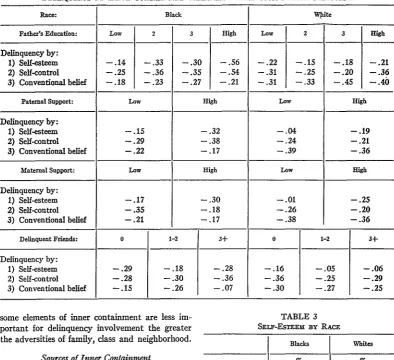
A complete test of the inner containment hy-pothesis requires that we examine the felationships when environmental and outer containment are held constant. If the hypothesis is correct, then we should find self-esteem, self-control and conven-tional belief to be negatively related to delinquency when outer containment is weak and when environ-mental pressures or pulls are likely to be present-As summarized in Table 2, all three variables are negatively related to delinquency in "all twenty-two subdivisions examined. The grekter the self-esteem, sense of self-control, and acceptance of the law as morally binding, the less the delinquency in all race-class, family and peer group situations ex-amined.
However, there are some patterns of variation in the magnitude of these relationships which sug-gest that the degree to which these variables are interconnected may vary by social context: (1) Self-esteem and self-control are'far more sftongly related to delinquency among upper-class blacks than lower-class blacks; (2) among both blacks and whites, self-esteem is more intimately con-nected with delinquency for those experiencing emotionally supportive parental relationships than among the relatively less supported; and (3) for white adolescents, the association between de-linquency and self-esteem is stronger when a boy has no delinquent friends than when he has one or several. Such patterned variation suggests that some elements of inner containment may be most relevant to variable involvement in delinquency where significant others are likely to sanction and disapprove of delinquent behavior. If an adolescent is in a situation where no one is likely to disap-prove of what he does, then there would be less reason for self-image variables to be related to delinquency. It could be argued that delinquency is most likely to detract from self-esteem when it occurs in contexts where the behavior is disap-proved. Thus, it may very well be the case that
GARY F. JENSEN
TABLE 2
DELINQuENCY BY INNER CONTAINMENT VARIABIZS WITIm SOCIO-RACrAL- CATEGORIES
Race: Black White
Father's Education: Low 2 3 High Low 2 3 High
Delinquency by:
1) Self-esteem -. 14 -. 33 -. 30 -. 56 -. 22 -. 15 -. 18 -. 21 2) Self-control -. 25 -. 36 -. 35 -. 54 -. 31 -. 25 -. 20 -. 36
3) Conventional belief -. 18 -. 23 -. 27 -. 21 -. 31 -. 33 -. 45 -. 40
Paternal Support: Low High Low High
Delinquency by:
1) Self-esteem -. 15 -. 32 -. 04 -. 19
2) Self-control -. 29 -. 38 -. 24 -. 21
3) Conventional belief -. 22 -. 17 -. 39 -. 36
Maternal Support: Low High Low High
Delinquency by:
1) Self-esteem -. 17 -. 30 -. 01 -. 25
2) Self-control -. 35 -. 18 -. 26 -. 20
3) Conventional belief -. 21 -. 17 -. 38 -. 36
Delinquent Friends: 0 1-2 3+ 0 1-2 3+
Delinquency by:
1) Self-esteem -. 29 -. 18 -. 28 -. 16 -. 05 -. 06 2) Self-control -. 28 -. 30 -. 36 -. 36 -. 25 -. 29 3) Conventional belief - .15 - .26 - .07 - .30 - .27 - .25
some elements of inner containment are less im-portant for delinquency involvement the greater the adversities of family, class and neighborhood.
Sources of Inner Containment
In his textbookg Reckless cites Donald's research (1963) to the effect that it is the quality of family interaction and other supplementary social rela-tionships which are the most important sources of inner containment, in contrast to such variables as race and social class. As summarized in Tables 3 and 4, our findings are generally consistent with Donald's speculation. Race and social class are only slightly related to self-esteem. Blacks are not particularly low in self-esteem when compared to whites, and measures of socio-economic status are not very strongly related to self-esteem. By com-parison, measures of the quality of parent-child relationships and relationships in other settings are far more strongly related to self-esteem. For
9 W. RECKLESS, THE CRIHE PROBLEM 446-47 (4th
ed. 1967).
TABLE 3
SELF-ESTEEM BY RACE
Blacks Whites
Self-Esteem
High 38 32
Medium 34 32
Low 28 35
N = 693 1372
example, among both black and white adolescent males, the stronger the bond to parents, the higher an adolescent's own feelings of personal worth. Furthermore, the more difficulty a student has learning and interacting with others, the lower his self-esteem.
[image:6.454.33.428.59.419.2]INNER CONTAINMENT AND DELINQUENCY
TABLE 4
CoRELATEs OF SErF-EsTEEm
Race: Blacks Whites
Father's Education +.02 +.14
Months Unemployed -. 16 -. 13
Maternal Rejection& -. 37 - .40 Paternal Rejection- - .31 -. 35
Maternal Support +.31 +.31
Paternal Support + .28 +.29
Interpersonal Awkwardnessb -. 26 - .17
Learning Frustrations' -.43 - .49
a Based on responses to the statement "Have you
ever felt unwanted by your mother (father)?"
b Based on responses to the statement "It is hard
for me to talk to people when I first meet them."
0 Based on responses to the statement "I often
feel that I just can't learn."
even when some of these source variables are held constant or that conditions of inner containment may "interact" with situations of outer contain-ment as barriers to delinquency. The most serious interpretive error in the self-concept research was the claim that the research had revealed a self-concept factor which acted as a buffer when outer containment was weak when, in fact, outer con-tainment was varying. The "good" boys had a better home life and experienced a less adverse neighborhood environment than the "bad" boys. However, our data avoid this problem by actually measuring and controlling for some dimensions of outer containment, and we still find elements of inner containment acting as buffers to delinquency. We are left with the same problem of explaining how conventional beliefs and self-images can be products of certain environmental circumstances, and yet shape behavior independent of those cir-cumstances.
The fact that there is variation in inner con-tainment variables when present external condi-tions are held relatively constant suggests (1) that there may be other environmental factors which we have not held constant, or (2) inner contain-ment is a product of earlier experiences. There is a wide-range of institutions and persons which can shape beliefs and self-images, and it is impossible to hold all environmental circumstances constant. Moreover, environmental circumstances may change such that inner containment may be ex-plained by factors other than those measurable in the present. This latter solution is implied by
Dinitz, Scarpitti and Recklesse0 when they attrib-ute a "good" self-concept to "residual socializa-tion" by age twelve. External control processes shape internal control processes. These internal processes may come to shape behavior even when the external situation has changed. Such a possi-bility is implicated in discussions of concepts such as "internalization." For example, Marvin Olsenn points out that "norms and role expectations are not just learned, but are incorporated by the in-dividual into his personality. He then abides by them not because of external forces or rational decisions, but because his own mind and total personality compel him to."
With these possibilities in mind, we can seriously question any conclusion that inner containment acts as a buffer among boys who have experienced the same adversities. The very existence of variable inner containment, as acknowledged by contain-ment theorists, seems to be proof that the environ-ments are not, or at least were not identical. A more appropriate conclusion would be that variable inner containment processes can be explained by variable external control processes, but that such internal controls can come to operate independ-ently or in combination with external controls.
It is noteworthy, however, that the independent operation of internal controls may be very limited. One cannot assume that self-esteem, a sense of self-control and beliefs, remain constant. If inner containment grows out of family interaction and supplementary relationships, then a change in those relationships should have some impact on inner-containment. Without some form of rein-forcement from others (outer containment), the beliefs and self-images relevant to delinquent be-havior are likely to change.
Surmmary and Conclusions
The major aim of research with self-concept variables has been to explain "why some persons do and others do not respond to the situation they are confronted with." However, the analysis of research with the self-concept variable suggests that such research has little bearing on the issue. The assumption has been that some aspect of inner containment explains responses to identical situa-tions, that boys experiencing the same adversities
1 0
Dinitz, Reckless & Scarpitti, Delinqueny
Vulner-ability: A Cross Group and Longitudinal Analysis, 27
Am. SocioLoGicAL REv. 515, 517 (1962).
1 M. OLsEN, THE PRocEss oF SoCmAL
[image:7.454.29.222.50.196.2]GARY F. JENSEN
respond differently as a product of inner strengths or weaknesses. However, the very data taken as support for the argument show that the external situations were not identical, but rather were quite variable.
Nevertheless, the present analysis found such elements of inner containment as self-esteem, a sense of self-control, and conventional belief to be negatively related to delinquency, even when attempts were made to hold some aspects of the external situation constant. Since we obviously did not and could not hold everything constant, the external situation was not necessarily identical for boys who fell in a particular category. There are, in fact, very few cues in the presentation of the inner containment hypothesis concerning just exactly what aspects of the external situation were as-sumed to be constant in the self-concept research. The data presented here suggest that elements of inner containment account for some variation in delinquency under (1) similar socio-economic con-ditions, (2) among boys in similar family situations and (3) among boys who fall in similar categories in terms of number of friends picked up by the police. The fact that there is variation in inner contain-ment within control categories may be due to other adversities and aspects of the social environ-ment which were not held constant.
The present analysis also suggests that some elements of inner containment may be most rele-vant to delinquency when outer containment is strong. A positive self-image may act as a greater barrier to involvement in delinquency in favorable than in adverse environments. On the other hand, in some socio-cultural contexts, variable self-conceptions may be irrelevant to delinquency involvement.
While the analysis summarized above is largely consistent with containment hypotheses, it is far from clear how the perspective leads to any new recommendations for treatment or prevention. Reckless claims that the perspective is more readily implemented in the treatment and prevention of delinquency than are such theories as differential association. Yet, when the implications of a con-tainment perspective are spelled out, they are the same old recommendations for prevention and treatment as advanced by differential association
theorists:
Treatment consists of manipulating or changing an environment ... building up ego strength .. helping him find significant persons who can act supportively, who can provide models of behavior that he can internalize ... getting him to attach himself to effective reference groups where his participation can be internalized, that is, where he can find a sense of belonging and a sense of worth or status.n
At the same time, critics have assailled differ-ential association theorists asserting that "under the aegis of such a theory prevention would have to consist of diminishing the pull of delinquent subculture and increasing the pull of acceptable norms of behavior, without assuming that inner controls may be built up." 13 However, definitions favorable or unfavorable to the violation -of the law are learned standards which come to shape behavior from within and hence, legitimately qualify as inner controls. Moreover, getting an offender to attach himself to effective reference groups where his participation can be internalized seems identical to the differential association theorists' recommendation that association with persons espousing conventional standards be in-creased and associations with persons espousing deviant standards be decreased. "Self-concept" variables of the type suggested by containment theorists are a product of interaction with others, just as are definitions relevant to law-breaking.
In fact, the differential association perspective has some advantages over the containment per-spective as presented by Reckless. Reckless seems to ignore the fact that delinquent friends and others who may espouse definitions favprable to law-breaking may be significant persons who can act supportively or effective reference groups pro-viding a sense of worth or status. If he was re-ferring only to groups and persons who allocate status on the basis of conformity, the argument seems to become little more than that delinquency can be reduced or prevented by increasing attach-ment to groups and persons who reward conformity and disapprove of delinquency. This is hardly an original recommendation.
12 REcKLrss, supra note 9, at 481.
n Id. at 482.