• No results found

Secure Anti Collusion Data Sharing Scheme for Dynamic Groups in Cloud

N/A
N/A
Protected

Academic year: 2020

Share "Secure Anti Collusion Data Sharing Scheme for Dynamic Groups in Cloud"

Copied!
8
0
0

Loading.... (view fulltext now)

Full text

(1)

© 2017, IRJET | Impact Factor value: 5.181 | ISO 9001:2008 Certified Journal | Page 730

Secure Anti-Collusion Data Sharing Scheme for

Dynamic Groups in Cloud

M.Nikitha

1

,R.Aiswarya

2

,N.praveena

3

,N.Ramakalpana

4

1,2,3

Department of Computer Science and Engineering, Adithya Institute of Technology, Coimbatore,

TamilNadu, India.

4

Assistant Professor, Department of Computer Science and Engineering, Adithya Institute of Technology,

Coimbatore, TamilNadu, India

---***---Abstract -

Cloud Computing, users can achieve an growing

and balanced methodology for data sharing among the group members and individuals in the cloud with the characters of tiny management and tiny maintenance cost. It provides a security certification for data sharing because outsourced data’s are at risk .Due to frequently changing the memberships in the group provide privacy preserving issue ,mainly for an untrusted cloud due to collusion attack or pilot attack. In existing system key distribution is based on secure communication channels[1]. In that key is known to everyone and implementation is very difficult to practice. In this paper, we propose a key distribution without any communication channel and the user can know their private key from their group manager in secured manner. AES Algorithm is used for data encryption and decryption techniques and ring signature is used for key distribution between the group members.

Key Words

:

AES Algorithm, Ring signature, pilot attack, cloud computing, privacy preserving.

1.INTRODUCTION

Cloud computing ,with characteristics of natural information data sharing with low maintenance and better utilization of resources. In this data can be shared data in secured manner, in cloud it can be achieve secure data sharing in dynamic groups. Cloud computing offers an infinite storage space. In our scheme, secured data sharing

can be protected from collusion attack. In this paper the main contributions of this scheme include:

1. The key distribution without any communication channel and the user can securely know their private key from their group manager without any certificate authority because of verification of public key of the user .

2. This scheme can achieve fine grain access control, any user in the group can access their resources and revoked user cannot access the data in the cloud after they are rejected.

3. This can protect collusion attack which means the revoked user cannot get original data from the cloud.

4. Our scheme can achieve secure user revocation with the help of polynomial function.

(2)

© 2017, IRJET | Impact Factor value: 5.181 | ISO 9001:2008 Certified Journal | Page 731

2. EXSITING SYSTEM:

In existing techniques of key policy attributes based on “lazy re-encryption, proxy re-encryption and encryption” to achieve fine-grained data access control without disclosing data contents. In this schemes, the security of key distribution is based on the secure communication channel, however, to have such channel is a strong assumption and is difficult for practice. It is based on encryption techniques due to secure provenance by leveraging group signature and cipher text. Each user obtains two keys after the registration while the attribute key is used to decrypt the data[16].

Every user in the group gets two key after registration when the private key is used to decrypt the data. Role based encryption techniques is used for secure access control scheme on encrypted data in cloud storage. This scheme can achieve efficient user revocation that combines role-based access control policies with encryption to securely store large data in the cloud. Private key is easily cause collusion attack and can take sensitive data files. The verifications between entities are not concerned.

2.1

Disadvantage in existing system:

 It is difficult to design a secure and efficient data sharing scheme.

 The system had a heavy key distribution overhead.

• The verifications between entities are not concerned, the scheme easily suffer from attacks, for example, collusion attack

• It is not secure because of the weak protection of commitment in the phase of identity token.

3. PROPOSED SYSTEM:

A secure data sharing scheme proposes, which can achieves the key distribution is secured and sharing the data for dynamic groups. . Key is distributed securely without any communication channels. The user can obtain their private key from the group manager without any certificate

authority due to the verification of public key of the user[15]. Our scheme achieves the fine grained access control with the help of group members list, any members in the group can use the resources in cloud and revoked user cannot access their original data in cloud after they are revoked. It can achieve secure user revocation with the help of polynomial function. It support dynamic group efficiency the other user in the group need to update or recomputed their private key when new user joins or user revoked from the group.

3.1 Advantages:

 It supports dynamic group efficiency.

 The other user in the group need to update or recomputed their private key when new user joins or user revoked from the group.

 The user can securely obtain their private key from the group manager without any certificate authority.

 Propose a secure data sharing scheme which can be protected from collusion attack.

4.

SYSTEM ARCHITECTURE:

(3)

© 2017, IRJET | Impact Factor value: 5.181 | ISO 9001:2008 Certified Journal | Page 732

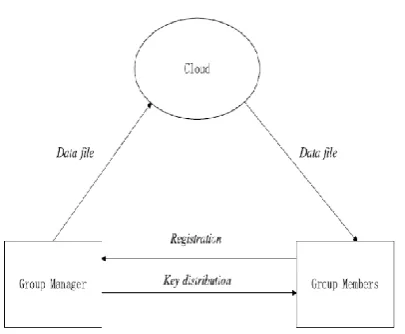
Fig -1: System Architecture

5. ALGORITHM/TECHNIQUE USED:

5.1 Advanced Encryption standard (AES) 5.2 Ring signature

5.1

Advanced Encryption standard

Description:

AES is a symmetric block cipher,

 It is based on secret key encryption algorithm[2].

 AES is sequence of 128,192 and 256, no other bits are supported. Based on the bit it will go to cipher engine and it will produce a cipher text.

 A cipher key of AES is also sequence of 128,192 and 256 bits.

 Same step will be performed for both encryption and decryption in reverse order.

 10,12,14 rounds for 128,192,256 bit keys.

 This key is expanded into individual sub keys, for each operation round. This process is called Key Expansion.

[image:3.595.49.252.101.268.2]

 Symmetric or secret-key ciphers use the same key for encrypting and decrypting, so both the sender and the receiver must know and use the same secret key.

Fig -2: Working Flow of AES

5.1.1 Operations:

 AES is an iterative rather than Feistel cipher. It is based on ‘substitution–permutation network’.  It comprises of a series of linked operations, some

of which involve replacing inputs by specific outputs substitutions and others involve shuffling bits around permutations.

 AES performs all its computations on bytes rather than bits. AES treats the 128 bits of a plaintext block as 16 bytes.

 These 16 bytes are arranged in four columns and four rows for processing as a matrix − Unlike DES, the number of rounds in AES is variable and depends on the length of the key.

 AES uses 10 rounds for 128-bit keys, 12 rounds for 192-bit keys and 14 rounds for 256-bit keys. Each of these rounds uses a different 128-bit round key, which is calculated from the original AES key.  The schematic of AES structure is given in the

(4)
[image:4.595.50.284.101.317.2]

© 2017, IRJET | Impact Factor value: 5.181 | ISO 9001:2008 Certified Journal | Page 733

Fig -3:Operations

5.1.2 Encryption Process:

[image:4.595.100.294.468.676.2]

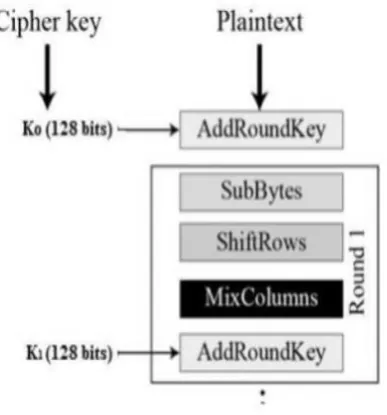
Description of a typical round of AES encryption. Each round comprise of four sub-processes. The first round process is depicted below,

Fig-4: Encryption Process

5.1.3 Byte Substitution SubBytes

The 16 input bytes are substituted by looking up a fixed table S−box given in design[12].

 The result is in a matrix of four rows and four columns. Shiftrows Each of the four rows of the matrix is shifted to the left.

 Any entries that ‘fall off’ are re-inserted on the right side of row. Shift is carried out as follows − First row is not shifted. Second row is shifted one byte position to the left. Third row is shifted two positions to the left. Fourth row is shifted three positions to the left.

 The result is a new matrix consisting of the same 16 bytes but shifted with respect to each other.  MixColumns Each column of four bytes is now

transformed using a special mathematical function.  This function takes as input the four bytes of one

column and outputs four completely new bytes, which replace the original column.

 The result is another new matrix consisting of 16 new bytes. It should be noted that this step is not performed in the last round.

 Add round key the 16 bytes of the matrix are now considered as 128 bits and are XORed to the 128 bits of the round key.

 If this is the last round then the output is the ciphertext. Otherwise, the resulting 128 bits are interpreted as 16 bytes and we begin another similar round.

 Decryption Process The process of decryption of an AES ciphertext is similar to the encryption process in the reverse order.

(5)

© 2017, IRJET | Impact Factor value: 5.181 | ISO 9001:2008 Certified Journal | Page 734  AES Analysis In present day cryptography, AES is

widely adopted and supported in both hardware and software.

 Till date, no practical cryptanalytic attacks against AES has been discovered. Additionally, AES has built-in flexibility of key length, which allows a degree of ‘future-proofing’ against progress in the ability to perform exhaustive key searches.  The AES algorithm operates on bytes, which makes

it simpler to implement and explain[15].

5.2RING SIGNATURE:

 In cryptography, a ring signature is a type of digital signature that can be performed by any member of a group of users that each have keys.

 Ring and group signatures are technologies used for signing the data by an individual or some of the group members. Ring signature technology simply hides the individual

 who signs the data before sending. The ring signature scheme, a group is defined and everyone has their own signature in the group.

 One individual or a group of individual can sign the data for encrypting or decrypting. Security of ring signature is computationally infeasible to find out the secret keys of individuals participating in the scheme keys that are required to generate the signature.

 Ring signatures are like group signatures yet contrast in two key routes: initially, individual signatures cannot be modified and a group can be formed by any number of persons.

 Thus a signature, which is anonymous utilizing the multiple public keys is generally termed as a Ring Signature.[14]

 Ring signatures portray as an approach to release a mystery.

 It also provide the authenticity and anonymity of the end users.

 Therefore, a message signed with a ring signature is endorsed by someone in a particular group of people[5].

 One of the security properties of a ring signature is that it computationally infeasible to determine which of the group members keys was used to produce the signature

Ring signatures are similar to group signatures but differ in two key ways:

1. First, there is no way to revoke the anonymity of an individual signature.

2. Second, any group of users can be used as a group without additional setup.

Ring signature is a promising candidate to construct an anonymous and authentic data sharing system for end user[7].

It allows a data owner to secretly authenticate his data which can be put into the cloud for storage.

5.2.1. Applications of Ring signature:

(6)

© 2017, IRJET | Impact Factor value: 5.181 | ISO 9001:2008 Certified Journal | Page 735

6. IMPLEMENTATION:

6.1 Group Manager:

Group manager takes charge of

system parameters generation, adding the user and deleting the user. Group manager is leader of the group.All the other parties in group trust group manager.

6.2 Group members

: Group members or group users

who are registered in that group. Only registered user can store their data in cloud and share them to others[3]. Group memberships are dynamically changed , its because of the user revocation and new user joins the group.

6.3 Key Distribution:

The group manager securely

distributes their private key to group members without any certificate authorities. In other existing scheme the goal is achieved by assuming communication channels is secure. However, in our scheme we can achieve it without communication channel.

6.4 Access control:

Group members are able to use

their resources in cloud for sharing the data and storing the data. Person who are not authorized are unable to access the resources in cloud at any time or at any situation. Revoked users are unable to use the resources in cloud after they are revoked[8].

6.5 Data confidentially:

It requires that the persons

who is not authorized are not capable of learning the data which is stored in cloud. To maintain the availability of data confidential is still a challenging issue for dynamic groups in cloud. It is mainly for revoked users are unable to decrypt the store data file after the revocation.

7.MODULES

1. User Interface design 2. Signature generation

3. File upload and encryption 4. File access and download.

Fig-5: User Interface design

Fig-6: Registered Users

(7)

© 2017, IRJET | Impact Factor value: 5.181 | ISO 9001:2008 Certified Journal | Page 736

7.CONCLUSION

In this, we design a secure anti-collusion sharing the data for dynamic groups in the cloud. User can obain their private key securely from the group manager without any secure communication channels and without any certificate authories. It supports dynamic group efficiency. Private key of the group member need be updated or recomputed when the user joins or leaves the group. Revoked user are unable to get their original data from the cloud after their revocation. This scheme can achieve secure user revocation.

REFERENCES

[1] M. Armbrust, A. Fox, R. Griffith, A. D. Joseph, R. Katz, A. Konwinski, G. Lee, D. Patterson, A. Rabkin, I. Stoica, and M. Zaharia. “A View of Cloud Computing,” Comm. ACM, vol. 53, no. 4, pp. 50-58, Apr.2010.

[2] S. Kamara and K. Lauter, “Cryptographic cloud storage,” in Proc. of FC, January 2010, pp. 136-149. [2]M. Armbrust, A. Fox, R. Griffith, A. D.Joseph, R. H.Katz, A. Konwinski, G. Lee, D. A. Patterson, A. Rabkin, I. Stoica, and M. Zaharia, “A View of Cloud Computing,” Communications of the ACM, vol. 53, no. 4, pp. 50-58, Apirl 2010.

[3] M. Kallahalla, E. Riedel, R. Swaminathan, Q. Wang, and K. Fu, “Plutus: Scalable Secure File Sharing on Untrusted Storage,” Proc. USENIX Conf. File and Storage Technologies, pp. 29-42, 2003.

[3]M. Kallahalla, E. Riedel, R. Swaminathan, Q. Wang, and K.Fu, “Plutus: Scalable Secure File Sharing on Untrusted Storage,” Proc.USENIX Conf. File and Storage Technologies, pp. 29-42, 2003.

[4] E.Goh, H. Shacham, N. Modadugu, and D. Boneh, “Sirius: Securing Remote Untrusted Storage,” Proc. Network and Distributed Systems Security Symp. (NDSS), pp. 131-145, 2003.

[5]G. Ateniese, K. Fu, M. Green, and S. Hohenberger, “Improved Proxy Re-Encryption Schemes with Applications

to Secure Distributed Storage,” Proc. Network and Distributed Systems SecuritySymp. (NDSS), pp. 29-43, 2005.

[6] Shucheng Yu, Cong Wang, Kui Ren, and Weijing Lou, “Achieving Secure, Scalable, and Fine-grained Data Access Control in Cloud Computing,” Proc. ACM Symp. Information, Computer and Comm. Security, pp. 282-292, 2010.

[7] R. Lu, X. Lin, X. Liang, and X. Shen, “Secure Provenance: The Essential of Bread and Butter of Data Forensics in Cloud Computing”, in Proc. of AISIACCS, 2010, pp. 282-292.

[8] C. Delerablee, P. Paillier, and D. Pointcheval, “Fully Collusion Secure Dynamic Broadcast Encryption with ConstantSizeCiphertexts or Decryption Keys,” in Proc. of Pairing, 2007, pp.39-59.

[9] D. Chaum and E. van Heyst, “Group Signatures,” in Proc. Of EUROCRYPT, 1991, pp. 257-265. [10] A. Fiat and M. Naor, “Broadcast Encryption,” in Proc. Of CRYPTO, 1993, pp. 48

[10]B. Waters, “Ciphertext-Policy Attribute-Based Encryption: An Expressive, Efficient, and Provably Secure Realization,” Proc. Int’l Conf. Practice and Theory in Public Key Cryptography Conf. Public Key Cryptography, http://eprint.iacr.org/2008/290.pdf, 2008

[12] C. Delerablee, P. Paillier, and D. Pointcheval, “FullyCollusionSecure Dynamic Broadcast Encryption with Constant-SizeCi-phertexts or Decryption Keys,” Proc.First Int’l Conf. Pairing-BasedCryptography, pp. 39-59, 2007.

[13]https://en.wikipedia.org/wiki/Advanced_Encryption_St andard.

[14] J.Kar,“Low Cost Scalar Multiplication Algorithms for Constrained Devices”, International Journal of Pure and Applied Mathematics, vol.102, no.3, pp.579-592.

(8)

© 2017, IRJET | Impact Factor value: 5.181 | ISO 9001:2008 Certified Journal | Page 737 Encrypted Data,” Proc. ACM Conf. Computer and Comm.

Security (CCS), pp. 89-98, 2006.

[16]G. Ateniese, K. Fu, M. Green, and S. Hohenberger, “Improved Proxy Re-Encryption Schemes with Applications to Secure Distributed Storage,” Proc. Network and Distributed Systems Security Symp. (NDSS), pp. 29-43, 2005.

BIOGRAPHIES

First Author: Ms.M.Nikitha

She is currently a B.E student in Department of Computer Science and Engineering at Adithya Institute of Technology, Coimbatore Affiliated to Anna University. Her area of interest is Cloud Computing, Big Data Analytics.

Second Author: Ms.R.Aiswarya

She is currently a B.E student in Department of Computer Science and Engineering at Adithya Institute of Technology, Coimbatore Affiliated to Anna University. Her area of interest is CloudComputing,Image Processing.

Third Author: Ms.N.Praveena

She is currently a B.E student in Department of Computer Science and Engineering at Adithya Instituteof Technology, Coimbatore Affiliated to Anna University. Her area of interest is Cloud Computing, Data Mining.

Fourth Author: Mrs. N.Rama Kalpana

Figure

Fig -2: Working Flow of AES
Fig-4: Encryption Process

References

Related documents

Vol 10, Issue 10, 2017 Online 2455 3891 Print 0974 2441 POTENTIAL ANTIOXIDANT AND CYTOTOXIC ACTIVITIES OF ARECA NUT (ARECA CATECHU LINN ) EXTRACT IN HUMAN ORAL SQUAMOUS CELL CARCINOMA

The findings revealed that for all pilgrims, one socio- demographic factor (education), one personal factor (expectation), two social factors (provision of information and

KEY WORDS: control element drive mechanism, CEDM, motor housing, coil, electromagnetic analysis, finite element method, simulation, B-H curve, magnetic field, leakage flux, lift

All estimation, sensitivity, standard error, etc., calculations were then carried out for the re- sulting finite dimensional state and finite dimensional parameter problems

kiss kiss mollys lips says: been around u 2 for 2 long lol jk i just mean its not simple. kiss kiss mollys

In this paper, a new message encryption scheme is proposed using cheating text.. The sender embeds an evident message in another plain text called Cheating

Mission control center mainly developed to collect the data from local user terminals in our project mission control center collects the data such as beacon

et al., 2007 Dose-dependent oncogene-induced senescence in vivo and its evasion during mammary tumorigenesis. A ndrews et al., 2007a A viable allele of Mcm4 causes