http://dx.doi.org/10.4236/jsea.2015.83016
Four Sliding Windows Pattern Matching
Algorithm (FSW)
Amjad Hudaib1, Rola Al-Khalid1, Aseel Al-Anani1, Mariam Itriq2, Dima Suleiman2 1Department of Computer Information Systems, King Abdullah II School for Information Technology, The University of Jordan, Amman, Jordan
2Department of Business Information Technology, King Abdullah II School for Information Technology, The University of Jordan, Amman, Jordan
Email: [email protected], [email protected], [email protected], [email protected], [email protected]
Received 25 February 2015; accepted 18 March 2015; published 20 March 2015
Copyright © 2015 by authors and Scientific Research Publishing Inc.
This work is licensed under the Creative Commons Attribution International License (CC BY). http://creativecommons.org/licenses/by/4.0/
Abstract
This paper presents an efficient pattern matching algorithm (FSW). FSW improves the searching process for a pattern in a text. It scans the text with the help of four sliding windows. The windows are equal to the length of the pattern, allowing multiple alignments in the searching process. The text is divided into two parts; each part is scanned from both sides simultaneously using two slid-ing windows. The four windows slide in parallel in both parts of the text. The comparisons done between the text and the pattern are done from both of the pattern sides in parallel. The con-ducted experiments show that FSW achieves the best overall results in the number of attempts and the number of character comparisons compared to the pattern matching algorithms: Two Sliding Windows (TSW), Enhanced Two Sliding Windows algorithm (ETSW) and Berry-Ravindran
algorithm (BR). The best time case is calculated and found to be
4 m
O while the average case
time complexity is
4
n O
m .
Keywords
Pattern Matching, FWS, Enhanced Two Sliding Windows Algorithm, RS-A Fast Pattern Matching Algorithm
1. Introduction
techniques and algorithms to find all possible occurrences of a pattern P of size m from the text string T of size n
[1]-[3]. The researchers focus on reducing the number of character comparisons and processing time. String matching algorithms are used in various applications such as matching DNA sequences [4] [5], voice recogni-tion, image processing, text processing [6]-[8], network security, real-time problem, web applications and in-formation retrieval from databases [9] [10].
In this paper, we combine the searching strategy of the ETSW algorithm and the shifting process of the BR algorithm [11] [12]. This paper ends up with a new algorithm (FSW) that uses four sliding windows which are equal to the length of the pattern. FSW divides the text into two parts; each part is scanned from both sides si-multaneously using two sliding windows. The four windows slide in parallel in both halves of the text. The comparisons done between the text and the pattern are done from both of the pattern sides in parallel. The FSW algorithm finds the first occurrence of the pattern from either the left windows or the right windows from both parts of the text. In all the cases we tested and the comparisons we performed with other matching algorithms such as BR, TSW and ETSW, the proposed algorithm FSW proved to be the best in reducing the number of comparisons and attempts needed to find the pattern [13] [14]. This paper is organized as follows: Section 2 provides an overview of the related works; Section 3 explains the FSW algorithm; Section 4 includes the per-formance analysis and Section 5 concludes the paper.
2. Related Works
Recently, several new pattern matching algorithms have been proposed to minimize the number of comparisons done to locate a pattern in a text [15]-[17]. Enhancements are made on both the searching process by using sev-eral sliding windows that scan the text in parallel and on the preprocessing phase by determining the shift value that the pattern should move in the process of searching the text for the pattern [18].
The Berry-Ravindran algorithm (BR) uses the bad character shift function to calculate the shift value for the two consecutive characters in the text immediately to the right of the pattern window. In BR the searching time complexity is calculated to be O nm
( )
and the pre-processing time complexity is O( )
σ2 [14]. The Two- Sliding Window algorithm (TSW) determines the shift value by using the idea of Berry-Ravindran bad character shift function. The pre-processing time complexity is found to be 2(
m−1)
.In the searching phase, TSW uses two sliding windows to scan the text from both sides in parallel. The search process continues until the first occurrence of the pattern is found or until both windows reach the middle of the text. The size of each sliding window is equal to the length of the pattern. In TSW, the best time complexity is
( )
O m and the worst case time complexity is 1
( )
2n
O − +m m
[12].
The Enhanced Two Sliding Windows algorithm (ETSW) utilizes the idea of Berry-Ravindran bad character shift function to get better shift values during the searching phase. In the searching phase, ETSW scans both of the text and the pattern from both sides in parallel. Both the text and the pattern are divided into left and right parts. So, the text is searched from both parts simultaneously and the comparisons with the pattern are done from both its parts at the same time. ETSW algorithm stops when the pattern is not found. In ETSW, the best
time case is
2
m O
while the average case time complexity is 2
n O
m
[11]. The Enhanced RS-A algorithm
(ERS-A) [19] utilizes the idea of RS-A algorithm to get better shift values. ERS-A algorithm uses four consecu-tive characters in the text immediately to the right of the pattern window.
The ERS-A algorithm uses two sliding windows to search for a pattern in a text. The two windows slide from both sides of the text simultaneously. The searching process continues until a match is found. It stops imme-diately if the pattern is not found in the text. In ERS-A, the best case complexity is O m
( )
while the average case time complexity is(
)
2 * 4
n O
m
+
[19].
3. The FSW Algorithm
The FSW algorithm scans the text as well as the pattern from both sides simultaneously in order to improve the search process. The proposed algorithm (FSW) scans the text using four sliding windows, allowing multiple alignments in the searching process. Each window size is equal to the length of the pattern. In the searching phase, the text is divided in into two parts; each part is scanned from both sides simultaneously using two sliding windows. The four windows slide in parallel in both halves of the text. The comparisons done between the text and the pattern are done from both sides of the pattern in parallel.
Two of the siding windows are aligned with the left and the right sides of the first part of the text and at the same time the other two sliding windows are aligned with the left and the right sides of the second part of the text resulting in four sliding windows that scam the text simultaneously. FSW algorithm stops when a sliding window finds the pattern or the pattern is not found within the text string at all.
FSW algorithm enhances the searching process in the ETSW algorithm. Both the FSW and ETSW algorithms utilize the idea of BR bad character shift function to get better shift values during the searching phase.
The main difference between the FSW and the ETSW algorithms lies in the searching process. During the search the comparisons between the pattern and the text in the FSW are made using four sliding windows while in the Enhanced TSW algorithm two sliding windows are used. Using two additional windows during the search process decreases the number of comparisons and attempts done.
3.1. Pre-Processing Phase
The pre-processing phase of the FSW algorithm is the same as in ETSW algorithm. Two arrays nextl and nextr are generated. Each array is a one-dimensional array. The shift values are calculated according to Berry-Ravindran bad character algorithm (BR). The shift values needed to search the text from the left side are stored in the nextl array. On the other hand nextr array contains the shift values needed to search the text from the right side.
To build the two arrays (nextl and nextr), we take each two consecutive characters of the pattern and give it an index starting from 0. For example for the pattern structure abcd, the consecutive characters ab, bc and cd are given the indexes 0, 1 and 2 respectively.
The shift values for the nextl array are calculated according to Equation (1) while the shift values for the nextr array are calculated according to Equation (2). In Equation (1), we compare between the last character in the pattern m − 1 with a if there is a match the window is shifted 1 character to the right. If there is a mismatch the shift is the minimum of m − i in case of p i p i
[ ] [ ]
1+ =ab, m + 1 in case of p[ ]
0 =b and m + 2 otherwise. In Equation (2), if the first character of the pattern matches b then the window is shifted 1 character to the left oth-erwise we take the minimum of m−(
(
m− −2)
i)
in case of p i p i[ ] [ ]
+ =1 ab, m + 1 in case of p m[
− =1]
a, m + 2 otherwise.[ ]
[
]
[ ] [ ]
[ ]
1 if 1 a
if 1 ab
Bad Char a, b min
1 if 0 b
2 otherwise p m
m i p i p i
shiftl m p m − = − + = = + = + (1)
[ ]
[
]
(
)
(
)
[ ] [ ]
[ ]
1 if 1 a
2 if 1 ab
Bad Char a, b min
1 if 0 b
2 otherwise
m p m
m m i p i p i
shiftr p m + − = − − − + = = = + (2)
3.2. Searching Phase
with the text at index n 2+ −m 1 while p1R window is aligned with the text at index n 2 1− where n is the text length and m is the pattern length. The alignments of p2L and p1R are calculated taking into consideration the case where some characters of the pattern may appear in part1 of the text and the rest may appear in the second part of the text.
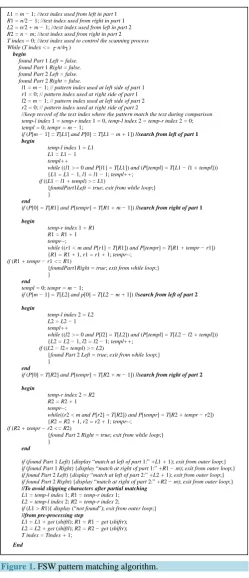
Figure 1 explains the algorithm of the FSW algorithm.
L1 = m − 1;//text index used from left in part 1
R1 = n/2 − 1;//text index used from right in part 1
L2 = n/2 + m − 1;//text index used from left in part 2
R2 = n − m;//text index used from right in part 2
T index = 0; //text index used to control the scanning process While (T index <= ┌ n/4┐)
begin
found Part 1 Left = false. found Part 1 Right = false. found Part 2 Left = false. found Part 2 Right = false.
l1 = m − 1; // pattern index used at left side of part 1
r1 = 0; // pattern index used at right side of part 1
l2 = m − 1; // pattern index used at left side of part 2
r2 = 0; // pattern index used at right side of part 2
//keep record of the text index where the pattern match the text during comparison temp-l index 1 = temp-r index 1 = 0, temp-l index 2 = temp-r index 2 = 0;
templ = 0; tempr = m − 1;
if (P[m − 1] = T[L1] and P[0] = T[L1 − m + 1]) //search from left of part 1
begin
temp-l index 1 = L1
L1 = L1 − 1
templ++
while ((l1 >= 0 and P[l1] = T[L1]) and (P[templ] = T[L1 − l1 + templ])) {L1 = L1 − 1, l1 = l1 − 1; templ++;
if ((L1 − l1 + templ) >= L1)
{foundPart1Left = true; exit from while loop;} }
end
if (P[0] = T[R1] and P[tempr] = T[R1 + m − 1]) //search from right of part 1
begin
temp-r index 1 = R1
R1 = R1 + 1
tempr--;
while ((r1 < m and P[r1] = T[R1]) and P[tempr] = T[R1 + tempr − r1]) {R1 = R1 + 1, r1 = r1 + 1; tempr--;
if (R1 + tempr − r1 <= R1)
{foundPart1Right = true; exit from while loop;} }
end
templ = 0; tempr = m − 1;
if (P[m − 1] = T[L2] and p[0] = T[L2 − m + 1]) //search from left of part 2
begin
temp-l index 2 = L2
L2 = L2 − 1
templ++
while ((l2 >= 0 and P[l2] = T[L2]) and (P[templ] = T[L2 − l2 + templ])) {L2 = L2 − 1, l2 = l2 − 1; templ++;
if ((L2 − l2+ templ) >= L2)
{found Part 2 Left = true; exit from while loop;} }
end
if (P[0] = T[R2] and P[tempr] = T[R2 + m − 1]) //search from right of part 2
begin
temp-r index 2 = R2
R2 = R2 + 1
tempr--;
while((r2 < m and P[r2] = T[R2]) and P[tempr] = T[R2 + tempr − r2]) {R2 = R2 + 1, r2 = r2 + 1; tempr--;
if (R2 + tempr − r2 <= R2)
{found Part 2 Right = true; exit from while loop;} }
end
if (found Part 1 Left) {display “match at left of part 1:” +L1 + 1); exit from outer loop;}
if (found Part 1 Right) {display “match at right of part 1:” +R1 − m); exit from outer loop;}
if found Part 2 Left){display “match at left of part 2:” +L2 + 1); exit from outer loop;}
if found Part 2 Right){display “match at right of part 2:” +R2 − m); exit from outer loop;} //To avoid skipping characters after partial matching
L1 = temp-l index 1; R1 = temp-r index 1;
L2 = temp-l index 2; R2 = temp-r index 2;
if (L1 > R1){ display (“not found”); exit from outer loop;} //from pre-processing step
L1 = L1 + get (shiftl); R1 = R1 − get (shiftr);
L2 = L2 + get (shiftl); R2 = R2 − get (shiftr);
T index = Tindex + 1;
End
3.3. Working Example
In this section we will present an example to clarify the FSW algorithm. Given:
Pattern (P) = “abcd”, m = 4,
Text (T) = “abaccbacdacdbadcbaadcbbcacbbcaaddcaabcbaaacbddababcdddabdaabaabccdabccdbacbdcbcdacc dbcbddaadddbcabdb”, n = 100.
3.3.1. Pre-Processing Phase
Initially, shiftl1 = shiftr1 = shiftl2 = shiftr2 = m + 2 = 6.
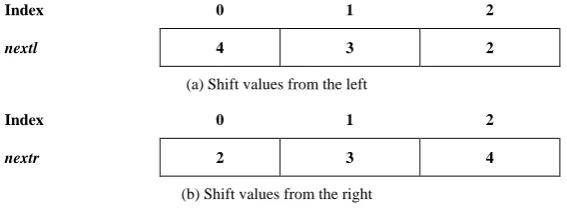
The shift values are calculated using equations 1 and 2. The values are then stored in two arrays nextl and nextr as shown in Figure 2(a) and Figure 2(b)respectively.
3.3.2. Searching Phase
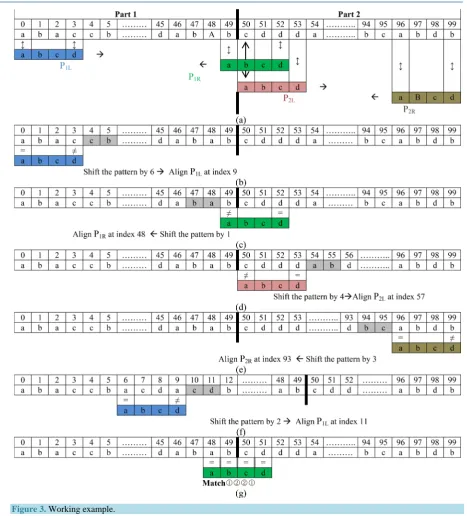
The searching process for the pattern P is illustrated through the working example as shown inFigure 3.
First attempt: (see Figure 3(b))
We align p1L with the text from the left of part 1. In this case, comparisons are made between the text charac-ter located at index 0 (characcharac-ter a) with the leftmost characcharac-ter in the patcharac-tern (characcharac-ter a). At the same time, comparisons are made between the text character at index 3 (characterc) with the rightmost character in the pat-tern (character d). As a result, a mismatch occurs between text character c and patpat-tern character d; therefore we take the two consecutive characters from the text at index 4 and 5 which are c and b respectively. To determine the amount of shift (shiftl) we have to do the following two steps:
a) We look for the index of cb in the pattern.
b) Since cb is not found in the pattern, so the window is shifted to the right 6 steps (see Equation (1)).
As explained in the example the number of comparisons needed to determine if there is a match or not is one; this is because two character comparisons between the text and the pattern are performed at the same time.
Second attempt: (seeFigure 3(c))
We align p1R with the text from the right of part 1. In this case, a match occurs between the text character at index 52 (d) and the rightmost character in the pattern d while there is a mismatch between the text character at index 49 (b) and the leftmost character in the pattern a; therefore we take the two consecutive characters from the text at index 47 and 48 which are b and a respectively. To determine the amount of shift (shiftr), we have to do the following two steps:
a) We look for the index of ba in the pattern.
b) Since ba is not found in the pattern, but the p
[ ]
0 which is a matches the text character at index 48 then according to the pre-processing phase the sliding window will be shifted 1 step to the left.Third attempt: (see Figure 3(d))
We align p2L with the text from the left of part 2. In this case, a mismatch occurs between the text character at index 50 (c) and the leftmost character in the pattern a while there is a match between the text character at index 53 (d) and the rightmost character in the pattern d; therefore we take the two consecutive characters from the text at index 54 and 55 which are a and b respectively. To determine the amount of shift (shiftl) we have to do the following two steps:
a) We look for the index of ab in the pattern, which is found 0.
Index 0 1 2
nextl 4 3 2
(a) Shift values from the left
Index 0 1 2
nextr 2 3 4
[image:5.595.174.458.599.704.2](b) Shift values from the right
Figure 3. Working example.
b) Since we search from the left side we use nextl array, and shiftl = nextl [0] = 4. Therefore the window will be shifted to the right 4 steps.
Fourth attempt:
In the fourth attempt (seeFigure 3(e)), we align the fourth sliding window with the text from the right of part 2. In this case, a mismatch occurs between the text character at index 99 (b) and the rightmost character in the pattern (character d) while there is a match between the text character at index 96 (character a) and the leftmost character in the pattern (character a); therefore we take the two consecutive characters from the text at index 94 and 95 which are b and c respectively. To determine the amount of shift (shiftr), we have to do the following two steps:
b) Since we search from the right side, we use nextr array, and shiftr = nextr[1] = 3. Therefore the window is shifted to the left 3 steps.
Fifth attempt:
In the fifth attempt (seeFigure 3(f)), we align the first sliding window with the text from the left of part 1. In this case, a match occurs between the text character at index 6 (a) and the leftmost character in the pattern (cha-racter a) while there is a mismatch between the text cha(cha-racter at index 9 (cha(cha-racter a) and the rightmost cha(cha-racter in the pattern (characterd); therefore we take the two consecutive characters from the text at index 10 and 11 which are c and d respectively,
a) We look for the index of cd in the pattern.
b) Since we search from the left side we use nextl array, and shiftl = nextl [2] = 2. Therefore the window is shifted to the right 2 steps.
Sixth attempt:
In the sixth attempt (seeFigure 3(g)), we align the second sliding window with the text from the right of part 1. A comparison between the pattern and the text characters leads to a complete match at index 48. In this case, the occurrence of the pattern is found using the right window of part 1.
4. Analysis
Preposition 1: The space complexity is O
(
2(
m−1)
)
where m is the pattern length.Preposition 2: The pre-process time complexity is O
(
2(
m−1)
)
.Lemma 1: The worst case time complexity is 1 .
2 4 4
n m m
O − +
Proof: The worst case occurs when at each attempt, all the compared characters of both pattern sides at 4 windows that slide simultaneously are matched the corresponding text characters except the pattern character indexed (m), and at the same time the shift value is equal to 1.
Lemma 2: The best case time complexity is . 4
m O
Proof: The best case occurs when the pattern is found at the first index 1 2
n−
, 1
2
n m
+ − , or at the last index
(n− m), in this case the number of comparisons made to compare m pattern characters are
4
m
.
Lemma 3: The average case time complexity is
4
n m
.
Proof: The average case occurs when the two consecutive characters of the text directly following the sliding window is not found in the pattern. In this case, the shift value will be (m + 2) for each window from 4 available windows.
5. Results
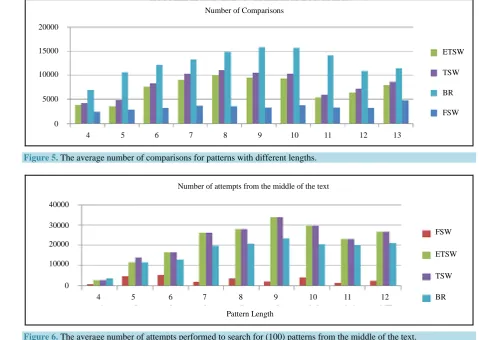
In order to ensure that the FSW algorithm gives extraordinary results in the searching process, several experi-ments were performed. The FSW algorithm searches the text using four sliding windows. All the windows slide in parallel. Comparisons done with the pattern is also done from both sides simultaneously.Tables 1-5 as well as Figures 4-7 show the results of comparing FSW with ETSW, TSW and BR algorithms.
Table 1. The average number of attempts and comparisons for patterns with different lengths.
Pattern length
Number of words
FSW ETSW TSW BR
Attempts Comparisons Attempts Comparisons Attempts Comparisons Attempts Comparisons
4 8103 2525 2488 3904 3875 3904 4213 6409 7039
5 4535 3133 2856 4456 3549 4456 4896 9577 10645
6 2896 3232 3252 7596 7633 7596 8311 10898 12173
7 1988 3723 3697 9341 9118 9341 10263 11953 13345
8 1167 3502 3577 10056 10115 10056 11087 13256 14807
9 681 3330 3350 9538 9590 9538 10538 14149 15892
10 382 3708 3822 9283 9339 9283 10272 14127 15799
11 191 3341 3363 5451 5482 5451 5967 12808 14243
12 69 3232 3255 6384 6433 6384 7168 9598 10923
[image:8.595.87.539.342.520.2]13 55 4781 4807 7947 7986 7947 8673 10334 11370
Table 2. The average number of attempts and comparisons performed to search for (100) patterns selected from the middle of the text.
Pattern length
FSW ETSW TSW BR
Attempts Comparisons Attempts Comparisons Attempts Comparisons Attempts Comparisons
4 875 879 2726 2737 2726 2959 3645 4070
5 4706 4730 11582 11618 13965 15140 11558 12793
6 5152 5175 16682 16771 16682 18317 12878 14337
7 1895 1907 26104 26242 26104 30095 19547 22006
8 3511 3530 27830 28015 27830 30915 20831 23336
9 2021 2029 33929 34069 33929 37200 23284 25852
10 4152 4176 29676 29845 29676 32817 20546 22989
11 1333 1341 23195 23242 23195 24646 20264 22005
12 2413 2435 26806 27009 26806 30222 21113 24235
Table 3. The number of attempts and comparisons performed to search for a set of patterns that do not exist in the text.
Pattern length
FSW ETSW TSW
Attempts Comparisons Attempts Comparisons Attempts Comparisons
4 135592 136887 136188 137630 136188 152137
5 116040 1173911 116644 118058 116644 130485
6 101652 102826 102076 103338 102076 113994
7 90480 91359 90854 91798 90854 101469
8 81472 82381 81700 82691 81700 91419
9 74080 74886 74326 75157 74326 83085
10 68012 68698 67984 68722 67984 75863
11 62648 63220 62738 63405 62738 70012
[image:8.595.92.539.547.723.2]Table 4. The average number of attempts and comparisons performed to search for (100) patterns selected from the begin-ning of the text.
Pattern length
FSW ETSW TSW BR
Attempts Comparisons Attempts Comparisons Attempts Comparisons Attempts Comparisons
4 278 280 143 145 143 157 76 85
5 359 361 185 187 185 206 100 115
6 443 448 227 230 227 255 121 142
7 686 691 347 351 347 388 195 226
8 967 975 504 510 504 568 270 310
9 1340 1349 670 677 670 750 363 417
10 2269 2285 1160 1170 1160 1290 640 727
11 1243 1251 622 628 622 705 331 396
[image:9.595.86.540.341.705.2]12 1729 1747 865 878 865 972 478 557
Table 5. The average number of attempts and comparisons performed to search for (100) patterns selected from the end of the text.
Pattern length
FSW ETSW TSW BR
Attempts Comparisons Attempts Comparisons Attempts Comparisons Attempts Comparisons
4 251 253 133 135 133 148 6899 7719
5 508 510 268 270 268 297 12930 14404
6 716 720 364 368 364 402 21315 23957
7 792 797 402 405 402 447 22237 24731
8 1056 1063 536 541 536 592 21495 23841
9 1489 1498 776 783 776 859 24919 28257
10 3047 3067 1579 1593 1579 1756 31603 35360
11 1238 1244 619 624 619 669 32797 36438
12 3269 3296 1667 1685 1667 1872 30928 35069
4 5 6 7 8 9 10 11 12 13
FSW BR TSW ETSW Number of Attempts
0 5000 10000 15000
4 5 6 7 8 9 10 11 12 13
FSW BR TSW ETSW Number of Comparisons
[image:10.595.73.538.82.237.2]0 5000 10000 15000 20000
Figure 5. The average number of comparisons for patterns with different lengths.
4 5 6 7 8 9 10 11 12
FSW
BR TSW ETSW Number of attempts from the middle of the text
0 10000 20000 30000 40000
[image:10.595.63.543.86.426.2]Pattern Length
Figure 6. The average number of attempts performed to search for (100) patterns from the middle of the text.
4 5 6 7 8 9 10 11 12
FSW
BR TSW ETSW Number of Comparisions from the middle of the text
0 10000 20000 30000 40000
Pattern Length
Figure 7. The average number of comparisons performed to search for (100) patterns from the middle of the text.
Table 2,Figure 6and Figure 7 show the average number of attempts and comparisons performed to search for 100 patterns selected from the middle of the text. FSW algorithm shows the best results in both number of comparisons and attempts.
This is expected since FSW search the text using four windows, two of them starts from the middle of the text. On the other hand, ETSW and TSW uses two windows aligned at the rightmost and the leftmost sides of the text.
[image:10.595.86.541.258.409.2] [image:10.595.87.539.436.617.2]For example, to search for a pattern of length 4, the average number of comparisons and attempts made by FSW is 879 and 875 respectively. Compared to ETSW, TSW and BR, the results are far better in FSW than in the other algorithms.
FSW algorithm has the minimum number of comparisons and attempts performed to search for patterns of different lengths that are not found in the text as shown in Table 3.
Table 4 show the average number of comparisons and attempts performed to search for 100 patterns selected from the beginning of the text. BR algorithm has the minimum number since it searches the text using only one window from the left, i.e. from the beginning of the text. On the other hand, ETSW and TSW use two sliding windows that slide from the left side and the right side of the text which increases the number compared to BR algorithm. FSW algorithm’s results show that there is an increase in the number of comparisons and attempts performed especially if the pattern is found in the middle of the text. This is expected since four sliding widows are used.
Table 5 show the average number of comparisons and attempts performed to search for 100 patterns selected from the end of the text. The results of FSW are reasonable since the pattern is found at the end of the text. BR on the other hand performed a large number of comparisons and attempts since it searches the text starting from the left side of the text.
6. Conclusions
In this paper, we presented a new pattern—matching algorithm (FSW) which finds all occurrences of a given pattern p in a given text t using four sliding windows. The new algorithm enhances the ETSW algorithm which uses only two sliding windows. Extensive experiments have been conducted. The results show that FSW best performance appears when the pattern is found in the middle of the text. If the pattern is in the beginning or the end of the text, the number of comparisons and attempts in FSW increases compared to other algorithms.
Using four sliding windows that search the text in parallel as well as comparing the pattern from both sides simultaneously makes the FSW performance better and decreases the searching time. In the future we intend to apply the FSW algorithm to additional applications such as computational biology and search engines. Also we intend to use threads to implement the FSW algorithm.
References
[1] Simone, F. and Thierry, L. (2013) The Exact Online String Matching Problem: A Review of the Most Recent Results.
ACM Computing Surveys, 45, 13.
[2] Yang, Z., Yu, J. and Kitsuregawa, M. (2010) Fast Algorithms for Top-k Approximate String Matching.Proceedings of the Twenty-Fourth AAAI Conference on Artificial Intelligence, Atlanta, 11-15 July 2010.
[3] Pendlimarri, D. and Petlu, P.B.B. (2010) Novel Pattern Matching Algorithm for Single Pattern Matching. International Journal on Computer Science and Engineering, 2, 2698-2704.
[4] Bhukya, R. and Somayajulu, D. (2011) Article: Exact Multiple Pattern Matching Algorithm Using DNA Sequence and Pattern Pair. International Journal of Computer Applications, 17, 32-38. http://dx.doi.org/10.5120/2239-2862
[5] Alsmadi, I. and Nuser, M. (2012) String Matching Evaluation Methods for DNA Comparison. International Journal of Advanced Science and Technology, 47, 13-32.
[6] Bhandaru, J. and Kumar, A. (2014) A Survey of Fast Hybrid String Matching Algorithms. International Journal of Emerging Sciences, 4, 24-37.
[7] Linhai, C. (2014) An Innovative Approach for Regular Expression Matching Based on NoC Architecture. International Journal of Smart Home, 8, 45-52. http://dx.doi.org/10.14257/ijsh.2014.8.1.06
[8] Diwate, R. and Alaspurkar, S. (2013) Study of Different Algorithms for Pattern Matching. International Journal of Advanced Research in Computer science and Software Engineering, 3, 615-620.
[9] Singla, N. and Garg, D. (2012) String Matching Algorithms and Their Applicability in Various Applications. Interna-tional Journal of Soft Computing and Engineering (IJSCE), I, 218-222.
[10] Guo, L., Du, S., Ren, M., Liu, Y., Li, J., He, J., Tian, N. and Li, K. (2013) Parallel Algorithm for Approximate String Matching with K Differences. IEEE Eighth International Conference on Networking, Architecture and Storage, 17-19 July 2013, 257-261. http://dx.doi.org/10.1109/NAS.2013.40
[12] Hudaib, A., Al-Khalid, R., Suleiman, D., Itriq, M. and Al-Anani, A, (2008) A Fast Pattern Matching Algorithm with Two Sliding Windows (TSW). Journal of Computer Science, 4, 393-401. http://dx.doi.org/10.3844/jcssp.2008.393.401 [13] Suleiman, D. (2014) Enhanced Berry Ravindran Pattern Matching Algorithm (EBR). Life Science Journal, 11, 395-
402.
[14] Berry, T. and Ravindran, S. (2001) A Fast String Matching Algorithm and Experimental Results. In: Holub, J. and Si-manek, M., Eds., Proceedings of the Prague Stringology Club Workshop’99, Collaborative Report DC-99-05, Czech Technical University, Prague, 16-26.
[15] Khan, Z. and Pateriya, R.K. (2012) Multiple Pattern String Matching Methodologies: A Comparative Analysis. Inter-national Journal of Scientific and Research Publications, 2, 2250-3153.
[16] Claude, F., Navarro, G., Peltola, H., Salmela, L. and Tarhio, J. (2012) String Matching with Alphabet Sampling. Jour-nal of Discrete Algorithms, 11, 37-50. http://dx.doi.org/10.1016/j.jda.2010.09.004
[17] Zhang, P. and Liu, J. (2011) An Improved Pattern Matching Algorithm in the Intrusion Detection System. Applied Mechanics and Materials, 48-49, 203-207. http://dx.doi.org/10.4028/www.scientific.net/AMM.48-49.203
[18] Faro, S. and Lecroq, T. (2012) A Multiple Sliding Windows Approach to Speed Up String Matching Algorithms. SEA, 172-183.
[19] Suleiman, D., Hudaib, A., Al-Anani, A., Al-Khalid, R. and Itriq, M. (2013) ERS-A Algorithm for Pattern Matching.