© 2016, IRJET | Impact Factor value: 4.45 | ISO 9001:2008 Certified Journal | Page 501
Solving Combined Economic Emission Dispatch Solution Using Jaya
Optimization Algorithm Approach
Sudhir Phulambrikar
Associate Professor, Department of Electrical Engineering S.A.T.I. Vidisha (M.P.)
Abstract:- For large power system operation Economic Load Dispatch is one of the most important problem. Its objective how to schedule generation at various inter connected generating plants , to meet required load demand, considering system constraints to keep operating cost at minimum level. In combined economic emission dispatch (ceed) not only minimize the operating but simultaneously keep emission level low also. There are various technique, proposed by several researchers to solve ceed problem. In this paper Jaya, Particle Swarm Optimization and Bare-Born Particle Swarm Optimization and Differential Evolutionary algorithms are applied to minimize operating cost with minimization of emission too. Generation for various units and Power loss is calculated using Newton-Raphson power flow method on IEEE-6 and IEEE-14 bus test data.
Key Words:- Combined Economic Emission Dispatch, Particle Swarm Optimization , Bare-Bone PSO, Jaya Optimization Algorithm
I. Nomenclature:-
Fi Pi Fuel cost function of ith generator
Pi Real power generation of ith generator
Pimin Minimum limit of real power generation
Pimax Maximum limit of real power generation
PD Total real power demand
PL, QL Real and reactive power losses of the system
NG Number of generator
Ei Total Emission from generators
ai , bi ,ci Cost coefficient of ith generator
di , ei , fi NOx emission coefficients of ith generator
h Price penalty factor
© 2016, IRJET | Impact Factor value: 4.45 | ISO 9001:2008 Certified Journal | Page 502 Gbest Globle best position of particle
µki,j mean of pbest and gbest in jth decision variable of ith particle at kth iteration
σki,j absolute difference pbest and gbest in jth decision variable of ith particle at kth iteration
N represents gaussian distribution
2. Introduction :- Generating stations are interconnected to achieve benefits of better operating conditions, flexibility with better reliability of system. By economic load dispatch minimum production cost can be achieve. As per government regulations on environment protection , the conventional operation at absolute minimum fuel cost, cannot be the only basis of dispatching electric power. There is expectation from society for adequate and secure electricity at minimum possible price with minimum levels of pollution, produced by fossil-fuelled electric power plants. The clean Air Act Amendments instruct to reduce NOx and SO2 emission also be minimum from such power plants. The single objective
can no longer be considered alone. So Environmental Economic dispatch is a multi-objective problem. Well known long established techniques such as integer programming, dynamic programming and legarangian relaxation method[1-2] have been used to solve economic load dispatch problem. Nanda et al. solved economic-emission problem using goal programming technique for a system having six generator[3]. Nanda et al. also applied classical technique based on coordinated equation to obtain economic emission load dispatch for IEEE14 and 30 bus system[4].Dhillon et al.[5] applied weighted minimax technique and fuzzy set theory to find out solution. Recently other optimization method such as Genetic algorithm[7],Artificial Bee Colony Optimization[8], Modified Ant Colony Optimization[9] are applied for ceed solution,. Swarm intelligence algorithms [12 -16] is also applied by researchers. Niched parato genetic algorithm is also reported for optimum solution for ceed problem.
In this paper NOx contains are minimized by applying Particle Swarm Optimization (PSO) and
Bare-Bones Particle Swarm Optimization (BBPSO), Differential Evolutionary (DE), Jaya Algorithm and their results are compared for various load demand. A price penalty factor (h) [8,11], is used in the objective function to combine the fuel cost and emission function.
3. Problem Formulation
:-The mathematical formulation of the total fuel cost function as follows
Min j = Fi Pi (1)
𝑁𝐺
𝑖=1
Where Fi is the total fuel cost for the generator (in Rs/Hr). Generally the fuel cost of thermal generating
© 2016, IRJET | Impact Factor value: 4.45 | ISO 9001:2008 Certified Journal | Page 503 The combined economic and emission dispatch problem can be formulated as to minimize
Min f = 𝑁𝐺𝑖=1Fi(Pi)+ℎ 𝑁𝐺𝑖=1Ei(Pi)(2)
where
Fi(Pi) = aipi2 + bi pi +ci(3)
andai , bi, ,ci are cost coefficient of generator i
Ei(Pi) = di pi2 + eipi + fii(4)
Where di , ei , fi are NOx emission coefficient and h is price penalty factor.
Constraints of the system:-.
Inequality constraint:- Generation of power of each generator should be within limit of their maximum and minimum limits. The inequality constraint for each generator
Pimin ≤ Pi ≤ Pimax (5)
Cost coefficients and emission coefficients are given for generators units are in use while penalty factor ‘h’ is to be evaluate. A practical way of evaluating h is discussed in [9] The procedure to calculate’ h is as follow.
For given load in the system Pd MW
(1) Calculate the maximum cost of each generator at its maximum output, i.e. Fi(Pimax) = (aiP2i max + biPi max
+ ci) Rs/hr
(2) Calculate the maximum NOx emission of each generator at its maximum output Ei(Pi max) = (diP2i max
+ ei Pi max + fi) kg/hr
(3) Divide the maximum cost of each generator by its maximum NOx emission.i.e.,
𝐹𝑖( 𝑃𝑖𝑚𝑎𝑥 ) 𝐸𝑖 ( 𝑃𝑖𝑚𝑎𝑥 )
=
𝑎𝑖𝑃𝑖𝑚𝑎𝑥2 + 𝑏𝑖𝑃𝑖𝑚𝑎𝑥 +𝑐𝑖
𝑑𝑖𝑃𝑖𝑚𝑎𝑥2 +𝑒𝑖𝑃𝑖𝑚𝑎𝑥 + 𝑐𝑖 (6)
𝐹𝑖 𝑃𝑖𝑚𝑎 𝑥
𝐸𝑖(𝑃𝑖𝑚𝑎𝑥 )
= ℎ
𝑖 Rs / Kg (7)After calculation of hi
© 2016, IRJET | Impact Factor value: 4.45 | ISO 9001:2008 Certified Journal | Page 504 (5) Add the maximum capacity of each unit, (Pi max) one at a time starting from the smallest hi unit total
demand is met to satisfy
𝑃𝑖𝑚𝑎𝑥
𝑁𝐺
𝑖=1 >= PD
(6) At this stage, hi associated with the last unit in the process is the price penalty factor h in Rs/kg for
the given load
Arrange hi in ascending order . h = [h1,h2,---,hn] for a load of PD starting from the lowest hi of
maximum capacity of unit is added one by one and when this total equals or exceeds the load, hi
associated with the last unit in the process is the price penalty factor for the given PD, then substituting
the value of ‘ h’, equation can be solved. 4. Jaya Algorithm: an overview
The word Jaya is taken from sanskrit its meaning is victory. Jaya algorithm is developed by R.Venkata Rao in 2015 [ 23 ]. It is algorithmic specific parameter-less optimization algorithm. It requires only common controlling parameters like population size and number of generations for its working. It can be applied for solving constrained and unconstrained optimization problems. Among the population best candidate f(x)best and worst candidate f(x)worst are obtained from entire candidate solution. Its implementation moves solution towards best solution and avoid solution moves towards worst solution. The steps of implementation of jaya algorithm is as follows
Step(a) : Initialization population of size n, with m design variables P = [ X1, X2, X3 ---Xn ]
Xi = [ Xi1, Xi2 , Xi3, ---Xim ]
Step(b) : Evaluate fitness for each population
Step(c) : Obtain best value (i.e.f(x) best) and worst value (i.e.f(x) worst) among the population Step(d): Update each population as per following eqution
Xj worst,i = X j,k,i + r1,j,i ( Xj,best,i - | Xj,k,i |) – r2j,i (Xj worst,i - |Xj,k,i|)
Where Xj,best,i is the value of variable j for the best candidate
Xj worst,i is the of the variable j for the worst candidate
Xj worst,i is the updated value of Xj,k,i
© 2016, IRJET | Impact Factor value: 4.45 | ISO 9001:2008 Certified Journal | Page 505 the term “r1,j,i ( Xj,best,i - | Xj,k,i |) “ has tendency to bring solution closer to solution while the term “r2j,i (Xj worst,i
- |Xj,k,i|) “ has tendency to avoied the worst solution. X’j,k,i is accepted if it gives better function value. All
better function values become the input for next iteration.
Yes No
[image:5.612.43.503.165.601.2]No
Fig 1 Flow Chart for Jaya Algorithm
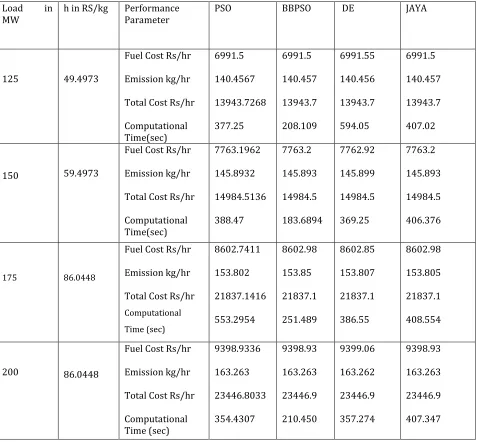
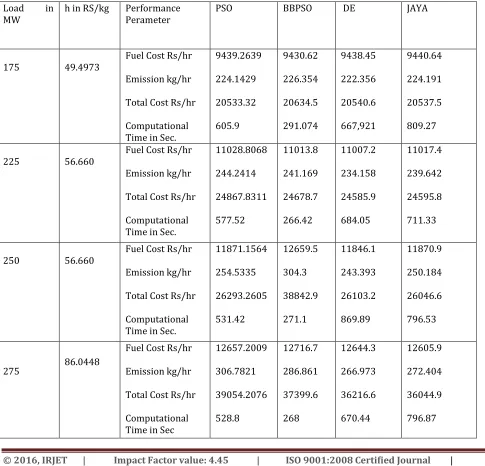
5. Results and Discussion :- The applicability and validity of PSO and BBPSO,DE, Jaya algorithm, tested on IEEE 6 Test system and IEEE 14 Test system by taking various load demands. Table No. 1. Are applied to 6- bus system consist of three generator buses and three load buses while 14 – bus system consist of five generator bus and 11 load buses .
Initialize Population Size, numberof design variables and termination criterion
Identify best and worst solutions in the population
Modify the solutions based on best and worst solutions
X’j,k,I = Xj,k,I + rj,k,I [ ( Xj,best,i) - | ( Xj,k,i) | - r2,j,i [ (Xj,worst,i) - |(Xj,k,i)|]
Is the updated solution
f(X’j,k,i) is better than f( Xj,k,i)
Keep the previous solution Accept and replace the previous
solution
Is the termination criterion satisfied
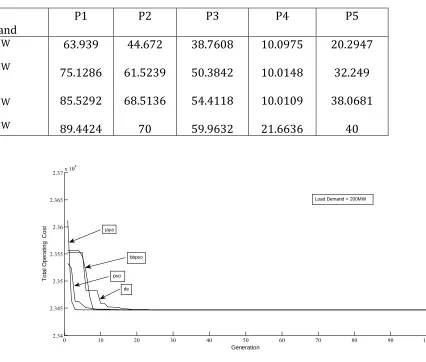
© 2016, IRJET | Impact Factor value: 4.45 | ISO 9001:2008 Certified Journal | Page 506 Table1,( 6- bus system) while Table3,( 14 bus system) shows results for fuel cost, emission, total operating cost and computational time for stated optimization algorithms. Table 2 and table 4 shows results using Jaya algorithm for min. power generated by various generating units in 6 and 14 bus system to meet required load demand keeping fuel cost, emission of NOxand total operating cost at minimum level.
Table No. 1 Comparison of Test Results for Three Generating Units, IEEE 6 Bus System
Load in
MW h in RS/kg Performance Parameter PSO BBPSO DE JAYA
125 49.4973
Fuel Cost Rs/hr
Emission kg/hr
Total Cost Rs/hr
Computational Time(sec) 6991.5 140.4567 13943.7268 377.25 6991.5 140.457 13943.7 208.109 6991.55 140.456 13943.7 594.05 6991.5 140.457 13943.7 407.02
150 59.4973
Fuel Cost Rs/hr
Emission kg/hr
Total Cost Rs/hr
Computational Time(sec) 7763.1962 145.8932 14984.5136 388.47 7763.2 145.893 14984.5 183.6894 7762.92 145.899 14984.5 369.25 7763.2 145.893 14984.5 406.376
175 86.0448
Fuel Cost Rs/hr
Emission kg/hr
Total Cost Rs/hr Computational Time (sec) 8602.7411 153.802 21837.1416 553.2954 8602.98 153.85 21837.1 251.489 8602.85 153.807 21837.1 386.55 8602.98 153.805 21837.1 408.554
200 86.0448
Fuel Cost Rs/hr
Emission kg/hr
Total Cost Rs/hr
© 2016, IRJET | Impact Factor value: 4.45 | ISO 9001:2008 Certified Journal | Page 507 Table No. 2 Optimum Power Dispatch Results By Jaya Optimization Algorithm For 3 Units , IEEE Six Bus System
Power
Demand P1(MW) P2(MW) P3(MW)
125 MW 150 MW 175 MW 200 MW 58.6394 66.912 77.6116 86.0307 34.885 44.1942 52.3504 61.5931 35.778 43.5112 51.6838 59.4374
Table No. 3 Comparison of Test Result for Five Generating Units, IEEE 14 Bus System
Load in
MW h in RS/kg Performance Perameter PSO BBPSO DE JAYA
175 49.4973 Fuel Cost Rs/hr
Emission kg/hr
Total Cost Rs/hr
Computational Time in Sec.
9439.2639 224.1429 20533.32 605.9 9430.62 226.354 20634.5 291.074 9438.45 222.356 20540.6 667,921 9440.64 224.191 20537.5 809.27
225 56.660 Fuel Cost Rs/hr
Emission kg/hr
Total Cost Rs/hr
Computational Time in Sec.
11028.8068 244.2414 24867.8311 577.52 11013.8 241.169 24678.7 266.42 11007.2 234.158 24585.9 684.05 11017.4 239.642 24595.8 711.33
250 56.660 Fuel Cost Rs/hr
Emission kg/hr
Total Cost Rs/hr
Computational Time in Sec.
11871.1564 254.5335 26293.2605 531.42 12659.5 304.3 38842.9 271.1 11846.1 243.393 26103.2 869.89 11870.9 250.184 26046.6 796.53
275 86.0448
Fuel Cost Rs/hr
Emission kg/hr
Total Cost Rs/hr
Computational Time in Sec
© 2016, IRJET | Impact Factor value: 4.45 | ISO 9001:2008 Certified Journal | Page 508 Table No. 4 Optimum Power Dispatch Results By Jaya Optimization Algorithm For 5 Units , IEEE 14 Bus System
Load
Demand P1 P2 P3 P4 P5
175 MW
225 MW
250 MW
275 MW
63.939
75.1286
85.5292
89.4424
44.672
61.5239
68.5136
70
38.7608
50.3842
54.4118
59.9632
10.0975
10.0148
10.0109
21.6636
20.2947
32.249
38.0681
40
Fig. 2 Convergence of three generating units, IEEE 6 bus system
0 10 20 30 40 50 60 70 80 90 100
2.34 2.345 2.35 2.355 2.36 2.365
2.37x 10
4
Generation
T
o
ta
l
O
p
e
ra
ti
n
g
C
o
st
Load Demand = 200MW
jaya
de pso
© 2016, IRJET | Impact Factor value: 4.45 | ISO 9001:2008 Certified Journal | Page 509 Fig.3 Convergence of five generating units, IEEE 14 bus system
6. Conclusions: -In this paper PSO and BBPSO, DE, Jaya algorithm has been applied for CEED problem, for IEEE -14 test system with five generating units. On comparing results for various load it is found that Jaya algorithm giving better results than DE,PSO,BBPSOalgorithm in total operating cost This shows the effectiveness and applicability of Jaya algorithm to achieve objective of CEED i.e. minimum fuel cost operation with minimum emission while considering constraints of the system
Appendix:-
[image:9.612.69.466.92.304.2]Table No 5 Fuel Cost coefficient
Table No 6Emission Coefficient (NOx)
Generator Unit Fue l Emission Coefficient PGmin PGmax
di ei fi
G1 G2 G3 G4 G5 0.00419 0.00403 0.00551 0.00483 0.00600 -0.3276 - 0.1032 -0.2056 0.0555 0.0100 35.859 56.300 52.099 30.266 41.859 50 30 30 10 10 90 70 60 50 40
0 0.1 0.2 0.3 0.4 0.5 0.6 0.7 0.8 0.9 1
0 0.1 0.2 0.3 0.4 0.5 0.6 0.7 0.8 0.9 1
0 10 20 30 40 50 60 70 80 90 100
2.6 2.62 2.64 2.66 2.68 2.7 2.72 2.74 2.76 2.78 2.8 2.82x 10
4 Generation T o ta l O p e ra ti n g C o st
Load Demand 250 MW
Jaya DE pso bbpso Generator Unit
Fuel Cost Coefficient PGmin PGmx
ai bi ci
© 2016, IRJET | Impact Factor value: 4.45 | ISO 9001:2008 Certified Journal | Page 510 VII. References
[1 ] Baiyat, T.C. Cheng, Economc Load Dispatch Multiobjective Optimization Procedures Using Linear Programming Techniques, IEEE Transactions on Power Systems Vol. 10, No 2, May 1995
[2] Hadi Saadat, Power System Analysis, Tata McGRAW-Hill New Delhi
[3] J.Nanda, D.P.Kothari, K.S. Lingamurthy, Economic –emission load dispatch through goal programming, IEEE Transaction n Energy Consevation ,Vol.3,No1, 1988
[4] J.Nanda, Lakshman Hari, M.L. Kothari, Economic emission load dispatch wit h line flow constraints using classical technique, IEE Proc.- Gener. Tran Distrib vol 141, No 1
[5] j.S. Dhillon, S.C. Parti, D.P.Kothari, Stochastic economic load dispatch, Electrical Power System Research- 1993
[6] L D Arya, S C Choube and D P Kothari Emission constrained secure economic dispatch, Electrical Power & Energy Systems Vol.19, No. 5
[7] M Shailaja Kumari, M.Sydulu, “ A Fast Computational Genetic Algorithm for Economic Load Dispatch” International Journal of Recent Trends in Engineering Vol.1 , No1, May 2009
[8]Gaurav Prasad Dixit et.al., Economic Load Dispatch Using Artifitial Bee Colony Optimization,International Journal of Advances in Electronics Engineering,pp 119-124
[9] R Gopal Krishnan & A krishnn, An Efficient technique to solve combined economic and emission dispatch problem using Modified Ant Colony Optimization, Sadhana Vol. 38
[10]I.F. Robert ,Ah King and Harry C.S. Rughoopath, Elitist Multiobjective Evolutionary Algorithm for Envirnmental Economic Dispatch, University of Mauritius
[11] C.Palanichamy , K Srikrishna, Economic Thermal Power Dispatch with Emission Constraint, J.IE(India), Vol72, April,99
[12]Leandro dos Santos Coelbo, Chu-Sheng Lee, Solving economic load dispatch problems in power systems using chaotic and Gaussian particle swarm optimization approaches, Electrical Power & Energy Systems 30(2008)
[13]M.A. Abido, Multi objective Particle Swarm Optimization for Environmental/economic Dispatch Problem, Electrical System Research 79(2009),2009
[14]K Satish Kumar et.al , Economic Load Dispatch with Emission Constraints Using Various PSO Algorithms ,WSEAS Transaction on Power System, Issue 9, Vol. 3,Sept 2008
[15]Emananuel Dartey Manteaw , N.A. Odero, Combined Economic and Emission Dispatch Solution Using ABC-PSO
© 2016, IRJET | Impact Factor value: 4.45 | ISO 9001:2008 Certified Journal | Page 511
[17] A.Amgad El-Dib et. al,Maximum Loadability of Power Systems Using Hybrid Particle Swarm Optimization, Electrical Power Systems Research 76 , 2006
[ 18] M.A. Abido, Environmental/Economic power dispatch using multi objective evolutionary algorithms, IEEE Transaction on Power system Vol. 18, No.4,2003
[19] M.A. Abido , A niched parato genetic algorithm for multi objective environmental/economic dispatch, Electrical Power & Energy System, 2003
[20]A. Radhakrishnan, Economic Dispatch with multiple fuel options using CCF, Energy and Power Engineering 2011, 13-19
[21] Sarat Kumar Mishra, Sudhanshu Mishra A comparative study of solution of economic load dispatch problem in power system in the environmental perspective , Procedia Computer Science 48 (2015)
[22] S. K. Dash, S.K. Mohanty, Multi objective economic emission load dispatch with nonlinear fuel cost and nonlinear emission level functions for IEEE-118 bus system, Electronics and communication system,2015
[23] R. Venkata Rao, Jaya: A simple and new optimization algorithm for solving constrained and unconstrained optimization problems, International journal of industrial computations 7(2016) 19-34
[24]Marco Dorigo et.al, Particle Swarm Optimization, Scholarpedia, 3(ii):1486,2008
[25]Jingzhrng Yau,D. Han, Improved Bare-Bones Particle Swarm Optimization with Neighborhood Search and its Application On Ship Design, Hindawi , Mathematical Problem in Engineering, Vol 2013(2013), Article ID 175848
[26]Yong Zhang, Duni-weiGong,Xiao-yansun, NanGeng, Adaptive Bare-bones Particle Swarm Optimization Algorithm and its Convergence Analysis, SoftComput(2014),18:1337- 1352
[27] Mritunjay, K Modi, et.al, Stochastic economic load dispatch with multiple fuel using improved Particle Swarm Optimization, IFSC papers, Elsvier, 2015
[28] Leandro dos Santos Coelbo, Chu-Sheng Lee, Solving economic load dispatch problems in power systems using chaotic and Gaussian partical swarm optimization approaches, Electrical Power & Energy Systems 30(2008)
[29]A.Koshti, L. D. Arya, S.C. Choube, Voltage Stability Constrained Distributed Generation Plannig using Modified Bare Bones Particle Swarm Optimization, J. Inst.Eng. India Ser B (June – August 2013)
[30]Yong Zhang, Duni-weiGong,Xiao-yansun, NanGeng, Adaptive Bare-bones Particle Swarm Optimization Algorithm and its Convergence Analysis, SoftComput(2014),18:1337- 1352
[31]C Kumar, T Alwarswami, “ Solution of Economic Dispatch Problem Using Differential Evolution Algorithm” International Journal of Soft Computing and Engineering Vol. 1, Issue6, January 2012
© 2016, IRJET | Impact Factor value: 4.45 | ISO 9001:2008 Certified Journal | Page 512