Political Science Theses Department of Political Science
8-11-2015
What is the Likelihood of Being Heard? An
Examination of the Relationship Between
Decentralization, Strength in Indigenous
Movements, and Meaningful Consultation with
Indigenous Groups in Latin America
Brittany M. Bromfield
Georgia State University
Follow this and additional works at:https://scholarworks.gsu.edu/political_science_theses
This Thesis is brought to you for free and open access by the Department of Political Science at ScholarWorks @ Georgia State University. It has been accepted for inclusion in Political Science Theses by an authorized administrator of ScholarWorks @ Georgia State University. For more information, please [email protected].
Recommended Citation
Bromfield, Brittany M., "What is the Likelihood of Being Heard? An Examination of the Relationship Between Decentralization, Strength in Indigenous Movements, and Meaningful Consultation with Indigenous Groups in Latin America." Thesis, Georgia State University, 2015.
WHAT IS THE LIKELIHOOD OF BEING HEARD?
AN EXAMINATION OF THE RELATIONSHIP BETWEEN DECENTRALIZATION, STRENGTH IN INDIGENOUS MOVEMENTS, AND MEANINGFUL CONSULTATION
WITH INDIGENOUS GROUPS IN LATIN AMERICA.
by:
BRITTANY BROMFIELD
Under the Direction of Jennifer McCoy, PhD
ABSTRACT
There is a gap in the literature that does not explain the circumstances under which Latin
American governments allow MNCs to expand and violate indigenous protection laws. I examine
how the capacities of indigenous groups, economic autonomy, and pro-indigenous policies impact
government decisions in regards to indigenous land rights. In recent years, indigenous rights are
increasingly recognized in Latin America, but with the pressure for economic development to
compete internationally, Latin American governments sometimes violate indigenous rights in order
to attract multinational corporations. I hypothesize that high economic autonomy, pro-indigenous
policies, and strong indigenous groups lead to a higher likelihood that governments will hold
meaningful consultations. I compare case studies in Ecuador, Bolivia, and Brazil. The results
demonstrate that there is a positive, causal relationship with economic autonomy and meaningful
consultations. Research of this phenomenon is imperative to furthering our understanding about the
INDEX WORDS: Indigenous Peoples, Indigenous Rights, Human Rights, Latin America, Social
Movements, Indigenous Movements, International Law, Resource Extraction
WHAT IS THE LIKELIHOOD OF BEING HEARD?
AN EXAMINATION OF THE RELATIONSHIP BETWEEN DECENTRALIZATION, STRENGTH IN INDIGENOUS MOVEMENTS, AND MEANINGFUL CONSULTATION
WITH INDIGENOUS GROUPS IN LATIN AMERICA.
by:
BRITTANY BROMFIELD
A Thesis Submitted in Partial Fulfillment of the Requirements for the Degree of
Master of Arts
in the College of Arts and Sciences
Georgia State University
Copyright by Brittany Bromfield
2015
WHAT IS THE LIKELIHOOD OF BEING HEARD?
AN EXAMINATION OF THE RELATIONSHIP BETWEEN DECENTRALIZATION, STRENGTH IN INDIGENOUS MOVEMENTS, AND MEANINGFUL CONSULTATION
WITH INDIGENOUS GROUPS IN LATIN AMERICA.
by:
BRITTANY BROMFIELD
Committee Chair: Jennifer McCoy
Committee: Henry Carey
Charles Hankla
Electronic Version Approved:
Office of Graduate Studies
College of Arts and Sciences
Georgia State University
DEDICATION
I would like to dedicate this work to my supportive family- my father, Cleverton Bromfield, my
mother, Lorene Bromfield, my sisters Briana and Simone; and my loving fiancé, Marvin Diaz.
ACKNOWLEDGEMENTS
I would like to thank Dr. Jennifer McCoy, Dr. Henry Carey, and Dr. Charles Hankla for your
guidance and help in my writing of this document and other supportive actions you all took in
helping me throughout my graduate career. I would also like to acknowledge Caroline Wood and
Diana Guyton in their help in proofreading my thesis.
TABLE OF CONTENTS
1 INTRODUCTION ... 5
1.1 Gap in the Literature and How I Resolve It: ... 5
1.2 My Argument: ... 6
1.3 The Decentralization Puzzle and How Indigenous People Do Not Benefit From Decentralization Policies ... 6
1.3.1 Limits to Decentralization Policies and How It Influences Indigenous Political Access ... 8
1.4 Low Economic Autonomy and Indigenous Territorial Rights Abuse ... 10
1.4.1 Territorial Rights ... 10
1.4.2 Extractive Industry Exploitation in Indigenous Territories and Economic Autonomy . ... 11
1.5 Pro-Indigenous Ideologies ... 13
1.6 Indigenous Strength ... 14
1.6.1 Movements and Parties ... 14
1.7 The Role of INGOs ... 15
1.8 Theory: ... 18
1.9 Independent Variables: ... 19
1.9.1 Economic Autonomy ... 19
1.9.2 Pro-indigenous Ideology & Policies: ... 20
1.9.3 Indigenous Strength: ... 20
1.10 Dependent Variable ... 22
1.10.1 Meaningful Consultation ... 22
1.11 Methodology: ... 24
2.1 Ecuador ... 27
2.1.1 Problem ... 27
2.1.2 Decentralization ... 28
2.1.3 Constitutions, Ideology, and Movements ... 29
2.1.4 Economic Autonomy ... 32
2.1.5 Conclusion ... 33
2.2 Bolivia ... 34
2.2.1 The Problem ... 34
2.2.2 Decentralization ... 36
2.2.3 Pro-Indigenous Ideology, Movements, and Meaningful Consultations ... 38
2.2.4 Economic Autonomy ... 41
2.2.5 Conclusion ... 42
2.3 Brazil ... 43
2.3.1 Problem ... 43
2.3.2 Decentralization ... 44
2.3.3 Pro-Indigenous Ideology ... 45
2.3.4 Economic Autonomy ... 47
2.3.5 Conclusion ... 47
3 DISCUSSION, LIMITATIONS, FUTURE RESEARCH ... 48
4 CONCLUSION ... 50
1 INTRODUCTION
Reports of human rights and environmental rights abuses targeted at indigenous
groups abound in Latin America. Many of these stem from multinational corporation and
central government negligence in protecting indigenous territorial rights. Curiously, there
are provisions in Latin American constitutions that protect indigenous communities and
territories. However, indigenous rights abuses perpetrated by multinational corporations
operating in the host country and tolerated by governments continue to be reported. In
this paper, I look at how the governments of some Latin American countries, specifically in
Bolivia, Ecuador, and Brazil, respond to those abuses. I seek to understand why some
governments step in to protect indigenous rights or why they ignore them.
1.1 Gap in the Literature and How I Resolve It:
Upon doing the preliminary research for this research proposal, I have found a gap
in the literature in addressing why and how some Latin American governments allow these
indigenous rights abuses to go ignored or unpunished. Very little existing literature
adequately addresses when indigenous rights abuses go unpunished, especially when
countries in Latin America have decentralized and their constitutions have recognized
indigenous land and cultural rights. I examine the trends of indigenous rights abuses and
under what conditions indigenous groups become successful in combating or even preventing these abuses.
1.2 My Argument:
I examine political, legal, and economic factors that improve government respect for
indigenous property rights in Latin America. Specifically, I argue that Latin American
governments are more likely to respect indigenous rights when economic autonomy is
high, when pro-‐indigenous ideology is present, and when indigenous groups are strong.
First, economic autonomy is important because it allows for national governments
to make economic decisions more independently without the fear of breaking agreements
with their international lenders. Second, indigenous groups need to be numerous, strong,
and strategic to improve their representation in politics (concepts of “strength” and
“strategy” to be discussed further in the paper). If an indigenous population is too small
and disorganized, they will be less likely to be represented in policy decisions. Lastly, a
state’s constitution needs to recognize indigenous people as citizens with cultural and legal
rights. The more official recognition in the constitution, the more pro-‐indigenous a state is
with rights to prior, meaningful consultations. I hypothesize that all of these factors are
critical in impacting whether or not Latin American governments respect indigenous land
rights by holding meaningful consultations with indigenous groups. The project examines
resource extraction in three cases-‐ Bolivia, Ecuador, and Brazil-‐ to identify patterns of
abuse or respect of indigenous rights and to examine the role of the proposed variables in explaining those outcomes.
1.3 The Decentralization Puzzle and How Indigenous People Do Not Benefit From
Decentralization Policies
political and fiscal control for local governments. According to the literature, there are several types of decentralization: administrative, political, and fiscal (Treisman, 2007). Administrative decentralization is defined as a system in which “at least one policy is implemented not by the central government directly but by locally based agents.” Political decentralization is a system in which “at least one subnational tier of government has exclusive authority to make decisions on at least one policy issue,” and fiscal decentralization entails subnational governments accounting for a “large share of total government revenues or spending/decision-making on tax or
expenditure issues” (Treisman, 2007, 28).
Hankla, Ponce Rodriguez, et al. (2014) theorize decentralization in another way. They break down decentralization into two main categories: whether a state is “democratically decentralized,” that is, if they have democratically elected subnational governments; or if the state is “party decentralized”, that is, if “the national leaders lack the power to select candidates for these sub-national elections.” Both Treisman (2007) and Hankla, et al. (2014) find that decentralization does not automatically mean that perfect representation and control in local political control. Levine and Molina (2011) explain why Mexico’s federal government is not able to combat violence and corruption caused by drug cartels despite the Mexican government being fiscally decentralized but not having an efficient politically decentralized system. They argue that “decentralization reforms that gave state and local governments more power of the purse without strengthening key governing institutions are partly to blame for this situation” (Levine and Molina, 2011, 98).
can push them to optimally supply these goods” (11). This could mean that national governments in Latin America could dictate what policies local governments implement.
1.3.1 Limits to Decentralization Policies and How It Influences Indigenous Political
Access
Literature on Bolivia suggest that since Bolivia’s decentralization reforms began in the 1990s, accountability and responsiveness at the local level, and in particular in rural areas, has improved and encouraged local participation among indigenous groups, resulting in more representation (Levine and Molina, 2011, 159).
With regard to fiscal decentralization, local governments also need to have a certain level of autonomy to represent local citizens. In a Woodrow Wilson Center Report on the Americas by Joseph Tulchin and Andrew Selee (2004), being highly dependent on national fiscal transfers “is said to reduce” the degree of autonomy that subnational governments have to set policy” (16). Tulchin and Selee go on to give the example that in “Mexico most federal transfers to states come with significant strings attached.” What can explain the link between decentralization and likelihood of governments to adhere to indigenous land rights?
Some multinational corporations can indeed have a positive relationship with indigenous groups, provided that local governments and indigenous groups actually have a say in when, where, and how MNCs can use their land without the expense of local indigenous communities. According to Gerald P. Neugebauer’s 2003 article “ Indigenous Peoples as Stakeholders”,
When indigenous people speak up and take an active role in exercising their human rights and property rights in defining how MNCs can use their land, there tends to be less conflict and property rights abuses against indigenous people. The way this negotiation happens points back again to the level of decentralization. If a state is not democratically and party decentralized, then the MNC will consult with the central government without acknowledging the needs and
preferences of local residents. Moser (2001) talks about MNCs’ failure to consult with local communities:
An important consequence of prioritizing alignment with Central Government
expectations is that these MNCs perceived themselves as operating largely in isolation from their local context, notably local communities living in the project area. They
overemphasized their own importance, while underplaying the significance of the broader local social context of which they formed only a part. They frequently failed to
acknowledge the indirect impacts of their activities (Moser, 2001, 301).
Summarizing the literature above, although decentralization has overall increased in Latin America and has thus, improved indigenous peoples’ access to local government, limitations to environmental and natural resource policies that directly effect indigenous groups leaves them with little to no power on how the central governments can use natural resources located on their land. This presents the paradox that this paper will attempt to solve: despite having legal
1.4 Low Economic Autonomy and Indigenous Territorial Rights Abuse
1.4.1 Territorial Rights
In Latin America, indigenous people have been marginalized for centuries since the
Spanish conquest. Not until the 1990s were indigenous people’s rights widely recognized.
The International Labour Organization No. 169 in the Indigenous and Tribal Peoples
Convention, indigenous people and indigenous territorial protections are defined as:
(a) tribal peoples in independent countries whose social, cultural and economic
conditions distinguish them from other sections of the national community, and
whose status is regulated wholly or partially by their own customs or traditions…
(b) peoples in independent countries who are regarded as indigenous on account of
their descent from the populations which inhabited the country… (Whiteman,
2009, 102).
For many indigenous people, territorial rights are a direct link to maintaining
cultural autonomy and livelihood. Article 7 of the ILO 169 describes protections of
indigenous territory. It obligates governments to collaborate with indigenous peoples in
assessment and participation with any development activity on land they inhabit. It also
states that governments, with the cooperation of indigenous peoples, should take measures
to protect and preserve the environments they inhabit (ilo.org). For example, many
indigenous communities living in rural areas make their living on subsistence farming. If
there is a large agribusiness company that wants another product produced using “western
techniques” made at a cheaper price, then farming families’ livelihood usually will be in
The 1980s presented a new conjuncture in the history of this new struggle… the
implementation of a new economic model in the form of structural adjustment
policy reforms created conditions that in the late 1980s reached crisis
proportions…those indigenous communities and peasant farmers that retained
access to some land were hit by a decline in demand in their product…(Petras et al.,
139, 2005).
The ILO 169 Convention on Indigenous and Tribal Peoples was written in September 1989
and put into force in 1991. Even though several Latin American countries ratified the
Convention (Bolivia ratified the Convention in the same year, 1991; Brazil ratified it in
2002; and Ecuador in 1998), there are still many cases where governments do not actually
enforce this law.
1.4.2 Extractive Industry Exploitation in Indigenous Territories and Economic
Autonomy
Latin America has used resource extraction for the development of their economies.
In the 1990s, many Latin American countries received IMF loans, signed free trade
agreements, and sought foreign investment in natural resource extractive industries. Many
of these projects were to repay debts and to rebuild the economy after the strategy of
Import Substitution Industrialization failed in the 1970s. Out of these attempts to develop,
conflicts with indigenous people increased.
Nita Rudra’s “Globalization and Race to the Bottom in Developing Countries,” (2008) she argues that globalization “leads to lower social welfare expenditures in labor-rich developing countries.”
Levine and Molina (2011) discuss the concept of economic autonomy -- the more debt a government accumulates from a foreign institution or government, the less control they have over making independent decisions. They measure economic autonomy by using the indicator based on the value of foreign debt service as a percentage of the value of exports of each country in 2004 (World Bank 2006). The result of this percentage is the weight of debt on the economy: the “greater the weight of debt on the overall economy, the more likely it is that the country will be obligated to follow economic policies dictated by its creditors” (Levine and Molina, 2007, 25). For my study, I will use the indicators for the most recent time span the cases take place (2010-2014).
An article by Jonathan Watts in The Guardian supports this notion. Watts writes about a drilling project in the Yasuní Rainforest Reserve, one of the many projects Ecuador is carrying out on indigenous or protected lands because of pressure to “pay back debts to China” (2014). Though Bolivia is less involved with transnational trade, resource extraction is still a major method of its development. However, because many of the mining companies are nationalized, the government has more control in monitoring and enforcing social responsibility regulations on the companies. Rochlin (2007) writes:
Latin America’s governments generally have moderate to high decentralization levels. According to the
World Bank, the region of Latina America has made “long strides in improving decentralization policies”.
However, holes in decentralization systems exist. These include language requirements for voting and
local governments being unable to impact environmental policy or what the central government uses
natural resources located in subnational regions put indigenous peoples at a disadvantage when trying to
change policy regarding the environment.
1.5 Pro-Indigenous Ideologies
Acknowledging indigenous rights in a country’s constitution is an important step for national governments to respect indigenous rights. According to J. Wolff (2012), both Bolivia and Ecuador became “plurinational “states when they recognized indigenous nationalities and languages in the 1990s. Both Presidents Correa of Ecuador and Morales of Bolivia promised and initiated a more leftist approach to their governments. Both constitutions have allowed citizens to propose legislation, provide popular consultation, and have established regional or municipal and indigenous autonomies (Wolff, 2012, 5). Because Bolivia and Ecuador are not federal systems, but decentralized systems, they allow for “better institutional environments for indigenous municipalities, movements, and parties” (Van Cott, 2007, 26).
In addition to these institutional changes, both Bolivia and Ecuador are signatories of the ILO 169 on the Rights of Indigenous Peoples and Tribal Populations which states that
lack of “meaningful” consultation, which is a process that “permits a well-informed, culturally appropriate and influential participation of affected communities” (Schilling-Vacaflor, 2014, 2).
1.6 Indigenous Strength
1.6.1 Movements and Parties
As established above, indigenous people in Latin America lacked representation and respect from the government prior to the 1980s and 1990s, when an increased awareness of political rights, nongovernmental organizations, and other transnational institutions, pressured governments to remain accountable of international human rights standards (Barrera, et. al 2010). This part of the literature review will cover the impact of indigenous movements and political parties and how they become successful in affecting government decisions.
Recently, more and more indigenous groups have tried to change policy through protesting and forming their own political parties, such as Bolivia’s current governing party
Movimiento al Socialismo, or the Movement toward Socialism (MAS). This party has been
successful in recruiting white, mestizo, and indigenous supporters from various ethnicities. This has allowed for more protection of poor laborers and indigenous rights (Madrid, 2012).
Indigenous strength depends on several factors, like ethnic fractionalization or inclusivity (Madrid, 2012; Levine and Molina, 2011). Once in power, or if still campaigning, the party must make up ten percent of the legislature to influence policy. In order to mobilize the most
people:
A few indigenous parties and leaders have expressed hostility to the non-indigenous population, but these parties have traditionally fared extremely poorly in elections in Latin America, even among the indigenous voters they claim to represent. The radical “Indianista” parties in Bolivia, for example, never obtained more than 2 percent of the vote in national elections. The Movimiento Indígena Pachacuti (MIP), a Bolivian indigenous party whose leader, Felipe Quispe, has at times voiced hostility to non-indigenous people, did win 6 percent of the national vote in the 2002 Bolivian elections, but Quispe toned down some of his inflammatory rhetoric during the campaign (Madrid, 2005).
Those that are exclusive (i.e., only focus on mobilizing members within their own group and exclude other indigenous or non-indigenous people) will tend not to be successful in gaining support to push for policies or politicians that protect indigenous land rights. With the growing presence and support of NGOs, indigenous political strength now have new ways of organizing and attracting national and international attention.
1.7 The Role of INGOs
Transnational actors like nongovernmental organizations and international
(since electronic mail was the primary use of communication to other NGOs that then rose international awareness of the issue). On the eve of the ratification of NAFTA in early 1994, the National Zapatista Liberation Army (EZLN) organized and protested against NAFTA because they feared that this agreement would take away their subsistence and they would not be able to compete with large American corporations (Navarro, 2006). Keck and Sikkink’s (1998)
boomerang theory explains how protesters gain the support of the international community. First, protesters gain support and visibility from domestic NGOs. From there, domestic NGOs increase the visibility of the issue, shame the perpetrating government, and provide information to
subnational entities and other INGOs or international governmental organizations (IGOs) (see graph 1 in appendix). Afterwards, INGOs pressure and inform intergovernmental organizations which then returns to the perpetrating government and pressures that government to stop its abuse. According to Sikkink, et al. (1998), the Zapatista National Liberation Army (EZLN) “demonstrated a sophisticated awareness of the international press and other transnational actors” (Keck and Sikkink, 1998, 115). As a result, the press, domestic NGOS, and INGOs closely monitored the conflict and the “government acted with greater restraint for a political solution in Chiapas because it was now accountable to constituencies beyond its borders which had raised the political costs of repression” (Keck, and Sikkink, 1998, 115). Furthermore, international governments will tend to use sanctions on human rights violators (Lutz; Sikkink, 2000).
movements)”, increases pressure on the state through raising awareness and pressuring (through protests and shaming campaigns that reveal human rights abuses) international institutions like the World Bank to stop payments or support for projects by MNCs:
Groups such as the National Resources Defense Council and the Wildlife Fund exerted constant pressure in 21 House and Senate hearings on World Bank performance and funding. The Environmental Defense Fund delivered 21,000 individual protest petitions to the World Bank. The World Bank suspended payments on the Polonoreoeste project in 1985 until modifications were made (Bryske , 2000).
Fundapaz is another example of how NGOs help to strengthen indigenous movements in Brazil. Fundapaz, a Catholic NGO, understood the cultural difference that caused a gap in
communication and development in indigenous communities with non-indigenous communities. In 1997, Fundapaz specifically served indigenous communities by “promoting different kinds of projects in the Wichí (indigenous group) and criollo communities” (Eversole, 2003, 67). The NGO acted as a mediator between Wichí communities and as a lobby group in pressuring the government (Eversole, 2003, 67).
NGOs also played a critical role during the uprising of the “Black October” Indigenous Rights Movement in Bolivia (Martin et al., 2008, 586). The Black October Revolution gained international support and funding by the European Union in the Northern Oruro department called the Campesino Self-Development Project. This project funded local community
Brazil’s indigenous movement is unique because of the role the Catholic Church in mobilizing indigenous people in Brazil (Brysk, 2000, 78). Due to the threat that indigenous land ownership status was to be revoked, Catholic missionaries assisted in providing transportation and food, and encouraged indigenous leaders from different groups to come together to share their unique experiences with resource extraction on their land. After some time these indigenous groups united to become the Union of Indian Nations (UNI). The UNI gained national attention and support from other NGOs like the Brazilian Anthropological Association and the National Association of Geologists. Because of symbolic and pressure politics (like protesting or
shaming), the Brazilian government redistributed land back to the original indigenous owners in the 1980s through 2006 (M. Carter 2011). However, due to the continued push for extractive projects for development, there have been recent reports of the Brazilian government ignoring its constitutional law of prior consultation (Amazon Watch, 2014,
http://amazonwatch.org/news/2014/0311-indigenous-leader-condemns-brazils-rights-abuses-at-united-nations). With international support and collaboration among various indigenous
Brazilian tribes, indigenous groups have stepped in and succeeded in getting a proposal passed in congress that would, if approved, prevent the demarcation of indigenous lands by farmers or agri-business groups (Survival International, 2014,
http://www.survivalinternational.org/news/10623).
1.8 Theory:
that supports indigenous rights and autonomy, if the ideology of a state is pro-indigenous, and has strong indigenous groups, then the state will tend to carry out more meaningful consultations.
1.9 Independent Variables:
1.9.1 Economic Autonomy
a) Conceptual Definition: The amount of control a government has to make economic
policy decisions independently from its obligations from loan agreements that the government is engaged in.
b) Operationalization: Levine and Molina measure economic autonomy by using the
indicator based on the value of foreign debt service as a percentage of the value of exports of each country in 2004 (World Bank 2006). The result of this percentage is the weight of debt on the economy: the “greater the weight of debt on the overall economy, the more likely it is that the country will be obligated to follow economic policies dictated by its creditors” (Levine and Molina, 2007, 25). For my study, I will use the indicators from the World Bank’s measure of the value of foreign debt service (which is “the sum of principal repayments and interest actually paid in currency, goods, or
services on long-term debt, interest paid on short-term debt, and repayments (repurchases and charges) to the IMF”
and low autonomy: 0-37% is no autonomy; 38%-58% is low autonomy; 59%-79% is moderately autonomous, and 80%-100% is high economic autonomy.
c) Hypothesis: The closer to 100 the state’s economic autonomy is, the more likely it is to
have meaningful consultations with indigenous groups.
1.9.2 Pro-indigenous Ideology & Policies:
a) Conceptual Definition: A state is pro-indigenous when it recognizes indigenous people as citizens of the state with constitutional rights to be protected, and that supports the cultural and territorial autonomy of indigenous peoples.
b) Operationalization: This IV is dichotomous in that a state is considered “pro-indigenous” when it includes all of the following qualities: (1) it is a signatory of the ILO 169 and (2) it includes in its constitution that the state is
plurinational, that is, made up of different ethnic groups and recognizes indigenous languages as official languages of the state. If a state does not have both of these characteristics, it will not be considered “pro-indigenous”.
c) Hypothesis: States that are signatories of the ILO 169 and recognize indigenous peoples and languages as protected citizens in their constitutions with rights to cultural and political autonomy, tend to carry out meaningful consultations.
1.9.3 Indigenous Strength:
a) Conceptual Definition: indigenous strength is defined by indigenous groups
unity (minimal fractionalization among different types of indigenous ethnicities), inclusivity (including non-indigenous constituents in support network), and ability to gain international support (any international support from international NGOs, i.e. advocacy, sanctions, financial contributions, protests, and technical support, for policy change, and pressure in form of sanctions can count as INGO pressure).
b) Operationalization: Indigenous fractionalization refers to how cohesive the
affected group is. If all members of affected groups are in agreement with what they want get out of the consultation and their plan of action to defend their land rights, they will count as cohesive. For indigenous strength,I will use Madrid’s theory (which defines inclusive as the affected indigenous group working with other indigenous, ethnic, or non-indigenous groups in their movement) and the ability to attract attention of domestic or international NGOs to pressure the domestic
government to enforce protection of indigenous land rights over its original plans or the plans of other resource extractive company in the affected area. Even though I will follow Keck and Sikkink’s Boomerang Theory to determine this pattern, it is not necessary that the pattern follow exactly the order of the “boomerang effect” present to cause the change. The pressure can come from domestic systems or international sources. The end is if indigenous groups achieve change in their favor.
1.10 Dependent Variable
1.10.1 Meaningful Consultation
a) Conceptual Definition: culturally competent talks between the affected indigenous group
(the people and land which is being unwillingly used for resource extraction by the government or by the MNC) with the leaders and planners of the natural resource extraction activity, along with a representative of the central government, that are not usually under time pressures by the corporation. The end decision, though a compromise between the two parties, must reflect the interests of the affected indigenous group.
b) Operationalization: Meaningful consultation, also dichotomous, will be defined in my
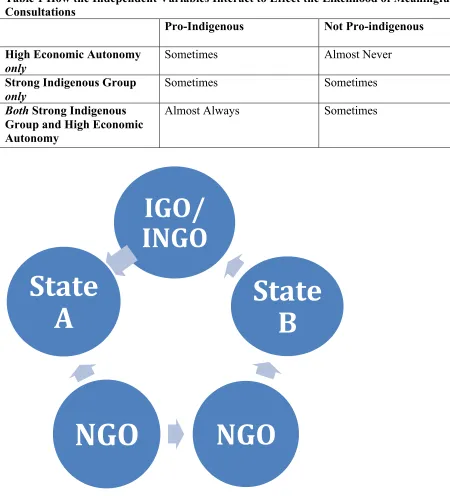
Table 1 How the Independent Variables Interact to Effect the Likelihood of Meaningful Consultations
Pro-Indigenous Not Pro-indigenous
High Economic Autonomy
only
Sometimes Almost Never
Strong Indigenous Group
only
Sometimes Sometimes
Both Strong Indigenous Group and High Economic Autonomy
Almost Always Sometimes
Figure 1 Keck and Sikkink's Boomerang Theory for Raising International & Transnational Awareness and Support
Starting from the left, the first NGO tries to pressure State A (the perpetrating government).Then the first NGO from the home state raises awareness and attention from other NGOs in different countries, which then pressures that government to respond to State A’s violations. State B then goes to an international government organization to receive support in pressuring State A. After the process of pressuring State A (through shaming politics or sanctions, etc.), State A then intervenes to stop indigenous rights violations.
IGO/
INGO
State
A
NGO
NGO
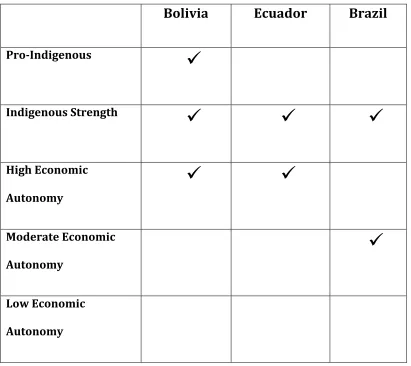
Table 2 Independent Variable Variation
This table illustrates the characteristics of each case. Because Bolivia is pro-indigenous, has indigenous strength, and has high economic autonomy, Bolivia is more likely to have meaningful consultations. This will be explained in the case studies.
Bolivia
Ecuador
Brazil
Pro-‐Indigenous
ü
Indigenous Strength
ü
ü
ü
High Economic
Autonomy
ü
ü
Moderate Economic
Autonomy
ü
Low Economic
Autonomy
1.11 Methodology:
governments did not enforce meaningful consultations. I examine how my variables of economic autonomy, pro-indigeneity, and indigenous strength play roles in the outcomes of these cases. I chose these three countries because of their differences in the outcomes and characteristics. Though decentralization is not a variable, I briefly state how each country is decentralized and why decentralization policies in these countries do not prevent MNCs or central governments from extracting natural resources from their land. For this study, I define decentralization as the presence of regional and municipal (local) governments. Because the number of municipalities varies for each state and the names for each regional government (i.e. departments, provinces, etc.) differ, I will only categorize a state to be “decentralized” or “not decentralized”. This uniform definition is used to include all the forms of decentralization in each state and to focus on why none of the decentralization systems benefit indigenous people since this is the common factor.
Country Indigenous Population Economic
Autonomy Strong Indigenous
Groups
Pro-Indigenous Ideology
Bolivia Majority (62%) –World Bank Highest Yes Yes
Ecuador Minority (25%) –World Bank High Yes No
Brazil Minority (.4%)
-Survival International
(http://www.survivalinternational. org/tribes/brazilian)
Moderate Yes No
groups were able to collaborate with other indigenous and non-indigenous ethnicities and/ or politicians for support. I also use UN reports and briefs on the Guarani case in Bolivia. For decentralization, I use data from the Georgetown University’s Political Database of the Americas.
I chose my cases to show variation in the dependent variable among a universe of episodes of natural resource extractive activity in indigenous areas. In the Bolivian case, consultations with indigenous groups have taken place whereas in Ecuador and in Brazil they have not, despite their being signatories of ILO 169. I choose the Guarani case in Bolivia because it is an example of what meaningful consultations look like, and also, what other conflicts can arise from consultations. For example, how inclusion and cohesion of different indigenous ethnic groups can influence effectiveness in the consultation process, or how being a country with an indigenous majority can even complicate the consultation process..
2 CASE STUDIES
2.1 Ecuador
2.1.1 Problem
The Yasuní National Park is located at the intersection of the Amazon, the Andes
Mountains, and the equator. It is recognized as one of the most bio-‐diverse areas in the
world, which also houses a large oil reserve (Finer, Vijay et al., 2009, 1). It is also
recognized for its cultural diversity as well as its home for the Guarani and other
indigenous groups (Finer, Vijay, et al., 2009, 1). Because of these factors, there is a growing
interest on the international and national level for several motives like resource extraction
and environmental conservation. At the expansion of oil and petroleum development in
the 1980s, there were more cases of illegal logging and oil exploration. By 1999, a decree of
‘Zona Intangible’ was marked in the lower region of the Yasuní to set an off-‐limits area from
extractive activities (Finer, Vijay, et al.,2009, 9).
When President Correa was elected, he tried to build from the momentum of the
Pachakutik Movement. The Pachakutik Movement was a social justice movement in the
late 1990s that later became a political party that gave indigenous communities and other
disadvantaged groups an alternative for political representation and an opportunity to
move away from neoliberal policies that many indigenous groups disagreed with (Beck,
2008, xi.). Correa, promising to prioritize indigenous and environmental rights, decided to
launch the ITT (named after the three untapped oil fields: Ishpingo–Tiputini–Tambococha)
Initiative which was to provide an alternative to drilling in the ITT oil fields in “exchange
for international compensation” (Beck, 2008, 12). Because of the lack of international
the national income through oil extraction since, according to Escribano (2013), oil
extraction has been the primary source for development for over thirty years (and the ITT
reserves make up one-‐fifth of the country’s oil reserves). Ecuador has also relied on loans
from China to help reach their development goals and to pay back their international loans
in exchange for oil. Due to this agreement with China, Correa is now faced with pressures
to drill in the Yasuní area. There have been many other instances where President Correa
has been reluctant or has even ignored indigenous land protections for development, going
as far as to cancel the Yasuní ITT initiative in August of 2013(sosyasuni.org). The president
has overstepped many controls of his office and has gone back on many of the promises he
made before becoming president. Below are sections that explain how economic autonomy
are related to this phenomenon.
2.1.2 Decentralization
Despite the challenges their efforts have faced to create local governments since the
1980s, Ecuador has continued to develop its local government systems (Daughters, et al.,
2007). Ecuador is divided into 21 provinces with autonomous councils and has 221
municipalities in which municipal government officials are elected through secret popular
vote (localdemocracy.net). Fiscally, according to a report by the Inter-‐American
Development Bank, the local governments only use 23% of central government
expenditure. So, fiscally, local governments are decentralized but are unable to change
policy because the natural environment sector is nationally controlled. This
decentralization has allowed for the creation of regional organizations like the AIECH,
Asociación de Indígenas Evangélicos de Chimborazo (the Indigenous Evangelist Association of
became more available for indigenous groups to organize and hold local elections” (Lucero, 2005, 33). Despite Ecuador’s challenges to implement political decentralization laws in the early 2000s, there was political opportunity for transnational actions to support de facto
decentralization in some areas like health, education, and water management (Kauffman, 2011, 6). However, like in Bolivia, environmental management is under the jurisdiction of national ministries like the Ministry of Environment of Ecuador, which the central government controls (Kauffman, 2011). According to MacDonald (2011), Ecuador’s 2008 constitution gives
Jurisdicción Indigena (Indigenous Jurisdiction) over territory but does not specify to what extent
indigenous peoples have control over natural resources. MacDonald (2011) argues that this is true because the state does not want to give absolute control over to local governments and risk losing and accounting for its over all wealth. The Political Database of the Americas at
Georgetown University also shows that Ecuador’s constitution gives the central government power to enforce environmental policies that “will be applied cutting across all sectors and dimensions” (pdba.georgiatown.edu). Because environmental resources are under central government control, it is more challenging for local governments to fight policies or
environmental extraction projects that were approved or overlooked by the national government.
2.1.3 Constitutions, Ideology, and Movements
Ecuador became a plurinational state at the recognition of indigenous people in
Chapter Four, Article 56 of the 2008 Constitution:
Indigenous communities, peoples and nations, the Afro-‐Ecuadorian people, the
part of the single and indivisible Ecuadorian State (Political Database of the
Americas, http://pdba.georgetown.edu/Constitutions/Ecuador/english08.html).
Also, upon signing the ILO 169 in 1998, the Ecuadorian government acknowledged and
promised to protect indigenous lands and conserve their culture. Even though, like Bolivia,
Ecuador officially recognizes indigenous communities as citizens with constitutional rights.
However, “being indigenous” does not have the same meaning and weight as it does in
Bolivia. In Bolivia, indigenous groups transcend class and geographic lines, whereas in
Ecuador, the overwhelming majority of indigenous communities live in extreme poverty
and in non-‐urban areas (Gustafson, 2009). Furthermore, indigenous languages are not
recognized in the Ecuadorian constitution; only Spanish is recognized as the official
language (Gustafson, 2009, 11). As a result, it is more clear as to who is indigenous and who
is not in Ecuador than in Bolivia.
Instead of supporting the ITT initiative and land rights of indigenous people, as
President Correa promised during his campaign, there have been reports revealing that
President Correa is purposefully ignoring indigenous rights to meaningful consultations:
After president Correa cancelled the Yasuní ITT Initiative on 16 August 2013, people
started to demonstrate in many parts of the country. Despite this, the national
parliament, where Correa’s Alianza Pais holds absolute majority, approved the
president’s oil exploitation plans in October of the same year-‐ without consulting Ecuadorian citizens (sosyasuni.org)
Albert Acosta, Ecuadorian economist and former president of the Constitutional Assembly, posits that it is crucial that laws be passed in language that is rooted in everyday life. If this doesn’t happen, no matter how advanced the Constitution is it will mean nothing. The problem is that President Correa believes that laws about water and communication aren’t important, which, for Acosta, is the same as saying that “the Constitution is neither fundamental nor a priority”. He wonders: “Could it be that President Correa sees the Constitution as a straight jacket?” (Zibechi, 2010, America’s Program, http://www.cipamericas.org/archives/2810).
Also, Ecuador’s prior consultation laws do not require consent or approval of extractive projects by indigenous groups. According to Luis Angel Saavedra’s article on consultation and prior consent, corporations and the Ecuadorian government have used the vagueness of the law requiring prior consultation “convene a meeting of the community” and inform them about government plans with no opportunity for the community to express their agreement or
disagreement with the proposal” (Saavedra, 2011, 6). According to the Freedom House article by Senior Research Assistant Ashley Greco-Stoner, “Correa is invoking an exception in the
country’s 2008 constitution that allows oil to be extracted from protected land in cases of
national interest” and “abandoning conservation efforts” (2013). Even though environmentalists and anthropologists have warned against this drilling project, saying that this project threatens indigenous and natural life, Correa still plans to drill and has not consulted with the potentially affected indigenous groups.
Soon after as President Correa abandoned the Yasuní ITT initiative, citizens formed
the Yasunidos, which is what the movement is known by. Since its formation, there have
over Ecuador with the backing of 85% of Ecuadoran citizens (sosyasuni.org). Methods that
are currently being used include creating its own website where participants can download
and sign petitions and social media websites like Twitter and Facebook to also increase
awareness and support internationally.
2.1.4 Economic Autonomy
Until Ecuador’s constitution was redrafted in 2008 under President Correa, Ecuador was
less open to getting involved in free trade/ multilateral agreements due to the potentially
negative effects they may have had on indigenous land and other conservation areas
(Levine, et al., 2014). However, upon the creation of the 2008 constitution (and the election
of Correa), the government redefined how Ecuador would become more involved in the
global economy. Instead of being involved with free trade agreements, Ecuador’s
constitution talks about maintaining its consistency with the “national plan for good living”
yet helping to integrate Ecuador into the global economy and to justify its multilateral trade
activities. In doing this, Ecuador hoped to maintain its “economic sovereignty” However,
reports demonstrate that it is not the case that Ecuador is maintaining its economic
autonomy. According to the World Bank, Ecuador’s total debt service is 11.2% of its GDP.
This means, using Levine and Molina’s measure, Ecuador’s economic autonomy is 88.8%.
Though this is highly economic autonomous, this number overlooks other loans that
Ecuador is involved in such as those with China. Following a 2015 report by Amazon
Watch, China provided 61% of Ecuador’s financing needs and has been pushing Ecuador
for drilling and expanding its projects in more areas, such as the Yasuní National Park and
Central-‐South Amazon (http://amazonwatch.org/news/2015/0113-‐racking-‐up-‐the-‐china-‐
that allows China to “seize many of Ecuador’s assets if the country fails to repay the loans.
(Considering this fact, Ecuador’s economic autonomy may be even lower. The pressures
that Ecuador receives from its transnational loan agreements lead to the conclusion that
this is the reason why President Correa ignores indigenous land rights to drill for oil.
2.1.5 Conclusion
The Yasuní National Park, home of several indigenous communities in Ecuador, has
had its ebbs and flows of government protection. These fluctuations are attributed to how
the indigenous rights movements, political and fiscal decentralization, and the lack of pro-‐
indigenous ideology of President Correa interplayed. Since the 1980s, the fiscal and
political decentralization policies had helped to allow for more available resources and
representation at the local level and led to the creation of the Pachakutik political party.
The Pachakutik Party supported indigenous territorial rights with the ratification of the
ILO 169. However, even though President Correa appeared to be supportive of indigenous
rights during his campaign, his image changed when he signed agreements to receive
developmental loans from China in exchange for oil extraction targeted at the Yasuní
National Park. There have been protests against this decision. Protestors have included
indigenous and non-‐indigenous Ecuadorians, as well as international protesting of citizens
of different countries.
According to yasuninationalpark.org, Correa has approved the decision in April
2015 to move forward with the plans to drill in the Yasuní without out consulting
indigenous groups. The fact that Correa has not consulted affected indigenous groups about
Although Ecuador has implemented decentralization policies, this does not benefit
indigenous people because the central government has control over natural resources.
This lessens the power that indigenous communities and local government have over
influencing more protective policies or ensuring that a meaningful consultation is held.
Because the central government has absolute power over natural resources, President
Correa has ignored indigenous peoples’ rights to prior consultation due to the pressure he
receives to pay back loans provided by China, which begs the question of how much of a
role economic autonomy plays in the decisions of a national leader. This evidence of
Correa may have been pressured from the loans from China to ignore indigenous citizens’
right to meaningful, prior consultation.
2.2 Bolivia
2.2.1 The Problem
The case of multinational corporation (MNC) abuse against indigenous rights in the
Margarita oil drilling case in Bolivia involves transnational oil firms like Pan-‐American
Energy and the BG Group. All of these firms had well on the Margarita field in which many
indigenous communities resided. In 1996, the Bolivian Government established new
energy policies that would allow for the exploration and extraction of hydrocarbons and for
a new pipeline that would by drilled to Brazil (Perrault, 2012, 84). The Margarita
hydrocarbon gas field is one of the four main gas reserves in Bolivia that was discovered on
the Communal Lands of Origin of the Guarani (Perrault, 2012, 86). In a land dispute over
over 10 million hectares of the land to maintain their livelihood. However, the government
only gave them just 6.8% of their original request and the other 94% has been used for gas
and oil extraction (Perrault, 2012, 87).
The firms that had a well on the Margarita field attempted to foster a good
relationship with the nearby indigenous community, the Guarani, by constructing health
posts and adobe houses (Perrault, 2008, 88). However, according to Perrault, the
investment in development of the Guarani community only spent 0.05 percent of its
payments for “Guarani Development” (Perrault, 2012, 89) and the rest of its investment in oil
drilling projects that occurred on indigenous land. The firm violated indigenous land rights because the 1991 Bolivian Law 1257 mandates consultation with indigenous communities throughout the project’s progress.
MNCs got around this law because the government in the host country handed the
By February 2012, thanks to the additional support of NGOs (the role will be discussed later on in the paper), the Guarani were able to come to an agreement with both the Bolivian government and the corporation and were given compensation as monetary investment in their community for the damages they suffered (Schilling-Vacaflor, 2014,14). However,
contestations continued as the process of meaningful consultations and compensation
continued to be questioned (Schilling-‐Vacaflor, 2014, 14). Even though conflicts persist,
the fact that there are consultations being held with indigenous groups is a step in the right
direction and one step in front of other Latin American countries like Ecuador and Brazil.
The next sections analyze how Bolivia got to this point.
2.2.2 Decentralization
Bolivia created political and fiscal decentralization reforms in the 1990s as a
response to heightened poverty and unemployment levels. It created 314 new
municipalities that were given authority to make decisions about development planning,
infrastructure construction and budget decisions (Olsen-‐Nalum, 2012). This divided
Bolivia into 9 departments and 339 municipalities led by governors. In the municipalities,
the Guarani participate in popular voting in the municipalities and have even engaged in
national reforms (Gustafson, 2009).
Bolivian fiscal decentralization is 27% of central government revenue. According to
Gustafson (2009), “the most commonly transferred positive powers are tax and fee
revenues from local natural resources. These revenues have made significant contributions
time. It leads to more institution-‐building and understanding of conditions (Colfer, 2005,
27).
Despite Bolivia’s decentralization programs, there is evidence that the national state
government owns the natural resources. In the Bolivian constitution, natural resources are
listed under “exclusive competencies of the central government.”
(http://pdba.georgetown.edu/Constitutions/Bolivia/bolivia09.html). Like Ecuador, this
exclusive access of the central government to natural resources limits local government
and indigenous control over natural resources used on their land. For example, Schilling-‐
Vacaflor talks about the confusion over the land tenure and gas exploitation. After disputes
of the ownership of the land in the Margarita gas field case, the area was claimed to be
owned by the state and rights were granted to the Bolivian Ministry of Rural Development
and Lands (Schilling-‐Vacaflor, 2014, 11). However, regional organizations like Central de
Pueblos Indigenous de La Paz agreed to conduct meaningful consultations. They agreed to
conditions like “the transmittance of better information regarding planned activities, the
elaboration of a strategic environmental evaluation…” ( Schilling-‐Vacaflor, 2014,12). The
Guarani pushed on with their protests and were able to make a change with the help and
support of NGOs (discussed later on).
appease their preferences. This makes it more difficult and less accessible for indigenous communities to express their opinion and needs about extractive activities on their land. Instead of going to local governments, they must address the national government through traveling to the capital and talking to national officials that may not understand the affected communities’ local needs. Although the New Forestry Law of 1996 in Bolivia put total control in the central government to manage what happens on the ground with local people and the corporation, after the election of Morales, the process of prior consultation has been implemented (Schilling- Vacaflor, 2014).
2.2.3 Pro-Indigenous Ideology, Movements, and Meaningful Consultations
In reference to how indigenous people are acknowledged in the constitutions, there are, indeed, differences between “plurinationalism” in Bolivia and in Ecuador. In Bolivia’s
constitution, according to Wolffe (2012), “Bolivia has recognized the thirty-six languages spoken by the indigenous peoples of Bolivia as ‘official languages’ of the state” (Wolffe, 2012, 11). Furthermore, “indigeneity” or “being indigenous” has become a part Bolivia’s national identity, especially in recent decades (Pastero, 2013). However, it seems that “being indigenous” in Bolivia is much more complex than it is in Ecuador or Brazil.
indigenous people, as Morales’s campaign promised, since there is not a clear “indigenous problem” as indigenous people make up both the urban poor and residents of non-urban, traditional lands (Olsen-Nalum, 2012, 28). Even though it is mentioned above that some prior consultations leave indigenous people feeling as though they were ignored, the Bolivian
government tries to compensate by giving economic benefits as with the Guarani case (Schilling-Vacaflor, 2012, 12).
After years of tension and conflict between the government and the Guarani, several
Guarani groups came together to stage a peaceful protest in the Margarita gas field that
blocked the entrance of food and supplies to the oil company’s workers (Olsen-‐Nalum,
2012, 36). These protests gained media attention and the help of NGOs, European advocacy
groups, and other independent organizations ( Olse-‐ Nalum, 2012, 11). The most organized
and inclusive groups had their needs met, whereas rival and disorganized groups tended to
not be successful in gaining reparations or consultations with corporations (Schilling-‐
Vacaflor, 2014).
Schilling-Vacaflor (2014) states that Nelly Romero, vice president of the Confederation of Indigenous Peoples from Bolivia’s Orient considers the consultations to be unhelpful:
There was no consultations that actually changed a project, they only want to legitimize what had already been decided… they bring geophysics, environmentalists and a lot of specialized equipment…We are at a disadvantage, we do not have enough arguments to say that certain seismic lines or routes of gas ducts should be changed…(Schilling-Vacaflor, 2014, 8).
Besides indigenous groups being at an economic and informal disadvantage as mentioned above, internal cohesion among the indigenous group can impact the effectiveness of making their case for or against the extraction project (Schiling-Vacaflor, 2014, 14). Schilliing-Vacaflor also says the consultation process tends to be costly and lengthy and thus, not in the national government’s best interest ( Schilling-Vacaflor, 2014, 15). Furthermore, interviews done in the article reveal that the MHE staff and the corporations believe that indigenous communities’ authority over the final agreement of the consultation should come secondary. Schilling-Vacaflor quotes a
managing staff member of the oil company, REPSOL, who believes that indigenous people should not have that last say, or authority over the result of consultations:
Consultation only means the right to be informed. When a project of national interest is at stake that will benefit the whole society, they (the indigenous peoples) cannot oppose it…Actually, I should not ask the indigenous authority or whoever for his permission, as the subsoil belongs to the state (Schilling-Vacaflor, 2014, 13).
Gail Whiteman (2009) also argues that many indigenous groups feel that their voices are not heard during the consultation processes. Whiteman defines meaningful consultation as a