Georgia State University
ScholarWorks @ Georgia State University
Respiratory Therapy Theses Department of Respiratory Therapy
Fall 11-13-2015
Clinical Instructors’ Perceptions of Effective
Student Behavioral Characteristics Among
Respiratory Therapy Students in the State of
Georgia
Yousef Saad Aldabayan
Georgia State University
Follow this and additional works at:https://scholarworks.gsu.edu/rt_theses
This Thesis is brought to you for free and open access by the Department of Respiratory Therapy at ScholarWorks @ Georgia State University. It has been accepted for inclusion in Respiratory Therapy Theses by an authorized administrator of ScholarWorks @ Georgia State University. For more information, please [email protected].
Recommended Citation
Aldabayan, Yousef Saad, "Clinical Instructors’ Perceptions of Effective Student Behavioral Characteristics Among Respiratory Therapy Students in the State of Georgia." Thesis, Georgia State University, 2015.
ACCEPTANCE
This thesis, CLINICAL INSTRUCTORS’ PERCEPTIONS OF EFFECTIVE STUDENT BEHAVIORAL CHARACTERISTICS AMONG RESPIRATORY THERAPY STUDENTS IN THE STATE OF
GEORGIA, by Yousef Aldabayan, was prepared under the direction of the Master’s Thesis Advisory Committee of the Respiratory Therapy department at Georgia State University. It is accepted by the committee in partial fulfillment of requirements for the Master’s of Science degree in Respiratory Therapy at Byrdine F. Lewis School of Nursing and Health Professions, Georgia State University.
The Master’s Thesis Advisory Committee, as representatives of the faculty, certifies that this thesis has met all standards of excellence and scholarship as determined by the faculty.
______________________________Date_________
Lynda T. Goodfellow, Ed.D., RRT,
FAARC-Committee Chair
______________________________ Date_________
Robert B. Murray, MS, RRT
Committee Member
______________________________ Date_________
Ralph D. Zimmerman, MSM, RRT-NPS
AUTHOR’S STATEMENT
In presenting this thesis as partial fulfillment of the requirements for the advanced degree from Georgia State University, I agree that the library of Georgia State University shall make it available for inspection and circulation in accordance with its regulations governing materials of this type. I agree that permission
to quote, to copy from, or to publish this thesis may be granted by the professor under whose direction it was written, by the Byrdine F. Lewis School of Nursing & Health Professions director of graduate studies
and research, or by me. Such quoting, copying, or publishing must be solely for scholarly purposes and will not involve potential financial gain. It is understood that any copying from or publication of this
thesis, which involves potential financial gain, will not be allowed without my written permission.
Author
NOTICE TO BORROWERS
All these deposited in the Georgia State University Library must be used in accordance with stipulations prescribed by the author in the preceding statement. The author of this thesis is:
Yousef Aldabayan 4205 Peachtree creek circle
Atlanta, GA 30341 The director of this thesis is:
Lynda T. Goodfellow
Associate Dean for Academic Affairs
Byrdine F. Lewis School of Nursing and Health Professions Georgia State University
Atlanta, GA 30303-4019
Users of this thesis not regularly enrolled as students of Georgia State University are required to attest
acceptance of the preceding stipulation by signing below. Libraries borrowing this thesis for use of their patrons are required to see that each user records here the information requested:
CLINICAL INSTRUCTORS’ PERCEPTIONS OF EFFECTIVE STUDENT BEHAVIORAL CHARACTERISTICS AMONG RESPIRATORY THERAPY STUDENTS IN THE STATE OF
GEORGIA
A thesis submitted by
Yousef Aldabayan
in partial fulfillment of requirements for the degree of
Masters of Science in
Health Sciences
in
The Department of Respiratory Therapy
Under the supervision of Dr. Lynda T. Goodfellow in the
Byrdine F. Lewis School of Nursing and Health Professions
Georgia State University, Atlanta, Georgia
Clinical Instructors’ Perceptions of Effective Student Behavioral Characteristics Among Respiratory Therapy Students in the State of Georgia
By
Yousef Aldabayan
(Under the Direction of Dr. Lynda T. Goodfellow)
ABSTRACT
ACKNOWLEDGMENTS
I would like to thank my thesis chair, Dr. Lynda Goodfellow for her continuous support and her
patience. Her guidance helped me in all the time of research and writing of this thesis. Besides my thesis
chair, I would like to thank the rest of my thesis committee: Prof. Ralph Zimmerman and Prof. Robert
Murray, for their insightful comments, expertise and time to facilitate this process. Special thanks for Mr.Alasmari for giving me the permission to use his instrument. Last but not the least, I would like to
thank my family and my friends for supporting me spiritually throughout writing this thesis.
Yousef Aldabayan
Table of Contents
LIST OF TABLES ... vi
LIST OF ABBREVIATION ... vii
CHAPTER I ... 1
INTRODUCTION ... 1
Statement of the Problem ... 3
Purpose of the Study ... 4
Significance of the Study ... 4
Summary ... 4
CHAPTER II ... 5
REVIEW OF THE LITERATURE ... 5
Students’ Perception of Clinical Instructors ... 6
Clinical Instructor’s Self-‐Assessment ... 9
Clinical Instructors’ Perception of Student Behavioral Characteristics ... 14
Summary ... 18
CHAPTER III ... 19
METHODOLOGY ... 19
Instrumentation ... 19
Study Design ... 20
Sample ... 20
Data Collection ... 21
CHAPTER IV ... 23
FINDINGS ... 23
Research Questions ... 23
Demographic Findings ... 23
Findings Related to Research Question 1 ... 25
Findings Related to Research Question 2 ... 27
Summary ... 28
CHAPTER V ... 29
INTERPRETATION OF FINDINGS ... 29
Overview of the Study ... 29
Research Questions ... 29
Discussion of Findings ... 30
Findings Related to Research Question 1 ... 30
Findings Related to Research Question 2 ... 31
Implications for Research ... 31
Recommendations for Future Research ... 32
Study Limitations ... 32
Conclusion ... 32
REFERENCES ... 34
Appendix A – Effective Student Behavioral Characteristics Instrument (Survey) ... 38
Appendix B – Georgia State University Institutional Review Board (IRB) Approval Letter ... 43
Appendix C – Final Cover Letter ... 45
Appendix D – Follow-Up Email ... 47
LIST OF TABLES
Table1. Demographic Data of Respiratory Clinical Instructors by Degree.
Table 2. 10 Most Effective Student Behavioral Characteristics Ranked by RT Clinical Instructors.
LIST OF ABBREVIATION
CIs: Clinical Instructors
ECICI: Effective Clinical Instructor Characteristics Inventory
AARC: American Association for Respiratory Care
IRB: Institutional Review Board
PT: Physical Therapy
RT: Respiratory Therapy
CHAPTER I
INTRODUCTION
Medical and health care professionals are the first advocates of health care. Thus, it does not come as a surprise that health professions and the health care industry are amongst the top in-demand careers
and industries in the world today. However, numerous research studies have suggested and documented that certain health care professionals’ roles and responsibilities overlap with those of another health care area of expertise, which suggests there is confusion in their scope of duties. In line with this, respiratory
care is one of the areas in health care that have faced this problem. For example, the profession of
respiratory care does not only pertain to the discipline specializing in taking care of the respiratory system.
It is also concerned with the application of the fundamental principles, skills necessary to target the treatments related to respiratory system disorders, and taking care of the needs of the patients (Mussa, 2008).
Recently, the utilization of clinical preceptors and the need for clinical skills development has received much attention in the health care industry. This is evidenced by the rising advocacy towards the
development and improvement of preceptorships concerning health care education and clinical training. Preceptorship is a term used to indicate the relationship between a clinical instructor (CI) and the students' application of clinical knowledge and skills learned during clinical practice (Rye & Boone, 2009;
Mantzorou, 2004). Therefore, students need the opportunity to hone their performance, knowledge, and skills during their clinical practice and their delivery of patient care. They can exhibit their clinical skills
In relation, there are various difficulties that CIs at different educational levels and expertise face every day. A clinical instructor (CI) refers to “a person who provides direct supervision and instruction to
students in the clinical aspect of training education” (Laurent, 2001). These include having clinical students that lack motivation or interest and are not prepared to undergo clinical training. It does not help that integration of information, decision-making, professional behaviors, values, technical skills, and
problem-solving skills, are required in the fast growing and shifting health care environments where professional respiratory therapists practice. Beginner students also termed novices, receive high
expectations like performing efficiently and immediately while being particular with their roles and duties, such as delivering quality of health care service and advocating the patients’ needs and rights. On the other hand, an issue that remains here is how CIs tend to forget that the students are still in their novice
phase where they are grasping, learning, and mastering the basic practice itself. In this case, it is the responsibility of clinical educators to advocate the students’ development while supervising that patient
care is rendered well. They must possess the passion for teaching, the ability to share their experiences, and ultimately build a beneficial mentor-protégé relationship (Cullen, 2005).
Moreover, Cullen (2005) contends that some CIs are considerably “underprepared” to teach and are
uncomfortable when students evaluate them. This is because of the high expectations that students and their academic heads have on their knowledge and skills. Additionally, with CI evaluations, there is no
guarantee that student evaluations are free from personal bias and/or prejudice. Similarly, this is similar to how some clinical educators may lack the ability to differentiate the levels of the students’ competence without bias or prejudice (Cullen, 2005). Nonetheless, it is imperative that CIs and their students
Statement of the Problem
Healthcare practice necessitates that teaching with regards to practice, intuition, and reflection
should be given top priority in the school setting. In the clinical environment, teaching and learning are usually demonstrated through knowledge and skills. Health educators should exhibit professionalism, strict competency, and appropriate knowledge and enthusiasm for the students to develop good clinical
judgment, proper reasoning skills, and the ability to reflect, especially on emergency health-related cases or scenarios (Cullen, 2005). Thus, CIs may facilitate and help the students in their application of
theoretical knowledge and skills in clinical settings. For example, during clinical demonstrations, the students are expected to demonstrate what they have learned by doing a particular medical procedure while the instructor assists and observes. Another example is by encouraging the students to ask questions
while CIs provide examples or health scenarios so students may imagine and come up with solutions addressing the health care problem presented.
On the other hand, CIs differ in their ways of teaching and imparting their experiences to their students. They may either leave a positive or a negative impact on the way the students perform during clinical practice. Additionally, the students’ behavioral characteristics are crucial to the success of the
CI’s teaching and ability to motivate the students. In relation to respiratory therapy (RT) education, it is found that there is an insufficient amount of literature addressing the behavioral characteristics of students
and how CIs may motivate the students through their teaching strategies. Therefore, there is a need for further research on the perceptions of clinical instructions. This may offer and explore the effectiveness of behavioral characteristics among students, and serve as a significant indicator on how clinical teaching
Purpose of the Study
The purpose of this study was to determine the perceptions and assessment of RT CIs in the State of
Georgia with regards to the effective behavioral characteristics of students. Below are the research questions addressed:
1. What student behavioral characteristics do CIs see as the most important among students to
possess?
2. What role and influence do the perceptions of CIs of students’ behavioral characteristics have
on their motivation to teach?
Significance of the Study
This study aims to advance both past and current research on RT clinical education by providing additional information about the utilization of different tools and strategies meant to gauge the
effectiveness of behavioral characteristics of RT students. This will be according to the CI’s perceptions
of the students’ effective and ineffective behavioral characteristics during their clinical experience. Research concerning the relationship between the CI and the students in the RT clinical setting remains
inadequate.
Summary
In summary, this study will be able to facilitate better understanding of what effective behavioral
characteristics RT students must possess. Additionally, it will highlight the significance of the CIs’ perceptions and how it motivates them to teach. This is important because it will help present and future students to do their best in their clinical demonstrations and future professional practice. Since the CIs
CHAPTER II
REVIEW OF THE LITERATURE
In this chapter, it is important to note that there are limited studies that have focused on the
perception of CIs regarding what effective student behavioral characteristics are among RT students. The
purpose of this literature review is to determine the CIs’ perceptions of effective student behavioral characteristics among RT students in the states of Georgia. Internet search and web databases like PubMed, EBSCOhost, ProQuest, Medline, and CINHALL were accessed for this review. Meanwhile,
search keywords used include CI perception, preceptorship, student behavioral characteristics, respiratory therapy, respiratory therapy students, respiratory care, and clinical training. The search was limited to
studies published during the past 16 years, which produced over 20 scholarly articles. Furthermore, this literature review aims to answer what student behavioral characteristics that CIs see as the most
significant among students to possess, and what role and influence do CIs’ perceptions of students
behavioral characteristics have on their motivation to teach. This chapter will present a compilation and review of recent studies about (1) the students’ perception; (2) the CI’s self-assessment; (3) and the CI
perception will be discussed and presented.
CIs in various fields of health care have their individual interpretations and measurement of what are the important behavioral characteristics students must possess in the clinical area. Similarly, the
perceptions of CIs have an impact on their motivation to teach. On the other hand, identifying the level and sufficiency of the clinical performance of students is a hard process normally happening in various
Students’ Perception of Clinical Instructors
For the students, it is significant to understand what characteristics CIs wish to see from them. Through
observation, CIs can form their opinions about a student based on a set of criteria suited for entry-level practice. They commonly evaluate the students’ abilities based on their performance, execution of skills, and demonstration of behaviors (Jette, Bertoni, Coots, Johnson, McLaughlin, & Weisbach, 2007).
Meanwhile, CIs are influential professionals that are held responsible for the students and their
competence levels. For example, nursing students perceive professional competence of their CIs and role
modeling to be the most important characteristics that CIs should showcase (Madhavanprabhakaran, Shukri, Hayudini, & Narayanan, 2013). Based on the three domains of cognitive, psychomotor, and affective learning, CIs rely on these to assess professional behaviors of the students and rule out which are
appropriate and acceptable behaviors from those that not. Some of the inappropriate behaviors include a negative attitude, lack of interest, poor communication skills, and unprofessionalism. Meanwhile,
appropriate behaviors include accepting responsibility for learning, communication skills, empathy, and professionalism (Wolff-Burke, 2005).
In relation, the primary basis for most professional education is Bloom’s taxonomy of 3 domains of
learning, including cognitive, psychomotor, and affective learning. For physical therapists (PT), students are expected to be competent in the entry-level education program before they start their clinical training.
Thus, they are often evaluated through both written and practical examinations and interactions.
However, it was noted that PT students have a hard time with cognitive and noncognitive skills required in the clinical setup, regardless of their academic success and classroom performance, due to their inability
to understand the meaning of the clinical procedures they are asked to do (Hayes, Huber, & Rogers, 1999). In Hayes et al.’s, (1999) study, the researchers found that over half of what CIs identified as
example of this is the absence of student feedback, which is important in changing unacceptable student behavior. Behaviors that change were often related to success in the clinical setup. For example, students
exhibited positive behaviors whenever they are praised or given incentives for a job well done (Hayes et al., 1999).
During simulated clinical training experience in the hospital, effective teaching and learning
strategies can be observed. The educator’s role in determining the level of effectiveness of the learning experience is evidenced by the positive (or the negative) outcome of the simulated clinical experience
(Schoening, Sittner, & Todd, 2006). This is because the role of the CIs greatly affects the development of behavioral characteristics of the students.
A descriptive survey on preceptor training in clinical education of RT departments was
disseminated. Aljasser (2012) argues that numerous RT students often do not have preceptors because of staff shortages. Instead, the students are assigned to an RT staff that has minimal or no formal training in
preceptorship. As a result, the students lack proper role involvement, patient skills experience, and appropriate decision-making skills (Aljasser, 2012). Thus, there appears to be a need for a standardized preceptor training program specifically for RTs to advance the quality of clinical education and learning
among RT students (Aljasser, 2012).
CIs are advised to emanate confidence and respect for their students. Clinical instructors are
expected to be accessible and approachable to their students, communicate their expectations from their students, and listen attentively to their students (Laurent & Weidner, 2001). Clinical instructors should also offer opportunities for their students to practice and hone both their technical and problem-solving
knowledge and expertise in the clinical setting, such as proper use of respiratory equipment like mechanical ventilation (Laurent & Weidner, 2001).
CIs enhance the learning experiences of their students from their initial encounter. For example, physical therapy students and their CI’s influence begin during introductory clinical placement. In a study composed of 51 physical therapy students as the subjects, students were asked the moment they felt
engaged or distanced, what actions of others they perceived most affirming or confusing, and what surprised them during the placement day(Cole & Wessel, 2008). In doing so, the researchers found that
CIs were able to help students cope and adapt to their clinical setting through clinical demonstrations, feedback, hands-on experience, reflection, promotion of independence, and role modeling professional behavior. Similarly, students revealed they preferred CIs that allowed them to become involved in patient
care and those that modeled admirable professional behaviors (Cole & Wessel, 2008). Such findings suggest that the adoption of effective behavioral characteristics is possible if both the students and the CI
work hand-in-hand to achieve common goals in the clinical setting.
In recent research regarding preceptorship, preceptor behaviors are integral in promoting the students’ critical thinking skills. There are four particular behaviors originating from preceptorship that
promote critical thinking skills. These include role modeling, facilitation, guidance, and prioritization (Myrick & Yonge, 2002). This is similar to the findings of Siraj’s (2015) and Madhavanprabhakaran et
al.’s (2013) studies, which claim that the facilitation of critical thinking during clinical practice, as well as professional competence, are perceived by CIs to be the most significant teaching characteristics that RT CIs should remember and improve on (Siraj, 2015; Madhavanprabhakaran et al., 2013).
Based on a preceptorship program, students reveal their expectations from their CIs, which include increased knowledge of the teaching and learning process; increased knowledge of preceptor
Meanwhile, preceptorship in pharmacy addresses: effective clinical teaching methods (including adult learning styles and useful student feedback); the ability to evaluate weak student performance; and the
knowledge of the school’s philosophies, curriculum, and policies (Aljasser, 2012).
As role models, CIs can show their students compassion and, in return, encourage them to see their general clinical experience as a positive and enjoyable one. For example, in an online clinical teaching
perception inventory (CTPI), Masunaga and Hitchcock (2010) discovered that ideal CIs must be
“stimulating, encouraging, competent, and communicating. They should not be conventional, cautious, or
controlling” (Masunaga & Hitchcock, 2010). Students who are motivated by their CIs are more likely to exhibit positive behavioral characteristics. This is because the perception of the students’ towards their CIs indicates important information because it commonly affects their drive to learn.
According to Tang, Chou, and Chiang (2005), the significant qualities of clinical faculty can be categorized into four main qualities which include professional competence, personality characteristics,
interpersonal relationship, and teaching ability. These qualities contribute to the effectiveness of the faculty, which eventually reflects on the effectiveness (or ineffectiveness) of the students’ clinical education. In fact, among the 214 nursing students who have taken the researchers’ questionnaire, they
discovered that the attitudes of CIs toward their students are critical because they affect the behavior and learning abilities of the students (Tang, Chou, & Chiang, 2005).
Clinical Instructor’s Self-Assessment
Various methods can be used to determine the effectiveness of the CI and his or her clinical teaching, such as peer-, student-, and self-evaluation. Effective teaching is defined by the qualities of
teaching ability, student evaluation, professional competence, personality traits, and interpersonal
teaching for students who want to become competent and those who seek knowledge in their chosen medical/ health field (Ali, 2012). Okoronkwo et al. (2013) point out that the present evaluation
procedures of CIs and their effectiveness are usually based on the evaluation of the students’ performance and efficient behavioral characteristics. The overall success of the clinical experience depends on the quality of students’ performance and behavior in actual clinical practice (Okoronkwo, Onyia-pat, Agbo,
Okpala, & Ndu, 2013).
As previously mentioned, CIs evaluate their effectiveness through different means. In the field of
nursing, one method to assess effectiveness is the Nursing Clinical Teacher Effectiveness Inventory (NCTEI). This measures the student-faculty perceptions of other faculty members according to their ability to teach, their competence, interpersonal relationships, and personality traits (Allison-Jones, 2002).
In the case of certified athletic trainers, for example, the best possible clinical education for athletic training students is required to practice didactic information during hands-on clinical training. Weidner
and Henning (2005) asked 55 program directors to invite their CIs to complete their questionnaire. The majority of the 399 CI respondents worked in colleges/ universities (79%), in high schools (13%), and in clinics (8%). They found that interpersonal relationships and legal-ethical behaviors had higher
importance among CIs. Other behavioral characteristics of the CIs evaluated include communication skills, instructional skills, supervisory and administrative skills, clinical skills, knowledge, and evaluation
of the students’ performance. Nevertheless, the Weidner and Henning standards prove to be an important and applicable standard in various athletic training clinical education settings despite the role strain discovered among CIs with their dual roles as both clinicians and as instructors (Weidner & Henning,
2005).
In relation, a comparison of the perceptions of students and of CIs with regards to what comprises
and allied health clinical education literature suggests that modeling professional behavior is considerably the most helpful CI characteristics according to 206 undergraduate students and 46 CIs from the National
Athletic Trainers’ Association District (Laurent & Weidner, 2001). The survey participants believe that the integration of knowledge and research is the least helpful characteristic of a CI. Thus, it is
recommended that CIs model good professional behavior to facilitate better learning outcomes among
their students (Laurent & Weidner, 2001).
Since the number of students is small in comparison with the number of CIs in athletic training, CIs
may individualize their instruction. Some researchers suggest that CIs must explore gender differences, but there have been no seen differences in the views of male and female athletic training students in determining the effectiveness of CIs (Laurent & Weidner, 2001). Other subgroups or behavioral
characteristics ranked in the study include the ability to understand one’s subjective behavior or
humanistic orientation, attitude of the CI toward teaching, student participation, self-perception, problem
solving, instructional strategy, and knowledge and research (Laurent & Weidner, 2001).
Additionally, focusing on the student-CI relationship suggests that such relationships also affect the learning of the students. Numerous allied health-related studies highlight the importance of caring
behaviors as part of effective characteristics for both CIs and their students (Aljasser, 2012; Ali, 2012; Allison-Jones, 2002). Student-CI relationship is found to be an integral part of teaching effectiveness
because it can lead to a purposeful educational experience, improved student evaluation of faculty
members, and improved student learning are some of the benefits of an effective student-CI relationship. Other qualities that prove the presence of an effective learning environment include empathy, trust and
honesty, awareness, tolerance, awareness, and setting aside of self (Allison-Jones, 2002).
increasingly believed to be dependent on the quality of the clinical learning environment” (Ali, 2012, P16). A caring attitude and effective teaching behaviors among CIs in different clinical settings are two
vital qualities required in the health care practice. In order for a student-CI relationship to work, a positive learning experience and efficient CI behavior and qualities must be present in the clinical setting. The interaction between the students and their instructor may either encourage or deter the integration of
theory to practice among the students. Thus, scholars propose that CIs possess caring behaviors and behavioral characteristics that are deemed proper and effective so that students may mirror them (Ali,
2012). On the other hand, there are other qualities of teachers that are considerably effective in the clinical setting aside from being caring or compassionate. A study of 101 fourth-year undergraduate nursing students indicates that professional or clinical and teaching knowledge are important skills in
clinical teaching. Other behavioral qualities among effective CIs are being honest with the students, motivation to teach, good communication skills, willingness to listen, positive role modeling, and
effective supervision (Okoronkwo, et al., 2013).
Likewise, good role models for students are described as: (1) possessing behavior that strengthens constructive behavior in other students; (2) having conduct that supports the resistance of the student in
acquiring destructive or ineffective behaviors; and (3) allowing students to develop new habits based on what they observe and see (Gunderman, 2002). However, great role modeling does not stop there. There
are three conditions that need to be met by the students: (1) they should pay attention to their role models; (2) students should see models as worthy and credible; and (3) students should embrace uncertainty about the material they wish to understand (Gunderman, 2002). Conditions are conducive to urging students
Furthermore, in clinical practice, feedback is an important part of student learning. Feedback offers students with current practice information and practical advice to improve their overall performance. Its
advantage involves increased confidence in the student, higher motivation, increased self-confidence, and enhanced clinical practice skills, as well as improved interpersonal skills and personal satisfaction. However, there are difficulties that can hinder the feedback process, which includes insufficient
supervisor training and education, an undesirable learning environment, and lack of time spent with the students (Clynes & Raftery, 2008).
In one study, which assessed qualitative data gathered from the experiences of field instructors in assessing students and giving constructive feedback, it was determined that the majority of standard, objective, and unbiased evaluations of student performance do not entirely showcase the CIs’ overall
effectiveness (Bogo, Regehr & Power, 2007). Thus, effective behavioral characteristics of clinical students should also reflect qualities associated with professional values. This includes respect for
diversity, emphasis on strengths and empowerment, advocacy for vulnerable people, and value for relationships as an area for growth, change, and development (Bogo, Regehr & Power, 2007).
In preparation for the students’ transition from being students to working professionals, CIs and
professional allies of the medical field must understand what the students think and feel as they approach the end of their academic program. In Cooper et al.’s (2005) study, thirty-two senior nursing students
were asked what comprises effective behavioral characteristics related to clinical practice. Results include awareness of human vulnerability, feeling the weight of responsibility, ability to identify limitations, self-evaluation, viewing the patient/ family perspective, facing ethical issues, and confronting reality in
graduating students, and help them overcome these challenges in preparation becoming actual health professionals.
Clinical Instructors’ Perception of Student Behavioral Characteristics
Among RT students, CIs can either negatively or positively affect the experiences and practices of
clinical students. Among RT CIs, their behavioral characteristics as much as their students’ behaviors are critical to the success of the clinical learning experience of their students’. Thus, the effectiveness of one’s behavior whether the CI’s or the students’ behavior is deemed a critical indicator of the need to
modify clinical instruction in order to ensure its efficacy (Alasmari, 2014). Based on the most effective clinical teaching behaviors, undergraduate RT and graduate RT students surveyed by Alasmari (2014)
reveal that there are similarities with regards to what they think are the most vital behavioral
characteristics. These include being approachable, having respect for the students as individuals, and demonstrating self-control and patience. It is important to note that these characteristics’ ranking differ as
the students shifts from first to second year as they advance in their course of clinical work and/or their previous educational experiences (Alasmari, 2014).
CIs should strive to allow students to learn and acquire hands-on experience and cultivate valuable techniques through practice (Alasmari, 2014). For example, a learner-centered form of education and an excellent teacher-student relationship are effective strategies because they focus on counseling and holistic
learning (Cornelius-White, 2007). Therefore, the students are expected to exhibit improved behavioral characteristics associated with evidence-based medicine, critical thinking, and clinical skills. This requires that the CIs possess effective behavioral features that are crucial to the students’ overall clinical learning
experience as well.
CIs (Alasmari, 2014). An evaluation of a group of CIs’ opinion on students’ behavior during their first entry to a clinical setting was explored. Twenty-one physical therapists working as CIs for physical
therapy students evaluate seven criteria including knowledge, safety, clinical skills, clinical decision-making, self-directed learning, interpersonal communication, and professional demeanor to assess the students’ ability to practice at an entry level (Jette, Bertoni, Coots, Johnson, McLaughlinand, & Weisbach,
2007). The study found that entry-level students should still be guided all throughout their clinical practice. However, for entry-level students, the students’ performance is expected to gradually move
towards independence from their CI during most clinical situations (Jette, Bertoni, Coots, Johnson, McLaughlinand, & Weisbach, 2007).
One of the most important behavioral characteristics among students is professionalism. Based on
clinical experience and behavioral characteristics, a student’s professionalism can be evaluated according to the possession of certain qualities and traits, such as enthusiasm in the clinical area, physical
appearance for clinical rotation, concern over patients’ needs and rights, ability to accept responsibility, effectively communicates with peers, shows interest in the clinical field, and incorporates the knowledge acquired in the classroom to the clinical setting. Professionalism, nonetheless, is an important measure of
competence in medical education (Papadakis, Teherani, Banach, Knettler, Rattner, Stern, Veloski, & Hodgson, 2005).
In order to become highly successful professionals after clinical education, students should be aware of their behavioral characteristics and should work out their weaknesses, especially during the earlier stages of clinical training. Upon seeing unprofessional and negative behavioral characteristics, CIs must
should also learn to appreciate their teachers’ efforts and contributions to their personal growth and development, as well as their influence to the students’ future success (Siraj, 2015).
For example, a negative habit or behavior among clinical students is stress aversion (Gunderman, 2002). When a student fears failing, he or she often stops trying. On the other hand, overconfidence is another trait that should be avoided because it hinders proper learning. Instead, successful clinical
students are skillful in developing their situations of success and spend time envisioning their goals and attaining them. Students with effective behavioral characteristics welcome challenges because they know
it is for their benefit to learn and develop their personality and character (Gunderman, 2002).
Surprisingly, deficiencies in professionalism can be detected early through the evaluation of medical students in one particular school. In the School of Medicine at the University of California in San
Francisco, numerous students were perceived to have professional deficiencies during their clerkship and exhibited problematic behaviors during their first and second years in medical school. Thus, it is not
enough that students excelled in scientific knowledge and clinical problem-solving skills but should also possess (if not acquire) valuable, effective behavioral characteristics that would prove to be advantageous in the clinical or hospital setting, such as the ability to be patient, resilient, and quick to solve problems
(Papadakis, Loeser, & Healy, 2001).
Meanwhile, in physical therapy (PT) education, professional development activities are devised as a
method to heighten the effectiveness of CIs for their students. According to one survey, about half of the 497 CI respondents, the availability of professional development opportunities were seen as adequately present. However, they admit that support for professional development is limited. This finding implies
that professional development opportunities are insufficient in supporting their teaching roles (Maudsley, 2001). In this case, physical therapy students may find it hard to find role models if professional
In relation, educators of PT view professional behavior as a difficult concept to define. An attempt to create validity of a professional behavior model was recently done through mutually reported literature
(Jette & Portney, 2003). Out of 183 students originating from two professional programs, a study
evaluated principal components factor and discovered that professionalism, critical thinking, professional development, personal balance, communication management, working relationships, and interpersonal
skills are assessed among the students and their progress. These factors match the objectives of behavioral development in the course of the educational experience of the clinical students (Jette &
Portney, 2003).
Preceptorship in PT, for example, the following should be achieved: a partnership between the academic program and the clinical affiliate; CIs’ and students’ roles are clear during clinical learning;
legal regulations are discussed (i.e. HIPPA regulation); special-case students are detected and managed well; develop individualized learning experience from one student to the next; and enhance skills in
support of present education through evaluations. This is similar to preceptorship in RT regarding to what Aljasser, (2012) found , which seeks CI skills that assess and test the students’ clinical performance, full understanding of roles and responsibilities, and skills in giving useful feedback to the students. In the end,
preceptorship remains as an important aspect of clinical education in RT and is an equally vital part in other health professions (Aljasser, 2012).
For clinical students, lectures, Internet media, and books alone cannot cover many lessons. Behavioral characteristics of goal-setting, patient interaction, work ethic, coping with failure and
uncertainty, and consultation are just a few that can be named by CIs. Radiology instructors, for example,
the CI. Radiologists understand that it is important for a student to be clear with his or her goals. Otherwise, these students will fail to acknowledge and benefit from the learning opportunities thrown at
them. Thus, it is the CIs’ task to help the students take a pro-active role in setting their learning objectives and devise their experience to encourage success (Gunderman, 2002).
Summary
In summary, it is paramount for students to acquire behavioral characteristics in the clinical setting, regardless if they are future RTs, PTs, nurses, physicians, medical technologists, or radiologists. Effective
behavioral characteristics that are honed and enhanced prior to becoming licensed professionals will help the students adjust to various clinical challenges and become effective practitioners in the future.
Similarly, CIs undeniably have a major role in training students to become effective in the clinical setting. Thus, CIs should be good role models and avoid personal biases in evaluating their students. This will encourage the students to become better stewards of health and help guide them in their respective
CHAPTER III
METHODOLOGY
In this study, the researcher explored the current effective behavioral characteristics of students that influence the RT CIs’ teaching outcomes. The following questions aimed to provide valuable insight
into the improvement of clinical RT educational programs:
(1) What student behavioral characteristics do CIs see as the most important among students to possess?
(2) What role and influence do the perceptions of CIs of student behavioral characteristics have on their motivation to teach?
Instrumentation
The survey instrument used in this study was a modified version of Alasmari’s survey, which was
for the RT students’ perceptions of effective teaching characteristics of CIs at an urban university. After permission had been acquired, necessary modifications were made to the survey to make it meet the purpose and objectives of this study. The main goal was to determine the RT CIs’ perceptions of effective
behavioral characteristics of students.
Alasmari’s instrument was a modification of Madhavanprabhakaran’s et al. survey. The reliability
of the Effective Clinical Instructor Characteristics Inventory (ECICI) was developed by the researchers Madhavanprabhakaran, Shukri, Hayudini, and Narayanan in 2012. The final modified questionnaire of Alasmari contains 40 survey questions that were tested based on Cronbach’s alpha reliability coefficient
and scored 0.87, which shows the tool’s reliability.
Alasmari’s survey questions were modified appropriately, the researcher and thesis adviser thoroughly reviewed the study’s tool and applied recommendations and the suggested revisions with regards to the
wording, format, and overall content.
Study Design
In conducting this study, a survey composed of convenient descriptive research method was used. In general, a survey is a common method of descriptive research that engages participants to answer a set of questions or an interview (Brown, 2009). The survey design was meant to gather data from CIs, as
participants, on how they distinguish effective behavioral student characteristics that have an impact on the overall clinical education and experiences. One of the numerous benefits of using this kind of survey
research is that it offers the ability to gather large amounts of data from several participants with the utilization of a single instrument. Also, another benefit of this survey research is that it is cost-effective as evidenced by its use of the Internet to reach a wider set of participants (Portney & Watkins, 2008).
Sample
This study’s population was convenience samples of all CIs/staff therapists who were active members in the AARC. Subjects in this convenient sampling were further chosen based on their
availability. Moreover, the participants were given a cover letter that contained information about the study’s nature and purpose, as well as to guarantee their confidentiality will be maintained. Inclusion
Data Collection
Before conducting this study, the approval of the Institutional Review Board (IRB) was sought and
received. The Georgia State University Institutional Review Board (IRB) approval letter, final cover letter, follow-up email, final email, and survey are located in the listed appendices (Appendix A, B, C, D and E).
The research tool used to collect data was an anonymous questionnaire. This questionnaire was
disseminated among CIs in the State of Georgia. The CIs that participated in this study are valuable subjects as they have had both direct and indirect participation.
The study was completed using a survey sent to AARC communication coordinator, who was asked to disseminate the online survey to their active respiratory instructors’ members in their database.
Moreover, the AARC education department was able to evaluate each element of the instrument and
arrived with 41 survey questions. The online version of this survey was created using Survey Monkey.
The questionnaire’s behavioral characteristics category were categorized by: (1) professional
competence; (2) the relationship of the CIs and their students; (3) personal attributes; and (4) the perceptions of the CIs and its role and influence in their motivation to teach. Furthermore, the
questionnaire’s choices adopted a ranking likert scale of 5, for most important, and 1, as least important.
Data Analysis
With the help of the statistical program Statistical Package for the Social Science (SPSS) version 22,
the gathered data was analyzed and evaluated. The descriptive statistics were frequency, percentage, mean, and standard deviation. These were done to define the differences in the ranking of the perceptions of the CIs with regards to the effective student behavioral characteristics among RT students. For each
higher scores mean have been deemed more important while lower scores meant the characteristic(s) is least important.
Summary
Overall, the methodology aims to answer what student behavioral characteristics that CIs expect
from their students, and what role and influences these perceptions have on their motivations to teach. . The use of Alasmari’s survey, reliability of Cronbach’s Effective Clinical Instructor Characteristics Inventory (ECICI), and a descriptive research method, as well as the results of the disseminated
CHAPTER IV
FINDINGS
Research Questions
The purpose of this study was to determine the perceptions and assessment of RT CIs in the State of
Georgia with regards to the effective behavioral characteristics of students. This chapter includes the results of the statistical analysis and the demographic information of the respondents. Statistical Package
for the Social Sciences 22(SPSS 22) was used to conduct the statistical analysis. This chapter outlines the methods used to answer the research questions:
(1) What student behavioral characteristics do CIs see as the most important among students to
possess?
(2) What role and influence do the perceptions of CIs of student behavioral characteristics have on
their motivation to teach?
Demographic Findings
The study was comprised of a convenience sample of respiratory therapy clinical instructors enlisted as active members of the American Association for Respiratory Care (AARC) in the State of
Georgia. One hundred eighty-four responses were acquired out of eight hundred emailed surveys, with a response rate of 23%. The male participants represented 37.5% (n=69) while the female participants represented 62.5% (n=115) of the respondents. In addition, out of one hundred eighty-four participants,
degree composed of male (44.1%) and female (55.9%) CIs. The mean and S.D. as RT CIs clinical
experience were [2.9, ± 1.4]. The third category represents the CIs with a master’s degree. They are male
(31.2%) and female (68.8%) CIs while the M and S.D. of their clinical experience were [3.3, ± 1.3] as RT
CIs. Lastly, the fourth category illustrates the CIs with a doctorate. This category is separated into male
(66.7%) and female (33.3%) CIs with the M score and S.D. of their clinical experience were [5.0, ± 0.0] as
RT CIs.
Table1. Demographic Data of Respiratory Clinical Instructors by Degree
(n=184)
Demographics AS/ASS BS/BA MS/MA PhD/ED.D
Clinical experience (years)
Mean ±SD or % M =3.4, SD ±1.5
Mean ±SD or % M =2.9, SD ±1.4
Mean ±SD or % M =3.3, SD ±1.3
Mean ±SD or % M =5.0, SD ±0.00
Male Female 25.5% 74.5% 44.1% 55.9% 31.2% 68.8% 66.7% 33.3% Level of
Findings Related to Research Question 1
The first research question asked, “what student behavioral characteristics do CIs see as the most
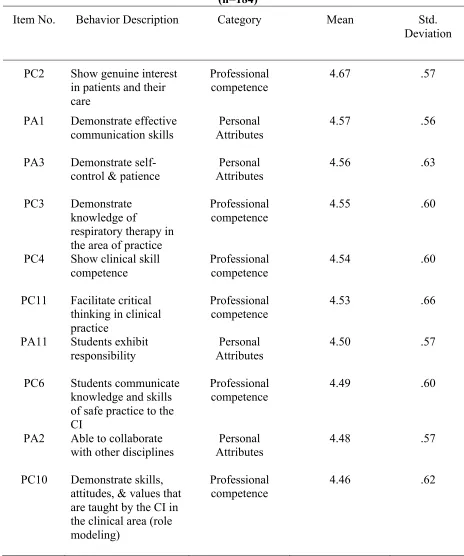
important among students to possess?” Table 2 summarizes the mean scores (M) and the standard deviation (SD) of the most important and effective student behavioral characteristics as ranked by the RT CIs, who completed the survey. This includes the item number in the survey, student behavior description,
and the equivalent category for each student behavior. RT CIs who evaluated the RT students ranked the student behavioral characteristic of showing “genuine interest in patients and their care” as the most
Table 2. 10 Most Effective Student Behavioral Characteristics Ranked by RT Clinical Instructors
(n=184)
Item No. Behavior Description Category Mean Std.
Deviation
PC2 Show genuine interest in patients and their care
Professional competence
4.67 .57
PA1 Demonstrate effective communication skills
Personal Attributes
4.57 .56
PA3 Demonstrate self-control & patience
Personal Attributes
4.56 .63
PC3 Demonstrate knowledge of
respiratory therapy in the area of practice
Professional competence
4.55 .60
PC4 Show clinical skill competence
Professional competence
4.54 .60
PC11 Facilitate critical thinking in clinical practice
Professional competence
4.53 .66
PA11 Students exhibit responsibility
Personal Attributes
4.50 .57
PC6 Students communicate knowledge and skills of safe practice to the CI
Professional competence
4.49 .60
PA2 Able to collaborate with other disciplines
Personal Attributes
4.48 .57
PC10 Demonstrate skills, attitudes, & values that are taught by the CI in the clinical area (role modeling)
Professional competence
Findings Related to Research Question 2
The second research question asked, “What role and influence do the perceptions of CIs of
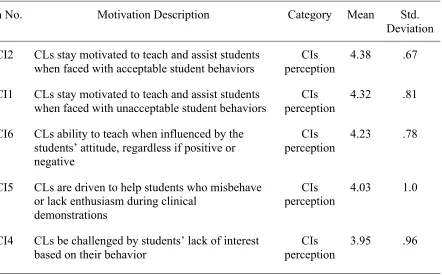
students’ behavioral characteristics have on their motivation to teach?” Table 3 displays the mean scores (M) and standard deviation (SD) of the most important and effective student behavioral characteristics that CIs perceive to have influenced their motivation to teach. Based on the ranking of RT CIs who responded
in the survey, the item number in the survey, CIs’ motivation description to teach, and the corresponding category for each perception. RT CIs who ranked the perception that “CIs stay motivated to teach and
Table 3. 5 Most Effective influences of CIs motivation to teach based on Student Behavioral
Characteristics(n=184)
Item No. Motivation Description Category Mean Std.
Deviation PCI2 CLs stay motivated to teach and assist students
when faced with acceptable student behaviors
CIs perception
4.38 .67
PCI1 CLs stay motivated to teach and assist students
when faced with unacceptable student behaviors perception CIs 4.32 .81 PCI6 CLs ability to teach when influenced by the
students’ attitude, regardless if positive or negative
CIs perception
4.23 .78
PCI5 CLs are driven to help students who misbehave or lack enthusiasm during clinical
demonstrations
CIs perception
4.03 1.0
PCI4 CLs be challenged by students’ lack of interest based on their behavior
CIs perception
3.95 .96
Summary
This chapter summarized the demographic information of the respondents, what behavioral
CHAPTER V
INTERPRETATION OF FINDINGS
In this chapter, the findings discussed in Chapter IV are interpreted. The chapter is separated into major sections, which include the overview of the study, research questions, discussion of findings,
implications for research, recommendations for future research, study limitations, and conclusion.
Overview of the Study
The purpose of this descriptive study was to determine and recognize the effective behavioral characteristics of RT students according to what the RT CIs in the State of Georgia perceived to be the most and the least important. Data was gathered from CIs who were active members in the American
Association for Respiratory Care (AARC). The survey used included four main domains that include a survey on professional competence, relationship with the CI, personal attributes, and the perceptions of
CIs and the role of these perceptions in their motivation to teach.
Research Questions
1. What student behavioral characteristics do CIs see as the most important among students to
possess?
2. What role and influence do the perceptions of CIs of students’ behavioral characteristics have
Discussion of Findings
Findings Related to Research Question 1
The first research question asked, “What student behavioral characteristics do CIs see as the most important among students to possess?” One hundred eighty-four respondents out of the eight hundred
emailed surveys (23%) ranked showing genuine interest in patients and their care as the most important student behavioral characteristics that CIs perceived students should possess. This is followed by other behavioral characteristics according to the top ten most important behavioral characteristics: demonstrate
effective communication skills; demonstrate self-control and patience; demonstrate knowledge of RT in the area of practice; show clinical skill competence; facilitate critical thinking in clinical practice; students
exhibit responsibility; communicate knowledge and skills of safe practice to the CI; able to collaborate with other disciplines; and demonstrate skills, attitudes and values that are taught by the CI in the clinical area (role modeling). Likewise, it was revealed that professional competence is far more important for
most RT CIs than the students’ personal attributes.
The findings are inconsistent with Alasmari’s (2014) that revealed how students perceive the
significance of establishing a good student-teacher relationship with their CIs to be more important than professional competence, which the findings of this study indicates as more important. In comparison with effective clinical teaching behaviors, students anticipate to learn from CIs that are approachable.
Both undergraduate and graduate RT students want to have a CI that possess teaching behaviors that include being approachable, having respect for them as individuals, and shows self-control and patience (Alasmari, 2014). This implies that, for students, the personal attributes is much more important than
Findings Related to Research Question 2
The second research question asked, “What role and influence do perceptions of CIs of students’
behavioral characteristics have on their motivation to teach?” One hundred eighty-four RT CIs that responded out of the eight hundred emailed surveys (23%) are highly motivated by the students’ exhibit acceptable student behaviors. The perception of CIs regarding the behavioral characteristics that motivates
them to teach are relatable to how they interact with the students and their ability to interact with them. If the CIs perceive the behavior of the student to be acceptable, then the CIs have the tendency to be
motivated to teach. As a result, the students also become motivated to learn, especially when their CI is able to boost their confidence, respect them, is honest and direct with them, and encourages them to ask questions or for help (Siraj, 2015).
Implications for Research
The results of this study will help provide supportive framework on how the CIs’ perceptions of
effective student behavioral characteristics among their students will serve to encourage CIs to teach enthusiastically, as well as help the students manage their behaviors and cope with the challenges that
come with clinical training. Similarly, areas of improvement in clinical teaching and clinical student learning may be emphasized and addressed. The perceptions of what effective behavioral characteristics that the students must possess will help to develop a list of recommendations and standards in terms of
culture, work ethics, and values among aspiring RTs. On the other hand, this study will encourage RT CI to reflect on their teaching strategies and personal behavioral characteristics when teaching, as well as allow RT clinical students reflect upon their own [behavioral characteristics]. Furthermore, the RT CIs
important behavioral characteristics RT clinical students should acquire, emanate, and maintain. Thus, the findings of this study will assist RT programs set up and deliver a specific set of criteria when evaluating
the students during their clinical rotations, and promote modeling and a list of expected qualities of RT students in the clinical setting.
Recommendations for Future Research
Due to the limited amount of research that exists on this topic, further research highlighting the most effective characteristics among RT clinical students and how these qualities affect the CIs’
motivation in teaching are two area of research investigation. Also, it would help to validate the results of this study by doing a similar study outside the State of Georgia. Moreover, another study about the
ineffective behavioral characteristics of RT students may also offer contrasting and comparable findings that can also provide valuable insight into the betterment of the general clinical education. Lastly, further research on the specific acceptable student behaviors that motivate the clinical instructors to teach based
on their ranking would also welcome valuable input and address areas to improve in line with the RT clinical education’s goals.
Study Limitations
Since the sample was solely obtained from the State of Georgia, the involved participants in this study cannot be generalized throughout the country. Additionally, there is a lack of literature in RT
education that addresses the behavioral characteristics of effective students as well.
Conclusion
In conclusion, it has been determined that the most effecting behavioral characteristics among
these acceptable behaviors are. RT CIs from the list of active AARC members agreed that showing genuine interest in patients and their care was the most effective student behavioral characteristic among
RT students in the State of Georgia. Clinical instructors agreed that professional competence is much important than professional attributes and the relationship of students with their clinical instructors. According to these findings, it is highly suggested that RT clinical students should work hard in
REFERENCES
Alasmari A, Gardenhire DS. (2015) Respiratory Therapy Students’ Perceptions of Effective Teaching
Characteristics of Clinical Instructors at an Urban University, Respiratory Care Education Annual,
24:11-18.
Ali, W.G. (2012). Caring and effective teaching behavior of clinical nursing instructors in clinical area as
perceived by their students. Journal of Education and Practice, 3(7): 15-26.
Aljasser, T. (2012, December 20). A survey of preceptor training in clinical education of respiratory care
departments in selected hospitals in metropolitan Atlanta. Thesis, Georgia State University. Retrieved January 10, 2015, from http://scholarworks.gsu.edu/rt_theses/16
Allison-Jones, L.L. (2002, September 9). Student and faculty perceptions of teaching effectiveness of
full-time and part-full-time associate degree nursing faculty, nursing clinical teacher effectiveness
inventory. Virginia Polytechnic Institute and State University, Virginia. Retrieved January 12,
2015, from http://scholar.lib.vt.edu/theses/available/etd-10042002-183948/
Burns, N., & Grove, S. K. (2005). The practice of nursing research: Conduct, critique, and utilization (5th ed.). St. Louis: Bridles.
Brown, S. J. (2009). Evidence-based nursing: The research-practice connection. Jones & Bartlett Publishers.
Bogo, M., Regehr, C., Power, R., & Regehr, G. (2007). When values collide: Field instructors’
experiences of providing feedback and evaluating competence. The Clinical Supervisor, 26(1-2): 99-117.
Cole, B., & Wessel, J. (2008). How clinical instructors can enhance the learning experiences of physical therapy students in an introductory clinical placement. Advances in Health Sciences Education,
13(2): 163-179.
Cooper, C., Taft, L.B., & Thelen, M. (2005). Preparing for practice: Students’ reflections on their final clinical experience. Journal of Professional Nursing, 21(5): 293-302.
Cornelius-White, J. (2007). Learner-centered teacher-student relationships are effective: A meta-analysis.
Review of Educational Research, 77: 1113-143.
Gunderman, R.B. (2002). Role models in the education of radiologists. American Journal of Roentgenology 179: 327-329.
Hayes, K.W., Huber, G., Rogers, J., &. (1999). Behaviors that cause clinical instructors to question the
clinical competence of physical therapist students. Physical Therapy 79(7): 653-667. Jette, D.U., Bertoni, A., Coots, R., Johnson, H., McLaughlin, C., & Weisbach, C. (2007). Clinical
instructions’ perceptions of behaviors that comprise entry-level clinical performance in physical therapist students: A qualitative study. American Physical Therapy Association 87(7), 833-843. Jette, D.U. & Portney, L.G. (2003). Construct validation of a model for professional behavior in physical
therapist students. Physical Therapy, 83(5): 432-443.
Laurent, T. & Weidner, T.G. (2001). Clinical instructors’ and student athletic trainers’ perceptions of
helpful clinical instructor characteristics. Journal of Athletic Training, 36(1): 58-61.
Masunaga, H. & Hitchcock, M.A. (2010). Residents’ and Faculty’s Beliefs About the Ideal Clinical Teacher. Family Medicine, 42(2): 116-120.
Madhavanprabhakaran, G.K., Shukri, R.K., Hayudini, J., & Narayanan, S.K. (2013). Undergraduate nursing students’ perception of effective clinical instructor: Oman. International Journal of
Maudsley, R.F. (2001). Role models and the learning environment: Essential elements in effective medical education. Academic Medicine, 76(5): 432-434.
Myrick, F. & Yonge, O. (2002). Preceptor behaviors integral to the promotion of student critical thinking.
Journal of Nurses in Staff Development 18(3): 127-133.
Okoronkwo, I. , Onyia-pat, J. , Agbo, M. , Okpala, P., & Ndu, A. (2013) Students’ perception of effective
clinical teaching and teacher behaviour. Open Journal of Nursing, 3: 63-70.
Portney, L.G. & Watkins, M.P. (2008). Foundations of Clinical Research: Applications to Practice. (3rd
ed.). Pearson Prentice Hall, Upper Saddle River, New Jersey.
Papadakis, M.A., Loeser, H., &Healy, K. (2001). Early detection and evaluation of professionalism deficiencies in medical students: One school’s approach. Academic Medicine, 76(11): 1100-1106.
Papadakis, M.A., Teherani, A., Banach, M.A., Knettler, T.R., Rattner, S.L., Stern, D.T., Veloski, J.J., & Hodgson, C.S. (2005). Disciplinary action by medical boards and prior behavior in medical school.
The New England Journal of Medicine, 353: 2673-2682.
Schoening, A.M., Sittner, B.J., & Todd, M.J. (2006). Simulated clinical experience: Nursing students’ perceptions and the educators’ role. Nurse Educator, 31(6): 253-258.
Siraj, R. (2015). Respiratory therapy faculty perceptions of effective teaching characteristics of clinical instructors in the state of Georgia. Thesis, Georgia State University, 2015. Retrieved from
http://scholarworks.gsu.edu/rt_theses/23
Tang, F. I., Chou, S. M., & Chiang, H.H. (2005). Students’ perceptions of effective and ineffective clinical instructors. Journal of Nursing Education, 44(4): 187-92.
Weidner, T.G. & Henning, J.M. (2005). Importance and applicability of approved clinical instructor standards and criteria to certified athletic trainers in different clinical education settings. Journal of
Dear Clinical Instructor,
This study aims to explore the effective student characteristics perceived important by respiratory therapy clinical instructors. Your sincere response is appreciated. We assure you the confidentiality of the data. Please check (√) according to your opinion on the Effective Student Characteristics.
There are five options to mark: 5 = Most Important 4 = Important
3 = Neutral or Uncertain 2 = Less Important 1 = least important
Section I: Characteristics of an Effective Student
(CLINICAL INSTRUCTORS’ PERCEPTION ON STUDENTS’ BEHAVIORAL CHARACTERISTICS)
I Professional Competence
Most Important (5) Important (4) Neutral/ Uncertain (3) Less Important (2) Least Important (1) 1
How important is it for you to showcase students’ awareness of their professional responsibility?
2
How important is it that students show genuine interest in patients and their care?
3
How important is it that students demonstrate knowledge of respiratory therapy in the area of practice?
4
How important is it that students show clinical skill competence?
5
How important is it that students relate theory to practice?
6
How important is it that students
communicate knowledge and skills of safe practice to the clinical instructor (CI)?
7
How important is it that students receive assistance from the CI without letting the CI take over the task?
8
How important is it that students are available to work with a CI in a clinical setting?
care as learned from the CI?
10
How important is it that students
demonstrate skills, attitudes & values that are taught by the CI in the clinical area (role modeling)?
11 How important is it that students facilitate critical thinking in clinical practice?
12
How important is it that students identify each individual attribute of the CI?
13
How important is it that students provide individualized timely feedback?
14
How important is it that students show improvement based on CI’s constructive feedback?
II
Relationship with Clinical Instructor (CI) Most Important (5) Important (4) Neutral/ Uncertain (3) Less Important (2) Least Important (1) 1
How important is it that students respect CI as an individual?
2
How important is it that students be realistic in expectations of CI’s performance?
3
How important is it that students be honest and direct with the CIs?
4
How important is it that students
proactively ask questions or help from the CIs?
5
How important is it that students participate during discussion?
6
How important is it that students express thoughts and feelings (based on what was learned) from the CIs?
7
How important is it that students be supportive & helpful to CLs?
8
How important is it that students be approachable?
III Personal Attributes
Most Important (5) Important (4) Neutral/ Uncertain (3) Less Important (2) Least Important (1)